Skip to content
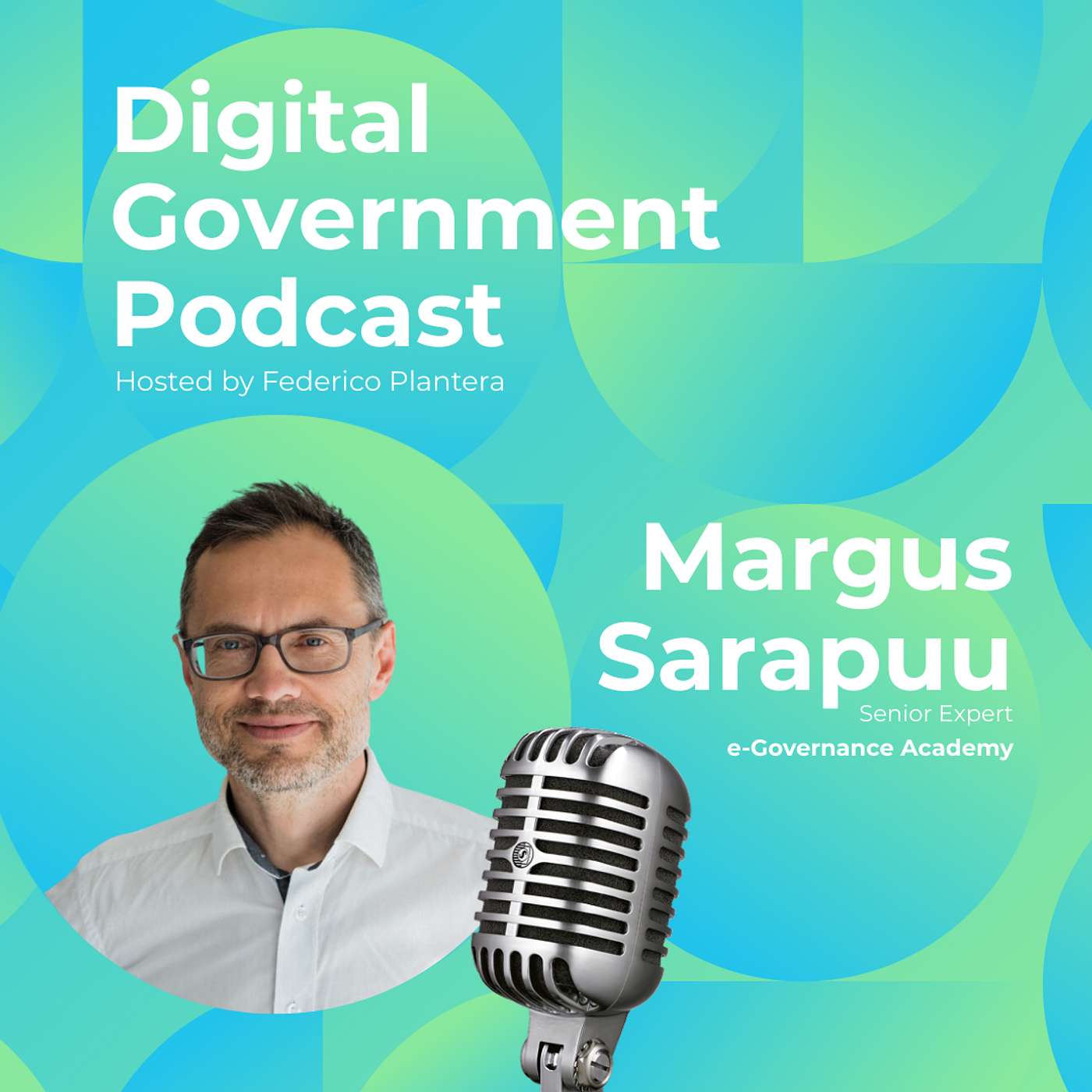
Artwork for Digital Government Podcast

Digital Government Podcast

e-Governance Academy

Welcome to e-Governance Academy’s podcast to discover the future of governance. e-Governance Academy has assisted digital transformation globally in more than 145 countries. Our experts will share their insights and worldwide examples on how digital technology could benefit every society. Tune in for the digital government podcast every Wednesday! 

Play
  • 23 episodes
  • Avg 37 min
  • English
Counted on this page — what you have heard stays on this device, so it is not something the list can be paged by.
  • S8 · E1
    Yesterday · 42 min

    Governments cannot ignore the agentic AI shift

    What happens when AI agents start making decisions, managing workflows and interacting with public services, and are governments ready for the shift? In this episode of the Digital Government Podcast, Federico Plantera brings together Luukas Ilves, co-founder of The Agentic State initiative and former Chief Information Officer of the Estonian government, and Piret Hirv, Head of the Data Management and AI Competence Centre at eGA, to discuss how agentic AI could transform public administration. They explore the shift from process-based automation to outcome-driven government, the growing pressure from AI agents interacting with public services, and the challenges of accountability across institutions. The conversation also examines why digital identity, data governance and cybersecurity are essential for managing AI agents, and why governments must invest in the less visible foundations of digital transformation before they can realise its benefits. Tune in to discover why governments can no longer afford to ignore agentic AI, and what it takes to prepare public administration for a future where machines do more than follow instructions. This podcast was produced as part of the project “AI-ready Municipalities”, with financial assistance from the European Union via the Technical Support Instrument. The information and views set out herein are those of the author(s) and do not necessarily reflect the official opinion of the European Union or its institutions.

  • S7 · E10
    October 28 · 27 min

    Building cyber defence from the ground up

    What does it take to build military cyber defence capacity from the ground up, and how can international assistance create capabilities that last? In this episode of the Digital Government Podcast, Merle Maigre, Head of Cybersecurity at the eGA, speaks with senior cybersecurity expert Pirit Pikker and senior technical cybersecurity expert Janis Janusjavics about their experience implementing European Peace Facility cyber defence projects in Ukraine and Moldova. They explore the building blocks of effective cyber defence, from trained personnel and foundational cyber hygiene to infrastructure monitoring and rehearsed incident response. The conversation also examines why trust comes before planning, how equipment deliveries and training need to work together, and why assistance must adapt to an organisation’s readiness and the realities of war. Tune in to discover how people, technology and lasting partnerships come together to strengthen cyber defence. This podcast was produced as part of the project “European Peace Facility Assistance on cyber defence in Moldova”, with financial assistance from the European Union via the Technical Support Instrument. The information and views set out herein are those of the author(s) and do not necessarily reflect the official opinion of the European Union or its institutions.

  • S7 · E9
    October 21 · 32 min

    National Cyber Resilience in the Age of AI

    As AI makes cyberattacks faster, cheaper and more widely accessible, how can governments keep essential services running and protect public trust? In this episode of the Digital Government Podcast, Merle Maigre, Head of Cybersecurity at the eGA, speaks with Madis Tapupere, former CTO of the Estonian Government and now a tech management consultant, about the white paper National Cyber Resilience in the Age of AI: A Doctrine for Asymmetric Cyber Defence. They explore what a state cannot afford to lose, how AI can help defenders respond at machine speed, and why cyber resilience requires cooperation across government and the private sector. Drawing on Estonia’s experience, the conversation also examines why clear, timely communication during a crisis matters as much as technical recovery. Tune in to discover what it takes to keep a digital state functioning and trusted in the age of AI.

  • S7 · E8
    July 6 · 43 min

    The UN Global Mechanism and the next phase of cyber diplomacy

    At this year's Tallinn Cyber Diplomacy Summer School, one question kept coming up: how can international cyber agreements move beyond diplomatic language and translate into real action? The question is particularly timely as the United Nations Global Mechanism prepares for its upcoming meeting in New York this July, an important milestone for the permanent UN process on responsible state behaviour in cyberspace. In this episode of the Digital Government Podcast, recorded during the Summer School, Patryk Pawlak speaks with H.E. Ambassador Egriselda López, Chair of the UN Global Mechanism, about what comes next for cyber diplomacy at the United Nations. Together, they discuss how implementation can become more action-oriented, why capacity building is essential for meaningful ownership, and how governments, experts, and technical communities can work together to make the mechanism effective in practice. Listen to the episode to learn why turning commitments into action matters now more than ever.

  • S7 · E7
    May 27 · 44 min

    What it takes to get AI working in government: Lessons from Estonia

    The last time Ott Velsberg appeared on this podcast was early 2022. Popular LLMs had not yet been released. The conversation was about how AI could support data-driven decision-making in government – a topic that felt, at the time, more prospective than operational. Four years on, with Estonia counting over 220 public sector AI use cases and close to 60 million euros in estimated annual impact, the frame has shifted. So, it is now less about what AI in government could look like and more about what it has taken to get there. In this episode of the Digital Government Podcast, Ott Velsberg, outgoing Chief Data Officer of the Estonian government and responsible for Estonia's AI policy, tells us about the path from strategy to working infrastructure. And the long institutional work that makes it possible to coexist with both consent-based data sharing and AI adoption at scale.

  • S7 · E6
    May 14 · 43 min

    Supporting the EU Member States in advancing reforms and innovation

    When governments across Europe try to modernise, the challenge is rarely that they lack ambition or resources. More often, what is missing is the space to think carefully before acting – to understand what the actual problem is, what has already been tried elsewhere, and who inside the administration will need to carry the change forward. The European Union’s Technical Support Instrument (TSI) was built around exactly that gap: not funding, but structured expert support, delivered at the moment when a reform is still being designed. In this episode of the Digital Government Podcast, recorded around Europe Day, we speak with Florian Hauser, Deputy Head of Unit for Public Administration at SG REFORM – the European Commission’s Task Force for reforms and investment – and with Hannes Astok, Executive Director of the e-Governance Academy (eGA), which has been working closely with the TSI across a growing portfolio of themes in recent years. Explore the European Union’s approach to reform support and what it actually takes to make them work. Tune in!

  • S7 · E5
    April 15 · 46 min

    Ivo Visak: AI in education starts with a question, not an answer

    Thirty years ago, Estonia launched Tiger Leap, a programme that put computers and internet in every school and, in many ways, laid the groundwork for a digital society what we have known to call e-Estonia. Today, the country is attempting something just as ambitious with artificial intelligence (AI) in education. But the conditions are different this time. When Tiger Leap started in 1996, neither the schools nor the students had the technology – everybody had to learn together. Now, the asymmetry runs the other way: the students have leaped, while the education system is catching up. In this episode of the Digital Government Podcast, Ivo Visak, CEO of AI Leap (TI-Hüpe), the national programme integrating artificial intelligence into Estonian high schools, Visak makes the case for why treating AI in schools as an intervention rather than an experiment is the only responsible path forward. Tune in to explore the Estonian path in implementing AI in education!

  • S7 · E4
    April 1 · 41 min

    Digital public infrastructure and the foundations of AI in government with Krisstina Rao

    Governments are racing to adopt AI in public services. EU-funded projects show the pace is only accelerating. But this push raises a deeper question: what lies beneath? Too often, the answer is the same – weak or uneven digital foundations. Digital public infrastructure (DPI) can help integrate and connect siloed systems into a coherent digital government platform. So, where does it stand globally, as an enabler of AI development? What makes it work? And why does it matter more than ever for AI adoption? We explored these questions on this episode of the Digital Government Podcast with Krisstina Rao, now at Co-Develop, and outgoing Research Fellow at the Institute for Innovation and Public Purpose at University College London (UCL), where she led the work on the Digital Public Infrastructure Map. Listen now and explore what’s really powering AI-enabled public services behind the scenes! This podcast and podcast blog were produced within the project “EU Commission Project (24ES06/24DE33): Supporting regional entrepreneurship through the adoption of innovative technologies, including AI, in public services” with the financial assistance of the European Union via the Technical Support Instrument. The views expressed by the speakers in the project video are their own and do not necessarily reflect the official opinion of the European Union.

  • S7 · E3
    February 25 · 37 min

    What leadership through digital change actually looks like with Taimar Peterkop

    Leadership in the public sector has always demanded resilience. This is best exemplified by three elements: 1) the ability to hold long-term vision steady while reacting to short-term pressures, 2) to build consensus across institutions that do not naturally cooperate, and 3) to keep an organisation moving when the ground shifts beneath it. Digital transformation has sharpened all of these demands. The leaders steering this process need more than technical knowledge. They need self-awareness, the capacity to build the team and trust it, and the judgment to know when a crisis is also an opportunity. In this episode of the Digital Government Podcast, hosted by Merle Maigre, Head of Cybersecurity at e-Governance Academy, we hear from Taimar Peterkop – former State Secretary of Estonia, former Director General of the Information System Authority, and now Senior Expert at the e-Governance Academy. Drawing on over two decades at some of Estonia's most consequential institutions, Peterkop shares practical wisdom on what it takes to lead through change and crisis – with honesty and without pretending to have all the answers. Tune in!

  • S7 · E2
    January 27 · 30 min

    Ukraine builds citizen control into its data infrastructure

    Following Estonia’s example, Ukraine is launching a Personal Data Access Monitoring Subsystem embedded in Trembita, the government’s secure data exchange platform. The mechanism allows every Ukrainian to see who accessed their personal data stored in government registers. In this episode we host Yurii Kopytin, Senior Expert at the e-Governance Academy, and Hannes Astok, our Executive Director, about what transparency means in practice in Ukraine and, on the side, in Estonia too. Tune in!

  • S7 · E1
    January 14 · 32 min

    With the data tracker, visibility prevents misuse

    The topic of data protection spans the entire spectrum of the internet, from when users surf the web to when they benefit from efficient online services as citizens. Cookie banners, privacy policies, GDPR compliance notices – all and more. And yet, for how practical the concept and its implications are, it still remains quite abstract for many. The rules exist, across the globe, actually, but the reality of what happens to your data most often stays invisible. Estonia has taken a different approach. Through the Data Tracker, every Estonian citizen can log in and clearly see who has accessed their personal data in government registers, when it was accessed, and for what purpose. In this episode of the Digital Government Podcast, we speak with Maarja Kirss, Head of Cooperation at the Estonian Data Protection Inspectorate (DPI), about what happens when transparency becomes a working system for the government. Dive in!

  • S6 · E26
    Dec 10, 2025 · 28 min

    How to rethink growth in the intangible economy? A Case from Finland

    We sit down with Eeva Hellström, Senior Lead in Foresight and Training at the Finnish Innovation Fund Sitra, to explore one of today’s most urgent questions: how do we value what we cannot see? Eeva explains why traditional economic models overlook the “invisible” factors that increasingly shape our economies. And why failing to recognise them leaves policymakers with critical blind spots. We discuss: ✅ Why digital transformation shouldn’t be measured only by short-term ROI. ✅ The environmental and social costs of we rarely consider. ✅ What “post-growth” means for high-income countries. ✅ Why governments need new indicators of well-being and long-term public value. Tune in!

  • S6 · E25
    Nov 26, 2025 · 31 min

    Reform calls for digitalisation, and the other way around with Margus Sarapuu

    In this episode, governance expert Margus Sarapuu cuts through one of the biggest myths in government transformation: that digitalisation and public administration reform can happen separately. Spoiler: they can’t. From Estonia and Ukraine to Moldova, Bangladesh, and Kosovo, Sarapuu shares why digital reforms often stall and how governments can avoid the trap of layering shiny tech on top of unreformed bureaucracy. If you’re looking at how to build resilient, future-proof governance systems, this episode is a must-listen. Tune in now and join the conversation about what it really takes to make government work in the digital age.

  • S6 · E24
    Nov 12, 2025 · 45 min

    The learning curve for effective AI in government

    Governments worldwide are eager to harness AI — yet many remain stronger on ambition than readiness. In this episode, “The Learning Curve for Effective AI in Government,” we talk with Piret Hirv, Head of the Data Management Competence Centre at the e-Governance Academy, about what it takes to turn AI pilots into lasting impact in public services. We also speak with Oscar Del Campo Barxias, Deputy Director General for Entrepreneurship of the Community of Madrid, who shares the lessons learned for implementing AI in public services in the Madrid region. Tune in!

  • S6 · E23
    Oct 29, 2025 · 33 min

    Caring with data in a healthy digital society

    In this podcast episode with Dr. Lili Milani, Head of the Estonian Biobank and Professor of Pharmacogenomics at the University of Tartu, we discuss how Estonia’s national biobank has become a trusted platform where science, ethics, and personal agency meet. The Estonian Biobank began as a research initiative focused on the genetics of disease, but over time, its purpose has deepened and broadened. “The original goal was to understand how genes relate to diseases so we could improve care,” Milani explains. As more participants joined and the scope of available data expanded, the Biobank grew into a national tool for real, tangible benefits to people’s personal lives. Tune in!

  • S6 · E22
    Oct 15, 2025 · 38 min

    Twenty years online: Lessons from internet voting in Estonia

    Two decades ago, Estonia made democratic history. In 2005, it became the first country to hold legally binding national elections using internet voting. At the time, it was a bold and technically complex initiative. But twenty years later, i-voting has not only endured – it has grown to become the preferred method for a majority of Estonian voters. What can we learn from this story of digital continuity? In this podcast episode, Liia Hänni, digital democracy expert and former Estonian Minister, and Arne Koitmäe, Head of Estonia's State Electoral Office, take us through a journey in retrospect – without forgetting to look ahead. Tune in!

  • S6 · E20
    Oct 1, 2025 · 33 min

    Cyber safety as a public good in Moldova

    When cybersecurity becomes a national and societal priority, the challenge for governments is to ensure relevant messages resonate broadly, are easily understood, and are culturally meaningful. This means going beyond technical language or one-size-fits-all solutions, and instead working with local trends, social dynamics, and communication habits that shape how citizens engage with digital risks. In this podcast episode, Rica Williams, Senior Expert at the e-Governance Academy, and Moldovan journalist Svetlana Gore share how Moldova is turning digital safety into a whole-of-society conversation. Capitalising on all resources available, Moldova embraced creative and community-based strategies to embed cybersecurity into public life – with approaches ranging from digital street interviews to campaigns on public transport. Tune in!

  • S6 · E19
    Sep 17, 2025 · 37 min

    EuroStack is Europe’s bid for digital strategic autonomy

    Can Europe really reclaim control over its digital destiny, or dependency on foreign tech giants looms ahead? Global power structures, trade, and value chains are being reshaped – today. And with reliance on foreign digital infrastructure running deep, Europe is at a crossroads. Paul Timmers, outgoing Chairman of e-Governance Academy and Visiting Professor at KU Leuven, joins us in this Podcast episode to discuss why EuroStack might just be the answer Europe needs. At its core, EuroStack stands for a simple but powerful idea: Europe should be able to rely on itself when it matters most. But, as Timmers quickly points out, that doesn't mean shutting others out. “It’s not protectionism. Rather, we need to address the critical dependencies we have, and ensure we keep a say in shaping our digital future.” Tune in!

  • S6 · E18
    Sep 3, 2025 · 35 min

    Training digital safety through cyber resilience in Montenegro

    Montenegro’s digital journey has been one of deliberate reconstruction and collaboration. In 2022, a major cyberattack exposed critical gaps in the country’s digital infrastructure. The experience sent shockwaves through Montenegro’s public administration and made it abundantly clear that preparedness on paper does not equal resilience in reality. Instead of responding with short-term fixes, public institutions focused on long-term change. They initiated a wide-ranging transformation, strengthening cyber capabilities, forming new partnerships, and prioritising resilience not as an end goal, but as an everyday practice. In this podcast episode, we take a privileged look at what that transformation felt like from the inside with Dušan Polović, Director General for Infrastructure, Information Security, Digitalisation and e-Services at the Ministry of Public Administration of Montenegro, and Milan Sekuloski, Senior Cybersecurity Expert at the e-Governance Academy. Tune in!

  • S6 · E18
    Aug 20, 2025 · 41 min

    Coping with bureaucracy takes continuous practice

    Bureaucracy – everybody’s favourite colleague. A structure that ensures governance, compliance, and stability, however, at the cost of efficiency and agility. Is bureaucracy a necessary evil? No need to wonder anymore, in this episode of the Podcast with Margus Sarapuu, Senior Expert at e-Governance Academy. Seasoned in public sector innovation, he comes from the recent experience with Estonia's Zero Bureacracy initiative, within a wider framework of real-time economy plans taking place across the EU. We shed light on how digital transformation can help governments cut red tape, enhance efficiency, and drive economic growth by addressing the details that matter. However, this also highlights the differences across the globe in how this is done. Tune in!

Showing 1–20 of 23 episodes