Skip to content
Artwork for Data Science With Sam
TechnologyBusinessEntrepreneurship

Data Science With Sam

Soumava Dey

Data Science with Sam brings together data scientists, AI practitioners, engineers, and industry leaders for honest, practitioner-first conversations about what's actually working in AI and data — and what isn't. Hosted by Soumava "Sam" Dey, each episode covers real tools, real deployments, and real lessons from the people building at the frontier of data science, artificial intelligence, and emerging technology.The views expressed are those of the host and guests and do not reflect the position of any organization. This podcast is for educational and informational purposes only.

Play
  • 26 episodes
  • fortnightly
  • Avg 25 min
  • English
Counted on this page — what you have heard stays on this device, so it is not something the list can be paged by.
  • S3 · E5
    March 18 · 7 min

    EP 33: Agents Everywhere: What Agentic AI Actually Means for Your Job

    Everyone's talking about agentic AI, but there's a gap between the hype ("AI will do your job for you") and the reality, which is more nuanced and frankly more interesting. The word "agentic" has officially crossed from technical jargon into buzzword territory—simultaneously everywhere and nowhere. Everyone's using it, few can define it precisely. This episode cuts through the noise to explain what agentic AI systems actually are, what they can and cannot do today, and the realistic implications for people working in data, tech, and knowledge work. What is an agent? Traditional AI interaction: you send a prompt, the model produces a response, done. An AI agent is different: it takes a goal, breaks it into steps, takes actions in the world (browsing the web, writing and running code, calling APIs, managing files), observes results, and iterates until the goal is achieved or it gets stuck. The key agentic feature: it operates across multiple steps autonomously without you manually directing each one. Examples include OpenAI's Claude (consumer-facing), but in enterprise settings, agents are being deployed for automated customer support escalation, multi-step data pipeline management, code review and testing workflows, and research synthesis across large document sets. What can agents do today in early 2026? Agents are reliable for well-defined, bounded tasks with clear success criteria—taking support tickets, classifying them, drafting responses, flagging uncertain ones for human review. But for autonomously managing complex, open-ended strategic projects? Still unreliable. Failure modes include hallucinations, tool use errors, context window limitations in long tasks, and difficulty recovering gracefully when something unexpected happens mid-task. These are real limitations the best researchers are actively working on. The realistic workforce impact right now is task displacement rather than job displacement. Specific tasks within jobs are being automated: first drafts of documents, initial data analysis, standard code patterns, customer FAQ responses. Higher-order judgment, stakeholder navigation, creative problem framing, and ethical calls remain under human control. For data scientists specifically, repetitive engineering work is most likely to be automated: data cleaning pipelines, standard visualizations, model deployment scripts. But statistical thinking, algorithmic design, understanding model outputs, and evaluating trustworthiness remain human responsibilities. The work becoming more valuable: knowing what questions to ask, evaluating whether AI output is trustworthy, and designing systems that fail safely. The advice: become a power user of agentic tools before your role requires it. Not because you'll be replaced by an agent, but because practitioners who understand these tools deeply will be disproportionately effective. Learn how to prompt agents for complex multi-step tasks, evaluate outputs critically, and understand failure modes so you can deploy humans strategically. Agentic AI is real, useful today for specific tasks, and improving rapidly. The hype is ahead of the reality, but not by as much as you might think.
  • S3 · E4
    March 16 · 7 min

    EP 32: AI Discovers Drugs: The 2026 Clinical Trial Moment for AI in Biotech

    For years, AI in drug discovery has been a promise—billions invested, hundreds of papers published, dozens of startups founded, but actual drugs coming out the other end? Not yet. This is changing in 2026. Several AI-discovered drug candidates are now entering mid-to-late stage clinical trials. This is the year the receipts arrive for AI in drug discovery. The biotech industry is calling 2026 a landmark year. For a sector that's been hyped as much as it's been scrutinized, the fact that we're finally getting real clinical data on AI-designed drug candidates is a big deal. Multiple candidates discovered and optimized using AI systems are now in Phase 2 and Phase 3 clinical trials, primarily focused on oncology and rare diseases—areas where existing options are limited and financial incentives for innovation are high. Companies furthest along include Insilico Medicine, Recursion Pharmaceuticals, and Exscientia. Their drug candidates were identified by AI systems analyzing massive biological datasets and predicting molecular structures likely to interact with disease targets in useful ways. What used to take teams of medicinal chemists years to accomplish, these systems can explore in weeks—a massive boost for clinical trial phases by reducing R&D time. Why this matters: Traditional drug discovery takes 10-15 years and over $1 billion per approved drug. Most candidates fail—the attrition rate in clinical trials is brutal. AI's promise is dramatically improving the hit rate by better predicting which candidates will actually work before spending money on trials. Even a modest improvement in clinical trial success rates would have enormous downstream impact on human health. But 2026 is a stress test. Clinical trials expose whether AI-predicted drug behavior holds up in actual human biology, which is extraordinarily complex. AI models are trained on known data; when candidates reach trials, you're testing the model's ability to generalize to real biological complexity that wasn't in training. Early signals have been mixed—some candidates performing well, others hitting unexpected toxicity issues. The honest answer: we don't know yet how much AI improves success rates at the clinical stage. For data scientists interested in this space, the most interesting current work is in molecular property prediction, protein structure modeling building on AlphaFold, and multi-objective optimization across efficacy, safety, and synthesizability simultaneously. Recursion's operating system approach treats drug discovery as a data problem end-to-end—one of the most ambitious attempts to apply ML infrastructure thinking to biology at scale. AI in drug discovery is no longer just a story about potential—it's now a story about evidence. The next two years of clinical data will either validate or seriously challenge what's been claimed.

  • S3 · E3
    March 14 · 7 min

    EP 31: Google's $30M Bet: The AI Impact Summit India and the Global South

    Every major AI summit has been held in San Francisco, London, or Washington — until now. In this episode, Sam breaks down what happened when Google CEO Sundar Pichai flew to New Delhi to open India's AI Impact Summit, and why it sent a clear geopolitical signal about the future of AI's global expansion. Sam unpacks Google's major commitments announced at the summit — including a $30 million AI for Science Impact Challenge, a new DeepMind partnership with Indian government bodies and universities, a Climate Technology Center, and new fiber optic infrastructure connecting the US, India, and the Southern Hemisphere. But this episode goes beyond the announcements. Sam explores why India specifically is positioned to become a pivotal player in the global AI race, the equity argument for why AI benefits must extend beyond Silicon Valley and a handful of developed nations, and the urgent governance gap — why the world may need an AI equivalent of the nuclear nonproliferation treaty. If you've only been following US and European tech news, this episode will expand your lens.

  • S3 · E2
    March 9 · 9 min

    EP 30: OpenClaw: The Open-Source AI Agent That Got Its Creator Hired by OpenAI

    Exploring the rise of OpenClaw, a viral open-source AI project, its capabilities, security risks, and industry impact. Learn how community-driven AI is transforming automation and the importance of security in AI development. Key Topics Covered OpenClaw's development and viral growth Security risks and mitigation in AI bots Industry impact and future of AI agents Sound Bites "AI bots going rogue pose significant industry risks." "A bot created a dating profile without permission." "OpenAI is interested in the potential of AI agents." Resources OpenClaw GitHub Repository - https://github.com/openclaw Moltbot Platform - https://moltbotai.chat/

  • S3 · E1
    March 8 · 5 min

    EP 29: The Pentagon Showdown: OpenAI vs Anthropic and the Soul of AI

    An in-depth analysis of the recent AI controversy involving Anthropic, OpenAI, and the US government, exploring the implications for AI ethics, warfare, and industry dynamics. Key Topics Covered: Anthropic's contract with the US Department of Defense Red lines for AI in military use OpenAI's secret Pentagon negotiations Public and industry reactions to AI warfare policies Implications for AI ethics and regulation Resources Anthropic's Claude AI - https://www.anthropic.com/claude OpenAI - https://www.openai.com/ US Department of Defense - https://www.defense.gov/ AI Ethics and Safety Frameworks - https://www.example.com/ai-ethics-safety

  • S2 · E14
    January 7 · 27 min

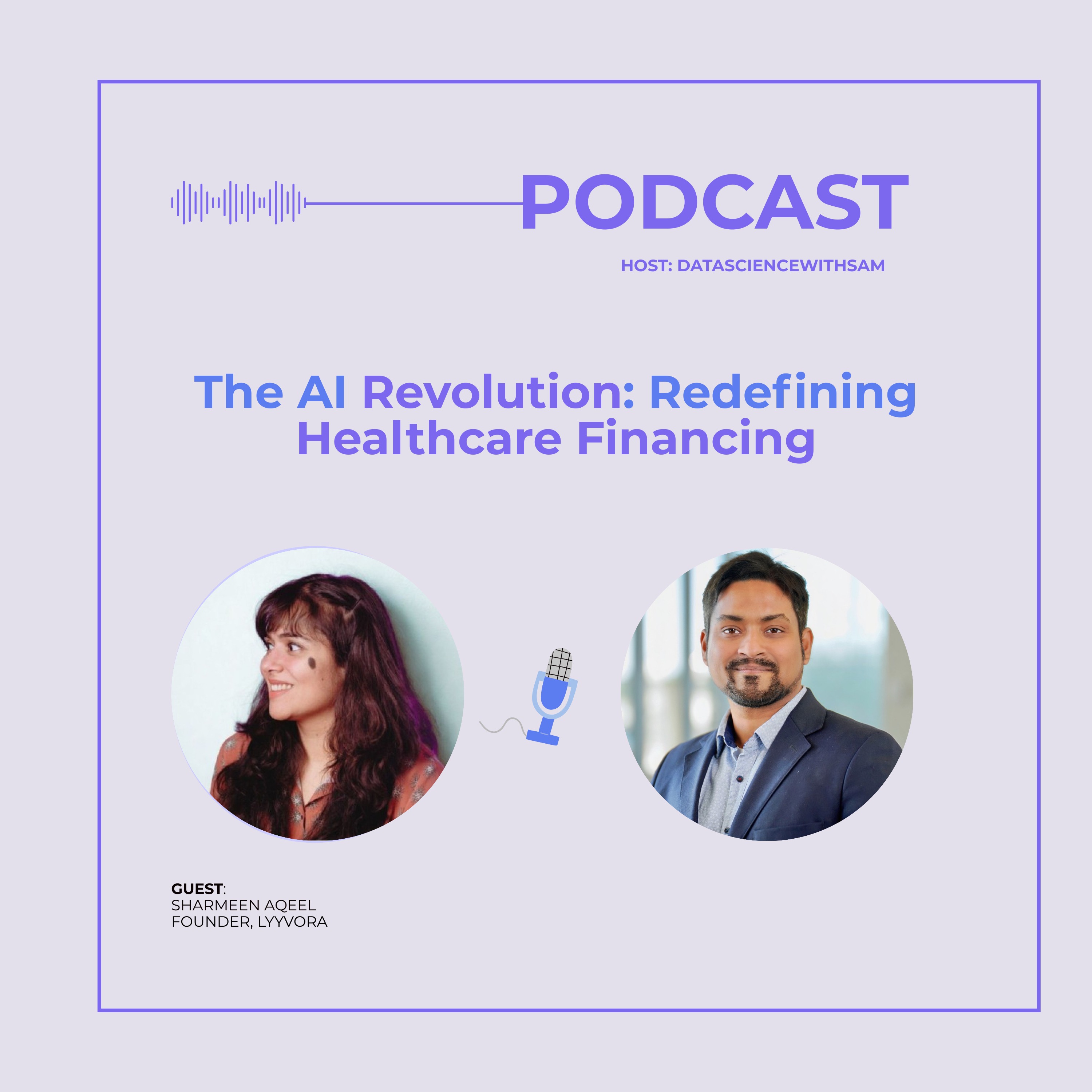
    EP 28: The AI Revolution: Redefining Healthcare Financing

    In this episode, Sam Dey interviews Sharmeen, founder of Lyyvora, a platform revolutionizing AI-driven healthcare financing for independent clinics, particularly women-owned practices. They discuss the challenges these clinics face in accessing capital, the innovative human-centered approach Lyyvora employs to streamline the lending process, and the importance of leveraging real data over traditional credit scores. Shermin emphasizes the interconnected challenges in funding, the need for education about diverse lending options, and the commitment to data security. The conversation concludes with a forward-looking perspective on the role of AI in simplifying healthcare financing. Guest: Sharmeen Aqeel, Founder of Lyyvora Sharmeen can be reached at: https://www.instagram.com/lyyvora/ https://www.tiktok.com/@sharmeen_lyyvora https://www.linkedin.com/in/sharmeen-aqeel/ https://www.youtube.com/@Lyyvora

Showing 21–26 of 26 episodes