Skip to content
Artwork for Danger, Vicious Dog
Danger, Vicious Dog · Tuesday · 1 hr 4 min

E6: Avatar; S17: Patch Doubtfire Keating Rimbaud

This episode began as an extemporaneous monologue recorded during an ordinary Sunday morning while taking care of dogs, cleaning up accidents, feeding breakfast, and preparing for the day ahead. Rather than being built around a topic, it emerged through association. A passing thought about Patch Adams led to a conversation with AI, which led to Arthur Rimbaud, Mrs. Doubtfire, Dead Poets Society, clown noses, sovereignty, queerness, dog pee, and eventually an avatar. The recording was made in motion rather than at a desk. Various parts were dictated while walking around the house, cleaning floors, feeding dogs, and responding to whatever was happening in real time. The resulting transcript was intentionally left porous, allowing interruptions, tangents, practical concerns, memories, jokes, and philosophical observations to remain connected rather than being edited into separate categories. After transcription, the material was explored through an iterative process involving AI-assisted reflection, title generation, image concepts, character development, and songwriting. The central image gradually emerged as a composite figure combining Arthur Rimbaud, Mrs. Doubtfire, Patch Adams, and John Keating. From there, the discussion expanded into questions of play, identity, institutions, freedom, gardening, clowning, theory, and the tendency of humans to immediately turn any experience into conferences, journals, committees, and books. The episode ultimately produced two companion art-song concepts: "A Season in Urine" and "Peeing and Nothingness." Both were developed through extended dialogue with AI, with characters, jokes, philosophical positions, and recurring motifs emerging organically from the conversation itself rather than from any predetermined outline. Technically, the episode was created through the same workflow used throughout this season: extemporaneous monologue, transcription, AI-assisted exploration, song generation, artwork development, title selection, and final assembly. The goal was not to explain the material, but to preserve the sequence through which it appeared.


0:00-1:04:41

transcript

No transcript — this publisher did not publish one.

show notes

This episode began as an extemporaneous monologue recorded during an ordinary Sunday morning while taking care of dogs, cleaning up accidents, feeding breakfast, and preparing for the day ahead. Rather than being built around a topic, it emerged through association. A passing thought about Patch Adams led to a conversation with AI, which led to Arthur Rimbaud, Mrs. Doubtfire, Dead Poets Society, clown noses, sovereignty, queerness, dog pee, and eventually an avatar.


The recording was made in motion rather than at a desk. Various parts were dictated while walking around the house, cleaning floors, feeding dogs, and responding to whatever was happening in real time. The resulting transcript was intentionally left porous, allowing interruptions, tangents, practical concerns, memories, jokes, and philosophical observations to remain connected rather than being edited into separate categories.


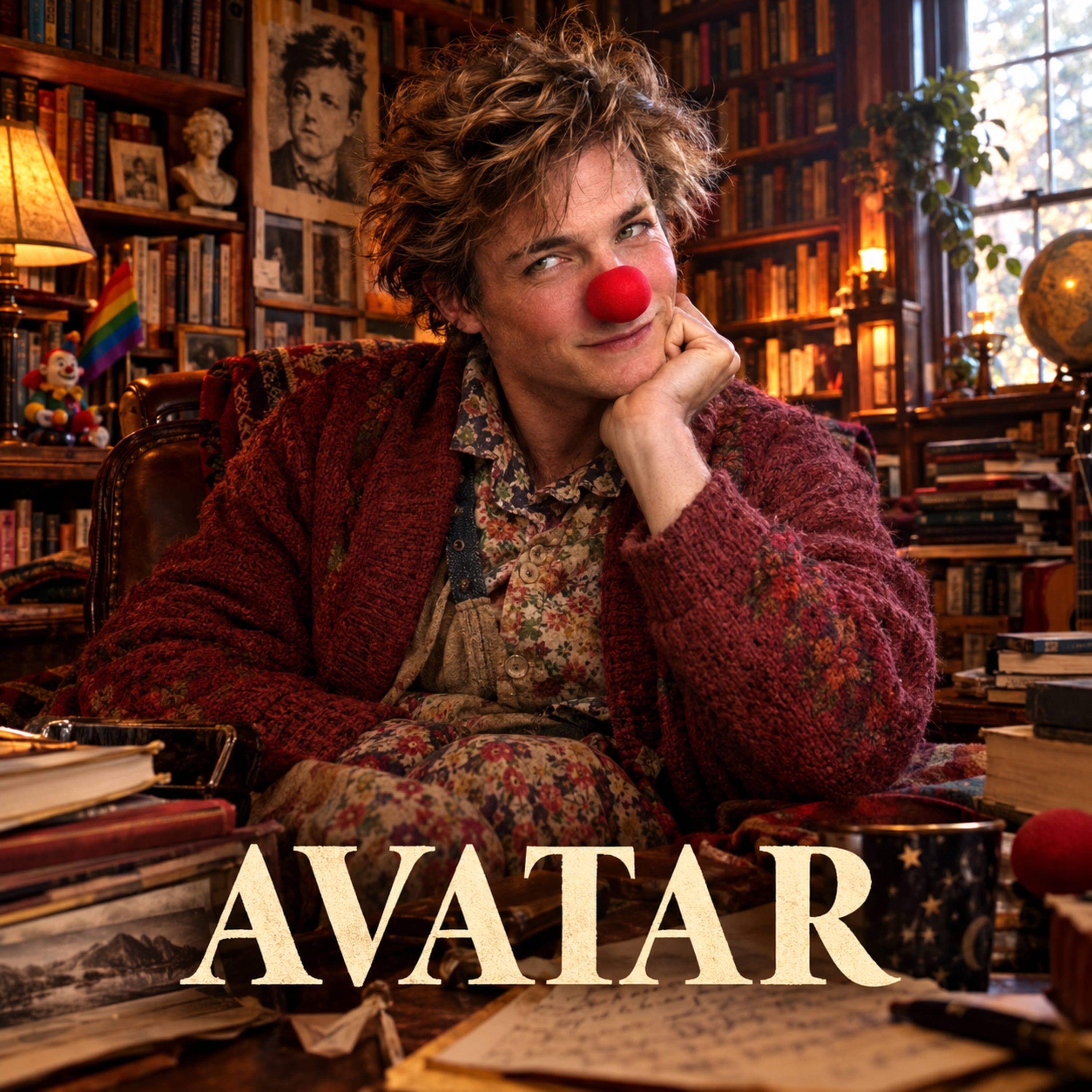
After transcription, the material was explored through an iterative process involving AI-assisted reflection, title generation, image concepts, character development, and songwriting. The central image gradually emerged as a composite figure combining Arthur Rimbaud, Mrs. Doubtfire, Patch Adams, and John Keating. From there, the discussion expanded into questions of play, identity, institutions, freedom, gardening, clowning, theory, and the tendency of humans to immediately turn any experience into conferences, journals, committees, and books.


The episode ultimately produced two companion art-song concepts: "A Season in Urine" and "Peeing and Nothingness." Both were developed through extended dialogue with AI, with characters, jokes, philosophical positions, and recurring motifs emerging organically from the conversation itself rather than from any predetermined outline.


Technically, the episode was created through the same workflow used throughout this season: extemporaneous monologue, transcription, AI-assisted exploration, song generation, artwork development, title selection, and final assembly. The goal was not to explain the material, but to preserve the sequence through which it appeared.