Skip to content
Artwork for Dam Parenting
Kids & FamilyParentingExplicit

Dam Parenting

Dam Parenting Podcast

Parenting in the Netherlands as an international family can feel overwhelming — but you don’t have to do it alone.
DAM Parenting is a weekly podcast supporting international parents through pregnancy, birth, and parenthood in the Dutch system. With 175+ episodes, we explore everything from giving birth in a system you may not fully understand to raising third-culture kids in multilingual homes. Featuring real birth stories, expert insights, and honest conversations, this is your space for clarity, reassurance, and community. You are not alone.

Play
  • 21 episodes
  • weekly
  • Avg 24 min
  • English
Counted on this page — what you have heard stays on this device, so it is not something the list can be paged by.
  • Wednesday · 22 min

    Language Loss vs Reduced Activation: Returning to School in the Netherlands After Summer

    The school bag is back out. The new lunch box is ready. And somewhere between the airport and the front door, your child tried to say something in Dutch — and it didn't come as easily as it did before you left. Does that mean something has gone wrong? Did six weeks speaking your home language undo years of work? In this episode of Dam Parenting, Eva sits down with multilingualism specialist Mimi - from Growing Up Multilingual— back for another episode of their ongoing multilingualism series — to talk through one of the most common end-of-summer anxieties in international families: the moment the school language feels rusty. They cover: — What is actually happening in your child's brain after weeks in a different linguistic environment — Why reduced activation is completely different from language loss — What parents do that makes the transition harder (and what actually helps) — How to talk to your child about the shift so they understand it — and stop interpreting it as failure — When to genuinely worry, and when to simply stay steady Mimi also addresses younger children, preschoolers, and families whose children are starting school in Dutch for the first time this September — and what they need to know before day one. This episode is for every multilingual family in the Netherlands returning from the homeland, heading into a new school year, and quietly wondering: are we okay? Yes. You are. And here's why. Dam Parenting is the weekly English-language podcast for international families navigating life in the Netherlands. New episodes every Wednesday. This episode is brought to you by MamaSocial , because navigating motherhood far from home is so much better with the right women around you. Events and spaces for mothers of all backgrounds, right here in the Netherlands.

  • August 19 · 55 min

    7 Types of Trauma That Show Up When Living Abroad — With Trauma Therapist Adina Petre

    You moved here. You built a life. And somewhere along the way, you started carrying something you couldn't quite name. In this episode, clinical psychologist and trauma therapist Adina Petre joins us to break down 7 types of trauma that show up specifically in expat and international family life — the ones that don't look like trauma from the outside, but quietly shape everything. We cover: relocation grief, cultural identity loss, generational trauma, birth trauma in a foreign healthcare system, parenting without your support network, the psychological cost of living in a second language, and vicarious trauma in a world that won't stop delivering bad news. This episode won't overwhelm you. It will give you words. And sometimes — that's exactly what's needed. Share it with someone who needs the language. Adina Petre: adinapetre.com Follow us: @damparentingpodcast

  • August 15 · 22 min

    Dutch School Starter Pack: Groep 1, Gym Days, BSO and the Summer Slide

    After Wednesdays school lunch episodes, i have recieved several DM's asking for hints and tips about schools - and without asking everyone to go back listeniing to the numerous episodes we already have in our archive - I decided to magpie this episode, and grab a selection of learnings from previous episodes and also add in a few of my own. In the Netherlands children start basisschool the day after their fourth birthday, so your child may walk into a class that's already formed. This episode covers what to expect in groep 1 and 2, what to send them in, and what to do in those first overwhelming weeks — for parents new to the Dutch system and for anyone heading back after the six-week summer holiday. WHAT'S IN THIS EPISODE - The Dutch school words nobody translates: groep 1, 2 and 3, kleuters, juf and meester, wennen, BSO, TSO, luizenzak, het tien-uurtje, gymles - Why gym day means your kleuter may be asked to strip to their underwear - Clothes, shoes, rain gear and mittens — Isabel Cruz's four practical rules - Leerplicht: your four-year-old is not legally required to be at school until they turn five, and what that means for half days and BSO - The summer slide, and why groep 1 and 2 have nothing to catch up on - What to say at pickup instead of "how was your day" - What to do when your child says someone was mean to them QUICK ANSWERS What is groep 1? The first year of Dutch primary school, for four-year-olds. Groep 1 and 2 run almost entirely on play; formal reading and writing start in groep 3. What is wennen? Settling-in practice mornings before your child officially starts. Ask your school how many they offer. What is BSO? Buitenschoolse opvang — after-school care, booked and waitlisted separately from school. When does school become compulsory? Leerplicht starts at five, from the first school day of the month after your child's fifth birthday. When do Dutch schools go back? Summer holidays are staggered across three regions, so return dates differ by where you live. MENTIONED Isabel Cruz, Kaleidoscope Consulting — school choice and school-readiness workshops in Amsterdam Faye Poole, child psychologist — the emotional support and "someone was mean" frameworks Melody, Petit Gourmet Academy — our school lunch box episode, where she went through eleven real listener lunch boxes Our paediatric dentist episode — why you're still brushing their teeth for them at nine It's a scramble of an episode at 9pm on a Friday night, but I hope it answers an unasked question for you. Tell me what I've missed: @damparentingpodcast on Instagram, or damparentingpodcast@gmail.com

  • August 12 · 45 min

    What to Put in Your Child's Lunch Box for a Dutch School — With a Children's Nutritionist

    What do you actually put in a Dutch school lunch box? Parents at an Amsterdam school sent in 11 photos of their children's real lunch and snack boxes, and children's nutritionist Mélody goes through three of them with us — what's working, what a child's body genuinely needs to get through a school day, and what she'd change. This one is for you whether your child starts school next week starts next month, or next year. We cover what balance actually means across a week rather than in a single box, why the Dutch fruitpauze does more work than parents realise, why the water-only rule at most Dutch schools is a support rather than a restriction, and whether the classic broodje kaas is nutritionally fine. Spoiler: it is. We also talk about what happens when your food culture doesn't match the Dutch one — warm lunches versus sandwiches — and what to do when your child comes home asking for the same thing everyone else has. Plus three staples for the morning you have five minutes, why children under five shouldn't have nuts, and Melody's three professional permission slips for parents carrying too much already. All 11 lunch boxes are on our Instagram, @damparentingpodcast. Part of DAM Parenting's August back-to-school series for international and expat families in the Netherlands.

  • August 5 · 18 min

    Why Your Desire Disappeared — And How to Find It Again (With Science)

    DAM Parenting says the stuff out loud that you might be thinking — just in your headphones, on your own time, when you're not quite ready to say it to anyone else yet. In episode 4 of DAM Sex, Eva is back with sex and intimacy counsellor Debby Poort to talk about something that doesn't get said enough — and not in the way it usually gets said. Sex is good for you. Not as a favour to your partner. Not because it's been a while. For you. Your sleep. Your cortisol. Your sense of yourself as a person who exists in a body that belongs to you. They get into the actual science — cardiovascular benefits, dopamine, oxytocin, endorphins, and yes, headaches — and then into the harder question: how do you share that with someone who is depleted, running on empty, and already feeling like everything is a should? Debby also unpacks responsive desire and the crucial difference between willingness and wanting — including the very real risk of responsive desire being used as pressure, and why that misses the point entirely. They talk about what it takes to reconnect to desire that has genuinely gone quiet — not just low, but offline — and whether it ever really comes back. Plus: why couples stop touching each other completely, the fear underneath non-sexual touch, the couples who stopped initiating without a single fight about it, and why there is always a reason — even when brain fog means you can't remember what it was. And Debby shares details of her free welcome course at sexandintimacycounseling.nl — no appointment needed, no commitment, just a place to start. Find Debby Poort: yellowwood.nl Got a question for Debby? DM us on Instagram or email damparentingpodcast@gmail.com

  • August 1 · 15 min

    They Couldn't Find the Right School. So They Built One.

    What do you do when the school you want for your child simply doesn't exist? If you're Tim and Camilla, co-founders of Seeker — you build it. Seeker is a brand new private bilingual Dutch-English Montessori primary school opening in Eindhoven this September. And the children starting now? They are the founding class — the ones who will set the tone, the culture, and the standard for every child who comes after them. In this episode, Eva talks to Tim about what was missing in Eindhoven for international families, what it actually takes to open a private school inside the Dutch education system, why the inspectie only shows up after you open your doors, and what it means to ask families to trust something that has no history yet — because it's about to become history. A short, feel-good summer episode about the audacity of building something from nothing. Find Seeker at seeker.education Eindhoven | Bilingual Dutch-English | Montessori | Ages 4–6 | Opening September 2026 Part of Dam Parenting's ongoing series on schools, systems, and raising children in the Netherlands.

  • July 29 · 27 min

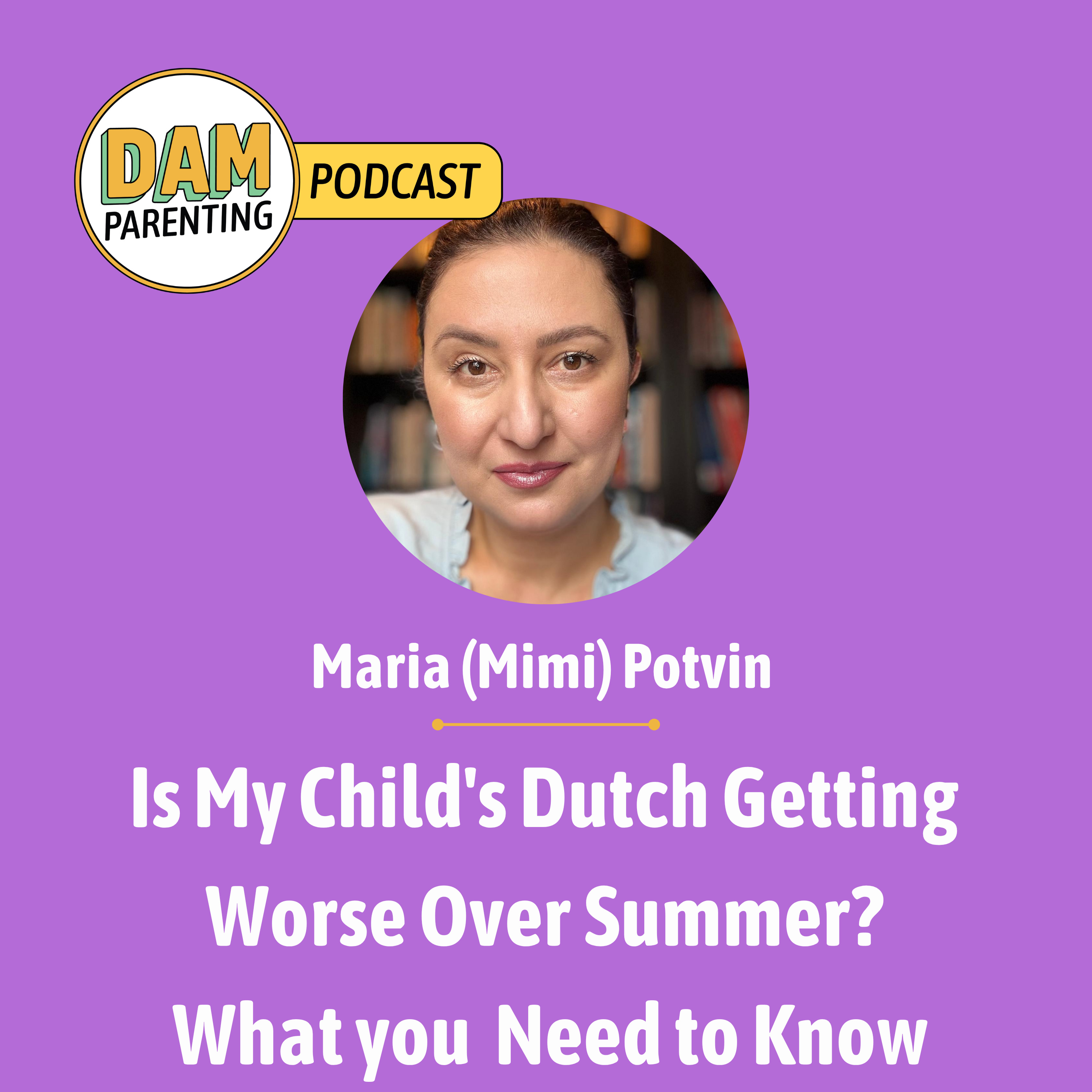
    Is My Child's Dutch Getting Worse Over Summer? What Multilingual Families in the Netherlands Need to Know

    You're away for the six weeks of school holiday in your home country. Maybe you dropped your children off and came back to work. Or you're staring down the new school year starting soon with a child who has barely spoken Dutch all summer — and a quiet worry that something has slipped.This episode is for all of it. Eva sits down with multilingualism specialist Mimi from Growing up Mulltilingual for a wide-ranging conversation about the language anxiety that follows multilingual families through summer — whether that's a child who goes quiet in the home language when they arrive at the grandparents', a child returning to the Netherlands after weeks abroad wondering if their Dutch is still there, or a family heading into September with a child who has barely spoken the school language in months. They cover what actually happens to language when the environment changes, why reduced activation is completely different from language loss, what the silent period really means, and the BICS versus CALP distinction that reframes what fluency actually looks like in a child. BICS (Social Language): The conversational language used in casual, face-to-face, or everyday interactions (e.g., chatting on the playground, ordering food). Because it is highly contextualized, learners typically master this within 6 months to 2 years of immersion CALP (Academic Language): The specialized, context-reduced language required to succeed in classroom subjects and professional settings (e.g., reading textbooks, writing essays, solving math problems). It takes significantly longer to develop—typically 5 to 7 years. Mimi also has something important to say about the child who compares themselves to monolingual cousins and feels behind — and why that comparison is never a fair one. For multilingual families in the Netherlands navigating summer, the homeland, and the return to the academic year.

  • July 22 · 6 min

    You're Allowed to Be Exhausted: A Reality Check Before the Summer Holidays

    Feeling like an exhausted parent before the summer holidays have even started? You're allowed to be. This short, one-take episode — no editing, no polish, on purpose — is a reality check on parent burnout, the mental load, and why holidays with young kids are not actually holidays (they're taking the show on the road). Recorded at the start of the Dutch summer break, this episode gives you permission to rest before you crash — because burnout doesn't send a calendar invite, and the signs of parental exhaustion are easy to miss until someone points them out. Consider this that someone. Inside: a four-question burnout self-check you can do on the bike, why the gap between how you're doing and how you say you're doing is the first warning light, lowering the bar for the school holidays without guilt, and why five minutes a day beats the 5K run you keep not doing. With a little help from Brené Brown's Daring Greatly and Leonard Cohen's beauty of cracks. Part of DAM Parenting's ongoing conversation about what it actually takes to stay well while raising kids far from home — because parents don't need fixing, they need conditions where they can function.

  • July 15 · 25 min

    Why Does a Hand Lotion Calm Me Down? Nervous System Regulation with Elif Durgel

    You catch a smell. A lotion, a tea, something cooking. And in under a second — before you've even thought about it — you're home. That's not nostalgia. That's not weakness. That is your nervous system doing something remarkable. This week we're joined by psychologist and cross-cultural specialist Elif Durgel, founder of Roots and Wings Academy in Eindhoven, for a warm, science-light conversation about why smell bypasses the thinking brain entirely and connects directly to memory, identity and emotion — and what that means for international parents living far from where they started. We talk about: Why smell hits faster and deeper than any other sense What nervous system regulation actually feels like from the inside The invisible extra load of living between cultures — and why July makes it louder Why so many of us quietly deny ourselves the things that help Why going to the expat shop isn't retail therapy — it's something more real than that Whether you're heading home this summer, somewhere completely new, or discovering the Netherlands in July for the first time — this one is your permission slip. 20 minutes. No jargon. Just a really good conversation. Find out more about Elif: rootsandwingsacademy.nl Come tell us yours on Instagram

  • July 8 · 31 min

    What Is Trauma? Big T, Little T, and Why It Might Be You

    Have you ever reacted to something and thought — why did I react like that? Or carried a weight you couldn't quite name? Today we're breaking down what trauma actually is — plainly, warmly, and without the jargon. Because if you're living in the Netherlands as an expat or immigrant, building a life far from home, navigating a foreign healthcare system, raising children in a second language — this conversation is for you. We're joined by Adina Petre, clinical psychologist and trauma therapist , who will be joining us monthly to help us understand ourselves a little better, one episode at a time. In this episode: — What trauma actually is (and what it isn't) — The difference between Big T and Little T trauma — Why the nervous system doesn't grade on a curve — What happens when we stay in survival mode for too long — And why your experience is real, because it happened to you — and that is enough Share this episode with someone who needs the words.

  • July 1 · 23 min

    Obligation Sex Is More Common Than You Think — Here's What It's Really Costing Your Relationship

    This episode is brought to you by MamaSocial, who connect mums across the Netherlands so you actually have a community to lean on. Brunches, mingles, networking, whatever you need — MamaSocial will be hosting something near you. Check out their website and Instagram to find your nearest one now. Have you ever had sex because saying no felt harder than just getting it over with? In episode 3 of DAMSex, Eva sits down again with sex and intimacy counsellor Debby Poort to talk about obligation — or "duty" — sex, and what it quietly does to you, your partner, and your relationship over time. They unpack what's really happening when one partner is having sex out of guilt rather than desire, and what it does to the partner on the receiving end of that obligation — most of whom don't actually want it that way. Debby introduces responsive desire, a concept that explains why "wanting" doesn't always come before "willing," and why that's a completely normal, healthy starting point — especially for parents whose spontaneous desire has quietly disappeared since having kids. They also get into the orgasm gap, what a healthy "no" actually sounds like, how to respond to one without it becoming a wound, and how to keep this conversation going with your partner without it turning into an accusation. This episode is part of the monthly DAM Sex series — sex, intimacy, and connection for international parents in the Netherlands, and honestly, everywhere else too. Brought to you this month with thanks to MamaSocial, supporting our community of mums across the Netherlands. Find Debby Poort: yellowwood.nl Got a question for Debby? Send it via Instagram DM or email damparentingpodcast @ gmail.com

  • June 27 · 28 min

    Queer Parenting in the Netherlands: Why One Dad Built a 250-Family Community From Scratch

    When Aldo's daughter arrived via surrogacy in Canada, he looked around and realised he'd spent 10 years focused on becoming a dad — and forgotten to build a community for her. So he started a WhatsApp group for four or five families. Within months, it had grown to 250 members from every corner of the Netherlands. In this episode, Aldo — founder of Queer Families NL — talks about what it actually takes to raise a child in a rainbow family here, the gap between the Netherlands' progressive reputation and the lived reality for queer parents, and the moment his two-year-old daughter came home from City Hall and said: "Mama — baby Sophia haved two papas. Kaya haved two papas." Whether you're a queer parent, an expat family finding your footing, or someone who simply wants to raise their kids in a more open world — this one's for you. Find Queer Families NL on Instagram: @queerfamilies.nl Tiktok @queerfamiliesNL and Aldo and Kim on @2GayDadsinNL DAM Parenting is the podcast for international and expat parents in the Netherlands. New episodes every week.

  • June 24 · 24 min

    Raising Bilingual Children in the Netherlands: What Summer Travel Really Does for Heritage Language Development

    Your child speaks the school language all year without thinking. Your language — the one you grew up in, the one your parents use, the one you hoped would just stick — has to fight for space. And then summer comes. You get on a plane. And suddenly the whole dynamic shifts. In this episode, Eva talks to multilingualism specialist Mimi about what really happens to language development when families travel home — and why most parents underestimate how significant that window actually is. They talk about the child who understands everything but answers in the wrong language, why love of family isn't always enough motivation, and how to have the conversations that actually help your child build a relationship with their own multilingual identity — not just manage it. Practical, honest, and grounded in lived experience as a multilingual parent herself, Mimi brings a warmth to this topic that cuts through the anxiety and gives you something real to do. For international families in the Netherlands navigating language, identity, and belonging.

  • June 20 · 29 min

    Coparenting After Separation in the Netherlands: One Dad's Honest Story

    What actually happens after a relationship ends — when you have children together, you're living in the Netherlands, and your village is far away? Niko, a German dad, joins us this week to talk honestly about something most men never say out loud: the grief, the guilt, the fear of what separation would do to his kids — and how he came out the other side. They talk about growing apart after years together, the question he had to ask himself when staying felt like slowly disappearing, why he believes ending a marriage and ending a family are not the same thing, and how he and his ex built a coparenting relationship they're both proud of. This is not a conversation about divorce being easy. It's a conversation about what's possible when two parents put their children first — and take care of themselves in the process. For any dad who is struggling and hasn't told anyone yet: this one's for you. RESOURCES — Nationwide Netherlands For children: KIES (Kinderen In Een Scheiding Situaties) — free municipality-funded support groups for children aged 4–18. Available across the Netherlands. Self-refer or via your child's school. Find your local KIES via: kiesvoorhetkind.nl or kiesamsterdam.nl (Amsterdam-specific) Villa Pinedo — online support platform for children and young people with divorced parents. Available in English. Buddy app, forum, and parent resources: villapinedo.nl/english For parents: Mediation in the Netherlands — if you need support building a parenting plan, a registered mediator can help. Search via the Dutch Mediation Federation: mfnregister.nl Your gemeente — ask your local jeugdregisseur (youth coordinator) what coparenting support is available in your area. Every municipality is different.

  • June 17 · 35 min

    Why Becoming a Dad Made Me Finally Realise I Had ADD - Mens Mental Health Week

    If you became a father and suddenly felt like you couldn't keep up — with the admin, the overwhelm, the switching, the forgetting — this episode is for you. Liam, founder of Dads Do Art and familiar Dam Parenting voice, joins Eva to talk about his late ADD diagnosis. What fatherhood revealed that decades of coping had hidden. How he navigated the Dutch healthcare system — the huisarts, the waiting lists, the private vs public route. Why he initially thought he'd fooled the professionals. What medication actually changed, and what it didn't. And the moment his mum arrived at the diagnostic session with every school report from age seven, and everything finally made sense. This episode covers: adult ADHD and ADD diagnosis in the Netherlands, neurodiversity and fatherhood, burnout and undiagnosed attention difficulties, ADHD medication, ADHD therapy, and the very first step to take if you think this might be you. For international parents in the Netherlands. Every Wednesday.

  • June 13 · 15 min

    Buying a House in the Netherlands: What No One Tells You

    The Dutch housing market is fast, opaque, and genuinely unforgiving if you don't know the rules — and most of us didn't get the rulebook. In this episode, Eva is joined by Nic, co-founder of Buy Home Helper, who built a platform specifically for internationals navigating the Dutch home buying process after his own experience of lost bids, hidden costs, surprise neighbours, and a final invoice that came out of nowhere. We get into what the market actually looks like right now, why more internationals are being pushed into buying whether they're ready or not, and how Buy Home Helper guides you from first search to signed keys — with the tips, warnings, and stage-gate reminders your makelaar probably isn't sharing. If you're logging into Funda morning and night, building spreadsheets, and wondering if there's an insider club you somehow missed — this one's for you. Exclusive offer for the Dam Parenting community: Use code DAMPARENTING at buyhomehelper.com — the first 10 listeners get a full year free.

  • June 10 · 33 min

    Vaccinations in the Netherlands: Everything International Parents Need to Know

    Confused about vaccinations in the Netherlands? You're not alone — it's one of the most asked questions in every expat parenting group. This week I'm joined by Youth Healthcare physician Dr. Marenne van Hengel Budde for a complete, plain-English guide to the Dutch vaccination system — from pregnancy through to age 14, and everything in between. We cover the full Dutch National Immunisation Programme (RVP), why chickenpox isn't on the Dutch schedule, the BCG tuberculosis vaccination that surprises many international families, meningitis B, travel vaccinations, and how to check your child's vaccination record online in minutes. IN THIS EPISODE: The Dutch National Immunisation Programme — who runs it, how it works, and why your GP is probably not involved Every vaccine on the schedule — from the whooping cough vaccine in pregnancy to the HPV vaccine at age 9, including the new RSV antibody (September 2025) and rotavirus vaccine (added 2024) Chickenpox — why it's not in the Dutch programme, what to do if you want it privately, and why age 12 matters BCG tuberculosis vaccine — who receives it, how the automatic invitation works, and what to expect from the skin reaction Meningitis B — why it's not included in the Dutch programme and how to access it privately (and what it costs) Travel vaccinations with babies and young children — where to go and how far in advance to plan How to check your child's full vaccination record online at mijn.rivm.nl — in under 2 minutes Missed a vaccination window? Here's what actually happens (it's probably not as bad as you think) Arriving from abroad with an existing vaccination schedule — do you have to start again? No. Here's how it works. ALL LINKS AND RESOURCES: 🔗 Dutch National Vaccination Programme (English): https://www.rivm.nl/en/dutch-vaccination-programme 🔗 Check your child's vaccination record online: https://mijn.rivm.nl 🔗 JGZ parental portal (online environment of the Youth Healthcare Centre): https://www.mijnkindgegevens.nl 🔗 DigiD (needed to log in to mijn.rivm.nl): https://www.digid.nl 🔗 KNCV TB Foundation — high-risk TB country list: https://www.kncvtbc.org 🔗 GGD — find your local office for BCG and travel vaccinations: https://www.ggdghor.nl 🔗 LCR Travel Vaccination Advice (enter destination country for required vaccines): https://www.lcr.nl 🔗 Private vaccination centres in the Netherlands (incl. chickenpox / varicella): https://www.vaccinatiecentrum.nl 🔗 RIVM contact (to request vaccination record by email or post): https://www.rivm.nl/en/contact

  • June 3 · 19 min

    ‘We’re Housemates Who Share a Bed’ — How Can Emotionally Focused Therapy Help You?

    ‘We used to be so passionate. Now we’re housemates who just happen to share a bed. I’m scared we’ve lost something we can’t get back.’ IIn this episode, sex and intimacy counsellor Debby Poort answers it. This month on DAM SEX, Eva and Debby go into Emotionally Focused Therapy — the attachment-based model that reframes ‘we have a sex problem’ as ‘we have a connection problem.’ They talk about the pursue–withdraw cycle, what it looks like in real couples, and why both people in the cycle are doing the exact same thing: trying to get their needs met. Plus: the A.R.E. framework (Accessible, Responsive, Engaged), what emotional safety actually feels like in the body, and why couples wait an average of seven years before getting help. The cycle is the problem. Not the couple. Debby Poort — Sex & Intimacy Counsellor Yellowwood | Amsterdam & Amstelveen Website: www.yellowwood.nl DAM SEX is monthly. Every episode builds. Dam Parenting — every Wednesday.

    • Transcript
  • S2 · E56
    May 31 · 21 min

    The Word They Used to Silence Women — And How We're Taking It Back

    Gossip. Gossib. Godsib. The same word — and the meaning was changed on purpose. Before gossip became something shameful, it meant godsib: God's sibling. Your circle. The women who gathered around you when you gave birth, who cooked and held and stayed. That tradition was deliberately dismantled — and we are reclaiming it. In this final episode of the Maternal Mental Health Month series, I sit down with artist Sanne Freijdag, whose project the Gossib Gathering is doing exactly that: bringing women together over fabric, stitching, and the kind of honest conversation that happens when your hands are busy and your guard is down. We cover the medieval history of women's gathering spaces, how the quilting circle became women's last sanctioned meeting place, the science of why working with your hands is so healing, and what matrescence — the becoming of a mother — has to do with all of it. And we launch the next session: three Sunday sessions in Amsterdam Oost where we'll be making a quilt together for one pregnant woman in our community. Because you can't always see your village — but you can make something that proves it exists. You don't need experience. You just need to show up. Book your spot HERE 📅 28 June · 5 July · 12 July 12:30–16:30 GROND, Amsterdam A donation of €10 on the day to fund the supplies is all that is asked! Sanne Freijdag: www.freijdag.com Instagram @sanne.freijdag

    • Transcript
  • May 30 · 14 min

    You don't have to do this alone: MamaSocial, mum friendship and maternal mental health in the Netherlands

    We close Maternal Mental Health Month with something the research says matters just as much as therapy: community. Rachael Forester — therapist and new lead of MamaSocial — joins Dam Parenting to talk about why mum friends aren't optional. The science of co-regulation. Why female friendship in early motherhood is neurologically unique. And what MamaSocial — the community space for international mothers across the Netherlands — actually looks like to walk into for the first time. If you've moved to the Netherlands, newly pregnant or just looking to fine more mom frirneds and you're doing this without your village yet — this one is for you. MamaSocial runs events in Amsterdam, Rotterdam, Utrecht, Haarlem and more. MamaSocial instagram page

    • Transcript
Showing 1–20 of 21 episodes