Skip to content
Artwork for Crossing the Valley
TechnologyGovernment

Crossing the Valley

Frontdoor Defense

Few companies make it from pilot to production in the defense market. Those who do often change the industry in the process. How do they do it? What lessons can startups take from their trials, successes, and failures? Crossing the Valley tells the stories of the trailblazers who are forging a new path for America's defense.

www.valleycrossers.com
Play
  • 24 episodes
  • weekly
  • Avg 43 min
  • English
Counted on this page — what you have heard stays on this device, so it is not something the list can be paged by.
  • #76
    March 18 · 45 min

    Ep. 76 - WHOOP: Wearables at War

    About Todd Stiefler Todd Stiefler is VP of Enterprise at WHOOP, overseeing the company’s B2B and B2G business lines. He brings an unusually cross-functional background to the role: a decade as a Senate defense staffer focused on missile defense and strategic nuclear deterrent, followed by product and commercial leadership roles at GE’s industrial IoT division, LMI, and Palantir. A self-described “tech nerd” and ultra-marathoner who finished the Leadville 100 in 27 hours, Todd found WHOOP the way most people find things that change their lives — by accident, scrolling LinkedIn late one night. He’s been building the company’s defense business ever since. About WHOOP WHOOP is a Boston-based wearable technology company focused exclusively on human performance and health optimization. Unlike general-purpose smartwatches, WHOOP does one thing: continuously measures high-fidelity physiological data — heart rate variability, resting heart rate, respiratory rate, skin temperature, and strain — and translates it into actionable metrics around sleep, recovery, and readiness. Its early customers included elite professional athletes, and it has since grown into a mass-market product worn by hundreds of thousands of consumers and, increasingly, military personnel. WHOOP is actively pursuing the DOD enterprise market, partnering with programs like SOCOM’s POTD and the Army’s Holistic Health and Fitness (H2F) initiative. The company’s enterprise division, led by Todd, handles everything from individual unit programs to large-scale institutional deployments. Key Takeaways 1. Build for your most demanding user first. In contrast to the “minimally viable product” framework, WHOOP’s early decision to build exclusively for elite athletes — with LeBron James and Michael Phelps among their first 100 customers — wasn’t a marketing stunt, but a product strategy. By targeting the most demanding performance environment, they built something rigorous enough to eventually serve everyone else. That same logic attracted special operators before conventional forces, and conventional forces before institutional DOD programs. They solved for the “edge cases” first rather than the average user, because they were solving their distribution challenge through their product design. 2. But the right product alone isn’t enough… you still have to solve the process. Todd was direct about what WHOOP got wrong in its early defense push: they had a best-in-class product but hadn’t built the surrounding infrastructure. No contract vehicles. No data sharing agreements. No pricing architecture tuned to government procurement. “The DOD buys from people that solve their process, not their problem.” Getting that right — not just shipping a great device — is what actually enables scale. So while many of us laugh at high-ceiling IDIQs without real funding, the vehicle is a key ingredient. 3. The wearable itself is actually not the intervention. This was one of the most important points from the episode: motivated, self-selected consumers who buy WHOOP on their own are signaling their desire to change their behavior. Warfighters handed a device in a conference room, with no context, no coaching, and no program design, often won’t. Even though the average warfighter may be more attuned to their body than the average civilian, in this case, if the warfighter doesn’t opt in, the product won’t deliver. This insight is why Todd never sees WHOOP going to a “push to all” rather than a “pull” based sales motion. If it’s foisted upon people, it will not produce the desired effect. 4. In federal sales, relationships and strategic partnerships beat conference booths. Todd assesses that in the defense market, niche events where you can have real conversations, and partnerships with athlete management system providers who can pull WHOOP into their stack, have been the most valuable sources of leads. Trade show booths? Much less effective. As always, your mileage may vary, but it’s another reinforcing data point suggesting deep, niche relationships beat a larger breadth with high impressions. 5. Sell sustainable programs, not hardware deployments. Todd’s north star for WHOOP’s next 12 months is helping customers build programs that will still be running in five years. That means bringing in WHOOP’s human performance experts and solution architects early, co-designing integration with existing data platforms, and being the vendor who asks, “What are you actually trying to achieve?” before taking the purchase order. For more Crossing the Valley: valleycrossers.com | LinkedIn For more on WHOOP: WHOOP.com Follow Todd: https://www.linkedin.com/in/toddstiefler/ Follow Noah: https://www.linkedin.com/in/noahsheinbaum/ This is a public episode. If you would like to discuss this with other subscribers or get access to bonus episodes, visit www.valleycrossers.com
  • #75
    March 11 · 16 min

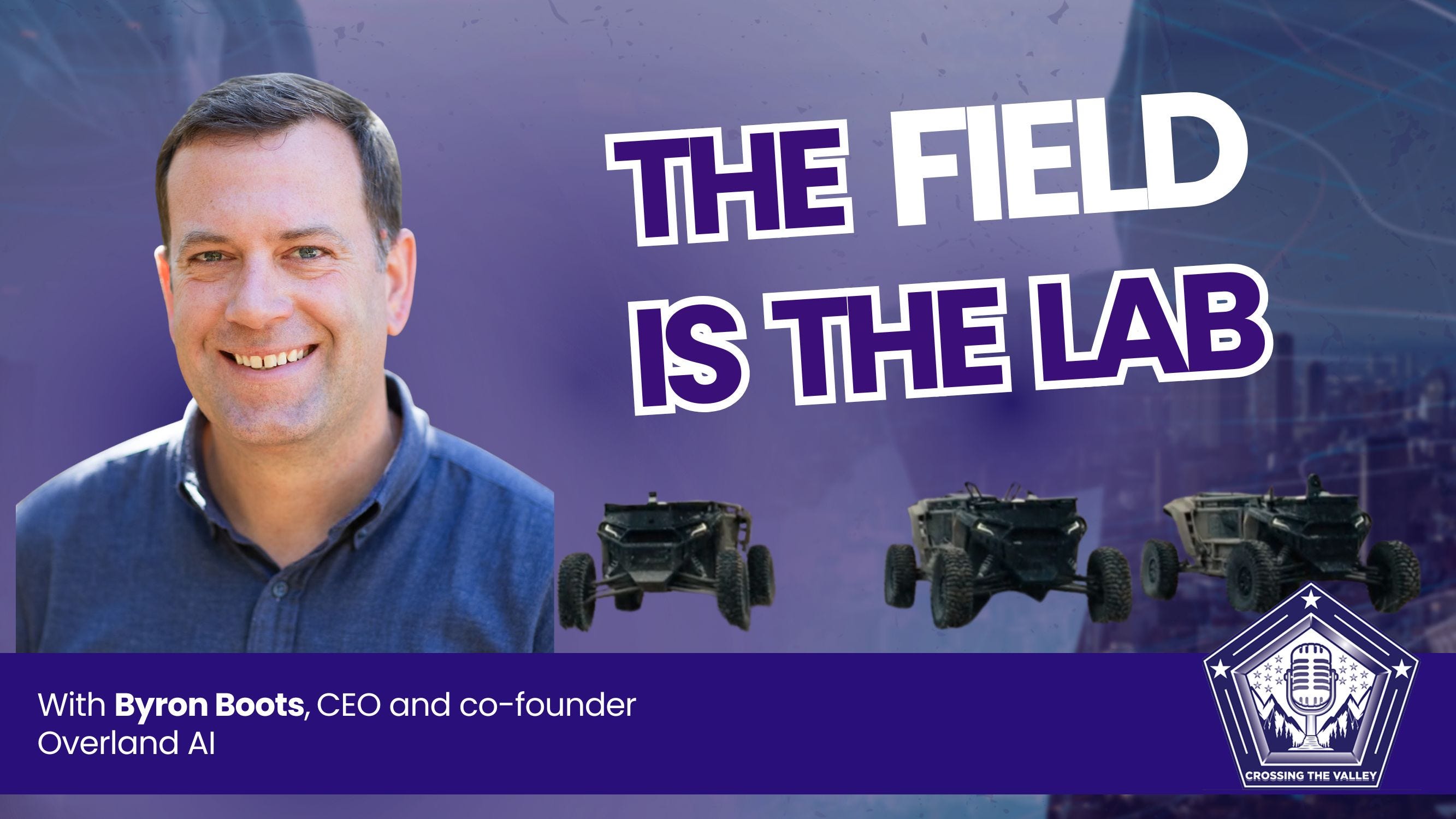
    Ep. 75: The Field is the Lab for Overland AI

    About Byron Boots Byron Boots is the co-founder and CEO of Overland AI. Prior to starting the company, he was an associate professor in computer science at the University of Washington, where his research focused on machine learning and robot autonomy. Byron served as principal investigator on DARPA’s Racer program, one of the most ambitious off-road ground autonomy challenges the agency has run since its landmark Grand Challenge series in 2004–2005. It was in that role — out in the field, iterating under adversarial test conditions — that the insight and technology behind Overland AI took shape. About Overland AI Overland AI builds autonomous ground vehicle software and systems for the U.S. military. Their flagship platform, ULTRA, is a purpose-built unmanned ground vehicle with upgraded suspension, miniaturized compute, and a suite of sensors including stereo cameras, LiDAR, thermal cameras, and Starlink — capable of GPS-denied navigation in extreme off-road terrain. The company operates across four primary concept of operations: ISR (intelligence, surveillance, and reconnaissance), logistics and resupply, layered protection (including counter-UAS), and breaching. Their go-to-market approach has been almost entirely driven by demonstrated field performance. Initially this came through DARPA experiments, then through DIU and direct work with Army and Marine Corps units. Overland has won contracts including the DIU Ground Vehicle Autonomous Pathways program and is currently focused on scaling into formations and establishing a permanent operational presence with the services. Key Takeaways Five principles from Byron’s journey that apply broadly to defense tech founders: * Field, first. One of the most counterintuitive decisions Byron made at University of Washington was to hire strong vehicle mechanics as some of his first team members. It’s a simple but counterintuitive logic. You don’t have to build the perfect software in the lab before you put it on the vehicle because if vehicles could be repaired rapidly in the field, the software team could test more aggressively, fail faster, and iterate without fear. Thus, the vehicle mechanics gave the rest of the team leverage. * The best BD is performance (with the lights on). Overland AI’s early business development was almost entirely organic. I pressed him on DARPA’s checkered history of transitioning programs, but in this case, DARPA invited the other services to watch their field experiments. Those experiments were credible, because the company often didn’t know what was coming. It wasn’t a PowerPoints brief or a table top conversation; it was an opportunity for customers to see the tech in action. That credibility dramatically accelerated their sales path. * Build on top of what works. Byron’s framework for capability development is deliberate: get one robot working reliably, then add a second, then build multi-vehicle coordination. Don’t architect for the end state. Prove each layer before adding the next. This mirrors successful product development in commercial software but is even more important in defense, where integration failures in the field are immediately visible and costly. * “If it’s not seamless, it won’t survive contact with the warfighter.” Despite the old saying “good enough for government work,” the operational bar for defense products is actually quite amorphous. Byron observed that “a slow or unreliable robot simply gets abandoned.” In other words, your project might die without you even knowing. The product actually has to perform well enough that operators don’t think about it. Only then can you expand the mission set, add payloads, or introduce multi-vehicle coordination. * It’s not about your tech. The sooner you embrace this, the faster you’ll win. Winning a contract gets you in the door, but a contract isn’t the same thing as winning warfighter trust. Byron draws a clear distinction between them. Overland's next 12 months aren't going to be defined by new contracts as much as they are going to be defined by creating "a permanent presence" with Army and Marine Corps units. I love this point because it suggests a totally different motion. It’s not about closing the deal or renewing it. It’s not about another slide or another meeting. It’s about doing things that don’t scale, having people side by side with the mission owners, and obsessing over the question of how to make your technology invisible inside existing workflows rather than celebrated as a novelty. For more Crossing the Valley: valleycrossers.com For more on Overland AI: www.overland.ai Follow Byron: https://www.linkedin.com/in/byron-boots/ Follow Noah: https://www.linkedin.com/in/noahsheinbaum/ This is a public episode. If you would like to discuss this with other subscribers or get access to bonus episodes, visit www.valleycrossers.com
  • #74
    March 4 · 49 min

    Ep. 74 - How Forterra Acquired goTenna in 72 Hours

    What happens when a Friday morning coffee turns into a term sheet by Sunday night? In this episode, Forterra CEO Josh Araujo is joined by Ari Schuler, a returning CTV guest, to take us inside Forterra’s acquisition of goTenna. Company Overview About Forterra: Ground autonomy company enabling war fighters to shoot, move, and communicate more effectively. Technical stack includes autonomous driving systems, mission payload integration, and now mesh communications through the goTenna acquisition. Working with military customers across operational theaters. Founded 20+ years ago (as Robotic Research), recently closed Series C while simultaneously acquiring goTenna. About goTenna: Mesh networking communications company providing interoperable comms, born from Hurricane Sandy in Brooklyn. Pivoted from consumer to military/public safety after discovering product-market fit with operators in Afghanistan, Iraq, and the southern border. Technology enables high node-count networks (100+ devices) sending low-bandwidth position/location data, critical for blue force tracking and preventing friendly fire. About our Guests About Josh Araujo: CEO of Forterra, building autonomous ground vehicle technology for military operations. Retired Marine, and Jefferies investment banker covering aerospace and defense. Joined Forterra (then Robotic Research) in 2021 as the first non-technical hire, now leading a company with 20+ years of autonomy innovation transitioning to programs of record. About Ari Schuler: Former CEO of goTenna, now leading the communications division at Forterra. Built goTenna’s pivot from consumer to B2G, deploying mesh networking technology in conflict zones globally. Former DHS official who created Customs and Border Protection (CBP)’s innovation team, bringing government operator perspective to commercial tech development. Key Takeaways 1. Skip the vitamin, find the medicine. Ari’s mentor gave him a deceptively simple framework: are you selling something people want (vitamins), or something they can’t live without (medicine)? goTenna started as a consumer product, but product-market fit became unmistakable once the technology hit Afghanistan, Iraq, and the southern border. Ari explains that when you found the true medicinal use case, you go all in. Straddling consumer and government markets wastes capital and credibility that companies don’t have to spare. 2. The ability to sustain operations in the field is the real moat. Both Forterra and goTenna had extraordinary technical pedigrees: Forterra’s co-founder holds 100+ patents, and goTenna’s mesh protocols are proprietary and deeply differentiated. But Josh was explicit: deploying at scale into combat environments is “miles apart” from having a cool demo. The muscle required to do customer success, field maintenance, and operational support in places like Afghanistan or Ukraine is not taught in any graduate program. 3. In M&A, cultural alignment is what ultimately determines deal success or failure. The core of the conversation centers on how Josh turned a term sheet around in 72 hours, from a Friday morning coffee between Ari and Scott Sanders (another CTV alum), to an afternoon board meeting, to a signed term sheet by Sunday night. This kind of speed is not only a function of high caliber financial modeling and expertise, but of a clear strategic rationale and cultural fit. Josh talked about his view that even the best business alignment in the world can’t overcome a cultural mismatch. Culture doesn’t mean squishy values in this case. It refers to the companies’ shared mission focus, values, and tech stack (NetSuite, Arena, JIRA). 4. The defense VC funding model is creating a structural problem for which consolidation is the only solution. Josh flagged a concern that most defense tech founders are quietly aware of: many of the best companies in this space have great technology, great teams, and genuine product-market fit, but lack venture-scale TAMs. VC math requires one in a hundred to go 100x. At the risk of sounding trite, that calculus alone will not support the entire ecosystem of mission-critical hardware businesses. As a result, if venture is the primary tool, companies that shouldn’t fail will fail because of capital structure problems. This is why Josh is shaping Forterra into a leading consolidator to create a home for these companies. 5. In a post-merger integration, the first priority is “do not break what’s working for the customer.” Too many post-merger integration efforts try to move fast, combine everything, and extract synergies. In this deal, Josh and Forterra explicitly rejected this. The approach has been phased and deliberate: first, validate the technology combination (goTenna’s X2m module was physically integrated into Forterra’s Vector platform within 30 days, achieving 25x the range of the previous radio). Second, resource the acquired team to execute on their existing pipeline. Third, after the teams have developed organic trust, start to combine go-to-market and engineering functions. This cadence matters because defense vendors cannot afford to push artificial disruptions on their customers. As Ari explains, “We can figure out the HR systems. What we can’t do is mess up operational deployments.” The customer relationship is paramount. For more: * Website: Forterra | goTenna * LinkedIn: Forterra | goTenna * Follow Josh: https://www.linkedin.com/in/josh-araujo/ * Follow Ari: https://www.linkedin.com/in/ari-schuler-1ab93239/ * Follow Crossing the Valley: https://www.linkedin.com/company/102082197/ This is a public episode. If you would like to discuss this with other subscribers or get access to bonus episodes, visit www.valleycrossers.com

  • #73
    February 25 · 47 min

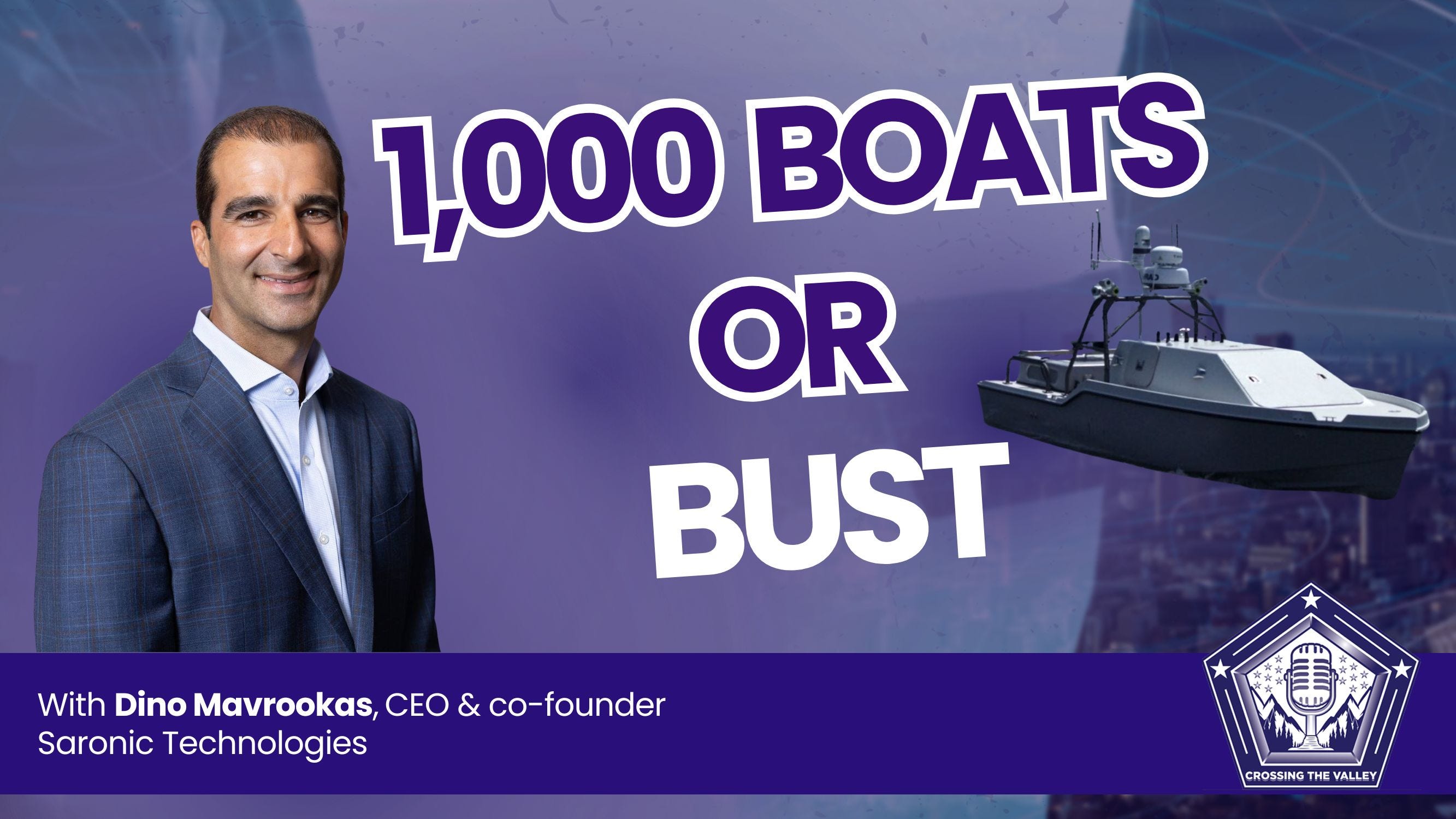
    Ep. 73: SARONIC - "If We Can't Build a Thousand Boats, I Don't Care About the Design"

    About Dino Mavrookas Dino Mavrookas is the CEO and co-founder of Saronic. He served 11 years in the U.S. Navy SEALs (2004–2015), with his final five years on SEAL Team Six. After leaving the military, he transitioned to private equity at Vista Equity Partners, where he spent roughly five years before the pull of mission-driven work drew him back to defense. Dino describes his transition as a gradual realization, like being a “frog in boiling water,” that he wanted to dedicate his career to building solutions that protect the country. He founded Saronic in September 2022 with backing from 8VC and a slew of other high profile investors. About Saronic Saronic is a maritime autonomy and shipbuilding company headquartered in Austin, Texas. Founded in September 2022, the company designs, builds, and deploys autonomous surface vessels for the U.S. Navy and allied forces. In just over three years, Saronic has grown to approximately 1,000 employees across six U.S. locations and two international offices (Australia and UK). The company’s flagship products are Corsair, a 24-foot autonomous speedboat built at their 500,000 sq. ft. Austin facility (capacity: 2,000+ units/year), and Marauder, a 180-foot autonomous ship being built at their shipyard in Franklin, Louisiana. Saronic secured a $392 million contract with the U.S. Navy in late 2025, with the Secretary of the Navy publicly endorsing their approach as the model for future procurement. The company has announced Port Alpha, a $5B+ initiative to build the world’s largest and most advanced shipyard, with the goal of producing 10 million gross tons annually. This would effectively 100x current U.S. shipbuilding capacity. For more on Saronic: * Website: saronic.com * LinkedIn: https://www.linkedin.com/company/saronic-technologies/ * Follow Dino: https://www.linkedin.com/in/dino-mavrookas-190244127/ * For Careers: https://jobs.lever.co/saronic For more Crossing the Valley: www.valleycrossers.com This is a public episode. If you would like to discuss this with other subscribers or get access to bonus episodes, visit www.valleycrossers.com

Showing 21–24 of 24 episodes