Langdon Winner - Do Artifacts Have Politics?
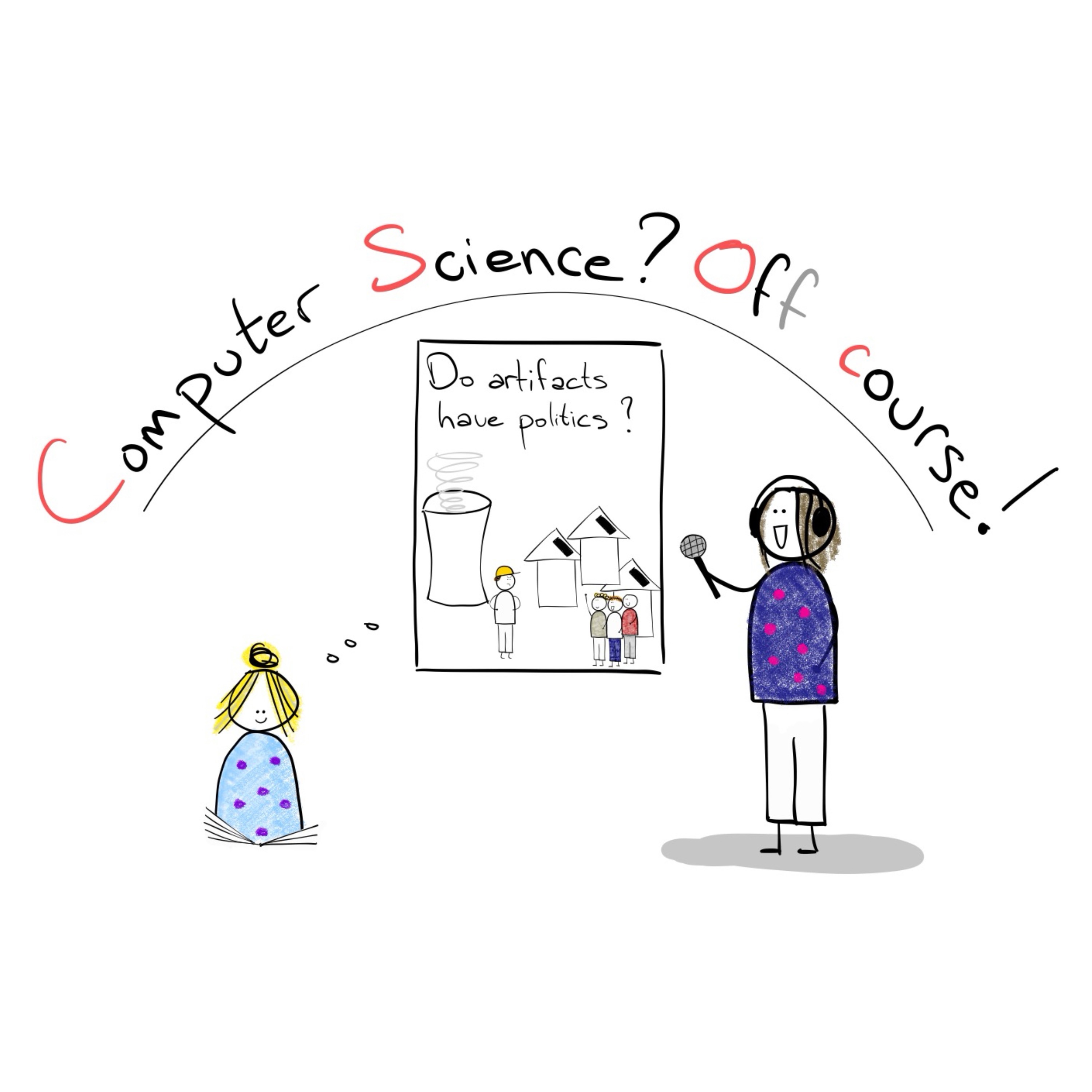
Does software have politics? Are LLMs like power plants? Do ships need captains? In this final episode of our first season, we discuss these questions and take a look at Langdon Winner's paper "Do Artifacts Have Politics?" (1980). Spoiler alert: the answer to the question in this paper's title is a big, bold YES! According to Winner, there are two ways in which artifacts can have political properties. In our episode, we illustrate these with examples and apply Winner's observations to current technologies such as LLMs. We explore how the political properties of software can be accounted for in Computer Science education and establish links to prior episodes. As always, Felienne considers new tattoos, and Hanna finally does the homework she's been assigned. Links: Our Discord channel for the pod: https://discord.com/invite/Vt2Pcc44m6 Felienne’s blog post: https://www.felienne.nl/csoc-s01e10/ Hanna’s homework: https://homework.unedited.me/posts/csoc-s01e10-homework/ Mentions and references: Winner, L. (1980). Do Artifacts Have Politics? Daedalus, 109(1), 121–136. Published by: The MIT Press on behalf of American Academy of Arts & Sciences. URL: http://www.jstor.org/stable/20024652. Article on Robert Moses' Southern State Parkway's bridges: Campanella, T. J. (2017, July 9). Robert Moses and his racist Parkway, explained. Bloomberg.com. URL: https://www.bloomberg.com/news/articles/2017-07-09/robert-moses-and-his-racist-parkway-explained Winner's quote about the inevitable link between nuclear power and a techno-scientific industrial-military elite comes from: Mander, J. (1977). Four arguments for the elimination of television. William Morrow & Co. Jansen, F., Schraffenberger, H., & Jacobs, B. (2026, April). Decidos: Accessible, Usable and Secure Voting in Low-stakes Elections Using Identity Wallets. In Proceedings of the Extended Abstracts of the 2026 CHI Conference on Human Factors in Computing Systems (pp. 1-8). Kaltenbrunner, M., Jorda, S., Geiger, G., & Alonso, M. (2006, June). The reacTable*: A collaborative musical instrument. In 15th IEEE International Workshops on Enabling Technologies: Infrastructure for Collaborative Enterprises (WETICE'06) (pp. 406-411). IEEE. Wall of Sound (2008). Student project at Stuttgart Media University (HdM). Team: Steffel Abel, Tobias Adam, Simon Brenner, Andreas Jäger, Christian Schilling and Hanna Schraffenberger. See: https://vimeo.com/2477598 Audio and music credits: Song: “Curiosity Rag” (1910) by James E.C. Kelly (public domain) Sound effects and background sounds: Public domain/CC0 sounds from Freesound.org and self-recorded page-turning sounds Audio editing: Hanna at Earpolish.com
- Chapters