Skip to content
Artwork for Complexified
GovernmentReligion & SpiritualitySociety & Culture

Complexified

Institute of Religion Politics and Culture, Amanda Henderson, Iliff School of Theology

For too long we have avoided talking about religion and politics. But the truth is, religion and politics are about daily life. When we avoid the hard topics connected to religion and politics, we become stuck in the status quo. On Complexified we dive into the places where religion and politics collide with real-life, so we can get unstuck- so we can make real change. We dive into our most entrenched problems to better understand the hidden histories and experiences of real people on the front lines. We look at the ways religion has shaped our systems - and the ways we see ourselves and others– from there, we work together to imagine new paths forward.

Play
  • 22 episodes
  • weekly
  • Avg 29 min
  • English
Counted on this page — what you have heard stays on this device, so it is not something the list can be paged by.
  • Monday · 27 min

    How One City Became an American Flashpoint

    In Springfield, Ohio, a small Rust Belt city where thousands of Haitian immigrants had settled… America’s fights over work, migration, race, religion and belonging stopped being abstract. The pressures have accumulated for years. Then, on one night in 2024, Springfield became an American flashpoint. RNS reporter Kathryn Post has followed what happened in Springfield across three reporting trips—from churches transformed by Haitian worship to residents emerging from ICE check-ins wearing ankle monitors. This is the story of how Springfield became a microcosm of 2026 America. RELATED: As ICE closes in, Ohio churches line up families to care for Haitian kids left behind As Supreme Court clears way to deport Haitians and Syrians, faith leaders grieve, prepare for what’s next As Springfield's 15,000 Haitians brace for deportations, local churches train to resist ICE Learn more about your ad choices. Visit megaphone.fm/adchoices

  • August 17 · 26 min

    High Church on Chicago’s South Side

    Pope Hats, Hot Dogs and Holy Ground: Baseball has long been called a kind of church. It has its own calendar and rituals, its sacred places and inherited traditions. Its faithful gather at appointed times, sing familiar songs, share food, pass stories from one generation to the next, and keep believing through seasons of disappointment. Like religion, baseball asks people to live with failure, practice hope, and trust that renewal is always possible. RNS Reporter Bob Smietana was recently in Chicago for a remarkable night with the White Sox. But this was not just any old night of baseball. This was high church! Learn more about your ad choices. Visit megaphone.fm/adchoices

  • August 10 · 44 min

    Put on a Pedestal, Kept Out of Power: How The LDS Church Is Losing Women

    The Church of Jesus Christ of Latter-day Saints says it is bringing in new converts at an extraordinary rate. Its practicing members are among the most religiously engaged people in the country. By a lot of measures, active Latter-day Saints appear to be doing well. At the same time…the church is losing nearly half of the people who were raised in it. Even for kids raised going to church every week with families committed to the Mormon faith, one in three leaves. Both of these stories are true. So what happens between a deeply Mormon childhood and the decision to walk away? Amanda Henderson speaks with RNS columnist Jana Riess on the declining numbers of LDS women. Learn more about your ad choices. Visit megaphone.fm/adchoices
  • August 3 · 37 min

    The “Pastors In Name Only”: The New (Old) Fight Over Who Counts As Christian

    Why Democratic pastors are being attacked for their faith, not merely their politics. Pastors, seminarians and other faith leaders are running for office as Democrats across the country. Their campaigns are making progressive Christianity newly visible—and prompting opponents to challenge not only their politics, but their legitimacy as Christians. RNS national reporter Jack Jenkins joins Amanda to examine James Talarico’s rise, attacks involving a “Satanist wedding” and biblical inerrancy, and the theological dispute between Raphael Warnock and Mike Johnson over Matthew 25. Do these candidates represent a durable religious political force, or are they a temporary reaction to Trump? Learn more about your ad choices. Visit megaphone.fm/adchoices

  • July 28 · 27 min

    Data Centers, Dark Money: The Interfaith Group That Won't Disclose Anything

    Who's behind a mysterious mass-text that invoked faith and economic justice to promote data centers? A few weeks ago, residents of Prince George’s County, Maryland, received a text message telling them about the benefits of data centers: jobs, investment, economic opportunity. The message wasn’t signed. It didn’t say who had paid to send it. But it linked to a website belonging to something called the Interfaith Action Movement. Sounds like a coalition of religious leaders. But the leaders, followers, and houses of worship were not disclosed by the IAM contact. And the timing was interesting. Less than a week earlier, Prince George’s County had imposed a two-year moratorium on hyperscale data centers. Residents were already fighting over the environmental costs, the economic promises and who would ultimately benefit. So who was behind this “interfaith” campaign? RNS reporter Aleja Hertzler-McCain followed the anonymous text to a Seventh-day Adventist faith leader and political consultant with connections in Maryland, New Jersey—and a campaign-finance scandal in Bermuda. Learn more about your ad choices. Visit megaphone.fm/adchoices

  • July 20 · 34 min

    $438 Million Later, What Does This Faith-Tech Company Actually Do?

    RNS reporter Bob Smietana on Gloo, the faith-tech company chasing a one-stop IT/AI solution for churches. Nearly half a billion dollars, gone, over thirteen years. That's how much a company called Gloo has lost trying to build an all-in-one digital & administrative powerhouse for what it's calling the "Faith & Flourishing Ecosystem" of American churches. A tech company that can handle email & texting, data analytics, web hosting, podcast hosting, IT infrastructure, sermon-to-social video clips, all the way to AI-generated devotionals and study guides. That's just a taste. Our guest is RNS reporter Bob Smietana, and we're asking: What happens if it works? What happens when one for-profit company, one whose SEC filings admit it might not survive the year, becomes the back office for a huge slice of American Christianity? Who holds that data? Who shapes that message? What happens if all of that data falls into the wrong hands? Check out more here: Faith-based AI company Gloo faces moment of truth after $438M in losses — Bob Smietana, July 9, 2026 Former Intel CEO Pat Gelsinger hopes Gloo can make AI a force for good — and for God — Bob Smietana, March 24, 2025 Learn more about your ad choices. Visit megaphone.fm/adchoices

  • July 14 · 31 min

    The Catholics Who Broke With Rome. Again.

    When Tradition Becomes Trouble On the side of a mountain in Switzerland, in the shadow of the Alps, a fanciful event attracting a small but ardent group of Catholic traditionalists gathered to celebrate the consecration of 4 new bishops… Who were then promptly excommunicated from the Catholic Church along with the bishop who appointed them. The group is called the Society of St. Pius the Tenth, or SSPX. It has spent decades claiming to defend the true Catholic tradition against a church it sees as too modern, too open, too willing to change. But this time, by moving ahead without Rome’s approval, SSPX triggered excommunications and pushed its whole society into schism. And it's not the first time this group has run up against the disapproval of the Holy See. Today, Vatican reporter Claire Giangravè joins us to talk about SSPX, Pope Leo, the Latin Mass, and what happens when longing for an older church becomes a rupture with the church itself. Learn more about your ad choices. Visit megaphone.fm/adchoices

  • June 15 · 31 min

    Spiritual Technology for the 21st Century

    Philip Reed-Butler, Black AI, and the future of healing For the last few weeks, we’ve been talking about artificial intelligence. We’ve talked Vatican positioning, Silicon Valley philosophers, Catholic ethics, corporate power, doomsday language, all circling the question of who gets to shape the future these machines are confining us in. But most of those conversations begin from the same assumption: AI is a tool built somewhere else, by someone else, to give us answers. Productivity. Efficiency. Surveillance. Profit. Today’s conversation starts somewhere else. Philip Reed-Butler is a scholar, theologian and technologist at Iliff School of Theology, where he directs the AI Institute and teaches Theology and Black Posthuman Artificial Intelligence Systems. He is also the founder of the Seekr Project, a distinctly Black conversational AI project designed around introspection, healing and mental-health capacities. Learn more about your ad choices. Visit megaphone.fm/adchoices

  • June 9 · 36 min

    The Business of Being Good

    Anthropic, the Vatican, and the Moral Branding of AI Imagine you're an engineer at one of the most powerful AI companies in the world. You've built a system that can write poetry, pass the bar exam, and hold a conversation that feels startlingly human. And then someone asks you: but does it know how to say it's sorry? That question — about fault, correction, forgiveness — is not a technical question. It's a theological one. And the fact that engineers at Anthropic were asking it, and that they were asking it of Catholic ethicists and Vatican officials, is the story we're unpacking today. Learn more about your ad choices. Visit megaphone.fm/adchoices

  • June 3 · 28 min

    Building God, Fearing Doom: The Theology of Superintelligence

    A theology of sorts has been building in Silicon Valley, where questions about digital, biological and spiritual life are beginning to converge. For most of us, AI means chatbots, recipe tips, work tools and strange little images. But in other circles, the conversation is darker and far more existential. Some believe AI could give humanity powers that once belonged to science fiction: curing disease, extending life, even overcoming death. Others look at the same advances and see catastrophe — even the possible end of civilization. So which is it? Are we watching the future of medicine take shape, or the beginning of something closer to the end times? Through it all, religious language is never far away. Religion News Service reporter Hayden Royster joins Complexified to explain the belief systems shaping the AI race — from accelerationists and doomers to transhumanism, superintelligence and the strange theological language running through it all. Learn more about your ad choices. Visit megaphone.fm/adchoices

  • May 27 · 27 min

    Pope Leo XIV and the Case for Imperfection

    In 1891, Pope Leo 13th looked at the Industrial Revolution — factories, machines, workers being displaced and exploited — and decided the Church had a role to play. The result was an encyclical: Rerum Novarum, translated as “On New Things,” it became one of the foundational documents of modern Catholic social teaching. 135 years later, another Pope Leo sees another technological revolution enveloping humanity: his first encyclical is about artificial intelligence. The Ethics of AI is not a question for solely for engineers, investors, governments, or Silicon Valley. It is a question for all of us about the human person. So today we begin there: with the document, the history behind it, and the tension the Vatican is highlighting as we are barreling into the age of artificial intelligence. technology is building machines that aspire to transcendence, while religion maintains that the divine is already present in fragile, embodied human life Religion News Service Vatican correspondent Claire Giangravé has spent most of her waking hours with this encyclical and has been reporting on what it says, why it matters, and what kind of future Pope Leo is warning us not to sleepwalk into. Learn more about your ad choices. Visit megaphone.fm/adchoices

  • May 20 · 23 min

    America, According to Hillsdale

    Who gets to tell America's story? Hillsdale College is small by most reckoning, but punching above its weight in influence, with its ethos and teaching saturating all levels of education far beyond its campus in Michigan. It is showing up in charter schools. In civics curriculum. In state-level fights over history education. In Trump-aligned patriotic education projects. And recently, in Rededicate 250, a faith-filled gathering on the National Mall where conservative Christian leaders, political figures, and Trump allies are preparing to rededicate America as “one nation under God.” This week on Complexified, Amanda Henderson talks with RNS reporter Kathryn Post about how one small, academically serious, deeply conservative liberal arts college became a key intellectual partner in MAGA’s Christian America story. Listen to the new episode of Complexified wherever you get podcasts. Learn more about your ad choices. Visit megaphone.fm/adchoices

  • May 4 · 29 min

    Separation of Church and State Was a Baptist Idea. What Happened?

    The Baptist preacher (and Texas Lieutenant Governor) who stood before the White House Religious Liberty Commission had a message: there is no separation of church and state in the Constitution. That's a shift... For two centuries, Baptists didn't just support the wall of separation between church and state — they built it. They famously asked Thomas Jefferson for it. And then as recently as 1960, Southern Baptist leaders argued that a Catholic president would surely subordinate the Constitution to the Pope. This devotion to a secular state was deep. But that was then, this is now... Baylor University historian Elesha Coffman suggests Southern Baptists have become the very force they feared Catholics would be — a dominant religion using political power to shape society along theological ideals. According to Coffman, the receipts are right there in the historical record. In this episode, Amanda Henderson talks with Coffman about her recent article, Southern Baptists have become what they once feared Catholics would be, about the winding path from Jefferson's reply to the Danbury Baptists, through the founding of a prominent anti church-state separation organization, through Ronald Reagan telling a room full of evangelical leaders, "I know you can't endorse me, but I endorse you," all the way to Texas Lieutenant Governor Dan Patrick declaring the wall never existed. The question underneath it all: is this hypocrisy, strategy, or evolution? Learn more about your ad choices. Visit megaphone.fm/adchoices

  • April 20 · 30 min

    What Stuck: Reading Pope Francis a Year Later

    A year after his death, the Catholic Church is moving forward—and revealing what Francis actually changed. While he was alive, Francis' papacy was interpreted in real time: praised, criticized and debated. It was difficult to separate what was truly changing from what simply felt different because of him. Now, the Church moves forward, and this movement offers something new. A chance to see what was durable. What still feels like Francis? What has been absorbed into the Church’s way of operating? And what, if anything, has already begun to fade? In this episode, we step back from the moment-to-moment reactions and take a first real look at Pope Francis in hindsight. Not to revisit his papacy, but to understand it differently—through what we can now see. Learn more about your ad choices. Visit megaphone.fm/adchoices

  • April 15 · 28 min

    What If the Most Powerful American in the World Isn't Who You Think?

    The playbook for dismissing a pope just stopped working. Trump called Pope Leo weak. Catholics — including some of Trump's own — aren't buying it. Vatican reporter Claire Giangravé joins Amanda Henderson to explain why Leo, a Chicago-born American pope, can't be dismissed the way his predecessors were, what his quiet first year was actually building toward, and whether the unlikely Catholic coalition forming behind him can hold. Learn more about your ad choices. Visit megaphone.fm/adchoices
  • April 6 · 45 min

    He Survived Conversion Therapy. The Supreme Court Just Made it Legal Again

    Tim Schrader Rodriguez spent eight years trying to "pray out the gay". He modulated his voice. He stopped listening to music with female lead singers. He sat weekly with a therapist who watched him come apart — and said nothing. Last week, the Supreme Court ruled 8–1 that therapists have a First Amendment right to pursue conversion therapy with their patients, upending a Colorado ban on the practice. This isn't history, nor is it a Colorado-only case. Bans that advocates spent years winning in state after state will unravel. The number of LGBTQ youth being engaged in conversion practices nearly doubled in the last year alone — from 10 to 20 percent. What Tim's story makes clear is how ordinary this harm looks from the outside. It's not electroshock. It's not boot camps. It's a weekly therapy appointment. It's a trusted relationship. It's the promise that if you pray hard enough and want it badly enough, God will change you. And when it doesn't work, the program tells you that's your fault too. Amanda Henderson talks with Tim this week about what eight years inside that world actually felt like — and what it means that the one protected space survivors thought they still had is now gone. Learn more about your ad choices. Visit megaphone.fm/adchoices

  • March 30 · 24 min

    The Myth of Sudden Change: How the First Woman Archbishop Got There

    When Sarah Mullally was installed as Archbishop of Canterbury, it looked like a breakthrough. It was. But it didn't happen by accident. In this episode, Amanda Henderson talks with Catherine Pepinster, a journalist who reported on Mullally's rise and the network who helped make it possible. Before women could even become bishops in the Church of England, a small group of clergy saw a gap: being allowed to lead and actually getting there are two very different things. So they built Leading Women, a mentoring organization designed to prepare female candidates for leadership inside one of the world's oldest institutional churches — one still embedded in British parliamentary life and still navigating deep divisions over sexuality and abuse. Pepinster traces Mullally's path from chief nurse of Britain's National Health Service to the most powerful seat in Anglican Christianity — a woman who has reached the top of two professions in one lifetime. She also maps what Mullally is walking into: an institution in numerical decline that still sits at the center of British public life, now led by a woman who will serve only six years and inherit two unresolved crises her predecessor couldn't survive. Learn more about your ad choices. Visit megaphone.fm/adchoices

  • March 23 · 25 min

    Are You a Starseed? The Search for Meaning, Rewritten

    Inside a growing spiritual movement built around awakening, ascension, and the search for something bigger At a packed conference in Los Angeles, thousands of people gathered to explore a different way of understanding reality—through crystals, energy healing, and the belief that some humans didn’t originate on Earth. They’re called starseeds: people who believe they were sent here from other planets to help humanity “ascend” to a higher dimension. According to our guest RNS reporter Kathryn Post, it might sound fringe. But the deeper you go, the more familiar the underlying search begins to feel. Because the people drawn to this world aren’t so different from anyone else. They’re looking for meaning, for purpose, for a way to make sense of suffering. And increasingly, they’re finding those answers online—through influencers, shared language, and communities that have no central authority. But as these beliefs spread, they’re also evolving. In some cases, blending with conspiracy theories about hidden elites, cosmic battles, and the end of the world as we know it. So what happens when belief becomes entirely personal—but still somehow shared? And how do you tell the difference between a spiritual search… and something more dangerous? RELATED: Starseeds, government plots and an alien mantis: Inside New Age spirituality's new age Learn more about your ad choices. Visit megaphone.fm/adchoices

  • March 17 · 18 min

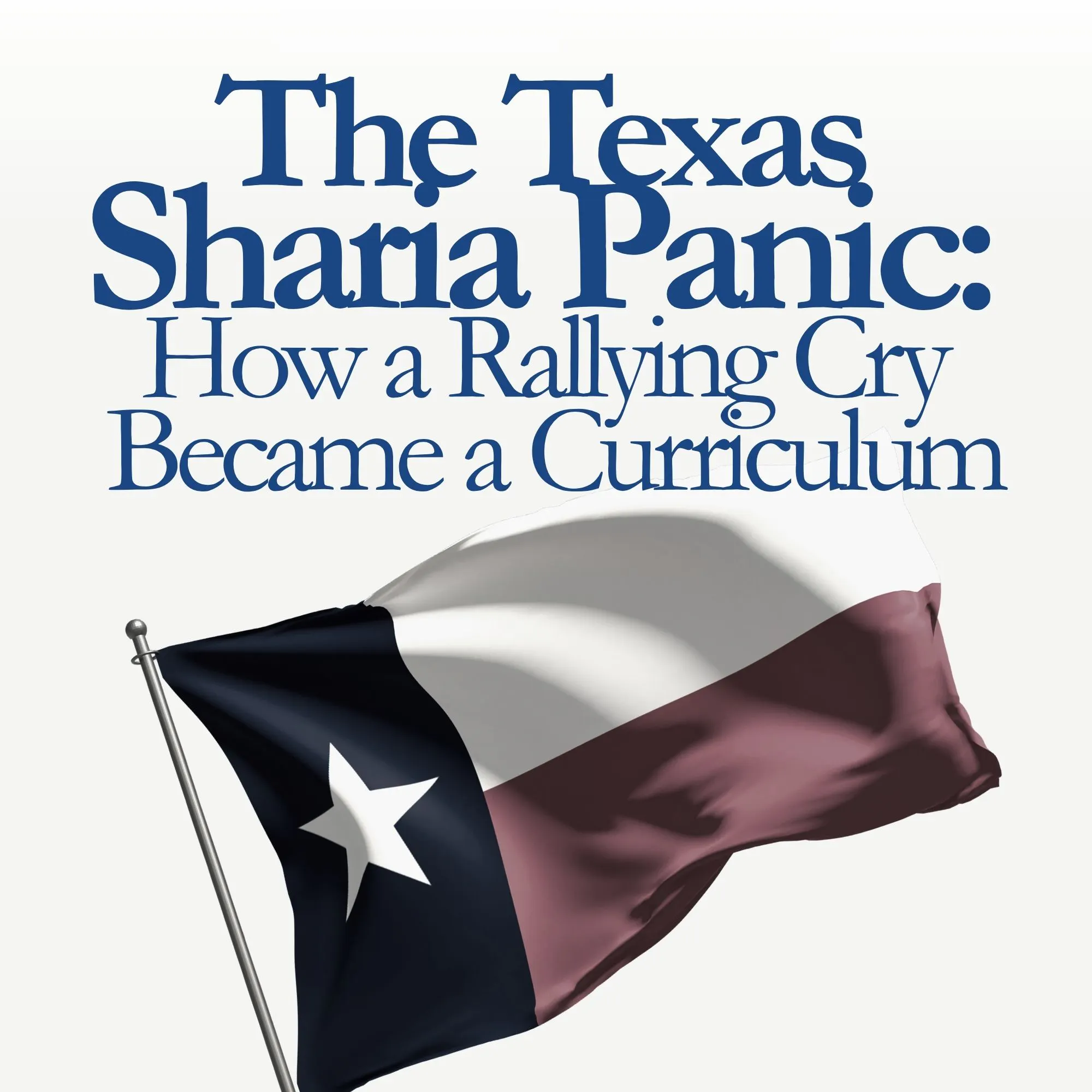
    Texas Created a Program to Fund Religious Schools. So Why Are Muslim Schools Missing?

    Muslim families in Texas are asking: does school choice include us? A Houston father went to enroll his kids in Texas's new school voucher program and discovered his school wasn't on the list — along with every other Islamic school in the state. Texas launched one of the country's largest school choice programs promising families public funds for religious private schools, but roughly a hundred Muslim schools were excluded without official explanation. State officials have posted publicly about not funding schools tied to terrorist organizations, pointing to Governor Abbott's designation of CAIR as a foreign terrorist organization — a designation the federal government has not made. Now families are suing with a March 17th deadline bearing down. Amanda Henderson talks with RNS reporter Fiona André and editor-in-chief Paul O'Donnell about the lawsuits, the communities affected, and what this moment reveals about who "school choice" was really built for. Learn more about your ad choices. Visit megaphone.fm/adchoices

  • March 11 · 22 min

    Baptizing the Battlefield: Pete Hegseth's Holy War at the Pentagon

    When the podium becomes a pulpit. At a Pentagon press briefing this week, Secretary of War Pete Hegseth closed his remarks with a reading from the Book of Psalms and ended with "Amen." Press briefings don't usually end that way. RNS reporter Jack Jenkins joins Amanda Henderson to trace how we got here — from monthly worship services in the Pentagon auditorium to biblical scripture overlaid on weapons systems to a Secretary of War who told his troops the nation needed to be "on bended knee, recognizing the providence of our Lord and Savior Jesus Christ." When the podium becomes a pulpit, what happens to everything else? That question hasn't gotten easier. 00:00 — Introduction: When the Podium Becomes a Pulpit 01:27 — The Original Episode: Setting the Scene 02:41 — The Generals' Meeting and the Warrior Ethos 05:14 — Christianity in the Military: Civil Religion vs. Hegseth's Faith 06:57 — "SecWar's Worship Service": The Pentagon Prayer Series 07:59 — Bible Verses Over Fighter Jets: The Social Media Campaign 10:15 — Recruitment, Viral Content, and Capital-B Believers 12:50 — The Theological Question: Faith as Military Doctrine 15:17 — Pushback — and Why It's Hard to Find 17:14 — Closing: The Baptism of the Military Learn more about your ad choices. Visit megaphone.fm/adchoices

Showing 1–20 of 22 episodes