Skip to content
Artwork for Clearly Conspicuous
TechnologyGovernment

Clearly Conspicuous

Holland & Knight

Clearly Conspicuous is a podcast series brought to you by Holland & Knight and hosted by consumer protection attorney Anthony DiResta. Here at Holland & Knight we have the working knowledge of how federal and state agencies operate and how courts address consumer protection issues.

Consumer protection laws and regulations impact every dimension of business. Aggressive federal and state agencies are getting the attention of senior executives who are concerned about risk management, compliance challenges and high-profile governmental inquiries. Holland & Knight's Consumer Protection Defense and Compliance Team has the experience, knowledge, relationships and platform to effectively work with our clients to address these issues.

Play
  • 22 episodes
  • Avg 10 min
  • English
Counted on this page — what you have heard stays on this device, so it is not something the list can be paged by.
  • #81
    Tuesday · 20 min

    The FTC's Personalized Pricing Policy Statement

    The best compliance strategy is not waiting for enforcement to arrive; it's preparing for it before regulators ask questions. In this episode of "Clearly Conspicuous," Anthony DiResta interviews his colleague Benjamin Genn of Holland & Knight's Consumer Protection Defense and Compliance Team about the Federal Trade Commission's (FTC) proposed personalized pricing policy statement and its potential impact on consumer-facing businesses. Mr. Genn explains the FTC's disclosure-based approach to personalized pricing (also known as surveillance pricing), outlines the deception and unfairness theories underlying the agency's enforcement framework, and distinguishes lawful dynamic pricing based on broader market conditions from the individualized pricing practices targeted by the government's proposed enforcement focus. He also highlights the practical steps companies should take now, including auditing pricing algorithms, evaluating data use disclosures and assessing risks tied to vulnerability-based pricing practices before the September 18, 2026, comment deadline.
  • #80
    August 20 · 17 min

    Surveillance Pricing vs. Dynamic Pricing: What Companies Need to Know

    The strongest defense when the government asks questions is knowing your answers beforehand. In this episode of "Clearly Conspicuous," Anthony DiResta interviews his colleague Benjamin Genn of the Firm's Consumer Protection Defense and Compliance Team about the increasing scrutiny of surveillance pricing and how it differs from lawful dynamic pricing. After explaining the distinction between these two pricing models, Mr. Genn highlights a major airline's response to a congressional inquiry regarding its use of artificial intelligence (AI) in flight pricing. When three senators demanded answers about the airline's plans to expand AI use in flight pricing, the airline addressed lawmakers' concerns by producing documentation showing its systems use aggregate demand signals rather than individualized personal data. This example underscores the importance of understanding and documenting pricing algorithms and loyalty program data flows before inquiries arise from Congress, the Federal Trade Commission (FTC) or state attorneys general.

  • #79
    August 13 · 12 min

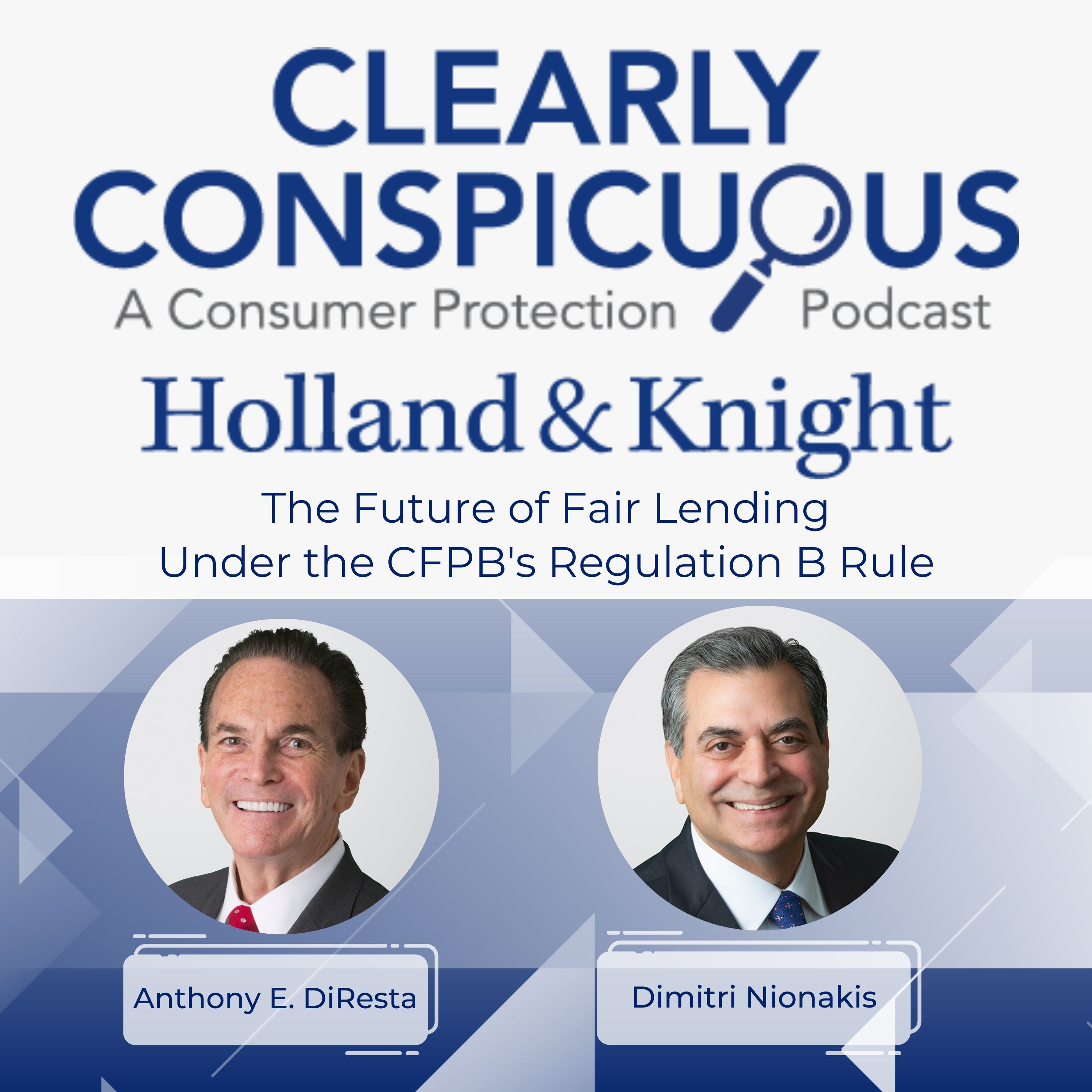
    The Future of Fair Lending Under the CFPB's Regulation B Rule

    Regulatory changes do not eliminate compliance risk. In this episode of "Clearly Conspicuous," consumer protection attorney Anthony DiResta interviews financial services regulatory attorney Dimitri Nionakis about the Consumer Financial Protection Bureau's (CFPB) final rule amending Regulation B under the Equal Credit Opportunity Act (ECOA), which pertains to disparate impact claims. Using a practical lending example, Mr. Nionakis explains how a facially neutral policy can create disparate impact concerns and emphasizes that banks and non-bank lenders still face exposure under the Fair Housing Act and state lending discrimination laws, even as the CFPB deprioritizes enforcement of Regulation B and pursuit of ECOA violators and executive orders portend broader policy priority shifts. He outlines why institutions should maintain existing compliance controls, review policies and procedures, train staff and continue auditing fair lending practices to mitigate liability potential.

  • #78
    July 16 · 16 min

    The Impact of the Supreme Court's Decision in Trump v. Slaughter

    A single Supreme Court decision can reshape the regulatory landscape overnight. In this episode of "Clearly Conspicuous," consumer protection attorney Anthony DiResta examines the U.S. Supreme Court's decision in Trump v. Slaughter, a ruling that eliminates long-standing removal protections for Federal Trade Commission (FTC) commissioners and other independent agency leaders. The decision reversed Humphrey's Executor by allowing President Donald Trump to remove former FTC Commissioner Rebecca Slaughter. Mr. DiResta outlines how this outcome may influence future federal agency activity and highlights practical steps companies should take to evaluate regulatory exposure, compliance programs and enforcement risk. He explains how the court's decision marks a fundamental shift in the relationship between the president and executive agencies, signaling a more fluid regulatory environment in which enforcement priorities, rulemaking and oversight may change more quickly than at any point in the past nine decades.

  • #77
    April 22 · 15 min

    The Core Elements of an Effective Compliance Management System

    In today's regulatory environment, one weak link in your compliance strategy can expose your business to serious legal, financial and reputational risk. In his latest podcast, consumer protection attorney Anthony DiResta delivers a clear, executive-level look at what it takes to build a compliance management system (CMS) that meets the expectations of regulators including the Federal Trade Commission, Federal Deposit Insurance Corp. and Consumer Financial Protection Bureau. He provides practical insight into the essential prongs of a CMS: board and management oversight, written policies and procedures, effective training, ongoing monitoring and audit, consumer complaint response, risk assessment and third-party oversight. With a strong emphasis on leadership, accountability and culture, this episode shows why compliance is not simply a legal obligation, but a core business function that protects the organization, strengthens decision-making and drives long-term success in the marketplace.

  • #76
    April 8 · 11 min

    The FTC and Consumer Online Transactions

    Online commerce may not be a new concept, but the laws governing it continue to evolve. In this episode of "Clearly Conspicuous," consumer protection attorney Anthony DiResta examines the history of the Federal Trade Commission's (FTC) enforcement in the e-commerce space, with a particular focus on negative option billing practices. A negative option is a billing arrangement in which silence or inaction is treated as acceptance of an offer. The FTC drafted a formal amendment to the Negative Option Rule, but it was struck down in July 2025. Despite that setback, the agency has continued to pursue enforcement actions involving false advertising, failure to disclose membership enrollment terms and unnecessarily difficult cancellation processes, all while signaling plans to revisit the rulemaking process. The agency has also emphasized that any platform providing enrollment options must also provide cancellation options that are equally easy to access and use. Mr. DiResta advises that consumers who wish to report fraud, scams or deceptive business practices can do so at reportfraud.ftc.gov.

  • #75
    February 25 · 8 min

    Where the FTC Stands on AI: Evidence Over Speculation

    As artificial intelligence (AI) becomes embedded in daily life, the Federal Trade Commission (FTC) has signaled it has no immediate plans to implement AI-specific rules. In this episode, consumer protection attorney Anthony DiResta analyzes recent statements by FTC Bureau of Consumer Protection Director Chris Mufarrige and compares the agency's current enforcement outlook with past regulatory actions. According to Mr. DiResta, the FTC appears focused on targeting bad actors, rather than the technology they are using, and avoiding the pursuit of rules that could slow AI industry growth. That shift is evident in the commission's case against AI writing assistant Rytr, which alleged review generation abuses but was set aside for lack of evidence of actual consumer harm. The outcome aligns with the White House AI Action Plan's emphasis on avoiding regulatory overreach. Overall, Mr. DiResta concludes, AI use that misleads consumers or violates existing laws will still draw federal scrutiny, but the FTC is signaling a more supportive posture toward technological innovation.

  • #74
    February 18 · 8 min

    FTC Consumer Review Rule Warning Letters Target a Digital Marketplace Cornerstone

    Online reviews are critical to developing consumer trust, and the Federal Trade Commission (FTC) has signaled it's ready to track down anyone trying to manipulate such reviews. Consumer protection attorney Anthony DiResta breaks down the FTC's latest warning letters targeting potential violations of the consumer review rule, an enforcement move that puts online reviews and testimonials at the center of attention. This episode also explains what the rule covers, from fake "verified" experiences and undisclosed insider reviews to incentivized ratings and suppression of negative feedback, and why the FTC is now shifting from education to action. With civil penalties up to $50,000 per violation and industries spanning e-commerce, hospitality, beauty, wellness and technology potentially exposed, Mr. DiResta recommends businesses and their advisors take proactive compliance steps now to avoid regulatory scrutiny later. This conversation is a timely road map for companies as they audit current marketing practices and tighten incentive programs to protect consumer trust and avert formal investigations or lawsuits.

  • #73
    January 21 · 12 min

    Social Media Advertising and the FTC: Deception and the Architecture of Compliance

    In this episode of "Clearly Conspicuous," consumer protection attorney Anthony DiResta breaks down why social media advertising has become a top Federal Trade Commission (FTC) priority for 2026 and how long‑standing consumer protection rules against deception and unfairness apply to today's influencer-heavy and algorithm-driven marketing. He explains how brands use social platforms to leverage trust, reduce consumer resistance to ads and benefit from algorithmic amplification while increasing legal risk when sponsorships aren't clearly disclosed or when responsibility is spread across brands, creators, agencies and platforms. Mr. DiResta also outlines the FTC's expectations for businesses utilizing online advertising, as put forth in its Endorsement Guides. He concludes by highlighting why companies must have a real social media compliance program with policies, training, monitoring and corrective action going into 2026.

  • #72
    January 7 · 6 min

    Key Consumer Protection Issues in 2026

    In this episode of "Clearly Conspicuous," consumer protection attorney Anthony DiResta previews the top Federal Trade Commission (FTC) and state attorney general enforcement priorities for 2026, stressing a shift from one-off misrepresentations to systematic enforcement focused on governance, design and individual accountability. He highlights key risk areas including privacy and data security, social media advertising, online consumer transactions and artificial intelligence. Overall, he says, companies should expect regulators to judge less what business say and more how their systems operate.

  • #71
    Nov 19, 2025 · 9 min

    The FTC's Interest in Governance Matters: Board Oversight, Compliance and Awareness

    In this episode of "Clearly Conspicuous," consumer protection attorney Anthony DiResta examines why board governance is under the Federal Trade Commission's (FTC) microscope and what directors must do to meet agency expectations. He begins by categorizing the main themes of regulatory focus: data security, antitrust and board composition, compliance and risk governance, and the emergence of artificial intelligence (AI) and algorithmic accountability. He then offers practical steps such as building regulatory literacy, establishing measurable risk reporting, structuring effective governance committees, testing resources and programs, documenting oversight in minutes and embedding ethics into culture—along with a checklist of specific governance risks to monitor.

  • #70
    Nov 5, 2025 · 8 min

    The Digital Marketplace: The FTC's Focus on Fair Online Transactions

    In this episode of "Clearly Conspicuous," consumer protection attorney Anthony DiResta provides an update on Federal Trade Commission (FTC) actions in the digital commerce space. Mr. DiResta discusses the FTC's core concerns with online transactions, including unclear or deceptive terms and conditions, insufficient privacy protections and failure to comply with the "Click to Cancel" rule. He then outlines a best practices framework for companies seeking to ensure compliance and build consumer trust. His final takeaway: Online commerce must be transparent, be fair and be consumer-centric.

  • #69
    Oct 8, 2025 · 13 min

    The Future of the FTC: in the Hands of the Supreme Court

    In this episode of "Clearly Conspicuous," consumer protection attorney Anthony DiResta unpacks a recent update in Trump v. Slaughter, in which the U.S. Supreme Court issued a stay allowing President Donald Trump's removal of Federal Trade Commission (FTC) Commissioner Rebecca Slaughter to stand while the case makes its way through the appeals process. He previews full arguments in December of this year that could revisit – and even overturn – Humphrey's Executor. Mr. DiResta explains the FTC's origins, structure and independence, as well as the 1935 precedent set in Humphrey's Executor limiting presidential removal of FTC commissioners. He additionally reviews Justice Elena Kagan's dissent in the court's order and analyzes how the move signals a potential recalibration of separation of powers. The episode outlines far-reaching implications if removal protections are narrowed: greater presidential control over independent agencies (FTC, National Labor Relations Board (NLRB), Federal Communications Commission (FCC), Consumer Product Safety Commission (CPSC) and Merit Systems Protection Board (MSPB)), reduced institutional independence, more litigation over "for cause" standards and broader precedent shifts affecting agency governance. The discussion closes with key questions for businesses and counsel to monitor as the future of the FTC, and independent commissions more broadly, may be shaped by the court's forthcoming decision.

  • #68
    Sep 17, 2025 · 11 min

    A Roadmap for Emerging Consumer Protection Issues

    In this episode of "Clearly Conspicuous," consumer protection attorney Anthony DiResta covers the emerging issues driving federal and state enforcement and private litigation. He highlights six themes shaping priorities: artificial intelligence (AI) and automation, advertising and marketing practices, privacy and data security, unfair and abusive practices, sector-specific scrutiny of financial services, health and environmental claims, and escalating coordination among enforcers. Mr. DiResta explains how agencies are intensifying oversight of AI transparency and bias, influencer and native advertising disclosures, data collection and breach response, "dark patterns," hidden fees and products targeting vulnerable consumers. He then describes practical steps to help mitigate unwanted attention from the government, from AI audits and human oversight to substantiation, social media policies, incident response plans and consumer-centric design. He concludes by highlighting how important it is to build trust through first instance compliance to reduce risk and position your business to thrive in a dynamic enforcement landscape.

  • #67
    Sep 3, 2025 · 8 min

    Consumer Protection Investigations: What You Should Do

    In this episode of "Clearly Conspicuous," consumer protection attorney Anthony DiResta discusses strategies and techniques for defending an investigation by a federal or state consumer protection agency in the current political landscape. He breaks the process into five phases: 1. understanding the landscape 2. discovery and information gathering 3. communication and relationship building 4. controlling the narrative 5. strategic resolution Mr. DiResta emphasizes the importance of strategy, credibility and advocacy throughout the process, as well as securing counsel who will protect your interests while building rapport with government staff.

  • #66
    Aug 20, 2025 · 9 min

    Tracking Trends in State-Level Consumer Protection Enforcement

    In this episode of "Clearly Conspicuous," consumer protection attorney Anthony DiResta reviews recent trends in state-level consumer protection enforcement. He highlights notable actions by state attorneys general (AGs) across the U.S., from Florida's investigations into Roblox and Google's advertising practices, to multistate efforts against illegal electronic cigarettes, multimillion-dollar settlements in Illinois and California, and New Hampshire's lawsuit against Meta for addictive design features that allegedly harm teens. The discussion underscores how states are actively policing deceptive marketing, false advertising and emerging digital issues, often filling gaps left by waning federal enforcement. With investigations intensifying and priorities varying by state, businesses are advised to maintain high compliance standards and pursue transparent, ethical marketing to avoid legal risks and foster consumer trust in an evolving regulatory landscape.

  • #65
    Aug 6, 2025 · 9 min

    An Overview of State Attorney General Consumer Protection Enforcement

    In this episode of "Clearly Conspicuous," consumer protection attorney Anthony DiResta discusses recent actions taken by state attorneys general (AGs) in the enforcement of consumer protection laws and regulations. His overview covers enforcement actions regarding deceptive advertising and fees in industries including Big Tech, social media, health and consumer products. Mr. DiResta reminds his listeners that state-level protection laws help provide a foundation for regulatory oversight, despite the shifts in federal enforcement priorities that can occur during the transition to new political administrations, meaning companies still need to stay aware of changes in compliance requirements that may affect their operations.

  • #64
    Jul 23, 2025 · 7 min

    Tips for Maintaining FTC Compliance When Using AI

    In this episode of "Clearly Conspicuous," consumer protection attorney Anthony DiResta shares best practices for compliance with Federal Trade Commission (FTC) rules and regulations when using artificial intelligence (AI). Mr. DiResta's discussion outlines eight essential pillars for effective compliance management: governance, substantiated marketing, transparency, data integrity, security, staff training, continuous monitoring and special precautions for high-risk AI uses. He emphasizes the importance of truth in advertising, informed consent, ethical data handling and ongoing vigilance in adapting to regulatory changes when companies advertise or promote their AI services or products.

  • #63
    Jul 9, 2025 · 9 min

    Legal Implications of the Supreme Court's Ruling on Universal Injunctions

    In this episode of "Clearly Conspicuous," consumer protection attorney Anthony DiResta discusses the recent U.S. Supreme Court decision in Trump v. CASA, Inc., where the court ruled federal district courts generally cannot issue universal injunctions under the Judiciary Act of 1789. The decision, delivered on June 27, 2025, means that district courts can only grant injunctions that provide relief to plaintiffs with standing, not to those who are not parties to the case. Mr. DiResta examines possible significant implications for businesses and individuals subject to federal statutes or executive actions, as well as the other avenues that remain available for obtaining broad relief.

  • #62
    Jun 25, 2025 · 7 min

    FTC to Focus on Deceptive AI Claims: Compliance Management Strategies

    In this episode of "Clearly Conspicuous," consumer protection attorney Anthony DiResta explores the Federal Trade Commission's (FTC) increasing scrutiny of deceptive claims related to artificial intelligence (AI). He outlines the FTC's focus on exaggerated performance claims, misleading product labeling, opaque data practices and bias in AI-powered systems, highlighting recent enforcement actions for false or misleading representations. Mr. DiResta emphasizes that businesses must ensure their AI-related claims are accurate, transparent and comply with existing consumer protection regulations.

Showing 1–20 of 22 episodes