Skip to content
Artwork for China In Context
NewsNews CommentaryPoliticsEducation

China In Context

SOAS China Institute

China In Context is a fortnightly podcast by the SOAS China Institute (School of Oriental and African Studies, University of London) which offers expert analysis on the politics, economy, society, culture and history of China, Hong Kong, Macau and Taiwan. It features interviews with leading academics, researchers, journalists and other China-specialists from around the world.

Play
  • 20 episodes
  • fortnightly
  • Avg 40 min
  • English
  • S6 · E11
    July 15 · 44 min

    Europe’s New ‘China Shock’ — Trade tensions, job losses, crisis talks

    Despite decades of rapid Chinese growth, it’s over the past year that European politicians have begun to talk of facing what’s been dubbed the ‘China Shock 2.0’ — as surging Chinese exports and the impact of higher technology Chinese growth increasingly affect the heartlands of European industry — particularly German car and machinery manufacturing. Germany’s industrial output has fallen around 10% since 2022, and the country is estimated to be shedding some 10,000 industrial jobs every month; Volkswagen has just outlined up to 100,000 possible job cuts. Much of the blame has been placed on Chinese overcapacity, and what Europe sees as unfair subsidies and an overvalued Chinese yuan. And amid fears that job losses could further boost the rise of the far right in European politics, there have been calls for new import restrictions and higher tariffs on Chinese imports to Europe. The European Union and China have just begun three months of trade talks in an attempt to find a solution — but will Europe dare to take tough action in the face of China’s stranglehold on sectors like rare earths and legacy chips — and is China prepared to compromise? Joerg Wuttke of the consultancy DGA Albright Stonebridge Group, for many years president of the European Union Chamber of Commerce in China, and former Vice President for China at the German chemicals giant BASF, discusses the roots of the crisis and the chances of finding a solution. Image © European Union, 2025 / CC BY 4.0 For information about the SOAS China Institute Corporate Membership scheme, please contact SCI director Steve Tsang: steve.tsang@soas.ac.uk ________________________________________ The views and opinions expressed on this podcast are those of the speakers and are not necessarily those of the SOAS China Institute. ________________________________________ SOAS China Institute (SCI) SCI Blog SCI on X SCI on LinkedIn SCI on Facebook SCI on Instagram ________________________________________ Music credit: Sappheiros / CC BY 3.0

  • S6 · E210
    July 2 · 41 min

    Family and Relationship Trends in China — Across generations, across the urban-rural divide

    There’s been much talk recently about China’s demographic challenges: a fast-ageing population, a fall in the number of marriages, and record low birth rates - despite the relaxation of the One Child Policy ten years ago - as well as a rise in divorce rates over the past two decades. So what is going on in Chinese families and relationships? One person who studies this in great depth is Liu Jieyu, professor of sociology and China Studies at SOAS, and co-editor of the journal the China Quarterly, whose new book, Embedded Generations — Family Life and Social Change in Contemporary China, features interviews with more than 200 people from three generations — from those born in the 1930s and 40s to those born in the 1990s and beyond. Based on her fieldwork in villages in three provinces, and three cities from northern to southern China, it focuses on her interviewees’ experiences of childhood, relationships, sex and marriage, grandparenting and ageing. And it challenges traditional sociological attitudes to the impact of modernization and individualisation on Chinese society, highlighting some unexpected continuities and reinventions of tradition. Professor Liu joins us to discuss her findings. Image © PRPicturesProduction / Adobe Stock For information about the SOAS China Institute Corporate Membership scheme, please contact SCI director Steve Tsang: steve.tsang@soas.ac.uk ________________________________________ The views and opinions expressed on this podcast are those of the speakers and are not necessarily those of the SOAS China Institute. ________________________________________ SOAS China Institute (SCI) SCI Blog SCI on X SCI on LinkedIn SCI on Facebook SCI on Instagram ________________________________________ Music credit: Sappheiros / CC BY 3.0

  • S6 · E209
    June 17 · 39 min

    World Cup Dreams and Own Goals — Football in China

    Despite the extra places on offer at this year’s expanded FIFA World Cup Finals, the Chinese men’s soccer team once again failed to qualify, continuing a series of disappointments dating back to 2002, when China made its only appearance at the tournament after extra slots were freed up by the host nations, Japan and South Korea, qualifying automatically. Over the past two decades vast sums have been poured into the Chinese Super League, which for a while attracted many foreign stars and managers. And President Xi Jinping has spoken of his dream that the country would host and one day win the World Cup. Yet despite his launch of a major football reform plan in 2015, Chinese soccer is again in disarray — two leading clubs have gone bankrupt, while nine of the country’s top teams were recently docked points, in a corruption scandal that led to the jailing of senior football association officials, club administrators, and even the former national team boss Li Tie. And Chinese state TV only reached a deal to show this year’s World Cup just a month before the competition began. So are China’s traditionally passionate football fans falling out of love with the game? Rowan Simons, author of the book Bamboo Goalposts, and chairman and founder of Club Football Beijing, which trains young players and runs a youth league in the Chinese capital, joins us to discuss the state of Chinese soccer, and whether the country’s World Cup dream might ever become a reality. Image © safat / Adobe Stock For information about the SOAS China Institute Corporate Membership scheme, please contact SCI director Steve Tsang: steve.tsang@soas.ac.uk ________________________________________ The views and opinions expressed on this podcast are those of the speakers and are not necessarily those of the SOAS China Institute. ________________________________________ SOAS China Institute (SCI) SCI Blog SCI on X SCI on LinkedIn SCI on Facebook SCI on Instagram ________________________________________ Music credit: Sappheiros / CC BY 3.0

  • S6 · E208
    May 21 · 42 min

    Did China trump Trump? — After the Beijing summit

    Donald Trump's visit to Beijing, the first by a US president in nine years, not only included plenty of pageantry, but produced some apparently substantive agreements. Aside from China resuming purchases of Boeing planes, beef and soybeans from the US, the two countries agreed to set up boards of trade and investment, and pledged to establish a 'constructive relationship of strategic stability'. And Xi Jinping will visit the US in September. But will this really ease recent trade and political tensions? Melinda Liu, veteran Beijing bureau chief of Newsweek magazine, and Professor Steve Tsang, director of the SOAS China Institute and co-author of 'The Political Thought of Xi Jinping', discuss who got the most out of a summit described by President Trump as 'very successful' and by President Xi as ‘historic’. Photo credit: Daniel Torok / White House For information about the SOAS China Institute Corporate Membership scheme, please contact SCI director Steve Tsang: steve.tsang@soas.ac.uk ________________________________________ The views and opinions expressed on this podcast are those of the speakers and are not necessarily those of the SOAS China Institute. ________________________________________ SOAS China Institute (SCI) SCI Blog SCI on X SCI on LinkedIn SCI on Facebook SCI on Instagram ________________________________________ Music credit: Sappheiros / CC BY 3.0

  • S6 · E207
    May 6 · 35 min

    China's Middle East Balancing Act — Peace plans, pragmatism and economic prospects

    The war in the Middle East has affected China in many ways: as well as targeting Iran, a country with which Beijing has a comprehensive strategic partnership, it has disrupted exports, rattled consumer confidence, and forced the Chinese government to step in to protect consumers from the worst of rising petrol prices. Yet some believe Beijing may benefit from the damage to US global credibility, and China has sought to highlight its role as a responsible diplomatic player, proposing a joint peace plan with Pakistan, and holding talks with Gulf leaders and Iranian officials. And China may also benefit from fresh opportunities, as Gulf countries, with which it has fast growing economic ties, seek to build new port and railway infrastructure to bypass the Strait of Hormuz. Yet Beijing’s veto of a Bahraini resolution, opposed by Iran, to guarantee safety of navigation in the Strait at the UN in April was a reminder of the fine line it has to tread in maintaining relations with both the Gulf states and Iran, 90 percent of whose oil sales go to China. Jonathan Fulton, professor of international relations at Zayed University in Abu Dhabi, editor of the China MENA (Middle East and North Africa) Newsletter, and senior fellow at the Atlantic Council, joins us to assess how recent events in the region will affect China in the longer term. Image © Ruma / Adobe Stock For information about the SOAS China Institute Corporate Membership scheme, please contact SCI director Steve Tsang: steve.tsang@soas.ac.uk ________________________________________ The views and opinions expressed on this podcast are those of the speakers and are not necessarily those of the SOAS China Institute. ________________________________________ SOAS China Institute (SCI) SCI Blog SCI on X SCI on LinkedIn SCI on Facebook SCI on Instagram ________________________________________ Music credit: Sappheiros / CC BY 3.0

  • S6 · E206
    April 1 · 44 min

    China's International Ambitions — A Global Opposition Party?

    The presidency of Donald Trump has given China fresh opportunities to increase its influence on the international stage. China has long been seeking to expand its role in global governance, proposing initiatives on issues ranging from development and security to the regulation of the internet and AI. It’s also founded the Asian Infrastructure Investment Bank and is a prime mover in groups including the BRICS and the Shanghai Cooperation Organisation. At the recent annual China Development Forum, its premier Li Qiang told an audience of international executives that China was a ‘haven of stability’ in a volatile world. And Beijing, along with Pakistan, has now proposed a peace plan for Iran and the Middle East. Yet China also continues to assert what it sees as its core interests on issues including Taiwan, Hong Kong and the South China Sea, and in its tariff clashes with the US. And many observers have argued that China’s rise makes a conflict with the United States almost inevitable — in line with concepts such as power transition theory and the Thucydides trap. But a new article by two academics proposes an alternative analysis of China’s international role — as the leader of a ‘global opposition campaign’. Its co-authors, Todd Hall, professor of international relations and director of the China Centre at Oxford University and author of the book ‘Emotional Diplomacy - Official Emotion on the International Stage’, and Hannah Bailey, assistant professor at Carnegie Mellon University and a specialist on Chinese global influence campaigns, join us to discuss China’s global ambitions, and the tensions between what they describe as the nation’s overlapping and sometimes contradictory personas. Photo credit: kremlin.ru / CC BY 4.0 For information about the SOAS China Institute Corporate Membership scheme, please contact SCI director Steve Tsang: steve.tsang@soas.ac.uk ________________________________________ The views and opinions expressed on this podcast are those of the speakers and are not necessarily those of the SOAS China Institute. ________________________________________ SOAS China Institute (SCI) SCI Blog SCI on X SCI on LinkedIn SCI on Facebook SCI on Instagram ________________________________________ Music credit: Sappheiros / CC BY 3.0

  • S6 · E205
    March 18 · 40 min

    Slower Growth, Hi-tech Self-reliance, and 'Ethnic Unity' — China plans the future

    China's legislature this month set the nation's GDP growth target at 4.5 – 5%, the lowest since 1991, and also approved the country's new five year plan, which calls for higher quality growth with an emphasis on self-reliance and technological innovation, and pledges to promote domestic consumption and improve citizens' livelihoods. The National People’s Congress also passed a new 'Law on Promoting Ethnic Unity', which among other things, enshrines the use of Mandarin in schools in ethnic minority-dominated regions. In this episode, Evelyn Cheng, senior correspondent for CNBC in Beijing, joins us to assess China’s economic plans, while Christopher Mittelstaedt, Professor of Chinese politics at the University of Zurich, analyses the political implications of the Five Year Plan and the ethnic unity law. Photo credit: Gary Lee Todd / CC0 1.0 For information about the SOAS China Institute Corporate Membership scheme, please contact SCI director Steve Tsang: steve.tsang@soas.ac.uk ________________________________________ The views and opinions expressed on this podcast are those of the speakers and are not necessarily those of the SOAS China Institute. ________________________________________ SOAS China Institute (SCI) SCI Blog SCI on X SCI on LinkedIn SCI on Facebook SCI on Instagram ________________________________________ Music credit: Sappheiros / CC BY 3.0

  • S6 · E204
    March 3 · 43 min

    China's Economic Plans — and Consumer Challenges

    China’s legislature is meeting in March to approve the nation’s new Five Year Plan, which aims to promote higher quality growth, and make China increasingly self-sufficient in new technology of all kinds, from AI to semiconductors. Yet it comes against a backdrop of uncertainty and tariff wars abroad, and high youth unemployment and a slumping property market at home. Xi Jinping has pinned his hopes on boosting domestic consumption and has pledged to promote the private economy, which he had previously hit with a major regulatory crackdown. But will this be enough to stimulate the kind of economic revival the government is hoping for? Andy Rothman, founder of the consultancy Sinology LLC, former China-based analyst and diplomat, and now senior advisor to the DGA Albright Stonebridge Group and senior China fellow at the Asia Society Northern California, discusses China’s economic prospects — and the challenges for consumer confidence and private enterprise. Photo credit: Yu Ko / Unsplash For information about the SOAS China Institute Corporate Membership scheme, please contact SCI director Steve Tsang: steve.tsang@soas.ac.uk ________________________________________ The views and opinions expressed on this podcast are those of the speakers and are not necessarily those of the SOAS China Institute. ________________________________________ SOAS China Institute (SCI) SCI Blog SCI on X SCI on LinkedIn SCI on Facebook SCI on Instagram ________________________________________ Music credit: Sappheiros / CC BY 3.0

  • S6 · E203
    February 17 · 45 min

    Xi Jinping and his Father — Power, purges, parenting

    The run-up to the lunar year has been a busy one for China’s President Xi Jinping, with world leaders beating a path to Beijing to meet him; he also found time to purge two of the Chinese military’s top generals, while the outspoken Hong Kong newspaper publisher and democracy advocate Jimmy Lai was jailed for 20 years. And with the erratic trade and foreign policy of the US currently boosting Beijing’s global influence, the 72 year-old leader could be said to be at the height of his powers. Yet even after more than a decade in charge of China, to many people outside the country he remains something of an enigma, rarely speaking to international media. Professor Joseph Torigian, a specialist on Chinese politics at American University in Washington DC, offers an unusual insight into Xi Jinping’s backstory in his new book, The Party’s Interests Come First, a biography of the Chinese president’s father, Xi Zhongxun (1913-2002), who was himself a senior party official, but was purged from the leadership by Chairman Mao and jailed in the 1960s and 70s, before returning to pioneer economic reforms in southern China. In this episode, Joseph Torigian looks at how his father’s experiences may — or in some cases may not — have influenced Xi Jinping’s life and politics. Photo credit: Tatarstan.ru / CC BY 4.0 For information about the SOAS China Institute Corporate Membership scheme, please contact SCI director Steve Tsang: steve.tsang@soas.ac.uk ________________________________________ The views and opinions expressed on this podcast are those of the speakers and are not necessarily those of the SOAS China Institute. ________________________________________ SOAS China Institute (SCI) SCI Blog SCI on X SCI on LinkedIn SCI on Facebook SCI on Instagram ________________________________________ Music credit: Sappheiros / CC BY 3.0

    • Chapters
  • S6 · E202
    February 3 · 41 min

    China and Britain — Thawing ties, underlying tensions

    Sir Keir Starmer described his recent trip to China as a chance to end the ‘ice age’ in the two countries’ ties and build a more ‘sophisticated’ relationship. But despite the announcement of visa free-travel to China for British visitors, and the lifting of sanctions on six British MPs and peers, Starmer has been criticised by political opponents for failing to secure the release of publisher and British citizen Jimmy Lai, recently found guilty of sedition and national security offences in Hong Kong. This follows controversy over the approval of China’s new embassy in the City of London, and concerns about alleged Chinese espionage and the potential security risks of Chinese technology. Professor Steve Tsang, director of the SOAS China Institute, and Jonathan Fenby, former editor of the Observer newspaper and Hong Kong’s South China Morning Post, and author of The Penguin History of Modern China, discuss where Britain stands in its relations with an increasingly powerful China — and the significance of President Xi Jinping’s assertion that when it comes to his country, the UK needs to ‘see the entire elephant’. Photo credit: Simon Dawson / No 10 Downing Street For information about the SOAS China Institute Corporate Membership scheme, please contact SCI director Steve Tsang: steve.tsang@soas.ac.uk ________________________________________ The views and opinions expressed on this podcast are those of the speakers and are not necessarily those of the SOAS China Institute. ________________________________________ SOAS China Institute (SCI) SCI Blog SCI on X SCI on LinkedIn SCI on Facebook SCI on Instagram ________________________________________ Music credit: Sappheiros / CC BY 3.0

    • Chapters
  • S5 · E201
    Dec 17, 2025 · 42 min

    Mistress Dispellers and Shanghai Girls — Two female film-makers on love, marriage and divorce in China

    In this episode we look at love, marriage and divorce in contemporary China, from the perspective of two female filmmakers. These are topics with a political as well as personal significance — the Chinese government is keen to boost the birth rate to tackle the problem of an ageing population, but the marriage rate has fallen sharply, while the divorce rate has grown significantly over recent decades. Elizabeth Lo’s remarkable new film Mistress Dispeller looks at a growing industry in China — people you can hire to intervene if your spouse is having an affair, and who promise to help save your marriage. Luo Tong’s documentary Shanghai Girls, meanwhile, is an intimate depiction of the experiences of a group of women in their early fifties, and their lives and loves over the past thirty years. They join us to discuss changing attitudes to relationships in China. Photo credit: Ariela Ortiz-Barrantes / CC BY-SA 4.0 For information about the SOAS China Institute Corporate Membership scheme, please contact SCI director Steve Tsang: steve.tsang@soas.ac.uk ________________________________________ The views and opinions expressed on this podcast are those of the speakers and are not necessarily those of the SOAS China Institute. ________________________________________ SOAS China Institute (SCI) SCI Blog SCI on X SCI on LinkedIn SCI on Facebook SCI on Instagram ________________________________________ Music credit: Sappheiros / CC BY 3.0
    • Chapters
  • S5 · E200
    Dec 1, 2025 · 43 min

    Japan-China Tensions — Taiwan, Tourism, Migration

    Relations between China and Japan — never smooth, given the legacy of Japan's invasion of China in the 1930s — are currently at their tensest in years. This follows the new Japanese Prime Minister Sanae Takaichi's remarks in Japan's parliament last month that if China were to use military force against Taiwan — which Beijing claims as part of its territory — Japan would view this as a threat to its survival, and could deploy its own military in response. China has denounced Ms Takaichi's comments as crossing a red line, and warned that they hint at a revival of militarism in Japan. It has warned its citizens against travelling to Japan, leading to mass cancellations of bookings and flights; concerts by Japanese pop stars and screenings of Japanese films in China have also been cancelled, and seafood imports halted. The tension comes amidst rising Japanese nationalist sentiment, much of it directed at a recent influx of immigrants, including, by some estimates, more than a hundred thousand middle class migrants from China. Rupert Wingfield Hayes, for more than two decades a BBC correspondent in first Beijing, then Tokyo, and most recently Taiwan, joins us to discuss the significance of these developments, and the historical resonances that lie behind them. Photo credit: Official Website of the Prime Minister’s Office of Japan For information about the SOAS China Institute Corporate Membership scheme, please contact SCI director Steve Tsang: steve.tsang@soas.ac.uk ________________________________________ The views and opinions expressed on this podcast are those of the speakers and are not necessarily those of the SOAS China Institute. ________________________________________ SOAS China Institute (SCI) SCI Blog SCI on X SCI on LinkedIn SCI on Facebook SCI on Instagram ________________________________________ Music credit: Sappheiros / CC BY 3.0

  • S5 · E199
    Nov 14, 2025 · 17 min

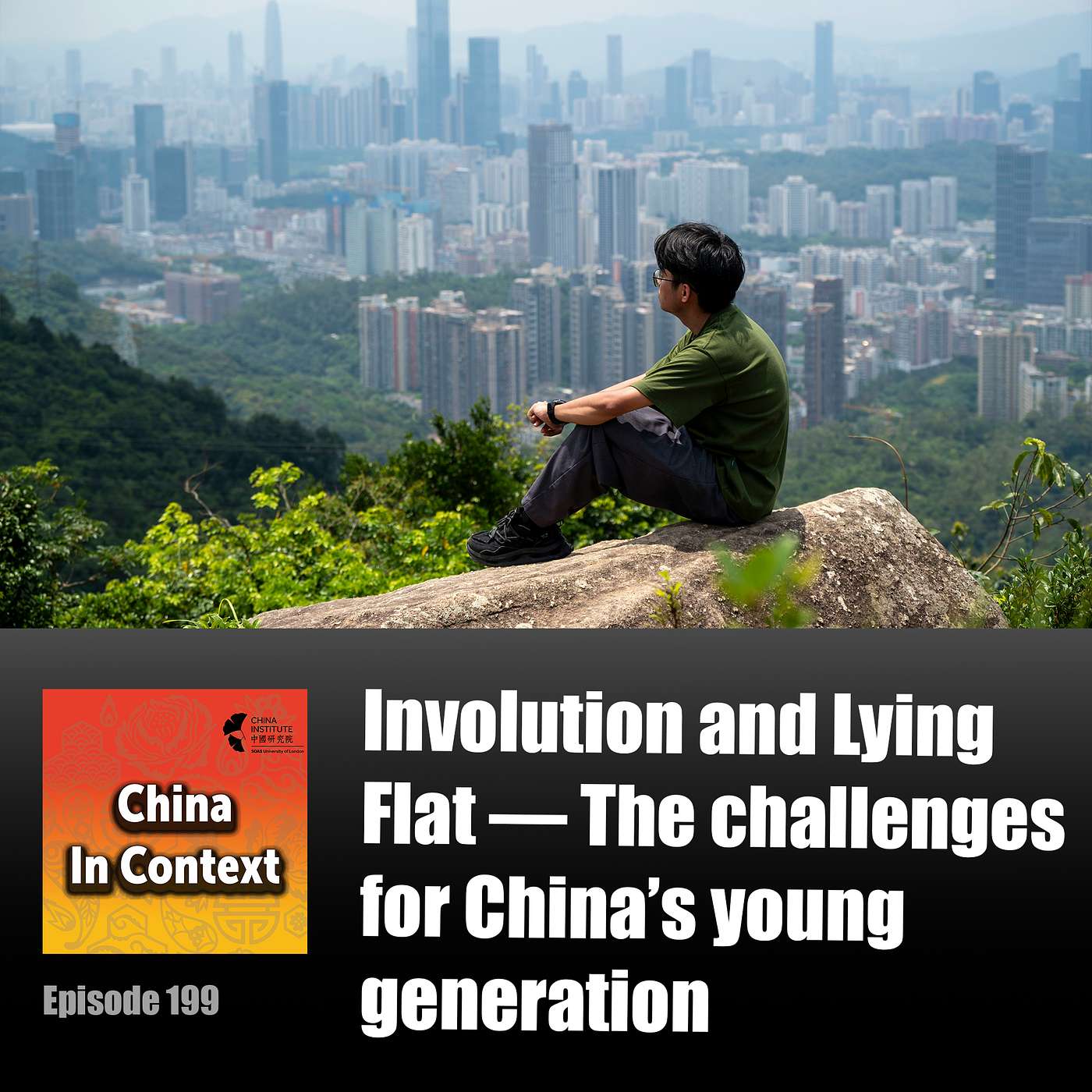
    Involution and Lying Flat — The challenges for China’s young generation

    While young people around the world face growing difficulties finding work and coping with the cost-of-living crisis, the situation confronting China’s youth seems particularly acute. Years of pandemic disruption, economic slowdown and mounting social pressure have created a sense of fatigue and frustration for many. This has given rise to a new language of despair and dark humour. ‘Nei Juan’ (内卷) — or ‘involution’ — describes the exhausting, endless competition where everyone works harder yet gains less, a race to the bottom with no finish line. In contrast, ‘Tang Ping’ (躺平), or ‘lying flat’, signals quiet resistance: choosing to step back, do less, and let go of society’s impossible expectations. But is this realistic in a country with a limited social welfare safety net? Guest host Howard Zhang speaks with Dr Yuan Zhong from SOAS about her recent research in China, exploring what these buzzwords reveal about a generation under strain — and the country’s future. Photo credit: leoon liang / Unsplash For information about the SOAS China Institute Corporate Membership scheme, please contact SCI director Steve Tsang: steve.tsang@soas.ac.uk ________________________________________ The views and opinions expressed on this podcast are those of the speakers and are not necessarily those of the SOAS China Institute. ________________________________________ SOAS China Institute (SCI) SCI Blog SCI on X SCI on LinkedIn SCI on Facebook SCI on Instagram ________________________________________ Music credit: Sappheiros / CC BY 3.0

  • S5 · E198
    Nov 3, 2025 · 30 min

    Trade War Truce — and a Five Year Plan

    China and the US reached a truce in their trade war at the recent meeting between Donald Trump and Xi Jinping in South Korea. And the two leaders even pledged to visit each other’s countries next year. But US tariffs on Chinese imports remain at around 47% — and a dispute over the export of US semiconductor chips to China looks set to continue. These tensions seem to have informed the Communist Party’s newly released proposals for China’s next Five Year Plan, which focus on innovation and making China technologically self-sufficient. But will this approach, along with promises to boost the private economy, help to tackle unemployment and sluggish domestic consumer spending? Minxin Pei, professor of government at Claremont McKenna College in California, and editor of the website China Leadership Monitor, discusses the prospects for Sino-US relations and the challenges facing China’s leaders. Photo credit: Daniel Torok / White House For information about the SOAS China Institute Corporate Membership scheme, please contact SCI director Steve Tsang: steve.tsang@soas.ac.uk ________________________________________ The views and opinions expressed on this podcast are those of the speakers and are not necessarily those of the SOAS China Institute. ________________________________________ SOAS China Institute (SCI) SCI Blog SCI on X SCI on LinkedIn SCI on Facebook SCI on Instagram ________________________________________ Music credit: Sappheiros / CC BY 3.0

  • S5 · E197
    Oct 16, 2025 · 45 min

    Translating China — Prizes, pressures and prospects for Chinese literature today

    The inaugural US-based Baifang Schell Book Prize for Chinese language fiction in English translation was recently awarded to the Taiwanese writer Yang Shuang-zi’s novel 'Taiwan Travelogue'. And with an ever-growing number of Chinese to English translators, and a well-resourced mainland Chinese publishing industry keen to expand globally, this could seem like a significant moment for Chinese writing. But with continuing censorship in China, and the rising popularity of often throwaway internet writing, can mainland Chinese fiction remain relevant and viable, and tackle important contemporary and historical themes? And with heightened tensions between China and the West in the last few years, is there still the same international interest from readers and publishers? Leading translators Jeremy Tiang, himself a published novelist and playwright, and Nicky Harman, founding member of the Chinese literature website Paper Republic, discuss the pressures and prospects for Chinese literature, while Daniel Li of UK-based publisher Sinoist Books reflects on the challenges of navigating between the Chinese and western publishing industries. Books referred to in the discussion: Taiwan Travelogue by Yang Shuang-zi Delicious Hunger by Hai Fan Diablo’s Boys by Yang Hao Old Kiln by Jia Pingwa Cocoon by Zhang Yueran For information about the SOAS China Institute Corporate Membership scheme, please contact SCI director Steve Tsang: steve.tsang@soas.ac.uk ________________________________________ The views and opinions expressed on this podcast are those of the speakers and are not necessarily those of the SOAS China Institute. ________________________________________ SOAS China Institute (SCI) SCI Blog SCI on X SCI on LinkedIn SCI on Facebook SCI on Instagram ________________________________________ Music credit: Sappheiros / CC BY 3.0

  • S5 · E196
    Oct 3, 2025 · 39 min

    Innovation in China — After the 'DeepSeek moment'

    After the sudden emergence of the Chinese company DeepSeek’s generative AI model in January, there has been much excitement about the future of innovation in China. But continuing US efforts to limit the sale of the latest AI chips to China are a reminder of the tensions surrounding this area. The recently announced deal for a partial US takeover of Chinese social media platform TikTok’s American operation may hint at the potential for cooperation. But Jensen Huang, CEO of chipmaker Nvidia, has warned that restrictions on chip production will only encourage the development of China’s own semiconductor industry, with China already just ‘nanoseconds behind’ in AI. Yet how far is Chinese innovation handicapped by political controls? And as China seeks to promote new sectors like robotics and cloud computing, can it avoid the type of overcapacity already seen in its electric vehicle industry? To discuss these issues, we’re joined by Duncan Clark, a specialist in Chinese technology since 1994, when he founded the investment advisory company BDA in Beijing. An early advisor to Jack Ma, founder of the e-commerce giant Alibaba, he’s also author of the book ‘Alibaba — The House that Jack Ma Built’, and is co-chair of the Asia Society France. Books referred to in the episode: Breakneck: China's Quest to Engineer the Future by Dan Wang Apple in China – The Capture of the World’s Greatest Company by Patrick McGee Image © 光画社 (Kōgasha) / Adobe Stock For information about the SOAS China Institute Corporate Membership scheme, please contact SCI director Steve Tsang: steve.tsang@soas.ac.uk ________________________________________ The views and opinions expressed on this podcast are those of the speakers and are not necessarily those of the SOAS China Institute. ________________________________________ SOAS China Institute (SCI) SCI Blog SCI on X SCI on LinkedIn SCI on Facebook SCI on Instagram ________________________________________ Music credit: Sappheiros / CC BY 3.0

  • S5 · E195
    Sep 18, 2025 · 47 min

    China, the US and WWII — Wartime memories and contemporary resonances

    This month’s huge parade in Beijing for the 80th anniversary of the end of World War II in Asia prompted much debate — both about the array of new missiles, drones and other military technology on display, and about the presence of not only Vladimir Putin, but also the North Korean Leader Kim Jong Un. But while Beijing is happy to demonstrate its newfound military confidence, the parade is also a reminder of the increased attention China has been paying to its own role in World War II, with a growing number of museums and exhibits dedicated not only to its fight against Japan, but also — despite current tensions — to wartime military cooperation between China and the US, in the form of the Flying Tigers and the Doolittle Raiders. Melinda Liu, veteran Beijing bureau chief of Newsweek, and Vice-President of the Royal Asiatic Society in Beijing, discusses the contemporary resonances of these wartime echoes, as well her family connection to a period of history which is becoming an increasingly important aspect of the image China presents to the world. Photo: Kremlin.ru / CC BY 4.0 For information about the SOAS China Institute Corporate Membership scheme, please contact SCI director Steve Tsang: steve.tsang@soas.ac.uk ________________________________________ The views and opinions expressed on this podcast are those of the speakers and are not necessarily those of the SOAS China Institute. ________________________________________ SOAS China Institute (SCI) SCI Blog SCI on X SCI on LinkedIn SCI on Facebook SCI on Instagram ________________________________________ Music credit: Sappheiros / CC BY 3.0

  • S5 · E194
    Jul 15, 2025 · 38 min

    After the Dalai Lama — China, India and the Tibetan Succession

    The exiled Tibetan spiritual leader, the 14th Dalai Lama, marked his 90th birthday earlier this month with an announcement that his successor as Tibetan Buddhism’s most senior religious figure would be a reincarnation, to be identified after his death by the staff of his office in Dharamsala in northern India — where he has lived since fleeing Tibet in 1959 after a failed uprising against Chinese rule. The announcement is likely to set up a clash with Beijing, which says it alone has the right to confirm the selection of the next Dalai Lama, and points to its possession of historical relics, including a golden urn from the Qing dynasty traditionally used to select the reincarnations of senior lamas. So how will Tibetans inside and outside China respond if two different Dalai Lamas are nominated? Could the exiled community abandon the current Dalai Lama’s emphasis on seeking only autonomy for Tibet under Chinese rule? And how will this affect India, which has offered shelter to the Tibetan exiled administration, but has recently been seeking to improve its relations with Beijing? Tsering Shakya, professor of Tibetan history at the University of British Columbia, and Robbie Barnett, professorial research associate at SOAS and former professor of contemporary Tibetan studies at Columbia University, join us to share their thoughts. Photo by Norbu Gyachung For information about the SOAS China Institute Corporate Membership scheme, please contact SCI director Steve Tsang: steve.tsang@soas.ac.uk ________________________________________ The views and opinions expressed on this podcast are those of the speakers and are not necessarily those of the SOAS China Institute. ________________________________________ SOAS China Institute (SCI) SCI Blog SCI on X SCI on LinkedIn SCI on Facebook SCI on Instagram ________________________________________ Music credit: Sappheiros / CC BY 3.0

    • Chapters
  • S5 · E193
    Jul 1, 2025 · 40 min

    China, Iran and the Middle East — After Trump's Airstrikes

    The shockwaves from Donald Trump’s airstrikes against Iran’s nuclear programme continue to reverberate. China condemned the attack as violating the UN Charter and warned that it risked destabilising the Middle East, an area where Beijing has fast-growing economic and diplomatic links — indeed China is now the biggest buyer of Iranian oil, and after the strikes the US asked it to persuade Tehran not to cut off oil supplies from the Gulf. So will the attack change China’s policy in the Middle East — and could it also have implications for China’s aim of regaining sovereignty over the island of Taiwan, with which the US has close defence ties? We hear the views of Rana Mitter, ST Lee Professor of US-Asia relations at Harvard University’s Kennedy School, and Professor Jonathan Fulton of Zayed University, a senior fellow at the Atlantic Council and author of a new book, Building the Belt and Road Initiative in the Arab World (Routledge, 2025) on China’s relations with the Arab world. Photo: Khamenei.ir / CC BY 4.0 For information about the SOAS China Institute Corporate Membership scheme, please contact SCI director Steve Tsang: steve.tsang@soas.ac.uk ________________________________________ The views and opinions expressed on this podcast are those of the speakers and are not necessarily those of the SOAS China Institute. ________________________________________ SOAS China Institute (SCI) SCI Blog SCI on X SCI on LinkedIn SCI on Facebook SCI on Instagram ________________________________________ Music credit: Sappheiros / CC BY 3.0

  • S5 · E192
    Jun 17, 2025 · 35 min

    Left-Behind Men and Rebellious Women — Dating, Relationships and the Gender Imbalance in China

    China's one child policy may have ended a decade ago — but its consequences are still being felt — not least in the continuing gender imbalance in the country's population: for several decades, the combination of restrictions on family size with traditional attitudes favouring male children, especially in rural areas, led to many female babies being aborted. China is currently estimated to have at least thirty million more men than women — and a new documentary film explores the impact this has had, particularly on young men from the countryside, who can struggle to find a mate in China's increasingly competitive dating market. Director Violet Du Feng, previously shortlisted for an Oscar for her film 'Hidden Letters' about the secret Chinese women's language Nüshu, joins us to discuss 'The Dating Game', which follows three young men who go on a week long 'dating camp' run by a self-styled 'dating coach' in an attempt to reinvent themselves, and find love. For information about the SOAS China Institute Corporate Membership scheme, please contact SCI director Steve Tsang: steve.tsang@soas.ac.uk ________________________________________ The views and opinions expressed on this podcast are those of the speakers and are not necessarily those of the SOAS China Institute. ________________________________________ SOAS China Institute (SCI) SCI Blog SCI on X SCI on LinkedIn SCI on Facebook SCI on Instagram ________________________________________ Music credit: Sappheiros / CC BY 3.0

Showing 1–20 of 20 episodes