Skip to content
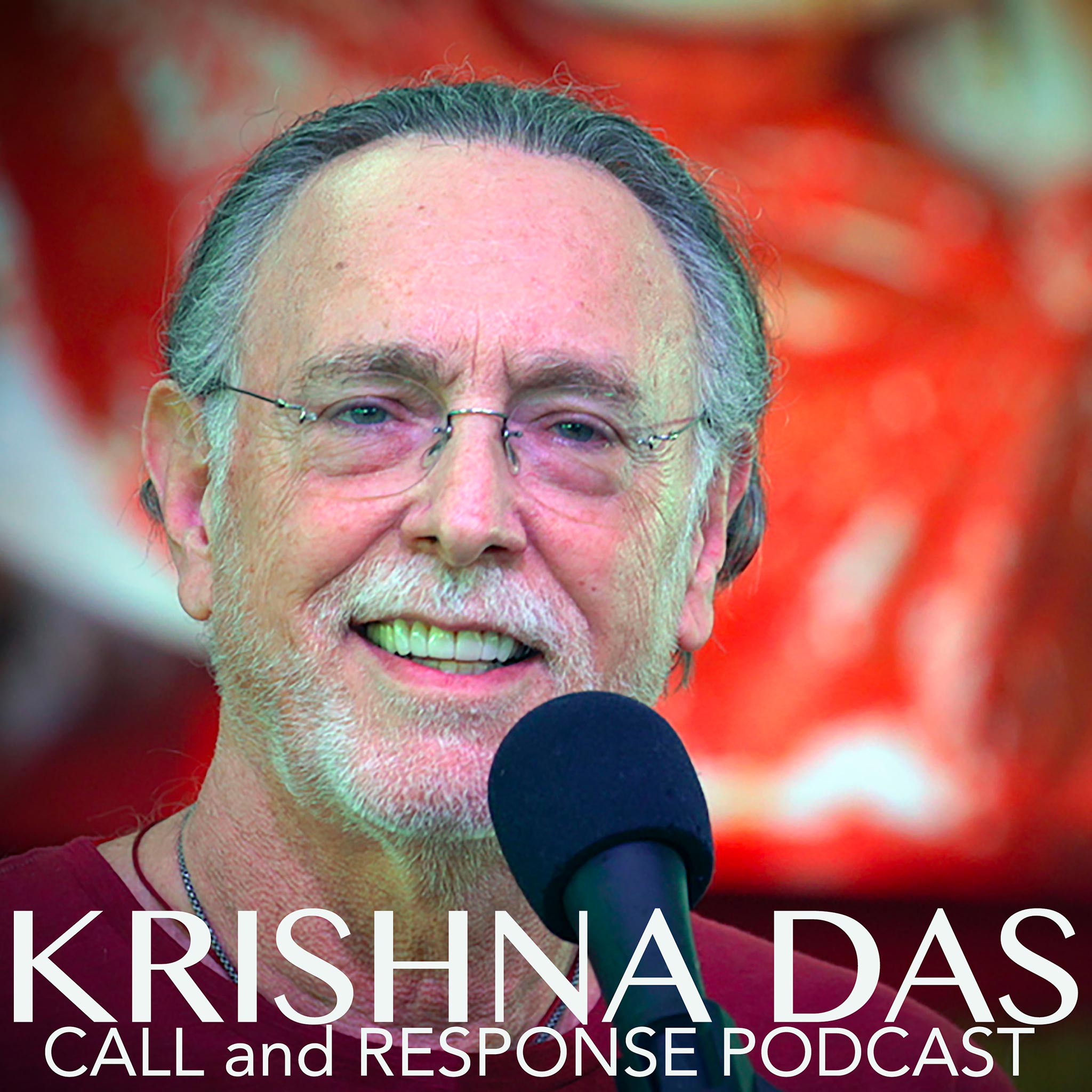
Artwork for Call and Response with Krishna Das

Call and Response with Krishna Das

Kirtan Wallah Foundation

Devotional yogic chanting with a Western influence. CDs and cassettes for sale, artist background, schedule of live appearances.

Play
  • 20 episodes
  • Avg 43 min
  • English
  • August 3 · 54 min

    Call and Response Podcast Special Edition | Mocha Lattes and Samadhi

    Call and Response Podcast with Krishna Das | Special Edition – Mocha Lattes and Samadhi SPECIAL OFFER: This special edition comes with a special offer from our friends at SoHum Mountain Healing Resort ~ When life moves too fast, the body and heart begin to whisper for rest. Ayurveda is the science of life, teaching us how to live in balance with our true nature. SoHum mountain healing resort offers Ayurvedic Pancha Karma detoxification retreats in a calm, supportive environment. You can learn more at SoHumhealing.com and use the code KrishnaDasPK2026 for $500 off on your PanchaKarma retreat! “Stuff comes, stuff goes. But the more we practice remembering to let go, remembering to release and come home, come back home to ourselves, the less dependent we are on outside things for happiness, for joy, for pleasure, for peace of mind. We all look out there. Even we think God’s out there like some little blue baby flying up in the sky. That’s there to remind us to look. Everything is in here. Everything.” – Krishna Das Cover photo: Via Arngrímur Fannar TRANSCRIPT: My guru had a very great disciple named Siddhi Ma, who was with him for 40 years. She was extraordinary. Now, when we used to sit with… My guru’s name was Neem Karoli Baba. We used to call him Maharajji. We used to sit with him, and he would look at us, he would say, “I have the keys to the mind. I could turn your minds against me.” We would go, “No, don’t do that.” He would laugh, “Ha ha ha.” You know? But he meant it. He used to say, “I’ll transfer you. Transfer ho jayega.” And he did. You know, he dragged us there, and he transferred us back home. But anyhow, so many years after he left the body, I said to Siddhi Ma, I said, “Ma, Maharajji said he has the keys to the mind. So, to me, that means that I am where he wants me to be, where he’s put me, wherever that is.” That’s where, wherever I am, that’s where he has put me. Whatever I’m thinking, whatever I know, whatever I don’t know, that’s his business. He put me there. So, I said to her, “Is it all his doing, or is it grace, or is my effort required, right?” This is the famous question, grace or effort. She said, “Krishna Das, it’s all grace, but you have to act like it isn’t.” That’s such a great answer. It’s all done. There’s no time. There’s nothing. Who we think we are isn’t who we are. That’s just thoughts. We’re all enlightened beings who forgot. But how do we remember? Some effort is required because we think we are who we think we are, and that’s total insanity. But that’s the deal. You think you’re you, I think I’m me, so we’re fucked. Right from day one. But you can’t stop those thoughts. How do you stop those thoughts? You can’t stop a thought. It’s not like you’re going to shoot it while it goes by. You practice letting go. That’s the kind of effort that’s required. Practice releasing the thought and coming back. And so, we add something to our daily life that we can come back to, like a mantra or the breath, something that is going to be there, and we know it’s going to be there. And as soon as we notice that we’re gone, we come back to that. And that builds up this muscle called “the letting go muscle.” I discovered that. No one discovered it before me. “Letting go muscle.” It’s not something we’re taught to do. Nobody in my life growing up had anything to do with being here or letting go. Nothing. It was hold on to as much as you can, or as long as you can. Break your hands holding on to shit. Right? Relationships? Torture. Stuff comes, stuff goes. But the more we practice remembering to let go, remembering to release and come home, come back home to ourselves, the less dependent we are on outside things for happiness, for joy, for pleasure, for peace of mind. We all look out there. Even we think God’s out there like some little blue baby flying up in the sky. That’s there to remind us to look. Everything is in here. Everything. Maharajji once said, “Go on, sing your lying Ram Ram. One of these days you’ll say it right once.” And he said, “Say it when you’re angry, say it when you’re tired, say it when this, that.” Because if you don’t, if we don’t plant the seeds of the things we want, where are they going to come from? Nobody’s planting them for us. We have to plant those seeds. That’s the good news and the bad news. Nobody can do it for us. Yeah, yeah, a great saint can kind of turn the light on for a second so you can see there’s a door, but we have to walk to that door because the light goes off again. But we know there’s a door now. That’s a different thing. I’d been in India for two and a half years, and, he had actually kept me there. All the other Westerners had to go home. He sent me… I was going to have to go home too, but at the last minute, he sent me to one of his devotees who was a chief of police somewhere, and he stamped my passport, so I had another year. So, then I’m sitting with him one day in a apartment building in Bombay, in Mumbai, and he looks at me and says, “America jao. Go to America. You have to go.” I said, “But I’m, I’m just learning Hindi.” “Too bad. You have to go.” And he said, “You have attachment there.” Now, when I left America in August 1970, the previous yuga, I gave everything away. I sold my guitar, my car. I gave my jeans away. I was out of here. I was never coming back to the West. I didn’t tell my parents. But that was the deal. I never thought I would come back to the West. I was so at home in India. So, when he tells me, “You have attachment there,” I think, “What is he talking about?” Now I know. Every single thing that’s happened, every thought I’ve had, every single thing that’s happened to me from that moment to this moment is what he was talking about There was so much stuff inside that had to come out, that had to be worked through, lived through, survived. Couldn’t happen in India. Also, I was so sick, it was ridiculous, you know. I had hepatitis. I had every kind of parasite known to man. Fun, you know. Yeah. And it took a long time to kind of get with the program You know, we have this subtle program going on in us, some of us, that we’re trying to make ourselves like a better version of ourselves, a version of ourselves we could like, you know? One time I was at one of his old devotees’ houses and, it’s a long story, but it was at the Kumbha Mela in 1989, and we were going to stay in the mela at a camp… because I’d been hanging out with this baba who was 163 years old. Really, he was. I remember one day he looked at us and said, “You’re from America, right?” “Yeah.” “You remember when Lincoln was shot?” And he goes, “Oh, no, no, no, you wouldn’t remember. We read about it in the paper,” he said. He really was 163. His older guru bhai was 250. You might have heard of Deora Baba. You ever hear of him? Anything? He was over 250 years old, and this was his younger guru brother. He was 163. So, he had sent one of his sadhus to the house to lead us into the mela because otherwise we would never find him. And this guy was so full of himself. He was so, it was horrible. He was just so, so Dada, who… The old devotee grabs me. He takes me into the back room where Maharajji used to stay. He closes the door. He opens up this, cupboard. First, he reaches down under the cupboard and gets this key, and he opens the cupboard, and he reaches down on the bottom floor, the bottom shelf, and he pulls out something wrapped in old, funky, dusty newspaper, right? And he opens it up, and he holds it in front of me, and it’s this funky, cheap, rusty lota. You know, a lota is one of those metal cups that they… a small pot that they carry water in and do stuff. And he holds it up in front of me. He goes, “Do you see? Do you see?” And I said, “No, Dada, I don’t see.” “Do you see?” And his eyes are like… He’s freaking me out, you know. “Do you see? Do you see?” I said, “No, Dada, I don’t see.” He said, “You don’t have to sh…” He said, “Maharajji left this for me the last time he was stayed here. Do you see?” “No.” And he goes to me, and he says, “You don’t have to shine.” And he wrapped it up, put it on the shelf, locked the cupboard, put the key down. You don’t have to shine. How much of time do we spend in our lives trying to shine in one way or another? So much time, so much effort, so much of our self-worth is tied up with trying to shine for one reason or another. You don’t have to shine. We think if we shine, you know, we’ll attract stuff to us, these things we want. Maybe, but they don’t last. Because sooner or later the plug comes out, and you can’t shine forever. It’s hard work shining. That doesn’t stop us. Q: Hi. I’m curious what Maharajji was like as a businessman. KD: A businessman? Q: Yeah, like finding balance in that area of life. KD: I don’t know he did any business at all. Q: Oh, I thought… Did he sell fruit? Or… I thought I heard… Like as a father, I’m just curious about like the balance there. KD: He was just a sadhu. He had nothing. Although he inherited… His father was a landowner, and he inherited all this land, but he had left home when he was 10, I think. His mother had died, and his stepmother also had a son, and she didn’t feed him. She wanted her son to inherit everything. So, he just ran away at ten. But he was engaged, first to a village girl, and later on, they found him when he was like eighteen or nineteen, and they brought him home, and he got married and had a family. But he never really, he didn’t stay around much. His daughter told me that he stayed around until she left for college. And the weird thing was he would stay in the house mostly, and sadhus would come and knock on the door, and they would ask to talk to him. How did they know he was there? It was weird. But no, he didn’t do much business. In fact, in the summer of ’72, when I was living in the temple with him, at one point, he would go up on the roof of the Dharmsala in the back, and he wouldn’t let anybody come. And after he got to the roof, these two guys would drive up in a car. They’d come over the bridge, they’d walk into the temple, and they’d go right back to the back of the temple, up to the roof. They’d talk with him for a while, and then they’d leave. They wouldn’t look at anybody, wouldn’t even talk anybody. Years later, we found out that was his son and his nephew, and they were coming for instructions. What to plant, when to plant, what to do this, what to do that. You know. So, he took care of business, but kind of not like usual people. For instance, one of his old devotees told me they were, they were driving in a Jeep, and they stopped by this jungle. And the two of them got out of the Jeep, and they walked through the jungle to his village. When they got out of the Jeep and started walking, Maharajji was wearing his dhoti and a blanket. When they got to the village, he was wearing a uniform of the village headman, which he was the village headman. And he would walk, walked around, and everybody was waving, “Hey, how you doing? What’s up? Yeah, cool. See you around. Okay.” And then they left, and halfway through the jungle, the guy looks again, and he’s wearing his dhoti and blanket again. I mean, what kind of business is that? You know? One time there was this guy comes, this very poor man came, and he and his friend came. I don’t remember exactly what happened, but Maharajji says to him, “Oh, you want to be rich? Okay.” So, he pissed in a cup, and he gives it to the guy to drink. “Drink this, you’ll be rich.” So, the guy’s drinking the piss, and his friend says, “Come on, give me some of that. Give me some of that.” So, he gave his friend about half of the cup, right? And the guy drank it. That guy became the richest, one of the richest guys in India. I don’t know what happened to his friend. Imagine if he drank the whole cup. Jesus. I mean, stuff like this was happening all day. It’s totally insane, you know. But he did take care of business, but it was everybody’s business he took care of. I mean, everybody who came to him got something, whether you knew it or not at the time. That’s what he did. That’s what he did. That’s why he was here, to help people. We didn’t know any of that stuff. We didn’t know he had a family until later. When we came back after he left the body, I was walking down the street in Vrindavan. Somebody said, “Oh, you see that guy in that car? That’s his son.” I said, “What?” So, I went over and I said hello, and he said, “Oh, you people are… you Westerners, you people are his real children. We didn’t know anything about him.” They didn’t know. Literally, he was in control of your mind. But you weren’t afraid because there was so much love. I mean, it wasn’t like anything to be afraid of. But whatever thoughts you had, you know, you kind of had to get used to that. It was weird. But after a while, you just kind of went with the flow, and everything was cool Q: I have a question. But also, maybe just some thoughts. Because I’m curious as to your thoughts on bhakti and how we practice kirtan and singing, but also, like, this feeling of separation when we are chanting to yearn, like this. This yearning feeling I felt here all night. We’re singing and singing together. But then at the same time, we’re also cultivating the divine. And I’m just curious, how do I marry the idea of yearning for the divine? How, how do you cultivate or how do you marry the idea of yearning for the divine, but also realizing “I am the divine” and we’re all… Like, I’m just curious about the separation and the non-separation, and just your ideas on that. KD: You don’t have to think about it. In terms of when you say, “I am the divine,” no. The one who’s saying isn’t. That’s the me. The ego saying, “I am the divine.” It’s a nice phrase, and it’s positive thinking. It’s better than thinking, “I’m a piece of shit.” But it’s not going to help you too much because you can’t maintain. It’s not rooted in anything real. It’s just another thought. But the practices of releasing that thought, you actually begin to touch that place inside of you that is, and the yearning or the longing is the saving grace. Without that, we’d just be watching serial killer murder mysteries all the time. But with that, it forces us to look for something and to try to find something real. So, the separation hurts, but it’s only temporary, but it does hurt. But you can’t think your way out of it. You know, you can’t think your way out of a prison that’s made of thought. Every thought is the prison. It’s nice to think, “I am the divine.” I mean, it’s cool, you know? Wear a T-shirt, “I’m the divine.” But you have to take that T-shirt off at night, or when you take a shower anyway. So those things, those things are helpful at times because positive thoughts definitely take up space, and they don’t allow negative thoughts to come. But that’s like, you know, it’s the same level as the thought. What we want to do is recognize that we’re not present when we’re thinking. We’re thinking about this, we’re thinking about that. You’re still here, but you’re not aware you’re here. So, you just start your practice going, watch your breath, slow down, calm down. Sometimes you feel that sadness, and there’s a lot of reasons for sadness, you know? Nobody told me at the beginning of this that it wasn’t required. Because I was depressed my whole life, you know? I used to mope around all day. You know what moping is? Do you mope here? Good. I should move here. I spent my whole life moping around, you know? And one of the fruits of practice is that you spend less and less time in negative states of mind, which you don’t notice. But if I think back, I think, “I don’t mope as much as I used to.” I miss it. Don’t you miss it? You know, “Ah, fucking shit. Blah, blah, blah, blah, blah, blah,” you know? It just feels so good. But you don’t miss it, because what’s gone, what’s not there as much is that judger, the evaluator. “How am I now? How am I now? How am I now? Am I okay? Am I okay? Do we need more of this? I need less of that.” That’s where the suffering comes from, the constant evaluating ourselves with- from our heads. And it will never cure anything, and it’ll never make anything go away. The sadness, there’s a lot of different reasons that we’re sad, you know. We have our emotional stuff. We’ve been beaten up by life enough times to feel it. But even that is something that is not our true nature. That’s covering up our true nature. So, the more we can practice and practice letting go, even if it’s just for a few minutes a day, that letting go thing starts to work by itself, you know. And you don’t have to actually attack the sadness. If it’s emotional stuff and depression, you don’t have to attack it. You can be with it, and the less you fight it, the less control it has over you, which is one thing. One of the Tibetan lamas I study with, he talks about the handshake practice. It’s like he, he says, “There’s no use trying to fight with these negative emotions. But when you notice one coming, when you notice something coming, you go, “Oh, hi. Weren’t you just here yesterday? Oh, yeah. Well, how are you doing? Come on in. Have a seat.'” Because the minute you notice the feeling, it’s not in you the same way. It can’t grab you the same way. But it does take a little bit of working on it, And the main work you do is when you do your practice. The rest of the day, you do the best you can. You try not to kill anybody. You try not to beat yourself up. There’s a lot of things you can try, but it’s the moments when you’re actually paying attention. Make a deal with yourself that, for the next period of time, I’m going to…anything I’m thinking, I’m going to let go. Anything I’m feeling, I’m going to release it and come back. See, the problem, we don’t do that because we expect that we’re going to be levitating in ten minutes, you know? You know, “Wow, this is a really good meditation. I ought to write it down,” you know? Yeah. No. You just sit, you do your thing, and you live your life. You do the best you can not to create suffering for yourself or for the people we meet. The funny thing about spiritual practice, it’s not about “me.” It’s not about me. It’s just not about me. What did that guy say? “Do unto others?” “Treat other people the way you want to be treated.” If we could do that, what kind of a world…. In a second, this would be a different world. But no, we want bliss. “I want ecstasy.” You know, “I want to do this, I want that there.” So do some drugs. Get over it. But when you sit, sit. Be there. There’s so much nothing, it’s incredible. It’s so deep, but it isn’t me-ness. It isn’t about me. Your life isn’t even about you, but we think it is. We think, think, think, think, think it is, all life long, and then we keep going. So, with that sadness, try not to fight it, you know? And don’t be afraid of it. It can’t hurt you. It may not be very pleasant, but it’s not always there also. So don’t be afraid of it. But we’re afraid of it. We’re afraid of those things, you know? I mean- I don’t know how much you know about me, but I’m pretty crazy. Never mind. But anyway, ultimately, it can’t hurt you. And if you’re not afraid of it, if you kind of be with it, don’t try to solve it, don’t try to push it away, and don’t be afraid of it. Let it be what it is, and it’ll come, and it’ll go. Even the pleasures come and go. Even the things we want to hold on to, we can’t hold on to. So, the things that make us feel bad also don’t last. But the deeper we can, the more we can commit to a practice on a regular basis… You’ve got to do it every day. I mean, even if it’s three minutes of just turning everything off for three minutes and just sitting there like a lump, that’s a good thing, because we are being washed away down the river towards the, the waterfall, and there’s not much we can do unless we start to pay attention. And it doesn’t take much. It just takes developing a new habit, because the old habits are driving us crazy, literally. But we can develop new habits. It’s not easy. It’s not easy because there aren’t a lot of people helping, you know, supporting us, which is why satsang or sangha is very important.People who are looking for the same thing. But don’t go to an ashram. There’s nothing worse than an ashram for politics. I’ve been to a lot of them. Believe me, it’s the last place you want to go. It looks good for a few minutes, and then you see, you know, people who are sitting up a little straighter than other people, walking with a little bit of this and that, you know. Oh, God, get out of there as fast as you can. Not every ashram, but almost every ashram. Especially if there’s not a realized being there. If there isn’t a realized being, it’s just another fucking insane asylum. So if you like that, fine. It’s up to you. I’ll hear about that, I’m sure. But really this longing It’s the thing that ruins your life, but it saves your life too, because nothing will ever be enough, ever, for more than, you know, a couple of minutes, if it’s really good. Nothing’s going to be enough, so get over it. Nothing’s going to be enough. Things are okay for short periods, but they don’t last. That’s what this world is. They don’t last. If you expect them to last, you suffer. Very simple. If you don’t expect them to last, you can watch them come and go. You can enjoy them when they’re here, and you can feel okay when they go. But we get glued to stuff. We get glued to stuff. We want it to last forever. We are not even going to last forever. First of all, our bodies are going to go, and then this thing that people call ego, which is nothing but thoughts, once the body goes, poof, that’s gone too. But the heart, the mind, the soul, so to speak, that goes on. But it doesn’t look like you and me. It’s the source of all the different forms that we take over many lifetimes. Stuff don’t last. What does last is this longing, and it gets mixed up with emotional pain and emotional suffering. But even that is touching this, the reality that we need to find something deep, deeper than our thoughts, deeper than our emotions. Which is not hard to do because it’s in there. It’s covered up. All we have to do is uncover it. It’s not like you’re getting something you don’t have. Everybody has it. It’s looking out of your eyes right now, hearing through your ears, feeling through the skin, tasting through the tongue. Everybody is exactly the same looking out of their eyes. The presence within each one of us is exactly the same. But we think we are who we think we are. What are you going to do? That’s the way it is. So, when we chant, we simply come back to the sound of the mantra, or the name, as you call it. That’s all that’s required. You don’t have to imagine anything. You don’t have to create everything in your mind. You don’t have to judge it. Is this good? Is this bad? You just come back again, and again, and again, and you can always come back. You can always come back. You can always let go, but it takes a little getting used to that, what that feels like. Q: Hi. It’s an important question for me, for my son, so I wrote it down before. Krishna Das Ji. Yes. Thank you very much for being here. My son has been living in India. It’s exactly to the day I was in Vrindavan for three years ago. He is, practicing Hare Krishna for, has devoted his life for six years or yeah, he’s been in India pretty much for six years. KD: Who? Your son? Q: Yeah. My son, yes. Yeah. Okay. And it’s, I mean, it’s transformed him in so many ways. It’s given him everything. He says it’s the highest high he’s ever had, and he’s tried a lot of stuff. I’ll get back to my question. So he’s a devoted to Krishna, and he’s been, he’s given everything he has, or at least he thinks so, he has. Lately, he’s been feeling very discouraged, like devotion hasn’t brought him what he’s hoped for, and he has yet to find a spiritual teacher and to be initiated. KD: He, he hasn’t been initiated? Q: No. KD: And he’s in Vrindavan still? Q: Yes. Okay. Yeah. he’s a bit different socially and sometimes struggles to find his place, but his devotion is very deep. Do you have any guidance for someone who wants their heart to, who wants to keep their heart open and maintain the trust of the path, even when it feels like devotion is unseen? KD: Are you asking or is he asking? Are you asking for him? Q: Well, I spoke to him today, and I just felt, there was a mystic that said he was going through a very hard time unusually, and I called him. Sure … and it was true. And he just said that I just… I felt like he was almost giving up, you know? It’s something that has given him everything. Absolutely everything, and all of a sudden, he just feels like he’s unseen, and it’s… KD: So, he’s not officially in ISKCON? Q: Yes. Well, yeah. He is in ISKCON. KD: He’s in ISKCON? Q: Yeah. KD: But he hasn’t been initiated by… Q: No. KD: I thought you had to be to be. Q: No. No. He’s been servicing a, what he thought would be a spiritual master, but somehow this didn’t quite fit, I guess. KD: Well, I couldn’t really give specific advice for him, but I do know one person who I would certainly suggest that he go see if he wants to. His name is Sacinandana Swami. Q: I’ve heard, I’ve heard him speak too. KD: Yeah, he’s a German Swami, and he’s a god on earth as far as I’m concerned. He’s my good friend. He’s unbelievable. He’s totally good. No bullshit, no nastiness, no manipulation, no business, no nothing. He’s the real thing. And whether he’s going to initiate your son or not, I don’t know. But if your son has issues regarding… He’s not an ISKCON either, Sacinandana. He’s left ISKCON. Q: Okay. KD: He does his own thing. Q: Yeah. Okay. But, I think that could be a good thing for my son too. KD: Yeah. Yeah. He’s, he’s just joy. He’s a wonderful being. Really is. Okay. And, he doesn’t pay me to say that either. So he’s not in Vrindavan now, unfortunately. But if you, I’ll give you a, an address to get in touch with him. With his secretary. Q: Yeah. But I mean, I understand it. Giving yourself so… Your heart, everything. I mean, spending hours and hours and hours in service and service and service and living, owning nothing, having no money and it doesn’t seem like he’s going forward, no matter how much. And he’s really… This is his everything. And I’m so afraid that if the bottom falls out, where is he left then, you know? KD: Yeah, well, maybe he should come home and get a job. Leave that Krishna shit in India. Find a girlfriend, get married, have a house. Q: I’m not going to tell him this. KD: Don’t ask me then. Well, yeah, okay. So, it, this wouldn’t be… I can’t know what, who he is or what he’s going through from here, but let him get in touch with Sacinandana Swami, because that’s a path that he seems to be on, or wants to be on, and he’s the real thing. He’s a good being. He’s a very, very good, good person, and nothing bad could happen to him from that. So yeah. If you come later, I’ll give you the address. Q: Okay. Thank you. Thank you. KD: Sometimes when the bottom drops out, the bottom drops out. I dropped out on me a few times. But it ain’t fun. Q: I was wondering, I might maybe have at least three questions. Start with the first. KD: Okay. Q: These mantras are Sanskrit words. Yes. And I am one of those that, you know, I haven’t delved into Sanskrit. KD: Me neither. Q: You neither? KD: I don’t know anything about Sanskrit. Q: Okay. But do you understand the words, what they mean? KD: The few words I know, I know. Q: Okay. So, my question is, does it really matter if it is a Sanskrit word or just a word that doesn’t mean anything that is being chanted? Does it mean anything? Could it be a gibberish word? KD: Okay. Sanskrit is called a revealed language. What that means is, they say… And that’s what I say when I don’t know what I’m talking about. I say, “They say.” They say that it actually comes from reality, and that the sounds themselves are the thing itself. If you could be, one-pointed and really get into it, you could get the thing itself from the sound. Some languages aren’t like that, they say. The meaning of the stuff that we sing here, what they call the names of God, the divine name, the meaning is beyond the conceptual mind. Although there are storylines attached to these names, Rama, Krishna, Kali, Durga. They all have a storyline. You could say a myth or a story, a legend, but that’s not what the real, the deepest meaning of the sounds. Like St. John of the Cross said, “In the beginning, the Father uttered one word. That word is His Son, and He utters Him forever in everlasting silence, and it is in silence that the heart must hear.” That’s a Christian way of talking about it. But these sounds come from a place that’s deeper than our thinking and our emotions. They’re like doorways into a different, a deeper state of being. Q: So, in your opinion, you go deeper into the state of being, chanting these Sanskrit words versus words that have no meaning. You go deeper… KD: I don’t chant anything that doesn’t have any meaning, like blah, blah, blah, blah, blah, blah, blah, blah, blah. Q: Like these words don’t have any meaning for me when I hear them, you know? KD: Well, you don’t know the meaning, but they have a meaning. They have a connection to reality, which we don’t have at this point, which we’re not aware of at this point. So even though you don’t know the meaning… When you take medicine, you don’t know how it works, but it works. So, this is medicine. It’s not necessary to understand that Rama was this guy who was a king, whose wife got kidnapped, who beat up the demons and all that. That’s not necessary. That meaning is not necessary. It’s fun for some people, some people it’s not. But the name of Rama, the name of Krishna, Kali, Shiva, Shambo, all those names, they were brought into this reality by beings that experienced what they are, by a human being of some kind that brought it to us as a path to get deeper into our self. So, that doesn’t guarantee that if you sat and went Ram, Ram, Ram, Ram, like, you know, like in India you, you can walk around and these sadhus come up and they say, “Ram, Ram, Ram, Ram, Ram, Ram, give me some money, give me some money. Ram, Ram, Ram, Ram, Ram.” You know, that kind of Ram’s not going to help anybody. And some people change, “om mani padme hum” to “om money, give me some.” You know, that ain’t going to help anybody. But, it might make your pocket a little heavier or something. What we would like is to be released from this obsessive flow of thought and self-judgment and self-hatred and self-loathing- … which we can’t find a way to get free of. The repetition of these names will, over time, help us free ourselves from that kind of stuff, whether you know the actual meaning or not. Because the real meaning of these names is you. It’s who we, we are underneath all the stuff we think. But to get underneath that stuff, you have to do something. It ain’t going to just happen by itself. So. Q: People who don’t want to chant or just don’t trust, to let their voice be heard. KD: Yeah, it doesn’t have to be vocal. It can be mental. Q: But, yeah, it’s the same effect, just doing it mentally? KD: Except that it’s a little bit harder to pay attention to, because when you sing out loud, you there’s breath, the body, the ears hear. So, there’s more to hold on to. Yeah. But it… otherwise, there’s no difference, as far as I understand. Q: And my last question is samadhi. Is it possible to reach samadhi … chanting? KD: Yeah, sure. No problema. Yeah. But what is samadhi? There are many different types of samadhi, different levels of samadhi. But the answer is still yes. But, you know, there’s this great story of this yogi who is living by the river, has a nice hut by the river, and he sends his disciple down to the river to get some water. And while the disciple’s gone, he goes into what they call nirvikalpa samadhi, and it lasts like thirty years. And he opens his eyes, and he looks around, and the hut is gone, the disciple’s got grown children, you know, the whole thing. He says, “What’s going on here?” Because that type of samadhi is like sleep almost. And Ramana Maharshi talks a lot about, well, he doesn’t talk a lot about anything, but he does mention that. Talks about the difference of sahaja samadhi, which is the natural state, and nirvikalpa samadhi, which is temporary. And when you’re there, no karma is burned in that state. It’s like, they say it’s like time off almost, you know. It’s like a kind of a sleep. I’ll take it though. I mean, if anybody wants to give me some of it, I’ll happy to take it. I was in the jungle once in a place called Amarkantak, and with that Baba I told you about who was 163. And we went on a, a walk through the jungle, and we’re walking down the banks of the river, and there was a small little fenced-in place, like maybe twenty feet this way, with a little fence and a little hut. And there was this beautiful old yogi sitting in front of the hut. And we said hello to him, and he said hello, and he realized that, who the Baba was that I was with, the old guy. And he said, “Oh, thank you for coming. I’ve been wanting to meet you for so long.” So, they were talking for a while, and this guy told the Baba I was with, he said, “You know, I’ve been going into samadhi for so long that I’ve instructed my disciples not to bury me or burn me until the ants move in.” He said, “When the ants move in, you know I’m gone.” In the meantime, it was like, but he apparently he’d been going like for long periods of time, days and days, just not breathing, just, you know, in this kind of trance state. But, You know, you can’t get a good mocha latte when you’re in that, you know? Q: Have you reached that state? KD: Mocha latte? Yeah. Definitely. Many times a day. Yeah, no, I’d rather have a mocha latte than be asleep for a month. Thank you. You’re welcome. Thank you. The post Call and Response Podcast Special Edition | Mocha Lattes and Samadhi appeared first on Krishna Das.

  • July 10 · 1 hr 14 min

    Call and Response Podcast Special Edition | Figuring Out What Works

    Call and Response Podcast with Krishna Das | Special Edition – Figuring Out What Works This special edition comes with a special offer from our friends at SoHum Mountain Healing Resort ~ When life moves too fast, the body and heart begin to whisper for rest. Ayurveda is the science of life, teaching us how to live in balance with our true nature. SoHum mountain healing resort offers Ayurvedic Pancha Karma detoxification retreats in a calm, supportive environment. You can learn more at SoHumhealing.com and use the code KrishnaDasPK2026 for $500 off on your PanchaKarma retreat! “It’s interesting because in the old days, before radio, Newspapers were the only way people got their news, and to do that, they had to go out and get it in the morning or get it delivered. So, whatever happened from one morning to the next morning, twenty-four hours, was nobody knew, right? Then came radio, and I was reading about how much it changed life. It completely changed the world, radio, because now you could go like this and hear what was happening as it’s happening, reported every hour and this and that. Now, it’s like we’ve got a chip in our brain, and we’re getting twenty-four seven, three sixty-five, you know? I don’t know if that’s useful in any way whatsoever, but each one of us has to figure out what works for us, you know? But don’t– I wouldn’t beat yourself up for not reading the news. There’s other things you can beat yourself up for, I’m sure. Much more juicy and much more real and much more, you know, hurtful.” – Krishna Das TRANSCRIPT: Q: Jai Shri Ram, Krishna Dasji. My question is, so, when I sit alone doing nothing and- KD: How can you do that? You’re never doing nothing. You’re just wasting time … Q: Just wasting time, right? KD: So, there’s a big difference. Q: Yeah. KD: Doing nothing would be fantastic. But how do we do that? Go ahead, sorry. Q: No. S,o I have zillions of thoughts in my mind besides all the comfort, food, shelter, basic necessities that we have, right? And it feels empty from inside. And when I follow spirituality, chanting, going to the temple, all the rituals, it fills me up from the inside. KD: It what? Q: It fills me up from the inside because I am empty, right? KD: So, it fills you up from the inside even though it’s from the outside. The temple is not inside, it’s outside. Q: Okay. KD: So, it fills you up on the inside from going to the outside. Q: Yeah. KD: How does that work? Q: So, my question is, so, to you that when you sit alone and not chanting, not remembering anything, and you have had discussions with different gurus, different spiritual leaders, et cetera, right? So, what’s your thought in the mind? Any learning, any teachings that you want to share? KD: When’s the next game from the UConn’s women’s basketball? That’s my only thought about anything at ever… any time What do you care what I think? It’s what you think that matters. And you say you have millions of thoughts. I don’t see millions of thoughts. You have one thought, me, me, me, me, me, me. Everything revolves around that. So, when you notice you’re thinking, what do you do? You let go and you come back to the name. That’s all you have to do. You don’t have to think about it. You don’t have to figure it out. It’s impossible to figure it out. And it doesn’t matter what anybody else says about what they feel. It’s what you feel that’s important. So, when you say you get filled up– when you say you’re empty, you’re not empty. That’s a feeling, and it’s not like there’s nothing there. No, there’s a feeling of being empty. That’s a big feeling. So, let it go or just start the name going along with the so-called emptiness and see what happens. You have to do something at those moments. If you want, you can do something, which is to remember the name and try to pay some attention to it. Don’t try too hard, but just gently try to remind yourself that you’re actually here. And when you become aware of the feeling, you’re aware of the feeling, so, you’re not the feeling, right? In that moment, you’re feeling empty. I’m empty. I’m empty. I’m empty. No, you’re feeling emptiness. You’re aware of that feeling. There’s a separation. There’s you and the feeling. So, you come back to the you side again and again Good luck. Q: I am a little, a little nervous here. KD: Me, too. I have no idea what you’re going to say. Q: I’m going to I’m going to do some nervous rambling before I ask my question. And I just want to say, I grew up in a Hindu family, and my parents are pretty religious, and we used to go to the Masonic Temple where they set up their Hindu, you know, temple there when I was, eight years old. KD: Where? Q: In Flushing. KD: Flushing. Q: On, next to Main Street. And I used to think “Who is this flying monkey god, this cartoon?” KD: That’s what I think all the time. Q: And all the years of growing up, I just, poo-pooed, you know, Hinduism. And finally, about five or six years ago, I got into Ram Dass and Neem Karoli Baba and you. And it was 2020 during the COVID epidemic, and I just… I’m a writer. I like to write, and I wrote a short story, got published. You’re in it. And, and I would love for you to read it. I’d love to send it to you. KD: Okay. Q: But basically, I want to thank you and Ram Dass for, teaching this Hindu respect for Hanuman and coming back to, you know- her. KD: Thank you. Q: And I want to ask you, in all seriousness, I’m the mother of a, a primary caregiver for an adult with autism, and I want to know what Neem Karoli Baba would say. He has severe autism. What he would say about individuals that are born here… I’ve come to peace with, you know, who my child is, and he’s special and he… It could be part of my karma and… KD: It’s his karma, for sure. Q: What would Neem Karoli Baba say about it? KD: I have no idea. Yeah. But ask him next time you see him. I don’t know what he would say. It’s unimaginable to me what he would say because I’m not him. I have a friend who teaches yoga. She had an autistic child herself. So, she developed this yoga program, asana practice for kids like that, and she always plays the chants for the kids, and they zone right in, you know what I’m saying? But then she said to me, “But when it speeds up, they get, they get nervous, and they kind of…” So, that’s why I made that last CD called Peace of My Heart. It doesn’t speed up. It’s just, boring, you know, the whole thing. That’d be a nice thing to play for him because it’s steady and easy, and it’ll allow him to kind of zone right in. Q: Yeah, I’ve played your music for him, and he loves it. KD: Good. Yeah. just love, you know? That’s all, and just more of it every day. Q: Hi KD. So, 10 years ago I came across the Ram Dass book, Be Here Now, and 10 years later, now I’m here flying from Brazil. My wife flew us here just to see you. KD: Wow. From where? Which place? Q: São Paulo. KD: São Paulo. Q: And I was there in your workshop as an attendant, and I learned something from you. You said something that it really, you know, carried, which was when you left India and came to the States, you heard from your beloved that you should or you would sing for people, but it took you 20 years to do so. And I’m struggling with something that I feel deeply in my heart that I should be doing for the past eight years. So, when I heard you saying that, I was “Well, if it took, if it took him 20 years, I mean…” KD: 21 years. Q: 21 years. Okay, so, you know, I still have a lot of time to, to go. KD: Yeah. Good. So, chill. Q: But in the same way, if you heard from your guru, and yet you still, took 20 years, what chance do I have? Because I don’t have my… I have my own feeling, intuition. So, what I want to ask you is, looking back, why do you think, what was holding you for that 21 years and what did change? When did you realize, or what action did you take, did you take to actually, you know, be here for us now? Thank you. KD: Well, it took really recognizing that I wasn’t going to make it if I didn’t start to sing with people, period. That was it. I had an epiphany that if I didn’t start singing with people, I would never be able to clean out the dark shadows in my own heart. So, if it was either I did it or I didn’t do it. If I didn’t do it…If I did it… So, I made the choice to start doing it because it was live or die, essentially. It got to that point. So, I wouldn’t say it was much of a conscious decision. It was more like recognizing the way things were, which was if I didn’t do this, it was over for me. You know, I just had a lot of, you know, when Maharajji sent… I’d been in India two and a half years. He kept me there. He got my visa extended and all that. And then after two and a half years, he looks at me, he said, “Okay, time to go back to America.” I said, “What?” “Yeah.” “I’m just learning Hindi.” “Too bad. You have to go. You have attachment there,” he said. I thought, “What is he talking about?” I gave everything away when I left America. I sold my car, my guitar. I gave my jeans away. I had maybe a small little box of books in my mother’s basement. I had nothing in America. I never wanted to go back. What was he talking about? Now I know. Every single thing that’s happened to me from that moment to this moment is what he was talking about. My stuff had to come up, had to come up. I had to live through all kinds of shit, and somehow I’m still here. I have no idea how. But he saved my ass so many times. I don’t know why, but he did. So, you have to recognize what’s important to you. That’s all. But you can’t do it in here, you know? It has to be come from here. You know, that’s all. And it doesn’t matter. I don’t know what it is. Maybe it’s not the right thing. You don’t know until you try. If you don’t try, you try. You don’t try, you try. Who knows? But, you know, maybe it’s just a trip you land on yourself to make yourself unhappy. We’re good at that. What if you didn’t have that thought? Would you be happy as you are? Don’t answer, please. But you know what I’m saying. Who knows? But let’s see what happens. Let’s see how it goes. Q: Hi. I find myself here curious about breath. I’m curious what you’ve learned from Maharajji or Maa about breath KD: Nothing. Or less. Yeah, no, you know, one thing is, it’s good to keep breathing if possible. Aside from that, I don’t know anything about breath. I remember Shyama, we were in the room with, with Siddhi Maa and Shyama. Siddhi Maa told Shyama to do asana and pranayama. Let’s see if I’m remember correctly. And then Shyama said, “Ma, I can’t do those asanas,” you know. So, Maa said, “Okay, Shyama, just do the pranayama. Krishna Das.” Like that. So, since that moment, I’ve been doing pranayama. Other than that, I don’t know anything. But I do pranayama every day. Q: I will keep breathing for a while. KD: You hope, but I hope so, too. Thank you Is that accurate? Semi-accurate? It’s the way I remember it, which is, of course, the only thing that counts. Q: Hi, KD. Thank you so much for all you do. I had a very simple question. How has the practice of chanting transformed you as a person over these years, and how does it continue to do so, even today? KD: It’s been incredible, just incredible. Now I don’t care that I’m just the biggest fucking asshole in the whole world. Before, I really cared. Now, I don’t give a shit. It’s almost true, too. Q: Hi, KD. Namaste. I’m Siddharth. Me and my wife moved to the States last year, and I come from a city north of India called Lucknow. KD: Oh, I know Lucknow. Q: So, Neem Karoli Baba established a Hanuman mandir in Lucknow in 1960s. And as kids, you know, when we were, growing up, we used to go there. But then we used to listen to the bhajans that were being performed on the temple, you know, inside the temple. It was very recent, you know, during the pandemic that I discovered you, and you happened to just come on my YouTube all of a sudden, out of nowhere. Nobody introduced me to you. You just happened to come on my YouTube, and since then I’ve been following you, and I feel more connected to both Guruji as well as, you know, Hanuman. Even more connected. I have an incident to share with you. So, I lost my mom during pandemic, and that is when I, you know, I found my peace with your bhajans. And a lot of chanting that, you know, we were doing at that time as a family. Before moving to the States, you know, I just thought when we were preparing, you know, to move here, I just wished that, you know, before finally, you know, getting on that flight, I get a chance to visit, visit Kainchi. And you will not believe, just a month before my flight, all of a sudden we made a plan and we visited Kainchi. And it has been magical since then, because you know, I never thought that somebody would call me like that. You know, I have my flight. I have my packing going on, no plans at all, and then we just, you know, get gas in the car and we are on the road, and we are in Kainchi. It has been magical for all of us. And you, I feel that you are the path that has led me to a better devotion, better connection, as well as understanding of all of these things at a level that probably was much superficial to me earlier. Because I used to hear it but then never feel it. Now I feel it. My question to you is, in this world where we are so, busy and we are surrounded by so, many gods, especially in India, as you see it, what is devotion to you? Like my father calls me from India and he’s “Did you pray today?” So, I tell him that I pray, you know, as soon as I get up. I do my stuff. I start my day, and I try to pray, you know, whenever I get a chance. But then he’s “No, but that’s important.” So, what is devotion according to you? does it have a structure? Does it have a format? how do we feel that we are devoted to a person, a god, or a feeling, and then we are not, you know, probably parting ways just because we are so, busy in our lives? KD: You know, Maharajji didn’t make us Hindus. He didn’t make us wear the same clothes. Basically, we didn’t even like each other, you know, the Westerners. Some, you know, there were little cliques, you know? The Indian people would come, and he’d say, “You people, you come here. Oh, you only come for yourselves. Look at these people. All they want is God.” We look around, “Who’s he talking about?” You know? We had no idea what he’s talking… But that’s how he, he said that, you know? And we just wanted to be with him. We just wanted to be in that love. That was our puja, that was our practice. That’s what my practice is right now. Chanting is just another way of becoming, entering into his presence. So, there’s, for me, there’s no particular form for it. But you come from a different culture, and there’s expectations on you from that culture. You just have to see if it fits or not, you know? I don’t think you should let yourself be pushed around and made unhappy by not fulfilling other people’s expectations of what you should be doing. But it’s difficult. I mean, if your father’s going to call you every day, you can change your number. But then he’ll probably get on a plane with a lathi. But yeah, you have to figure out what works for you. Nobody can tell you. Q: And I have one more question. While, you know, after I lost my mom, I changed as a person, and this was not told to me by my brother or by my father or anybody else, but my wife told me. Because we dated for a long time, and then my mother was there, and then after my mother passed away, I got married. So, she tells me that I’ve changed a lot as a person. And then she tells me that, “I think, Sid, you need to address the grief that you have within you.” And I feel that too, that I haven’t addressed that grief because nobody ever talked about how I felt, how I feel till date, and maybe there’s a lot inside me, but then I am just being told that I need to address the grief. And in one of the workshops, or rather in, on the YouTube sessions that you took, I did ask you about this, that how do we address the grief? But I still am still looking for answers, like how do we address a grief which is within, and I mean, should we address it? KD: It should be addressed. It should be. Who knows, you know? there’s grief because we feel we lost something. and on one hand, it certainly looks like that. But if you look around the room, everyone has lost something or someone, if not many people. None of our great-great-grandparents is alive, not one person here. Right? And sooner or later, we’ll be in the same situation.Our great-grandchildren will say, “Yeah, I remember that guy. He used to make noise with this whole, this little squeeze box.” So, it’s natural to have grief. We’re human. But you can’t let it push you around, and making it into a big thing “I’ve got to deal with this grief.” It’s natural to have grief. You live with it. It’s also presence. When you’re feeling that grief, you’re feeling that person and you’re feeling their presence. So, the grief is keeping you away from the presence. But it’s natural to feel that. It does pass in time usually, unless you really dedicated to keeping it going, which many of us are. But you don’t have to. You know, remember this, when you think of somebody like that, somebody who’s left the body They haven’t gone anywhere. It’s just the body that’s gone somewhere. But because we identify with the body, it feels like a real loss for us, and we have to deal with that, because we feel that, but that doesn’t mean it’s a true feeling. I mean, there’s a difference between a true feeling and a real feeling. The grief is true. You feel it, but is it real? What is it based on? It’s based on attachment, on the fact that you think you are who you think you are. But that’s just what it looks like. So, you can’t push it away. You can’t get rid of it. It’s not like something you can take out and throw away. It’s, it’s a… it’s part of you. It’s not a bad part either. It’s, it’s… there’s a richness to it, a, a longing, a sweetness sometimes, a presence, you know. It’s not a bad thing, but we don’t like it. So, but, you know, just be with it, and don’t believe everything everybody tells you for Christ’s sake, or for somebody’s sake. For your sake. Q: Thank you, KD. I have a picture of Hanuman Setu for you, and I’ll get it to you there KD: Thank you. I’ve been there many times. Thank you. The manager of Maharajji’s temple used to be the head of the prison, the big- biggest prison in Uttar Pradesh. And there was this thing that happened in Kainchi, and so, Maharajji sent this guy. He said, “I’m sending you to central jail,” and he sent him to Lucknow to stay with the guy in them prison there. Thank you. Very nice. Yeah, this is s beautiful Hanumanji. Okay, good. Q: Hi, KD. Good afternoon. My question is, sometimes when we sit down to meditate or, you know, do name repetition, some days it’s very nice. You feel connected and you know, it’s all harmonious. But then there are days when it feels like a drag in the sense… KD: Those are the good days Q: Yeah, so, there are days where it feels like just going through the motions and not really… KD: Yeah, those are the good days. The other days suck. You’re just lost in some little pleasant feeling, just bullshit. When you’re really in the nitty-gritty and it feels like shit, those are the good days. See? Don’t you wish you didn’t open your mouth? But I am serious. Don’t be attached to a pleasant feeling. It has nothing to do with it. What you feel when you’re doing practice is completely irrelevant. It has nothing to do with it. Nothing. I don’t know what I feel when I sing. Why would I even care? I’m going to be with the name. That’s all. I don’t know what that feels like. I couldn’t even tell you. Q: Right, but there are days when you… KD: But … Q: When the mind will basically… KD: But. Q: Mind will revolt with all of its power. KD: And you believe your mind, right? You believe your thoughts, right? Why? Q: I’ll try not to. KD: Don’t try not to. Just look at them and notice that you do. You can’t try to change it. But see what it is. And you, you let your thoughts eat you up, eat you alive, like some kind of vampire bats or something, you know? So, that’s when you just let go again and you come back to the sound of the name for a millisecond, then you’re gone again. But if you don’t come back again and again, then what are you going to do? You’re going to spend the rest of your life being eaten by your thoughts It’s up to you to pay attention, to use your will, to use your inner strength, find that place, and keep coming back to the home, back, back, back. And when you feel like shit, notice it and come back to the name. When you feel, “Wow, this is a really good meditation, I feel really good,” let it go and come back to the name, because it doesn’t matter what you feel in those moments. The rest of the day we can be really stupid and like what we feel and don’t like what we don’t feel. Okay. But when you’re sitting, what you feel is irrelevant. You do the practice, then you go watch a murder mystery Q: Thank you. KD: Okay Q: Oh, hi. I also, want to thank you for coming to New York. It’s sort of a little bit related to the last question. I find that, you know, I live in New York City, do a lot of pranayama meditation. I try to stay, and then I come here, and I see you, and I do kirtan, and I’m like, “Okay, I got it.” But then it’s New York City, and I’m interested in the whole way that you’re cranky today or whatever because, you know, I also, work as a therapist, and so, I see all this stuff. It’s just stuff. So, I get, “Okay, it’s just stuff. It’s not real,” but everyone thinks it’s real, and I just wonder how I can bring the name and the repetition of the name just to everyday New York. KD: You know Mark Epstein? You know who he is? Q: Yeah, Thoughts Without a Thinker. KD: Yeah. And once I think he was talking to Ram Dass and asked him for advice, and Ram Dass said, “Just see your patient as perfect.” Right. And from there, you don’t need to fix anything, right? Q: Can I keep saying the name all the time? I mean, is it, is it all the time like with you? KD Can you? That’s up to you. I have no idea if you can. Q: Yeah. KD: But it would be good. Q: No, I think is the answer, but yeah KD: But I mean, you just got to start where you start, where you are. You can’t pretend you’re somewhere where you’re not, you know? Just whenever you remember, you can be with that sound of the name. You can take little moments during the day where you just drop into it. Even though your thoughts are going to still eat you up alive, you’re still paying more attention in those short moments. And little by little, you get more familiar with being there, more accustomed to to just being there with whatever’s happening and not judging the thoughts, not getting carried away by them, which is very hard. I’m mostly carried away by my thoughts, mostly. Q: And sometimes I get excited, and I want to, I want to tell people, “This is not real. Stop it,” but I can’t, I can’t. KD: Because you think that’s real. Yeah. Then what are you going to do? That’s like standing on butter and thinking you’re a piece of bread. Well, I’m sure that means something to somebody. Good luck. Q: Thank you so, much for your lovely bhajans and reflections today. I actually have a question, two questions that sort of tied thematically what I noticed in the questions and the responses. My first one is, do you fear death, and when was the last time you felt fear of death? And the follow-up,,, KD: What time is it? Q: And a follow-up is how do you distinguish between purpose, rest, and distraction in your activities? KD: This is too advanced for me, I’m sorry. I have no idea what you’re talking about. As far as the first part of the question, I figure it’s going to happen someday. But in the meantime, I just try to do the best I can every day. And, you know, basically, if I stub my toe in the morning, like the next week is ruined So, I have no hope of ever dying in a good way. It’s not going to happen. You know, I’m going to be pissing and moaning and freaking out and yelling and screaming, so, I don’t expect anything good. So, who knows? Q: But do you fear it? KD: I’m not smart enough to fear it. I mean, that would really be intelligent to have a fear of death. I’m too stupid. I just figure I’ll deal with it when it, when it comes the best I can. What can I do? They say the way you live is the way you die, and they say the only thing you can take with you is your state of mind. So, I do the best I can with my state of mind now, and hopefully when now is then, I’ll do the best I can. More than that, I don’t know what to do Q: Ram Ram, KD. KD: Ram Ram. Q: My question is less spiritual, more phonetic. KD: Frenetic? Q: Phonetic KD: Oh, phonetic. Q: Phonetic. In the last couple of… Well, last night and today, I’ve heard you use the F-bomb several times. That’s perfectly fine with me. KD: You should see all the, the emails I get from these little old Indian ladies, you know. “You are spiritual people, don’t talk like that. You should not do that.” And I know I’m doing the right thing. Q: Well, that’s my question. I’ve listened to, to hours of your kirtan. KD: I actually haven’t been cursing that much lately, until today. Q: Okay. That being said, I’ve never heard… KD: I think it’s the European vibe. It’s just kind of like bringing it out of me. Yeah, go ahead. Q: I’ve never heard in all all your kirtans, in mostly, you know, other people’s as well- Yeah … I’ve never heard the F syllable. Is it just absent from Hindi, Pali? I’ve never heard, heard the F syllable. I know Jagat Singh sings a lot of songs that have the “ff” sound in it, but have you ever sang the “ff” sound? KD: Well, in, in Hindi, it’s, it’s a P-H. It’s not “ff,” it’s ph. Really. Okay. So, phuck you. Q: Thanks. I really needed this, and so, did the rest of the room. Thank you. KD: Thank you for my talk. You can’t take me anywhere. I don’t know what’s going on here. Thank you. I must have shot some coffee up this morning. Okay. Hey. Q: Hari Om, Krishna Dasji. So, I had all these questions in my head, and every time a question would come, you would end up answering it already. KD: That is one of my siddhis. Q: I know. I know. I figured that out. I figured that out. I was up there on the balcony thinking about Bhagwan Das. You answered the question on Bhagwan Das. Then I’m thinking about why me? You answered that. And then I always listen to my wife. So, my wife comes by, and she goes, “Aren’t you going to ask a question?” And I was like, “Okay, I’ll ask a question.” So, a little bit of background. I’m initiated disciple of Swami Chidananda Divine Life Society, Swami Sivananda. In 1995, when I was with Guru Maharaj and Gurudev Kutir… There is a picture of Neem Karoli Baba. I’m sorry. KD: Don’t b.e Q: And Guru Maharaj said, he goes, “He’s coming.” I never understood why he said that Then, just a couple years ago, when I’d be washing the dishes, I would always be listening to Bhagwan Das’ version of the Hanuman Chalisa, and I’d be singing Neem Karoli Baba’s name. And then my wife, Jyoti… Oh, and that was my daughter, by the way, Shiva, who came up here. You’ve met all of us in Tarrytown a few times. I saw. KD: Okay. All right. And then what ends up happening is, my wife, she sees Neem Karoli Baba’s picture, and she started to cry. And so, now Neem Karoli Baba’s come full force into our house. And I’m a medical doctor, and I’ve been, you know, and then I went to Kainchi Dham, and ever since then, my life has changed. You’ve already answered all my questions, so, I just want to say thank you. Thank you for giving us the kirtan, the name. Thank you for bringing the blessings. Thank you for making me feel closer to Neem Karoli Baba. Thank you. Hari Om.. KD: When you, when you say Guru Maharaj, who, who are you talking about? Q: Swami Chidananda Guru Maharaj. KD: Chidananda. Chidananda. Yeah … you remember the story? Q: Yes. He made, he made hot milk for your Gurudeva. KD: Yeah. Sure. I was there. I know. Well, I’ll tell you soon. Tell you the story, so. Q: Sorry, one more thing. KD: Yeah, go ahead. Q: I saw pictures of you with Swami Vimalananda. KD: Oh, yeah. Swami Vimalananda was the one on my prayer bag. the Guru Maharaja’s photo and Swami… He’s the one who gave that to me. He was so wonderful. For some reason, he really loved me. He used to call me Krishna Das Maharaj. He would go like that. He was so sweet. He used to sing Hanuman Chalisa with this little electronic keyboard. It was just fantastic, really. Last time I saw him in at Shivananda Ashram, he said, “Krishnadas Maharaj, this will be the last time we meet in these bodies.” And it was. He was a beautiful man, beautiful being So, I think I had met Ram Dass in the winter of ’68, ’69, and then I went to a weekend at, one day on a weekend at Ananda Ashram, where Swami Sacchidananda was giving a talk, and I’d been to his talks before. So, he finished the talk, and He used to go, “Hari Om,” at the end of the talk, you know? So, I had my eyes closed. There was this other Swami sitting with him, and I was waiting for the Hari Om, and instead I hear, “Sri Ram Jaya Ram,” you know? And I went, “Aah” like this. It was like everything… I was completely electrified, every part, every cell in my body. But I didn’t know who it was. I didn’t know anybody. I didn’t know what to ask, right? So, then four years later, pretty much, I’m in Kainchi now with Maharaji, and a car pulls up, and a bunch of Swamis get out of the car. They come into the temple, and they go right into Maharaji’s room, which was unusual, right? But they go right in, and I hear, “Sri Ram Jay…” The same Sri Ram Jaya Ram, and it was Swami Chidhananda, who was very close with Maharaji. Maharaji loved him very much. The thing is, he already had been singing that to Maharaji before I met him. So, I got Sri Ram Jaya Ram from Maharaji through Swami Chidhananda the first time. And there’s a picture of him holding the, the book I wrote about Hanumanji, The Flow of Grace. He’s lying in bed, and he’s got the book up like this. Swami Vimalananda was his attendant for many, many years. And when they came to New York, they were given one tiny little apartment. So, Vimalananda used to take a couple of books and go ride the subway all day long and all night long so, Chidanandaji could have his alone time. Then at night he’d go back. He was just such a beautiful being. Q: Thank you, Krishna Dasji. KD: You’re welcome. Q: Swami Chidhananda knew I was a hardcore Hanuman bhakta. Now I understand why he told me he’s coming. Q: Thanks for being here. It’s always lovely to spend time with you and just hear what you have to say and the community that you bring together. I have a question for you. Something that is important to me in my spiritual practice is to be present, not to drop anchor or get too stuck in things, and also, not to spiritually bypass what’s happening. So, I go through this thing maybe a couple times a week where I just, I delete all the news apps. I can’t deal with it. And then it’s like I miss what’s actually happening in the world, and I feel like I need to drop back in and pay attention. I think that’s important. I hear a lot of times in yoga classes, “Oh, you just don’t look at the news.” And I don’t agree with that. I think part of our spiritual practice in being present is being aware of what’s happening in the world. But how do we, how do we do that without just… it’s soul-sucking sometimes, and I wanted to know what your relationship with the news is. KD: Well, I get all my spiritual teaching from Facebook Reels. So, I don’t get much news. But really, I do. You know, if you … It depends on what you, you choose. Now I don’t get anything else but, this and that and, you know, Buddhist teachings and chanting and there’s … I get lost in it for hours. I think it’s an individual choice, what you can deal with, what you want to deal with. If you’re going to have a nervous breakdown because of the stuff that’s happening in the world, what’s the sense? If you can deal with it, deal with it. If you don’t want to deal with it, you don’t have to deal with it. That’s the way I feel about it. But you still want to be a good person, and be open to individuals and meeting, and being the best person you can, and treating people well. But if you’re watching the news and you’re going to go, you know, crush up your Valium and snort it, it’s not going to be good. So, you have to figure out what you can deal with and what you can’t, what you don’t want to deal with. It’s totally up to you, and it doesn’t matter. You shouldn’t judge yourself according to what you think you should be doing, what they say or who says or whatever says. But don’t listen to me. Listen to you. You, you’re the one who has to live your life, and you can choose how you want to live that. Sometimes I, you know, I’ll open up the New York Times app, and I’ll just kind of go through the, the headlines. Then when I get to the sports section, I start reading. Or the entertainment section, you know. The headlines just fuck me up. But it’s okay. If it gets me, then I have to deal with it. If it doesn’t, that’s okay, too. I don’t think that’s running away from life. I think each one of us has our own path through all this mess, and you know… It’s interesting because in the old days, before radio, Newspapers were the only way people got their news, and to do that, they had to go out and get it in the morning or get it delivered. So, whatever happened from one morning to the next morning, twenty-four hours, was nobody knew, right? Then came radio, and I was reading about how much it changed life. It completely changed the world, radio, because now you could go like this and hear what was happening as it’s happening, reported every hour and this and that. Now, it’s like we’ve got a chip in our brain, and we’re getting twenty-four seven, three sixty-five, you know? I don’t know if that’s useful in any way whatsoever, but each one of us has to figure out what works for us, you know? But don’t– I wouldn’t beat yourself up for not reading the news. There’s other things you can beat yourself up for, I’m sure. Much more juicy and much more real and much more, you know, hurtful. Q: Thank you. KD: You’re welcome. Q: So, I was talking to Maharajji and I always talk to him, but I guess I’d been kind of annoyed at him because it’s just like same old, same old in my life. And you know, I thought about Hanuman. My mind went to Hanuman, and I get that. love the compassion and the service. And then I was like, “But Ram, who is this man? Who is this Ram?” I was raised Catholic. We have Jesus, right? And Ram is new for me. And I’m like, “Well, he, Isn’t he, into the war?” You know? I don’t, I realize I don’t know anything about Ram. And I know Ram is … Maharajji serves Ram. Hanuman serves Ram. Can you give me a little something about Ram? KD: Ram is love. I mean, you can read about what, how these beings are defined But essentially from our point of view, you could say that Ram, Hanuman, all of that, Sita, this is a loving presence. This is our true nature, what lives within us as, as who we really are underneath our thoughts, underneath our emotions, underneath the stories we tell ourselves about ourselves. All the stuff, everything you think about you, it’s underneath that. And when Jesus says, “I and my Father are one,” that one is Ram. Same, same. Every culture has a different name for that thing in the sky, that orange thing that gets warm, you know? Different name, same thing. That’s all. And you don’t need to adopt another culture’s way of seeing it, as long as you feel connected and can connect to that place inside of you. That’s the only important thing. So, yeah, I mean, I don’t know. I’ve lived in India like half of my life, but I can’t say that I know deeply what all these beings are in any way, you know? But there’s a beautiful, the way that love is expressed and the way that the path of love is opened up in those cultures is really, you know, wonderful. In the West, there’s a lot of the good and evil stuff, good and bad stuff and judgments. There’s not a lot of that over there. It’s much less judgmental in a way, which is good for us because we do a lot of shit that could be judged. There’s a beautiful phrase, “Ram only loves love, And those who know that know what needs to be known.” Where is that in the other stuff? You know, it’s somewhere, it’s there, but we don’t get that so, much Q: Greetings. I was thinking about asking a question, but I was a little shy to come up, and then the previous woman who came up and asked about the news, you know, made me inspired me to hop up. So, I don’t watch the news, and I, of course, get the news just from social media, and I think that the rate that we are receiving news is way too much for humans to process in this time. But in a world that is full of injustice, if our prayer is, you know, lokah samastah sukhino bhavantu, where is the balance in your perspective between taking inspired action and also, accepting that there is maybe not so, much that we can control? KD: You’re here. We’re here. This is what I do. We still meet people. We still have interactions with people. We try to do the best we can not to create suffering. And more than that, I’m not sure what we can do, but we should do that. We could do that. Yeah. I mean, you asked me what I do, to do that. Look around. This is what I do. And I don’t do it for that, because that would be a little grandiose. I do this to come into the presence of the love that is Maharajji, because that’s good for me, and I’m just using you all to help me get there. See, now the truth comes out. Q: Is it not, I don’t want to use the word duty, but I don’t have a better word right now. But as yogis, or as freedom-loving people who sincerely wish freedom and liberation for all beings, like are we, should we take inspired action, whatever that is, beyond our chanting and coming together, whatever that is to people? KD: Protesting? I don’t, I don’t know. You should definitely do whatever you feel you should do. I mean, nobody, I can’t tell you what to do, or what you should do. Ram Dass used to, you know, get out there in the wheelchair and protest and do stuff. And so, yeah, I mean, it’s up to each one of us to see what, how, what works in our life and how we see it. But as Sharon Salzberg always reminds us of the words of the Buddha, that you can search the whole universe and never find anyone more worthy of love and caring than yourself. So, if you start there and allow that to spread and open, that would be a good way of doing it. But if you’re going to go out and try to save somebody or change somebody and almost even help somebody, then it gets complicated because, because you think you’re the doer. You’re creating karmas for yourself and for the person you think you’re helping, which okay, if the intention is good to help, that’s not a bad thing. But are you getting more locked in being who you, you delusively believe you are by doing that? Maybe, maybe not. Maybe by not doing it, you’re getting more locked. I don’t know. But you have to find out what works for you. Maharajji was busy 24 hours a day, seven days a week, every breath of his life, doing things for people, taking on karmas, helping people. We’d be sitting with him and he’d just go like this. Just… And then he’d look, and he’d say, “The mind can travel a million miles in the blink of an eye.” And we knew he’d just gone somewhere and come back. He did nothing, but every breath was dedicated to destroying suffering. So, we can’t really do that, but we can do the best we can. So, each one of us has to figure out what that is, you know? And it shouldn’t be a judgment thing. It shouldn’t be like a goody-goody thing. Nothing worse than the Salvation Army, you know? Q: Hi, KD. I’m from a city in the eastern part of India called Kolkata, Calcutta. I first heard Kashi Vishwanath Gange when I was traveling around India in a train, and honestly, there’s been no looking back since. So, thank you so, much for everything you do, the music you compose, and what you create around us. KD: Thank you. My question is, I’m curious to know what your take is on how much of life is about living with yourself, your thoughts, processing your emotions, the darker side of you, versus living with others, let’s say friends, community, doing what you enjoy, versus finally doing something and living for others, which is service or seva, especially when you’ve been on the receiving end of so much grace, protection from the power above you. KD: This world you talk about is simply your version of it. We don’t know reality. We all are in our own version of this, whatever it is. So, it’s up to us to kind of untangle it and get to the bottom of it and open it up and relieve the suffering involved with it. And each person does their own, does it their own way. I have no advice for you as what you should do or what you shouldn’t do. But the first line of the Hanuman Chalisa is simply to clean the mirror of your heart first with the dust from the lotus feet of the guru, which is grace. So one should kind of have a little humility about one’s own, where one is before one goes out to save the world. But you don’t … You can walk around somebody sleeping in the street. You don’t have to kick them, you know? So, it’s all … You have to find out what works for you. Thank you. Q: Thank you KD: Hi, KD. Q: Thank you for being here. so, my lady bought me a ticket to, to see you here today and today is my birthday. KD: Happy birthday. Q: Thank you. And it’s nice to see you again. I saw you last in Portsmouth, New Hampshire, many years ago. And so, my twin brother passed away 30 years ago, and I promised him I would honor him in some way special this year. So, Jason, I love you, and thank you for being here, and I’m going to sing to him tonight. KD: Good. Q: So, thank you for the opportunity. KD: You’re welcome. Q: So, my, my question, entirely different area, is as soon as you play the first note, everything in the world is perfect. It’s just at peace for me. KD: Me too. Q: And I also listen to the teachings of Jiddu Krishnamurti quite a bit, and even though I don’t understand most of what he’s saying. KD: Nobody does. Q: But when I listen to him, I feel the same sense of peace. So, you two are a beautiful marriage for me. And I’m just curious, actually, do you have any stories about him? KD: Krishnamurti? Q: Yeah. KD: No. Q: No? KD: No. I listen to stuff on Facebook a lot, because that’s where I got my teachings. But, you know, after a few minutes of it, it just kind of turns into scrambled eggs. You know, I just, “Okay, next. Boop” He had an interesting life, you know. He was found as a kid by the theosophist Annie Besant, and he was believed to be an avatar and taught, told that he was by these people, you know. Then he rejected all that. Yeah, I don’t know much about him really other than that. That’s pretty interesting. Imagine, you know, somebody comes to your, your school, you’re in sixth grade on Long Island, and pull you out of class and say, “You know, you’re, you’re an incarnation of God.” I think you’d call the police probably, you know? But yeah, he, I think he was… Oh, there’s a story about him and Maharaji actually, Tiwari told me. Tiwari, Mr. Tiwari, my Indian father and Maharaji was sitting in the back of the temple by the rocks, by the river, and Maharaji said to him, “Look, go over there behind that big rock down below and hide. Don’t let anybody see you.” So, he went down, and right after that Krishnamurti arrives with some of his people, and they knew each other already. And so, as he’s arriving, he starts berating Maharaji. He said, “What is all these temples? What are all these murtis, these statues? What is all this nonsense?” You know. And Maharaji says, “Oh yeah, you’re right, you’re right, you know. But I have to eat, so, the people come here and they bring, you know, they think they’re feeding the deities, but I’m getting my food, you know, that way.” So, Krishnamurti went like this, and then Maharaji starts on him, you know. He says, “But what about you? Giving lectures to the intellectuals? What kind of bullshit is that?” You know. Maharaji had this way of shocking you. He could just make your body go… you know. And that’s what happened, and then Maharaji said, “Oh, no, no, no, he’s really great. So, everybody touch his feet, touch his feet.” And, and then they left. Q: Thank you. KD: Tiwari was always, he was always seeing these things. Nobody recognized that he was aware of all these things that were happening, but he could see what was going on with Maharajji a lot of the time. Q: Hi, KD. So, I have a question. What does following the heart mean when the mind gets in the way and it feels conflicting trying to differentiate between what the heart is saying and what the mind is saying? KD: Well, on the very basic level, there’s not a lot of difference. What we usually say, what my heart wants is just what we want, and the mind saying, “Well, you, you should do this, you should do that.” It’s all part of the same level of stuff. But when we really talk about the heart, we’re talking about some kind of intuition, which is a different type of knowing that shows up sometimes when you have a feeling that something, you know, about something, about yourself or about a situation. It’s deeper than what we usually think about You just know something, you know. Somethings you just know, and there’s no doubt about it. You just know. You might try to talk yourself out of it later, but you know you know, and you know you know you know, but you might still not believe you know, but you know you do. So, that’s really when you know something, you know? It’s like… Like when I met Ram Dass the first time, I knew, this is it. What I was feeling was, “This is it,” and that’s never changed. And that was Maharajji, and that has not changed from that moment to this moment ever, not the slightest. So, that’s a knowing. That’s a certain kind of knowing which you can forget because, you know, we’re really busy, but it’s there, and it’ll pull you back to it also, Thank you. Q: Namaskar, Krishna Dasji. KD: Thank you. Q: I have grown up in India, spent 30 years of my life in India. And of course, growing up in India and being in a Hindu family, I always listened to Hanuman Chalisa, but during my childhood, it was just one verse, “Bhoota pishacha nikata nahi aave, mahavira jaba naam sunave,” only when I was scared. KD: Yeah. Q: And then when I moved to US, my kids are very small and I made sure that I actually made them learn Hanuman Chalisa because they were very small when they were in India. They were six years and seven years old. KD: You could call that cruel and unusual punishment, you know. Q: Right. So, when they were in middle school, I made them learn by rote. I used to chant. I used to have every verse of Hanuman Chalisa and have them repeat 10 times till they actually told it without me prompting them. KD: Good. You’re scary. Q: So, this was Hanuman Chalisa. So, this was Hanuman Chalisa for me, that I passed it on to my kids who were growing up in US. KD: Good. That’s good. Q: But yes, after all these years, I came across your chanting, your Hanuman Chalisa, and it actually went and and hit me in a way which all, all those years did not. And especially your Shri Ram Chalisa, I listen to it literally every day. I take my walks. When I’m completing my 10 kilometers, I make sure I’m playing that so, that I get that extra pump of energy. KD: 10 kilometers? I can’t walk 10 feet. Q: So, I just want your guidance to actually internalize Hanuman Chalisa in my life, not just use it as a tool to… In the childhood I used it to not get scared, then I used it as a tool to pass it on to my children, but now after listening to you, I want to internalize it, make a part of me. So, please guide me on that. KD: May it be so. What do you want from me? Just do it, that’s all. Don’t think about it so much. Q: So, what should I think? Like I do get distracted. I do Hanuman Chalisa every day. But it’s a long one, so, by the time I reach half of it, my mind just wanders. But I complete it, just … You know, I really want to be in it throughout. I know you’ll say go back to it again and again. But how to, how to be really effective in that? KD: You know, there’s a story about Gandhi. This mother brought her young child, and she said, “All he wants to eat is sugar. He won’t eat anything else but sugar. Sugar, sugar, sugar all the time. What can I do? Can you tell him to not eat sugar?” So, Gandhiji says, “Come back tomorrow.” Right? So, she comes back tomorrow with the boy, and he looks at the boy and says, “Don’t eat sugar.” And she says, “Why did we have to come back from that?” He said, “I didn’t give up sugar until this morning.” My point is, how can I help you? I can’t do it myself. You just do it. It, itself, the more you do it, the deeper it comes, the more real it becomes, the more it’s magnetized, the more the space opens up. You just got to do it. At one time, my Indian father, Mr. Tiwari, told me that I had to do, every week I had to do 108 chalisas. Once a week. I did that for years. I hated it. I had to do it on Sundays, so I couldn’t watch football because you couldn’t record anything in those days. It was torture. So, what can I tell you? Do 108. Q: Thank you for being so, simple, Krishnadasji. KD: Yeah, but Hanumanji himself, you remember this, the name and what’s named are not different. We don’t experience that, but that’s the actual reality. The name and what is named. So, when we’re singing Ram, Ram is there, but we don’t see, we don’t feel it because of our stuff. But that doesn’t mean it’s not true. So, the more we invoke the name and the more we gradually give more of ourselves to that invocation, the deeper and the more real it all becomes. It’s a practice. It’s a process. Good luck. Q: Thank you. KD: Yeah. Okay Q: Hi. Could you talk a little bit more about that journey from that moment when Maharajji said, “Just do what you want,” and to us now sitting here 40 years later? KD: 40 years. Is it really? Q: I mean, Vague math. KD: No, it’s 5:30. It’s over. Bye. As, you know, what can I say? It took me a long time to kind of get with the program, but I had a lot of serious negative beliefs about myself, which were hurting me a lot, and continue, and still to this day. and there was a lot of destructive behavior on my part towards myself and others, a lot of suffering. But what can I say? You know, He had a plan, and it just took me a while to get with it. So, here we are. You just have to live your life. It’s, you know, you don’t have to … There’s no meta story on top of that. Every day unfolds. You just do the best you can. That’s all you can do. Thank you. Yeah. Yes, miss. Can I help you? Okay. We’ll see you all later, huh? The post Call and Response Podcast Special Edition | Figuring Out What Works appeared first on Krishna Das.

  • June 18 · 1 hr 1 min

    Call and Response Podcast Special Edition | Fierce Grace in NYC

    Call and Response Podcast with Krishna Das | Special Edition – Fierce Grace in NYC This special edition comes with a special offer from our friends at SoHum Mountain Healing Resort ~ When life moves too fast, the body and heart begin to whisper for rest. Ayurveda is the science of life, teaching us how to live in balance with our true nature. SoHum mountain healing resort offers Ayurvedic PanchaKarma detoxification retreats in a calm, supportive environment. You can learn more at SoHumhealing.com and use the code KrishnaDasPK2026 for $500 off on your PanchaKarma retreat! “We don’t know what we have to go through. We don’t know why we’re going through it, but we have to get through it the best we can. And so let’s try to have some gratitude for even being semi-conscious about who we are and what we’re doing and what we have, you know?- Krishna Das photo: dj Pierce TRANSCRIPT You know, Maharajji said in Hindi, “Ram Nam Karn Se Sab Pura Ho Jata Hai.” From going on repeating these names, which we’ve been doing, everything’s accomplished. That’s, like, ridiculous. And first of all, this is a person who knows what he’s talking about. Okay? And he just gave us a guarantee. Do this, and then that happens. Do we do it? Yeah, between serial killer murder mysteries… sometimes Yeah, that’s our karmas. We, you know, we can’t do what we can’t do. We can’t see what we can’t see, and we can’t feel what we can’t feel. But the great beings who know tell us that if we do this, then that will happen. But you know, this is New York. We don’t give a shit about anything. That doesn’t mean it’s not true. Every time we do something or think something or act in one way or another, we plant a seed that will grow and bring fruit. But wouldn’t it be nice to plant the seeds of the things we want and the things we would like to have? But if we go along blindly reacting to every little thing that happens to us, then we’re not planting seeds of any kind of happiness or love at all. So, sooner or later we have to kind of try to take some responsibility for the way we go through the day. We can’t change the way other people are. I’m not even sure if we can change the way we are, but at least that’s a place to start. Like my friend Robert Svoboda says, “If you don’t deal with reality, it will deal with you.” And that’s very true. So, while we seem to be semi-conscious and seem to be alive and seem to have some agency over how we go through the day, maybe we should try to clean our shit up a little bit. Because if we don’t do it, it’s not going to get done. Every repetition of the name is a seed that we plant in our own hearts, and since all of our hearts are connected and actually one, it’s the best thing we can do for any– at any time for anyone, anywhere. Maybe if I keep cursing, everybody will leave. You’ve got to do something, you know what I mean? There was some, one of those bhajans that says, “I was, I was caught in the rapids helplessly heading towards the waterfalls, and on the shore I saw the guru, and the guru brought me to the shore and saved me.” But if we’re not looking, we’re not going to see anything. But we have to find some space in our daily lives to slow down a little bit, take some time to just feel where we’re at. I mean, forget about meditation. It would just be nice to slow down a little bit, wouldn’t it? But we sit down, “Okay, now I’m going to meditate,” and you immediately get tense, so no meditation’s going to happen. Maharajji said, “If you bring your mind to one point, you’ll see God.” Being God, that’s a whole other thing But I can’t get my mind to… I can’t even see the point where it’s, where it is. And I’ve been pretending to do this shit for so long. What to do? You’ve got to deal with the cards you’ve been dealt with. You got to play with those cards. So yeah, something every day. Got to do something every day. I don’t care what it is. Just sit down for five minutes. Five minutes is enough for you to notice that you’re not there, and if you notice you’re not there, you’re there. But it’s very important to notice, and it’s a big thing to notice because we spend all day long completely lost in our daydreams Me, me, me, me, me, all day long. But it’s hard to overcome the programming. It really is. There’s no question about it. So many programs are running from our childhood, from the place we grew up, the people we met, the teachers we had. So many programs. But even inside of all those programs, we’re here, and we can inflate that presence. Because every repetition of the name does that. It brings us back to our self for just a millisecond. Yeah. Okay. Let’s do some Q&A. That’ll save me from my own mind. Q: What was your favorite part of your recent trip to India? It looked like it was feature rich. KD: My favorite part was that there was always a bathroom when I had to poop. Q: Come on. I’m not accepting that. KD: Have you been to India? Q: Yes. Yes. Yes. KD: Then? Q: Now I understand. Okay. You’re right. And you brought toilet paper. KD: Well, you know, the really, the most amazing part was the chanting with the people there. It was so incredible. I think they think I’m Bruce Springsteen. And that’s fine with me. So yeah, the chanting was so wonderful. And, you know, they kind of… The feeling was like they owned me. You know what I mean? They were yelling out things they wanted to hear. I would say, “Shut the fuck up.” They would just laugh, you know? It was like, “Hello, what’s going on here?” You know? It was so sweet. It was really wonderful. Well, some cranky classical musician wrote something in a paper down in Mumbai, I think. “Why do these, all these Indian people, what’s wrong with them going to hear, like, this Westerner sing?” You know? That’s classical musicians, you know. Just jealous. Q: Hey. Could you talk a little bit about Bhagavan Das and his connection, you know, bringing Ram Dass and Richard Albert, you know, to Neem Karoli Baba and, you know, just your experiences of him? I read his biography recently. It’s crackers. I mean, it’s so crazy. KD: Yeah. I read his book and I said to him, “Yeah, I really learned something, uh…” He said, “Oh, yeah? What?” I said, “I didn’t know you were enlightened.” Yeah. Bhagavan Das is a wonderful character. He’s really incredible. He lived in India for seven years, just wandering around, being like a sadhu and Ram Dass met him up in Kathmandu. And Bhagavan Das hustled him to drive him down to see Maharajji so he could get his visa extended, because he was getting thrown out of India and he had to get an extension on his visa. So he asked– he got Ram Dass to drive him down in this Land Rover that he was, Ram Dass was taking care of. And that’s what led to this moment, you know. So, we have a tremendous debt of gratitude to him for hustling Ram Dass And yeah, I haven’t seen much of him in the last many years. But, I don’t know more about it right now, what he’s doing. I hear he lives somewhere in the Midwest, but I don’t know what he’s doing. He had a bad car accident some years ago. I think he’s recovered now. Q: You and Nina and Elizabeth, Ambika and the band are my daily spiritual companions, and I would hate myself if I didn’t say that. When Ram Dass first encountered the Hanuman Chalisa, he said he thought it would be too complex for Westerners. Now you do events where- KD: He, he was obviously right. Q: But now, you know, all these years later, you do events where invariably someone in the back of the room yells out, “Play the Hanuman Chalisa.” Yeah. So, I’m just curious to get your take on what has happened over this span of years. KD: Well, it proves he wasn’t right about everything. You know, the Hanuman Chalisa was given to us by Maharajji in his own way. In other words, he never said, “Learn this.” But we saw that the Indian people treated him as Hanuman and sang to him, and we wanted to get more time with him. So, we figured if we learned this, then we could sing it to him, and we’d be able to spend more time, and that’s what happened. Maharajji said every line of the Hanuman Chalisa is mahamantra, the name, and that it can remove obstacles and change fate, and it’s a gift that he gave us, a way of connecting to the deepest reality. And it is hard to learn. It’s 40 verses. It takes some dedication, but it’s not that complicated. There’s another chant to Hanuman called the Bajrang Baan, which means the arrow of Hanuman, the weapon of Hanuman. And Siddhi Maharaj told Ram Dass that if he learned that, he would be able to walk again So I recorded it for him, and you know, line by line, word by word. But he couldn’t… He was conflicted, actually, about it. He tried to learn it, but after the stroke, his mind wasn’t really working that well. And he also was in this place of being okay with what was happening. You know, he was okay with the stroke. He accepted it as his karma. Not as Maharajji’s doing, but as his karma. You know that when he first had the stroke, he said, “This is fierce grace. Maharajji gave me the stroke. This is fierce grace.” But when he went to India, the only time after the stroke, Siddhi Ma immediately said to him, “Ram Dass, Maharajji didn’t give you the stroke. He would never do that. The stroke is your karma.” What Maharajji gives us is the strength to overcome the negative effects of that karma and the blessings and the grace to do that, and Ram Dass did that. You know, in the old days, in those early days with Maharajji in the early ’70s with the Westerners there, Ram Dass basically hated the other Westerners because we had stolen Maharajji away from him. He had him all to himself, and then he couldn’t shut up, and then all of us came, you know? So, he was– he had to share us, share Maharajji with us. So one day, Maharajji had said to Ram Dass, “Ram Dass, you’re a saint. You shouldn’t touch money.” So, Ram Dass gave his money to Lakshman, Raghu’s brother, to be his bag man, you know, buy him tickets and food, et cetera. And then he said, “You shouldn’t drive. Give him the keys.” That was me. So, I got the keys to the car, and I got my first name, “Driver.” I thought, “Oh, that’s pretty cool. Yeah.” So then, one day Ram Dass wakes up in Nainital, which in those days we were still staying in the town, and all the Westerners had left. We, you know, I had driven the bus loaded with like 20 people hanging off the Volkswagen bus. And he wakes up alone in Nainital with no money, no car, and he was pissed. So, he had to walk to the temple over the mountains. It’s like four-hour walk, three and a half, four hours, and he’s fuming the whole way. And he walks in the temple, and the guy, one of the guys that he hated the most stood up and handed him a plate of food. We’re being fed in the courtyard. Maharajji’s sitting there, and we’re sitting on the other side of the courtyard, and they’re giving us prasad. So, this guy stands up and gives Ram Dass a plate of food. Ram Dass takes the food and throws it in the guy’s face. Maharajji goes, “Ram Dass, something wrong? Come here.” So, he goes and sits down. “What’s wrong?” Ram Dass says, “I can’t stand impurity in other people, and I can’t stand it in myself.” So, Maharajji looks him up and down a few times, and he says, “I don’t see any impurity.” So, Ram Dass starts to cry. And Maharajji says, “Ram Dass, love everyone and tell the truth.” Now Ram Dass says, “The truth is I don’t love everyone.” Maharajji moved closer, nose to nose, eye to eye. “Ram Dass, love everyone and tell the truth.” So, by the end of his life, that’s the state he was in. It was so extraordinarily beautiful. Really, it was so beautiful. The truth was he really was in that love with everyone. It was so beautiful. But it took him a long time, and he used to say, you know, “The stroke saved me.” He said, “The stroke saved my life.” Because there was a core of stuff in there that he just couldn’t get to, and maybe none of us can get to it, but with him, because of his being kind of an older being in a sense, that core was holding him back, but the stroke just blew it up. It blew it up, and he never, he didn’t have any time off. You know, twenty-four-seven, three sixty-five, he’s in that chair, he’s in pain, he’s got diabetic neuropathy, he can’t move, he can’t this, he couldn’t, you know. But he surrendered fully, almost fully, ninety-nine percent. One time, he used to go into the water on Monday mornings. They used to go down to the beach, and he’d go out in these floats, you know, with these tubes and float in the water, and it was the only time he could be free of the weight of his body, you know? So, I usually caught up with him a little later because I don’t get up so early. I’m walking down to the beach, and I see in the corner of the parking lot, he’s sitting alone in a car, and the door is open to the car, and he’s just sitting there. So, I walk over, and he’s fuming. He’s just like… So, I just stood there, and he looks at me and he says, “I’m a fake, and you’re a fake too.” So, I looked at him, and I said, “Yeah, but we’re real fakes.” He almost fell out of the car laughing so hard. We had a lot of fun together. But really by the end of his life, he was so deep into it. It was so beautiful. So sometimes, you know, we don’t know what we have to go through. We don’t know why we’re going through it, but we have to get through it the best we can. And so, let’s try to have some gratitude for even being semi-conscious about who we are and what we’re doing and what we have, you know? Because most of us have it pretty easy, despite all the emotional bullshit, which we all have. Most of us. Some of us really have, are paying…. I have a very dear friend who’s very, very, very, very, very ill. Just what she goes through in 10 minutes, I don’t think I’ll go through in 20 lifetimes But she knows, she really knows that this is… she’s burning off a lot of negative karmas, and she’s okay with it. She’s so okay with it, sometimes it pisses me off. But she’s really okay with it, and it’s extraordinary, the inner strength that she has to get through the day and not give up. Whoa. It’s amazing. So, you know, all we can do is the best we can do. Q: Hi. You talk a lot about just now being okay with what we’re going through, what’s happening and- KD: I lie. Q: And I think obviously that takes a great deal of surrender. I tend to have control issues, you know, with God, the universe, et cetera, when it comes to, “Hey, where’s my car?” Or, “Where’s my new job?” Or something. Do you have like, a how-to guide to surrender for someone that might have a control issue perhaps a little bit? KD: Get over it. Look around, girl. What are you controlling? Nothing. Absolutely none, not even your thoughts, which is, like, the deepest thing that you are aware of right now, right? So just recognize it. Recognize how silly you are all the time, thinking you’re taking… You, you actually can do something about anything, other than letting go and being present and doing the best you can. It’s a delusion. We have this delusion and, and that prevents us from actually working on ourselves, you know, because when the shit hits the fan, you’ve got to go through it, and you got to have the strength and the courage to do the best you can with it. There’s no option. So, while we’re kind of in this comfortable, semi-comfortable state… “Life’s not that bad. I don’t have any major diseases. I have food. I have a…” You know, we think we’re having issues. Wait till the shit hits the fan, then you see what issues you have. But in the meantime, you can do some practice, and practice letting go and coming back, letting go and coming back, because that’s what you’ll need. That’s what you need now, and that’s what you’ll need now later, because later will be now, later, and you’ll need this then later, now. So good luck Q: Hi, KD. I’m a big fan. Thank you for everything you do, your voice, your existence. And the question I have is, while you’re chanting, what is going on in your brain? What are you thinking about? I have thousands of thoughts. I want to know. KD: Only thousands? Wow. Q: Millions. I wanted to be nice. KD: I have billions. Quintuple billions. I… You know, it’s not my job to, to know what’s going on when I’m chanting. There’s me, there’s the mantra, and there’s me and the mantra. And that’s… Then there’s just the mantra sometimes. And when I notice that I’m not paying attention, then I pay attention. I don’t write down what I was thinking about. I don’t make mental notes, remember that later. I just come back, and you get the practice coming back more quickly, more easily. But that’s what you do. That’s what the practice is. You start that repetition going. When you notice you’re thinking, you come back. You’re already back because you noticed you’re not there. So then where are you? You’re here. Then you rededicate yourself to the sound of the name again, and again, and again, and again, and again, Get the idea? Yeah. So that’s all. Q: I’ll try that. It’s hard, but I’ll try. KD: Okay. Q: Thank you. Thank you. Q: Hey, KD. KD: Hi. Q: I’m curious if you could share a story with us about Dada and the journal entry from the devotee of Anandamayi Ma, where Neem Karoli Baba visited them after he passed away KD: Oh, that. Yeah, yeah So, I was staying in Lucknow with the Tiwaris, and we all went to visit Dada in Allahabad. So, we’d been there for a night or two, I guess, and, we were getting ready to go back, and the Tiwaris were in the car when Dada called me in his room And, he pulls out this book and he says, “You see this book?” And I say, “Yeah.” He says, “It’s written by this Swami, okay? He’s a devotee of Anandamayi Ma, okay? And see this picture here? Here’s… He’s actually feeding Krishna, this murti of Krishna, and Krishna’s eating the milk or whatever, drinking the milk.” I said, “Oh, wow. He’s a good Swami. Right. Okay.” So then he keeps… He opens the book to, like, some place in the middle, and he says, “Read this.” So, I read. It said, “Mataji Anandamayi Ma and I were traveling around, and we went to visit Neem Karoli Baba, who.. in his cave, where he was hiding from his devotees. And, we spent some time there, and then he came back to Ma’s ashram for a few days before returning to his cave.” And Dada pointed out that the book was written in the mid-’80s, okay? And about something that happened in the mid-’80s. So, I read this, and then, just then Tiwari comes in and he’s all pissed off because they’ve been sitting in the car. And he goes, “What are you doing? We’re waiting in the car.” I said, “Baba, read this.” And he read it. “Yeah, so? They knew each other.” I said, “Baba, this was in 1985.” “Yeah, so?” I said, “Baba, he died in ’73.” “Oh.” That was that. Then Dada took the book and put it away, so… Maharajji, you know, Siddhi Ma said no one can understand Maharajji’s lilas after leaving the body. No one. If he was even in a body in the first place, I’d be surprised. But it looked like that. But it’s– To these people, these beings, it’s, it’s not like it is for us. It’s just different. Like when you go to sleep and you dream at night, doesn’t that feel real to you? Hello? Q: Sometimes, yeah. KD: Don’t give me that shit. Q: I know, right? KD: When you are dreaming at night asleep, you think it’s real in your dream. Q: Yeah. Right. Hello, this is also a dream, and we think this is real. For them, this is just another dream, and they can come and go. They can come into the past or what we call the past, or go into the future, what we call the future, or enter this moment, because it’s like that. So, it’s very liquid, very, very malleable from their point of view. Q: Thank you. KD: You’re welcome I’m a little cranky today. I think you can tell. Coffee’s not working. I don’t know what I’m going to do. Q: Hey. I was wondering if there’s some teachings on the dying experience. Could you share teachings about the dying experience? Or even after dying or are there any…. I never hear teachings about that. KD: Yeah, well I really don’t know that much about it. Not having died yet, this life. There are some really wonderful books about those things and about what it’s like. There’s a really great book that I read not too long ago called “Peaceful Death, Joyous Rebirth.” And it’s by a beautiful Tibetan lama who lived in America for a very long time. Tulku Thondup is his name. And it’s about these beings called delogs in Tibet, which are people, sometimes ordinary people, who die, and they might be dead for like three days, four days. And then they sit up, and like they’re back. And what happens is they go, and they, in this case, they meet the Lord of Death and his attendants. And the Lord of Death has a watch, probably an Apple Watch. And he looks and he says, “Uh, you know, you’re not supposed to be here yet. But since you’re here, take a look around, and when you go back, tell people how this works.” So, it’s a very cool book. And he points out that he’s describing the Tibetan version of the experience. But in all different cultures, they have similar things. So, you might enjoy that book. “Peaceful Death, Joyous Rebirth.” Q: Thank you. KD: And there’s another really nice book called “Graceful Exits,” which was written by a woman, she’s a student of Tibetan Buddhism, but who was– had a fatal illness. She was dying, and she went around and collected stories from Lamas and other kinds of beings, and collected stories about how these advanced beings actually left the planet, and about how they left their bodies. A very beautiful book, “Graceful Exits.” Q: Hey, KD. Um, I’m wondering about the time that you spent with Siddhi Ma, and I’m curious if there are any leelas that come to mind during that time, maybe when you experienced Ma’s grace or if you had times where you felt her love. KD: She was nothing but love. I mean, that’s all there was there. And of course, all kinds of wisdom I remember one time Arjun, I always get this wrong, but I have the gist of it right. That there’s a line in the Hanuman Chalisa that says, ” Anta kaala Raghubara pura jaaee, Jahaan janama Hari bhakta kahaaee.” When you die, you go to Ram’s abode, where you get born as a devotee of Ram. So, Arjun said to Ma, “So that’s, that’s what happens?” She just looked at us. She said, “Not exactly.” She put up with more shit. I can’t tell you. The Westerners were so crazy. Ah. And all she did was love us. She never… One time we were going to Bhadrinath, which is way up in the mountains, and it was at the end of the season. There were only like a few days left before they close it for the winter. And we were in the room with her and she’s telling us, “Now, it’s a very dangerous drive. I want you to repeat, redo the Hanuman Chalisa all the way… Ah, never mind. You’re covered.” I could just see Maharajji saying, “Ah, leave them alone. They’re covered,” you know? She just went, “Okay, never mind. You’re covered.” So, here’s another story. So, she told me … I had never been there before. She said, “Out in front of the temple there’s a very hot pool, and it’s very hot. It’s almost boiling hot,” which I didn’t know. And she told me I should take a bath there. So, we went to the temple and had darshan, and we came out of the temple, and I went over there, and I put my finger, so I did what they call a Ganga snaan, a Ganga bath. I took some water, and I sprinkled it on my wrist. “I’ve had my bath, thank you.” And then I went to sleep that night. I went to sleep. I didn’t tell anybody anything about it. We come back to Kainchi. Oh, and so that night I had this incredible dream. I was sitting at the edge of the kund with my feet dangling in the water, and Ma was swimming around in the water, and she swam over to me, and she started washing me like a kid, like I was a little kid. It was so sweet, so beautiful. I never told anybody about the dream. We went back to Kainchi, and I’m in the back of the temple with her hanging out, and she sent one of the women to get something from the room inside. The woman comes out with a, a bottle of water. She says, “Give it to Krishna Das. This is the water he was bathed with in Bhadrinath.” Get it? Okay. Yeah, I mean, she was extraordinary But, you know, she didn’t want to be talked about. She didn’t want people going there. Even today, it’s hard to talk about her for me, because for 30 years or more, I just shut it down in terms of in public, you know? You know? I have that bottle of water. Q: Namaste. Thank you for not drowning in the six inches river in Kainchi. I often say, “Krishna Das has saved my life many times.” I first saw you in 1996 at Mastery Yoga Academy, and that doesn’t make me any different than somebody who is here for the first time. But you got me through divorce, you got me through a lot of suicidal thoughts. You got me through my mom dying, my dad dying, and I want to thank you because the bhavana and the vibration of your voice does something to my heart chakra. And when I go into my story, and when I, you know, have the ego to go through the negative and chatter, I place either the iPod or iPhone on my chest, and it’s often in the middle of the night, has been a thousand nights in the past twenty-five, thirty years. And I don’t know if I would make it to this moment without you chanting, and me chanting along with you and everybody else. I do have a question, though. You say everything is accomplished by chanting the name. KD: I didn’t say that. He said that. Q: He said that. So you’re munching on the Ricola all the time, I wonder what would you be without your Ricolas. And if Neem Karoli- KD: I’d have a lot more money, and my dentist would have a lot less. Q: Okay. Well, did Neem Karoli Baba– And I was blessed to be in, you know, Kainchi, in his bedroom, and other temples. But did he ever spoke about, like, supreme detachment? KD: He is supreme detachment, yeah. Q: He is supreme detachment. KD: Supreme detachment is supreme attachment to the One. In other words, he didn’t, he didn’t really give a lot of, kind of, teachings. Of course, he would say things, “You want the chai? Don’t take it.” That’s too advanced. We want to take it. So, he gave up that kind of teaching for us. But, you know, detachment…Let’s become attached to the good stuff, the stuff that lasts, the real stuff, and the other stuff will fall away naturally. I don’t think you can’t– unless you’re ripe, you can’t peel your skin off, you know. A fruit has to be ripe and you can’t rip things away. But when, when we get in touch with the real love and, and we begin to feel what might be possible in life, then other stuff, the volume gets turned down a little bit on, of that stuff. So, I mean, I’m just… For me, I’m not good at detachment, you know. I’m attached, and that’s the deal. But I’m also attached to other things which are deeper. So, as the years have gone by, those things have gone, you know, they don’t mean that much to me anymore. These days, basically all I want to do is chant with people. But this carcass is getting a little old and somebody’s going to have to carry me around soon, but still I could do it. Yeah. Q: Thank you very, very, very much. KD: Thank you. Yeah Q: Hi, KD. My question revolves around surrender. How do we make sure that this surrender is coming from the faith but not from the escapism from the reality? KD: You don’t. Next question. Surrender happens by grace. We’re not going to surrender. Our egos are never going to surrender. They’re going to find all kinds of ways of maintaining this, this sense of a separate self, of being separate from everything. And, like Ramana Maharshi said, asking the mind or the ego to kill the mind or ego is like asking the thief to be the policeman. There’ll be a lot of investigation, but no arrest will ever be made. So once again, we turn towards that place inside that’s more real than all the other stuff, and we gradually move towards that place, and the other stuff falls away. And, basically, what they say is you purify your heart, purify your mind, and wait for grace. So, you know, Maharajji used to tease us. Actually, he used to torture us. He used to say, “I have the keys to the mind. I could turn your minds against me. Ha, ha, ha, ha.” And we thought, “Oh, Jesus, we’ll wake up one day and go like, ‘What am I doing in India? I’m going to go back to New York.'” Which is what happened. But anyhow, so I once said to Siddhi Ma, I said, “Ma, Maharajji said he has the keys to the mind, which to me means that I am where he put me, where he has put me right now. This is it. This is where he wants me to be. So, is my effort required or is it just all his grace?” She said, “It’s all grace, but you have to act like it isn’t.” That’s just so incredible. It’s all grace. Ultimate reality, nothing ever happened. There’s no one, there’s only one. But this is another place. This is relative reality, where you think you’re you, and I think I’m me, so we are fucked, so to speak. So, in that reality, we have a lot of work to do, and then maybe someday surrender will show up. But we have to do the work because we think we have to do the work. Q: Hi. Ram Ram. I’m 15 years old. Okay. And, I’m trying to practice spirituality, right? But throughout my spiritual journey, I’ve made a lot of mistakes. Like, I’ve made oaths to Maharajji, and I’ve broken them. So, I feel like I’ve lost connection with Maharajji and God, and I don’t know if He’ll forgive me or not, because I feel like I’ve made a lot of mistakes. And how can I reconnect with Maharajji again? KD: You haven’t made any mistakes. And besides that, He doesn’t give a shit. You do. That’s the mistake. He doesn’t care. He knows who you are. He’s always with you. It’s just your mind that’s eating you up. That’s your work. Get over it. That’s all. Who cares? Fuck up again, and again. The more you fuck up, the better it is. Get it out of your system. Q: Thank you. KD: Don’t worry. He would say, “Theek ho jayega. Bas.” That’s it. No problem. Just don’t let your mind eat you up. And if it does eat you up, make sure it spits you out so you can do it again. Q: Thank you so much. KD: Okay? Don’t, don’t be so hard on yourself. Practice not letting yourself be so hard on yourself. See where that comes from, okay? Where does that come from? Look at it. No, look at it. No, there’s no easy answer. Just keep looking. Say, “Why am I…? Where do these feelings come from? And why do I believe them?” Isn’t it weird we believe everything we think? That’s fucking craziness. Okay? Q: Thank you KD: Okay, big guy. Lay it on me. Q: How you doing? Thanks for coming out. My question is, Do you have any advice on building a relationship with Hanuman and deepening it over time? KD: Advice? You’re crazy asking me for advice. Ha. Let me see You know, there’s a line in that prayer I sing at the beginning of every kirtan. Right now, I can’t remember it. It’s in there somewhere, but it’s almost like a visualization of Hanumanji. He said, “he sits at the foot of this tree called the Parijata tree, eyes filled with tears of love for Ram.” Okay? That’s his natural state, and at the same time, whenever there’s something to do, he does it. But when I read that, it was really important for me when I read that. It really struck me, because– And another thing, so there’s a place in Chitrakoot, which is where Ram and Sita and Lakshman spent a long time. It’s It’s up on Hanuman Dhara, which is this hill, Hanuman’s hill, and it’s called Sita’s kitchen, and there’s a spring there. And one time, Maharajji was up there with Dada, and he said, “Dada, when after burning Lanka, Hanumanji came here, and he pounded the mountain, and a spring came out. He came here to cool off, to calm down,” he said, “because he had just burnt Lanka.” His whole body was, you know…” But then quietly, kind of to himself, he said, “But Hanumanji was always at peace.” Even burning Lanka. So, this is the secret about Hanumanji. He always was with Ram. He’s always one with Ram. Never fooled by separateness at all. No idea of a separate self. And yet he acted completely and fully and successfully, everything he did. So just think about that, and do Hanuman Chalisa. Q:Thank you Q: Hi, KD. How are you? KD: I don’t know. Q: Look, KD, I have two questions for you. One is like, when Maharajji left his body in 1973, and you were not there at his life’s last rites. So, do you feel regret that you didn’t get a chance to meet him for the last time? And second is for all those of us who feel connected to Maharajji through talking to his pictures, keeping his pictures as a wallpaper or keeping his pictures where we work, like a desk, et cetera. So, we feel connected to him by talking to his picture. Do you do the same, or he has given you any secret to talk to him directly? KD: If it was a secret, you think I’m going to fucking tell you? I told you I’m cranky today. I had this dream once. I was in this, some kind of lecture, and there was this woman psychologist giving this lecture. And I’m sitting in the back like, “What the fuck does she know?” You know, like this, you know? And all of a sudden, Maharajji’s standing there and looks at me and he says, “She talks to me and I don’t give her anything. I give you everything, and you never talk to me.” I still don’t talk to him much. He said, “When you think of me, I’m there.” It’s that simple. It’s just too simple. We think we’re separate. We think we are who we think we are, but he knows what the reality is. He’s not a separate being. He’s the indwelling presence in all beings, which there’s only one of. So, from his point of view, there’s no problem. The problems are on our side: our minds, our thoughts, our emotions, all the stories we believe about ourselves. So that’s our work, just to clean that stuff up And, I did see him for the last time, the last time I saw him. And he told me… you know, he didn’t tell people what to do, much. I mean, he would tell you at times if he needed to save you from something, but he didn’t really tell… Like, he never told me to go forth and multiply, you know? He didn’t tell me to go sing with people. He told me to do what I wanted to do. And unfortunately, this is that. How horrible. This is that. Q: Jai Hanuman. Can you describe in words when you first met Babaji in his physical body? And has he ever told anything about why are we all here? Why is there… if everything is one, why is there misery and sufferings all around? KD: Is there? Q: Yes. KD: Oh. It’s our minds that are creating the suffering. I– what we see in the world today is the minds of all of us. The minds and the emotions. The anger, the fear, the grief, the selfishness, shame. This is what’s creating the world as it is right now, people identified with negative emotions. That’s us. There’s a lot of good things in the world too, because there’s a lot of people who are trying to become more harmonious with life, trying to serve others, trying to develop kindness and compassion. But he didn’t speak about those things much. Although, someone once… There’s a story in “Divine Reality,” the book, “Divine Reality,” where somebody came to Maharajji. Some devotee said, “Baba, the world’s in such bad shape.” This is like in the ’60s. Really? “The world is in such bad shape. I wish there was a king like Janaka,” you know, King Janaka, Sita’s father, who was a Raja Rishi, an enlightened king. He said, “I wish there was a king like Janaka who could take care of the world.” Maharajji said, “There is a king much greater than Janaka, and if it has to go this way, let it go.” Brutal from our point of view, but, you know, it’s cycles they say, and the sun comes up and goes down every day. So, what are you going to do? We do the best we can. That’s what we’re going to do, and that’s all we can do. But we should try to do the best we can. Q: Thank you for being here. I would like to ask you about your chanting and music-making with Tulku Sherdor, and what surprised you or delighted you interacting with another musician, but from a different tradition. And what’s some of your takeaways for that in collaborating without collapsing it from both traditions? KD: I don’t think about it that way. He’s a good friend, and a very deep practitioner. I respect his wisdom and awareness very much, so I always like to hang around with him. And he likes to sing, so let him sing. What do I care? More than that, there’s nothing to say. Just, he can be really, really fierce sometimes- which I love. He wrote a book, what is it called? “A Path Strewn with Bones and Ashes.” You know? Who wants to read a book like that? But it’s really good. So, he’s great. He’s in Kathmandu now making a whole beautiful center for his guru, Kusum Lingpa. Really beautiful. You know, what do you expect from a Jewish lawyer from Montreal? He sings good for a Jewish lawyer from Montreal. I love him very much. He and Surya are really close friends of mine. Jewish Lamas, what are you going to do? The post Call and Response Podcast Special Edition | Fierce Grace in NYC appeared first on Krishna Das.

  • May 26 · 53 min

    Call and Response Podcast Special Edition | Removing the Triggers

    Call and Response Podcast with Krishna Das | Special Edition – Removing the Triggers cover photo: Lonnie Raffray This special edition comes with a special offer from our friends at SoHum Mountain Healing Resort ~ When life moves too fast, the body and heart begin to whisper for rest. Ayurveda is the science of life, teaching us how to live in balance with our true nature. SoHum mountain healing resort offers Ayurvedic PanchaKarma detoxification retreats in a calm, supportive environment. You can learn more at SoHumhealing.com and use the code KrishnaDasPK2026 for $500 off on your PanchaKarma retreat! “Through the name, you can actually remove the triggers for those thoughts. It’s a different practice. but pranayama is very useful in calming … It can calm the mind and the thoughts, slow down the thoughts, and give you a little hit. But there’s no destruction of the thinking mechanism or the triggers for those thoughts. It’s temporary, very temporary. But the name is different. That’s what they say. I can’t prove it to you.” – Krishna Das Watch the video: TRANSCRIPT Q: Hi. KD: Yeah Q: Could you tell us about the saints that you met this summer? KD: No. Yes, I can tell you, you’ll never find them. Yeah. Well, I’ll tell you about one baba that we met. He’s easily over 100. He looks like he’s over 100, too. He couldn’t sit up straight, and it … He was in this … his devotees built, like, a little, small little temple room for him, and he would sit in front of the murti and just give out prasad all day. But we walked in, and then there’s, like, maybe 30, 40 people in this tiny room, people sitting on the floor, talking on their phones, dogs walking through, the ladies stalking the men, coming and going, and it was like, it was like walking through somebody’s living room, you know? And yet … But the guy was sitting there, you know? And, we brought some ladoos, and we held them. He couldn’t pick his head up. He’s, you know, he was just sitting like this, but he took a pinch from each tray of ladoo. And his devotee said, “Oh, he accepted your prasad. That’s very good.” And we just sat down on the bench there for about half an hour and just watched this crazy scene, like a circus, you know, people talking, coming in, the baba sitting there, you know. And then we left. It was great. There was a beautiful banyan tree just outside the little room, right on the banks of this river. So, he must’ve been, like, sitting under the tree for 50 years or so, you know. People started coming to him for this and that, and then they built him a room, a temple, and he just sits there. Fantastic. Yeah. I mean, there’s a lot of beings like that all around. And when I was in this place called Amarkantak many years ago, the, the baba I was with was 163, and he was taking us through the jungle, and he was pointing out all these herbs and saying, “You know, this is a cure for this kind of cancer, and this is a cure for that, and this and that, and this and that.” And then there was these little small hills, and he said, “You see those hills?” And he said … I said, “Yeah.” He said, “They’re not hills. Inside that hill, it’s all crystal, and in the center, there’s a yogi who’s been meditating for thousands of years.” Wow. And there were a few of them, you know. He pointed to this one and that one. And then we were walking down the river, and we came to this little area that had a short fence around it, and it was a tiny little ashram, and there was this beautiful baba standing, sitting there, very old, long hair, and very thin, sitting very straight up. And we walked by, and we pranamed to him, and he pranamed to us, and somehow or other he recognized that this baba I was with, who he was. And he said, “Oh, I’m so happy to meet you. I’ve been wanting to meet you for so long,” and, you know, and he told us … He told us two things. He said, “I’ve been going into samadhi for so long these days that I told my devotees not to burn the body until the ants move in.” Okay. Because he goes, “Who knows?” He went weeks at a time. He may not be going … He was not breathing. He’s just gone, you know? And they’ll go, “Maybe he’s dead now? Or wait, did the ants move in? No, not yet. Okay, we’ll wait.” But then he said, “On full moon nights, he’s a … There’s a hill, you know… This is like a little valley with a river, right? And we’re walking down the river. So, on either side, there’s these kind of … So he said on full moon nights, he’s sitting in samadhi facing the river, but from up the hill behind him, he said these two beings kind of float down. One is a male, a yogi about 16 feet tall, and the other one’s a yogini, and she was about 12 feet tall, and they silently float down. And as they pass where the ashram is, they open his eyes so he can see them, and they go down all the way to the river and bathe, and he’s sitting there, you know. And then they come back, and as soon as they pass him, his eyes close again. And he goes back into samadhi. They open his eyes so he can have their darshan. You know, India. It’s just like, what is going on here? Audience Member: You got some real good LSD. KD: Say what? Audience Member: I said you got some real good LSD. KD: Yeah. Yeah, so things like that. Q: So, speaking of samadhi… KD: Where are you? Where are you? Oh, hi. Q: In Flow of Grace, I think you talked about somebody who would, who went in front of you in samadhi, and you said you experienced it once while on LSD and the second time without it. But have you experienced it since then, and can you describe what does going into samadhi and what does that feeling even mean? KD: What, somebody, you’re talking about somebody else? Q: Yeah, in Flow of Grace- Yeah … you said somebody in front of you was teaching you how to go in to meditate and then go into samadhi, and they actually just, like- KD: No, no. Mr. Tiwari was teaching me a prayerd, and he just went into samadhi singing it … Q: Ah. KD: Yeah, that’s it. Okay, Q: Ok, sorry. So can you describe, like- KD: No … what does that mean? I don’t know what it means. I’ve never been there myself, so what can I tell you? Q: But you said you did, right? Like, once, what- KD: Maybe I lied. I don’t know. Or maybe I’m lying now, I don’t know. Q: You’re lying now. KD: You think so? No, first of all, I don’t know. I don’t know what samadhi is. No. I don’t. I’ve had some experiences, but mostly they’re not, describable, actually. There’s been times when I’ve completely disappeared, as far as I know. And then, but I’m still here, so I couldn’t have completely disappeared. So, I don’t know what to tell you. Q: What does disappearing mean? Like, what do you mean when you say, you know, “I completely dis-” KD: You could say “unconscious.” You could say “unconscious,” but it’s not really exactly what it was. But it felt like, kind of… It’s, like, not… It’s like when you go to sleep, but you’re not asleep. You see, that’s why I don’t talk about it. It doesn’t make any sense. Q: Does it happen while doing, the kirtan? KD: It doesn’t happen while driving, as far as I know. Q: Does it happen while doing kirtan? KD: I don’t know. I don’t know what happens when I do kirtan. I’m doing kirtan. You want me to think about it? I won’t. People ask me a lot of times, “What is it, what do you feel when you sing?” How the fuck am I supposed to know? I’m singing. I’m not writing down what happened… what’s happening. Whatever happens, I just let it go. I don’t make a note. Hello, goodbye, Ram, that’s it. And then, but you’re here, that’s the difference. You’re more present. You’re aware of the sound of the name, and, you know, that the bass player’s fucking up again. All kinds of things happening. He can take it. Hello. I woke him up. So, yeah. When you chant, anything you think, feel, if it’s not the name, you just let it go. Because, you see, intellectually, it doesn’t make any sense, because when I say if it’s not the name… okay, the name. But the implication is that that’s just another thing, but it isn’t. That’s the problem with words. You come back home to yourself through the sound of the name, and when you’re home, you’re at ease. Anything can come and go. It makes no difference. You’re home. So, thoughts, emotions, memories, fears, all kinds of things come, but they come and they go. They just flow through. They’re not thinking you. It’s different. It’s just, it’s a figure-ground relationship change, in a sense. You see, this is why we don’t talk about it, because now you’ll think about it while you’re singing. And you’ll think you really should be thinking about it, but you shouldn’t be. You just do it, and whatever you’re thinking, let it go. That’s all. But we think so quickly. There’s so many thoughts that we let go, but we’re still thinking. But that’s why you just keep coming back to the sound of the name. Either outside or inside, it’s still a sound. The silent name is always going on within us, but we have to tune to that. Q: What is the role of other people in all of this? What KD: There are no other people. Q: Well- KD: Okay … Q: We can react to people, we can need people, we can be each other. And in this process that you’re talking about, I wonder how you experience the people around you in the practice. KD: You know, Ram Dass used to talk a lot about roles and souls. Basically, when you say “people,” there’s two levels to “people.” There’s the role of the person, who the person thinks they are. And then there’s the soul. And the soul is the same in every being. There’s no difference between souls. Soul is pure light, pure clarity, pure being, pure awareness. That’s the same in everyone. What’s different is what’s laid over that. So, as we, as you go through your sadhana, your practice, what you see in other people changes, and also what you see in yourself changes. And so how you relate to the people that enter your awareness changes, too. If you’re seeing souls, which is a very advanced state, you’re experiencing oneness, and you might be able to see what that person thinks, who they think they are. But you’re not fooled by that because you see their essence. But until you see your own essence, you can’t see anybody else’s essence. You’re just projecting. But when your essence is open, or when the mirror of the heart is clear of its stuff, then what’s reflected is accurate and deeper than the stuff, because… So, at first, we are always in reaction mode to other people’s stuff. Our stuff doesn’t like your stuff, you know. “But I love you, but my stuff really doesn’t like your stuff, so get the fuck out of here.” But, as you get less attached and identify with your own stuff, you see other people differently. You experience things differently. People who were bothersome before, it doesn’t bother you quite that way. Or who you identified as something before, you don’t see them the same way. You’re not stuck in that reactive mode. It opens up, and there’s much more space in it, and you could call that love. There’s much more acceptance. You can see people’s pain. You can see why they do what they do to each other and themselves, and it opens your own heart, and you no longer judge and react against that because you see how people, what they do, and you see yourself. You know? Okay, we’re pretty… We think we’re on the path. We’re making some effort. All the people… This is a very small percentage of people on the planet doing this. Look what they’re doing. It’s horrific. But they can’t help themselves, and that’s horrific. It’s terrible. But we can barely help ourselves once in a while, and yet we’re ready to judge other people and react all the time. Right? So… not easy. That’s why we cultivate things like kindness and compassion and loving kindness, because something’s going be going on in there all the time. If we just allow those habitual reactive things to go on unimpeded, they just create more of that. So, we try to, through practice, we try to kind of sneak in a little kindness, sneak in a little compassion. We kind of develop different habits of thinking, because it’s just habits all the time. Mindless, stupid, habitual, reactive habits. That’s how we go through the day, most of us, our whole lives. So, what we want to do is create different habits that will bring to us what we want, will free us from that other stuff. That’s what cultivating compassion is about, that’s what loving kindness practice is about, that’s what the repetition of the name is about. Reminding us to come home again and again. Q: Hello. KD: Hi. Q: I have a question about, just the … I guess it’s more like a pragmatic question about arriving at the place that you were just speaking of in yourself, emptying your mind. We have the same thoughts over and over again every day. You know, tens of thousands that are the same as the day before, and letting that go has been really a lot of work for me for many years. And being able to just listen, you know, to nothing. My journey has been through, I think, chanting more than anything, aside from breathwork. And so, I’m just wondering, I don’t know how much breathwork you’ve done in your work with chanting, and how that relates, and if you have any advice on how breathwork and chanting work together, physically as well as just in the sense of letting go. For me, it’s been very helpful, more so than what the deities mean and- KD: So, when, when you mean breathwork, what are you talking about? Q: Well, when we’re chanting back and forth, doing breath holds, like really breathing in, belly breathing, and diaphragmatic breathing, and then holding when, bringing it to the top when, when you are singing, and then out breath when, when we’re chanting outwards- and using the breath to, you know, deepen the chant and allow the thoughts to stop. And just how … has that practice worked for you? Do you know … Like, what do you know about that, and how that works together? KD: I know it ain’t chanting. That’s all I can tell you. Q: You might just do it naturally, because you’re- KD: Yeah, I’m not … I don’t think about that. But breathwork, you can suppress thoughts by calming them, the breathing. But they … You don’t kill them, they just come back. Through the name, you can actually remove the triggers for those thoughts. It’s a different practice. but pranayama is very useful in calming … It can calm the mind and the thoughts, slow down the thoughts, and give you a little hit. But there’s no destruction of the thinking mechanism or the triggers for those thoughts. It’s temporary, very temporary. But the name is different. That’s what they say. I can’t prove it to you. Q: Thank you. KD: But that’s what they say. So, whatever happens, I mean, if you’re chanting the way I chant, I don’t think about anything. I don’t worry about what my breath is doing. I might have to worry about what my stomach is doing, depending on where I’ve been, but, you know, because I have to sing for two more hours before I can get to a bathroom, so. But other than that, it’s pretty much, you know, I don’t really think about it. So, I would, I mean, if you’re … I would experiment a little bit without thinking about breath. Because if you’re thinking about the breath, you’re not remembering the name. You can’t … The mind cannot do two … It’s called “mind moments.” There’s, like, millions of mind moments in the blink of an eye, and the mind can only be in one place at a time, even though it’s, like, a billionth of a second. So, if you’re thinking about breath, you’re not aware of the name while you’re thinking about the breath. You might think you are, but this is a Buddhist, you know, Abhidharma, the Buddhist psychology. They, they, you know, they got it together. They tell you. So, if you’re thinking about the breath, then you’re, you’re not aware of the sound of the name. So, you might want to just experiment a little bit and see how it goes. Q: Thank you. Appreciate it. Q: So, when you were with Maharajji, or the entire group was with Maharajji, did anyone ever ask this question? That, like, you know, in, let’s say in the year 1500, the human population was less than a billion. Now we are at eight billion. KD: In 1970, it was 500, 500 million. Now it’s, it’s over a billion. In 1970 it was- 1970, we got there to India. Q: You were probably at four-point-some billion, I’m pretty sure. KD: Oh, the world’s population. World’s population. I’m talking about India. Yeah. Q: No, no, no. Yeah. Not India. KD: Sorry. Q: So did anyone ask him, like, what the- KD: No. Like, what- Nobody asked him anything. The only thing we wanted to know is- are you, are you going away? And if you’re going away, when are you coming back? Or how long can we spend with you today? That’s all. I mean, we had no other interest in the universe other than staying close to that man. Q: No, but the question about what are we… just going be born and we’re going just die and? KD: No. Did you ever fall in love? Just by mistake, you might have fallen in love once. Q: Yeah, okay. KD: Did you ask that person, you know, what they ate for breakfast? You don’t give a shit what they ate for breakfast. You just want to be with them, and that’s what it was like with him. We didn’t care about anything. We didn’t care about ourselves. We didn’t care about our families. We didn’t care about anybody. We just wanted to be in that presence, in that love, period. That’s it. Q: Okay. KD: Yeah, we didn’t ask him anything. He wouldn’t have told us anyway. Even though he knew everything, he wouldn’t tell us. But we didn’t care. Q: Right. I, I could have told him that. KD: You could’ve. Why didn’t he ask you? Q: Yeah. So, I’m a person who’s had no profound experiences, no enlightenment. I don’t believe in much. I don’t buy into gods and gurus and all that stuff. KD: You, you believe all that stuff you just said? Q: I don’t- Not really. Not really. KD: Thank you. Q: Belief is my, is… Belief is very difficult for me to believe in anything, so… KD: You think so, but you believe who you think you are. Q: Well, you know, yeah, right. You can keep you know, going back and back in that. Why not? Yeah, I know, but where do you end up? And what do you do? KD: Right here. Q: You gotta take care of the kids. You gotta eat. You gotta drive the car. You gotta work, right? KD: You wind up completely, it’s called Sat-Chit-Ananda. That’s where you wind up. Sat-Chit-Ananda. And you can still stop at the red and go on the green. Q: What is Sat-Chit-Ananda again? KD: Truth, consciousness, bliss. Truth, consciousness, bliss, awareness, reality, awareness … Q: The bliss, the bliss is the, that’s the thing I don’t get a lot of. You know, because to me, life- KD: Sorry to hear that … Q: you know, life, life is- KD: Try some drugs … Q: Well, like you, it’s been a while, but I’m thinking about it again. KD: I keep thinking maybe I should take some acid, you know, and then I thought- My arms and legs will probably fall off. I have no idea what’ll happen Yeah. I think I’ll wait. Q: So I, I guess the question is when you, you have these, you know, 1% of life is wonderful, 1% of life is really, really bad. The rest of it is just kind of eh, meh, as they say. I- KD: You sure of those percentages? Q: I didn’t do a scientific study. KD: Yeah, I figured. Q: You know, I’m just, you know, spitballing. So even you, you seem to somehow, continue on and maintain both a sense of humor and a sense of love, or a sense of interest in life. How do you do that? KD: I meet people like you. I’m an atheist, I think. I don’t believe anything I haven’t experienced myself. I allow that it might be possible, but unless I experience it myself, I don’t believe it. I don’t fully accept it. I mean, I allow … Like, I don’t know what Maharajji’s experience is, but I know what my experience of him is, and that I believe. That, why not believe that? I have that. That, you know, so … But that leads me to a lot of other things, because if that’s possible, then there are a lot of other things that are possible. I may not be tasting that at the moment, but I can allow for the possibility that it’s in there, and it’s only a question of my ripening, so to speak, before I can actually taste it. And so, I do what I can do to help that ripening process, take my heart out into the sun as much as I can. It takes a lot of faith. Say what? Q: It takes a lot of faith. KD: I don’t think so. Right? What are the options? What are the alternatives? Q: Well, get old and die anyway, so I might as well do what I want. KD: Yeah. I mean, Faith, I don’t have faith. I have my experience. My experience. I believe my… I know what I know, and I … But I don’t know what I don’t know, and I don’t pretend to know what I don’t know. But what I do know is enough for me. So that’s pretty much it. You know, it took a lot of suffering to get to that place. 20 years I didn’t sing. I wouldn’t wish that on anybody. So, I paid for my stupidity. I paid for my darkness, and I know I did, so I don’t have to keep paying for that. The bill is paid. Mostly. There’s still a bunch of bills in the mail, I think. But they don’t have the right address. Q: Thank you. First of all, thank you so much for your gift of music that has brought me to my practice and my mat for decades. Thank you. KD: I thought you were going say, “Brought me to my knees.” Q: And that, yes, it has. So, thank you for that. So, my mother is turning 90, and I’ve found in the past few years this incredible new relationship that I have with her softening, I think sort of becoming nobody. And we spend a lot of time with Ma… laying next to her. She has peripheral neuropathy, but her brain is completely there. So, I just kind of almost spoon with her and read- KD: No dementia? Q: No dementia, and she’s so sharp. She can walk, but mostly she likes to lay around, and I read from a lot of these, you know, your books or Ram Dass books. I read her little sections and try to help her, you know, to just have some philosophy about what’s coming for her. But, because she doesn’t mind talking about it, talking about death. But for me, she’s almost become, like, a little guru to me. Like, I just want to be by her side, and even being here this weekend is hard for me not to be with her, because I don’t know when she’s going go. And I have this incredible fear building that I’m going not be there or not have spent enough time, or I’m teaching too many yoga classes. Well, why am I doing that? I should be laying by my mom. And, so I just wanted to… My question is, I know you experienced such an incredible deep loss when Maharajji left his body, and it took a while for you to find that. And I’m just trying to prepare myself, I guess, for as much as I read and know, that the soul is different than the body, I’ve– getting closer and closer to this, like, feeling of her body near me and feeling like it’s going… What’s, what… How am I going deal with that loss? So, I just thought you might be able to- KD: Well, you’re dealing with it the way you’re going deal with it. It’s not going… You’re going have regret. You’re going have sadness. You’re going have all the things you’re feeling right now. So, if you allow yourself to enjoy these moments more, you’ll have less regret later that you didn’t, right? But, you know, it’s… You know, how you live is how you die. And, the only thing we take with us is our state of mind. So that’s what we need to work on while we’re here, and we can. And what we share with other people also as they’re transitioning is, is our, our state of mind. So, the more you can kind of accept who you are and the inevitability of all the change, it’ll be- make it easier for her, too. She feels your tension. She feels your fear. So,yeah. Q: I think it’s also really interesting that it’s taken this long for all the judgment and all the expectations and approval and all that stuff from child to parent. I don’t care how old you are, you still feel like you want to do that for your parent. And it’s all, like, melted away now, and there’s this beauty of this relationship. And I guess I feel like this process is helping me to do that now in my life- and not wait till I’m in my last couple years of my life- where I can just be so loving and accepting. So that’s- that’s been really helpful. KD: Also, your mother’s probably lost a lot of her stuff, too, you know? Her attachment to her stuff and identification with that stuff, so that helps. So, there’s less, you know, stuff there. Parents. Who invented parents? Q: Well, my lesson is the earlier you can let go of that stuff- the better parent. And not that my parents weren’t good parents, but I certainly feel like the best relationship now when I barely have any time left- because they’re losing all that attachment, so… KD: Well, be thankful for what you do have. Gratitude is a really big thing. Most people don’t get this. Either their parents go right away while they’re still alienated from them or angry at them or something else. So, you have this opportunity. So, whether you’re … And don’t give yourself such a hard time about, “Oh, I’m not doing the best I can.” You’re doing the best you can. It’s okay. Be grateful for it. Q: Thank you Q: I have another question. So, when I was moving from Singapore, I had a few options, right? So, the options were, I could go to Germany, to US, or back to India. One reason why I moved to US is because I was just intrigued by, you know, yourself and Ram Dass. I mean, they come from such a different culture, and still the internal journey you must have gone through, to be there in India and to connect and kind of articulate the wisdom. I just wanted to get a feel of what the culture here is firsthand. KD: For me, Western culture is totally alien. I have no idea what it’s about. I’m at home in India. I was … The minute my feet hit the ground, I went, “Oh, finally. Made it.” Q: In the process of making that decision, you know, when I was thinking of, should I move back to India, the answer I was getting was I was not ready. KD: Bad internet. It’s getting better. Q: I felt that I had to be kind of much more mature in my practice before I could get back, because just the day-to-day mundane things that happen, I didn’t feel I was prepared for it. Even if there was a lot happening, like my mother was going through cancer and stuff, but somehow I wanted to be on this journey before I could get back. So now when I think … I mean, I’ve kind of at least known what it feels like to be here and what, you know, your journey must have been. Now when I think about, you know, when am I going to go back to India, I mean, I do have that longing, but my struggle is to understand whether, India symbolizes for me, going back to my past, or does it really symbolize going back to my roots? I really struggle with that and… KD: Only you know. Nobody can tell you. This is the path, finding out what to do and figuring it out. That’s the whole path. You have to … Only you can do that. That’s the good news, by the way. Even Maharajji never told us what to do, except go away. And he knew everything. If you don’t figure it out yourself, it won’t be real. He never told me to sing with people. If he had told me to sing with people, 100% guaranteed I wouldn’t be doing it. Really. It’s just, I’m that way. You tell me to stand up, I sit down. That’s another Springsteen song. It had to come from inside. It had to be what I needed to do for me. The whole path is just figuring out how to live your life in a good way. What else could it be? Create as little suffering for yourself and others as you can. That’s the second bump. But first of all, we have to figure out how to feed ourselves, how to live a good life, how to do what we want to do. Nobody told us we can do what we want to do. It’s kind of a big thing to learn how to do what you want to do. First, you have to figure out what that is, and the only way you figure that out is making mistakes, one after the other, after the other, till you’re battered and bruised, and finally you go, “Oh, wait a second. Yeah.” And then something happens and it’s all good. The struggle is what it’s about. It’s supposed to be that way. Otherwise, you’d never know when there’s no struggle. Q: Hi. This, I feel like this is maybe, I’m going ask a practical question, but in my mind it probably isn’t practical. I don’t know. I’ve been trying to plant seeds for like, 20 years, since I became aware of the ability to do so. But recently I was so triggered and, like, in my fear mind that I lost connection to all of that. And- KD: So, what are you doing here? Q: I’m taking notes. And literally you said, through the name- KD: Don’t forget to plant the notes Q: Through the name you can remove the triggers for those thoughts. I mean, what is … Can you just talk more about that? Like, what does that look like? KD: No. You have to keep repeating the name, to find out what it means. Q: But if those are the seeds, it’s like- KD: Well, you don’t stand there. You don’t go, “I just planted the seed. They’re not growing. It’s been 32 seconds. What the fuck is going on here? Hey, grow goddammit.” Q: I mean, I should have some trees by now. Like, what … You know? KD: Oh, yeah. You say so. Right. When you plant a seed. You don’t stand over it and, “What the fuck? What you…” Q: Well, I’m beating myself up over it. KD: Just keep planting the seed. Yeah. So, you’re planting those seeds too. That’s nice. But it’s okay, because the more aware you are of it, the more shallow those seeds are planted, the easier they die, so to speak. But it’s not, we don’t just stop all of a sudden killing ourselves, but we don’t complete the job that easily. We live to plant more seeds. But the other part of it, you plant the seeds and then you live your life. You don’t stand there waiting for them to grow. You just do your practice, and you live your life. That’s all. You don’t demand that your practice make you happy. You don’t demand that your practice give you this. You don’t demand anything from your practice. The doing of the practice is enough. But we don’t like that, because we want this and we want that, and we want this, and we want that. That’s not what it’s about. And the motivation that you have, all the stuff you bring to every moment, that also goes with the seeds. So, your fear, the anxiety, the wanting this, the wanting that, that goes in there with the seed too. Everything goes into that So that’s why you just keep letting go and coming back. That’s a seed. That’s the seed. The letting go is the seed. But that’s … It’s not like, “Okay, I’m planting a seed now.” No. You just let go, and you come back to the sound of the name. That’s it. That’s how the seed gets planted, the seed of coming home, coming back. it doesn’t say what it’s going feel like. It doesn’t say how long it’s going last. Doesn’t say if somebody’s going pat you on the back. Doesn’t say if your hair’s going uncurl itself or curl itself at that point. It just says, boop, you’re back, and then you’re gone again. So, the rest of the day, what do you do? You just try to be, you know, you try not to hurt other people. You try to treat people the way you would like to be treated. You try to remember that next time you get cut off on the highway, and before you get your shotgun out of the back of the car. Right? That’s not easy to remember. But over time, there’s more space to it, more space. Less reactiveness, more spaciousness, more presence. Don’t give yourself such a hard time. Q: I’ll try. KD: If you can help it, but you can’t help it, so might as well enjoy it then. Oh, there she goes again. Oh. Why are you … Oh, go- it’s okay. You can do that. Yeah. Invite it in. Say, “Oh, you’re back again. Didn’t you just leave?” “Okay, have some tea. What did you have last time? Here.” You know. Just keep noticing how they go, they come, they go, they come, they go, they come. And through the day you can notice, too. You don’t have to write it down. But you just can see how reactive you get, you know? But then there’s another reaction on top of that, judging yourself. That’s the stuff that really stings, because we’re so programmed to judge ourselves. But if, if we didn’t judge ourselves, if we didn’t have that internal dialogue, guess what? There’d be no place in the whole universe where it was. It’d be nowhere. So, if you don’t have that thought, it doesn’t exist anywhere. We’re doing it to ourselves, and that’s the good news because if we’re doing it to ourselves, we can stop doing it to ourselves. Nobody else is doing it to us, regardless of what brought us to that point, the external realities. That’s already in the past. This is this moment, and it’s still going on. That’s the good news, believe it or not. If you didn’t see it, you just keep piling more shit on. But when you see it, some of the shit falls off to the side. Some percentage. Yeah. So, just try to be good to people, and try to notice other people. You know, like the cashier at the supermarket. Look at the person. You can see their whole life. It’s scary. You know? Walk down the aisles of the supermarket, nobody’s home. You won’t see one present person, I guarantee you. It’s like empty space. Grabbing stuff up, throwing it in the cart, nobody’s there. These days, they’re probably listening to a podcast of Krishna Das, thinking that they’re really present. Q: I first wanted to thank everyone who’s asked their really intimate questions, because I think I dismiss my own. Or I say, “Oh,” like, “I don’t need an answer from KD. I’ll find it inside.” And yet I still really love listening to your answers, so thank you, everybody, for asking those questions. And the question I permit myself to ask feels really light. You know, when I sit and I listen to the cello or the violin or the bass, I often wonder … I’m really new to listening and knowing anything about you. It’s just been about a year, and I wonder, how has it happened that you’ve kind of collected either the instruments or the specific people to play with you? How has that evolved, or … KD: I have no fucking idea where these people came from. I wonder how they got here. I didn’t even know who would be here, actually, to tell you the truth, this week, or whatever this is. Just bad luck, I guess, you know? You know, actually, I love playing with these folks very much. It’s not easy to play with me, really, actually. Because it’s so much not about the music, that if somebody’s playing is more about the music, it just won’t work. You feel it. It gets too self-involved. So, everybody agrees to dumb down to my level. And they play with me. They sign the contract. “I agree to dumb down for three hours every night that we play.” So yeah, I mean, first of all, I don’t, don’t know what I’m going play, so I can’t tell them beforehand, mostly. It’s very beautiful. Their dedication is to the practice, you know. They’re bringing their music to the practice. It’s not about the music, and so that’s really great. Q: Thanks. Q: So, after that question, are there things that you do when you’re singing all day every day or don’t do to- KD: I don’t sing every day, all day. That’s the first thing I don’t do. Q: What do you do to preserve your voice or keep it there or- KD: Nothing. Q: You don’t do it. KD: Sometimes if I remember, I try to warm up a little bit before I sing. But I never remember. So sometimes I do. If I’m really out on the road singing a lot every night or every other night, I try to remember to warm up a little bit. I actually had to learn how to sing from an opera singer. I went to this, … My … I was having a problem with my throat. I went to this doctor, and he said, “Oh, you have … You, you’re singing from too low in your throat.” I was singing like rock and roll, you know? So, he had me take vocal lessons from this woman who’s a opera singer, and she taught me how to sing up higher in the throat. So, without pushing. So I had to learn how to do that, or else I wouldn’t be singing anymore. I forgot about that, but that actually happened. Like this. You know, that kind of shit. On that note, see you later. The post Call and Response Podcast Special Edition | Removing the Triggers appeared first on Krishna Das.

  • May 6 · 54 min

    Call and Response Podcast Special Edition | Saint Junky

    Call and Response Podcast with Krishna Das | Special Edition – Saint Junky This special edition comes with a special offer from our friends at SoHum Mountain Healing Resort ~ When life moves too fast, the body and heart begin to whisper for rest. Ayurveda is the science of life, teaching us how to live in balance with our true nature. SoHum mountain healing resort offers Ayurvedic PanchaKarma detoxification retreats in a calm, supportive environment. You can learn more at SoHumhealing.com and use the code KrishnaDasPK2026 for $500 off on your PanchaKarma retreat! “When we sit down to chant, the biggest obstacles are our expectations. We think something’s supposed to happen. Problem is, it already happened. We’re here, but we don’t know it. So, what we’re trying to do is come back home. We’re not looking for any particular kind of experience. You might be looking for bliss or ecstasy, but that actually might be just running away from suffering. And you can’t run away from things, nor can you hold onto things.” – Krishna Das Cover photo: Lonnie Raffray Watch the video: TRANSCRIPT: I remember when Ram Dass, we were at Brighton Bush. This is a long time ago. Soon after the stroke, a few years after the stroke he decided that he would try to talk with a group without smoking dope for the first time in 60 years, or something like that. So he was in total panic, right? “What am I going to say? What do I do?” You know? I say, “Look, just go out and say, ‘we will sit in silence until someone has something to say.’” And he said, “oh, that’ll never work.” I said, “just try it. Just try it.” So, he came out and he said, “we will sit in silence until someone has something…” Everyone, all the hands went up like in about a quarter of a second. He was worried that, you know, nobody would say anything. So, could be nappy time for the Das, too. You never know. Q: So you didn’t smoke today? KD: Huh? Did I smoke today? I, not only did I not smoke today, it’s probably been about 40 years or maybe more… What am I talking about? 50 years. Hi. Q: Hi. I hope this isn’t too silly, but… KD: I hope it is. Turn it up. If it’s silly, I really want to hear it. Q: Okay. I’ve always wondered, after Maharajji gave you the orders to sing, what you sounded like when you first started. KD: You’ll never know. I just… Q: Does she know? You know? KD: No, she doesn’t know. Q: Maybe she can do an impression KD: Somewhere, actually… the first thing I recorded was probably about a year and a half or two years before One Track Heart was recorded. We recorded it out in Taos, New Mexico, and how should I put it? It’s cringe-worthy. It’s so horrible. I can’t even bear to think about it. And even…. you don’t want to hear all this shit. Oh, you do? I even don’t like One Track Heart. I’m sorry. Except for the Devi Puja was very good. Because I can hear my mind, you see> I was thinking, how do you do this? What should I do? And I could hear my mind. Every time I listen to that, it’s like, ooh. But by Pilgrim Heart, that was a whole other thing. And then from then on, God knows what it is, I hope. So, yeah. There’s just so much less in between my ears these days. It’s scary sometimes. Anybody else? Yeah. It’s been a strange… long, strange trip. I mean, Ram Dass and I, in Maui, after breakfast, we would sit at the table together for hours and hours. Everybody else would go away, and we’d just kind of sit in silence, and talk, then silence, then talk. So, one day I turned the phone on… a recording and we sat there for hours. So, when it was over, I said, “you know, I recorded this.” And he goes, “Oh.” I said, “What should I call it?” He said, call it, “Dick And Jeff’s journey to,” what did he say… Oh, “Dick and Jeff’s journey to Soul Land.” Yeah, what a journey. Q: Hello, Krishna Das. I’ve waited 20 years to say this. You’re on my bucket list and I’m sorry, I’m going to tell everybody how old you are right now, but… KD: Don’t be sorry. I’m still alive. Be sorry if I wasn’t. Q: Last year when I realized you were 75, I knew I had to come and see you after 20 years. Because I’m like, “he might be gone!” KD: I’ve got at least 20 minutes left. Q: I wanted to give you a hug. I’m like, “oh my God, you’re still alive. Thank you for breathing. Thank you for continuing to breathe. I know it’s an effort, but make that effort.” KD: I’m actually not any more alive than I was before I had this body, but that’s okay. Q: That’s good. That’s good. Actually, I have a question. I’ve been studying Sikhism, I’m sorry, and I noticed that the name’s Krishna Das… KD: I’m sorry. No, I’m just teasing. Q: Krishna Das and Ram Dass. I noticed that Ros. Was a name that came from the Sikh tradition and I was wondering if … KD: It didn’t come from the Sikh tradition. It just means servant of God. It’s from all the traditions. Q: Okay. KD: All the same. There is Guru Ram Dass, of course, in the Sikh tradition. But the name itself is, it’s just like John or Frank or Tony in English. Q: So, there wasn’t like a significance to why Neem Karoli Baba named you guys Krishna Das and Ram Dass? KD: Well, the significance is that Maharajji is Hanuman. And that’s the Ram, the tradition of Ram, and Das means “servant.” Hanuman is the servant. So, part of that lineage. So Dasses and the non Dasses are all part of that with Maharajji. Q: Thank you. KD: You’re welcome. Was that worth 20 years waiting? Q: One of them, one of the things. Just being in front of you is enough. KD: Oh, really? He can’t pay for that. I mean, how do you get something like that? Q: So, God bless you. Thank you for all your music. Thank you for a lifetime of music. You’ve changed my life, and you’ll continue to change my life for the rest of my life, so I appreciate it. Q: I was introduced to your chanting when I was 12 years old, and then… KD: two years ago? Q: no, no. Oh no, no. 15. And then about five years later I got involved, heavily involved in a spiritual institution where I did kirtan a lot, both leading and just being in the audience, responding, but it was an environment where there was, it was just very damaging and destructive and there was a lot of ego and spiritual bypassing. And now that I’m out of it, I’m feeling that really damaged my relationship to the holy names of all kinds. And I still want, of course, to cultivate a relationship with them in my heart. But as I’m starting to be exposed to kirtan outside of that environment that I was in, I’m just feeling all of the blockages. And I’m wondering if you have any suggestions or advice on how to…yeah… repair that KD: First of all, let’s just think about chanting for a second. When we sit down to chant, the biggest obstacles are our expectations. We think something’s supposed to happen. Problem is, it already happened. We’re here, but we don’t know it. So, what we’re trying to do is come back home. We’re not looking for any particular kind of experience. You might be looking for bliss or ecstasy, but that actually might be just running away from suffering. And you can’t run away from things, nor can you hold onto things. So, when you sit down to chant or remember the name, silently or outwardly, you just… when you notice your thinking, whether it’s positive or negative, or fantasy or fear, you notice it, and you come back to the name. You see, you can always come back. That’s the beauty of the name. You can always come back from whatever you’re thinking. You have to notice that you’re thinking. So, you notice you’re stuck. You have all these negative stories that are going on. Okay, so come back. That’s all you have to do. And the more you do that, the more often we come back, the less glued we are to those stories, and then they’ll eventually, they just come through like Indian food. Right through. But they call it practice for a reason. It’s a repetition of training ourselves to let go again and again. And you might think, “oh, it’s unfortunate that I have all this negativity about the name,” but it doesn’t matter what the negativity is about. It’s not really about the name. It’s about your experience with that group and the names involved with that. But it doesn’t really matter what the subject matter is of the negativity. As soon as you notice that you’re stuck, you’re actually not stuck at that moment. I mean, the mist of the stuck might be around, but you actually, if you’re noticing, you’re no longer that stuck. That’s when you rededicate yourself just to the sound of the name. You don’t push it away and you don’t grab onto the name. You just remember it. You see, inside, everything’s totally cool. It’s just the next bump out, we’re totally fucked. Everybody’s the same, you see. It doesn’t matter what the subject matter is. Everybody’s screwed up, one thing or another, but the letting go is exactly the same for everybody. And here’s the other thing. So, you sit down, you’re going to practice and you, you know, all of a sudden, you’ve got all this stuff going on, and then you notice it. How did that happen? That you noticed you were stuck or that you noticed you were thinking? You woke up for a second. Now nothing can happen without a cause. Can the cause of waking up be “asleepness?” No. The cause of waking up can only be that we planted seeds of waking up previously. So, that’s already working. Underneath what you think you are and what you think you’re doing, there’s a whole karmic flow going on. So, you just keep letting go into that again and again, and you don’t try to push away the negativity. Look at it. Allow it to be. You can really learn a lot. You know, like one of the lamas I study with talks about the handshake practice. He says, “well, okay, you see something comes in, like some negative thing, a negative feeling, and you go, ‘oh, hi. How you doing? I know you, yeah, you weren’t you here just 10 minutes ago? I think you were, yeah. You know,’ so you say, ‘come on, come on in. Have a cup of tea. What do you like in your tea? Poison. Okay, I got some of that. Oh, okay. Never mind. I won’t give you poison. Just come in, have some something. How about sugar? That’s pretty bad for you.’” But the thing is, don’t be afraid. You’re here. Whatever happened, happened, but you’re still here. You’re here now, and 10 minutes from now you’ll still be here now. And tomorrow and next week you’ll be here now. So, it’s just a matter of remembering to let go, and just be. Don’t try to make something happen. It already happened, and nothing we can create in our minds or you know, “I want this kind of feeling. I want to have this.” None that could never last, because we created it. This is why Groucho Marx is my guru. He used to say, “I’ll never join any club that I’m invited to to join.” And that’s perfect, because I don’t want to join anything I can create in my mind, or my emotions. It won’t last. But what last is what is here now, and what will always be right here now, which is our true nature, who we really are. So, it’s good. And then you have resentment for being stuck. But there’s a secret in that, and the secret is, the lesson of betrayal is trust. Not only other people’s betrayal, but we gave ourselves away. So that’s how we learn to trust. We forgive ourselves for being, how should we put it… assholes, and needy and greedy, and wanting this and wanting that, and all the reasons we would join any kind of group, and be attracted to that underneath the surface. We have to forgive ourselves for that, because it’s just like everybody, we’re just like everybody else. But the lesson that we learn, that’s imprinted on us from betraying our own hearts, is learning how to trust that heart, because that’s what you’re doing now. It’s just a little unfamiliar. That’s all. But that’s okay. Q: Thank you. KD: Yeah. I was in a cult myself, you know? So, I know what it’s like. Fun. Q: Thank you. Hi. KD: Hi. Q: Two things. One may be silly. And then the other one’s more practical. The first one is, I think I remember seeing or reading that Maharajji threw fruit at you. KD: Everybody. Q: Right. If you were thinking? KD: Anytime. Q: Anytime? KD: He needed no reason to throw fruit. He wasn’t throwing it at you. He was distributing Prasad in all directions, but if He wanted to, it could hit you right in the head, you know? Q: Okay. Maybe I misunderstood. KD: Yeah, it wasn’t a violent act. Q: Okay. Oh, because then, yeah, I wanted to ask if it worked. KD: Sometimes. No, it didn’t work. It could be a wake up call, you know, like bringing you back from outer space. Because you’re sitting in front of him thinking about, you know, some movie you saw back in New York three years ago. Boom. Q: Okay. KD: But very gentle. I mean, yeah. However, I once got hit in the heart with a hard unripe guava from about 50 yards away by by a baba who was 270 years old. Q: Wow. KD: He hit me, and I turned away from it, and I went, what? And he was so far away I could hardly see him. You know, there were like a thousand people there, like, you know, and Maharajji, you just kind of…. Q: Oh, okay. KD: Soft bananas. Usually not hard. Q: I’m going to update my visual. KD: Yeah. Okay. Okay. And the other question was, I have a family. I have three kids, and many people in my house and I don’t really have like a sanctuary that I couldn’t go to and do this. And so, and I’m from Iceland, so I… KD: That’s what the bathroom is for. Q: True. And I’m from Iceland and I do the Thursdays a lot. KD: Oh, I love Iceland. I’ve been there so many times. Did I see you there? Q: No. KD: No? I love it there. Q: I found you after. But, and so it’s at like midnight or something and sometimes or 11 at night. And so I’ll go for walks in the empty cold tundra with my dog and so I’m walking and moving when I’m listening and chanting. Is that okay? KD: Sure. Any, anytime you remember the name is good. Yeah. You’re planting a seed. You know, if you’re walking on a tight rope, 3000 feet off the ground, maybe you should pay attention more to the rope. But you know, if you fall, the name will be there.So that’s good. Q: Thank you. KD: Where, where in Iceland are you from? Q: I’m from the north, but I live in Reykjavik now. KD: Very good. I loved it there. Q: will you come back? KD: You know, this is a country that the government, they believe in gnomes and stuff like that, you know, and there’s these certain rock formations that they believe these gnomes live in. So, if the government’s building a road, they build the road around the foundation. Not like America where they destroy cities just to put a road up. You know? They move 50,000 people just to make a highway. In Iceland, they go around it like that. It was so cool. Yeah, I had a great time there. I loved it. Was I there twice, or once? I don’t remember. Once maybe. Q: What were we like? KD: We were very nice. Q: I’ve just never seen a harmonium or anything like this there, so I was just curious. KD: This one group, this one spiritual group brought me over. But we sang, I sang in that beautiful new… I think it just built when I got there. Q: And will you come back? KD: Yeah. You know, it is. Iceland is amazing. We went down to the beach, it was like 110 degrees, and then we got into a car, and we drove maybe 15 minutes up to this canyon, and then we got into this machine. It had these paddles, but they’re like 15 feet wide, right? These big paddles going around like this, and we get up on this thing. And it starts going up the mountain. In 10 minutes we were in a blizzard and it was like 30 below. Unbelievable. We went up right into a glacier. It was extraordinary. Within like, you know, 10 minutes, you’re like on the beach, then you’re in a glacier. It was amazing. What a place. Yeah. Good. Q: Thank you. KD: Yeah. Nice place. I love that. Q: I have a Haman Chalisa question. Um, So I enjoy chanting, and like today I loved it, but a lot of times I mumble through certain parts because I just can’t pronounce everything. And when COVID hit, then you talked about the Hanuman Chalisa, I decided I really needed to learn it. That it would be important, but I really struggled with it, and it caused a lot of stress. Because I thought, “I need to learn this so I can find some peace and I, and I wasn’t.” And, so I think it was you that told the story about. Neem Karoli Baba put, that he put a song in someone’s head in India, and he was able to sing it and knew it perfectly. KD: Oh yeah, yeah. That was the Bhagavad Gita. Yeah. Q: And so I thought, you know, I’m going to ask if Neem Karoli Baba would put this in my head so I could just repeat it. And so I get down on my bicycle and I spin and I put like a YouTube of the Hanuman Chalisa, on or a cd and I just spin and I try to repeat it and learn it. And usually like I’ll listen to Nina’s, because she has that nice long one. And normally another Nina one pops up, But this time the, the next one that popped up was Neem Karoli Baba, who I’ve never Googled. And he’s just going, “Ram Ram Ram.” And I thought, “I can do that.” You know, it kind of took me off the hook from learning it, and I feel like I can just “Ram Ram Ram.” And I was just wondering what your thoughts were. KD: My, my thoughts are you are the hook. If we could repeat the name constantly, we would be, but it’s not so easy. We have a lot of other stuff going on, habitual patterns of thought, et cetera, et cetera. And the Hanuman Chalisa is a practice that purifies the heart, and the effort that it takes to learn it…. Now, it doesn’t have to be memorized. Nobody said you had to memorize it. Okay? Carry on a little piece of paper. You know, it’s not a test. But the Chalisa itself, the practice, Maharajji gave us that practice. And if you read the Chalisa, the translation, you learn a lot about Hanuman, and about a lot of things. You know, and Maharajji said, “Go on saying your fake Ram Rams. One of these days the real, your call will come and the real Ram will come.” So it’s not that you can just go Ram Ram… and that because we say Ram… But it’s said that the name and what is named, or God, are not different. But when we say “Ram,” you know, nothing happens. So, we don’t have that awareness. We’re not open that way. Our bandwidth is still too constrained. So, repetition of the name is also purifying. No question about it. And Maharajji just said, do it whether you feel any devotion or not. Whether you’re angry, whether you’re tired, whatever. Just do it. Because if you don’t do it, then what? You don’t plant seeds, nothing will grow. That being said, the practice of chanting the Hanuman Chalisa is very powerful, and it’s a direct connection with Maharajji, who is Hanuman himself. And so, if you want to learn it, there’s those two, you know, the Flow of Grace cd. And the second CD has every word or every phrase very slowly, easy to repeat. And you can just do it, just do it a thousand times. You’ll know it, it doesn’t have to be memorized. It’s just some kind of weird trip that we do to ourselves. Q: Okay so it’s okay just to keep repeating it with you on the cd. KD: Of course it’s okay. Right. Better than raping and killing, right? Then? Q: My name’s Peter, and I’m kind of on this almost opposite journey of everybody else where I’m a Gen Z. So, I’m kind of very young, especially among this group, and I don’t have, sorry… KD: Gen Z? What happens after z? You start back at A? Q: And I’m sorry if I offended anybody. I just… KD: I don’t even know what language you’re talking Go ahead, go ahead. Q: So I’m in this specific situation where I feel a strong calling towards service and towards kind of a spiritual path. And that’s very new towards my family and specifically even me. And I feel this calling towards specifically service in any way I can find it, but I don’t see many outlets in my, my current life to find that. And I always hear Ram Dass talking about the classic “be here now” and your next step is always right in front of you. But that can be a little hard to find and especially when there’s, there’s so many paths, especially for the younger generation to go, and there’s so many needs of this world when it comes to different societies, and I was wondering if you had any help with the ability to find that path when it comes to specifically a spiritual practice, but also just a pragmatic way to live life, I guess. KD: Whatever else you do, sooner or later you’re going to have to calm your mind down. So, start there, see what happens. And there’s a million different practices to do that. You can just simply watch your breath come in and out. And if you do it well enough, you know, you can get enlightened just with that. But start somewhere. I mean, start practicing calming yourself down a little bit, you know, and then see how things go. See what shows up in your life. I mean, the more open you are and receptive, the more you become aware of what shows up. A lot of things are there that you’re not aware of right around the corner. You know, Krishna could be living next door, but until you look, you never see. Actually, he is. He’s actually living in your house, as you. Yeah. So, you know, this is what’s called life and living. It happens. So, according to what you want in life and how you greet every day and every moment, you see what happens. It’s exciting. Sometimes it’s very depressing, but that’s what’s called an emotion. Let it go. Come back to your breath. Don’t believe what you think. Okay? That’s the definition of insanity. We all believe what we think. Isn’t that crazy? I mean, there’s no reason for us to believe what we think, but we do. And I feel like shit today. Why? Why did I think that? I don’t feel like shit. Why did I think I did? That’s weird. Okay, but calm your ass down. That’s the main thing. Every day. Just a couple of minutes at first, right? If you try too hard, if you ruin everything. Just chill. You know? Three minutes, four minutes. Set a timer so you don’t sit there too long. Maybe an alarm clock to wake you up when you fall asleep in 30 seconds. Q: Thank you. KD: Yeah. Oh, good advice. Really. Q: Hi. I wonder if you could… KD: Nah… Q: No, probably not, because of your attitude towards your own stories now. But I was wondering if you could elaborate on a story from your autobiography where Maharajji asked you to have courage, and I’m not sure in the book, whether it, you go into detail of like later in your life when you thought that that. Like you looked back and said, oh, he’s addressing this moment. So I guess the question is can you continue that story and how did you find the courage and what sort of grace was involved? KD: Well, he had just told me that he was sending me back to America, and I was sitting there, and my mind was totally spinning out. You know, I was thinking about chocolate chip cookies, and Wheaties and, you know, going to basketball games again, you know. I was just going crazy sitting there. Right? And I started to get worried. What am I going to do? I just didn’t know what I was going to do in America. And I still had January, I still had like three months in India. He said when my visa was up, that’s when I had to go back. So, this was Christmas time, and my visa was up at the beginning of March, so I still had a couple of months. So sitting there, all of a sudden he sits up and he looks at me really intensely and he says, “courage is a really big thing.” And the Indian guy goes, “Oh, Baba, God takes care of his devotees.” “Courage is a really big thing.” I was thinking, “what’s going to happen?” You know? So, I just remembered that, you know, because he put it in there pretty strongly and… there were a lot of times when all I had was the vague memory of that moment, which was just about enough to get me through whatever I was going through, internally or externally. There were a lot of, you know, horrible situations I found myself in over the years. But it was interesting because, you know, we have all these ideas. “Oh, God does everything,” or “everything is karma” or “it doesn’t matter.” But he was telling me courage was really important. So that was a big thing. There’s not really much to elaborate about other than that. There were times that there was nothing but the memory of that.You know, there wasn’t any courage, but just remembering that moment kind of got me through to the next moment. Yeah. Q: Thank you. KD: Yeah. Q: Namaste Krishna Dasji. You were introduced to me may be three, four years ago by a close friend of mine, and the first time I’ve heard you, the tranquility of your voice actually has taken me to a different plane. And since then, I’ve been a huge fan of you. So along with me, I brought about three, four friends of mine to attend this retreat. So, the question to you, what has been your experiences or transformational journey to took you on this path of Bhakti Marga? I don’t think you’re born as a singer or probably you’re not born as a practicing singer. So, what took you, or what experiences led you to that path of Bhakti Yoga Marga? KD: Bhakti, Jnana, Karma, it’s all the same. It’s your life. Bhakti means love. And when I met my guru, I fell in love, and I never fell out at that love. And that’s Bhakti. It’s also wisdom because Guru is everything. The whole universe. So, when you’re in a loving relationship with the universe, everything changes. So, I don’t know if there’s been much transformation, to tell you the truth. I mean, really, I just, you know. I just cut myself a break every once in a while now, when I didn’t use to, and as a result, I cut other people a break once in a while. Because everybody’s guru. When I can see that, when I live in that space, then it’s a very different universe, and that’s the way it really is. Guru is not a physical person and not limited to a body, a physical body. We think that, because we think we are physical bodies. That’s what we identify with. And so, when somebody says guru, you think of somebody out there. That’s not what it is at all. Guru is like the space of the sky. Inside, everything is inside of that. There’s nothing outside of that vast space, that vast presence. But we, our minds, our stuff is focused on stuff, on little things, on forms and shapes and egos and psychology, and all this stuff. So, we miss the space. We don’t see this. We don’t experience that presence in which we all live. When we do, then everything’s fine. That’s real devotion and that’s a mature devotion, a ripe devotion. But it starts very simply, you know, with a loving connection with either yourself or a being. You don’t have to meet that being physically to feel the love. I felt the love from Maharajji when I met Ram Dass, and I didn’t know what it was at first, you know. I thought it was Ram Dass, but he very quickly abused me of that thought, disabused me, or whatever the word is. Q: You beautifully explained that in your book though, by the way. That was very nice. KD: Yeah. And he liked that too. But you know, so one has to experience these things oneself. But we hear about them from other people. We hear about what’s possible, but it’s up to us to plant those seeds in our lives of the things that we want to experience. If we don’t plant the seeds, nothing can grow. The Hanuman Chalisa is a very powerful practice for cleaning the mirror of the heart. The mirror is covered with crud, all our stuff. So, when we look into the mirror, all we see is the crud. We don’t see what really could be reflected, but as the crud is polished off, we see more clearly and more accurately what’s reflected in that mirror. So, on one hand we’re looking in a mirror ourselves, and when the mirror is all our stuff, all the me, me, me stuff, all the ego stuff, all the greed, the selfishness, the shame, the fear, all that stuff, the anger… all that stuff. However, this is the mirror. Right now, what you’re looking into is a mirror, and you’re seeing your stuff, all your, all our, our ideas, all our interpretations, all our likes and dislikes, all our frustrations, all our neediness, all our beauty, all the everything. So, as we clean our hearts, everything we see changes. It’s like you’re born with glasses on that are the wrong prescription, but you don’t know that. So, you look around and everything, kind of what it is, doesn’t seem weird to you because it’s what you were born with. Little by little, that those glasses start, the prescription changes. It self-corrects and little by little, things come into clarity. And clear. Everything becomes clear and you see things as they are. I mean, you see yourself as you really are, and that’s the result of practice, spiritual practice, in a very general sense. So, we’re all in our own little version of the universe. But we share a bandwidth, so we can talk to each other, and we can see all these bodies and all these minds and all this stuff. But when the mirror of the heart is perfectly clear, everything’s very different. And that’s when you, you experience the oneness of it all. And on the way to that oneness, a lot of different qualities arise, compassion and kindness, equanimity, happiness, just for no reason. Just because that’s who we are. And Maharajji said, “from going on, repeating these names, everything is accomplished.” Whatever it is, it’s accomplished. It’s made full and complete. Q: I like, I’ve had… KD: Dysentery? Q: Not yet. A long way to go, though. It’s probably going to happen. So I’ve had, like, I’ve had these deep and profound awakening experiences in my life, and I used to be a person who sought ceaseless pleasure. KD: Good luck, Q: Right? And so I recognize that that’s a fool’s errand. And I no longer seek that. I want to be here for all of life. That includes all of it, the horror, pain, love, beauty, all of it. And so, like I feel this resistance to the possibility of enlightenment. Partially because I don’t believe, I guess I question if there would even be a me there to experience it, like this idea of enlightenment being a transcendence of being human, being here, being here in this form. I love that you’re making these faces at me. KD: It is totally the opposite of that, of course. You’re totally here and there’s nothing in your way. Everything is experienced because there’s nothing to filter or to push away or to judge or evaluate. It’s wide open total presence, which is who you are already. So, there’s no sense fighting it. That’s who you are. All this other stuff is just stuff. Let it go. By saying you want to be here for all of it. You’re actually narrowing it down pretty fiercely. Don’t say it. Don’t even think it. Just be here. But that’s not so easy. Because we’re always thinking all this stuff. When, when the me is not functioning, you’re completely present with everything and everyone and everything completely. Absolutely. There’s no fear, there’s no distance. You’re out of your own way. It is just exactly the way you know it is. But you can’t get there yet. And it’s just another storyline that you’re identifying with, which is gotta go anyhow, so let it go. Q: Thank you. I had a, another question. KD: He’s, he’s, he’s saying something. Oh, okay. Q: So, you’ve lived this amazing life with these amazing experiences. KD: You think so? Q: And these awakenings, we’re being…. KD: falling asleeps Q: A guru, right? And so I’m curious about your current experience. Like we all, we’re all coming starry-eyed, looking at you, and if there’s a need for you, like, do you look outward for something, to a person, a discipline? And is your current experience, is there a deepening, a deeper awakening? And or what, like what challenges you now in, in life? I’m curious about your current experience. KD: I am just hanging out. I don’t have much of an agenda. I signed the line and said I’d be here for a few days, so I drove over from my house. Other than that, I didn’t make any commitments to be especially holy or anything. I just said I’d be here with y’all. What did you ask? We could roll the tape back. Q: Oh, like there, well, I asked like a shitload of questions. That’s really the problem here. But like, one, if you’re seeking inspiration elsewhere, is there like a current deepening or awakening, or like, what is showing up as challenging or like in the way for you these days? KD: Having to get here at two in the afternoon is really hard. Okay. So, I love, yeah. I get inspiration. I love to find saints, yogis. I met a couple of really great yogis in India this time. Wow. They’re still here. It’s unbelievable. Let me tell you, they’re here. It’s extraordinary. So that’s what I am. I’m a Saint junkie. That’s what I am. And it’s all Maharajji. Everything that happens, happens inside of him. So, I don’t worry about that. But I love, I love finding, you know… I just love saints. You know, I love the beings that, that shine so much. It’s great. That’s very inspiring. Just knowing that they’re here is very inspiring. Because we get, you know, we see the world going down the toilet and we wonder is there any use or any hope and how could it get like this? But there are beings who know exactly what’s going on, who are doing what has to be done. And it’s all… Maharajji used to say, “It’s all perfect.” It’s a hard one. That’s a really hard one. Ram Dass wanted to take his van and go be a, like an ambulance out in in Bangladesh when all this bad stuff was happening. Maharajji said, “Ram Dass, don’t you understand? It’s all perfect.” That’s really hard, because people are suffering. That means suffering is also perfect, but we don’t like suffering. So how could it be perfect? Well, that’s a good question. So that’s very inspiring to me. And the only thing in the way for me, is me. So, I’m working on it. I’m not in a particular hurry, but I’m working on it. Time goes by though. Things happen. The post Call and Response Podcast Special Edition | Saint Junky appeared first on Krishna Das.

  • January 20 · 1 hr 1 min

    Call and Response Podcast Ep. 86 | Faith & Courage

    Call and Response Podcast with Krishna Das Ep 86 |Faith & Courage “I think of spiritual life as a ripening process more than anything else. You plant the seeds and as time goes on, they grow, and they literally change you from the inside. They change your experience. They change how you see yourself. They change how you go through your day. As these seeds that we ourselves plant along, with the grace to plant them in the first place, they change the way we navigate our lives. They change how we see other people. It’s like you’re born and there’s no sun and you grow up and it’s dark all the time, and you think this is the way it is because it’s always been that way. This is the way it is. And then, the sun starts to rise, and a little light comes into the world and all of a sudden everything looks different.” – Krishna Das Any questions or anything? Anybody but Robert. I’m not qualified to answer his questions. Okay. I’ll be brave. Give him the mic. Give him the mic. I’ll be brave. Robert had a question. Let me take a deep breath here. RS: It’s a very simple question. KD: I’ll give you a very simple answer. RS: (Someone I know) is in India right now, and he texted me a photo of the Hanumanji at the Lucknow Neem Karoli Baba Temple. Ha. RS: So, I wondered, and he was saying that Babaji had spent some time in Lucknow. I knew he spent time in Allahabad, , I knew he spent time in Brindavan, but I didn’t know about Lucknow. KD: Oh sure. RS: If you could tell me about Lucknow. Is that an easy enough question? KD: I think that’s okay. I think I handle that. Maharajji spent a lot of time in up UP, Uttar Pradesh, it was called, at and now it’s also, called Uttaranchal, the mountains. He was mostly, most of the life that we saw of him was in UP, Lucknow, Khanpoor, Aligarh, He was everywhere it seems. There’s a very old temple, a Hanuman temple in Lucknow, in Aminabad, a very ancient Hanumanji temple, and he used to spend a lot of time there. It used to be outside of town and now it’s… but Tiwari told me an interesting story. He said before this temple was built, there was an old Hanuman temple right by the river near this, the new temple, and he and Maharajji were walking by there, and Maharajji said to Tiwari, “Okay, do your puja here, your Shiva puja, right now.” Now, this means like three and a half, four hours of puja, and he had no book. He had to do it all by… But Tiwari said, “No, I’m not going to do that.” “I said, ‘Do it! You do it, what I say.” “I don’t care what you say, I’m not going to do it.” “Why?” He said, “Because the minute I sit down, you are going to run away. And you run away. You’ll leave me sitting here, and once I start my puja, I must finish. So, I’ll be sitting here for four hours by myself.” “Nay nay. I won’t run away.” “Yes, you will.” “I won’t.” “Yes, you will. Okay, promise me.” He held his ears like this. This is like cross my heart and help to die in India. And they sat down, and Tiwari started the puja and Maharajji sat down, and He sat there the whole time right next to him and Tiwari’s doing the puja. The other thing about it, Tiwari’s puja guru was also a very great saint, and he told Tiwari that when he did pu ja, he had to do it at the top of his lungs. And his voice was something like a chainsaw. Oh God, it was incredible, but like a chainsaw. I’m sorry. I’m sorry. Okay. But anyhow, so, this was right by the end, the last minute, the last “Om,” and Maharajji lept up, and said, “You miserable shit. You made me stay here and I have to have so much to do!” And he ran away. And that was right down below where the temple is now. There was an old Hanumanji there. He had so many devotees from Lucknow and all those places. Kanpur… The man who was the manager after the temple was built, the first manager of the temple, had been the head jailer of Central jail in Agra. His name was Mahotra, and whenever somebody needed to be kind of, reigned in, Maharajji said, “I’m sending you to Central jail.” And he would send him to the Lucknow Temple, to this guy. Maharajji had his own room in Central jail in Agra, his own cell that was kept empty for him. And he used to just go in there and they’d lock him in, but they’d find him walking around all night, and one time there was this, he had a devotee who was a really big dacoit, a bad guy, a criminal, and who had two guns, one registered with the government and one unregistered, which was for killing people. But he could sing the Ramayana, the Ramacharitamanasa very beautifully. And he had his own village in the jungle. It was like, he was like a king in his own village, and so he finally got caught and he was in central jail. So, Maharajji went there, and He said to him, He goes up to his cell and he says, “I know you’re planning to escape. Don’t do it. Because if you escape my other devotee, who’s the head of the jail, will lose his job, and who’s going to support his family? Don’t do it.” So, the guy literally didn’t escape, and one year later he was pardoned, and he was released forever. That’s faith. Because he could escape. He could. He was a really powerful bandit, a big guy. The way these people, I mean, this is how we learned about him. We watched how the Indian people, we observed, how they interacted with him, how they saw him. The reason we have the Hanuman Chalisa is because we saw they saw him as Hanuman. They Worshipped Maharajji as Hanuman himself. And look, I’ve said before. We used to come to the temple every day. And they would give us this little yellow booklet with a picture of a flying monkey on it. I had like at least a hundred of these booklets in my room when finally, one day I said, “What is this?” Right? And they said, “Oh, it’s a hymn to Hanuman.” Oh. So, I thought, wow, if we learn this, we could sing it to Maharajji. We knew he wanted to spend more time with us, but he couldn’t figure out how to do it. And we thought, okay, if we learn this, we’ll be able to sing to him and he’ll like that. And that’s exactly what happened. And here we are. We’re doing it now. It all came from that little yellow booklet and that one little thought that he finally got into my thick skull. But his old devotees, the Pukka devotees, the older ones, they worshipped him as Shiva. There was one guy, a very poor man who came from Aligarh. His name was Vishwambhar. I will never forget this guy. He used to come with a basket full of Puja articles, the trays and the plates and the lamps and the things in the ghee and everything. And he’d come outside Maharajji’s door and he’d prepare everything and he’d just stand there and wait. And Maharajji would be inside. He’d be saying, “Oh, he’s here and he’s got this and that. And he brought this and that. And he brought this kind of Prasad and that kind of Prasad.” He said, “Oh, I won’t go out. Okay, I’ll go out. No, I won’t go out. Okay, I’ll go.” So, he’d come out, and this guy, he would do his puja and he’d be weeping, right? I mean, it was such an extraordinary sight. And he’d be doing his puja and chanting these mantras and weeping. Weeping. And finally at the end, he’d start doing the Arati and he’d, he would just go into Samadhi, and he’d just be standing there like that. And then he’d be kind of crazy. He came up to the westerners and say, “Who are you people? Are you the gods who have taken forms to be with Maharajji? Who are you?” And Tiwari was like that, my Indian father was like that. He’d been with Maharajji for 40 years. The first time he met him, he was a school kid, maybe about eight years old. Maharajji had started coming, showing up in the hills, but he was kind of hanging out in the jungle, and he wouldn’t be with any adults, but he would come to see the school kids and he would do acrobatics for them and they would give him their lunches and stuff like that so he’d get something to eat. But he used to be able to put his arms on the ground like this and do a full somersault without picking his arms up, like whoop. And the kids, so, the kids would give him stuff to eat. That’s nothing. Sai Baba used to take his intestines out and wash them and put ’em back in. Shirdi Sai Baba. He’d take his arms off and put them back on. I mean, if it’s a dream, you can do whatever you want in your dream. It’s a dream for them. Q: You’ve been talking about the faith that you witnessed around you there. Yeah. Q: But could you talk about the evolution of your own faith? Because when you first arrived, you couldn’t have had much faith and then somehow you got to a point where you would do what He told you to do. Could you talk about that evolution? Let me think about it. It’s interesting. I was just on Maui, where Ram Dass lived the last 20 plus years of his life, and we were very close for many years, over 50 years. I first met Ram Dass in the winter of ’68-‘69. He was living at his father’s place in New Hampshire, and I heard about him from my friends, and I went to see him. And I walked into the room where he was sitting. He was sitting on the bed, and the bed was on the floor, and he had his eyes closed. He was leaning against the wall, and I walked in the room and without a word being spoken, without eye contact, the minute I walked into that room, something happened inside me, and at that moment I knew that whatever it was I was looking for was real. It was in the world and you could find it. That was the beginning of the rest of my life. And I was just on Maui, and I went to the house, Ram Dass’s house. It’s still there. There’s some people living there, keeping it together. And I went up to his room where we used to sit for hours, and I sat in the chair that I used to sit in, right next to his chair where he would spend a lot of time because he, after the stroke, he couldn’t walk. And I closed my eyes, and I was just sitting there and I thought, “Wait a minute. This is no different than the way we used to sit together.” And it was so strong, the presence, the feeling, that I opened my eyes to see if was there, because he was so there, that what I felt was so, strong. And that feeling that I had at that moment was exactly the same feeling that I had in 1968 when I walked in that room. That presence which I felt for the first time in that room with Ram Dass, the first time, which I felt in India with Maharajji and after he left the body, whenever I was not too stupid and busy to pay attention, it was there. And I saw that had been with me, unchanging, all these years. It had never changed. It was perfect as it is, and it never came and went. It was always here. I never thought of it as faith. That word kind of makes Westerners nauseous, but, the trust that I have, that the presence is with me all the time, even when I forget, is probably the biggest gift that I got from him. One time I was sitting with him in a Parsi apartment building in Mumbai, in Christmas, 1972, and he was sitting on the bed and he would sit up, he’d lie down, he’d sit up, he’d lie down, turn this way and turn that way. I was just sitting on the floor doing my practice, which was like… All I did was want to stare at him, because all the beauty of the universe was wrapped up in that blanket. It was like, my eyes did not, they wouldn’t go anywhere else. They just wanted to be right there. At one point, he sits up like this and he looks at me and he says, “Courage is a really big thing.” And there was an Indian guy there. He said, “Oh, Baba, God takes care of his devotees.” “Courage is a really big thing.” And he laid down and went back to sleep. I was like, “What’s going to happen?” But there have been times in my life that all I had was the vaguest, most distant memory of that moment, and it was just enough to kind of make it to the next moment. The faith thing, it’s my experience that no matter how close I’ve gotten to being destroyed by one thing or another, every time I would fall off the cliff, he’d move the cliff and I’d fall on my face, instead of 10,000 feet to my death. That just happened so many times. But a funny thing happened when I first met him physically. It was confusing because I was feeling him everywhere all the time after that first meeting with Ram Dass and then after traveling around with Ram Dass in the States for a year and a half before going to India. He was huge. And then I saw this little guy in a blanket, and I thought like, “Wait a minute, how does all that fit into that blanket?” I don’t know. It was like, how does this work? I got really confused. But I got over it. I got over it and I got completely attached to the body and I forgot about the space. So, that took a lot of getting over. I don’t know. It’s not much of an answer, but when you go, the more you go through and survive, you can start to trust that you’re going to make it, regardless of how you feel. Sometimes it feels like you’re not going to make it, but we’ve all survived so many difficult situations in our lives and we’re still here. Maybe we could relax a little? I don’t know. What do you think? Fear is a big thing. Fear is very crippling. But fear itself never hurt anybody. It’s a feeling that comes and goes. There’s reasons it arises in us for sure, but the more we get used to letting go of whatever pulls us away from whatever we are thinking about or concentrating on, every time you come back, it’s training, it’s mind training, and you get more used to what it feels like not to be lost in dreamland, or absorbed in thoughts, or thinking or planning, or the past. I mean, every moment is either that everything, it’s either that you’re thinking about the past or imagining the future or judging how you are now. So, it gets easier and easier to notice the more you, the more practice you do, to notice when you’re gone. Of course, when you’re really gone, you don’t notice until you’re back. But how does that happen? Shri, Ram, Jai, Ram, and you’re thinking about, “Oh man, what’s on Netflix tonight? Yeah, right. Okay.” Oh. How did that happen that you notice you weren’t paying attention? That’s a great moment. Because we’re not doing that. We’re gone. And yet, oh, we woke up. So, if you understand a little bit about cause and effect, nothing can happen without a cause. What could the cause be of waking up? We must have planted seeds of waking up already or we’d never wake up. So, that’s the work we’ve already done, coming into fruition and waking us up, bringing us home. But don’t think about it too much. But it’s there. You notice, you come back. I mean, I remember once I got asked to sing at this teacher training for this yoga studio. So, I showed up and the teacher who was going to train these poor people started haranguing them. And there were pictures of all the deities on the wall, and this person was going, “If you don’t know what all these, every one of these beings are, you’ll never be a good yoga teacher.” I wanted to commit Hara Kiri. I just wanted to get out there. I couldn’t, but there was nothing I could do. Man, the deities is who we are. It’s our true nature, home base. And we’re always home, but we’re not paying attention. So, all we have to do is train ourselves to let go of what’s taken us away, and come back. Let go, come back, let go. When you let go, you are back. You don’t have to then find back. You notice, you’re gone, you’re home. And then you try to stay with the sound of the name if that’s what you’re doing, or with the flow of the breath or whatever, but you can’t. The personal will can’t do that. You’re gone again, then you wake up, then you’re back, and you stay with the sound, but you’re gone. You just watch it happen again and again, over and over. And little by little you, you’re not gone so, long. That’s over time. One of the definitions of meditation is becoming familiar with getting used to being here. Someone asked Ramana Maharshi, what’s the result of Raama Japa, the repetition of Raam’s name? He said, Raa is reality. Ma is the mind. Their union is the fruit of Raam. Japa, utterance of words is not enough. The elimination of thoughts is wisdom. So, the reality, when the mind merges with that reality… mind is an interesting word. So, what we usually call mind is just thoughts. The mind is like the sky and the thoughts are like birds flying through the sky. The birds are not the sky. The mind is the awareness in which all of that happens, in which we’re always present, inside of that space. There’s no place we could ever be except here, but our stuff pulls us away all the time, all day long, all life long, and then… next life. Q: Thank you, KD. Q: Thank you, first of all, and Nina and Robert, everyone for being here. You mentioned how in that experience with Ram Dass, you saw or felt what was real, and that was that everything you wanted could exist. And like beings like Maharajji, Neem Karoli Baba are love, I’ve heard you say. And they remove the dirt from your eyes so you can see your true self. And these things are, in my experience, easier around beings like yourself and Nina and Robert, and so on. And you mentioned how quickly we forget and fall off this mountain, and Grace will, you fall on your face instead of to a horrifying death. What can we do to maybe fall off that mountain less often? Like, this is easy because I can walk down the road and Krishna Das is live in front of me and chanting in a room with people. But by the time you leave, I’m picking up a six-pack, and hitting the weed showcase in Woodstock sounds good. Why is it so easily that we forget and like neglect things that feel so, in harmony and like chakras balanced, good. Just keep doing this and then before I’m out the door, I forget everything you said. KD: That’s just who we are and there’s nothing to do about it. You have to be you. Inside of that, you are waking up slowly at your own speed. You can’t go faster, and you can’t slow down either. It’s happening at its own speed. It is a question of what you want. If we really wanted to be awake and present, really wanted, we would be, but we’re very conflicted. We have all kinds of things we want, so many programs running. You want this, you want that. But yeah, you take a little bit of that on the side, too. You’ve got to be you, but you’ve got to learn to love that, too and accept that’s who you are and just not fight it. No sense fighting who you are. But when you cultivate a practice, if we don’t plant the seeds of the things you want, we won’t get them. They don’t, the seeds don’t come from Outer space. They come from within us. The seeds of paying attention, the seeds of the repetition in the name, the seeds of coming back to the breath, the seeds of the mantras. This is what we can do to help ourselves. All those practices, all those things. Reading the books about the saints, how they lived, what they did, getting that kind of inspiration in our lives. There’s so many videos about so many Great Saints, but I watch Korean serial killer movies. Hello? I could be watching a video about the 16th Karmapa, but I’m watching a Korean serial killer movie. That’s me. What can I do about it? Well, when it’s over, when this 49 episode thing is finally over, I’ll never watch another one. I’ve said that a few times. It’s just who I am. It’s okay. But inside of that, at the same time I’m still doing a little bit of practice once in a while, and inherent in everything you said is a lot of self-judgment. And as long as you believe everything you think, you’re fucked. Just like the rest of us, we believe everything we think. Excuse me, why? Well, we do. And the thoughts, they’re showing up in this moment from the past or from, they’re like waves coming off a big storm in the far-off ocean of time, and now they arrive here and we think we’re thinking, and then we think we’re not thinking. So, we’re just becoming aware of the thought in this moment. And you go, “I’m thinking.” No, you’re not. You’re just glued to that thing, identified with it temporarily until it dissolves. But those programs, those repetitive thoughts and unconscious ways that we limit ourselves and judge ourselves and criticize ourselves and all that stuff, we’ve really been trained well to do that. So, it takes time to unwind that stuff. It just does. And really, I think of spiritual life as a ripening process more than anything else. You plant the seeds and as time goes on, they grow, and they literally change you from the inside. They change your experience. They change how you see yourself. They change how you go through your day. As these seeds that we ourselves plant along, with the grace to plant them in the first place, they change the way we navigate our lives. They change how we see other people. It’s like you’re born and there’s no sun and you grow up and it’s dark all the time, and you think this is the way it is because it’s always been that way. This is the way it is. And then, the sun starts to rise, and a little light comes into the world and all of a sudden everything looks different. That’s what happens on the inside. Everything starts to look different, naturally, as we release our stuff because it is different. It’s not how we think it is. We are completely involved, more or less, with our subjective version of ourselves, and life, and people around us, and our judgments, the likes and dislikes. The third patriarch of Zen said, “The great way is not difficult for those with no preferences.” Okay, well next. So, yeah. So, anyhow, that’s the deal. So, you just have to chill. Everything that you think about yourself is something you think about yourself, but you do, and you believe it. We all do. That’s what makes us, that’s where we share the same kind of bandwidth, mostly. We can drive on the same roads and stop at the red and go on the green. We share a bandwidth, and as time goes on, it does change. So, before we get there, Sri Ramakrishna, who was a very great saint in the 1800s, he talked about how the repetition of the name works. He said every repetition of the name is a seed, and just like a tiny seed can have a huge tree in it. So, does every repetition of the name have reality in it. And he said, the seeds of the repetition of the name are caught by the wind and they’re blown around. And some of those seeds land on the roof of an old house in the jungle somewhere. Right? And they get stuck between the clay tiles on the roof, and then time, seasons, snow, rain, sun, everything. Years go by, and the tiles begin to soften a little bit as time goes on. And when they get soft, the seeds start to grow, and the roots of the seeds start to grow. The seeds of the repetition of the name, they start to grow, and they destroy the roof of the house, and they keep growing, and they destroy the walls of the house. He says, that house is who we think we are, our version of ourselves, our subjective, delusionary, separate self, and that separate self was created by Karmas. The house was built for certain reasons, but when the walls of the house are gone, there’s only open space. Nothing is lost. You recognize your oneness with the whole universe. You’re no longer limited to the house, which is who we think we are in this, that house. But you notice what he doesn’t say. He doesn’t say, you’ll feel like this, or you’ll feel like that, or it’ll be blissful or anything like that, because it doesn’t matter. That’s not the point of it. The “what it feels like,” the experiences that might come as the house is being dissolved and broken down, and at the end there’s no walls. There’s no version of a “me” anywhere left. You’ve recognized reality. So, that’s why you simply plant the seeds. You do your practice, and you live your life in the best way you can. And we try to treat other people the way we would like to be treated. That’s one thing, one possible thought to keep in mind as we go through our day, in terms of how we meet each moment, how we meet each person that arrives in our lives. Because if we could treat other people the way we would like to be treated, the world would be a different place immediately. But it takes tremendous awareness and strength to be able to do that. It takes a lot of practice, a lot of work on oneself to release oneself from the grip of likes and dislikes and wants and all that stuff, to be freed from that so that you can be present. It’s something that takes time and dedication. When singing the divine name becomes continuous, all other thoughts cease and one is in one’s real nature, which is invocation or absorption. We turn our minds outwards to things of the world and are therefore not aware that our real nature is always invocation. That’s from Ramana Maharshi, also. “Invocation” really means clinging to one thought, to the exclusion of all others. That’s the purpose of it. It leads to absorption, which ends in self-realization or to surrender. Coming to America and the Vindhyavasini Q: I was curious about what your re-entry was like for you, when you came back from India to the United States? KD: Last year you said? You mean the first time? Q: And how you kind of found your… Well, my philosophy at that time… “Well, he’s sending me back, all right, fuck it, I’ll party.” My idea was to get as far out on the limb as I could, and just before it broke, to come back to him. So, I got out on the limb as far as I could go, and just before it broke, He left the body. Talk about fucked. I was fucked forever. And I spent the next 21 years hating myself. That’s how I came back. It took a long time to get over that, because he actually wrote to me, He had somebody… One day, He looked around, he said, “Where’s Krishna? Das?” The guy who knows everything. They said, “Baba, You send him to America.” “Nay. Tell him to come back. I want to see him. I want to hear him sing. Tell him to come back now.” So, I got a letter. It’s a long story, but I didn’t go. I betrayed… just like that, like nothing. I betrayed the love of my life as if it was nothing. I was so lost and so immersed in my own shit that I didn’t even know what I was doing, but just like that. “I love him. I’m such a great devotee. I sing to Him,” and in a split second, I betrayed it as if it was nothing, and I had to live with that for a long time. Just part of the show. Anybody? Oh, hi. Q: So, part of my rehabilitation from being strictly raised Irish Catholic has been following the teachings of Ram Dass, particularly his teachings about unworthiness and worthiness, and through my kind of contemplation about this, I’ve discovered it really shows up as self-hatred and self-loathing, and how this is stemming from the kind of indoctrination of fear by, really, the western religions, in my case, Catholicism. And in kind of investigating this, I found that the Eastern religions don’t, or just Eastern cultures, don’t really experience this phenomenon of self-hatred. There’s this story that Sharon Salzberg tells that she had an opportunity to ask His Holiness a question. And so, she asked him, what do you think of self-hatred? And his Holiness answered, “What’s that?” KD: Q: Yeah. And so, what I’ve noticed is that the Eastern traditions have a much deeper sense of honoring and regard for the sacred feminine, which the Western traditions do not, and there’s rampant denial and repression of the sacred feminine and of women in general. And so, as you just spoke about your own experience with self-hatred, I can assume that you’ve had some experience with overcoming it. KD: I’m an expert. Q: I’m just wondering how your, one, your relationship with the sacred feminine on the subtle plane evolved as you hopefully overcame your self-hatred, and two, how your relationship with women on the physical plane may have changed as you overcame self-hatred. KD: That’s a big chunk. Okay. One something at a time. First of all, there’s another story about His Holiness the Dalai. Lama. These Christian missionaries came to see him, and they said, your Holiness, what’s your idea of sin? And he thought for a minute, and he said, “That’s kind of a Christian thing, isn’t it?” They don’t have that. Paap. The word for sin usually is paap, which means to burn. Correct, Robert? Robert Svaboda: Not exactly. KD: Not exactly. Tell… Robert Svaboda: well, what you’re thinking of is paschat tapam, which means burning with regret. Paap is just a word that basically means karma that is unwisely performed. KD: Yeah. Okay. Which you suffer from. Robert Svaboda: Which you suffer from. KD: So, yeah, there’s no real concept like that, like original sin… Robert Svaboda: I mean, there’s plenty of guilt in India, but there’s no word for guilt in India. KD: A lot of times Indian people will come to talk to me and, oh boy, it is just how did, there’s a whole different family structure. The issues are not exactly the same as ours. But a lot of it has to do with our relationship with our physical mothers. Once a couple was having a problem and they came to Maharajji and he said to the guy, “Just see her as your mother.” He said, “I hate my mother.” He, “What? What did he say? What did he say?” Westerners are really strange. Early on, when I started getting interested in this stuff, I was very much into Kali. I really loved, I got very attracted to the idea of Kali and the Goddess and Durga, and Maharajji made me the pujari of the Durga temple also, for a while. There was a new temple he had built in the courtyard to Durga, and they brought in a pujari, but they caught him stealing the money in the donation box. They sent him home and brought in a second guy. They caught him stealing the money. So, they brought a third guy. They caught him stealing the money. So, the Temple Trust came to Maharajji and said, “Baba, we can’t find a priest or Pujari that won’t steal.” “My priest won’t steal.” “So, who’s that?” “Krishna Das.” So, that was my qualification. Guru is everything. Guru is male, female, and beyond all that. He could be the sweetest, sweeter than the sweetest mother. He was a mother to us and a father, and everything, even still, and then when he left the body, Siddhi Ma was there. She took care of us for so, many years and actually there’s a story. Near Allahabad, there’s a place called Vindhyachal, the Hill, Vindhyah Hill, and on that hill, there’s an ancient temple to Vaishnavi Devi, Vindhyavasini, Durga Devi, the form of Vaishnavi Devi who lives on this hill, this very sacred place. So, one time, Maharajji and Siddhi Ma and others were in a car and they were on their way up there to do Puja at the temple. But it got late in the day. They started late, and so the temple was going to be closed by the time they got there. So, halfway up, Maharajji says, “Pull over.” So, they pulled the car over and he gets out of the car and Ma was sitting in the back. He opens the door, he sits down on the ground, and he took all the utensils for the puja that they were going to do to the Murti on the hill. And he worshiped Siddhi Ma as Vindhyavasini Durga Devi. And the temple that he built in Kainchi, which is where Ma lived, is in Vindhyavasini, Durgadevi. That’s one of her forms. So, living with Ma, being with Ma was extraordinary. This, it’s hard for me to talk about it, because for 30 years she didn’t want anybody talking about her, and now she can’t stop us. But still, it doesn’t come out easy. But she was so great with the Westerners. She never judged us. She always loved and supported us and helped us, and we were really stupid. I mean, the level of stupidity that we were functioning under was… is… extraordinary. Forget “was.” But she never said a word, and she knew everything, and she just loved us. And that love, that love was more important than the blood in our veins. But still, the programs are running, they don’t go away so fast. The glue that holds us to that stuff is super, super, duper glue. But over time, it dissolves. And we no longer believe that shit about ourselves so much. In fact, I can actually tell that I mope around less than I used to. Really. I mean, I was born a moper. I spent my whole life moping around, but I hardly mope around now. I miss it. I really do. There’s something to moping around. Sometimes I do it just for fun, like, “fucking-a god damn piece of shit.” I mean, it’s like a home base, but I don’t go there very much anymore. My mother came to India after I’d been there for two years. I was in the living in the temple with Maharajji, and one day He looks at me and said, “Is your mother coming to India?” I said, “My mother? No.” Right. Okay. Later that day, a message arrives from town. Your mother called. She wants to talk to you. Oh, shit. So, I went to the town, and I called the local operator that called the town operator that called the county operator that called the national operator that called the international operator that booked the call. It took like 12 hours, “Hi mom.” “I want to come to India.” I said something to my mother that, if my daughter said it to me, I would lock her in a room and give her food once a week. I said, “I have to ask my guru.” “What? Why’d you say? What?” “I’ll call you tomorrow.” I said, “Maharajji. My mother wants to…” “Let her come.” So, she came. She had an idea. She’d seen pictures of Maharajji, because I sent some pictures back to my sister and everything. So, she had an idea that Maharajji’s nose was the same as her father’s nose, and she was going to come to India to see if that was true. Yeah. So, the whole time she was in India, she looked like this. I had to leader around. It was amazing. So, but it was good for us. So, we spent like 10 days in the hills seeing Maharajji every couple of days, and then we had to go down to the plains, she wanted to see the Taj Mahal and a couple other places. So, coming out of the temple. So, the temple is kind of below the road. There’s the road and you go down these steps and a bridge across the river, and then you walk down into the temple. So, we said goodbye to Maharajji and we walked out up the steps, and we’re up on the road, and I opened the door to the car for her to get in, and she turns and she looks back down into the temple. And Maharajji was just sitting on the tucket and she completely, she burst out crying. She exploded in tears, and I had to catch her so she didn’t fall. And I had to like, pick her up and kind of get her into the car. She totally lost it. She just was weeping. She just broke in half, and she cried for like an hour as we were like, driving down. It was amazing. She never knew what that is, but she, at that point in her life, she was still drinking. She was an alcoholic. And I think she went through like three rehabs before she stopped drinking. And then, when I’d be singing in the city, sometimes people from Long Island would stop and pick her up and bring her into the city, and they would ask, they’d say, “You met Maharajji?” And she’d start talking and she’d be like, but she couldn’t maintain that, but the hook went in, and that, that hook will never come out. So, it, it was interesting. She wasn’t a happy camper. But by the end of her life we had pretty much worked most of this stuff out. I told her to bring the best cashmere sweater she could find, right? So, she brought this beautiful sweater, and she brings it over, and Maharajji starts abusing the the Indians. “You miserable shits. You never bring me anything. This woman’s come all the way from America. Look what she’s…” He puts on the sweater, and they loved it. I mean, it’s teasing. Not really abuse, but you know, all the pictures of Him with the blue blanket. This is one of the most pictures that you see. There’s a red turtleneck, a maroon turtleneck he’s wearing. That’s my mother’s sweater. Is it there? No. I have no pictures of Him around here. Bob said he was going to put some pictures up. Bob used to come by the temple because he had a Volkswagen bus. He had to drive people to the hospital in Nanital from Almora, and he drove by Kainchi a number of times while we were there, while Ram Dass was there, but he never came in because he was mad at Ram Dass, and so he never saw Maharajji. Yeah. It’s a long story from the old acid Davis at Millbrook, and Ram Dass was… it’s a long story, but he was mad at Ram Dass, so he never stopped and went in the temple and he drove by it like this. Wow. Talk about regret. He regrets. Q: Thank you. It’s interesting that you just mentioned Bob Thurman being in India, because I was just wondering, although it’s, you can see that your hearts are in the same place as if you discuss with one another, just your different approaches and of your sacred practices between Bhakti and Tibetan Analytical Buddhism. KD: Was that a question? Yeah. I was wondering if you discuss it with one another. I just haven’t heard you talk about a different angle. KD:I take a lot of Buddhist teachings. A lot of Buddhist teachings. I go to a lot. I have, there are lamas I’ve been studying with for years. Q: So, you’re still doing that? Okay. I didn’t realize that. KD: Because, the Hindus or the Indians, they worship the car. You know, they do puja, they wash the car. The Buddhists, they tell you how it fucking works. When it breaks down, you can fix it. When the car breaks down in India, they just do some more puja and then it goes. But the Buddhists know how to fix the engine, the brakes, everything. Q: I didn’t realize that. Okay. KD: Well don’t take it to heart. One day Maharajji grabbed my book. Let me see what happened. Oh yeah. He grabbed my notebook. I had two notebooks, a diary, and then I had a notebook where we wrote out prayers and stuff from different traditions, so, he grabs it and he opens it up and he says, “What’s that?” He didn’t, supposedly he didn’t read English, right? He says, he goes down, stops at this one page. “What’s that?” And I looked. I said it was this Buddhist prayer. The song of Mahamudra. I said, it’s Buddhist. He said, “Translate some.” So, I couldn’t. So, the Indian guy there, he translated. He goes, “Teek. Correct. Very good.” I went, “What? What? What’s he talking about?” So, then he keeps going through the book and He, we had made these postage stamps, like a page of postage stamps of him, these little… he come across one of these stamps and he goes, “Who’s that?” I said, “Baba, it’s you.” “No! Buddha.” Interesting. And so, so many of us have done Buddhist meditation courses and things. And there’s another little story. So, the previous Karmapa, the 16th Karmapa, the head of the Kagyu sect, was an extraordinarily great Being. He was really special. And Maharajji had, there was a Westerner, Larry Brilliant, Dr. Larry Brilliant, who Maharajji sent forth to ultimately eradicate smallpox in India. They went all around India, inoculated everybody. It took years, but they, but it was Maharajji who got him doing that. So, at one point they had gone all through India and inoculated everybody. And now they were going around again to check and make sure there were no outbreaks of smallpox. And they were in Sikkim and they went to visit the Karmapa. And Karmapa said, “What are you doing?” And Larry told them, and He said, “Oh, no problem. The king is my disciple. You’ll be able to go wherever to check everything.” And then he says to him, “What’s your spiritual thing? What do you do?” We never knew what to say because all we did was sit around with Maharajji and eat and sing. It wasn’t like we did anything. So, how do you tell somebody that? So, he just, he took out a picture of Maharajji, and he hands it to the Karmapa. The Karmapa goes, “Oh, the teachings of all Bodhisattvas are the same, even if they appear different.” And then he points to his altar, and he says, “You see those statues? Mahasiddhas.” He points to the Mahasiddhas, then points at the picture. “Mahasiddha.” And then couple of days later, he asked Larry and his wife if they wanted to take refuge. There’s a ceremony where you take refuge in the Triple Gem, the Buddha, the Dharma, and the Sangha. It’s an initiation of sorts. So, they said, sure, yeah. But actually, on the day they went up on the roof and there was a whole Puja and an altar. Larry got nervous and he says to the Karmapa, he said “Your Holiness, do I have to give up my Guru?” And he said, “No, I’m going to give you refuge in your Guru, the way I give refuge in the Buddha. I’m going to give you a refuge in your work, the way I give you refuge in the Dharma, etc.” Like that. So, same. One thing. There was also a Lama that Maharajji met who had escaped from Tibet after the Chinese, and he was just wandering around. And he took care of him for two years. He called him Tibeti Baba and he made sure he had a place to stay and everything. And one day, early in the morning, Maharajji is banging on his door. He opens the door. Maharajji said, “Don’t listen to them. Whatever they say, don’t listen to them.” And then he went away. Lama doesn’t know what he’s talking about. Later in the day, the Lama’s guru’s brother arrives at this place to bring him back. His guru was now in Darjeeling, I think it was. And he wanted him to come back because he was his meditation master. He ran the retreats. So, the Lama comes to Maharajji and said, “Baba, they wanted me to come back.” And Maharajji said, “Don’t go. We love each other so, much. Don’t go. We’ll stay together our whole lives.” He said, “But Baba, he’s my guru.” “You must go. If you don’t go, your sadhana won’t bring fruit.” So, the Lama says, “But Baba, we’ll meet again.” Maharajji says, “Yeah, we’ll meet again. But after you die.” We’re so, hard on ourselves, we Westerners. We, whatever we are, we’re so, hard on ourselves. It’s not easy to let go of that. It’s so, ingrained in us, but we’re so busy being distracted and busy, and avoiding real love and not letting it, allowing it to show up in our lives. But through the repetition of the name, everything is accomplished. So, whatever else you do, try to remember that. Just like me in the middle of a serial killer movie, I remember that for 10 seconds or less. It’s a guarantee. Really, what else can I tell you? It’s a guarantee. He said that. He meant it. He knows what he’s talking about. Through the repetition of the Names, everything is accomplished. So, whatever else you do, what other practices you do, keep in mind that you can always do this practice. You don’t need to be initiated. You don’t have to wear holy clothes. You don’t have to stand on one leg. You don’t have to be vegetarian. You don’t have to give up serial killer movies. Nothing is required except the repetition of the Name. And then anything else you want to do is good. And all the names are the names of the One. The post Call and Response Podcast Ep. 86 | Faith & Courage appeared first on Krishna Das.

  • January 15 · 39 min

    Call and Response Ep. 85 | Dada Mukerjee, Maharajji, and the Practice of Ram Naama

    Call and Response Ep 85 |Dada Mukerjee, Maharajji, and the Practice of Ram Naama “When we chant, when we repeat the names mentally, physically, or when we even hear the names being repeated, when we chant, all we have to do is come back again and again to the sound of the name. We don’t have to manipulate our emotions to feel anything special. There’s no failing and there’s no getting anything. You simply come back, because you’re coming back to a flow, a living flow of grace.” – Krishna Das So, the story goes like this. Maharajji was staying in Allahabad at Dada’s House, which wasn’t really Dada’s house. It was Maharajji’s house, and it really was, because Dada had been living in a small apartment. Let me tell you about Dada. Dada was a communist economics professor, and he had absolutely no interest in religions and spiritual things at all. He was a good person, but he had no… his wife and auntie and mother, who lived with him, they were all into all that stuff, but he had no interest, and he had a group of friends who also had no interest in that stuff. So, one day he and his friends were sitting around drinking their tea, and his wife and aunt were getting ready to go outside to leave the house. So, Dada said, “Where are you going?” And they said, “Well, there’s this small house across the street that we hear this saint comes and visits, and we’ve been waiting, and we heard he’s there. So, we’re going to see him.” “Good. Go.” So, they left, and they came back in about a minute and Dada said, “What happened? Why are you back?” And his wife said, “Well, we walked into the house. It was a small mud house and a dark room. Couldn’t see very well…” So, they kind of had to bend over and come in the room, and just before his wife was sitting down, the Baba there said, “Jao, go.” But she said, she tells Dada, “I couldn’t believe he really wanted us to go. We just came. So, I sat down, and a minute later he looked at me and called me by my name.” “Kamala, go home. Your husband’s friends are waiting for their tea.” How he knew her name is also a mystery. So, this piqued Dada’s curiosity. So, the next day he goes across the street with them, and they walk into this little mud house. And as soon as they walk in, the Baba gets up from the cot that he’s sitting on, grabs a hold of Dada’s hand and starts walking across the street to Dada’s house, dragging Dada along behind him. And he says to Dada, “From now on, I’ll be staying with you.” Okay. Right. You just pulled up to the Stop-and-Shop, and you came out with your groceries and some homeless guy comes up to you and says, “From now on, I’ll be staying with you,” as he gets into your car? I don’t think so. But Dada being Dada, and India being India, this Baba comes in and sits down and the people from across the street all come to this house now, and all the other devotees start showing up and the Ma’s go into the kitchen. They start cutting fruit and prasad is served. And the whole thing starts. And it continued. However, that house was owned by a relative of Dada’s, and after a year or so, or some period of time, Maharajji started telling Dada, “You’re going to have to leave this place. You need to get a house. You need to get a house.” But they had absolutely no money. They were dirt poor. Dada used to tutor. Like I said, he was an economics professor, but he used to tutor students and stuff just to make enough money to live. So, every time Maharajji came and said, “Do you have a house yet?” Dada didn’t say anything. So, finally Maharajji says, “Okay, I’ll build it.” And so, this house was built and Dada was moved into it with his family. And from that point on, Maharajji came there to that house and it was a bigger house with a big sitting room, and over time, Dada gradually became a devotee. And he’s written two books that are really lovely. One is called “By His Grace,” and the other is called “The Near and the Dear,” in which his premise is that he didn’t learn anything from Maharajji at all. He learned how to become a devotee from the other devotees who were already pukka, who already knew how to do it. And it’s a wonderful book. It’s really good. However, one year Maharajji goes off on a pilgrimage with Siddhi Ma, Jivanti Ma, and Siddhi Ma’s husband, who had become a very close friend of Dada’s. And they went to Calcutta, and they went up to Dakshineswar. Now, when Dada was a young boy, he had come home from college in the summer, and in those days, you could buy a day pass on the public transportation, and you could go as many places as possible in one day. So, in order to say that he had gone there, Dada had decided to go to Sri Ramakrishna’s Temple in Dakshineswar, this Kali temple where Sri Ramakrishna, who was a great saint, had lived, not because he was interested, but because it was a tourist place now. So, he went there and he pranamed to the Murti. Then there was a courtyard. I haven’t been there, but I think there’s nine Shiva Temples, It’s a small little mandir. It’s like this high, each one with a Lingam, and it’s a big courtyard. It’s the middle of the afternoon. It’s probably 120 degrees. But in order to say that he’d done it, Dada goes in front of each one and he goes like this, and then he goes to the next one. He goes like this, and then he goes to the next one. He turns around and there’s some bulky gentleman standing there saying to him, “Come, I’ll give you a mantra.” And Dada says, “I won’t take your mantra.” “Yes, you’ll take it. You’ll take it and you’ll do it.” “No, I won’t. I won’t do it.” And then this Baba says, “Yes, you’ll do it. You’ll do it after you do your Gayatri.” So, Dada was shocked. The Gayatri mantra is… when a Brahmin boy is initiated, he gets a thread and the Gayatri mantra. Now, Dada had been initiated by his father, who died very shortly after his initiation. So, in order to honor his father, he did the Gayatri mantra every day when he took a bath. But it wasn’t a spiritual thing, it was just to honor his father. How this Baba knew what he was doing? He said, “You’ll do it after your Gayatri.” So, Dada said, “Okay, give it to me.” So, this Baba tells him this mantra. Dada turns around, pranams to the Murti. He turns around again. Nobody there. Wow. A huge courtyard. I mean, just gone. So, he thought, “This is very strange.” So, now maybe 30 years later, Maharajji is traveling with this group, and they go to Ramakrishna’s Temple and as they go there, they walk by the courtyard and Maharajji casually points, and he said, “See there. That’s where I gave your Dada his mantra.” Dada had no idea. He never connected that event with Maharajji, but he did that mantra every day because he said he would. So, one time in Allahabad, during the time of one of the melas, one of the great gatherings, the festivals at Prayag, where the three rivers come together, a very sacred place, Maharajji left early in the morning, and he told Dada that he would meet him there on the banks of the Ganga in the evening. So, that evening, Dada goes to Prayag, and he’s walking around on the banks of the Ganga looking for Maharajji. It’s nighttime, and he has this young servant boy with him, and they’re walking. They don’t see anything. Where’s Maharajji? They don’t know. And the servant boy is getting anxious and says, “Dada, we should go back. Maybe Maharajji has gone there. We should go back. We should, it’s late.” And Dada was just standing there, and he wouldn’t go, but he was also concerned because the boy was so upset and this and that, and then all of a sudden, out of nowhere, a boat appears right in front of them, and Maharajji is on the boat, and he says, “Dada, what were you doing? What are you doing?” And Dada wouldn’t talk. He wouldn’t say anything. “Tell me, what are you doing? Why are you here? Why are you here?” He said, “You said you would meet me here. So, I stayed.” “Why didn’t you go back? It was late, then you didn’t see me. Why didn’t you go back?” “You said that you would come. So, I stayed.” “Oh, and what were you doing? What were you doing?” Dada was quiet. “What were you doing?” Finally, he said, “Tell me.” He said, “I was taking Ram’s name.” “Ah.” Maharajji goes, “Ram nam karne se sab pur ho jate hain.” From going on repeating the names of God, everything is accomplished. And he said this to us many times. And this is somebody who actually knows what’s going on in the universe. This is not like a chai wala on the corner of Seventh Avenue and 14th Street, although you never know. So, through the repetition of the names, everything is accomplished. I mean, how difficult is that to understand, word-wise? Very simple, right? You do this, then that. However…Personally, I mean, it’s now more than 50 years since I heard that. If I really believed it, if I had the karmas to believe it, if I didn’t have all the tamasic nonsense in my emotional body, what else would I be doing but Raam Naam all day long? So, that’s what I ask myself. So, Maharajji didn’t teach much. He didn’t give lectures. He didn’t write books. He basically said that the Westerners were qualified for the five limbed yoga. Eight limbed yoga, right? Ashtanga yoga. This is Paanchtanga Yoga. Eating, drinking tea, sleeping, gossiping, and wandering around. This was the yoga that we Westerners were qualified for. Unfortunately, I think it’s true. He used to say to us Westerners, he said, “You can get everything from devotion.” He said, “You don’t need yoga.” And even, one time I asked Siddhi Ma many years later, I said, “Ma, should I meditate?” I’ve taken a lot of meditation courses with Tibetan Lamas, Dzogchen, the Great Perfection, all this really powerful, big-time stuff, and I like to fool myself and pretend I know what it’s about. So, I said to her, I said, “Ma, should I meditate? Or should I chant?” She said to me, “What do you like to do?” Hello? My mother never told me that what I’d like to do would be good for me, but this Ma, my real Ma… And then she said something very interesting. She said, “Krishna Das, in 40 years with Maharajji, not once did he ask me to meditate. He asked me to do Japa, to remember the name, to repeat the name, and to serve others. But he never asked me to meditate.” And she said, “Maharajji said that the more subtle, higher states of consciousness cannot be brought about with the use of personal will.” In other words, you can’t. It’s like Ramana Maharshi said, “It’s like asking the mind or the ego to kill the mind or ego. It’s like asking the thief to be the policeman. There’ll be a lot of investigation, but no arrest will ever be made.” The ego, the will that comes from the sense of a separate self, the “me” will never do what’s necessary to dissolve itself fully. It wants to live, it wants to keep its separateness, which in some of the, like in Dzogchen meditation or in Mahamudra, it isn’t the use of the will. It’s a different type of meditation, also. So, it’s interesting. Now I want to… Robert’s not the only one who can read stuff. I want to read stuff. Where are you? Not that. So, we were talking this morning. Robert was talking about surrender in different contexts. But here’s what Ramana Maharshi said. One of the things. I’m going to read you a few things. “Surrender to Him and abide by His will. Whether he appears or vanishes, await His pleasure. If you ask Him to do as you please, it is not surrender, but a command to Him. You cannot have him obey you and yet think that you have surrendered. He knows what is best and when and how to do it. Leave everything to Him. His is the burden. You have no longer any cares. All your cares are His. Such is surrender.” This is Bhakti. This is devotion. It’s a nice idea, but how do you do that? How do we give up? How do we let go of our stuff? How do we let go of all the things? Like Dilgo Khyentse Rinpoche was saying: your stories, all this stuff, all the things you think you need, that you want. How do you let go of that and really turn it, really let it be? So, when we chant, when we repeat the names mentally, physically, or when we even hear the names being repeated, when we chant, all we have to do is come back again and again to the sound of the name. We don’t have to manipulate our emotions to feel anything special. There’s no failing and there’s no getting anything. You simply come back, because you’re coming back to a flow, a living flow of grace. Like Robert said the other day, these names are the sound form of reality, of what’s beyond form. And so, as we become more and more familiar with letting go and returning, letting go, and returning to the name, to the sound of the name, every time we come back, it’s a very big thing. Most people, like I’ve said before, they get born, they graduate high school, they drink some beer, and they die, and that’s it. They’re not here for one second in a whole lifetime. So, if we’re at all involved in this situation, it’s because our own karmas are blossoming right now in our lives, bringing us to this place where we might be able to move towards our own hearts in a new way, in an ever-deepening way. Here’s another quote. “The guru is within. Meditation is meant to remove the ignorant idea that he or she is only outside. If he be a stranger whom you await, he’s bound to disappear. So, what’s the use of a transient being like that? In order to receive the grace of the guru, one of two things must be done. Either surrender yourself because you realize your inability and need a higher power to help you, or investigate into the cause of the misery by self-inquiry, and so, merge in the Self. Either way, you will attain freedom from misery. God or guru never forsakes the devotee who has surrendered himself.” Sometimes it seems like surrender might feel like driving a car with a blindfold on. Scary. But the reason that we have Saints, the reason that we know about these great beings, is because they have cultivated an attachment that keeps them here in physicality, and that attachment is compassion. They have no agendas. There’s nothing left. They don’t need anything. They’re finished. But because they know that there’s only one of us, and if there’s one person that thinks that they’re separate, then there’s no real freedom yet. There’s only one being here. We’re all parts of that. And if one of us is hurting, we’re all hurting. And they know that in a way that’s beyond what we could understand. They experience that directly. Maharajji, every minute of every day, He was taking suffering from people. He was giving. There’s a prayer to him called the Vinaya Chalisa. “Vinaya” means “to beg,” or what’s another word, Robert, for “Vinaya?” “Plead.” Like to plead or beg. To ask for something a polite way. “And you wander like a God distributing alms to all you meet.” And this was like Maharajji. Everywhere he went, he was giving things; children, jobs, curing people from diseases, twenty-four-seven. And the thing about these great beings is that they have hearts as wide as the world. So, at the same time that they can feel and experience our suffering, it doesn’t destroy them. There’s nothing in there to take it personally. Like I told you the other day.. did I tell you? I don’t know where I was. I told somebody. When I was going to kill myself in India, in the Temple, Maharajji, He said to me, “You can’t die. Only Jesus died the real death.” Because he never thought of himself. There was nothing in there, no person in there thinking about themselves. That’s the real death. And these great beings have died that real death. They’re only visible because we need them. And the more we understand that, the more we trust, the more we can trust life itself, that it’s leading us in the right direction. And that’s hard to do, especially if you read the papers. It doesn’t look like that in this world. Here’s another one. “Place your burden at the feet of the Lord of the universe who accomplishes everything. Remain all the time steadfast in the heart, in the transcendental, absolute. God knows the past, present, and future. He will determine the future for you and accomplish the work. What is to be done will be done at the proper time. Don’t worry. Abide in the heart and surrender your acts to the divine.” One way or another, we have to lay our burden down. We have to lay this burden of this delusion of feeling that we’re separate from other beings. Like right now, everybody sitting in this room probably thinks they’re different from the person sitting next to them. I mean, it’s reasonable, isn’t it? It looks, they look different, but what’s inside of each one of us is exactly the same. What’s looking out of our eyes, hearing through our ears, feeling through our skin, tasting in the tongue, smelling through the nose, what’s doing, that’s all the same in each being. That presence, that awareness, consciousness is the same. That’s one. There aren’t two of that. There’s one in the whole universe and world. Our true nature is that, and these names that we chant are the names of that place. So, as we get more familiar with letting go, coming back, letting go, coming back, we move more deeply into our own hearts, into our own being. Here’s a tough one. “The ordainer controls the fate of souls in accordance with their Prarabdha karma.” Prarabdha karma, which is the amount of karma to be worked out in this life. “Whatever is destined not to happen, will not happen, try as you may. Whatever is destined to happen will happen, do what you may to prevent it. This is certain. The best course, therefore, is to remain in silence.” And when he says “silence,” it doesn’t mean physical silence. It means the silence of the Self, the peace of being. So, it would be nice to even just touch that for a minute. Forget about remaining in it all the time. But that’s an interesting one. Most of us think we’re running our show. It gives me a good laugh sometimes. Like when I stub my toe, my day is ruined. What show am I running? So, ultimately the first and most important thing for us to do is to learn how to let go, is to quiet the mind a little bit, is to move out of the flow, the crazy flow of daily life, of daily worldly life, which is full of stuff and buttons that are getting pushed all day long. What we like, what we don’t like, what we want, what we don’t want, what we have, what we don’t have. This is like a whole sphere of stuff that we’re born into, and we die. But we, inside of those few years that we’re here, we can find a way to be in it, and not of it, but it means some type of practice has to be done. It just doesn’t happen. You can trip and fall in it, but it’s not too often that happens. And so, for me, the chanting has been an ever-deepening experience. There doesn’t seem to be a bottom to it. It’s always, every time I sit down to chant, it’s different, and the same in a way, but also, it’s ever deepening. One gets more and more familiar with the feeling of just being here and letting go again and again to whatever pulls you out of this or that. So, this mantra, this sloka is to Hanuman, “that Mahadev, that great God Mahakala, the eternal goodness, the blissful one who bestows liberation by allowing seekers to merge into his own state, as well as bestowing the enjoyment of all one’s cherished objects of desire.” So, this is not a renunciate path, this is a path of honoring the desires that you have, and allowing the desires that are good for us to come to fruition. We’re hungry. We’re born hungry. We have all kinds of hungers and a certain amount of food has to be eaten, otherwise we die. And not all food is physical food. We have desires. We have desires for certain things, and sometimes you just have to get those things in order to complete something. And this sloka talks about Hanuman as being the force that actually makes it possible for us to get those things. And when I was with Maharajji, I was twenty-three years old. The only job I ever had was like, driving a school bus around here in Kingston, and most of the Westerners there were around the same age. There were a few actual adults there, but very few. None of us had lives. We hadn’t done anything. I look back and I think, “Whoa, this is really interesting,” because I, not only had I not done anything, I didn’t want to do anything. I wanted to stay in India for my whole life. And there were other people also. I, did I tell you about where was? Did I tell you the story about my friend who was standing on the steps in Kainchi? I’ll tell you again. So, I saw a friend of mine standing on the steps in Kainchi. She had just come back to India with her husband for the first time after Maharajji left the body, since Maharajji left the body. And we were singing Chalisas at the temple, and I noticed her standing there just staring at the tucket, the cot that he used to sit on. She was just staring, and I thought, “Whoa, what’s going on over there?” And after we finished singing, she came over to me and she said, Krishna Das, I think you’re one of the few people who could understand what I’m going to tell you.” I said, “What?” She said she was standing there on the spot, looking at the tucket where he used to sit, and she remembered standing in that very spot watching Maharajji, and she remembered thinking, this is 30 years before, she remembered knowing that she was home. She finally made it, and she’d always be right here. And she looked at me and she said, “What happened?” Transferred. We were dragged there, and then we would drop-kicked back into our lives and all the desires. When Maharajji sent me back to America after two and a half years… He kept me in India. He got my visa extended twice, I think. When he sent me back, “You have to go. You have attachment. You have attachment.” And I said, “Baba, I’m just learning Hindi.” “Too bad. Jao.” I said, “What attachment?” I gave everything away. I gave my jeans away. I sold my guitar, my car. I had maybe one small little cardboard box in the basement of my mother’s house with some holy books. That’s all I had left. I was never going back to America when I left. My program was “America… finished.” What attachment was he talking about? Now, I know. Every single thing that’s happened to me from that moment to this is what he was talking about. Every single thing. Every single thing. Some of them cannot be spoken of here, but every single thing. That’s what he was talking about. And he could see it all. I mean, it was all sitting there for anybody to see, just all these uncooked seeds, these desires that just had to be worked out one way or another. India’s not the place to do that. It gets tricky. I’ve had friends who’d stayed in India a long time, and they get stuck in certain ways. They can’t quite get through some of their stuff. It’s not the place to work out certain karmas. New York on the other hand… So, this thing about trust is a really big thing. There’s so, many reasons not to trust life, the way things are in the world right now and the way people are suffering and the violence and the wars, but trust is what we need inside. We need to trust the process that we’re going through. We need to trust the love and beauty that’s in our own hearts when everybody’s telling you “no.” When everything you read is telling you, “no, you can’t do that, you can’t trust, you have to do this, you have to do that.” That doesn’t mean that we have to expose ourselves to danger. We need to take care of business and do what we have to do. But when it comes to the internal life, our internal work, our spiritual work, we have to find a way to unwind all that stuff and release all that stuff that we carry in our bodies, in our subtle bodies, all the emotional, all the betrayals, all the broken hearts. We have to find a way to let that stuff heal by releasing it again and again. Because the stories we tell ourselves, they go on and on just by themselves. We sit down and all we do is think. So, until you add an anchor, until you put an anchor into the ocean, the ship’s just going to get blown around. So, the anchor is some practice, some object of concentration and a mantra, your breath, something else that you can come back to, and you cultivate that a little bit every day. You don’t try too much because then the ego gets involved and you start trying too hard and then you fuck everything up. A little bit, more times a day. Every time you remember, just let go and then you’re gone again. Then you remember and you let go. Try not to let go when you’re at a red light because you know it’ll turn green before you can pay attention again. Somebody will wake you up. So, when we have something to come back to, after a while begins to feel like coming back home. There’s a shift that happens. The reason I’m chanting today is because Maharajji forced me to chant. He ordered me and the Westerners. After he kicked out the Kirtan Wallahs, he ordered the Westerners to sing. So, we had to sing all day long. We couldn’t even see him. It was like hell, it was horrible. Hare Krishna my ass, all day long. It was just, whoa. But because of that, I was forced to sing through every possible state of mind that could fucking arise. And they did. But I had to keep singing. Right now, you’re going to go home. You don’t have to keep singing. TV goes on, the 4,062 channels. You never have to turn it off, one channel to the other. We don’t have the space to go through what we have to go through to finally settle a little bit. You have to face, you have to feel that boredom. You have to like, sit in it. You have to allow it to be, and watch it dissolve. You have to go through the anger and then the memories of how many times you’ve been hurt and how many of “this one didn’t love you,” and how many of “this one took you away.” And all this. You have to sit there with it. You can’t push it away. You have to sit there with it, and you have to sing through it, chant through it. You can’t push it away. And then you think about, I mean… When I started thinking about my girlfriend back in America, Hare Krishna, and then I went, “Wait a minute. She broke up with me.” It went from one to the other and back and forth, this, but Hare Krishna kept going, and eventually something actually happened. Nobody.. who knew? really, you understand? I wasn’t doing it as… I was doing it because he told me to do it, not because I thought anything was going to happen. And after like, 400 years of Hare Krishna, I’m not going to tell you exactly what happened, but something happened and there was a shift and I understood how it works. But you have to find that yourself. You have to have that experience. And it only comes if you’ll do the practice. You have to surrender to the fact that you need to do the practice, whatever practice is to you. It can be anything that works like that. But really the simplest thing is watching your breath. I mean, you’re not going to imagine that you’re going to go bodily to heaven just by watching your breath, but when you say Rama Rama Rama, you think, “Oh, this is so, good.” Oh yeah, bullshit. So, watching the breath or bringing the name in with the breath, but the point is don’t try to make something happen. Your job is simply to pay attention, no more and no less. And it’s not easy. It’s ridiculously simple, but it is not easy. Nothing is required, except to pay attention to what you’re doing. And from that, everything else becomes possible. Faith & Courage Any questions or anything? Anybody but Robert. I’m not qualified to answer his questions. Okay. I’ll be brave. Give him the mic. Give him the mic. I’ll be brave. Robert had a question. Let me take a deep breath here. RS: It’s a very simple question. KD: I’ll give you a very simple answer. RS: (Someone I know) is in India right now, and he texted me a photo of the Hanumanji at the Lucknow Neem Karoli Baba Temple. Ha. RS: So, I wondered, and he was saying that Babaji had spent some time in Lucknow. I knew he spent time in Allahabad, , I knew he spent time in Brindavan, but I didn’t know about Lucknow. KD: Oh sure. RS: If you could tell me about Lucknow. Is that an easy enough question? KD: I think that’s okay. I think I handle that. Maharajji spent a lot of time in up UP, Uttar Pradesh, it was called, at and now it’s also, called Uttaranchal, the mountains. He was mostly, most of the life that we saw of him was in UP, Lucknow, Khanpoor, Aligarh, He was everywhere it seems. There’s a very old temple, a Hanuman temple in Lucknow, in Aminabad, a very ancient Hanumanji temple, and he used to spend a lot of time there. It used to be outside of town and now it’s… but Tiwari told me an interesting story. He said before this temple was built, there was an old Hanuman temple right by the river near this, the new temple, and he and Maharajji were walking by there, and Maharajji said to Tiwari, “Okay, do your puja here, your Shiva puja, right now.” Now, this means like three and a half, four hours of puja, and he had no book. He had to do it all by… But Tiwari said, “No, I’m not going to do that.” “I said, ‘Do it! You do it, what I say.” “I don’t care what you say, I’m not going to do it.” “Why?” He said, “Because the minute I sit down, you are going to run away. And you run away. You’ll leave me sitting here, and once I start my puja, I must finish. So, I’ll be sitting here for four hours by myself.” “Nay nay. I won’t run away.” “Yes, you will.” “I won’t.” “Yes, you will. Okay, promise me.” He held his ears like this. This is like cross my heart and help to die in India. And they sat down, and Tiwari started the puja and Maharajji sat down, and He sat there the whole time right next to him and Tiwari’s doing the puja. The other thing about it, Tiwari’s puja guru was also a very great saint, and he told Tiwari that when he did pu ja, he had to do it at the top of his lungs. And his voice was something like a chainsaw. Oh God, it was incredible, but like a chainsaw. I’m sorry. I’m sorry. Okay. But anyhow, so, this was right by the end, the last minute, the last “Om,” and Maharajji lept up, and said, “You miserable shit. You made me stay here and I have to have so much to do!” And he ran away. And that was right down below where the temple is now. There was an old Hanumanji there. He had so many devotees from Lucknow and all those places. Kanpur… The man who was the manager after the temple was built, the first manager of the temple, had been the head jailer of Central jail in Agra. His name was Mahotra, and whenever somebody needed to be kind of, reigned in, Maharajji said, “I’m sending you to Central jail.” And he would send him to the Lucknow Temple, to this guy. Maharajji had his own room in Central jail in Agra, his own cell that was kept empty for him. And he used to just go in there and they’d lock him in, but they’d find him walking around all night, and one time there was this, he had a devotee who was a really big dacoit, a bad guy, a criminal, and who had two guns, one registered with the government and one unregistered, which was for killing people. But he could sing the Ramayana, the Ramacharitamanasa very beautifully. And he had his own village in the jungle. It was like, he was like a king in his own village, and so he finally got caught and he was in central jail. So, Maharajji went there, and He said to him, He goes up to his cell and he says, “I know you’re planning to escape. Don’t do it. Because if you escape my other devotee, who’s the head of the jail, will lose his job, and who’s going to support his family? Don’t do it.” So, the guy literally didn’t escape, and one year later he was pardoned, and he was released forever. That’s faith. Because he could escape. He could. He was a really powerful bandit, a big guy. The way these people, I mean, this is how we learned about him. We watched how the Indian people, we observed, how they interacted with him, how they saw him. The reason we have the Hanuman Chalisa is because we saw they saw him as Hanuman. They Worshipped Maharajji as Hanuman himself. And look, I’ve said before. We used to come to the temple every day. And they would give us this little yellow booklet with a picture of a flying monkey on it. I had like at least a hundred of these booklets in my room when finally, one day I said, “What is this?” Right? And they said, “Oh, it’s a hymn to Hanuman.” Oh. So, I thought, wow, if we learn this, we could sing it to Maharajji. We knew he wanted to spend more time with us, but he couldn’t figure out how to do it. And we thought, okay, if we learn this, we’ll be able to sing to him and he’ll like that. And that’s exactly what happened. And here we are. We’re doing it now. It all came from that little yellow booklet and that one little thought that he finally got into my thick skull. But his old devotees, the Pukka devotees, the older ones, they worshipped him as Shiva. There was one guy, a very poor man who came from Aligarh. His name was Vishwambhar. I will never forget this guy. He used to come with a basket full of Puja articles, the trays and the plates and the lamps and the things in the ghee and everything. And he’d come outside Maharajji’s door and he’d prepare everything and he’d just stand there and wait. And Maharajji would be inside. He’d be saying, “Oh, he’s here and he’s got this and that. And he brought this and that. And he brought this kind of Prasad and that kind of Prasad.” He said, “Oh, I won’t go out. Okay, I’ll go out. No, I won’t go out. Okay, I’ll go.” So, he’d come out, and this guy, he would do his puja and he’d be weeping, right? I mean, it was such an extraordinary sight. And he’d be doing his puja and chanting these mantras and weeping. Weeping. And finally at the end, he’d start doing the Arati and he’d, he would just go into Samadhi, and he’d just be standing there like that. And then he’d be kind of crazy. He came up to the westerners and say, “Who are you people? Are you the gods who have taken forms to be with Maharajji? Who are you?” And Tiwari was like that, my Indian father was like that. He’d been with Maharajji for 40 years. The first time he met him, he was a school kid, maybe about eight years old. Maharajji had started coming, showing up in the hills, but he was kind of hanging out in the jungle, and he wouldn’t be with any adults, but he would come to see the school kids and he would do acrobatics for them and they would give him their lunches and stuff like that so he’d get something to eat. But he used to be able to put his arms on the ground like this and do a full somersault without picking his arms up, like whoop. And the kids, so, the kids would give him stuff to eat. That’s nothing. Sai Baba used to take his intestines out and wash them and put ’em back in. Shirdi Sai Baba. He’d take his arms off and put them back on. I mean, if it’s a dream, you can do whatever you want in your dream. It’s a dream for them. Q: You’ve been talking about the faith that you witnessed around you there. Yeah. Q: But could you talk about the evolution of your own faith? Because when you first arrived, you couldn’t have had much faith and then somehow you got to a point where you would do what He told you to do. Could you talk about that evolution? Let me think about it. It’s interesting. I was just on Maui, where Ram Dass lived the last 20 plus years of his life, and we were very close for many years, over 50 years. I first met Ram Dass in the winter of ’68-‘69. He was living at his father’s place in New Hampshire, and I heard about him from my friends, and I went to see him. And I walked into the room where he was sitting. He was sitting on the bed, and the bed was on the floor, and he had his eyes closed. He was leaning against the wall, and I walked in the room and without a word being spoken, without eye contact, the minute I walked into that room, something happened inside me, and at that moment I knew that whatever it was I was looking for was real. It was in the world and you could find it. That was the beginning of the rest of my life. And I was just on Maui, and I went to the house, Ram Dass’s house. It’s still there. There’s some people living there, keeping it together. And I went up to his room where we used to sit for hours, and I sat in the chair that I used to sit in, right next to his chair where he would spend a lot of time because he, after the stroke, he couldn’t walk. And I closed my eyes, and I was just sitting there and I thought, “Wait a minute. This is no different than the way we used to sit together.” And it was so strong, the presence, the feeling, that I opened my eyes to see if was there, because he was so there, that what I felt was so, strong. And that feeling that I had at that moment was exactly the same feeling that I had in 1968 when I walked in that room. That presence which I felt for the first time in that room with Ram Dass, the first time, which I felt in India with Maharajji and after he left the body, whenever I was not too stupid and busy to pay attention, it was there. And I saw that had been with me, unchanging, all these years. It had never changed. It was perfect as it is, and it never came and went. It was always here. I never thought of it as faith. That word kind of makes Westerners nauseous, but, the trust that I have, that the presence is with me all the time, even when I forget, is probably the biggest gift that I got from him. One time I was sitting with him in a Parsi apartment building in Mumbai, in Christmas, 1972, and he was sitting on the bed and he would sit up, he’d lie down, he’d sit up, he’d lie down, turn this way and turn that way. I was just sitting on the floor doing my practice, which was like… All I did was want to stare at him, because all the beauty of the universe was wrapped up in that blanket. It was like, my eyes did not, they wouldn’t go anywhere else. They just wanted to be right there. At one point, he sits up like this and he looks at me and he says, “Courage is a really big thing.” And there was an Indian guy there. He said, “Oh, Baba, God takes care of his devotees.” “Courage is a really big thing.” And he laid down and went back to sleep. I was like, “What’s going to happen?” But there have been times in my life that all I had was the vaguest, most distant memory of that moment, and it was just enough to kind of make it to the next moment. The faith thing, it’s my experience that no matter how close I’ve gotten to being destroyed by one thing or another, every time I would fall off the cliff, he’d move the cliff and I’d fall on my face, instead of 10,000 feet to my death. That just happened so many times. But a funny thing happened when I first met him physically. It was confusing because I was feeling him everywhere all the time after that first meeting with Ram Dass and then after traveling around with Ram Dass in the States for a year and a half before going to India. He was huge. And then I saw this little guy in a blanket, and I thought like, “Wait a minute, how does all that fit into that blanket?” I don’t know. It was like, how does this work? I got really confused. But I got over it. I got over it and I got completely attached to the body and I forgot about the space. So, that took a lot of getting over. I don’t know. It’s not much of an answer, but when you go, the more you go through and survive, you can start to trust that you’re going to make it, regardless of how you feel. Sometimes it feels like you’re not going to make it, but we’ve all survived so many difficult situations in our lives and we’re still here. Maybe we could relax a little? I don’t know. What do you think? Fear is a big thing. Fear is very crippling. But fear itself never hurt anybody. It’s a feeling that comes and goes. There’s reasons it arises in us for sure, but the more we get used to letting go of whatever pulls us away from whatever we are thinking about or concentrating on, every time you come back, it’s training, it’s mind training, and you get more used to what it feels like not to be lost in dreamland, or absorbed in thoughts, or thinking or planning, or the past. I mean, every moment is either that everything, it’s either that you’re thinking about the past or imagining the future or judging how you are now. So, it gets easier and easier to notice the more you, the more practice you do, to notice when you’re gone. Of course, when you’re really gone, you don’t notice until you’re back. But how does that happen? Shri, Ram, Jai, Ram, and you’re thinking about, “Oh man, what’s on Netflix tonight? Yeah, right. Okay.” Oh. How did that happen that you notice you weren’t paying attention? That’s a great moment. Because we’re not doing that. We’re gone. And yet, oh, we woke up. So, if you understand a little bit about cause and effect, nothing can happen without a cause. What could the cause be of waking up? We must have planted seeds of waking up already or we’d never wake up. So, that’s the work we’ve already done, coming into fruition and waking us up, bringing us home. But don’t think about it too much. But it’s there. You notice, you come back. I mean, I remember once I got asked to sing at this teacher training for this yoga studio. So, I showed up and the teacher who was going to train these poor people started haranguing them. And there were pictures of all the deities on the wall, and this person was going, “If you don’t know what all these, every one of these beings are, you’ll never be a good yoga teacher.” I wanted to commit Hara Kiri. I just wanted to get out there. I couldn’t, but there was nothing I could do. Man, the deities is who we are. It’s our true nature, home base. And we’re always home, but we’re not paying attention. So, all we have to do is train ourselves to let go of what’s taken us away, and come back. Let go, come back, let go. When you let go, you are back. You don’t have to then find back. You notice, you’re gone, you’re home. And then you try to stay with the sound of the name if that’s what you’re doing, or with the flow of the breath or whatever, but you can’t. The personal will can’t do that. You’re gone again, then you wake up, then you’re back, and you stay with the sound, but you’re gone. You just watch it happen again and again, over and over. And little by little you, you’re not gone so, long. That’s over time. One of the definitions of meditation is becoming familiar with getting used to being here. Someone asked Ramana Maharshi, what’s the result of Raama Japa, the repetition of Raam’s name? He said, Raa is reality. Ma is the mind. Their union is the fruit of Raam. Japa, utterance of words is not enough. The elimination of thoughts is wisdom. So, the reality, when the mind merges with that reality… mind is an interesting word. So, what we usually call mind is just thoughts. The mind is like the sky and the thoughts are like birds flying through the sky. The birds are not the sky. The mind is the awareness in which all of that happens, in which we’re always present, inside of that space. There’s no place we could ever be except here, but our stuff pulls us away all the time, all day long, all life long, and then… next life. Q: Thank you, KD. Q: Thank you, first of all, and Nina and Robert, everyone for being here. You mentioned how in that experience with Ram Dass, you saw or felt what was real, and that was that everything you wanted could exist. And like beings like Maharajji, Neem Karoli Baba are love, I’ve heard you say. And they remove the dirt from your eyes so you can see your true self. And these things are, in my experience, easier around beings like yourself and Nina and Robert, and so on. And you mentioned how quickly we forget and fall off this mountain, and Grace will, you fall on your face instead of to a horrifying death. What can we do to maybe fall off that mountain less often? Like, this is easy because I can walk down the road and Krishna Das is live in front of me and chanting in a room with people. But by the time you leave, I’m picking up a six-pack, and hitting the weed showcase in Woodstock sounds good. Why is it so easily that we forget and like neglect things that feel so, in harmony and like chakras balanced, good. Just keep doing this and then before I’m out the door, I forget everything you said. KD: That’s just who we are and there’s nothing to do about it. You have to be you. Inside of that, you are waking up slowly at your own speed. You can’t go faster, and you can’t slow down either. It’s happening at its own speed. It is a question of what you want. If we really wanted to be awake and present, really wanted, we would be, but we’re very conflicted. We have all kinds of things we want, so many programs running. You want this, you want that. But yeah, you take a little bit of that on the side, too. You’ve got to be you, but you’ve got to learn to love that, too and accept that’s who you are and just not fight it. No sense fighting who you are. But when you cultivate a practice, if we don’t plant the seeds of the things you want, we won’t get them. They don’t, the seeds don’t come from Outer space. They come from within us. The seeds of paying attention, the seeds of the repetition in the name, the seeds of coming back to the breath, the seeds of the mantras. This is what we can do to help ourselves. All those practices, all those things. Reading the books about the saints, how they lived, what they did, getting that kind of inspiration in our lives. There’s so many videos about so many Great Saints, but I watch Korean serial killer movies. Hello? I could be watching a video about the 16th Karmapa, but I’m watching a Korean serial killer movie. That’s me. What can I do about it? Well, when it’s over, when this 49 episode thing is finally over, I’ll never watch another one. I’ve said that a few times. It’s just who I am. It’s okay. But inside of that, at the same time I’m still doing a little bit of practice once in a while, and inherent in everything you said is a lot of self-judgment. And as long as you believe everything you think, you’re fucked. Just like the rest of us, we believe everything we think. Excuse me, why? Well, we do. And the thoughts, they’re showing up in this moment from the past or from, they’re like waves coming off a big storm in the far-off ocean of time, and now they arrive here and we think we’re thinking, and then we think we’re not thinking. So, we’re just becoming aware of the thought in this moment. And you go, “I’m thinking.” No, you’re not. You’re just glued to that thing, identified with it temporarily until it dissolves. But those programs, those repetitive thoughts and unconscious ways that we limit ourselves and judge ourselves and criticize ourselves and all that stuff, we’ve really been trained well to do that. So, it takes time to unwind that stuff. It just does. And really, I think of spiritual life as a ripening process more than anything else. You plant the seeds and as time goes on, they grow, and they literally change you from the inside. They change your experience. They change how you see yourself. They change how you go through your day. As these seeds that we ourselves plant along, with the grace to plant them in the first place, they change the way we navigate our lives. They change how we see other people. It’s like you’re born and there’s no sun and you grow up and it’s dark all the time, and you think this is the way it is because it’s always been that way. This is the way it is. And then, the sun starts to rise, and a little light comes into the world and all of a sudden everything looks different. That’s what happens on the inside. Everything starts to look different, naturally, as we release our stuff because it is different. It’s not how we think it is. We are completely involved, more or less, with our subjective version of ourselves, and life, and people around us, and our judgments, the likes and dislikes. The third patriarch of Zen said, “The great way is not difficult for those with no preferences.” Okay, well next. So, yeah. So, anyhow, that’s the deal. So, you just have to chill. Everything that you think about yourself is something you think about yourself, but you do, and you believe it. We all do. That’s what makes us, that’s where we share the same kind of bandwidth, mostly. We can drive on the same roads and stop at the red and go on the green. We share a bandwidth, and as time goes on, it does change. So, before we get there, Sri Ramakrishna, who was a very great saint in the 1800s, he talked about how the repetition of the name works. He said every repetition of the name is a seed, and just like a tiny seed can have a huge tree in it. So, does every repetition of the name have reality in it. And he said, the seeds of the repetition of the name are caught by the wind and they’re blown around. And some of those seeds land on the roof of an old house in the jungle somewhere. Right? And they get stuck between the clay tiles on the roof, and then time, seasons, snow, rain, sun, everything. Years go by, and the tiles begin to soften a little bit as time goes on. And when they get soft, the seeds start to grow, and the roots of the seeds start to grow. The seeds of the repetition of the name, they start to grow, and they destroy the roof of the house, and they keep growing, and they destroy the walls of the house. He says, that house is who we think we are, our version of ourselves, our subjective, delusionary, separate self, and that separate self was created by Karmas. The house was built for certain reasons, but when the walls of the house are gone, there’s only open space. Nothing is lost. You recognize your oneness with the whole universe. You’re no longer limited to the house, which is who we think we are in this, that house. But you notice what he doesn’t say. He doesn’t say, you’ll feel like this, or you’ll feel like that, or it’ll be blissful or anything like that, because it doesn’t matter. That’s not the point of it. The “what it feels like,” the experiences that might come as the house is being dissolved and broken down, and at the end there’s no walls. There’s no version of a “me” anywhere left. You’ve recognized reality. So, that’s why you simply plant the seeds. You do your practice, and you live your life in the best way you can. And we try to treat other people the way we would like to be treated. That’s one thing, one possible thought to keep in mind as we go through our day, in terms of how we meet each moment, how we meet each person that arrives in our lives. Because if we could treat other people the way we would like to be treated, the world would be a different place immediately. But it takes tremendous awareness and strength to be able to do that. It takes a lot of practice, a lot of work on oneself to release oneself from the grip of likes and dislikes and wants and all that stuff, to be freed from that so that you can be present. It’s something that takes time and dedication. When singing the divine name becomes continuous, all other thoughts cease and one is in one’s real nature, which is invocation or absorption. We turn our minds outwards to things of the world and are therefore not aware that our real nature is always invocation. That’s from Ramana Maharshi, also. “Invocation” really means clinging to one thought, to the exclusion of all others. That’s the purpose of it. It leads to absorption, which ends in self-realization or to surrender. Coming to America and the Vindhyavasini Q: I was curious about what your re-entry was like for you, when you came back from India to the United States? KD: Last year you said? You mean the first time? Q: And how you kind of found your… Well, my philosophy at that time… “Well, he’s sending me back, all right, fuck it, I’ll party.” My idea was to get as far out on the limb as I could, and just before it broke, to come back to him. So, I got out on the limb as far as I could go, and just before it broke, He left the body. Talk about fucked. I was fucked forever. And I spent the next 21 years hating myself. That’s how I came back. It took a long time to get over that, because he actually wrote to me, He had somebody… One day, He looked around, he said, “Where’s Krishna? Das?” The guy who knows everything. They said, “Baba, You send him to America.” “Nay. Tell him to come back. I want to see him. I want to hear him sing. Tell him to come back now.” So, I got a letter. It’s a long story, but I didn’t go. I betrayed… just like that, like nothing. I betrayed the love of my life as if it was nothing. I was so lost and so immersed in my own shit that I didn’t even know what I was doing, but just like that. “I love him. I’m such a great devotee. I sing to Him,” and in a split second, I betrayed it as if it was nothing, and I had to live with that for a long time. Just part of the show. Anybody? Oh, hi. Q: So, part of my rehabilitation from being strictly raised Irish Catholic has been following the teachings of Ram Dass, particularly his teachings about unworthiness and worthiness, and through my kind of contemplation about this, I’ve discovered it really shows up as self-hatred and self-loathing, and how this is stemming from the kind of indoctrination of fear by, really, the western religions, in my case, Catholicism. And in kind of investigating this, I found that the Eastern religions don’t, or just Eastern cultures, don’t really experience this phenomenon of self-hatred. There’s this story that Sharon Salzberg tells that she had an opportunity to ask His Holiness a question. And so, she asked him, what do you think of self-hatred? And his Holiness answered, “What’s that?” KD: Q: Yeah. And so, what I’ve noticed is that the Eastern traditions have a much deeper sense of honoring and regard for the sacred feminine, which the Western traditions do not, and there’s rampant denial and repression of the sacred feminine and of women in general. And so, as you just spoke about your own experience with self-hatred, I can assume that you’ve had some experience with overcoming it. KD: I’m an expert. Q: I’m just wondering how your, one, your relationship with the sacred feminine on the subtle plane evolved as you hopefully overcame your self-hatred, and two, how your relationship with women on the physical plane may have changed as you overcame self-hatred. KD: That’s a big chunk. Okay. One something at a time. First of all, there’s another story about His Holiness the Dalai. Lama. These Christian missionaries came to see him, and they said, your Holiness, what’s your idea of sin? And he thought for a minute, and he said, “That’s kind of a Christian thing, isn’t it?” They don’t have that. Paap. The word for sin usually is paap, which means to burn. Correct, Robert? Robert Svaboda: Not exactly. KD: Not exactly. Tell… Robert Svaboda: well, what you’re thinking of is paschat tapam, which means burning with regret. Paap is just a word that basically means karma that is unwisely performed. KD: Yeah. Okay. Which you suffer from. Robert Svaboda: Which you suffer from. KD: So, yeah, there’s no real concept like that, like original sin… Robert Svaboda: I mean, there’s plenty of guilt in India, but there’s no word for guilt in India. KD: A lot of times Indian people will come to talk to me and, oh boy, it is just how did, there’s a whole different family structure. The issues are not exactly the same as ours. But a lot of it has to do with our relationship with our physical mothers. Once a couple was having a problem and they came to Maharajji and he said to the guy, “Just see her as your mother.” He said, “I hate my mother.” He, “What? What did he say? What did he say?” Westerners are really strange. Early on, when I started getting interested in this stuff, I was very much into Kali. I really loved, I got very attracted to the idea of Kali and the Goddess and Durga, and Maharajji made me the pujari of the Durga temple also, for a while. There was a new temple he had built in the courtyard to Durga, and they brought in a pujari, but they caught him stealing the money in the donation box. They sent him home and brought in a second guy. They caught him stealing the money. So, they brought a third guy. They caught him stealing the money. So, the Temple Trust came to Maharajji and said, “Baba, we can’t find a priest or Pujari that won’t steal.” “My priest won’t steal.” “So, who’s that?” “Krishna Das.” So, that was my qualification. Guru is everything. Guru is male, female, and beyond all that. He could be the sweetest, sweeter than the sweetest mother. He was a mother to us and a father, and everything, even still, and then when he left the body, Siddhi Ma was there. She took care of us for so, many years and actually there’s a story. Near Allahabad, there’s a place called Vindhyachal, the Hill, Vindhyah Hill, and on that hill, there’s an ancient temple to Vaishnavi Devi, Vindhyavasini, Durga Devi, the form of Vaishnavi Devi who lives on this hill, this very sacred place. So, one time, Maharajji and Siddhi Ma and others were in a car and they were on their way up there to do Puja at the temple. But it got late in the day. They started late, and so the temple was going to be closed by the time they got there. So, halfway up, Maharajji says, “Pull over.” So, they pulled the car over and he gets out of the car and Ma was sitting in the back. He opens the door, he sits down on the ground, and he took all the utensils for the puja that they were going to do to the Murti on the hill. And he worshiped Siddhi Ma as Vindhyavasini Durga Devi. And the temple that he built in Kainchi, which is where Ma lived, is in Vindhyavasini, Durgadevi. That’s one of her forms. So, living with Ma, being with Ma was extraordinary. This, it’s hard for me to talk about it, because for 30 years she didn’t want anybody talking about her, and now she can’t stop us. But still, it doesn’t come out easy. But she was so great with the Westerners. She never judged us. She always loved and supported us and helped us, and we were really stupid. I mean, the level of stupidity that we were functioning under was… is… extraordinary. Forget “was.” But she never said a word, and she knew everything, and she just loved us. And that love, that love was more important than the blood in our veins. But still, the programs are running, they don’t go away so fast. The glue that holds us to that stuff is super, super, duper glue. But over time, it dissolves. And we no longer believe that shit about ourselves so much. In fact, I can actually tell that I mope around less than I used to. Really. I mean, I was born a moper. I spent my whole life moping around, but I hardly mope around now. I miss it. I really do. There’s something to moping around. Sometimes I do it just for fun, like, “fucking-a god damn piece of shit.” I mean, it’s like a home base, but I don’t go there very much anymore. My mother came to India after I’d been there for two years. I was in the living in the temple with Maharajji, and one day He looks at me and said, “Is your mother coming to India?” I said, “My mother? No.” Right. Okay. Later that day, a message arrives from town. Your mother called. She wants to talk to you. Oh, shit. So, I went to the town, and I called the local operator that called the town operator that called the county operator that called the national operator that called the international operator that booked the call. It took like 12 hours, “Hi mom.” “I want to come to India.” I said something to my mother that, if my daughter said it to me, I would lock her in a room and give her food once a week. I said, “I have to ask my guru.” “What? Why’d you say? What?” “I’ll call you tomorrow.” I said, “Maharajji. My mother wants to…” “Let her come.” So, she came. She had an idea. She’d seen pictures of Maharajji, because I sent some pictures back to my sister and everything. So, she had an idea that Maharajji’s nose was the same as her father’s nose, and she was going to come to India to see if that was true. Yeah. So, the whole time she was in India, she looked like this. I had to leader around. It was amazing. So, but it was good for us. So, we spent like 10 days in the hills seeing Maharajji every couple of days, and then we had to go down to the plains, she wanted to see the Taj Mahal and a couple other places. So, coming out of the temple. So, the temple is kind of below the road. There’s the road and you go down these steps and a bridge across the river, and then you walk down into the temple. So, we said goodbye to Maharajji and we walked out up the steps, and we’re up on the road, and I opened the door to the car for her to get in, and she turns and she looks back down into the temple. And Maharajji was just sitting on the tucket and she completely, she burst out crying. She exploded in tears, and I had to catch her so she didn’t fall. And I had to like, pick her up and kind of get her into the car. She totally lost it. She just was weeping. She just broke in half, and she cried for like an hour as we were like, driving down. It was amazing. She never knew what that is, but she, at that point in her life, she was still drinking. She was an alcoholic. And I think she went through like three rehabs before she stopped drinking. And then, when I’d be singing in the city, sometimes people from Long Island would stop and pick her up and bring her into the city, and they would ask, they’d say, “You met Maharajji?” And she’d start talking and she’d be like, but she couldn’t maintain that, but the hook went in, and that, that hook will never come out. So, it, it was interesting. She wasn’t a happy camper. But by the end of her life we had pretty much worked most of this stuff out. I told her to bring the best cashmere sweater she could find, right? So, she brought this beautiful sweater, and she brings it over, and Maharajji starts abusing the the Indians. “You miserable shits. You never bring me anything. This woman’s come all the way from America. Look what she’s…” He puts on the sweater, and they loved it. I mean, it’s teasing. Not really abuse, but you know, all the pictures of Him with the blue blanket. This is one of the most pictures that you see. There’s a red turtleneck, a maroon turtleneck he’s wearing. That’s my mother’s sweater. Is it there? No. I have no pictures of Him around here. Bob said he was going to put some pictures up. Bob used to come by the temple because he had a Volkswagen bus. He had to drive people to the hospital in Nanital from Almora, and he drove by Kainchi a number of times while we were there, while Ram Dass was there, but he never came in because he was mad at Ram Dass, and so he never saw Maharajji. Yeah. It’s a long story from the old acid Davis at Millbrook, and Ram Dass was… it’s a long story, but he was mad at Ram Dass, so he never stopped and went in the temple and he drove by it like this. Wow. Talk about regret. He regrets. Q: Thank you. It’s interesting that you just mentioned Bob Thurman being in India, because I was just wondering, although it’s, you can see that your hearts are in the same place as if you discuss with one another, just your different approaches and of your sacred practices between Bhakti and Tibetan Analytical Buddhism. KD: Was that a question? Yeah. I was wondering if you discuss it with one another. I just haven’t heard you talk about a different angle. KD:I take a lot of Buddhist teachings. A lot of Buddhist teachings. I go to a lot. I have, there are lamas I’ve been studying with for years. Q: So, you’re still doing that? Okay. I didn’t realize that. KD: Because, the Hindus or the Indians, they worship the car. You know, they do puja, they wash the car. The Buddhists, they tell you how it fucking works. When it breaks down, you can fix it. When the car breaks down in India, they just do some more puja and then it goes. But the Buddhists know how to fix the engine, the brakes, everything. Q: I didn’t realize that. Okay. KD: Well don’t take it to heart. One day Maharajji grabbed my book. Let me see what happened. Oh yeah. He grabbed my notebook. I had two notebooks, a diary, and then I had a notebook where we wrote out prayers and stuff from different traditions, so, he grabs it and he opens it up and he says, “What’s that?” He didn’t, supposedly he didn’t read English, right? He says, he goes down, stops at this one page. “What’s that?” And I looked. I said it was this Buddhist prayer. The song of Mahamudra. I said, it’s Buddhist. He said, “Translate some.” So, I couldn’t. So, the Indian guy there, he translated. He goes, “Teek. Correct. Very good.” I went, “What? What? What’s he talking about?” So, then he keeps going through the book and He, we had made these postage stamps, like a page of postage stamps of him, these little… he come across one of these stamps and he goes, “Who’s that?” I said, “Baba, it’s you.” “No! Buddha.” Interesting. And so, so many of us have done Buddhist meditation courses and things. And there’s another little story. So, the previous Karmapa, the 16th Karmapa, the head of the Kagyu sect, was an extraordinarily great Being. He was really special. And Maharajji had, there was a Westerner, Larry Brilliant, Dr. Larry Brilliant, who Maharajji sent forth to ultimately eradicate smallpox in India. They went all around India, inoculated everybody. It took years, but they, but it was Maharajji who got him doing that. So, at one point they had gone all through India and inoculated everybody. And now they were going around again to check and make sure there were no outbreaks of smallpox. And they were in Sikkim and they went to visit the Karmapa. And Karmapa said, “What are you doing?” And Larry told them, and He said, “Oh, no problem. The king is my disciple. You’ll be able to go wherever to check everything.” And then he says to him, “What’s your spiritual thing? What do you do?” We never knew what to say because all we did was sit around with Maharajji and eat and sing. It wasn’t like we did anything. So, how do you tell somebody that? So, he just, he took out a picture of Maharajji, and he hands it to the Karmapa. The Karmapa goes, “Oh, the teachings of all Bodhisattvas are the same, even if they appear different.” And then he points to his altar, and he says, “You see those statues? Mahasiddhas.” He points to the Mahasiddhas, then points at the picture. “Mahasiddha.” And then couple of days later, he asked Larry and his wife if they wanted to take refuge. There’s a ceremony where you take refuge in the Triple Gem, the Buddha, the Dharma, and the Sangha. It’s an initiation of sorts. So, they said, sure, yeah. But actually, on the day they went up on the roof and there was a whole Puja and an altar. Larry got nervous and he says to the Karmapa, he said “Your Holiness, do I have to give up my Guru?” And he said, “No, I’m going to give you refuge in your Guru, the way I give refuge in the Buddha. I’m going to give you a refuge in your work, the way I give you refuge in the Dharma, etc.” Like that. So, same. One thing. There was also a Lama that Maharajji met who had escaped from Tibet after the Chinese, and he was just wandering around. And he took care of him for two years. He called him Tibeti Baba and he made sure he had a place to stay and everything. And one day, early in the morning, Maharajji is banging on his door. He opens the door. Maharajji said, “Don’t listen to them. Whatever they say, don’t listen to them.” And then he went away. Lama doesn’t know what he’s talking about. Later in the day, the Lama’s guru’s brother arrives at this place to bring him back. His guru was now in Darjeeling, I think it was. And he wanted him to come back because he was his meditation master. He ran the retreats. So, the Lama comes to Maharajji and said, “Baba, they wanted me to come back.” And Maharajji said, “Don’t go. We love each other so, much. Don’t go. We’ll stay together our whole lives.” He said, “But Baba, he’s my guru.” “You must go. If you don’t go, your sadhana won’t bring fruit.” So, the Lama says, “But Baba, we’ll meet again.” Maharajji says, “Yeah, we’ll meet again. But after you die.” We’re so, hard on ourselves, we Westerners. We, whatever we are, we’re so, hard on ourselves. It’s not easy to let go of that. It’s so, ingrained in us, but we’re so busy being distracted and busy, and avoiding real love and not letting it, allowing it to show up in our lives. But through the repetition of the name, everything is accomplished. So, whatever else you do, try to remember that. Just like me in the middle of a serial killer movie, I remember that for 10 seconds or less. It’s a guarantee. Really, what else can I tell you? It’s a guarantee. He said that. He meant it. He knows what he’s talking about. Through the repetition of the Names, everything is accomplished. So, whatever else you do, what other practices you do, keep in mind that you can always do this practice. You don’t need to be initiated. You don’t have to wear holy clothes. You don’t have to stand on one leg. You don’t have to be vegetarian. You don’t have to give up serial killer movies. Nothing is required except the repetition of the Name. And then anything else you want to do is good. And all the names are the names of the One. The post Call and Response Ep. 85 | Dada Mukerjee, Maharajji, and the Practice of Ram Naama appeared first on Krishna Das.

  • January 8 · 53 min

    Call and Response Podcast Ep. 84 | At Home With KD, May 7 2020

    Call and Response Podcast with Krishna Das Ep. 84 |At Home With KD, May 7 2020 “All we have is what’s in front of our faces, which is the ups and downs of life. So, you have to learn to deal with those situations in the best way… and there’s no God outside of your Self, your true Self. And that true Self is the same in every Being. So, if you treat other people the way you would like to be treated, you won’t have any problems at all.” – Krishna Das “Ram nam karne se sab pura ho jata” My Guru used to say that to us quite often. “From going on repeating these Names, everything is accomplished. Everything is accomplished.” A very simple statement. Easy to kind of just say, “Oh, yeah, ok,” but I’ve been thinking about that, or trying to truly believe that for 50 years or so. 40 Years. 45 years. So, if I truly believed that what He said, that from repeating these Names, everything is accomplished, I would probably be giving more of myself to the practice as I’m doing it. But, you know, we have our own karmic predicaments that we live in. Very distracted lives. Very fast lives. Although it’s a little bit slower these days. Although we can fill it up with stuff quite easily. I remember many many years ago, before I went to India I was up in the mountains of New Mexico with Ram Das at the Lama Foundation for about a month in the winter. It was fantastic. And every day we would spend many hours meeting together, singing, talking, meditating. And we heard about this New York artist who had moved out to New Mexico and lived just down the hill, down the mountain from where the Lama was, and he had been to India and he knew how to meditate. This was Big Time. So a group of us went down to meet with him, to see him. And we spent a couple of hours with him, talking to him. I just sat in the back of the room, listening. And as we were leaving, I was the last one to go out the door. As I was about to go out the door, he grabbed my arm and he looked at me and he said, “You. You have to find out why it is you can’t give yourself 100% to whatever you’re doing.” Oh. He nailed me to the wall. That was unbelievable. That was in 19-, the winter of, let’s see, ’69. That’s what? 50 years ago? I can still feel his hand on my arm. You know, if we look at ourselves, we notice how difficult it is to be fully engaged in something. We’re not talking about watching a movie where you’re fully lost for as long as the movie’s on or some kind of entertainment, but whatever you’re doing, being fully engaged. Not thinking about the future, not the past, not this and that, not the chatter that goes on in the brain all the time, but truly present. Truly present and aware. So, I’ve been working on that a long time. Or, at least noticing how little of myself I really can give to each moment. So, when it comes to chanting or a practice that you do regularly, you create a situation where you’re training yourself to let go and come back. Let go and come back. Over and over again. It doesn’t, it’s not about up here. It’s about in here. And it’s not an intellectual process. It’s not a learning process. It’s a training process. So, little by little your Being gets familiar with these sounds, with these Names in this case, and you begin to relax into the Name. And the Name, as we come to know it, has been brought into this world by a Being who has fully realized the reality of that Name, the reality of what is Named, and has brought that Name into this world for us as a practice, as a doorway into that Name, into the reality, which is our own true nature, which is our soul. The love we’re looking for exists within us. It lives within us. We look outside ourselves in the outside world. We look for it everywhere and we don’t find it. We don’t find it until we look within. It’s not like you look with your eyes within. It’s not like that. It’s moving more deeply into ourselves by releasing the stuff that holds us and takes us away again and again and again. That naturally moves us within. Letting go again and again. And we don’t have to make this up. We don’t have to manipulate ourselves. We don’t have to be looking for anything specific, any kind of experience. Once we know who we are, we’re wide open. Everything is here and now. Everything exists within us. We’re so achievement oriented in the West. We’re in such a hurry because everything is done so quickly here. But that’s not how we find ourselves. So, anyhow let’s take some questions for a while. Q: Who was Neem Karoli Baba’s spiritual master and what were some of the practices they would do? KD: We don’t know. We don’t know who His gurus were. We have no idea. He never spoke about it. He had some… We hear stories, when He was very young, He went to this ashram, that place, He met this guy, that guy. But nobody really knows that we ever spoke to, ever told us anything definitive about that. He never spoke about it. He never had pictures up of this and that, you know? He was very much believed to be a manifestation of Hanuman himself. I don’t even know what that means. You know, we use all these words, all these words that we bring, we learn from India or from the spiritual path, but we don’t really know what these words mean. But, the lineage that He seemed to be a part of was a Ram lineage, the lineage of Ram and Hanuman. But more than that we don’t know. We know that He, He spent many years in a cave, in caves. There were two small caves, well, one big cave in a town called Neeb Karori, which is where He got His name, the Baba from that town, that village. I visited there and it was a very small village, a very funky village and they told us not to leave the temple, especially at night. You needed to be very careful. Apparently, there’s a lot of murders in that part of the country. But that’s where He decided to build the cave. The villagers dug out a cave for Him in this field, or it was, I think, in the jungle at the time. Later on it was cleared. And nobody knew that He was there. And He was existing on, existing on one glass of milk a day, which, this old village lady used to bring to Him. And then, she died and so He was starving. Nobody knew He was there. So, the story goes that He picked up His chimta, which is this metal tong for moving fire around, moving the logs around, and He threatened Hanuman. He had a little murti of Hanuman that He had in the cave. He threatened Him. He said, “You’ll starve me so I’ll beat You.” And apparently, the next morning, there was milk outside the door. Q: Do I draw any inspiration from Eddie Vedder with my vocal style? KD: Excuse me. Eddie Vedder is a kid. I’m 20 years older than him. No, I mean, he’s great. In fact, I think his wife said something to somebody I knew, that she reminded me of him. No, I love Eddie Vedder, but I just sing. I don’t have a vocal style as far as I know. Q: How do I remain focused on God when I have to deal with the ups and downs of life? KD: If you have to ask that question, you don’t know what God is, where God is or who God is. So, you can’t be focused on God, because you don’t know. We don’t know. All we have is what’s in front of our faces, which is the ups and downs of life. So, you have to learn to deal with those situations in the best way and there’s no God outside of your Self, your true Self. And that true Self is the same in every Being. So, if you treat other people the way you would like to be treated, you won’t have any problems at all. Calm yourself down. Calm your mind down little by little and find a way to get through the day without falling on your face too many times, or creating negative karmas by being angry at people and hurting others and hurting yourself. There’s no God out there. The God that you’re looking for is within us and until you learn how to be kind to yourself in a real way, which is to give yourself a break and learn to trust your own intuition about where to look for these deeper realities, you know, you need to do some practice. And you need to treat others the way you want to be treated. Q: Towards the end of your film, One Track Heart, you use a word. Someone said you were giving something to people. I tried looking it up but I found only something… KD: Yeah, Maharajji had asked me to be the pujari or the priest of the Durga temple that He had built in Kainchi in the courtyard and I had to distribute the charanamrit. That means the nectar of the feet, which is the water that was used to wash the feet of the Goddess in the pujas, in the rituals. Yes, it is water, but it’s blessed water because it was used in the ritual. So, distributing that charanamrit was a way of distributing the blessings of the ritual that the other pujari did. I just watched. “Charanamrit” is the name. Q: I need advice on suicide. KD: You mean how to do it? I can’t help you. I needed advice, too, you know? I was going to jump in the river and kill myself. I was having a nervous breakdown in Kainchi, right there in the temple. Maharajji was there and it’s a long story. It’s in my book, Chants of a Lifetime. It’s in that book. But the short story is that I was completely flipped out and I was going to kill myself and He called me over and He said, “What are you going to do, jump in the river?” And He laughed. “Ha.” He said, “Worldly people don’t die.” Us. Worldly people. People who are attached to this world and to the ego. “Worldly people don’t die. Only Jesus died the real death.” What? “Why? Because He never thought of Himself. He gave His life for His people. He never thought of Himself.” So, the idea is that, all we do is think about ourselves and suicide is not going to change that. You go from this body to some other body and the karmas that you have, that you can’t deal with now, you won’t be able to deal with later, either. So, the best way is to try and find a way to be in this world in a good way. Whatever you have to do to find some peace of mind, you should do. Counseling, therapy, antidepressants, whatever works for you. And that’s what you should do. You should dedicate your life to finding a way to live here. Because you got born here for a reason. We all did. And what’s in our life is what we have to deal with and there’s nowhere we can go to get away from that. Suicide is not going to change that. You’re not going to have this body but you’re going to have another one and who knows what it’ll be? It might not be as good. Q: These days I have to wear a police radio by my ear while I’m on duty. KD: That doesn’t sound like too much fun. Q: I have to listen and talk to others and write, etcetera. Any suggestions about how to not ignore the least urgent but to include? KD: Once again, it’s all about when you’re not on duty, what you do. It’s about developing a practice that helps keep you in line as the day goes on. You just pay attention to what you’re doing. You do the best job you can do. Don’t try to… give yourself 100% to what you’re doing. Whatever it is. Just do the best that you can. And do that when you’re doing your practice, too. I’m sorry I can’t really get into that one. Q: What’s your advice on sannyasa, to dedicate one’s heart and mind totally in service and surrender to God and also does Guru have to have a physical form? KD: Absolutely not. Guru doesn’t have a physical form. We see it that way because that’s what we’re attached to, a physical body. A Guru is never identified with the physical body although a Guru might take a body to help us if it’s necessary for us, but Guru, God and our true nature, the Self, the Soul, are not different. And, you know, these days it seems like there’s Gurus on every corner, but those are not Gurus. Those are not Satgurus. Those are not real Gurus, true Gurus. They might be teachers, they might be more advanced than us. But a Guru, a real Guru is something else entirely. So, you can read books about some of the real Gurus; Swami Nityananda, who was Muktananda’s Guru; Shirdi Sai Baba; and my Guru, Neem Karoli Baba; there are many, Sri Ramakrishna. Read those guys. Read how they lived. Read what they said. Read how they got through the day. What did they do? That’s how you get a feel for what a real Guru is. They don’t do business. Q: Can you get the grace of the Guru even though He isn’t in the physical form, through Bhakti? KD: Of course, absolutely. Of course. Grace is always here. We’re just not paying attention. We are not paying attention. It’s raining everywhere all the time but we can’t drink until we cup our hands. So practice, devotion to practice, the path is what trains us to cup our hands to get the water that we need to drink. Absolutely. No question. Grace is all the time. And the other part of that question is surrender. What is sannyasa, to dedicate one’s heart and mind? That’s wishful thinking, that’s what it is. You know, that’s wishful thinking. Good luck, you know? It’s not so easy to do, you know? You’ll go to some cave, you’ll put on orange clothes. You’ll just have a big ego about having orange clothes and thinking you’re more humble than other people. Give yourself a break. Live in this world like you are now and don’t let your neurosis fuck you up and make you think you have to go be a sannyasi because you’re too scared to deal with your shit. There’s no where you can go where your shit is not going to be right there with you. Deal with it. Find a way to live with it. Find a way to love yourself. That’s sannyasa. Clothes, initiations don’t do anything unless you’re ripe and if you’re ripe, you’re ripe. You would know it. Q: How do you know if your difficult, painful, stressful life situation is part of your dharma? KD: Well, it’s certainly your karma… Q: and you stick with it all through ups and downs and pain and sorrow or if it’s time to make a change? KD: I have a feeling you’re talking about relationships, because you can’t change your life. You can change the people in it and I don’t think there’s anything wrong with that if you, if you find yourself in a situation that is causing you pain and causing others pain and it’s just not working, you certainly can find a way to make something work for you. You know, we grow up thinking relationships are going to make us happy. We get turned on by somebody and we so-call “fall in love” and we fall in love and we are in a relationship. Relationships are busines. You give, you take, you give, you take. When somebody stops giving, you freak out. When you stop taking, they freak out. So, I don’t think there’s anything wrong with trying to find a more peaceful way to be in the world but you can’t avoid, by changing the external circumstances you can’t necessarily, necessarily make yourself happy. So, whatever you do, you should do with as much kindness to yourself and others that you can do, whatever that means to you. You’re the only one who knows. Q: How does it feel to offer the chants without the large energy you’re used to in the church or in a theater? KD: It feels fine. Better than robbing banks. I’m having a good time. I’m singing and you’re singing. That’s good. You know, because we’re attached to the physical body, because we’re attached to the physical body, we think we’re here and other people are somewhere else. That’s only one way of looking at it. In the space of the heart and the sky of the mind, we’re all within that and when, certainly when we’re doing practice, we’re all tuning into that space together and it’s all about doing the practice and if I was missing the energy of the people, I would notice that and I would let go and I wouldn’t be missing it anymore. You keep coming back to the chant. Anything you think about it, you keep letting it go and coming back. So, for me it’s not, I mean it’s very different on many levels, but it’s also very much the same. Q: I feel my devotion scattered over many aspects: Christ, Kali, Hanuman; and it keeps spreading over more. What are your thoughts over devotion: many aspects versus one aspect with full attention? KD: The more the better. More love is good. You’re overthinking this. It’s the love that’s important, not the object. The object is allowing you to release that love feeling in your own heart. When the whole universe becomes objects for you to release that love feeling then you’re enlightened. So, keep going. Don’t stop with Christ and Kali and Hanuman. Keep going until every Being you see turns you on and no beings turn you off. It’s all good. It’s all good. Q: Much has been said about being mindful of the company you keep. Do you think it presents in issues in relationships or detours one’s path with relationships, in relationship with them when they have no spiritual path of their own? KD: Maybe. But maybe not. If you’re in relationship with somebody, that’s the karmic imperative for the moment. That’s what’s there in your face. How it got there is irrelevant, but it’s there, so you have to be with that. And yes, the Buddha said that satsang or sangha is the most important thing in the spiritual life because our hearts are so hesitant and fearful and challenged that if we surround ourself with spiritual friends it can help us open up but it can also be completely negative because what we think is spiritual might not be spiritual at all. And the reasons you might move into an ashram or a so-called ashram or some kind of spiritual community might turn out to be very negative. Like you’re trying to hide from yourself so you want to go be with a group of people who turn out to be hiding from themselves. So, it’s all about learning to trust yourself and following your heart and yes, it’s difficult if somebody doesn’t understand what you’re doing, but you know, we probably don’t understand it. I once got an email from a friend of mine who said she and her husband were about to get divorced, and I said, “Oh, I’m sorry to hear that. Why is that?” And she said, “Well, you know, I play your music all over the house; in the bedroom, the bathroom, the kitchen, the living room and he just hates it.” I said, “Turn it off!” You know, what do you need to do that for? Turn it off. So she did and they’re still happily married. Q: As a householder mother, how can I attain moksha? KD: Be the best householder and mother that you know how to be and sooner or later you will be enlightened. There seems to be theme here today about trying to get away from stuff. Trying to and not accepting what’s in your life as the given, or what you have to deal with. You can’t change things. It’s not so easy to change. If you go off to a cave, you know, you bring everything with you, in your mind at least. So, it’s a question of seeing God in everyone and everything, even the people you don’t like. Even the people, especially the people who give you a hard time. There was a wonderful lama who was going on a long journey in Tibet and He had to take an assistant with him to help. He was a very old Lama. And so He picked this guy, this young Lama in the monastery who was the most difficult person in the world, just really difficult. And all the other Lamas said, “Why did you pick him? You’re going to go on this long trip with this guy?” He said, “Exactly. He’s going to teach me patience.” We don’t want to learn. We don’t want to transform our own negative thinking. We just want to change the outside world. But that doesn’t work. It does not work. What we need to change is the way we engage with the so-called outside world and so-called other people, and that’s what practice is about. Q: Can you talk about how the music you make connects with your practice? I’ve noticed select melodies reoccur throughout the chants and I’ve been fascinated by how they might empower each other. KD: Really? You know, if you have a good melody, you just use it to death. The music is part of the practice. It’s a way of transmitting the Name. If I sat here and went “Sri Ram Jai Ram Jai Jai Ram. Sri Ram Jai Ram Jai Jai Ram.” I don’t think many of you would hang out much and neither would I. So, the music is, you know, when a child is sick you have to give it medicine, so you hide the medicine in a sweet syrup. So, the music is that syrup and the Name is the medicine. Music will not cure us of our suffering. It could calm our minds down a little bit but it’s the Name which has the power to transform our lives and change the painful into living reality. So, it’s the Name that’s the medicine. Q: Years ago, you said something at a concert in Brazil that never left my mind. You were talking about Jesus and said He lost himself in love. Can you talk a little bit more about this state of the soul? KD: Well, you know this happened in India with Maharajji. This Canadian guy came to see Maharajji for the first time and he didn’t know, you know, Maharajji didn’t talk about meditation and spiritual practice and stuff like that. He didn’t talk about those things. He just fed you more than you could ever eat and told you to go away. So, this guy comes and Maharajji says to him, “What do you want? Why did you come?” And he thought he should give a spiritual answer. So, he said, “Well could you teach me how to meditate?” “Get out of here. Go in the back with the other crazy people, the westerners. Go on, go.” And as the guy is going, walking into the temple, into the back of the temple, He says, “Just meditate like Christ. Go on. Go.” So, he came to the back and we were all back there. Ram Das was there and others and we were debriefing him because we debriefed everybody. “What did He say” and “What did you say” and “What did He say?” And then he said, “You know, He told me to meditate like Christ.” What? What does that mean. So later on, Maharajji came in the back to hang out with us and Ram Das said to Him, “Baba, you said to meditate like Christ. How did He meditate?” So, it seemed like Maharajji was about to answer the question, but instead He just kind of stopped and His eyes closed and He sat in front of us completely still. It was like the earth stopped turning. It was so powerful. The vibe was so powerful. And after a couple of minutes, two tears came down his cheek, you know and He just shook His head and He opened His eyes and He said, “He lost Himself in love. He lost Himself in Love. That’s how He meditated. He never died. No one understands. He lost Himself in Love. He’s One with All Beings.” That wasn’t what I was taught about Jesus. So, it was very shocking and very beautiful. Very moving. Very moving. Q: Did you ever ask Maharajji when you were sitting with Him or listening to Him, “What is there after this life? And what is the purpose of this life? Do we just come here and do what?” KD: Yes. No. We didn’t talk to Him about those things. He didn’t talk about those things. He didn’t teach like that. When we were sitting with Him, we understood what the purpose of this life is. It’s to merge in love and to live in that love all the time and that means including everyone in it. Everyone. You can’t have any shadows. You can’t leave any shadows behind you. You have to follow that longing you have to be free of suffering and that leads you on to the path, to relieve yourself of suffering and then you start to recognize everybody’s suffering. So, you try to do your best to help whoever you can and learn how to be kind to yourself and others. We’re here to become good human beings. There’s no place else to go. This is it for now. Q: What’s the connection between Maharajji and Sombari Baba? KD: Now Sombari Baba was a very great Siddha who lived in the hills of India. I think He left the body. I’m not exactly sure when. I think maybe in the 1920’s. Something like that. And Maharajji, when He had His places, when He came to the hills in the 30s and 40s and 50s, He picked certain places that He built temples and a few of them were places where Sombari Baba had lived. He was a very great Siddha and “Sombari” means “Monday.” And Monday is Shiva’s day in India and He would do bhandara every Monday. Feed people. He was a great Sadhu. A great Siddha. I don’t know what their real connection is, but I know that Maharajji respected Him greatly. And Kainchi, the temple in Kainchi where I lived, is built, the Hanuman temple is right in front of, it wasn’t even a cave, it was just under a ledge of rock where Sombari Baba had His sacred fire, His fire, for a long time. And Maharajji built the first Hanuman temple right there in front of that in that place. Q: How did I know this was my path in life? KD: I’m not sure yet, but I think it is. I don’t even know what it is. And why did I go to India? I went to India because I felt pulled there. I felt tremendously pulled there. I wanted to go there more than anything. I just had to go. Had to go. So, I went. And in my mind, I was never coming back to America. I gave everything I had away. I sold my car, my guitar, gave my jeans away. I was gone. I had a couple of boxes of stuff in my mother’s basement but, you know, I didn’t think I was ever coming back. And then, after two and a half years, He sent me back. That’s why I’m here. Q: Can you please kindly explain how to adopt forgiveness and move on in life? Some mistakes are blunder and are difficult to be forgiven. KD: Yeah, forgiveness is a big thing. The sting of being betrayed and being hurt is something that is very hard to let go of. Very hard. But you know, on one hand, if we really look at the people who betrayed us and hurt us, we can see that their actions, just like our actions, are coming out of our own suffering and just like we’ve hurt many people without wanting to, it’s a very similar situation for other people. They hurt people out of protecting themselves, out of all kinds of reasons and yeah, and we take everything so personally. So it’s very painful. Very hard. But it’s a very powerful practice, trying to forgive. Trying to forgive… and we’re so involved with “me” and protecting “me” from pain that it’s very hard to forgive people who have crushed us, you know? But that’s why we do practice; to get strength, to do whatever we have to do to allow our hearts to unfold again and again and again. Because that’s how we get strength. It’s very hard to forgive ourselves, too, truly, for hurting all the people we’ve hurt. But I think once we can forgive ourselves a little, then we can forgive other people a little bit, too. Not easy, Not easy. Q: My memory of events from 50 years ago is uncanny. Do you remember everything in your life that clearly? Or is there just some special way that you’re preserved. KD: I can’t remember my name half the time. I don’t remember what happened 10 minutes ago or yesterday, but things that happened with Maharajji, I can remember so much but Oh My Goodness, so much is gone. You know, like for instance, some years ago, about 15-20 years ago I was, I found my diary from India and I opened it up just at random and I read in the diary, “Today Mahrajji looked at me and this other Westerner, Balaramdas, and He said to the Indian people sitting there, ‘these boys are my disciples.’ And He put ash on our tongues and our heads and said, ‘these boys are my disciples.’” I didn’t remember that. I didn’t remember that. How do you forget something like that. But I did. I had forgotten it. I forgot it for like 20 years. So, the funny thing, being with Maharajji, it was like a dream. It was a different kind of reality. Things happened and you were aware of them but you didn’t grok them in a certain kind of way. Later we would talk about things and we would go, “Wow, did that happen? Oh, yeah.” So, but there’s so much of it I don’t remember from, you know, spending so much time with Him in certain periods. So much would happen in a one hour darshan. You could never, you know there’s a really nice book called “Love Everyone.” Parvati Markus who was with us in India put this incredible book together from the diaries from a large number of us who were there at the time. And it’s called “Love Everyone” and it kind of reconstructs a day, the days with Maharajji and how He played with people and interacted and it’s really fantastic. “Love Everyone” is the name of the book. Q: So, are we to love the corrupt liars and evil-doers? I try every day to practice Metta Meditation and there’s great resistance I encounter with this. How would Maharajji advise? KD: Well, He would say, “Love everyone.” Love everyone. When Ram Das was very angry at the rest of the Westerners, you know, he felt that we’d, we had kind of stolen Maharajji from him in a way. Because we were taking up all the time and he had to share Maharajji with all of us. Of course, he did that by talking about Him when he came back from India the first time. But he was, Maharajji was working with Ram Das’s anger. So, one day Ram Das walked to the temple over the hills, about a four hour walk, and he was furious with the Westerners. Furious. Really. And he walks into the temple and we were… Maharajji was sitting on one side of the courtyard and the Westerners were sitting in a line opposite Him. He was feeding us. He was having us fed. So, Ram Das walks into the temple and one of the Westerners gets up with a plate of food and offers it to Ram Das and Ram Das takes it and throws it in his face, right there in front of Maharajji. Maharajji goes, “Ram Das, something wrong? Come here.” So, Ram Das goes over to where Maharajji’s sitting and Maharajji says, “What’s the matter?” And Ram Das says, “I can’t stand impure things in people. And I can’t stand the impurity in my own heart.” And Maharajji looks at him and says, like this, He says, “I don’t see any impurity.” Then he looks at Ram Das. He said, “Ram Das, love everyone and tell the truth.” Ram Das says, “Maharajji, the truth is, I don’t love everyone.” “Ram Das, love everyone and tell the truth.” So, he understood that he was going to have to get with the program as soon as possible. So, evil-doers. It’s a tough one. You know, I’ve told this many times, but back in the days when George W. was President, I wasn’t very fond of him. Not that I knew him, but I thought he was basically a bad guy. And one night I was going through the channels on the tv and I hit CNN and they were showing George W. going to meet the first group of widows from the Iraq war. Right? It was at some school in Florida, a public school, and he was walking down the hall towards this classroom where these women were waiting for him and the cameras are following him and he’s walking down the hall. “Yeah, I’m the President, hey.” “Hi Joe, hey Frank. How are you doing?” Walking down the hall all full of himself and he walked into this room. This was all live on television. He walked into this room and took one look at these women and he burst out crying like a baby. I couldn’t hate him anymore. In that moment I saw that this guy was the pawn of different political interests, different business interests. He made deals, all to achieve the Presidency, which was his desire, and he started this, started or whatever, got into this war where so many people were killed all because he was the pawn of all this inner and outer vested interest, his own desires for fame and what he owed, that he was going to have to pay for this, too. There was no escape from the karmas. None. Ever. And to tell you the truth, that didn’t make me happy. I didn’t, in my heart I didn’t want to see him suffer but I saw that he was going to suffer because he didn’t know any better and he had no idea what he was doing in the greater of scheme of things. He caused so much suffering, or was the primary cause, or the transformational cause of so much suffering. And he, himself, would have to pay for that. It was inevitable, but I didn’t want to see it. In my heart, I didn’t want to see him suffer. So, you know, I think as we learn to give ourselves a break and as we give some space to those negative places in ourselves and we see how hard it is to truly be caring and meet people in the best way, then we begin to give others a break, too. Even the worst people. It’s not something you can… It’s so emotional, and there’s no question when you’re in the emotions there’s no, nothing you can do about it. But, in the greater scheme of things, everyone has to pay, has to experience the fruits of their own actions. So, are we going to create more suffering with our own anger? Because we will have to pay for that ourselves. And our own hatred? So, it’s not just thinking of others only. It’s also recognizing that our own actions will be, we’ll have to pay for those karmas as well. So, I don’t know if that’s clear, but it’s complicated. That’s for sure. And you know, one time, Maharajji was sitting with one of His very old Indian devotees. Of all the devotees, this man was the sweetest, sweetest. Oh, he was so sweet. And he was sitting around with Maharajji and Maharajji pointed to him and said, “He was my enemy in our last birth.” What? What? “My enemy in our last birth?” “Enemy” means “enemy.” Right? So, that’s intense. So, who knows who anybody is, you know? We just, all we do is judge people by our own subjective standards and subjective understanding. So, it’s tough. It’s very hard to deal with those negative forces in a way that doesn’t create more karma for us, ourselves, as well. The post Call and Response Podcast Ep. 84 | At Home With KD, May 7 2020 appeared first on Krishna Das.

  • Dec 30, 2025 · 15 min

    Call and Response Ep. 83 | Recovery, India, Letting Go

    Call and Response Podcast with Krishna Das Ep 83 | Recovery, India, Letting Go “Ultimately, nothing ever happened, nothing ever will, there is no one and there never will be any one. No one’s separate from anybody else. It’s all one, all the time and always has been. Nothing ever happened. Obviously, when you stub your toe, that makes no sense. It hurts. So, we have to find a way to deal with that pain. You have to learn not to stub your toe. Pay more attention. Up-levelling it intellectually is not useful, as far as I’m concerned. I think it’s based on a fear of engaging with life for most of us. Not that it’s not ultimately true, but here, now, we have to get in the battle of life and go after what we want and find out what we want.” – Krishna Das Q: Hi KD. KD: Hi. Q: Actually, every question answered so many thoughts I had in my mind. The spirit in chanting did a major role in my transformation and especially through this mantra to the divine mother, Ma Durga. Can you explain a little bit about that? KD: Which one? Q: Ma Durga. Durga Ma.Yeah, it’s unbelievable what I felt when I chant that. KD: Yeah. Q: It’s a sort of divine connection. KD: Wonderful. Why do you want me to screw it up for you? Sounds like you’re doing just fine. You know? Don’t ask me to ruin it. The experience of the Name is your experience. That’s it. You don’t need to think about it. Just move into it more fully. Always. Every time. You don’t need this. It’s useless. Hi. Q: Thank you. I’ve really enjoyed listening to you last night and also especially today with this format. So, I’m glad you like it, too. KD: Good. There’s two of us, then. Q: You know, you were just talking about the selfishness and I’ve been in recovery for the past two decades and I’ve found myself here. I’ve really, you know, heard a lot of what you said today has really resonated with me and I believe you have a past with addiction and I was wondering what your feelings are about that and… KD: A path with? Q: A past with addiction, and what your thoughts and feelings are on addiction. KD: Well, it just doesn’t work. Bottom line. You know? Good luck with your addiction but it doesn’t work. So, I’m not a fan of anything that doesn’t work. And I’ve told many times how I was strung out on freebase cocaine for a couple of years and so people think I’m an expert on addiction. I mean, no offense, but I don’t know anything about it. I was saved, literally, by my Indian father and Maharajji. They just saved me. I’d flown in from California. Ok, Mr. Tiwari was coming from India to visit. Now, I was very close with this family for many years and I was actually treated like the eldest son in this family and I really treasured that and so, Mr. Tiwari came to America to visit with the devotees. He flew to Canada first. I was living in California and I was very addicted to freebase cocaine. And I flew into New York and I had enough to smoke for one night and I was up all-night smoking and then I ran out and I was scrounging around the floor. I was smoking lint from socks. Anything that looked like anything to smoke, I was smoking. And then I flew to Canada the next day and I drove out to the place, a couple of hours outside of Montreal where he was visiting. And I walked into the room where he was sitting. He had his back to the door. He was talking to another friend of mine and I walked into the room and as I walked into the room, I felt this, I don’t know what, like a forcefield and I stopped and I was just about to kind of back away, get away, I wasn’t even thinking, I was just like, and he turned and he looked at me, he said, “You, promise me now you will give up cocaine! Promise me now!” Like that. I said, “Ok.” And that was it. From that moment to this moment, gone from my consciousness. And I just want to tell you, if it had been up to me, there was no way. I was gone. I was on my way out. I could not deal with that. I could not get sober myself. “You.” And I couldn’t say no to him. I mean, it wasn’t an option. I would do anything he ever asked me to do. So, I just said, “ok.” And that was it. I don’t know. I guess they wanted the kid to live. Otherwise… So, but I was, I had just a black hole in my heart. And this is after being with Maharajji, you understand? After my time in India. This is in the 80s. I was still ridiculous. Completely meshuga. Meshuga? That’s what I got. So, they took it away from me. They just took it away. There’s no way I could have ever let go of that. So, I have tremendous respect for anyone who’s dealing with those issues because I know I couldn’t have. And I know how hard it is. And I also know what’s at stake and how difficult it is, so, that’s it. And how much it’s worth to be in the battle, by the way. And how much, what that means, to cherish one’s self enough to enter into battle with one’s own darkness and one’s own hungers because after all, it’s a desire for bliss. It’s a desire to be free from suffering. But it doesn’t work. That’s what I mean by that. It doesn’t free us from suffering. It creates more and more and more. So, there’s nothing wrong with the desire. It’s a good desire, to be free. But we’re not actually. We’re putting ourselves in bondage, which is just one of the ways we get fooled by our own stuff. When we look outside of ourselves for something that can give us that, what we want. Hi. We’re gonna sing. Yeah, no. We’ll be there in a second, but I mean, the woman who asked to sing, two hours ago, she went home to listen to me on cd. You can’t please everybody, what are you going to do? Q: Hi, Krishna Das. KD: Hello there. Very good. Q: I’m trying to wake everyone. KD: Ok, thank you. You woke me up to. Q: In recent times, how have you been spending your time when you visit India? KD: Oh, I go up to the mountains and visit the people that I knew for all these years, you know, wander around here and there. Been hanging out in the jungle with a nice Baba sometimes. And also, I’ve been singing in India, you know. I get so many emails from Indian people, you know, so sweet. You know. “I’m your devotee. You are my Guru. Please come sing. I want to see you.” You know? Delete. You know, I mean, I can’t. You know, enough already. But, I do go. So, I said to Siddhi Ma, I said, “Ma,” and She was always telling me to rest. Take care of myself. Get enough rest. Don’t sing too much. Don’t travel too much. So, once I said to Her, “Ma, you know I ‘m getting all these emails from India. You know, they want me to come sing. You know, should I accept?” And I figured She’d say, “No, no stay home.” I said, “Should I accept?” She said, “You must.” Why did I ask? So, I’m screwed. Now I have to go and sing. Any other questions? And then I go from pharmacy to pharmacy and get all the medicine I need to get over the dysentery and the malaria and everything else, you know? I love it very much. Q: Hi. KD: Hello. Q: Some of the Vedanta yoga teachings… KD: Say what? Q: The Vedanta yoga teachings… some of them teach that everything in your life is already destined to happen. Whatever’s going to happen is going to happen. KD: Really? What a concept. Q: Well, because you were talking about free will, and I’m just wondering how that Vedanta teaching… KD: Talking about what? Q: Will. And I’ve, I mean, I’ve had, I’ve heard people say, some Vedanta yoga teachers that, it’s like your life is a film that’s already been filmed and that your choice in your free will is how you respond to suffering or not suffering, but I was just curious to ask you your perspective on that. KD: People say all kinds of shit, you know. All I can tell you is Maharajji never spoke about that stuff. He said, “Serve people. Feed people and remember God.” If that talks to you, if that makes sense to you, fine. If it doesn’t, fine. Everybody’s selling something. You know? What are you going to do? You’re looking for a button to push to relieve you of the job of living your life, making your decisions. You’re looking for a way to make it ok. You’re looking for a concept to lay on your life that makes sense. I don’t think there is one. Give her the mic, where’s the mic. Finally, we’re getting into it here. Oh, it’s too late? The mic’s away? Ok. Some people say things like that, but the point is, those kind of statements, they’re very difficult to understand. One thing is, there’s ultimate reality, ok? They say. Which is ultimately final, this is the way things are, and then there’s relative reality, which is our worlds. So, the two things, ultimate reality includes our reality but relative reality, which is the way we live, all the stories, everything we see, it’s all relational. That’s included in relative, but relative reality doesn’t include ultimate truth. It’s all relative. It’s all subjective stories and our version of stuff. In relative reality, you just do the best you can. Ultimately, nothing ever happened, nothing ever will, there is no one and there never will be any one. No one’s separate from anybody else. It’s all one, all the time and always has been. Nothing ever happened. Obviously, when you stub your toe, that makes no sense. It hurts. So, we have to find a way to deal with that pain. You have to learn not to stub your toe. Pay more attention. Up-levelling it intellectually is not useful, as far as I’m concerned. I think It leads to, I think it’s based on a fear of engaging with life for most of us. Not that it’s not ultimately true, but here, now, we have to get in the battle of life and go after what we want and find out what we want. There’s no escape from that because, because every day we’re going on and on in one way or another and if we’re not paying attention, we’re not paying attention. If we’re not living in a way that satisfies us, how is that going to change unless we pay attention and notice it and understand it and find out why. So, yeah. Willpower doesn’t necessarily change the storyline because you don’t know what the storyline is. The storyline might be, yeah, on June 10th 2019, you decided to go this way. Well, that could have been the story, you just don’t know. You can’t, you know? One time, I was sitting with Maharajji and I was with one of my guru brothers. He had this book called the Ashtavakra Gita, which is the ultimate non-dual teaching book. I mean, it’s like, “there never was anything. It’s all one.” On like that. So, Maharajji sees the book. He said, “What’s that book?” So, he showed Him. “Oh, what does it say in there?” And the guy goes, “It says, it’s all One.” Which Maharajji always said. Maharajji goes, He looked at the Indian people and said, “These boys know everything.” You have to be it. You don’t need to hold onto it. You don’t need to understand it. You have to manifest it. One must manifest it in one’s heart and the only way to do that is to engage in some training, which is to keep coming back. Letting go, coming back. Letting go and coming back. As far as I can see, that’s the way you get the strength to let go. And you keep letting go until there’s no more letting go and no one to let go of anymore and then it’s a different ballgame. So, let’s practice letting go. The post Call and Response Ep. 83 | Recovery, India, Letting Go appeared first on Krishna Das.

  • Dec 16, 2025 · 15 min

    Call and Response Podcast Ep. 82 | Real Enlightenment, Service

    Call and Response Podcast with Krishna Das Ep 28 | Real Enlightenment, Service “A lot of people don’t give. You know, there’s so much fear about contacting other people and opening up and allowing the reality of this world to enter into our hearts. It can be very brutal. There’s no question about it. That’s why you need inner strength. Now there’s something to do. So, that’s why, when we have inner strength, when we trust our own hearts, when we learn to take it easy on ourselves, then we can just do what comes naturally. Helping people will come naturally once we overcome our own fears.” – Krishna Das Q: So, you were saying, now my question is gone. KD: Ok. No problem. Q: It’s back, ok. So, KD: Problem. Q: What if, in your life, you look and listen to your heart and you don’t get the direction for your life like you say. More, you just want to meditate and be in the silence and you don’t, you know, I’m going to work but it’s just so I can pay my bills and for awhile now, I don’t have any motivation to go after anything in life, and I wonder, is that wrong? From what you’re saying, because the only thing I want to do is be in the silence. KD: It’s not for me to say it’s wrong or right. You know, it’s your life. Only you know and only you can work through it, find out what’s right for you. But I will say that there is a lot of confusion about states of mind and when you say you want to stay in the silence, in the real silence, there’s no “you.” So, I hear that you seem to want to hold onto one particular type of feeling as opposed to other types of feeling. That’s not going to work. Q: yeah. KD: Because you’re pushing things away. Ultimately, the silence is everywhere, all the time. Because it is that way. And nothing can disturb it. Any state of mind you try to hold onto will not last. States of mind are all temporary. The only thing that’s not temporary is who you are, which is not a state of mind. It’s pure being. Pure ultimate reality. That’s who is in there. That’s what’s in there. So, it’s no different than wanting desert without eating your meal, you know? So, if you’re pushing anything away, it’s not something that’s ultimately going to give you what you want. So, that’s all I have to say about that. Ok? Q: Thank you. KD: People think, you know, we hear about samahdi and all this meditation stuff, you know, it’s very subtle stuff, really. It’s not so easy. I mean, don’t think you’re going to sit down and meditate yourself into some other planet. You know, it doesn’t work that way. And I remember, we used to, a lot of times we’d see Maharajji in the late afternoon when the temple gates had closed and just the people in the temple were there. So, I used to put on my Holy clothes and go out and sit down and one day I was sitting there, and I almost burst out laughing because as I was sitting there, I saw that my idea of enlightenment, nirvana was some place that I would not be. And where was that going to be? Where was the place that you’re not going to be? You’re here now, when you go to the bathroom, you’re going to be there, too. Tonight, you’ll go to sleep. Where are you going to be? Right there. There’s nowhere you can go where you will not be, and nirvana is not some other place. Liberation is not some other place where you won’t be. It’s actually where you are finally going to fully be present, when you stop hating yourself and limiting ourselves. So, that was interesting. Q: Good evening. KD: Hi. Q: In this process of serving, feeding and remembering, what is your understanding of the role of children and own children or children in general? KD: Your own children or other people’s children? I’m not sure what you mean. Q: Both. Having your own children, is this an important part of this or how does this fit into this? KD: It’s one of those things that happen when you do certain things. Yeah. You were a child. We were all children once, you know? And our parents, whether they were, whatever part of the scale they were on, were still here. They took care of us enough and at least cared enough that we’re still here and you know when you’re a baby, there’s nothing you can do for yourself and you know, India has a very strange way of looking at things. There’s an incredible hymn by Shankaracharya and I recorded part of it on my first CD, it’s called the Devi Aparadh Kshamapana Stotram. How do you like that? And it translates as “begging the Goddess for forgiveness.” And the line that’s repeated, verse after verse, is “in the whole,” let me see, basically, He keeps on saying that there will never be a bad mother, even though I’m such a bad child. And He begs the goddess for forgiveness. And the idea is simply, we don’t, we barely know we’re alive on a day to day basis. We float through our lives in a sleep. We don’t understand how hard it is to be, get a human body and to be in a position to satisfy our desires and live a good life and especially in this circumstance. We’re all, there are many places in the world where you can’t rest for a second, where you’re on the road, you’re being driven by this or driven by that. Bombs are falling. Poverty. A human body in a good circumstance is very difficult, they say, to get. But we don’t appreciate it. And we would not be here if our parents, regardless of their own problems, didn’t take care of us enough to keep us alive. It’s very interesting. I mean, I have all kinds of issues with my parents, right? But still, they fed me. They took care of me. They allowed me to live on this earth and to live and to manifest whatever karmas I had to work with. And now, here I am, learning to sing and chant the Name and find a good way to live. Without them, I wouldn’t be here. And it’s the same with our own children. We just do the best we can, which is, try to, regardless of our own shortcoming, we try to let our children know that we love them. And that’s not so easy sometimes. I don’t know. More? Anything else? I’m sure I didn’t answer your question. You’re right to give up. Q: Hi. KD: Hi. Q: So, you were saying earlier that we should be thinking about other people, we should be serving people and helping them out. KD: I don’t think I said, “should.” That’s one of the words I try to avoid. Especially when I’m talking to myself. Q: So, what was the word you used? KD: I have no idea. What’s your question? Q: So how do we help people or how do we think about them without we, ourselves, getting fatigued by it. Like, either in our work life, or in our family life or in other phases of life? KD: So, how do we think about other people? Q: yeah, how do we help them and not get fatigued by it? KD: Well, one of the ways you help other people is recognizing your own projections onto them and not doing that to other people. Like, say there’s somebody at work who never looks at you, never talks to you, seems to avoid you everywhere, you know, and you build up a story about that person in your own mind. And then you find out that he’s got brain cancer and the fact that he never spoke to you has nothing to do with you. He’s totally absorbed in his own shit. So, that’s one thing that we can do to help other people is not believe our own stories about them, unconsciously. And then as far as, you do what you can to help people. It’s not a question of trying to change anybody. The best way to help people is to work on yourself and allow some compassion towards yourself to also extend outward to other beings and not be so harsh on yourself or others. And more than that, I mean, if there’s some other way that you can help, you try to find a way to help, you know. I remember being completely blown away, I read about this woman down in Texas somewhere who just decided, she recognized how much food was wasted at the supermarkets, you know. That after a certain time, they have to throw everything out. She created a business of collecting all that food and feeding homeless people and people who needed it. It was amazing. I mean, like, she fed hundreds of thousands of people a week, and I thought, “Goddammit, I wish I could do that.” But it’s not me, you know? So, you find your way of doing it. Everything is good. And anything you can do for anybody is a good thing. But once again, it’s not done out of a sense of “I’m going to help this person,” you know. “How great I am. I’m going to give,” you know. Get over it, you know? You just do what you can in a very simple, easy way. A lot of people don’t give. You know there’s so much fear about contacting other people and opening up and allowing the reality of this world to enter into our hearts. It can be very brutal. There’s no question about it. That’s why you need inner strength. That’s why we need to get new mufflers for everybody on the fucking street. Now there’s something to do. So, that’s why, when we have inner strength, when we trust our own hearts, when we learn to take it easy on ourselves, then we can just do what comes naturally. Helping people will come naturally once we overcome our own fears and stuff like that. You just do what you do. You know, our own karmas allow us to do certain things and not to do other things. Sometimes, you have to feed yourself first before you can help another person. Sometimes, you have enough, you can just give. It’s just a way of overcoming selfishness and self-centeredness and the obsession with “me, me, me.” It’s a good practice to help with that. I’m sure that didn’t satisfy you, but I did the best I could. The post Call and Response Podcast Ep. 82 | Real Enlightenment, Service appeared first on Krishna Das.

  • Dec 2, 2025 · 27 min

    Call and Response Podcast Ep. 81 | Not Getting What you Want

    Call and Response Podcast with Krishna Das Ep 81 | Not Getting What you Want Also: Kirtans VS. Bhajans, Judaism, Willpower “If you don’t allow yourself to feel that terrible disappointment and the pain of not getting what you want, you’re never going to move through it to get what you really want. You know, we can’t pretend that we don’t hurt. All of us hurt, that’s the deal. And we have to allow that to be in our lives. It’s a big part of being human, to allow that all the different kinds of suffering and pain, to allow ourselves to feel that. It makes us human and it bonds us with every other being on the planet, because we all suffer.” – Krishna Das Q: Yes. KD: Yes. Sir. Q: Every morning I met, in the place that I go, I have five cats, seven peacocks, several dogs, several other animals, and they all have expectation that they’ll be fed. I try to temper my expectation. What do you say to that? Should I? Or should I expect what they always expect? Not necessarily to be fed kibble or whatever they get, meow mix, whatever, but should I always expect that things that I want to have or think about or whatever, is not expecting something a way to expect it? KD: You mean, can you fool yourself? No. Q: Yeah. In some ways… KD: We can’t. We can’t really fool ourselves. Sometimes you just have to live with the fact that a particular thing you want, you won’t get. You know? Like, I wanted to be 6’8” 240 lbs power forward on a basketball team. But I was 6’1” 185, and that guy used to beat the shit out of me. So, I’m never going to be 6 ‘8” 240, no matter what I do. I had to live with that. And, in fact, you know, in my life, I really wanted to play basketball and I went to, I had a basketball scholarship to Brandeis and before my senior year, I ripped up my leg, ligaments in my right leg, and I didn’t get into shape in time and they took the scholarship back. I was destroyed. That was the only thing I wanted. I mean, I was playing music. I loved doing all that, but I was a basketball maniac and I was destroyed by that. My whole life changed that day that I ripped up my ankle, my leg. It was amazing And it was very painful. So, my friend and I were going to build a Harley. Back in the old days in the comic books, there was a little ad, you know, “Build a Harley Motorcycle.” So, we were going to get this kit for like $10, build a motorcycle and drive out to the West Coast and be lumberjacks. And the basketball coach for Stony Brook called me. It was his first year. His name was Herb Brown, Larry Brown’s brother. He called me, he said, “Hi, Jeff, whatchya doing?” I said, “Well, I’m going to go be a lumberjack.” He said, “Oh, don’t you want to play ball?” Yeah. So, I went to Stony Brook, which was great, because it turned out to be the drug and music capital of the East Coast. I played more games on LSD than any other drug. It was unbelievable. The coach used to have me come sit next to him in the front of the bus and he’d put his arm around me and he’d say, “It’ll be ok, it’ll be ok.” And I’d be, “Ok, ok.” It was amazing. So, you know, you have to live with it, you know. But if you don’t allow yourself to feel that terrible disappointment and the pain of not getting what you want, you’re never going to move through it to get what you really want. You know, we can’t pretend that we don’t hurt. All of us hurt, that’s the deal. You know. And we have to allow that to be in our lives. It’s a big part of being human is to allow that all the different kinds of suffering and pain, to allow ourselves to feel that. It makes us human and it bonds us with every other being on the planet, because we all suffer. And so, it makes you more human, you know? And then you look at other people and you see what they feel, and you can feel that. You can relate. And you know what a person’s going through and that makes you compassionate, without even pretending to be compassionate. You just automatically understand what that person in the street is feeling. And you see somebody yelling at somebody else with terrible anger and you know what that feels like, not only to the person they’re angry at, but what it feels like to be owned by that fierce passionate anger in your own heart that’s burning you alive. That’s just a part of being human. KD: Hello. Q: Hi. I wanted to ask you a question, since you lived in India. What is the difference between kirtans and bhajans? KD: Well, you know, bhajans is usually a story, a song about a story, like something happened in the Ramayana or Krishna’s play, just like gospel songs, but kirtan is the repetition of the Name, only. I mean, more or less. You know, it’s India so anything is good. No problem. But, technically, one thing is one thing and another thing is another thing, you know? But yeah. So. KD: HI. Q: Hello. My name is Maura. KD: Oh, really. Q: How are you? I saw you the other night. KD: I know, I’ve got you down. Q: We were talking. We’ve been talking. I just was, you said the other night when you played with David, you know, you’re just two old Jewish guys playing in a band and I was curious how you feel or felt or where does your Judaism come into play for you. KD: I’m about as Jewish as the pope. Q: Ok. So, there is none. KD: I also, I usually joke, I say, “I’m Jewish on my parents’ side.” I mean, culturally, I’m Jewish. I grew up in that culture to some degree, but you know, I mean, nobody in my family believed in God, believed that there really is something to find in the world other than fighting over the pope’s nose. Anybody know what the pope’s nose is? It’s the part of the chicken that goes over the fence last. That’s what they… at the table they would fight over that. You know, it was… Q: You’ve sat with rabbis, I’m sure. KD: You know, my grandparents were so good to me on both sides. Without them, I would be dead, you know. And I realized later that every other weekend, when I was sent to my grandparents’ house, that’s when my parents went to therapy. You know? So, I got all that wonderful love and caring and affection from my grandparents. Not that my parents weren’t loving, but my grandparents really… so culturally, there was, but you know, the other thing, they never talked about the holocaust. I never heard about it. And all of those people I grew up with, they had relatives there they never mentioned. So, it was interesting. But yeah, you know, and then, of course, my bar mitzvah. I was bar mitzvah’d, you know? So, we had the celebration at this place called the Club Jericho on Jericho Turnpike in Long Island. Really fancy. And by the end of the day, I had like $1,000 in checks in my pocket, people, all my relatives, gave me. My father comes up to me and says, “Give me the checks.” What? “Give me the checks. I have to pay for this.” That’s when Judaism went out the fucking window. Not one minute after that did I ever think I would want anything to do with this ever again. I was thinking of all the porn I could buy. I was 13 and I’d just became a man, so, what else do you do? No, you know, but, later on I came to appreciate it a lot more. I read a bunch of books about the Baal Shem Tov. The Baal Shem Tov was, I believe, was 16th century. He was an incredible saint. And you know what it means, Baal Shem Tov? It means, “The Master of the Good Name.” Hello? The Name. I don’t know, maybe he sang Sri Ram Jai Ram when nobody was looking. The Name, the Name. So, he was incredible. So, I had come to appreciate a lot of that mystical, but you know, I’m a one trick pony. I woke up in India. I always… this is what I do. This is what I am. You know? I can’t do anything else except some things. Q: Hi. Can you hear me. KD: Yeah. Q: Ok. Thank you. I, maybe this is a little bit of a, you know, a for me question, but hopefully other people will appreciate it, too. KD: Don’t have hope. Q: I just want to acknowledge that we’re here in this space, like you had mentioned earlier, we’re here at Dharma’s place and I’ve seen you here before over the years, and I’m wondering maybe, if you could speak a little about your relationship with our teacher and if you want to share a story. Because I don’t really know much about it. KD: Dharma and I have spent very little time together physically, really. We love each other very much but we don’t, it’s never been, we’ve never had a lot of time to spend together. He would invite me to come sing to the teacher trainees at the old place and I would love to do that. It’s just kind of, we kind of know each other and love each other but we just haven’t spent a lot of physical time together. And of course, all the yogic teachers that I know, the older generation, they all used to come to Dharma for teaching. They all learn so much from him. He’s not just a yoga teacher. He’s a yogi. There’s a difference. And he’s a wonderful being. Yeah. Good. Good Being. It’s really not easy to be that. You have to really be that to be that. Ok. More? Or we can sing a little bit. Ok, yeah good. No, no. This is important. I don’t care if you don’t like it. It’s important to me. I go all around the world and I do this people all around the world and I want to tell you, they ask, it’s the same thing every time. Everybody wants the same thing. Everybody has the same issues, the same problems, a slightly different way of… the only place, two places… once, the first time I did a workshop in Zurich, they sat there like this for three hours. When the gong rang at three hours, they rushed me, and they all had questions. I said, “What’s been? For three hours, what have you been doing?” The other time was in Norway, ok. So, everybody, we had great singing, everybody was talking, there was one guy sitting like where you’re sitting, like this, the whole time. He didn’t move for three hours. And I thought, this guy’s a serial killer. What am I going to do with this guy? I’ve got to get out of here the minute I stop singing. So, I tried to get out, but everybody rushed the stage and they were waiting in line to talk to me and I saw he was like, in the line, so I was like smiling, “Hi, thank you, thank you so much.” And then the next one and all of a sudden, he’s there and he goes, “This was great!” All the sweat that I sweated for the first three hours was ridiculous. The guy, he was scary looking. This is why, we live in our own worlds, we’re projecting all the time on everybody else, you know. I don’t know who any of you are. A couple of you I might have some ideas. But basically, when I see you, you know, you’re playing your part in my dream, so I’m really playing your part in my world. Isn’t that incredible. So, when we talk like this we kind of bring the inside out and everybody can share so much of the same stuff. We’re all in the same place. We all want the same thing and we have all the same issues. So, I think this is great. And you came, so screw it, you’re dead. Where was it? Over there, yeah hi. Q: Hi, I have a practical question. KD: You’re asking me practical something? Q: I probably should just email somebody, but it was exciting to ask you directly, and then I have a spiritual question if I get two for one. KD: I’ll see if I can tell the difference. Q: I sing with a few people in Knoxville, Tennessee. And it’s mostly bhajans for Ammachi, the Hugging Saint. KD: Sure. Q: And some Sai Baba bhajans, but I’ve been doing some Krishna Das in the mix and I always feel really guilty because I always think “Oh, you know, should I be paying somebody some royalties, like, if we perform?” KD: 50 cents a mantra. Q: Does it matter if it’s donation? Does it matter if there’s a fee? KD: Nah. Come on. It’s all free. You just, when you buy a cd, you know, then I can pay my rent, other than that there’s nothing you have to do. Yeah, no problem. Q: Thank you. KD: They don’t punish you for singing my stuff in there? Q: Everybody told me not to worry about it, but I’ve got a guilty conscience. KD: I used to sing a lot for Ammachi here in New York when she came but I came once and there was a battle going on for stage time. There were like, a lot of people wanted to sing, and they were like, fighting with each other. I just took my harmonium and went home. I was just like, fine let them have it. What do I care? It’s crazy. The kirtan wallah wars I call them. One in World War Two, Kirtan Wallah War Two. Ok, go ahead. Now, your spiritual question. This is going to be great. Q: It’s probably pretty standard. You tell a great story about willpower and when you learned about the need and purpose of it and I get that, and then there’s also an element of like, about surrender and I feel like I get that, as well, and what I have trouble with is when to do which and the balance between the two. KD: Well, it’s not quite like that, at least as far as I can see. Surrender, real surrender means dropping the separate self, the sense of a separate self, the sense, the belief that you’re you and not that you’re, that you’re actually who you think you are. So, that surrender, being able to drop that and being able to merge into the oneness, and without willpower, there’s not the slightest possibility in hell that will happen. You just don’t drop it. You have to transmute it. You have to let it go. You have to give it away. You have to move it over. You have to look to see through it. You have to analyze it. You have to understand it. You have to see your motivations. You have to be good to people. You have to care about yourself and others. It’s really, it’s the whole path. Surrender is the goal. It doesn’t mean giving up your will to somebody else. It means dropping your separate self and merging with the whole universe. Dropping it, just letting it go. You think you can do that without willpower? No possibility. But we don’t even use our will well. You know? She’s referring to a story I told. What happened to me once, I was in the jungle with this very very old yogi. He was 163 years old. This was back in the 80s. He’s still alive, I hear. I haven’t seen Him for many years. So, we were sitting together, and he looked at me and he goes, and he said, “You have to develop,” he said in Hindi, “Iccha-shakti”. Iccha is desire, shakti is power. Icchashakti is willpower or the power to get what you want. And my thought was, “What do I need that for?” And then he went like, “oh,” and then he did something. He could read your thoughts. It was ridiculous, so then he did something inside of me. He showed me, inside of me, what he saw, and I went, “Oh.” I didn’t see that. And I saw myself. I was doing nothing. Nothing. I was floating. I wasn’t doing anything to help myself be happy, even. I was just, I wasn’t doing anything. It was a really dark time in my life. It was in the 80s. And I saw that I had chains around my own ankles and I wouldn’t let myself go after the things I wanted in life for so many stupid reasons, you know? Oh, I might not get it. What’ll they think. All that stuff. It was amazing what he showed me. And from that moment was life changing in many ways, and it kind of led, it was one step on the, on the path of getting, becoming, starting to sing with people. It was one move in the right direction. Our wills are really compromised by all the conflicting emotions that we have and all the conflicting desires and all the stories we tell ourselves about ourselves that we don’t like. So, we don’t, even when we use our will, our strength to go after something, the motivation for going after that particular thing is very confused. Very confused and it really doesn’t ever give us what we want, what we really want. And then, I saw, wherever that was, over there somewhere, I saw that there wasn’t worldly life and spiritual life. There was just me and my life and I was crippling myself in my daily life, my so-called worldly life. The life of my desires. How was I going to do something in the so-called spiritual realm? With no will, how am I going to calm my mind? It was the same will. There’s not two of me. There’s one of me. And if I wasn’t doing it over here, it wasn’t going to work over there, so it was very interesting. I had to start paying attention to myself in a different way. And you know, I think one has to find out that what one wants isn’t really what one wants, to some degree. You know, you have to live. You have to go for it. Even if it winds up that you just bash your head against the wall again at 100 miles an hour, because there’s no other way to learn. There’s no other way to find out that what you want, other than getting what you thought you want and finding out it wasn’t enough, or that it doesn’t last, or it’s not really what you want. It’s experiential. You can’t do it in your head. Maharajji sent me, after two and a half years, He looked at me one day, out of the blue as far as I was concerned and said, “Ok, go back to New York. You have attachment there.” What? What are you talking about? Forever I was going to live in India, you know? I had no plan to go back in my head, and now all of a sudden, I’m going back. He said, “You have attachment there.” I didn’t know what He was talking about. Hello. How are you, Mr. Attachment? Everything that happened to me, from that moment to this moment, is what He was talking about. I could not work through my stuff in India, in the way I was living in India at that time. And also, He was getting ready to leave as well. So that would have been very difficult to be there. So, He was telling me, I had to come back to America and deal with my stuff. It’s the only way to become free is to deal with it. There’s no fast track around it. It just doesn’t work that way. We misinterpret a lot of those things that we, oh, hello, Where were we? Willpower. Yeah, yeah, so you know, He sent me back. I would have, first of all, I was so sick. I had every disease you could get. I had it. Hepatitis. All kinds of parasites. Every kind. I wouldn’t have lasted long in India and, but there was no possibility of me working through my stuff in India. It just wasn’t going to happen. So, He sent me back. And I guess I’m ok with it. Eventually, I’ll probably get with the program. I don’t know. You know, He knew what was best for me and He knows what’s best for me and I try to listen to my own heart because that’s how He speaks to me. He didn’t tell me to go back to America and sing with people. He never told me to do that. I had to recognize that this was what I needed to do for me. And this is what’s happened, you know? I didn’t plan this. It just happened. So, it must be ok. But willpower is a very interesting thing. One can use it for so many different reasons, but if it’s the ability to keep yourself moving in the direction you want to move, ultimately. The post Call and Response Podcast Ep. 81 | Not Getting What you Want appeared first on Krishna Das.

  • Dec 1, 2025 · 47 min

    Call and Response Podcast Special Edition | April 8, 2021

    Call and Response Podcast Special Edition with Krishna Das | April 8, 2021 Taking time to look back and move forward. Conversations With KD episodes are derived from the recordings of KD’s online events from his home during the 2020/ 2021 days of social distancing and quarantine from the onset of COVID and beyond. “Shame is a trip we’re doing to ourselves. Forget about whether we’ve actually hurt somebody or not. The feeling of shame, that’s different than remorse, by the way. Remorse is truly recognizing that we’ve hurt someone, wishing that we had not created that suffering and hoping that we don’t create it again, and not just hoping, but doing what’s necessary that we don’t create more suffering again for others and ourselves. But shame, that’s a different thing. Remorse is useful. Remorse of spirit, that leads to, in Christianity they talk about confession. That’s ultimately what confession is supposed to be, giving up the feelings that of shame and stuff like that and starting again. You can’t forget what you’ve done. But what you have done in the past can stop bullying you in this moment if we truly have remorse.” – Krishna Das Namaste, everybody. Welcome to earth. Nice to be here. As you can see, I’m not exactly where I was last time I was somewhere. Now I’m here and through the graces of the Integral Yoga Institute in the Holy city of San Francisco, we come to you semi-live. I had to come out to the west coast for something, and befI had to change my plans before I could get home to do the Thursday night chanting, and so luckily our friends here at IYI manifested this whole thing, just like that. So, many thanks to them. They’re already asleep here, but that’s okay. It just looks like sleep. It’s actually the natural state. We did 53 straight weeks from home, except actually one, when I was recording the audio book for “Chants of a Lifetime.” 53 weeks. And then I got on a plane, and I don’t think I’ll know that I’m actually still alive till I get back home, but I’m doing the best I can. So, some of you may have heard this story before, but imagine how many times I’ve heard it. It was in the temple. It was in the days that we were coming back and forth from Nainital, which was the town nearby and coming to Kainchi, to the temple, Maharajji’s temple there. So, we came one day and as we were sitting there, these two old sadhus walked into the temple, and they were wandering sadhus, monks maybe. And they came into the temple and they asked Maharajji if they could stay for a while, and he said, “Yeah, you can stay. But every day I want you to sit out in front of the Hanuman temple and sing ‘Sita Ram.’ Just ‘Sita Ram.’” For three hours in the morning. Okay. Not bad rent to pay. So, the next day we arrived, and they were out there singing, the two of them, sitting opposite each other in front of the temple. They didn’t have any shakers or bangers or clangers or drums or anything. They were just singing. One of the guys would go, “Sita Ram, Sita Ram, Sita Ram, Jai Sita Ram.” And the other guy would answer, “Sita Ram, Sita Ram, Sita Ram, Jai Sita Ram.” “Sita Ram, Sita Ram…” Back and forth, back and forth. So, we were just sitting, waiting for Maharajji to come out, and this chanting was going on in the background. We heard it. And all of a sudden, I don’t know, something happened, maybe they got bored, so one guy goes, “Sita Ram, Sita Ram, Sita Ram Jaya Lakshaman.” Oh. Jazz. So, the other guy goes, “Sita Ram, Sita Ram, Lakshaman Jai Hanuman.” And before you know it, they’re going, “Rama Lakshaman Janaki…” having a great time. So, all of a sudden, from inside his room, inside a room, you hear Maharajji’s voice yell “Sita Ram!” That moment when Maharajji yelled… I saw the whole thing. I’d heard it, but I hadn’t focused on it. So, they had drifted off. They had just gone with the… Maharajji said, “Sita Ram” only. He said that. They had just gone off on their thing, probably getting bored with just the good old “Sita Ram.” So, he pulled them back and then they followed with that. And for me, that was a really big lesson of coming back. Because what makes this a spiritual practice is that no matter what, our job, so to speak, is to listen, to repeat the name, in this case we’re singing out loud, and hear it at the same time, not just so mechanically that we’re not even paying attention, which is what happens most of the time if we really look, and then when somebody else is answering the call with a response, we’re hearing it again. And the hearing is different than just listening. It’s an inner recognition. We’re hearing it from the inside, so to speak. And as time goes on, we begin to, through the repetition of the name, we begin to spend more time at home inside here.And when we go off in dreams and thoughts and fantasies and emotions and the past, the future, all that stuff, we spend less time in those states. Just take this morning. So, I got up. I got ready to leave to come to IYI here. And I looked around and I did not see my shoulder bag. My shoulder bag had my wallet in it. And I looked all around once. I looked around 20 times, the room. I looked everywhere. It was just not there. So, the adrenaline starts to pump and the panic starts to set in. “Where is it? What am I gonna do? I don’t even have a record of all those credit cards and what should I do? And my vaccine, my two shot vaccine stamp is in there.What will I do? And I won’t be able to get on the plane to go home without my driver’s license.” So, on a scale of one to 10 in terms of from “okay” to “complete panic,” I was at about at 12, but I wasn’t there for long. I calmed my ass down and I thought, “Okay, so where could it be?” I called Whole Foods where I had gone the night before to get some stuff. They didn’t see the bag. Okay. That was one option. But I noticed I didn’t, I wasn’t as gone as long and as deeply as I could have been. It was interesting to me at the time. So, then it turned out I had left it in the car when I went to park and that’s a whole story in itself. So, I ran down to the parking garage and I found the bag in there, but I saw the whole arc of the situation, from the moment I noticed that the bag was gone to the moment I saw it there under the seat, and I saw that really, it wasn’t as crazy as it used to be, you know? Not from my own effort, because when you’re gone, you can’t make that effort to remember. It is very hard, which is why they always say, do practice when you can, because there will be times that you will not be able to even remember what practice is about or what remembering is about. So that’s why we put the time in, even we don’t feel like it, because why would we pay attention to what we feel like? We’re supposed to be listening to the name, or whatever practice you do. So, for me, that was a very interesting moment. And of course it was much more fun that I didn’t lose my wallet. Then, I don’t know how we be right now with all of you. I would be smiling and thinking, “Where’s my fucking wallet…” Whenever we it comes over us that we’re really allowed to come home, that we really can come back to that place inside of us that is love, it is home, it’s just so powerful. Because we’re gone so much. So much of the time we’re lost in our stuff. And adding a practice to our life is what allows us, what creates the openness to return home. The sound of the name is the name of our own true nature, the love that lives within us is who we truly are. It’s the name of that love which lives in each of us, always all the time. Life after life after life, it’s the same. There you see Swami Shivananda, the Guru of this lineage, and behind me, unfortunately. He doesn’t want to be seen right now, Swami Satchidananda. And Maharajji loved Swami Shivananda very much. They were very close. They visited often. They knew each other very well. He came. Maharajji showed up at Shivannda Ashram in Rishikesh quite often, apparently, and it was Maharajji who, you can’t really say “forced,” but encouraged very strongly, Swami Chidhananda to accept the leadership of the Divine Life Society after Swami Shivananda left. Maharajji loved Swami Chidhananda very much. And in fact, a funny story is that one time maybe in ‘68, Could have been ’69, I’m not sure, Swami Satchidananda was giving a retreat at Ananda Ashram in Monroe, New York. And I had heard Swami Satchidananda speak a few times in the city, so I went up for the day, and we were sitting out on the lawn, and next to Swami Satchidananda was this, another Sannyasin, another Baba. Very gaunt. And to me, he looked very fierce at the time and he was just sitting there like this, and Swami Satchidananda gave the talk and after his talks, or in the beginning, he would always go, “Hari Om,” in this beautiful voice. Right? So, he finished the talk and I had my eyes closed, and I was waiting for the “Hari Om.” Instead of the “Hari Om,” there was this, “Sri Ram Jaya Ram Jaya Jaya Ram,”like this, and my whole body exploded. Every nerve went into overdrive, and I was just sitting there like this. I had no idea what was going on. I didn’t know who this guy was. I had heard “Sri Ram Jai Ram” before. I think I had met Ram Dass maybe once or something by now, maybe not. And then I left and I never knew who that Swami was, but that moment did something. Okay. So, 1, 2, 3, maybe four years later, three years later, not sure. Three. I am living at the temple in Kainchi with Maharajji in India, and one day a car pulls up and a group of Swamis came out of the car like bowling balls into the temple, over the bridge, right into Maharajji’s room. And I was standing outside. I noticed this, and then all of a sudden, what did I hear? “Sri Ram Jaya Ram Jaya Jaya Ram…” The same Sri Ram. I went, “What is that?” It was Swami Chidhananda, who came with some Swamis from Rishikesh. They were on tour, and apparently he knew Maharajji very well. He used to come quite often to see Him, and Maharajji would always ask him to sing and actually Swami has written about this particular day. There was some miracle about the number of oranges there that day. The swamis brought five oranges or something like that, and put them on the table in a little bowl for Maharajji near his Tucket. And there were like 20 people in the room and Maharajji started throwing the oranges to people and everybody got an orange, and Swami Chidhananda wrote about that. But the thing that got me, what I realized later, Swami had sung that “Sri Ram Jai Ram” to Maharaji before I met Swami Chidhananda that first time at Monroe. So “Sri Ram Jai Ram” was Maharajji’s joy. The name of “Ram” is what he always repeated. “Sri Ram Jai Ram” was very dear to his heart. So that connection, it was a transmission almost of also Maharajji at the time. And here’s another little story about how much, also, Maharajji loved Swami Shivananda. At one point, one of the very, very original old Swamis with Swami Shivananda, one of his original disciples, I don’t remember, it could have been Swami Krishnananda. It might have been Swami Nirmalananda. I can’t remember which one. He was off, He went, he left Rishikesh to do pilgrimage in the Himalayas, and on his way up to the deeper Himalayas, he stopped at Kainchi, and he went to see Maharajji. He had met him before, and Maharajji looked at him and he said, “Your Guru is sporting like Krishna, but how long can this last? Go right back to Rishikesh now.” He told him to go back to the Ashram. And so that Swami, Nirmalalanda or Swami Krishnananda, I’m not sure, He didn’t really take it to heart. “Oh yeah. Okay. Maybe after,” but he went back down to get his supplies to go up to the high Himalayas, and when he was at that house where he left him in Haldwani, that’s when he heard that Swami Shivananda had fallen ill. So, he finally rushed back to the Ashram, and as a result, he was able to see his guru before he left the body. But the way Mahrarajji said it: “Your guru is sporting like Krishna, playing like Krishna now, but how long can this last?” Because they say there’s a state of consciousness that only Shiva and Krishna can be in without having to leave the body. Only those two beings can hold the intensity of that state of… whatever. Believe me, I don’t know what it is, but I’m telling you about it. So, they say anybody who enters into that state, if they stay in that state too long, the body drops. And apparently, Maharajji knew that it was time for Swami Shivananda to go, so he entered into that state and the body finally dropped off. These guys. This is the major leagues. This is big time stuff. We’re still in little league here. All right, some questions. “Can you speak about surrender? I’m a first responder and I see all that stuff. I want to stay steady.” So, surrender. Surrender is not an act of will, of our will. Surrender comes from grace. We aspire to drop the ego, drop our identification with that. But like Ramana Maharshi says, “If you ask the mind or the ego to kill the ego or the mind, it’s like asking the thief to be the policeman. There’ll be a lot of investigation, but no arrest will ever be made.” So, asking yourself, saying to yourself, “I’m going to surrender.” This is not going to happen. Because the “I” does not want to surrender, the “me.” It likes to act like it will, but that’s just its way of staying alive longer. So that’s why practice is so important, and practice doesn’t mean, you know, when you’re sitting cross-legged on a pillow pretending to meditate. Practice means, first of all, being present with everyone as best we can, that we meet, and bearing witness to their suffering and “the suffering,” our own and theirs, and bearing witness means to be with it without projecting your own stuff onto it. “Oh, I’m so sad. This is so terrible.” We don’t know. We don’t know why things happen. We don’t why they don’t happen. All we know is what we feel in the moment. So, to bear witness is a big thing, and of course, Bernie Glassman, the great Zen master and my very dearest friend, used to speak of this quite often. In fact, this was his, one of his main teachings was to bear witness to the joy and the suffering. Because beings suffer. And when we bear witness, we are with them and that lessens their isolation, that lessens, takes some of the sting away of the pain. We can’t take their pain away, but we can be with them. So, the aspiration to surrender, that’s good, but don’t think that you can do it. When the mirror of the heart is clean of our greed, our shame, our selfishness, all our stuff, when the mirror of the heart is clean of that dust, then the reflection is true and accurate, and at that moment, surrender happens. We may get little hits on the way, of course, of what it might feel like to be less deluded, but surrender is the goal, and the path of devotion is the path of remembering over and over again, remembering “thy will, not mine.” That’s hard, because when we see people suffer, especially for us, the people who are closer to us, it hurts and we want that suffering to be taken away. But if we look at that, we want them not to hurt, so we won’t hurt so much by seeing it. So, there’s a selfishness involved in that, and we can’t accept things the way they are. We want to change them so we don’t hurt. Now that’s a motive that is actually not truly useful. It’s a perversion of real compassion. With real true compassion, Bodhi Chitta, we are not thinking about ourselves at all, but for most of us, what we call compassion is, “Oh, I wish you weren’t suffering so much so it wouldn’t be so hard for me to be with you.” That’s selfish. So, we have to see that stuff and let go and let go and let go, and then… because yes, that’s what we have to do. “How long does one need to chant before he can see God?” How the hell do I know? I’ll let you know. You know? What time is it? You know? Come on, gimme a break here. Maharajji used to say, “Go on, sing your fake lying ‘Ram Ram.’ Go on, keep doing. One of these days, the real Ram will show up and boom, that’s it. But until that time, keep faking it because you have to.” You have to. If we truly said the name, repeated the name fully with full devotion, a hundred percent awareness and concentration and paying attention. Boom. We’d see. We’d experience what and who Ram is, but we’re lying, but we’re faking it, because we can’t do that, but through practice and training the mind, training ourselves to keep coming back to the sound of the name and letting go of whatever we’re lost in again and again… should I go on? There’s not enough time to go on in the universe…. again and again and again, little by little we stay home for longer and we don’t go so far away, and sooner or later, the real Ram comes. And Maharajji said, “Go on doing this practice, even when you don’t feel spiritual, even when you’re tired, even when you’re angry, even when you’re sad, even when you’re grieving…” everything. Go on. Because if you don’t? Then what? One has to plant those seeds of remembering. If one does not plant seeds, nothing will grow. “Do you have any advice for overcoming shame for past negative actions towards ourselves, slash, others from many years ago?” Shame is a trip we’re doing to ourselves. Forget about whether we’ve actually hurt somebody or not. The feeling of shame, that’s different than remorse, by the way. Remorse is truly recognizing that we’ve hurt someone, wishing that we had not created that suffering and hoping that we don’t create it again, and not just hoping, but doing what’s necessary that we don’t create more suffering again for others and ourselves. But shame, that’s a different thing. Remorse is useful. Remorse of spirit, that leads to, in Christianity they talk about confession. That’s ultimately what confession is supposed to be, giving up the feelings that of shame and stuff like that and starting again. You can’t forget what you’ve done. But what you have done in the past can stop bullying you in this moment if we truly have remorse. I was at a teaching once with His Holiness the Dalai Lama. It was a three day teaching about Bodhi Chitta, which is compassion and kindness, caring for others and one’s self. Day after day, he talked about this and the last session he took questions from the audience and questions were written on a paper and sent in, and the translator picked the question and read it. So, one question said, “Your holiness, I hurt somebody once and I apologized and they would not accept the apology. Year after year, I’ve apologized for three years, but they won’t accept the apology. What should I do?” So, His Holiness said, “You keep apologizing, one year, two years, three years. If after four years, they don’t accept the apology, tell them to ‘go to hell.’” I was shocked because the Dali Lama was talking Tibetan. This was through a translator. And I thought, “His Holiness the Dalai Lama does not tell someone to go to hell because if he does, they will. And that’s not what he usually does.” So, Bob Thurman was there, my friend, Bob, who speaks perfect Tibetan and is also very close to His Holiness. I called him over. I said, “Bob, what did he really say?” The Dalai Lama said, “One year, two years, three years, you keep apologizing. Four years come and they don’t accept? Tell them to eat shit.” That is what he said. Because in Tibet, they’re very spiritual country. They would not say “go to hell,” but the way they say what we say, “go to hell” is “eat shit.” But the translator, knowing what Americans think, didn’t say, “eat shit.” He said, “go to hell.” Anyway, that’s the idea. You do what you can. If someone doesn’t want to accept the apology, what can you do? As long as you’re sincere and you understand what you’ve done, and you wish you hadn’t done it, and you’re sorry, you did it. It isn’t about whether somebody accepts that apology or not. That’s up to them. That’s their trip. They can choose to hang onto the anger or not. There’s nothing you can do about that. So, one has to be honor one’s own heart and work with one own one’s own stuff. One can’t do anything for somebody else. “How do I deal with aging? Is it a challenge?” No. I lost. “Even when you’re on the path, seeing your youth and beauty fading way slowly, we are not this body. I know, but we deal with it.” Yeah. I’m this body. I don’t know about you, and this body’s… I’m in an ashram here… I won’t use my usual words… screwed up. Shit just stops working. You wake up one morning and something that’s worked your whole life and all of a sudden it doesn’t work, and it didn’t ask you if it was okay to take the rest of your life off. it just stops working. You don’t get a vote. That’s aging. However, this body is what we have right now. This body is what we are living in. In this body, we are doing practice. In this body, we are trying to find truth and love and God and whatever. So, we have to take care of this body as best we can. There’s no guarantees on how long this body’s going to last, but while we’re here, this is the car we’re driving in. You don’t drive a car with flat tires. You put on new tires, if possible. Yeah. You pull out your gallbladder if it’s screwing you up, and you put in the best gas in that you can, and you try to get where you’re going. All we can do is the best we can do. So, you just do your best to take care of yourself so that you can do the practice that’s going to bring youto freedom. And it just happens. Being with Ram Dass, you know, Ram Dass and I were together for 50 years, but the last 19, 20 years after the stroke were very powerful. He had a catastrophic stroke and he was in a wheelchair. His right side was paralyzed. He was a lefty, and he had diabetes problems, neuropathy. He had so much going on. I’m not even gonna go into it, and he couldn’t do anything for himself. Everything had to be done for him. By the last years, He couldn’t even turn himself in bed because he had torn rotator cuffs from falling and he couldn’t turn himself. So, someone had to turn him. But he overcame pride. He overcame anger. He overcame all these things, and he had to accept help from others, and he really conquered pride. This is a huge thing. And it was so beautiful to watch how he accepted help from others. And they wrote a book once early on called “How Can I Help?” And he used to say, “If I wrote that book now, I would write, ‘How Can You Help Me?’” So, he always had a sense of humor, even in the most intense situations. He went through so much pain and suffering and he never complained. Almost never. It was amazing to be around. If I stub my toe in the morning, the rest of the day is completely ruined. So, I’ve got a long way to go. “How to let the chant enter the heart?” First of all, let’s not pretend that we really know what the heart is. Okay? We might have some concept in our minds about what that heart is, but we don’t really know. What we do know is that through the repetition of the name, gradually but inevitably that presence within us, that heart, that essence within us is uncovered. We can’t really see it right now. Clearly. It’s always with us. It’s actually who we are. But right now, our awareness is totally involved with the sense input and the thoughts going, receiving information from what we say is the outside. So. we are not tuned in and aware of the heart, so to speak, in a deep way. So, it’s through the repetition of the name that happens, and of course other practices, but this we’re talking about this. You simply repeat the name, and when you notice that you have not been paying attention, you come back, actually. You’re repeating the name and then you’re thinking about something. You’re dreaming about something. And then, oh, you realize that you haven’t been paying attention. How did that moment happen? You were dreaming. You were gone or you were remembering something or you were planning something, and you’re sitting with a thousand people chanting and you are chanting, but you’re not even there. How did that moment happen that you, “oh”? I don’t know. That’s grace. That is your heart pulling you back. You didn’t make that happen. You didn’t wake yourself up when you were gone, when you were dreaming, when you were thinking about the girl next to you, or you were thinking about getting home to the old lady. Or thinking about going and smoking a cigarette afterwards, or going to a movie later that day. You were not here. You were lost, dreaming that stuff. How did it happen that you recognized that? And all of a sudden you were back. Your heart woke you up. Your true nature is awake all the time. And the more we come home to the sound of the name, the Name is the name of that place. So, we’re constantly evoking and invoking that presence and then we’re pulled away again and then, “Oh, okay.” It wasn’t your personal will that brought you back from dreamland. It was the seeds you planted in your heart, in your Being, through the repetition of the name, that brought you back. Because when you’re asleep, even at night, when you’re asleep, you don’t wake yourself up. You set an alarm. Your heart is that alarm that’s always going off, but we don’t hear it. More and more, the more practice we do, the more we get comfortable letting go and getting at ease with what that sense of letting go means. That’s when we hear that alarm, which is actually, which is like, “Ah.” It’s, “Hi honey. Hi, sweetie pie. Welcome back. Love you. Okay. Here, have a banana. Okay.” “Is this my first time out of New York?” You betcha. 53 weeks at home except one week doing the audio book. It’s a trip. I’ll tell you. I can’t wait to get back home to close the door. “Hello. If faced with a significant decision or choice, but it does not seem clear which way to go, do you, me, have a full proof discernment process?” Yeah, I do. I do what I want. I do what I want to do. Sometimes it’s hard to know what you want to do, because you want to do 40 different things, but Maharajji’s last instruction to me when I was, when he was sending me back to America after two and a half years in India with him, I said, “Baba, what should I do in America?” I’d been wandering around India in a red dress, barefoot, stepping in cow poop, very happy, and now I was going back to New York. I didn’t think that was gonna fly in the city. I said, “How can I, what am I gonna do there? What am I do?” He said, “Do what you want.” Nobody in my life ever told me that. Certainly not the way he meant it. “Do what you want.” So, that put the onus on me to find out what I wanted. And I fought with terrible negative destructive stuff inside of me that wouldn’t even let me do what I really wanted to do, which was to sing to Him. I had a lot of really heavy, negative stuff that was just pushing me around for years and years, and in fact, I did not start singing to him this way until 21 years had passed after he left the body. 21 years. Am I stubborn? What do you think? Yeah, I was not a happy camper and I had to find what I wanted, because when you do something that you want to do, not because you’re told to do it. He never, he didn’t tell people what to do except “go away,” of course, you had to find your own thing, your own way. You had to find it yourself, and then it’s so much more powerful because you have listened to your heart and you’ve done what you felt you should do and want to do. If it works out, that’s good. If it doesn’t work out, there’s nobody to blame. You can’t be a victim. It’s your own stuff. So, for me to get to the point where I could actually sit down and sing with people, it took me 21 years, but I’m very grateful that I finally managed to do it. And every day, every time I sing it brings me home. It brings me back. It puts things into perspective. It’s practice every time. It’s different every time. Just hearing the name, repeating the name, not thinking about it, not anything. “Wow, this was really good.” “Oh, this was really bad.” The Name doesn’t care. And our job is to listen and hear the sound of the Name. And in this case, sing it. Okay. Just one more, maybe one. “I’ve lost all interest. I’ve lost interest in all the things I used to love. All I want to do is sit, listen to satsang or walk in nature. I have to force myself to do all the worldly things. I’m scared of what this means. What does this mean and what do I do?” Why do you think I know? However, since you asked, you think practice is one thing that it isn’t. The practice is what gives us the strength to treat other people the way we want to be treated. You don’t have to hide yourself from the world in order to do that, and in fact, the so-called world is very happy to show you how much work you have to do in order to become a good human being. What you’re talking about is, you’re attached to what you think you should be feeling and not feeling from so-called spiritual life. You think it’s all gonna be blissful. Well, let me tell you, good luck. It isn’t. Everything in your life is your karma. There’s nowhere you’re gonna go where this stuff is not gonna be. So, you’re making a dichotomy between what’s holy and what’s not holy, and your evaluative mind that’s screwing everything up for you. If you were meant to be in a cave, you’d already be there. So, calm yourself down. Stop judging other people. Stop judging the so-called world. There is no world out there. There’s only what you see, and your subjectivity is creating this problem for you. Nothing else. So, you wanna go away? Run away. It won’t work. Maybe it will. Maybe. I don’t know. It’s up to you to figure out what to do. I’m just sharing my experiences. Because I thought I would be a monk living in India for the rest of my life. Here I am, not in India and not a monk. So, we have all kinds of ideas about what we think we need to be in order to be something holy or good or something. It’s not like that. So, just calm down and listen very deeply to yourself, and then follow your heart. See where it takes you. That’s how you learn. Those 21 years I spent in inner darkness taught me a lot. Believe me. Taught me a tremendous amount. And do I regret it? Well, if it was 20 years, that might have been better instead of 21, but it was what it was so there’s nothing to do about it now. So, I think that’s it. Next week, I hope I’ll be home. Take good care. Ram Ram. The post Call and Response Podcast Special Edition | April 8, 2021 appeared first on Krishna Das.

  • Sep 10, 2025 · 27 min

    Call and Response Podcast Ep. 80 | He Knew Everything. There’s Only One Life

    Call and Response Podcast with Krishna Das Ep 80 | He Knew Everything. There’s Only One Life “There’s nowhere to go where you’re not going to be. And there’s nothing that you’re going to be doing that’s somebody else is doing. You’re doing everything. So, all you need to add, all we need to add to our lives is paying a little attention to ourselves and why we do what we do and keep trying to clean up our act. That’s all. It’s not, there’s not two things going on. There’s only you and your life and your desires are beautiful. They will never give you what you really want, but that doesn’t mean you have to try to kill them, pretend they’re not there.” – Krishna Das Q: You’ve described to us, what it was like for you and your devotees to be in the presence of Maharajji. If you could just maybe let us have some insight into what was your sense of Maharajji’s, did He understand the depth of the effect He was having on His devotees? KD: He knew everything, you know? Everything. Who was that? Where was the question from? Ok. Yeah, no, He knew everything. Past, present, future. He knew everything you were thinking, everything you were feeling. It was hard to get used to, living in the presence of somebody who knew everything about you, every miserable thought, thing you’ve ever done, and He loved you more than you could ever even imagine loving yourself, or be loved by anybody? That was really intense. And when we could open to it, it was fantastic. But the other times, we just couldn’t bear it, it was like trying to look at the soon. You know, we were just like, whoa, you know? It was interesting. Opening, closing, opening, closing, and then He would look at us and giggle and we’d be open again. Because He didn’t care about our stuff at all. Not at all. He literally didn’t judge us. He knew everything, but He didn’t judge. Q: So, He just loved you? KD: He, well, no. He didn’t just love us. He loved us more than, loves us more than anything and He also was a siddha, is a siddha. A siddha is a being that has the ability to change the situation from the inside. He can ripen your karmas, He can change the way your life is going to unfold, and He did that for everybody that He, with whom He had work to do. And I have no idea how many people that was. It could have been millions and millions of people. You know, we were sitting with Him, I was sitting with Him and like, I was looking at Him and He went like this. So, He’s talking to people and all of a sudden, He goes like this and He saw me looking and He went, “The mind can go a million miles in the blink of an eye.” He just went… and I realized He had just gone somewhere and come back. It’s very extraordinary. It’s, I mean the closest we get to this stuff is kind of science fiction and comic books, you know. It’s just like, we don’t grow up with the capacity, almost, to feel something. It’s like, how many colors are there? Red, orange, green, blue? ROYGBIV, I learned that in High School. Red, Orange, Yellow, Blue, Green, Indigo, Violet. Seven colors? Am I right? But it’s like there’s an eighth color that’s visible to those who can see it. But our eyes, our senses only can see, only can see those seven colors and every combination of that. But there’s an eighth color that’s here all the time but we don’t see it. And that’s interesting because we don’t see it, so we don’t believe it. And you should not believe anything you don’t experience yourself, by the way. Just because we’re talking about this stuff, don’t think you need to believe it. That’s not important. We need to believe ourselves and in ourselves and we need to deal with our lives as they are. Not to fantasize that there’s some other way of being. We have to deal with our shit as it is and learn to let go of it and learn to accept ourselves for who we are as we are and allow ourselves to breathe, really breath and just be in this world. It’s not necessary to believe any of this stuff about India or any of this stuff. It’s not necessary. I’ve been in India more than half my life, more than half, Jesus. Five-Sevenths of my life. And I can’t, I don’t necessarily believe that that stone sculpture in a temple is alive and real, but they do. You know? And nobody ever required me to believe that. Maharajji didn’t make us, He loved us, loves us as we are. He didn’t make us Hindus. He didn’t make us this or that. He helped us become human. That’s amazing. Human. With other humans. Wow. People everywhere. And it’s ok. When we asked Him, “How do we find God?” He said, “Serve people.” What? “What about, how do you raise kundalini, you know?” He said, “Feed people.” Feed people? What is He talking about? What is this? We just weren’t, we couldn’t handle it. It was too subtle. He was telling us not to think about ourselves all the time. Think about others. If we don’t think about ourselves, we won’t be unhappy. Because we won’t be thinking about ourselves. How simple is that? But how hard is it not to think about ourselves, right? It takes practice. So, He said, “Serve people. Feed people and remember God. Repeat the Names of God.” He was very big on that. And He said, over and over again, “From going on repeating these Names of God, everything is accomplished.” He said it. Ok, maybe five percent. Maybe, after 50 years. So, it’s not easy. But that’s what He said. “From remembering these Names, from repeating these Names, everything is accomplished. Everything is brought to fulness and completion.” Period. Amen. That’s the deal. Ok. Let’s get with the program. “I think I want to watch the Giants game.” It’s not so easy. The vasanas of our, of our mind and our own karmas keep propelling us into limited programmed reactive ways of thinking and being in the world everyday. We just can’t stop the flow. There’s no button to push. Nowhere. So, we have to do something. We have to start paying a little bit of attention, add a little bit of practice into our daily lives, start trying to figure out what it is we want. How do we want to feel? What do we want to do? When I started singing with people, nobody else was doing this, really, the way this is. So, I had nobody to follow or to ask, how do you do this? I had to listen to my heart. I had to do what I wanted to do. That’s what I’m still doing. I actually, I can’t believe I can actually live, I can do what I like to do in my life most of the time. How amazing is that? That’s not, you know. I grew up on Long Island, what were the odds of that happening. Right? Not much. So, it’s extraordinary. So, everybody has to find that. And you do it right where you are as your life is, right this moment. Everything in our lives is there. This is our karmic predicament at this moment. Now what? So, there’s no eraser, there’s no spray eraser. You can do like this one, erase him from our life, now that one. No. We have to find a way to deal with this stuff and still learn to listen to our own hearts and what’s good for us, what we need to do. Sometimes we have to do what we have to do and then you’re doing what you want to do because taking care of business is good. And there’s all kinds of business in our lives. Q: Thank you. I do want to thank you for all that you do. You, Nina and everyone, all that you do in giving us, I want to thank you. KD: Ok. Q: I would like to know, in your experience, understanding that Hanumanji is immortal, if you have ever experienced in your relationship with the Chalisa, that He has physically come to sit by you in your chanting, over your 50 years. KD: First of all, about “immortal”: I don’t even know what it’s like to be alive, temporarily. So, immortal is kind of out of the question. I have no idea what that means. However, as far as Hanumanji coming and sitting by me, that would mean that, I don’t see Him that way. I feel a presence and I want to enter into that presence of Love when I sing. That’s my Guru, for me. He hasn’t come like a person or a thing as far as I can tell. That’s not the way I see it. Some people do see those things. They’re open in different ways. I totally honor that. It’s just not my deal. But when I sing, I feel it. That’s why I sing, is that the rest of the day sucks. The only time I’m really happy these days is when I’m singing, you know? But you would think I sang more, but I don’t. Like, I’m sure, you might think, “Wow, Krishna Das, He gets up in the morning, He takes a cold shower, then He eats some vegetables, then He puts on His dhoti and His holy clothes and He sits by the harmonium and goes into bliss.” That’s a nice fantasy. Maybe someday. Probably not this life. I’m doing the best I can. That’s all I can do. What else am I going to do? I try not to give myself too hard a time. But I’m not sure how successful I am most of the time. Ok? Boy, I’m really good at avoiding questions today. Q: Hi. Two quick things. They maybe slightly, they might be slightly different than my colleagues here, but, first of all, did you remember to record the UCONN women’s game before? KD: I did. Q: Good man. Good man. Secondly, it means a lot to all of us that come here and have practiced in this space with Dharma to have you here as the closing act, as it were. KD: Oh, yeah. It’s next week. They’re moving out of here. Let’s stay! We won’t let them move us. Q: I wanted to ask you, very selfishly, as someone who subscribes to the Sirius and listens to your channel often, if you might consider honoring Dharma’s kirtan band with a little more air time? KD: You know, one of the first things I learned to say in Hindi, was “Dekhenge”, which means, “We’ll see.” Is that two question? Oh, yeah, it was. I’m still avoiding them. Good. Keep going. Somebody over here? There. Ok. Good. Hi. Q: Hey, KD. Thanks for coming. KD: Yeah. Q: I’ve heard you talk about there not being a divider barrier between the spiritual life and every day life. Can you talk a little bit about how you build up strength to bring those together? KD: they were always together. There’s not two lives. Are you, like, do you roll out of bed on both sides in the morning? What? There’s only your life. And everything’s a part of it, you know. There’s nowhere to go where you’re not going to be. And there’s nothing that you’re going to be doing that’s somebody else is doing. You’re doing everything. So, all you need to add, all we need to add to our lives is paying a little attention to ourselves and why we do what we do and keep trying to clean up our act. That’s all. It’s not, there’s not two things going on. There’s only you and your life and your desires are beautiful. They will never give you what you really want, but that doesn’t mean you have to try to kill them, pretend they’re not there. That’s what they do. You know, that’s not a good idea, as we know from all the problems with the priests and all the different organized religions, the problem that they never deal with the sexual energy, wind up being destroyed by it. So, it’s just a question of being alive and being true to yourself and learning how to do that, finding out who you are and what you want. That’s spiritual. There’s no “worldly” or “spiritual” as far as I’m concerned, you know. And Maharajji was totally in the world. He was totally available all the time and yet He was also totally present all the time. He never, everything was within that, you know? It’s not like there’s, nothing’s ultimately all good or all bad. It’s always a mixture of stuff. The point is, Buddha was very clear about this when He came out of the jungle. He said, “Oh, monks. Shit don’t work.” “Stuff does not work. Happiness will never come from stuff.” There’s always some dissatisfaction with objects. They never give us what we think they will give us. What we hope they will give us. You can’t squeeze water from a stone. It’s not meant to happen. But if you keep trying to do it, you suffer. Once you give up that activity that causes suffering, then there’s no suffering. If you don’t expect, when you sit down to a big meal, you eat, you eat, you eat, you understand without saying that, tomorrow you’ll probably have to eat again. Probably every day you’ll need to eat again. That doesn’t bother you because you don’t think ultimate final satisfaction will come from that meal. You know, and that’s the way it is with desire. It always has to be one more. More, more, more. Ultimately, we recognize how to live with that by seeing it clearly for what it is. At some point, you might decide to take some time off from your desires and see how that works. Usually, it doesn’t work very well. But, it’s useful to play with that and see how you are. But then you can, you know, you have to look at yourself. Is it because I’m afraid? Am I afraid of my desires? And if I am, why am I afraid? What’s, what is it? What is that fear? You know, you have to see yourself. You can’t, it’s up to each one of us to move through those places. It takes tremendous courage. It really does. There’s no two ways about that. It really takes courage to face ourselves and the incredible level of bullshit that we tell ourselves all day long. It’s very very very fierce. One time, I was in Mumbai with Maharajji. We had trailed Him. Long story, but we found Him in Mumbai and so, we were in this, every day we’d go to this apartment building, this beautiful new building and He was hanging out there. It was the son of a devotee. So, one day I was sitting, He was up on the bed lying down and I’m sitting, doing my spiritual practice, which was…He would sit this way, then He would sit up, then He would lie down this way. And then all of a sudden, after hours, He sits up like this and He looks at me and He goes, “Courage is a really big thing.” What’s going to happen? So, the Indian guy there said, “Oh, but Baba, God takes care of His devotees.’ Maharajji shot Him a look that could have destroyed a tank or something, and He said to me, “Courage is a really big thing.” Then He laid down and went to sleep again. There have been times in my life that I just had this very vague memory of those words and it was enough to save me from falling off a cliff or jumping off a cliff. It takes tremendous courage to really look at ourselves and see how conflicted we are about letting ourselves be happy. How hard it is to overcome the programs and all the betrayals and all the broken hearts. It’s really hard. But what else are we going to do. Eventually, you just say, “All right, I’m going to deal with this,” and you try to find a way to be more kind to ourselves. Buddha said that you could search the whole universe and never find a being more worthy of kindness and caring than yourself. So. Is that how we feel about ourselves? I don’t know. Only each one of us has the answer to that question. So, the chanting is a way of letting go of the programs for a little while and planting seeds of something else in our being. So, like I said, with Ramakrishna, I didn’t really finish that whole thing. So, the seeds of the repetition of the Name start growing at some point when the causes and conditions are good and then they destroy that house and He said, that house is who we think we are, right? So, when we’re no longer thinking that, so a house is a temporary structure and it’s built for a reason and when the walls and the roof are gone, the space was inside the house is just becomes the space that was outside the house. The division is gone. The difference between me and you and me and all the other “me’s” that bounce off each other all life long. That’s gone, and you live in the oneness of it all. You can still see other people. And you can see, and you can react and act with them and interact with them, but you know yourself to be the living inner presence of all beings. You don’t lose anything by not believing you’re who you think you are anymore. You gain everything. So, and you notice what Ramakrishna didn’t say. He didn’t say it’ll feel like this or it’ll feel like that and then you’ll have this. Because it isn’t about that. People ask me, “what do I experience when I sing?” And I say, “How do I know?” I sing. And anything that comes up, I let go and I sing. I don’t write it down. “Oh, then he thought about this.” Why would I? That’s not the deal. The deal is to sing. One hundred percent. At least 100 percent of my usual three percent. I’m not interested. I have no idea what happens. I sing. That’s it. Next. Then I go home. But if you’re doing spiritual practice and you’re like, evaluating the whole way down, “Yeah, this is a really good meditation, this is fantastic, I haven’t had a thought in maybe four seconds. Wait a second, that was a thought, wasn’t it, wow that’s amazing. There’s no way out of this, is there?” Let go. Come back to the breath. That’s all you have to do. It’s not about, how do I feel now? That’s more bullshit. Who cares how you feel? I don’t care. And when you don’t care, you’ll be happy. That’s the funny thing. When you don’t think about yourself, you’re ridiculously happy. When I was going to kill myself, you know, I was going to. There’s a river out behind the temple and I was going to jump in the river. It was only six inches deep, but I figured I could get my head under a rock maybe, you know. So, Maharajji called me. He said, “What are you going to do, jump in the river?” “He’s not taking this very seriously.” He said, “You can’t die. You can’t die. Worldly people don’t die. Only Jesus died the real death.” What the fuck is He talking about? Why did He die? Why did He die? Because He never thought of Himself. That Being, there was no planet of “Me” in that Being. For the thoughts of “me, me, me” to revolve around, orbit around. That Being was liberated. There was no “me” left. Like any true saint, there’s no “me” there. There’s only presence, being, bliss, happiness, a sense of well-being and even in the face of suffering, that well-being, that core of ok-ness is not lost. It’s not lost. So, plant the seeds of the things you want to grow. Period. That’s it. Plant the seeds of what you want to grow. If you keep planting selfishness and shame and fear and greed and anger and all that stuff, that’s what’s going to grow. We do that, we can’t stop, so we have to plant, when we can, plant the seeds of the good stuff that we want to have in our lives. It’ll make a little less room for the weeds as time goes on. Nobody can do it except us. That’s the good news and the bad news. The post Call and Response Podcast Ep. 80 | He Knew Everything. There’s Only One Life appeared first on Krishna Das.

  • Jul 23, 2025 · 21 min

    Call and Response Podcast Ep. 79 | Why We Chant

    Call and Response with Krishna Das Ep 79 | Why We Chant and Why We Chant The Chalisa “When we do the Chalisa, when we sing the Chalisa, we’re attempting to activate that kind of inner strength that can overcome any obstacle. Hanuman is called Sankata Mochan. Sankata Harana. Karuna Sagara. Ocean of compassion. Destroyer of suffering. Remover of calamities. This is what it is.” – Krishna Das Q: First I would like, we would like to thank you and the team and Krishna Das for your voice and your chanting. Your chanting echoes in our house for 12 months now, every day, all day. My wife here, she’s “Stop with this Om Namah Shivaya, right?” So, thank you very much for that. KD: You’re welcome. Q: I think all of us thank you for that. It’s amazing. I have two questions, if I may. One, I listen to Hare Krishna, Hare Rama, Jai Jai Ram, for 15 minutes, 18 minutes every day as I walk to work, all day. And I’m asking myself, “Why do I listen to it?” KD: What? Q: Sorry, why do I listen to these four words that you repeat over and over? I feel something. I feel something very strong from these words and I can not explain it in English or in anything. What’s actually so powerful in these words? So, first question, please, why these repeated words are so powerful and makes me listen to it all day every day? KD: Why? Q: I do not understand why Shiva, Ram and Jai Ram… I understand there are some Indian Gods, right? And second question, if I may, will you remember the first? KD: Probably not. Q: So, second question, please, Om Namah Shivaya, our number one track at home, that I listen to and I love, and I don’t understand why it’s so powerful, again, Om Namah Shivaya, which I understood, is the equivalent to the Hebrew thing for… no? Ram Das said something in the book… KD: It’s not “Om Namah Shimay… “ It’s “Om Namah Shivaya. Little different. The answer is, I don’t know. You’re asking me why you’re attracted to the Name of God? That’s a good question. I have no idea. Q: Or why I can listen for 15 minutes to Hare Krishna Hare Rama, Jai Jai Ram? KD: Only 15 minutes? What’s wrong? Q: No and then it’s on the repeat. Because it’s a 15-minute track. That’s what you did. And then it goes back again and again and again and again, but it’s a bit, if somebody doesn’t know us, we are like a bit, I don’t know, if they would say, hey, crazy, the people from that street. KD: Don’t play it loud enough for the neighbors to hear. Q: I do. I do. I do. KD: They’re going to come take you away. I had a friend who wrote to me once and she said, she and her husband were getting divorced. And I said, “Oh, I’m sorry to hear that. Why?” She said, “Well, you know, I play your music in the kitchen, in the living room, in the bathroom, in the bedrooms, all around the house and he doesn’t like it.” I said, “Turn it off!” They’re still together. That’s the marriage counseling I do. Turn it off! So, are you really asking that question? I mean, really? Think about it for a second. Amazing. That’s wonderful. Why do you want to think about it and ruin it? These Names are called the Names of God. God lives within us as who and what we really are. So, when we chant these names, when we think of these names, when we repeat these names, we’re invoking that place within us that’s just fine, that’s ok, that is the ultimate reality that lives within us. And the Names have a magnetism. They do. They have shakti. And each repetition of a Name, one of these Names, is a seed that we plant in our own Being and as time goes on, those seeds grow according to whatever conditions allow them to grow and I’ve told this story many times but I’ll tell it again, in the 1800s there was a very great saint called Ramakrishna Paramahamsa and He described the way this practice of the repetition of the Name works, ok? So, the first thing is, every repetition, every single repetition of one of these names is a seed that gets planted in us. We plant that. Second, as time goes on, these seeds grow, and He said that these seeds grow, and they get caught by the wind, so to speak, and they land on the roof of an old house in the jungle and they get stuck between the tiles on the roof of that house, right? And over time and seasons and wind and rain and whatever, those tiles begin to break down and they start getting soft and then, the seeds of the repetition of the Name start to grow and the roots start to grow, and they destroy the tiles and they destroy the roof of the house. They keep growing and they destroy the walls of the house. Ramakrishna said that house is who we think we are. So, imagine if you didn’t think you are who you think you are. Like, I had this experience once in India where I saw that, I looked up in the sky and I saw this whirling kind of, way up in the sky, and I laughed and I said, “Ha, that’s Krishna Das-ness” and I saw it was thoughts and when I thought “I am Krishna Das” then I thought I was Krishna Das. But when I didn’t, when that thought, “I am Krishna Das” didn’t arise in me, I’m just here, open, at ease. And when I did think I was Krishna Das, I acted like Krishna Das. But when that thought didn’t arise, I was just at peace, open, very very at ease, wonderful, feeling wonderful and then whoop, again. So, I noticed that even when I think I’m me, which is 122 percent of the time. Even when I think I’m me, it doesn’t affect this place of Being. Of openness. It doesn’t affect that. So, I realized, it was ok to be stupid because it didn’t matter. It was just me thinking. Of course, it mattered to me, because I think all kinds of things about myself and some of them hurt, some of them don’t, but it didn’t affect this presence, the space in which we all live, which is alive and full and very beautiful. But you can’t stop your thoughts. Where are you going to, what are you going to do? Get a gun and shoot them? Where are they? I don’t know. So, all you can do is add a practice to your life that allows you to come back again and again and again and eventually, that feeling of being back, of being present, gets deeper and deeper and as you go through your day, you’re pulled into it more easily. You live in it more aware, without effort. So, for instance, there is a place within us that these mantras are going on all the time by themselves and when we remember them, we actually move ourselves into that place for a second and then, of course, our thoughts pull us right out. But we’re actually here all the time. Even though, most of the time, we don’t know it. It’s amazing. We go, you know, most people get born, graduate high school, drink some beer and die and that’s it. They were never here for a moment. Not for one moment were they really present and alive. They were on automatic their whole lives. One thing after the other. One reaction after the other. Bouncing off of this one, bouncing off of that one and then, gone. So, if we’re interested in this stuff at all, it means that we have a longing already. We know we want something. We have a hunger, a longing and that’s enough. Believe it or not. Without that, we have no sense of direction. So, it’s really, if you want to get esoteric about it, which I’m sure he does, is the Name repeating us. You think you’re doing it because you think you are who you think you are, but it’s not that at all. The Name is repeating itself and making you aware of it. So, that’s a great blessing. But we take all that stuff like, you know, “yeah, yeah, sure, what’s on tv?” Next victim. You don’t have to stand. This is not Sunday school. Wait a minute, it is. This is Sunday. What’s up? Q: So, what you just said, I think leads into my question. I want to thank you, first of all, for introducing me to the Hanuman Chalisa because that is so meaningful to me and I heard you say once… KD: Uh-oh Q: I know, uh-oh, right? I heard you say once that we say the Hanuman Chalisa not for ourselves but to remind Hanuman who He is. So, can you explain that to me? KD: No, I can’t. I have no idea what that means. One time, I was coming back, I was in the temple in India and I was getting ready to leave for America and this really, really old devotee, Papa, we called him Papa, I went to say goodbye to him. So, I was in his room with him and he said, “So, do you do a Hanuman Chalisa?” I said, “Yeah, sure. Sure.” “Why?” “I don’t know.” He said, “We do Hanuman Chalisa to remind Hanuman of His strength and to ask Him to come and help us.” So, in the story of the Ramayana, which is where Hanuman comes from, that story, Hanuman is actually a form of Shiva, believe it or not. And Shiva emanated, sent His energy through the wind God. I know you all believe in the wind God. See, when you talk about this shit, it’s completely nuts because nobody knows what the fuck we’re talking about, but we all sit there like, “Oh, yeah, wow, ok.” I’m included. I don’t know who the fuck any of these people are. “Wind god. Whoa.” I love when people really talk like they know what they’re saying, you know? “Oh, yes, then the sun of the wind…” Yeah, who’s that? The sun of the wind? Ok. Praise the Lord. Anyway, so in the story, Rama, Vishnu, is going to take an avatar form on the earth to destroy the demons, the negativity. So, Shiva hears about this. He probably saw it on facebook. And He decided, He couldn’t incarnate Himself, so He sent His energy through the wind god. The wind god came and impregnated Anjani, who was a Vanar, which is like a half-monkey, half-human and so, Hanuman was born pretty much immediately, and He carried that energy of Shiva, so He had unlimited powers. Now, can you imagine a baby with unlimited powers? Right. Throwing your mother up and juggling your father and mother like this, you know, I mean, He could do anything. So, one of the things, since He was innately spiritual, He used to love to go to he jungle with the Rishis, where the Rishis were doing their ceremonies, and He loved them so much, He would like, throw them up and down and play with them, and they couldn’t do anything because He had ultimate power. He could do anything as a baby. So, they cursed Him that He would only remember His power when He was reminded. So, right after that, He became a good little boy. And so, when we do the Chalisa, when we sing the Chalisa, we’re attempting to activate that kind of inner strength that can overcome any obstacle. Hanuman is called Sankatamochan. Sankataharana. Karunasagara. Ocean of compassion. Destroyer of suffering. Remover of calamities. This is what it is. Now, look, do I know what I’m talking about? I don’t know. Yeah, that’s why I get the big bucks. But, intuitively, I feel it. Up here, it makes no sense at all, obviously. Flying monkeys? What is this shit? But in here, having been in India and having the blessings to be with some very very very great Saints and wonderful people who really completely immersed in this understanding of the spiritual path, this particular path, I kind of caught it like a bad cold or something like that. So, and of course, being with Maharajji, who we saw Him as Hanuman Himself, I don’t even know how to explain that to you, except that when we’re with Him and when we think of Him, when we are with Him, even inside of ourselves, there’s a depth of feeling and a depth of presence that changes the perspective on what’s going on in the outside world. And the results of that shift in perception is that everything looks different. Everything, things that are negative aren’t as necessarily aimed at me and things that are positive don’t necessarily make me stupidly happy, but it’s a way of being in the world without being completely reactive to the stuff that happens every day. There’s a presence or a space around it all. Just like this room, right? Each one of us are in our own little bubble. There’s a physical bubble, there’s a mental bubble, an emotional bubble. We’re all like, in that bubble, and we’re sitting next to all these other bubbles. But if you just kind of move back this way a little bit, you see all of these bubbles are held in this space, even of this room, and then you think, ok, well, this building is even held in the space of the sky and inside of the sky, everything in this ether, in this space, everything just inside of this space, so, it’s just, loosens up the knots in our hearts. What did you ask me? There He is out there. He’s roaring out there. That’s Hanuman farting. He’s big. Oh, boy. So, anyhow, that’s the deal. You know, there’s a macrocosm and a microcosm. There’s the stories. We could think, oh maybe this happened or maybe it’s just mythology but actually within us, the same forces exist, the same energies exist within us. And Ayurveda is all about that inner universe, which mirrors the external universe as well. So, there’s some way of understanding all this stuff. But, so you can say, Hanuman gives us the strength to overcome obstacles. But where is that strength? It’s already within us. So, it’s an idea of opening up to that within us, which we don’t really feel most of the time. We feel pretty much imprisoned by our stuff. So that’s why we do these practices. Ganesh is very similar to Hanuman in that way. Remover of obstacles. But that’s mostly in South India. Since I’m from the North, Hanuman’s a lot in the North. The post Call and Response Podcast Ep. 79 | Why We Chant appeared first on Krishna Das.

  • Jul 20, 2025 · 29 min

    Call and Response Podcast Special Edition | April 1, 2021

    Call and Response Podcast Special Edition with Krishna Das | April 1, 2021 Taking time to look back and move forward. Conversations With KD episodes are derived from the recordings of KD’s online events from his home during the 2020/ 2021 days of social distancing and quarantine from the onset of COVID and beyond. “Empathy is not exactly compassion, but it’s a good beginning when you start to be aware of what other people are feeling and how they might be hurting and how their pain is causing them to act in certain ways, even ways that might be difficult for you to deal with. So, the development of compassion is to see all that and wish them well and really feel for them, and see clearly that their own issues are causing them to act this way, which is causing them tremendous suffering.” – Krishna Das I lost it there for a minute. it reminded me of what something that happened when we were on tour. I was in Australia many years ago. Ty was still playing with me then. We had started in Melbourne and gone all through Australia, many places, but so many people came in Melbourne that we agreed to come back and do another kirtan at the end of the tour, and by that point, it was really hot. I don’t know. We went in the summer. That was the last time we ever went in the summer to Australia because everybody’s on the beach usually. But it was so hot. We got to the hall and there was no time to do a sound check, and I mean, it was a really fast sound check and I was sweating and there was no air conditioning. I was really cranky. Very cranky. So, I was just really pissed off and just in a bad mood and we started playing, everybody’s singing along, and at some point, in my mind, I just said to Maharajji, I said, “What would it be like if I could really sing to you?” And immediately this wave came over me and I just started going… And Ty was sitting, playing tabla and he was looking over at me like…Trying to follow me. I didn’t know. I was just like, “Ah, Sita Ram…” It was too funny. And finally, I came back to earth and it was just hilarious. I can still remember, the look on his face was like… All right. Let’s do some questions and stuff. Okay. So the question is, “I am in a very weird point. It’s so hard to choose if I want to surrender to Krishna, or if I want to choose the way of the Buddha. Please help me.” Well, ultimately, all ways lead to the same place: our true being; our true nature. I certainly don’t have any answers for you. I do whatever makes me, whatever I feel like doing, and I don’t even know why you think you have to choose right now. Just do something. Maybe it’s just a way of your mind keeping you from doing anything. just do something. And ultimately, little by little, maybe you’ll feel more comfortable in something and that’s what it is. That’s what it’ll be. It’s not such a big deal. Sometimes you feel like a nut, sometimes you don’t. Just go with it. Actually the whole idea of trying to work through this situation is part of your path anyway. So no one can tell you what to do. I do it all. I don’t care what it is. If it makes me feel good or helps me when I feel bad, that’s what I do. Singing to Krishna, singing to Tara, chanting “Om Mani Padme Hum,” which is to Avalokiteshvara Chenrezig, they’re all the same, ultimately. The paths may be taught differently. Of course, if you’ve taken or if you’re going to decide to take a transmission or lineage and join a particular group, well then go for it. Once you join a group, you should stay with it as best you can, unless you find that it’s just, after years, it’s just not working for you. Then I would talk to your teacher and tell him your problems or your situation, but this whole egoistic nonsense of thinking you have… First of all, you can’t surrender to Krishna,anyway. Who do you think you are? Krishna surrenders you when he wants you, not before, and same with the Buddha. You think you’re doing something in Buddhist teaching, supposedly. You think it’s up to you to do the practice. The way of surrender is a very different way of thinking about things, but the path is actually not any different. I mean, the actual results of the path. Yes. Some teachers would say, some teachers of this, Krishna, would say, “Oh no, this is the way.” And some teachers of the Buddhist path would say, “No, they’re not all the same. You have to do it this way.” Maybe they know. I certainly don’t, but I could see that you’re stuck in this point and this is all egoistic nonsense and just, relax. Take it easy. Enjoy life and do what you feel like. You don’t have to make a decision. Surrender happens. It’s not something you do. Your mind, your ego will never surrender. Never. When the grace is there, surrender happens. So, prepare for grace. Purify your heart. Prepare for grace. That’s that path. The other path is a little different, but it depends which type of Buddhism you’re talking about. In Theravada Buddhism, it’s very cut and dry. You do this, you concentrate. This is what you do. This is what you do. In Mahayana Buddhism, you cultivate compassion and the goal is to develop what they call Bodhi Chitta, which is well, there are two types of Bodhi Chitta, but simply, feeling of one with all beings, kindness and compassion and caring for all. And in Vajrayana, it’s also again different. The first basic step in Vajrayana is to unite your mind with the mind of your guru. That’s devotion. So then from there you get, you get the sense of direction and then teachings can be given to you, different types of teachings. So, yada, yada, yada. Just enjoy the fact that you’re totally fucked up and what are you gonna do? A lot of these questions are about, “What should I do if this is happening in my life?” Chant. That’s my answer. I’m not Dr. Ruth. I can’t give you advice, what to do in your life. You have to figure that out. What I can offer you is my practice, which helps me figure out what to do. So, if you do your practice, that’ll help you figure out what to do, hopefully. So, we all have problems in life, and we have to deal with them. And it’s very hard to see them clearly, sometimes, and it’s very hard to know what the best thing is to do, but we don’t have to know what the best thing is to do. We just have to do the best we can and try to work through these issues. That’s the whole path. It’s not like, “Okay, I’m gonna fix my life. Then I can get spiritual.” Whatever that means. No. This is the karmic situation. Find a way to deal with it in the best way you can, and by not hurting others and not hurting yourself. It’s not easy. It’s not easy to distinguish the difference between those two sometimes. And it’s very hard to know what to do, but there’s no playbook here. There’s no book that gives all the answers. There is, but that’s inside your own heart. So, calm yourself down. Chant. Do some practice. Try to become a good human being. And what does that mean to you? Okay? Oh boy, this is a good one. Do we really want to go there? “Why is sexuality such a challenge on the path?” Hare Ram. Well, it’s interesting. A few years ago, I was on tour in Southeast Asia and we were in Hong Kong and I took this shuttle train way up, that goes straight up this big mountain, and then you walk around the mountain, and from the top of the mountain, I looked down on Hong Kong and all these huge skyscrapers were squeezed together, and there were ships in the Harbor and there was more construction going on and it was, you could feel the energy of this place, and I thought, “This is so weird. This, how did this happen?” All we have to do is eat, sleep shit, fuck. And that’s the deal. Where did this come from? How did this happen? That everybody gathers together and business is done and money… I mean, it just looks like… I was astounded by it. It was amazing. So, you know, we’re in human bodies and the body itself has different hungers, not just for food, but it has hungers for sex, for procreation of the race, of the human race, and pleasure, and anything can be a, what’s the word you use? a “challenge,” so to speak, or you can embrace it and try to see what it is. My guru was married and had three children. We didn’t know that when we met him, actually. We only learned that after he left the body, which was very far out, but we’ve, since then we’ve met his children, and so obviously for him, sex was not a challenge. It didn’t seem to interfere with his becoming enlightened. So, we each have karmas to work through. We each have hungers, and it’s, I think, from my experience in my life and the people that I know, you have to eat. You don’t have to overeat, but you do have to feed certain things. And once again, Hanuman, the path of Rama, this type of devotion is not a path of renunciation. I’ve read that sloka many times, that Hanuman not only bestows liberation upon people, but he makes it possible for them to satisfy the desires that will be helpful for them to have to satisfy. So, a lot of times sexuality can be very painful and unsatisfying and scary, and the energy of that can also be very difficult to understand and feel at ease with, but that’s mostly psychological stuff. Animals don’t seem to have a problem jumping on each other at the right times, but human beings have confused pleasure with happiness. And that’s the real crux of the problem. It’s not just sex. It’s food. It’s listening to things. It’s craving pleasure from the outside world. And then of course it changes. It doesn’t last. So that’s one of the real issues. Anyway, good luck. Someone was asking me, the whole time that I knew Ram Dass, “Were there any teachings of his you can think of that didn’t age well or you disagreed with?” I never listened to him about relationships. Never. I barely ever spoke to him about relationships because everything he said just meant no sense to me. It was not something I could work with. And he had issues with his own relationships too, earlier in life, his romantic relationships, sexual relationships. So, it’s something that was… I never spoke to him hardly ever about my relationships. “How does one transition from the body when it’s time? How to let go when the ego is clinging?” That’s a good question. What they say is that the only thing you take with you when you leave your body is your state of mind, and obviously most people in this world don’t work on developing a harmonious state of mind, a wisdom mind, and a mind that understands or feels things in a certain way, in a spiritual way. So, there’s a lot of fear, a lot of clinging when the body is being dropped. The point is basically that, if you don’t practice now, if you don’t develop insight now and understanding now, and don’t develop the ability to let go of negative states of mind now, then you won’t be able to, when the body is dissolving, when your attachment, the connection to the body is dissolving, it’ll be very difficult and maybe painful and maybe scary. So, that’s the idea. One has to work on it now, because certainly, absolutely certainly the time will come when the breath that we take will be the last and how we meet that moment has a lot to do with how we live. You can’t expect to be angry and greedy and nasty to people your whole life, and then be smiling when you leave the body. It’s unreasonable to expect that to go through life, not caring about yourself or others and not working on your issues and just being an emotional mess your whole life, that it’s going to be easy to leave the body in a good way. And the problem is most people don’t really feel, in the west they don’t really believe in rebirth, so called “reincarnation,” rebirth, so there’s no reason to do anything. “I’ll be gone. Who cares?” That’s unfortunately, most likely a mistake, but that’s also karma. And one can always turn within. There is nothing, when it comes to turning within that, and when you really want to do practice and understand the need for it, nothing can stop you from doing that, no matter what’s going on in the outside world. You can always, every moment, be practicing, to just use a phrase. There’s a lot of books on this stuff. Andrew Holecek wrote books. There’s a book, “Living is Dying.” He talks a lot about the Tibetan tradition of hearing in the in-between, which is called the Tibetan Book of the Dead, or liberation in the Bardo, liberation in the in-between states, between death and rebirth. They seem to know what’s going on there. But for most of us let’s become good human beings now. Let’s work with our fear, our selfishness, our greed, our manipulative stuff, and let’s try to expand our hearts now, and that will help us when it’s time to leave. “Do I feel that my bond with Maharajji was particularly special in comparison to other devotees?” Absolutely not. Maharajji made everybody feel that they were special, because they were. They are. That was the amazing thing. Larry Brilliant said, “It wasn’t just that I loved him when I was with him. It was like, I loved everybody.” And conversely, you felt loved in a way, but so did everybody else, mostly, everybody who was attracted to him in a certain kind of way. We all felt that it was special. Every single one of us all sitting around, because he spoke, he would say something to somebody, but another person would get the message. He might tell a story to somebody or say something, and then somebody remembers “I had that dream last night and it was just about that.” And he was doing that. That was happening, let’s put it that way, all the time. So, we all felt special, and that’s not, I don’t think that’s wrong. We don’t think “special.” Like it’s mine and nobody else has it. It’s like we felt loved. Everybody felt loved in a way that we had never felt loved before. So, “How to let go? how to know when to let go and let God? And when to apply, ‘God helps those who help themselves?’” I don’t know. You can let go and let God, and still do what you have to do, and give up the attachment to the results. That’s one thing. But that’s a good quandary to work through in your life. And the more practice you do, the more deeply you move along the path into the heart, those kinds of issues just get resolved themselves. Nor did they really have to be resolved up here. They just dissolve in the heart. So, there’s no quick answer to that, but I just gave one. “How to make Maharajji, Neem Karoli Baba, my guru when he is not physically anymore with us?” It’s not up to us to make him our guru. If you feel attracted to him, it’s because he’s present with you. Why would you feel attracted to him? There’s so many other things to do in life. There’s so many other Babas out there. There’s so many great saints and Siddhas and Devis and Maas and everything out there. If you’re attracted to him, that’s the pull. That’s him pulling you to some degree you might say. You’re not gonna get a certificate of acceptance as a devotee. He doesn’t do that. It’s up to the devotee to follow his heart. And then eventually, you realize, you’ve been thinking you are following your heart, but actually you’re being pulled into your heart by the inner guru. “Do you ever have workshops or courses to teach people to sing or lead kirtan?” No, I don’t. Just sing. Nobody has to teach you. And leading kirtan is not a job. It’s spiritual practice. And I didn’t learn how to do it as much as I just absorbed by singing with people in India. That’s where I was immersed in this stuff for the first time. But Jai Uttal gives kirtan workshops. What does he call them? Something. Where he teaches people how to lead and sing Kirtan. So, if you want to do that, you can do that, but I don’t do it because I just sing, and then you just sing. It’s about love. How do you teach someone how to love? You don’t have to lead kirtan. You don’t have to be a Kirtan leader. If it’s your karma to do that, if it turns out to be good for you, you’ll do it, but it might turn out to be a problem. There’s a lot of egoistic stuff that can go on when you start to feel important and that you know more than other people. It’s an interesting situation. “Was I on the bus with Ram Dass when they found Maharajji at the Kumbha Mela grounds and went to Dada’s house?” Yes, I was on the bus. Absolutely. That was the bus from Bodhgaya on our way to Delhi. So, the bus got to the Mela grounds, and like I said before, it was absolutely deserted. Where there had been 12, 15 million people a week before, there was no one. And the bus made this long slow turn, because we were just gonna turn around and go, and as we were making this turn, in the other direction, there’s Maharajji walking, and he just kept walking. He didn’t even look up. If we hadn’t seen him… He didn’t go, “Hey, I’m here.” He just kept walking. And Rameshwar Das was the one who saw him. And as the bus approached, he just looked at Dada. He just said to Dada, the man who was with him, he said, “They’ve come.” It’s extraordinary. “How can we practice empathy and dispassion?” Well, one thing that is not useful is to try to stop your feelings. Feelings arise in the dispassion part. You can’t crush your feelings. Empathy is not exactly compassion, but it’s a good beginning when you start to be aware of what other people are feeling and how they might be hurting and why, how their pain is causing them to act in certain ways, even ways that might be difficult for you to deal with. So, the development of compassion is to see all that and wish them well and really feel for them, and see clearly that their own issues are causing them to act this way, which is causing them tremendous suffering. There are many books about this. We said, “Maharajji, how do you find God?” He said, “Serve people. Love everyone. Serve everyone.” That’s empathy. That’s empathy. And compassion and dispassion, I’m not even sure what that means, but if it means to you that you have to close off your feelings to protect yourself, that’s not correct. That’s not useful. So somebody wants help to pronounce the line in the Hanuman Chalisa, “Haata bajra aura dwajaa biraajai” ha the bud hot means hand, “Bajra” is the Thunderbolt or means that’s the is the cord, the sacred thread. Haata bajra aura dwajaa biraajai” “In your hands shine a mace.” The vajra is, in this case, is a mace, and you have a banner. “Biraajai.” You’re wearing a banner. I don’t even know what that is. a banner must be some like a little shawl or something. “Haata bajra aura dwajaa biraajai.” There you go. “Can I tell about my dark nights and how I moved through them?” No. Too much. Too many dark nights. But chanting and my connection with Maharajji and his grace and my longing to be in that love and my inability to function in the world when I don’t feel that love, that’s what pushed me through all those dark nights. And still to this day, that’s what helps me every day, the practice, developing a regular practice of turning within, one way or another, whatever that means to you. And if you want to read about it, the book I wrote, “Chants of a Lifetime,” describes so much darkness. You’ll be too happy. And there’s also an audio book of that now. Okay? So, that’s my plug of the day. Good to be with you again. May we all remain together in this heart space. Now and for all time. Namaste. The post Call and Response Podcast Special Edition | April 1, 2021 appeared first on Krishna Das.

  • Jul 10, 2025 · 23 min

    Call and Response Podcast Ep. 78 | Real Happiness and Becoming a Good Human

    Call and Response with Krishna Das Ep 78 | Real Happiness and Becoming a Good Human “So, the cards are stacked against us in terms of finding any kind of peace of mind. But that’s just the way it is. That’s this world at this time. That doesn’t mean we can’t find it, but it means one has to start paying attention. One has to start looking at one’s self and trying to figure out what you want, what we want. What do we really want? And on one hand, in some way, finding out what we really want is our spiritual practice. It’s not just when we sit down to meditate or calm ourselves down or do some asana or whatever we do. That’s part of it. That’s a method. Why do we do those methods? So, we can have a good life. And so, we can have the strength to become a good human being.” – Krishna Das There’s a place in our hearts, in our Being, it’s not in our Heart, it’s like, not here or here or here or here or there, where it’s ok. Where everything’s fine. Where it’s all right. Where there’s a core of a feeling of wellbeing. It’s ok right now. Not later. Not when your hair looks better. Right now. And we’ve lost that connection to that place. So, we’re, everything we do is, we’re trying to find that feeling. But it’s not out there. It’s not in anything you can get or hold onto or let go of. It’s who we are. But maybe you notice, we think a lot. Have you noticed that? No? Oh. Ok. Let me say something else then. I wonder if the Giants won today. What do you think? Or are you a Jets fan? Who’s a… they both suck. Give them some time. And then when they win, I’ll be all right. What if they play each other, like today, will I be all right or not all right? You know, there’s never going to be a time when you get it all up here. We’re never going to figure it out. It’s not figure-out-able. Finally, you just stop trying to figure it out and you get tired of trying to make it all right and then, guess what? Then, you notice that it’s all right, but you know, you have to be really obsessively crazy out of your mind trying to make it all right for a long time. Which most of us qualify for. And you know, I’m not making this up. This is what I experienced directly when I was with these great beings in India. They weren’t trying to make it all right. It was just all right. As we are. That’s really hard. Because nobody told us that, you know? Not our parents, not our teachers, not our friends. Nobody told us it was all right. One time, I was sitting in the back of the temple with Siddhi Ma, who was Maharajji’s great disciple, and the eldest son, no, the eldest grandson of a family, the Tiwari family, a very close family of devotees of Maharajji, the eldest grandson was getting married. He was the first one of the generation to get married. So, all the cousins and brothers and cousin brothers and cousin-sisters and sister-cousins, if you know India, some of them don’t even know each other, they all came to get blessings for the marriage, and I was sitting back there and all like, 15 or 20 of these younger people were there and I was just sitting there and I was watching them. There was so much love and affection between these relatives. I don’t know about you, need I talk about my relatives? Anywhow, and I was astounded, I mean, I just, I was just like, I couldn’t believe how much sweetness and joy there was with these kids and Siddhi Ma saw me and She said, “See, Krishna Das? You see? You see what you missed by being born in America?” Ain’t it the truth. I mean, really, you know. All of Western culture is basically dedicated to fucking us up. That’s what it’s here for. And we’re doing that. Our, all of us, collectively, all of our karmas, debts, this is what we created. The world we create every day over and over. Dedicated to keeping us asleep and unhappy and unfulfilled, because we’ve been trained, and we’ve been taught to believe that we’re going to find that thing outside of our self, whatever shape or form it is, animate or inanimate, a real person or whether it runs on batteries. We’ll find it, and it will make it all right. Gonna be a fun day. And, it never makes it all right. It gives us a little pleasure, which releases a little tension, and that’s nice, but that passes, right? Pleasure and happiness are two different things. If you have pleasure, there’s always an opposite of pain. Either the pleasurable experience goes away, or a painful experience goes away and then becomes pleasurable. So, if the pleasurable experience goes away then there’s dissatisfaction. It’s called, “The Pairs of Opposites.” And if you look at life, you can see that. If there’s fame, there’s always shame. If there’s loss, there’s always gain. There’s always two things like that. But happiness, happiness is in that feeling of ok-ness, lives inside of us already. It might be in here. Let me see. Is this going to give me eternal ok-ness? Depends on how high a dose it is. Nice. Temporary pleasure. So, yeah. So, then, you know, if you’re doing some spiritual, so-called “spiritual practice”, look at your motivation. Why are you doing it? One time, I was living in San Francisco and I had this little closet, it was a house with other people, I had a big closet where I could go in and sit down and meditate and I wouldn’t be bothered by anybody. So, I went in, closed the door, lit the candle, lit the incense and then I sat down. Before my ass hit the cushion, I went, “Oh shit.” Because I saw my motivation for meditating. I recognized it was to create a “me” that I could like. Right? Somebody I wouldn’t give such a hard time to like I do all the time to myself. So, then I said, “Shit,” and I left the closet. Now, if I’d stayed in that closet… but I didn’t. But I saw my motivation was self-hatred. So, what can come from self-hatred. Just more nonsense. So, when we sit, when we sing, when we do asana, when we do any kind of, whatever spiritual practice means to you, don’t try too hard. Be with it, you know? Just be with it. You’re not going to be able to take your mind and hold it on one thought. That ain’t going to happen. Not living in New York City or anywhere else on this planet. Very difficult to do that. It takes a lot of serious effort to concentrate the mind that way and it takes a lot of willpower and it’s probably beyond most of us to do that. It’s certainly beyond me to do that. But when I sit, or when I sing, I can notice when I’m, it allows me to notice when I’m gone. And then I just come back. Then I’m actually already back. So, you’re sitting or you’re singing. “Sri Ram Jai Ram Jai Jai Ram,” and you wonder if you set the recorder to get the Giants game, so you can watch it when you get home. “Sri Ram Jai Ram Jai Ram Jai Jai Ram” “Shit did I do that, I don’t know, man, I’m so stupid, I couldn’t do that. Oh. Sri Ram Jai Ram Jai Jai Ram.” That’s what it’s like and that’s what it’s going to be like. There’s no button to find that’s going to make that go away. Little by little, actually, we can calm our asses down, but it takes some regular intention and some regular practice to do that and we’re really busy. All of us. We have busy lives full of all kinds of stuff. So much input from so many directions. So, the cards are stacked against us in terms of finding any kind of peace of mind. But that’s just the way it is. That’s this world at this time. That doesn’t mean we can’t find it, but it means one has to start paying attention. One has to start looking at one’s self and trying to figure out what you want, what we want. What do we really want. And on one hand, in some way, finding out what we really want is our spiritual practice. It’s not just when we sit down to meditate or calm ourselves down or do some asana or whatever we do. That’s part of it. That’s a method. Why do we do those methods? So, we can have a good life. And so, we can have the strength to become a good human being. I’m sorry. Didn’t anybody tell you, you were human beings? That’s what this is about. What are you, trying to become a good Martian? You’re not from Mars. Human. Earth. That’s it. That’s the deal. You’re gonna go somewhere else? Where? How? Or you think you’re going to go to some nice blissful heaven world? Forget about it. It doesn’t last either. The only thing that lasts is what and who we really are. And that’s already here. That’s inside of us. That’s looking out of our eyes right now. We don’t see what’s looking out of our eyes. We only see what we see. We don’t see the consciousness, the being, the awareness that is doing the seeing. We’re surging out of our senses towards objects and all we see are the objects, the stuff. And our thoughts are stuff, too. We don’t see who we are. So, as we do these practices, as we start to overcome some of our crazy neurotic programs, we start to calm down a little bit and we stop giving ourselves such a hard time. If we weren’t giving ourselves such a hard time, like if I wasn’t having a thought, “Krishna Das, you’re such a piece of shit, you can’t do anything.” If I wasn’t having that thought, where would that thought be? In the whole universe, it wouldn’t be there. So, if we weren’t constantly telling ourselves, “We’re not enough,” or “We’re too much,” or “We’re this” or “we’re that,” those thoughts wouldn’t be anywhere We wouldn’t be a prisoner of that thought. So, practice means learning to let go of that stuff. Training to let go. Now, it’s not easy to just let go without finding, without bringing in another object that you begin to orbit around. So, maybe you watch your breath. You know, you’re going to be breathing no matter what else you’re doing, so, it’s always there to watch and it’s always there to come back to. So, that’s a great thing. That’s why it’s such a fantastic practice, just being with the breath. You don’t have to make yourself breath. “Ok, now what do I do? No what? Oh.” It just happens. So, you can just be with it. You don’t have to manipulate it. You don’t have to do anything, It’s a wonderful thing to come back to. So, now you’re watching your breath and you, after 20 minutes, you notice you haven’t been aware of one breath. You’ve been thinking about all kinds of other stuff, so you simply come back. Every time you come back, every single time you remember, they say, it creates a deeper neural pathway in the brain. It actually changes the shape of the brain. They’ve proven that now. And so, it makes it easier on the next time, the next time you remember. Bollywood. Where is that coming from? Outside? Oh. Very nice. So, anyhow, where were we? We don’t know. Our minds got, you know, ripped off again. “Ok. Breath. Ok, we’ve gotta come back to the breath. Oh, time to go to work, see ya later.” Boom. That’s how it is. We don’t have, you know, we have to make a little bit of time in our lives just to not do anything. Not even to do meditation. We need to make a little bit of time just to slow, you know, there used to be, they used to have standard transmissions, which are now not standard, where you push the clutch in. You’ve got to push that clutch in every once in a while, and just let the stuff… and be with it and then get busy again when you finish but it’s going to take regular paying attention to begin to become aware of the beauty and the love that lives within us as who we already are. It’s going to take a little paying attention. Nobody can do it for you. Nobody can give you that, because you already have it. There’s no room for anybody else to give it to you. Some great Beings can temporarily point you in the right direction, but you have to take the steps. And so, that’s the deal. So, I asked Siddhi Ma, after She said that, I said, “Ma, what is it with Westerners? Why can’t we love? We can’t we let ourselves be loved?” And She said something to me. I’m going to tell you what She said. “Well, Krishna Das,” She said, “What were your parents thinking when you were conceived?” Ok, we’ll just leave it there. And then, She said, “What were they eating when you were conceived?” You know, “What was their diet?” You know? Well, you know, meat eaters, of course. That seems to have some effect on the consciousness. And then, She said, “Affection was used to control you as a child.” You know, when you were crying and nasty, they didn’t even want to see you. But you know, you had to be picked up. So, you very quickly learned that to get the attention and the affection you needed, the way you needed it, you had to kind of give them what they wanted. So, affection became a business deal at a very early age and it hasn’t changed. We’re still doing business. What do you think relationships are? Business. “You give me a little bit of that, I’ll give you a little bit of this.” Ok. “You’re not giving it to me? What’s wrong? Oh, you have a headache. Ok. I thought it was me. I was about to go jump of the cliff, but you have a headache. I understand.” See, we can’t navigate this shit. It’s too difficult. So, relationships are business. So, once I was very in love with someone and I was with my Indian father, Mr. Tiwari, who was a great yogi. I mean, He was totally in the world, He was the headmaster of a big school. He had a large family. But he’d been with Maharajji for 40 years and he was just amazing. So, I was telling him how much I loved this woman and when I finally finished he said, “My boy.” He said, “Relationships are business. Do your business. Enjoy.” He actually told me, “Do my business.” Somebody finally telling me I could be stupid. Gave me permission to be stupid. How great. “Do your business. Enjoy. But love?” He said, “Love lasts 24 hours a day, 365 days a year.” We don’t get it from somebody. We don’t give love. Where is it that you give it? You can give affection, kindness, caring, but love is who we are. Love is in there as we are. But we’ve covered it up. We’re so busy, we can’t look. We don’t know where to look or how to look. And you know, there’s some confusion about the so-called “spiritual path.” We think we have to renounce or deny ourselves our desires. But on this lineage that I’m a part of, Hanuman, there’s a sloka in Sanskrit that says, I don’t remember the Sanskrit right now but it says, “Hanuman gives not only liberation but allows you to satisfy the desires that are useful for you to have.” It’s not a renunciate path. The only thing to renounce, ultimately, is selfishness and self-centered seeking of pleasure and avoidance of pain. That’s the only thing we have to renounce. The rest of it, we need. When you’re hungry, you eat. The body has lots of hungers. You have to eat, you have to have certain things. Why not? Who told you, you can’t? You know? Besides my mother? So, we’ve got to get over that. It’s ok to be a human being in a human body because that’s where we are. But that doesn’t mean we have to be selfish and greedy. That doesn’t mean our fears and shame have to control us 24 hours a day. We can come out from all of that. We can come through all of that. But it takes a little paying attention. It takes a little practice. And it takes, also kind of really getting comfortable with the idea that we’re beings-in-progress. We’re working on it. The post Call and Response Podcast Ep. 78 | Real Happiness and Becoming a Good Human appeared first on Krishna Das.

  • Feb 16, 2025 · 52 min

    Ep. 77 | KD and Surya Das on Mantra, Bernie and Hungry Hearts

    Call and Response Ep. 77 | KD and Surya Das on Mantra, Bernie and Hungry Hearts “There’s no possibility of being truly happy until everybody is happy and these great beings called Bodhisattvas, they are almost, essentially fully enlightened, but they make a vow, they take a vow to stay here in this realm or in a realm that we can access at least for our sake because we don’t know what it’s like, what real love means, so the beings who have recognized what that is, they hang around so we can get a taste of it, otherwise we don’t know.” – Krishna Das SURYA DAS: We’ve been chanting the six-syllable mantra of Tibet, “Om Mane Padme Hung,” the Dalai Lama’s mantra, the mantra of the Buddha, of Great Compassion, Avalokita, Chenrezig, Kuan Yin. “Om Mani Padme Hung”, the Jewel in the Lotus where the Buddha is within our own spiritual blossoming mantra. And cultivating boundless heartitudes or attitudes of noble heart, loving kindness, compassion, joy, equal to all, forgiveness and mercy. I love chanting. Chanting is a big part of the lightening path or the dharmic path of Vajrayana, like so many traditions, like the bhakti tradition and others. It really gets me out of my head, my New York motor mind, motor mouth, into my heart and into my gut and Hara, and Root Chakra, and healing, it’s really healing, the split between body and mind, heart and soul, self and other, heaven and earth, as you become just breath. Inspiration, expiration, the divine sound, shabda, and offer or surrender our bodies and mouths and lungs and throats and breath and energy to that which can come through us and through all together, like co-meditating, inter-meditating, inter-being together, and raise the spirit. KRISHNA DAS: So there’s a part of the practice, a very big part of the practice in Tibetan Buddhism and Buddhism in general, is the offering of the merits of our individual practice for the sake of all others, all beings in the universe, and in fact, it’s taught that the real, the purest motivation that we could have for doing our practice is not just to end our own personal suffering, but also to include, trying to relieve the suffering of all Beings. That means your mother and your father and your sisters and brothers and all the people who beat you up in elementary school. It’s a very, it’s not, it’s a very subtle and beautiful understanding of the way things really work. I think a lot of people in the yoga community and the so-called Bhakti community tend to think that they’re doing their practice for their own sake and that they’re trying to get something that, number one, they don’t have and number two, when they get it, they’re going to hold onto it and squeeze it to death and this is a self-defeating way of going about it. There’s no possibility of being truly happy until everybody is happy and these great beings called Bodhisattvas, they are almost, essentially fully enlightened, but they make a vow, they take a vow to stay here in this realm or in a realm that we can access at least for our sake because we don’t know what it’s like, what real love means, so the beings who have recognized what that is, they hang around so we can get a taste of it, otherwise we don’t know. I mean, I grew up on Long Island. Jesus. You know, there was nothing. Nothing and no one that I met in my life that had a clue. Really. It was extraordinary. He grew up on Long Island. SURYA DAS: I grew up on Long Island. What am I, chicken liver? Chopped liver? KRISHNA DAS: You were on the south shore. They didn’t let us go to the south shore. SURYA DAS: No, I didn’t have a clue, either. I had no interest in these things. KRISHNA DAS: No interest at all. SURYA DAS: And no inspiration to be interested. KRISHNA DAS: We had interest in the sense that we had longing, but we didn’t know what it was for, what we were longing for, because no one around us was manifesting that. We didn’t see it. And I remember, one of the first things that hit me was, I used to be on the track team. I used to throw the discus, you know, this thing would swirl around, so, but I was also smoking a lot of dope and thought I was really cool, so I used to bring this book on Buddhism to the track meets, and in between my discus throwing, I’d read a few lines of this book. And I remember, I opened up this book, I don’t remember which one it was and one of the first things it said is, “In Buddhism, it’s believed that your enlightenment is up to you.” And I read that and was like, when you’re sixteen, nothing is up to you and this book said that the whole thing was up to me. That really lit me up, you know? It’s up to me? Because nothing was up to me, you know? I had to be home by eleven o’clock. I couldn’t drive the car without my mother, you know. I had a junior license or whatever, it was a learner’s permit. Nothing was up to me. And this was up to me, so that was big news, you know, so… But one has to recognize that whatever state one is in, it influences everybody that you meet, everybody in your life and also we are influenced by everybody else in our life, too. So if we’re in reaction mode all the time then we’re always bouncing off of other people like pool balls, like pool, you know, just like bang bang bang and we never get a break from those reactions, so as we deal, as we start to relax our hearts and try to calm our minds a little bit, calm ourselves down, we begin to see how much we’re the slaves of these knee jerk reactions we have to the people in our lives and the events that happen to us all day long and then that’s when, when we notice that, then we start to try to do something about it. Bernie Glassman was a very close friend of mine and he was a Zen Roshi. He held the lineage of an ancient, a very ancient lineage from Japan and he was a recognized master and when his teacher finally died, Bernie took his robes off. He had, previous to this, he would be in the Zen center, and he’d be leading these intense meditation retreats, and people would have all these incredible experiences and you know, Satori experiences they call them, all these amazing experiences, and then they’d leave. And he was doing this. He was facilitating this. But, he had come to realize and to recognize that the only thing that, the only thing that keeps us locked up inside of our, all our emotional programs is our fears, the things we’re afraid of. So he decided to let go of his robes. He took his robes off. He grew his beard. He started dressing like a mensch from Brooklyn and he started going to the places that were the most fearful for us as human beings, the places where incredible suffering had happened, like Auschwitz, like Rawanda, like in Ireland and the terrible times in Ireland. And he would go and he would sit there and he would deal with his fears and he would be with his fear and he would bear witness to the suffering that was going on, that had gone on there and to be around somebody who’s not afraid of their fear is quite extraordinary because we all, we all, we kind of like, we signed a little thing and we won’t deal with it, you know? We’ll be together but we’re not going to really deal with our shit. We’re just going to try to get a little high and have a good time and go home, but that’s no going to work in the long run. Unless we face our fears and, or find a way to witness them within ourselves and outside of ourselves, we will always keep building that wall to protect ourselves from other people. So, in vadryana buddhism, in Mahayana buddhism, the very first thing is offering all the practice we do for the sake of all beings because it’s other beings who we’re afraid of, we think. First of all, we think there are other beings, which is pretty interesting, a nice illusion, so we try to deal with those fears. That’s one of the ways that we kind of can calm that kind of fear down, when we connect with other people from our hearts. SURYA DAS: Sometimes, I feel like KRISHNA DAS: A motherless child. SURYA DAS: Or a mother with child. That our dharma movement in the West, of meditation and yoga and tai chi and chi gong and many things, could easily get overburdened with just, falling into the self help bag and thinking about ourselves and self-development and self-actualization and self-realization, and self-help, but really the dharma is what heals us on outer physical and inner emotional and psychic and energy and really subtlest and mystical levels and liberation enlightenment, awake-ness, oneness with god, whatever you call it, inconceivable transcendental wisdom is possible within that in this life and I think it’s important and I feel, and I’ve been thinking about this a lot and I wrote a book about it, “Make Me One With Everything”, about moving from “me” to “we” and not just seeking self improvement, self help, self realization, but universal awakening. Awakening together. And I think that’s very important for us today, especially in these partisan times. So fractured. So fractious and violent. So I’m making a call or a plea or a calling us out like Rabbi Hillel of old. if not us, who? And if not now, when? The Bodhisattva, be altruistic, compassion, compassionate warrior, the really peaceful warrior code. If not you, who? If not now, when? And each of us has our part to play, large or small is irrelevant. It’s just a judgement. And coming together like this, I believe, has a great and profound effect on quelling a lot of the agitation in the force and on balancing the military activities right across the river and also helping us to not build walls around our hearts. Not just around our country, which I trust will never happen, but not build walls and moats around our hearts out of fear. And if Buddhism, Buddhist thought things or seems to say that there is no self, what it really means is there’s no separate independent, permanent self or identity. Everything is interconnected and changing. We could look into that. I think it could help us release the tight fist, the tight fisted grasping, the grab that things have on us because we grab it. Help us release all these fleeting things that are in any case passing through our fingers so we don’t get rope burn from holding on too tight. That’s the meaning of letting go. It means letting things come and go. Letting be. In fact, I just had a loss recently and my wife passed two weeks ago, Debby. It was a story I wanted to, it reminded me, it was two or three months ago I was across the river at His Holiness Dudjom Rinpoche’s Center, and there was a cremation there of Shenpen Dawa Rinpoche, his lineage successor. And I saw one of my old Lamas from Nepal, [ ] that I hadn’t seen in two or three years. Because I’d been here and staying here and taking care of Debby and things and not going to the East or France where he sometimes is. And I said to him in English, He speaks English, He’s about 60 years old, “Rinpoche, how are you keeping?” which is how people speak English in British-ified India. Not, “How are you?” Not “How are you doing?” like in Brooklyn. Not “Whassup,” or whatever it is now. “What’s shaking?” I said, “Rinpoche, how are you keeping?” This is not a translation, so you can hear it directly, and Rinpoche said, this wonderful, “Not keeping anything, Surya.” I was like, “Whoa… I was just asking ‘how are you?’” Oh, and then He went further and He said, “I’m not Rinpoche anymore. I’m not Tulku anymore. I’m just Pema Wangyal.” He just said His personal name. And then later, one of my students who was there, Drew, he said to me, “Whoa, I talked to Tulka Pema Wangyal, did you?” And I said, “Yeah.” And he said, this is Drew speaking, “Tulka Wangyal said to me, ‘I’m not a Lama anymore. I’m a siddha.’” So he gave me, like, the lesson in humility I needed and he gave my student the lesson in awesome, like, divine pride, transcendental authenticity that he needed. “Not keeping anything, Surya.” That was the message for me a few months before my wife died and other things. So that helped a lot for me to remember that the only true refuge is beyond all these comings and goings, the safe port that we can find under Maharajji’s blanket, in God’s arms, in Siddhi Ma’s arms. I was just looking at that picture over there and getting so much light and love from that picture of our Siddhi Ma, Maharajji’s disciple, and from all of you. We’re all in this together. No one can do it alone. Even the Dalai Lama, lifelong monk, says this, “No one can do it alone.” Because we need to develop empathic and warm, heartfelt compassion as well as transcendental wisdom and awareness and that’s why I love coming here to Garrison, because that’s what goes on here much of the time. And I love chanting with Krishna Das and all of you. It remembers me of when I learned to sing at Maharajji’s ashram. Before that, growing up on Long Island, unlike Krishna Das, who I think dreamt of being a rock start, I dreamt of pitching in Yankee Stadium in the World Series. KRISHNA DAS: Different sport. SURYA DAS: And, I learned to sing in front of Maharajji and learned that no one was listening and I could just really let it go and kind of, it opened my throat chakra, because I let go of my fear, you know, I didn’t really think this… I was 21 years old, I didn’t know anything. But the fears let go of me, in a sense that no one was listening and judging. KRISHNA DAS: Yeah. SURYA DAS: Well, maybe Danny or somebody. But mostly not. KRISHNA DAS: The other devotees were judging. Don’t worry. SURYA DAS: But I was singing to Maharajji and God and they were just nipping at my heels at dinner, or with my own mind’s judgements. But the Big Love doesn’t judge. Non-judgemental Day has already come in the Big Love. KRISHNA DAS: yeah. Yeah to be with somebody who not only knew everything about you, everything, everything, and loved you more than you could possibly love yourself was ridiculous, just ridiculous. Even now, I can’t believe it, you know? And there was no time in that Being, you know? When we were with Maharajji physically, that was the physical plane, but the experience we would have, had at the time, was Being Here, right now. It was no different. It’s hard to explain because people come to me and they, “Oh you were so lucky. You saw Maharajji, you were with a Being like that.” And I said, “Yeah, I wouldn’t wish it on my worst enemy.” Because half the time it was the most extraordinary blissful wonderful experience. The other half of the time was being in the bottomless pit of hell and one of the qualities of hell is that it’s endless, which is why it’s so bad. When you’re in it, it’s always going to be like that and half the time we were with Him, it was like that, until He threw an apple at you or something, or laughed and then you were released from the hell of your personal darkness, which is where most of us live most of the time. And then you go back into it because, “Great, I’m from Long Island. That’s where I live.” In that darkness and then He’d, you know, He’d let us out, and then we’d go back. He’d let us out. We’d go back. He’d help us out. We’d go back. That’s how He taught. He didn’t teach with words. He didn’t write books. He didn’t initiate people. But He shined like the sun and He burnt through our own clouds, you know? And then, then they would come back. And He’d burn through them again. But the quality of those moments was here and now and forever. It wasn’t… when I think of Him now, it’s not now as opposed to then, it’s always here. He’s here. Always here. Which is the only place He could be, by the way. SURYA DAS: The problem is we’re not always here. We’re not always totally here for that. KRISHNA DAS: I’m hardly here at all. You kidding? But once a year, I might wake up for three seconds and be here and that’s when He’s here. SURYA DAS: So, I’m getting tired of hearing this narrative that “I’m from Long Island.” I don’t feel like I’m from Long Island anymore. Do you really feel like you’re from Long Island? KRISHNA DAS: No, I feel like I’m from Rockland County. SURYA DAS: I’m not going to one-up you and say “I feel like I’m from God” or “from the mystery.” But I’m from this, I’m from this group like all of you. KRISHNA DAS: Yeah. SURYA DAS: That’s a narrative that I like to remember. KRISHNA DAS: Yeah. I don’t relate to… SURYA DAS: I know you like to say it and we have a good schtick about it. You know, the Das Brothers and we’re all Jewish on our parent’s side and we’re Hindjews and… but deep down we know that we’re just screwing with you all, that we’re really living the darkness… KRISHNA DAS: Yeah we’re just visiting. SURYA DAS: No, but even the shadows are nothing but light if we look deeply. Maharajji showed us that. Even in the ashes, we find God, or in Auschwitz, Bernie Roshi showed us. Bernie Roshi didn’t just go to Auschwitz, or Ireland and the other place that he mentioned, Calcutta, he went to the Bowery and slept and lived on the Bowery with his Buddhist friends and whoever else was living and sleeping on the Bowery. He called it a street retreat. If 2,500 years Bernie Roshi, Bernie Glassman, Jewish Roshi, Zen Master, invented a new kind of retreat, the street retreat. It was very impressive. He asked me to come once and I said, “No thanks, Bernie, I’m afraid.” KRISHNA DAS: Yeah. SURYA DAS: I lived in India but I don’t want to be sleeping in the Bowery. KRISHNA DAS: Yeah. I’ve been in India. I’ve been in the streets in India. Not New York. Yeah, I know, I was, I avoided going to Auschwitz for years. SURYA DAS: Did you go? KRISHNA DAS: Well, then one day he asked me to drive him back home so we were somewhere, I drove him home. And he said, “Why don’t you come in?” So I came into the house, we sat in the back yard for awhile, we smoked a cigar. About half way through the cigar, he said, “I think you should come to Auschwithz.” “Ok.” So that’s how I wound up going. And it was fantastic. It was a really extraordinary experience on so many levels. So many levels. Because we went there to bear witness to the suffering that happened there, to the souls who suffered there, the Beings who suffered there. We went there to be with that, not to judge, not to run away, not to impose our view of it, not to project our own feelings onto it. But to bear witness for their sake. To be with them. So in order to be with somebody, you can’t, you have to drop your trip. You can’t bring your trip, otherwise you’re not with somebody. You have to be with somebody to listen, to see, you have to look and see. You can’t be judging and and laying your trip on them, so, on the course of this four or five days we spent inside Auschwitz, you know, in order to open to that kind of suffering, I remember the first few days I was furious. I walked around because it was Fall and the trees were all golden, red and yellow. It was just amazing. And the grass was green and the sun was shining. And I said, I looked up at the sun, I said, “How fucking dare you shine on this place?” “How dare you?” And I walked around for two days like that, flipped out of my bird, you know? “How can you shine on this place? What happened here… “ And then, like, it was just building up and building up and building up and one day, I just looked up at the sun and I went, “oh. I get it. You’re the sun. You shine. That’s what you do. You shine on the good. You shine on the evil. You shine on the high and the low. You just shine. You don’t pick and choose.” And that lifted me out of my mind. And out of my emotions. And it brought me into a place where I recognized the bigger picture, so to speak and that, what unconditional love is and what, what that could feel like. Because one of the next thoughts I had was that, if I had been born in Germany at that time and raised by a family of Nazis, why would I be any different than anyone of those guards? Right? I couldn’t prove it to myself that I would be any… because how I know myself is, where I grew up, what my parents were like, what I was led to believe in this life by my experiences. So if I had been born in Germany at that time, my experiences would have told me that this was perfectly ok and there would be nothing. It’s not like I’m better than anybody else, that I wouldn’t have been, I wouldn’t have been that way. I couldn’t prove it to myself. That was very humbling and liberating at the same time because I saw that there was no innate evil. You were born in certain places, and due to your karmas, you were programmed in a certain way, but that’s not who you are. That’s not who I am, and it wasn’t who they are. Like Ram Das talks about the difference between the role and the soul. What a person does and what we really are inside. And what we’re forced to do by our experience. We may not even, most of us, we don’t recognize that, that we’re all like on a runaway train where there’s nobody driving. It’s just one experience after the other and we get very little vote. In fact, we get no vote about what actually happens. The only vote we could get is how we meet each moment as it arises. How we meet each experience as it it comes to us. Usually, it’s just a knee jerk reaction. Anger. Fear. Shame. Guilt. All those things. So, going to Auschwitz and facing my own fears about what’s going to happen to me there, how am I going to deal with this, etcetera etcetera, and going through that whole process was very, very, very powerful. And Bernie, because Bernie was there, it created that space of letting go. It became possible to let go into that bigger picture, so to speak. Because he was… that’s where he lives. And since he was there, everything that bounced off of him was kind of liberated, so to speak, into that more open space. But we don’t get that mostly going through our daily lives. We don’t get, we don’t meet the cashier at the stop and shop doesn’t liberated us the same way. But also, we’re not looking, you know? We’re just, we go through our days on automatic. SURYA DAS: When you guys were at Auschwitz, and gals, did you, did Bernie, being a Zen Roshi, did he lead prayers? Chants? Meditate? Or just be and walk around as is? KRISHNA DAS: All of the above, yeah. There was chanting. There were ceremonies. There were Christian ceremonies. There were Jewish ceremonies. There were Buddhist ceremonies. And the main ceremony was the, what did they call it… the offering ceremony, which I’ll sing this prayer for you in a couple of minutes. One of Bernie’s deepest experiences happened in the back of a car on the way to work, which, by the way, is where most of your experiences are going to happen. Forget about that. They happen when you’re not paying attention, then “Oh.” So, he’s on his way to work and he experienced the Oneness of Creation in the back of the car and he saw all beings were totally connected and totally interdependent on each other and his heart opened to such an extent that he offered his heart or his Bodhi Mind, the Bodhi Enlightened Mind, Enlightened Heart, he offered the heart to all beings who were suffering. And this prayer is part of the Japanese Buddhist Prayers. It’s called the Gates of Sweet Nectar. And one enters through the Gates of Sweet Nectar by offering your heart to all Beings who are suffering or lost or afraid. So, about oh, 15-16 years ago, he sent me eight lines. Like, this little piece of a prayer, and he said, “Can you do something with this?” So I said, “Like what?” He just sent me an email, “Can you do something with this?” “Like what?” He said, “Well, we Buddhists aren’t that good with melody, maybe you could come up with a nice melody for this prayer and then we could sing it at our Zen Peacemaker Community Gatherings.” So, I carried it around with me for about, and I said, “When is that?” He said, “About eleven months from now.” “Oh, good. Ok.” I carried it around the world with me for about eight or nine months and I wrote back to him, I said, “Bernie, can I mess with the words a little bit?” So he, a one word email comes back. “Mess.” Very Zen. So, I kind of messed with the words a little bit, then they kind of worked together in a different way and then a melody came for the prayer. So I said, “Ok, I’ve got this melody now.” He said, “Good, now you can start working on the rest of the prayer, which is like, 40 pages.” And I said, “Bernie, that’s going to take 3 lifetimes.” I get a one word email back. “Two.” So let me sing you the prayer that he asked me to come up with a melody for. And I think you’ll get a feel for what we’re talking about. I’ll sing it three times. So this is part of a longer ceremony that they do in his tradition, but it’s part of the prayer… Calling out to hungry hearts… KRISHNA DAS: Which one of us isn’t lost? Isn’t left behind? All of us. Funny thing, the original prayer says, “All of your sorrow, I make it mine.” You’re taking on the sorrow of all those who are lost and afraid. So, when I had finished the prayer, I handed it to Bernie and he looked at it and he saw the last line, he said, “All of your sorrow? What about your joy? I want your joy, too.” So I had to change it to “your joy and your sorrow.” SURYA DAS: We miss Bernie. But he still inspires us all. KRISHNA DAS: Yeah. SURYA DAS: Wonderful. KRISHNA DAS: Yeah. SURYA DAS: I didn’t know that he had that big awakening in the back of the car on the way to work. KRISHNA DAS: Yeah. SURYA DAS: In case you’re wondering what American Zen Masters like Bernie did for work, or even unknowing that they had to work… hmm, I can’t remember, what did he used to do in LA before he led the LA Zen Center, what was it? KRISHNA DAS: Actually, it was like a, like a nuclear engineer of some kind. Some kind of, I forget the word… SURYA DAS: It’s like in astrophysics or something like that. KRISHNA DAS: Astrophyics, something like that. SURYA DAS: He was… he covered the whole spectrum. KRISHNA DAS: First he figured it out one way, then he figured it out the other way. It’s so amazing, being with somebody who’s just not afraid, you know? Not afraid and not afraid of their own fear, either. You know, that’s another thing. Walking around the city with him was ridiculous. Just too sweet. Everybody was his friend. Everybody, you know… people were critical of him, too. “This isn’t Zen,” they’d say. “This is not Zen. He’s left the path.” That’s what they said about Buddha. Buddha’s original disciples were sitting next to Him by the tree waiting for him to be enlightened so they can get some of it, and there He was, essentially, doing these very difficult austere practices, maybe breathing three or four times a day, eating nothing, almost nothing, and they said you could see through Him. He had become like translucent. His skin was wrapped around His bones and it’s like, and so…they were just waiting for Him to get enlightenment, meanwhile Buddha’s sitting there thinking like, “This shit ain’t working. What am I going to do? This is not working,” you know? “I don’t know what to do.” And He was in terrible despair and then He had a memory came to Him of when He was a boy, sitting under a tree, watching his father work in the distance in this field and He experienced what He had experienced as a boy, which is this extraordinary joy and happiness. Now, He was practicing these austerities and happiness was not something He was accustomed to. He was starving Himself to death and doing all these practices, trying to achieve something. So when He had this feeling, this memory, He got scared actually and He said, “What is this?” Well, let me look at this feeling. Being Buddha, He said, “Let me look at this.” And He saw that this feeling of ok-ness that He was experiencing had no cause. In other words, it didn’t come from the joining of the senses or the mind with a pleasurable object, nor did it come from the separation of the senses or the mind with it, and what do you call it… a not nice object… so, it didn’t have a cause and He said, “If it has no cause, it must be natural. It must be natural.” And then He thought, “Maybe through this feeling of ok-ness, maybe this is the way to enlightenment.” And just then a woman comes by with some yogurt, some dahi, and He said, “Maybe I should eat something.” He puts His hands out, and she pours some food into His and eats and then those five disciples looked at each other, “Oh, Gautama has left the way, let’s get out of here.” And they took off and they left Him there. Disciples, you know? Yuck. You hate disciples. Devotees and disciples, they should all be shot. SURYA DAS: Darkness. KRISHNA DAS: They’ll kill each other, so it’s ok. Anyhow, so then He just kind of, that’s when He got up and He wandered some more and then He sat down under this other tree, which He sat down and said, “I’ve got it now. Not getting up til this is over.” So the idea is that the feeling of ok-ness, the something we’ve not lost touch with, we’ve lost touch with that feeling of basic all right-ness. Whatever reason, for whatever reason, the culture we’re born in, what our parents believed, how they lived, how they saw themselves, what our classmates were like, what our teachers are like, we were never allowed, we never had the chance to stay in touch with that place. You know, as kids, we had that, but then it disappears. We lose the connection to that and that’s where it all is, by the way, in that basic feeling of all right-ness. That’s the feeling of real love, the real heart. You think? SURYA DAS: I love thinking about our friends and how they each, through their own personality, it manifested their true heart. Like Bernie, for example, the astrophysicist went into Zen. After his teacher, as Baba, Krishna Das was saying, then he took off his zen robes and he took off his shaved head and started to wear hair and a beard again, and not only that, I don’t know if you remember, so for six months, he went to clown school because he’s a funny guy and he became more funny and then he did something else outrageous but I can’t remember what it was… flower arranging or calligraphy or something… and he was a strong, robust guy but then I was in India with him after that at an international Buddhist congress or something and all the muckybucks were there, the Karmapa and the Dalai Lama and the head monks and nuns of Burma, Thailand, Korea and Japan, all this, and Bernie, when it was his turn to speak, he said, “It’s very nice to see all of you gentlemen, a few women and not one untouchable from a hundred million untouchables in this country who are Buddhists,” and everybody went… because it was so true and it was so in our face. That was Bernie. And not one untouchable among the hundred million untouchables in this country, who were Buddhists. Maybe he didn’t say a hundred million, maybe he said 50 million, but the truth is, again, we’re afraid of what’s different and what’s unknown and we still have our class and our caste systems, even in our spiritual movement where we think about universal love and compassion. So again, I am calling out for moving from “me” to “we” and obviously inclusiveness and tolerance and acceptance and Krisha Das said it great and I want to highlight and underline it, especially in these partisan days where we all have a boogey man or boogey woman that we can’t stand when they come on tv, to give some kind of some kind of talk or something or whatever they do. Maybe we should put their picture on our altar like Ram Das used to do. Try to even out our feelings towards the saints and to them. It’s an austere practice and remember what Krishna Das was saying, he learned at Auschwitz, it’s a Buddhist practice of exchanging self in others, learning to see through the others’ eyes like the native americans say, “If you want to know where a person is coming from, walk a mile in their moccasins. Remember what Krishna Das learned at Auschwitz and we might check it out and come to our own conclusions but I’ve learned this, too, from living in a monastery with a bunch of people I would not have necessarily chosen to be married to for three and a half years as it were, that if I was brought up in their situation by those parents, with those genes, I would have been, you know, like I was on Little League in Long Island, I probably would have been Hitler Youth instead of the Cub Scouts. And that’s a hard thing to accept about one’s self, but I think it’s true. So when I see how the people from the other side, the other side of the aisle in politics, or the other religions, some of whom want to go back to the 14th Century ways, I think, “Well, if I grew up in a Madrass and was 15 years old and it was the only education I had in the middle east, I’d probably be thinking about being a martyr or some kind of, you know, terrorist, too. Because the peer pressure and cultural conditioning and parental guidance and it’s not that I condone that but I do have more sympathy for having seen that in the world and in myself. KRISHNA DAS: And the other side of that is let’s look at who we are now. We are not, most of us, contemplating those things, and most of us are not in the situation where we have no choices. We are finding ourselves with a longing to unravel the knots in our own hearts and find real love and real happiness in this world now. And that’s also the result of our own karmas and our own actions in the past. So, let’s take advantage of that situation as best we can because we can make choices and our choices will lead to making other choices and the quieter, the more open our hearts are, the choices we make will change and they’ll lead us further and further on the path to what, to finding out who and what we really are. So we have that opportunity and that possibility. Otherwise, what are we doing here? You know? So, let’s give ourselves credit for that, too. It’s both things. It’s not one or the other. It’s the whole thing. As they say in Tibet, the whole schmear. SURYA DAS: I think that’s in Brooklyn. KRISHNA DAS: Oh. SURYA DAS: But that’s what it means. But we call it the “middle way” of balance and inclusiveness. KRISHNA DAS: Ocean Parkway? Middle Way. SURYA DAS: Thank God for the dharma, that’s what I always say. Thank God for Buddhism, which is a non-theistic religion. That’s my little joke to myself. KRISHNA DAS: Yeah. There’s only one thing going on here, you know? All these different paths are different ways of looking at the same thing. Different ways of reaching towards the same thing and walking… all the paths converge at some point, depending on what your emotional, psychological, religious preferences are you follow the path that you feel works for you. It’s all you. It’s all us anyway, so… SURYA DAS: So Sab Ek. KRISHNA DAS: Maharajji used to say, “Sab Ek.” It’s all one. All One. All One. One time, I was sitting with Maharajji and He grabbed my notebook where I had all these prayers written out, you know, like, hundreds of prayers from all different traditions and He’s going through it, going through it, and He stopped on this one page and said, “What’s this?” And I looked at and I went, “Uh-oh.” I said, “It’s Buddhist.” I thought, “Oh shit, I’m in Hanuman temple with My Guru and He’s looking at my Buddhist stuff. I’m going to get it, right?” And He said, “Translate some of it.” So I couldn’t because it was… but there was an Indian guy there who translated a few verses. And then He goes, “Thik, correct. Very good. “ And I went, “Really?” He keeps going through the book and He comes across a little picture. We used to have these postage stamps made up of just Him, a little picture of Him. He said, “Who’s that?” I said, “Maharajji, it’s You.” “Nay. Buddha.” There you go. Ok. It’s ten o’clock. We were going to sing some more but it’s too late. So you’ll have to sing your own lullabye’s tonight and tomorrow. SURYA DAS: We should sing one more. KRISHNA DAS: Why don’t we sing Tara Mantra, but I can’t play your melody and I can only sing my melody. SURYA DAS: I’ll follow you. Even though disciples get shot around here. KRISHNA DAS: He said as he waved from the edge of enlightenment, “I’ll follow you.” SURYA DAS: And leading from behind is called… KRISHNA DAS: Leading from behind, yeah… talking from below. Nobody got that, that’s ok. Sign up for KD’s newsletter for updates on new events and offerings Have to been to the Heart Space Digital Library? Make your own FREE private account, we will add new material like videos, special podcasts, chant downloads and more Interested in a deeper dive? Check out KD’s Online Courses Krishna das often refers to the books he has read during his programs- head over to our Suggested Reading section for a list Follow Krishna Das ~ FACEBOOK: facebook.com/KrishnaDasMusic INSTAGRAM: instagram.com/krishnadasmusic YOUTUBE: https://youtube.com/krishnadasmusic X (formerly TWITTER): @krishnadas Call and Response Podcasts are made possible and free for all by Kirtan Wallah Foundation The post Ep. 77 | KD and Surya Das on Mantra, Bernie and Hungry Hearts appeared first on Krishna Das.

  • Apr 17, 2024 · 26 min

    Ep. 76 | Judaism, Christ and Namdev

    Call and Response Ep.76 Judaism, Christ and Namdev “So, Maharajji, it seemed like He started to say something and then His eyes, He just stopped and His eyes closed and He just sat in front of us, perfectly still. We had not seen Him sit still for more than two seconds. It was always fruit in all directions, laughing, joking, barking orders to the people at the temple, talking to this one then all of a sudden, boom. I remember thinking we’d killed Him. He just sat there and it was, the feeling was like the whole world stopped turning. And then two tears came down His cheek. Then He kind of shook Himself. He opened His eyes. He said, ‘He lost Himself in love. That’s how He meditated. He lost Himself in Love. He’s one with the whole universe. He never died. No one understands. No one understands. He lost Himself in Love.’ He immersed Himself in Love.” – Krishna Das Q: Hi, KD. Hello. KD: Hi. Q: How are you? Thank you for being here today. Ok, I was just wondering, you being Jewish, I’m Jewish as well. KD: I’m Jewish on my parents’ side. Q: On your parents’ side? You don’t really practice anymore do you? Any of the Judaic traditions? KD: Anymore? Q: yeah. Or did you back as a child? KD: You know, my family’s about as Jewish as the Pope’s family, that’s all I can tell you. Q: I was reading the Yoga Sutras and they were talking about praying to God, and we were talking about “What does ‘God’ mean to you?” And it was interesting to see how people were like corrupted by religion and how they grew up, and you know, like, originally nobody really mentioned the nature of the “one-ness.” KD: I’m sorry Q: Of their one-ness and what Christ teaches us. But I was wondering, when you came into realization of that and who taught you that and what you thought of before, before like the little bit of your changing “awakening” to realize that and how that helped you. KD: You know, a woman once said to me at a workshop, she said, “Last weekend I was at a Jewish weekend and they say you can’t say the Name of God.” And I said, “Absolutely right. You can’t.” Maharajji used to say, “Go on, sing your lying Ram Ram. One of these days you’ll say it right once. Boom. You’re out of here. The real Ram will come.” So we’re practicing. You can’t say the name of God because God is beyond Name and Form. It’s beyond any concept and anything that comes out of our mouths is a concept of some kind. So, it can’t be God. So, that being said, I remember I actually was bar mitzvah’d and I went to Hebrew school to learn the Haftorah, they call it, and my Hebrew school teacher used to bang his head on the blackboard and said, “If I didn’t see this class, I would not believe it.” And bang his head. Great memories. Yeah, you know, nobody in my family believed in God. Or forget God, nobody believed that they could even be happy. There was no idea of a path. All they did was complain. You know? We had one saint in the family and her qualification was that she did not complain. That was literally, I was told. I said “Why is Bubby a saint?” “Because she never complains about anything.” That was the qualification, you know? You know the Jewish lady sitting around, “Oh, how are you doing, is there anything all right?” You know the joke the old Jewish guy driving, driving though the mountains through a storm and the wind’s blowing and the snow and everything and he drives off the cliff and the car goes down down down, spinning, spinning, spinning and lands like upside down on the branch of a huge tree. So, the highway patrol guy comes up on his motorcycle and he runs down the mountain, he finds the guy, he’s hanging upside down in the car, right? He said, “Sir, sir, are you comfortable?” And the guy goes, “Eh, I’m making a living.” Oh, you know, I’m married to a Brazilian. She does not understand one joke I tell her. It’s torture. Not one. All the years I practiced abuse, being abused by all this Jewish humor I can’t share with her. It’s terrible. So. That’s about how Jewish I am. I don’t know. But like I said, Jesus was Jewish by the way. Did you know that? People seem to forget that, you know; painting Him like a white man with like long, straight hair, blonde. Forget it. He’s about as blonde as Bob Marley. It’s, you know, forget it. That’s not it. You know? And people, He wasn’t a Christian. He was a Jewish guy. They called Him “Rabbi”. For what, you think He was like, the Pope? He was a Rabbi. He just happened to, you know, find Reality somewhere along the line. He wanted to clean up. Just like Buddha did with the Hindu religion, you know. The priests had become all powerful and anybody who wanted to get good karmas had to pay the priests to do pujas for them or ceremonies or teachings. It was the same, all the money changes in the temple, you know the whole story. So, somebody said, “This is not the way it’s supposed to be” and tried to change it and you know. In India, they don’t hang people up quite as easily as they did in those days. Maharajji talked about Jesus, it was so powerful. I mean, He talked about Hanuman, of course, Ram and Krishna and Kali and Durga, but when He talked about Jesus it was, I can’t, I can’t, it was so powerful. Really. I mean, you must have heard me tell this story but I’ll tell you again. So, a Canadian guy came to the temple for the first time and he didn’t know anything about Maharajji, how He was, you know. He didn’t give lectures. He didn’t teach. He didn’t write books. He didn’t initiate people. He just hung around. So, Maharajji says to Him, “Why did you come? What do you want?” So, the guy thought he should give like a you know, spiritual answer, he said, “Well, could you teach me how to meditate?” “Get out of here. Go in the back with the crazy people, the Westerners. Go on. Go.” And as he’s walking away, He said, “Just meditate like Christ. Go on. Get out of here.” So, the guy comes in the back and we, you know, we debriefed anyone who spent two seconds with Maharajji. What’d he say? Then what’d He say? Then what’d you say? And then what’d He say? What did He do? Did He give you fruit? How many pieces? You know. What can I tell you. So, the guy said, “Well, you told me to meditate like Christ.” What? You know? So later on, we’re sitting in the back and Maharajji came to spend some time with us and Ram Das was there and Ram Das said, “Baba, you said we should meditate like Christ. How did He meditate?” So, Maharajji, it seemed like He started to say something and then His eyes, He just stopped and His eyes closed and He just sat in front of us, perfectly still. We had not seen Him sit still for more than two seconds. It was always fruit in all directions, laughing, joking, barking orders to the people at the temple, talking to this one then all of a sudden, boom. I remember thinking we’d killed Him. He just sat there and it was, the feeling was like the whole world stopped turning. And then two tears came down His cheek. Then He kind of shook Himself. He opened His eyes. He said, “He lost Himself in love. That’s how He meditated. He lost Himself in Love. He’s one with the whole universe. He never died. No one understands. No one understands. He lost Himself in Love.” He immersed Himself in Love. That wasn’t my idea of what meditation was, you know? I thought you had to sit down, fight with yourself and beat yourself up and pretend you were meditating. He lost Himself in love. I mean, what else do we want, right? Wouldn’t we like to live there no matter what else was going on? Wouldn’t you like to be in that space where you are open and flowing and connected with everything and at ease of heart with whatever arises in your life? You know? And you weren’t a prisoner of your own reactions and your own knee-jerk reactions and your own programming from the trauma we’ve had in our lives and the pain and the broken hearts. Wouldn’t we like to be free of that? That’s what that is, when we can immerse ourselves in that love that lives within us as who and what we already really are. It’s not something else. It’s really, it’s not something else. It’s who we are. Right now. So, I’m just going to read you this quick little poem I thought of today. It’s from a Saint in India named Namdev. “I have delved into the four vedas”- You know what the vedas are? The ancient teachings. “And I’ve drawn forth their hidden meaning. I’ve churned the six philosophies”- the different dualism, non-dualism, semi-dualism, UCONN basketball, you know, the six philosophies. “I’ve churned the six philosophies and I’ve extracted their essence And I’ve learned the ultimate goal of yogis and ascetics I’ve known the joy of merging in Brahma, the formless Lord Oh, My friend,” says Namdev, “I’ve transcended all this through the grace of the Saints. Realize, realize my mind that the secret is the Lord’s love. The secret is the Love.” That’s the secret. Everything we think we want, everything we’re looking for, the secret essence is the Love. We all want to get back home. Now. He’s a devotee so He, He expresses it in that way, that the grace of the Saints, but a non-dual person would say, “This is your own true nature. This is your essence, is this state of grace and that’s always pulling us home.” It’s like gravity for the heart. The secret is the love and the chanting, all these Names are the Names of that place. So we’re constantly evoking, invoking and evoking that place which is the Love. These are the Names of that place within us that is the Love. It’s not in India. It’s not somewhere else. It’s everywhere. So, anybody have anything they want to say important? Otherwise we’ll sing. Yeah? Ok. Give her the mic. Q: Hi. You talk about the practice helping to move us closer to our true Selves and you’ve brought up trauma. When you’re triggered by that trauma, I guess I’m talking about me, when I’m triggered by that trauma, I experience a paralyzing fear in my heart and I’m just curious if it’s been your experience that the practice will help to ease that fear eventually. KD: Well, there’s no question about that in my mind. However, the issue is, if we do the practice only to lessen the intensity of the effects of the trauma, will it work also? And it will. But, but as you focus, as you focus on other things in your life, those moments, when the trauma arises become and less and less. As you focus on other things. If you focus only on the trauma and you, and you’re, and you do the practice to cure yourself from the trauma, it’s, yeah, sure, of course, there will be an effect but they have this thing, nishkama karma. Nishkama, desireless action or desireless practice, so, not desireless but so, like I said, Maharajji said, “You want to find God. Serve people. Don’t think about yourself.” You know? Right? So, if you’re not thinking about yourself and you start noticing other people more and seeing other people and becoming more sensitive to their needs and who they are and where they’re coming from, you’re just automatically developing a whole other way of going through your day, which precludes that trauma. It might still be there, but it’s not going to get triggered the same way as often because you’re, because even with that, in the presence of that, those issues, you’re expanding in many other directions at the same time and you stop caring so much about that. Right now, we tend to identify very strongly with that and for good reason, you know. It’s powerful issues in our lives. But when you start developing loving kindness, and I know this sounds wimpy. Shit. But loving kindness and caring about other people and thinking about others rather than yourself, you’re just creating a whole new way of going through the day that doesn’t leave space for that. You’re not having to push that away. You’re not having to deal with it directly. Like, I’m taking this medicine for this disease. That doesn’t really have to work exactly like that. And in fact, even if you started with that in mind, which is not bad, I mean, fine, perfect. Over time, the effects, you’ll be thinking about yourself less. And when you’re thinking about yourself less, you know, there’s no room for that to arise. Now, it might arise in certain situations. But there’ll be so much more space around it in a sense, because you’re not, you haven’t been holding onto it with such intensity. You know, you know, so it’s kind of like that. But it’s all good. There’s no, for instance, with the practice of the repetition of the Name, these are mantras. There are many types of mantras. There’s mantras to find buried treasure. There’s mantras to rob banks. There’s mantras to get people to fall in love with you. There’s mantras to become president of the united states. I wish somebody didn’t know that one. But anyhow, the repetition of the Name is good for none of that. It’s only good for one thing. It has absolutely no, it’s only good for love. For finding out who you are. It’s not good for anything else. Those other mantras, you find somebody to initiate you in them and then god bless you, you’ll get it. Then you’ll have to deal with it. So, but this is not good for anything other than opening the heart and purifying the heart and opening it up and giving us more space in our life to be ourselves. Yeah. Good. Nice. Thanks for asking that. Q: Thank you and thank you for sharing your experience and for being so genuine. KD: Yeah. There’s a new movie coming out called “Cracked Up” by a friend of mine and it’s about this comedian, Darrell Hammond, who was on Saturday Night Live, and it’s a documentary about his journey through the trauma that he had and discovering it and how you work with it and how he overcame so much of it and how it ruled his life for so many years and forced him into so many negative and hurtful behaviors and alcoholism and drug addiction, all that stuff. So, it’s really juicy. And it should be, it’s being released next week. So, “Cracked Up,” if you hear about it, go see it. See, in India they don’t talk about this stuff like this. They need some cultural appropriation, I think. They say “Ram Ram Ram” and then they go steal from their neighbor, you know? It doesn’t work. We’re all kind of in the same boat, you know. Maharajji had a great devotee named Dada. Dada means “elder brother.” And Maharajji was, his name was Sudir Mukerjee. He was a communist economics professor who became a devotee of Maharajji and Maharajji would call Him “Dada” which means elder brother, which he certainly wasn’t, of Maharajji’s. But Maharajji told his wife, Dada’s wife, to call him Dada, too. And she said, “He’s not my Dada, he’s my husband.” Maharajji said, “If he’s my Dada, he’s your Dada.” So she had to call him Dada, too. This book, you could read some of these books. They’re out, and stories about Maharajji, and get a feel for how He went through His day, how He lived and how the devotees, how they were affected by Him, how their lives opened up and changed. For instance, this guy Dada, he was, like I said, he was a completely non-religious. He was interested in nothing like that. Totally into his professorship and all that stuff. One day, his wife and his mother, who lived with them, they were going out, and Dada said, “Where are you going?” They said, “Well, there’s a little house across the street and we heard that there’s this saint that comes there every once in a while and we’ve been waiting to hear when he came back so we could go see Him. And we heard He’s there today. So we’re going to see Him.” “Ok, go. Go.” So, they left, but they came right back. And Dada said, “What’s wrong? Didn’t you go?” “Well, yes we went and just as I entered the room, the Saint looked at me, called me by my name and told me to go. But I didn’t go. I sat down and then He looked at me again in a few minutes and called me again by my first name. ‘Kamala, go. Your husband’s friends are waiting for their tea. Go, go. Come tomorrow.’” So, this got Dada curious, right? So the next day, he walks over with his wife and they walk into the room and this Saint gets up, takes Dada’s hand and starts walking out the door and says, “From now on, I’ll be staying with you.” Now, think about your drive up to the Stop and Shop, you know, and you get out of your car and some homeless guy comes up and takes your hand and says, “From now on, I’ll be staying with you.” I don’t think so. But India is another universe. So, Maharajji, you know, this was Maharajji. Long story. But anyway, it’s in the books. Really good stuff. Reading about the Saints, reading about the really, the realized Beings and seeing how they interacted with people and seeing how they lived in the world and what they did and it’s life changing. Really, it is. It’s a spiritual practice in itself. The post Ep. 76 | Judaism, Christ and Namdev appeared first on Krishna Das.

  • Apr 4, 2024 · 1 hr 52 min

    Call and Response Special Edition Conversations With KD January 16, 2021

    Taking time to look back and move forward. Conversations With KD episodes are derived from the recordings of KD’s online events from his home during the 2020/ 2021 days of social distancing and quarantine from the onset of COVID and beyond. Call and Response Special Edition – Conversations With KD January 16, 2021 “Practice is so important because we plant those seeds of what we want to grow with our practice. It doesn’t mean just meditation practice or chanting practice. It means caring about people, caring about ourselves, caring about the world and offering kindness and compassion to everyone that comes into our lives. But if we don’t plant those seeds, in those moments that get very difficult, like this moment in the world, there’s very little we can do.” – Krishna Das Maharajji said, “Courage is a very important thing, a very big thing. It takes a lot of courage to let go. It takes a lot of courage to do practice, because we don’t know where we’re going, and we don’t know what we’ll find. All we know is that we’re inundated by our stuff, 24 hours a day. In the Gita, Krishna says, “Even the littlest bit of this Dharma, the tiniest bit of turning against the flow of that river of immersion in external sense objects and awareness, sense awareness, just the slightest bit of turning away and back to the source is a huge thing, and only we can do that. No one can do it for us. So, depending on what we really want for ourselves and our loved ones and the planet and the world, that’s what will dictate what practices we do, how we turn within and how much we dedicate to that, how much of our hearts we dedicate to that. You can’t fool yourself, really, because we’re always here, and there’s a part of us that is always knows what’s going on. Even if we refuse to see it, there’s a deeper part of us, that knows everything that needs to be known, but we’re locked out of that place at this point in our karmic predicament. It’s like we have a big, beautiful house, but we’re sleeping on the lawn of the house. We don’t realize that the house is our true home. So we’re living on the lawn. We get a little port-a-potty out on the lawn, a little garden hose to wash our faces. The house is right there. We just don’t realize it. Then when we do realize it, we have to find the key to the door, but at least we’ll be looking at that point. If we don’t look, we don’t find. Okay. Hi. How you doing? I’ve had better years. And worse, I’m sure. Yeah. Well, not a lot worse, actually. I guess the last time I was on was in August, so, it’s been awhile. The way I’m going to phrase this question is going to sound really really dramatic because it sort of feels that way, but hopefully it won’t seem weird. In Christianity, there’s a condition or a state of mind called the Dark Night of the Soul. Yeah. Are you familiar with it? Very familiar. And you know, I feel like I’ve gotten there. Even when I sit in my meditation room, I feel just totally disconnected, and the phrase over the doors of hell in Dante’s Inferno, “Abandon all hope, ye who enter here,” is sort of what I feel like my life is doing right now. The outcome is likely to be that because of things that are going on with my grandsons, of ages 13 and 14, and my daughter, and also just not being able to see my friends in person is really, it doesn’t help at all. So, here I am just to find out what your thinking is about that state, and if there’s a similar state in the Hindu tradition. You know, I just read something about it saying it just has to do with ego transformation, but it doesn’t feel that way. It feels really ego-taking-apart, in a way. So anyway, I appreciate your thinking on that. Have you seen the movie, the short film that was made about Ram Dass? There was a longer film made about Ram Dass by this guy, this English guy that we know, and most of it was clips of earlier talks that he gave way before the stroke, back in the eighties, nineties, early nineties, and we watched it together, me and Ram Dass and a few of the other people who were at the house in Maui at the time, and everybody said, oh, they liked it so much. And I was trying to hide, you know. Then they asked me what I thought and I said, ” Truthfully, I didn’t like it.” And the other thing was, it was kind of weird, kind of creepy, and Ram Dass said, “What do you mean?” I said to him, “Look, you’re giving lectures about suffering and dealing with pain and suffering and all these things, and you’re about to hit the wall at a thousand miles an hour, and you don’t know it.” He’s giving these talks, these lectures, you know. Brilliant. Intellectually brilliant. They’re wonderful. But the guy was about to be smashed against the fucking wall, and I said, “It’s creepy because you can tell you don’t really know what you’re talking about.” Anyway. Yeah. Right. And this is it. This is the stuff. This is what we have to deal with. There’s no way around it. So we keep looking for a cure for it, and that makes it just hurt more. It hurts. It really hurts, especially when those people that we’re very close with bound, by blood and karma, are suffering, and it’s just terrible. But there’s nothing you can do about it. That’s the hard part to accept, and I know you said that to me and other people many times, but I can’t find the key to surrender. If I sit there and I say, “Okay, I have to surrender now. I have to find a way to just give it up, but it doesn’t happen. And you can’t make yourself do that. No, you can’t. So when I hurt my knee in India you must have heard this story, maybe everybody didn’t. So I’ll just tell it briefly I stepped in a hole in the road, snapped my leg, and I woke up the next morning and my knee was out to here. It was all swollen, and I couldn’t hardly walk. So, we were not, supposed to come to the temple to see Maharajji until the afternoon, till about four, but this was first thing in the morning and I thought, “Well, you know, I have to get to the doctor. Otherwise this is really bad. I don’t know what this is.” So, my friend Raghu helped me walk to the temple. I had to lean on him the whole way. I could hardly walk. We get into the temple and I limp up to where Maharajji’s sitting in this middle of this empty courtyard, on his cot, on his little bed. I sit down and I put my leg out underneath the cot because I can’t bend me knee, and he didn’t say anything. He didn’t say, “What are you doing here? Why’d you come so early? Why? What’s wrong with you? Why did you hurt yourself?” He didn’t say anything. He just sat there for a couple of minutes, and I said to myself, “Well, I’m not going anywhere. I’m having Darshan. Let them cut the leg off. I don’t give a shit. I’m right here. I’m not going anywhere.” So then he gets up and he starts walking to the back of the temple and he took the hand of the Indian devotee that was there with him. It was the only other person there. And they’re walking away from where we’re sitting, and the further away he got, the more, he was kind of leaning on the guy, and leaning on him, and it was like he couldn’t walk, and I thought to myself, “He’s taking on the karma of my knee.” You know? At that minute I had that thought, he turned around and basically ran back to the tucket. He plops down and he looks at me and he said, “You thought I was in pain? You wanted to help me?” And he pats me on the head. “Good boy.” Meanwhile, I’m sitting there and I’m thinking, “What is this? What’s going on here?” You know, “What did I do? Why did this happen?” All the time I’m sitting there with him. Later in the day, other Westerners started to show up and at one point, he reaches down into the shoulder bag of this woman, one of the Westerners, and he pulls out a Bible. We started carrying Bibles around because he was always talking about Jesus. So we started reading the Bible. So, he pulls out the Bible. Now he’s not supposed to be able to read English and supposedly he doesn’t speak English, supposedly he doesn’t understand English. So he picks out the book, opens it up like this and holds it up for me and says, “Read this.” And he points to this like that, just like that. So, it was from Saint Paul, Corinthians and it said, ” In order to protect me from the abundance of revelations,” from getting a big head, “it was given to me a thorn in the side, and I beseeched the Lord three times to take it from me. And the Lord said, ‘My grace is sufficient for thee. My strength is made perfect in your weakness.'” Well Ram Dass and I have been talking about this for 50 years, and at one point, he said, “Well, we’re proof of that.” So I had t-shirts made up, one for him and one for me that said “proof.” And the point is this, when we recognize our inability to really do anything, to save our own asses, that’s when the reality of grace shows up for us, not the grace itself, cause that’s always there, but we recognize that power of grace. “My grace is sufficient for thee.” It’s enough, no matter what’s happening to you, and you recognize that by seeing that grace is made perfect in your weakness. You can’t change this. You can’t even change your mind. You can’t let go. You can’t surrender. Recognize that’s surrender and don’t fight against it. And you can’t even stop thinking about it. “Well, that’s not surrender. I haven’t given up. I’m still thinking about it.” Right? That’s because you can’t. “My grace is sufficient for thee. My strength is made perfect.” And the fact that you can’t do a fucking thing to help yourself except bow again and again. How long do you want me to go on? With you I might have to go on for 30,000 lifetimes,. Right. That’s what it feels, like again and again, and it ain’t happening. Yeah. And then you judge yourself, “Oh, I’m still doing this and it’s not working.” Again and again. That’s the recognition of your weakness. And that’s what the Lord said is the way it is. “My strength is made perfect in your weakness.” But do you ever come out the other side of this? I mean, is this this going to be forever? That’s not up to you. Why do you even think about that? It’s not your problem. You’re unable to do anything about it. Just stop thinking about it. You’re just obsessing. This is the program that’s running your whole life, beating the shit out of yourself every fucking moment, and I’ve known you long enough to say that. That’s what you can’t let go of ,beating the shit out of yourself. Stop that first, or keep recognizing that and let go of that. ” There I go again, again and again.” Yeah. But you know, what makes that really hard is that, the fact that I am inadequate is being reinforced by so many other people and circumstances. It has nothing to do with other people. Nobody said you’re inadequate. The Lord doesn’t say you’re inadequate. Well, that was a euphemism for what I really feel like. That was a what? A euphemism for what I really feel like. What I feel like is that I’m useless. Label it, “self evaluation.” Yeah. Again and again, and you’ll see all day long, that’s all you do to yourself is judge yourself harshly. Now that’s a program that’s running. That’s not you. That’s your training. That’s what you’ve been trained in, and that’s where you’ve lived most of your life, judging yourself harshly. Is there really anything wrong with you? Are you really bad? No, you’re not bad. Like everybody else, you’re fucked up. Everybody’s fucked up. That’s what samsara is. That’s where they put us. That’s the prison they put us in here. We’re all fucked up. We’re all hating ourselves, hating others, using others, manipulating ourselves, manipulating others, grabbing onto this, pushing this away, afraid of this, wanting this, ashamed of this, blah-blah-blah. This is the world. This is the world we live in. Everybody’s doing this. Yeah. But you know, it’s my inability to get to that good place that you’re talking about. Nope. Nope. Nope. Stuff. But the thing is… That’s just judgment. Hello? Hello. Hello. Listen to yourself. You’re just fucking repeating the same shit over again. Different words. Same shit. But it affects other people. It affects two kids. Fuck other people change yourself first and everything will happen for other people. If you can’t change yourself, what chance do you think they can change themselves? Can anybody do this for you? No, you have to do it. You can’t do it for somebody else. Once you accept yourself, the vibe will change, totally. But you can’t fake it. It’s not something you can fake. So how many times am I going to have to talk to you about this before it finally happens? I don’t know. As soon as you’re finished, whenever you’re ready. Okay. Just keep noticing. If it’s hard for you to notice, why don’t you get a brick, and every time you notice that you’re beating yourself up mentally, drop that brick on your foot. And maybe you’ll notice it.. Maybe eventually you’ll, ” Okay. It’s enough.” But see, you don’t get enough torture in your mind. It’s never enough for you, but if you actually bang your head on the wall every time you caught yourself judging yourself, you would stop, because the minute you start judging, “That means I’m going to have to bang my head on the wall. I can’t do that. It hurts too much.” So that’ll stop you. Put your hand on the flame, on the stove. Every time you find yourself judging, you’ll stop judging quick enough. You’ll notice it immediately. But right? It’s just too comfortable for you now. This is where you’ve lived your whole life. It’s so comfy. “Oh, I’m such a fuck up. And everybody look what I’ve done. My daughter and my grandson. It’s all my fault. I’m so fucked up.” Listen, girl, somebody did it to you as well. You’re no worse or no better than anybody else. And they have their own karmas. If you want to help them, help yourself first, and then everything will change in your dynamic with them as you change how you treat yourself. But you just don’t notice how hard, even now when we’re talking, you’re still thinking about, “How am I going to figure this out? I can’t do this.” It’s going on in your head and you can’t stop. That’s what I’m saying, wake up. Drop a brick on your foot. After a couple of times, you’ll start to notice. It doesn’t hurt enough. It’s too comfortable. You’re so identified with it. It’s so much Homebase for you. That’s why it’s so hard to stop. All of us. You’re not different than anybody else, and no worse and no better. We’re all in the same stew here. And this is the work we have to do. I didn’t mean to take up so much time. I just realized that I’d take up a lot of time. Other people might have questions. Fuck other people. They’re listening. They’re getting out of this too. This is more judging yourself. Oh, I’m not worthy. I took up too much time. Get over it. If I’m in charge here, if I didn’t want to talk to you, I’d just say, “Fuck off, go somewhere else. I’m finished with you.” Did I say that? No. Not yet. Okay. So, fuck off. We’re finished. Really. You’re so hard on yourself. It’s really heartbreaking. And it breaks your own heart, too. Yeah. There’s a lot of pain in there, you know? And that pain is not yours. That was given to you by the world and by your upbringing and by your karmic predicament, and you, like the people before you just transmitted that. You had no choice. Now you have a choice. Now you have a choice. Now you can do something to lessen the energy that that program rips off from you all the time. But you’re too hard on yourself. You sit for two seconds, “Ah, this is not working, you know, I’ve been doing this for more than 50 years and nothing’s happened.” You know, it just goes on and on, and every time you do it, you actually believe that. Maybe start to think of it as somebody else talking to you. What would you tell that person? You say, “Excuse me? Get the fuck outta here. Who do you think you’re talking to?” But no, because you just believe it. You accept it as if it’s true. It’s not true. It’s a program. It’s a reaction to the way the life you’re in the way you see it. You can change the way you see it, but not easy, but you can, and the longing to change is so strong in you, but the self hatred is just as strong. And I always say this, that the way our parents saw themselves is very much the way we learn to see ourselves, not how they saw us so much, but how they saw themselves. We absorbed that view of that way of seeing ourselves the way they saw themselves. And so you absorbed that. They absorbed that. Their parents absorbed that. It goes back to, you know, whatever, back to whatever, there wasn’t a beginning. So now just wake up. This is it. That’s a dream and it’s painful. It’s really painful. And it really, I’m not saying it’s not painful. It is painful. But yeah, the only thing you can do is to work on yourself and treat others as well as you can at this point in life. What’s done is done and what’s going to happen, hasn’t happened yet. So this is it, now. Intellectually. I understand all this. It’s just. Yeah. So now apply the understanding to actual practice and try to notice when you’re doing it to yourself again. I mean, you walk around all day long and you do it to yourself, and you don’t even notice that you’re spending all your time beating yourself up. And of course, these times make everything worse. There’s no question about it. It’s like injecting steroids into it. It’s just ridiculous. It makes everything so much harder to bear, so much more despair, but that’s also not you. That’s the whole world. The whole world is suffering like this. So, we’re absorbing that as well. Every time we look at the newspaper, every time we talk to somebody we’re getting the bad news. So it’s everywhere. It’s in the atmosphere. We’re breathing in and out. Yeah, that doesn’t help because not only do I feel like I’m coming apart, but I feel like the whole country, at least is coming apart. Maybe the whole world is coming apart. The whole world. Yes. It’s the whole world, the whole planet, and every level, socially, politically climate wise, everything falling apart. Everything. Right now, right here is all we’ve got. To do the best for other people, we have to be able to do the best for ourselves, too. And that would be in your case, trying to give yourself a break. It’s not easy. Yeah. Set a little alarm in the house. Every 20 minutes when it goes off, “Oh.” That will just get you out of your thought flow, which you’re completely immersed in all the time. That alarm goes off, it’s oh, so for 10 seconds you won’t be thinking about yourself. You set it again, and then for 20 minutes, you’ll be gone again till it rings. At least it’ll bring you back for a second. ” Oh, okay.” Don’t forget to hit the alarm and set it again, though. Yeah. I mean, I spend most of my time actually worrying about the other people in my life, more than I spend beating myself up, although there’s plenty of that. What does that help? What does that accomplish then? So why do it? It’s a habit and it’s another way of beating yourself up and making yourself feel bad. Concern can certainly be there because people are suffering. People are hurting and it breaks our hearts and it really hurts. And we don’t want it to be that way, but it is that way. So what can we do? We can release and let ourselves breathe and just let that stuff drip off of us, just drip out of us, just drain out of us. Whenever we remember, let it drain away. Just come back to your breath and let your body breathe, and relax and let that stuff drain away, and then you’ll forget, and then it will be built up again. Then as soon as you remember, just let it drain away. That’s huge. Don’t try to solve everything. Just let it drain off of you, drain out of you, and then you’ll do it again. No problem. But every time you allow that leaf to settle a little bit, just like a leaf falls from a tree, you know, so every time you go with that, it makes it easier and easier as time goes on. Once in a while, you’ll laugh at yourself. “Am I doing this again? Am I still doing this to myself?” At some point it looks so ridiculous. You can’t believe that you spend your whole life like this. That’s our situation. That’s what we do most of the time. So, your practice can only be one thing, just letting go. And you can pray if you feel like praying. “Can’t you do something, God damn it?” I’ve tried that. But you didn’t try it enough because they didn’t do anything. By grace, we’re saved. Faith. Isn’t something you manipulate yourself into. It’s something you recognize, you experience directly, and then it becomes real, and that happens by grace. And grace is always here, but we’re not tuned to it. You’re too busy, beating yourself up to even look for it. And when you do look it, you look for it with a chip on your shoulder. “Come on, where the fuck are you?” What do you expect? You’ve got to let go. And it hurts. I know it hurts. It really does. But what are the options? Going on like this? That’s not an option. Okay. You’re right. Recognize the severity of the situation and the importance of this moment. This is the only time that you have to make a stand against these programs that have been running your life. This is it. When you take your last breath, you don’t want to be thinking, “Oh, if I only paid more attention, if I only let go. Why didn’t I let go?” You don’t want to have that thought. So do it now while you can, because you can. It doesn’t mean doing more practice. It means being with what’s going on in a less obsessive, compulsive way, noticing how this is always going on. This can keep going. You don’t have to listen to it after a while. Eventually it just goes through. It doesn’t even grab you. You can’t stop thoughts. Sometimes I notice that there’s a certain attachment to that feeling and that makes it hard to let it go. To w hat feeling? To the feelings of worry and… Oh, absolutely. Totally. You’re totally identified. Not totally, but you’re mostly identified with all those thoughts and feelings. You actually believe them, and you feel them, and you think, “This is me. And this is the way I feel,” and you don’t recognize that the feelings are constantly changing, going and coming, rearranging. First it’s guilt. Then it’s fear. Then it’s anger. Then there’s despair. There’s not just one thing all the time, but for you, it’s just a big dark cloud, and you’re in it. You’re dancing around and you think this is the way it’s always going to be. But the cloud is not you, period. It’s just not. It’s an object of awareness. It’s an object of your consciousness. You’re aware of those feelings. That means there’s you. And there’s the feelings. But you’re like this with them right now. You think you are and so you are, but you’re not, really. But you think you are. And so that’s how you act. You identify with them. They are attached to those thoughts. You’re glued to them. But if you look closely, you’ll see it’s something outside of you, these feelings. But the main thing is to just let go. Notice that you’re caught. That’s already letting go. It’s not, ” Okay,, I’m going to take it. I’m going to let go.” No, just noticing that you’re doing it to yourself again, means, at that instant, you’re not. You’re noticing that you are and that’s different, but you can’t hold on to that noticing. You can only re-notice, because by the time you’ve noticed that you’ve noticed, you’re not noticing anymore. You’re tripping out on the fact that you noticed and you’re trying to hold on. “Yes. I just noticed.” But it’s already back and doing it to you again. So, you have to keep noticing and at the same time, one thing I would do is, as many times as in the day that you remember, just sit down and allow the breath to settle. You can’t settle the breath. I’m not asking you to slow your breath down. I’m asking you to sit down and allow the breath to settle. Allow your body to relax. That’s all. And then get up and be stupid again. It doesn’t matter, but do that 50 times a day, a hundred times a day. Do it for just two minutes. Don’t try to hold on to it because you won’t be able to, and then you’ll be beating yourself up again, and that will go on forever again until it stops. So, as many times as you feel, as you remember to do it, stop. Sit down and settle. “I can’t settle. This is stupid. I can’t do this. I’m not going to do this.” Yeah. Just allow it to settle again and again, and those thoughts will just float off into space, which is where they are anyway. And love means letting people be who they are. Our children and our grandchildren took these bodies. They brought their own karmas to those bodies. Those bodies themselves, are the creation of their karmas, and then with, and we were hosting them, and all we can do is the best we can do. There’s no more we can do, especially when we recognize how our weakness, our inability to do anything really. So, all we can do is the best we can do and pray for grace. But you still have to clean out the vessel to hold the grace. That’s the slowing down. The dirt is your thoughts. The sludge is our thoughts and emotions and the grace can’t come into a cup that’s filled with that stuff. So slow down, let it go and allow yourself to feel okay sometimes. You’re allowed. There’s no law written. “Everybody except Diane can feel okay in the world. She is not allowed to do that.” That’s something that you were taught about yourself, way early. Could be even in the womb. You just don’t know. We absorb a lot of stuff even before we’re born from our parents. Because we’re there while they’re yelling and screaming at each other. We’re there while they’re depressed, while they’re drinking, while they’re fucked up. We’re in that. Our consciousness is there and we feel all that stuff. So it’s not something you did. It’s just life. And so the more you learn how to give yourself a break, the more you have a possibility of allowing other people to do that for themselves as well. That’s about as much as we can do at this point. Thank you. Yeah. Good to see you. How’s the judge? She’s good. She’s good. She’s painting all the time now, right? Yeah. She loves the solitude. I don’t do so well in solitude. Well, that’s what you say, but you don’t know. It brings all this up and it’s a great time to do the work that you have to do. Yeah. Because tomorrow might be too late. Now. Today. Yeah. And at this point in my life, I’m really aware of it. Tomorrow might be too late. Well, don’t worry. You’ll have another chance, but now is now. Okay. All right. Take care. Hi. I’m from London. Thank you, Krishna Das, for taking my question. Actually you’ve sort of answered a lot of it, really, with the lady just then. Well, first of all I found you by accident and I’ve been sort of following you now for the past, I don’t know, few months now, and I’ve started chanting and I realized there’s something coming from you, and I don’t know what it is. When I start singing, listening to your melodies, I start crying you know, and I’m not depressed or anything like that, but I just feel like this release, and even as you’re talking now, I know it’s not about you, it’s about the universe. I know. I feel like this sensations in my hands, a lot of vibration inside me you know. And I think I’m making progress. I’ve come from a very abusive background, you know, as a child, and I’ve done a lot of shit things really when I reflect back. But I was really tested by the universe on Thursday, and somebody cheated me out of 50 quid, which is about one $70 as well as, which not a lot of money, but then murderous rage I got towards this person. I’ve never, and I’m not a murderer, by the way, and I’ve never hurt anybody, but I can be really nasty with my tongue, you know. I’ll keep that in mind. Yeah no, but I just I have this really murderous rage, like inside of me. Yeah. And then I thought, “Okay just go with the feeling. Go with the feeling.” Exactly what you’re advising the last lady. And it did. It sort of by it went, you know, the intensity did go then the following day, but that day, you know. It’s just like telephone scam, it was, I got ripped off on that. You know, and then I don’t usually fall for that kind of stuff, but I did on this occasion, but it’s the reaction really. And it frightens me sometimes because they diagnosed me with borderline personality disorder about 10 years ago. And I just, you know, I have got into rages of people in the supermarket sometimes, and so I’ve never hurt anybody, but it can result to me calling somebody an “F-ing…” you know. I think I’m following a spiritual practice, but I’m not doing very well. I’m not doing very well here. Anyway, I’ve shared with my flatmate who lives with me here. And he’s so honest. And I said to him about this. He says, “Oh, I just choose light. I just choose love.” So he’s following Louise Hay. And I agree with that. But when that fucking intensity of the murderous horrible rage comes in, I cannot focus on light. And I’ve listened to Ram Dass, and Maharajji when he was sort of telling the story of “Love everybody and tell the truth.” if I had to be honest, I don’t hate everybody, but I hate the unjust people. I really have hatred towards them, but I know it’s not them. I know they’re just acting out of ego just as much as I am, but I think the answer is going to be the same as you gave to the last lady, really, but I really struggle with it and I sometimes worry, am I going to really lash out at somebody? I think there’s like a schizophrenia in me. I’m either, I can be a best friend or I can be your worst enemy, and I’ll be the worst enemy to the person I perceive to be unjust. And that’s it really thank you. Well, you’re 51, but there’s still time, don’t worry. Yeah. To be an asshole. I mean, you know,. Yeah, we all have that stuff. Your flatmate: you step on his foot and see how much light and love he can find at that point. That’s bullshit. That’s just bullshit. You’re a thousand times more real than somebody who’s kidding themselves like that. You can’t talk yourself into this stuff. That’s not what it’s about. Be who you are. So, a good practice for you, really would be to remember to treat other people the way you would like to be treated. So, even when you hate somebody, when somebody has been such a fucking asshole and they ripped you off, just switch places with them for a second, and you see, well, you know, “I wouldn’t want to be treated the way I’m thinking about treating this person. You know, and you’re not going to be able to do that, but just trying to remember to see it that way is really big thing. If we could do that, if we could treat other people the way we would like to be treated, this world would be a different place immediately. Right? And all that anger, this comes from, you know, pain, being hurt. We’ve all been so hurt. All of our hearts. We’ve been so betrayed and we’ve been treated so badly by life that we really, that rage is our, it’s really our way of protecting ourselves from feeling how hurt we are. You know? So, when you hear that chanting and stuff and those tears come, they’re coming out of love. They’re coming out of the feeling that “Yeah, I’m letting go. I can let go. I can just be me.” You know? And that’s a wonderful thing. Don’t think about whether you’re unhappy or you’re sad. What else can you do when you come home? Right? You finally recognize there is a home to come back to. The tears always come. That’s a good thing. And let yourself cry. Let them come. It’s pure. That cleans the mirror of your heart. It’s a beautiful thing. Really. Just remember. And forget supermarkets. Supermarkets are where most people want to kill everybody else, anyway. That’s the craziest thing. It’s unbelievable. So, Yeah, just keep that in your thoughts. You know, keep the idea of treating, and the other thing is this, listen, don’t expect other people to respond to you that way. You’re not doing that in order to get other people to respond. You’re doing that because this is what you need to do, to treat other people the way you would like to be treated. Whether they respond and see you or not, that is not the deal. That’s not what it’s about. So don’t get upset when the world starts, all of a sudden, doesn’t put you on a pedestal and pour golden water all over you and lights come and everything. That’s not going to happen tomorrow. A little later, maybe. So just be you, man. And so that’s it. First of all, there’s nothing else you can be. There’s no one else you can be. So let’s make this the best you that you can be, which is fine because that’s already in there and it’s buried under all this stuff. And when we open up like that, when the chant, we hear the chant or something, it washes our souls. It washes our hearts. That’s a good thing. Thank you. Yeah. Thank you. Thank you. Thank you for coming today. I’ll speak to you soon. Thank you. Thank you. Okay. Be well. Hi. I’ve talked to you about this a little bit before, and you touched on this a lot earlier, but specifically what I wanted to talk to you about was my brother. He’s been going through a dark night of the soul since about the time he was 20 years old and he’s been on and off the street with schizophrenia and this year with COVID, we didn’t know where he was a lot of the time and it was extra scary at times, of course. And you know, I just really, I was really focused on opening my heart and praying for him, and in July he emerged and we were able to get him into a supportive housing situation, but time and time again, that only lasts for so long, and then he’s off running again. And the past few years it’s fallen to me to really oversee his care when he does emerge and try to help him. And I feel okay. I know there’s only so much I can do, and chanting and all these practices have been really beautiful and helpful in helping me, you know, remind me that, do what you can do and then let it go. Do what you can do for the day, if you’re in contact with him, and let it go. You talked in the beginning about being out on the lawn and not being able to find the door or find the key. And so I think I have these moments of intense sadness when I think that, because of his karmic situation and having grown up with him and seeing what a good little boy was, and how sweet, and just knowing that he may never even have the knowledge of rightful action or the sense, I guess you could say, to have that opportunity to practice. I don’t know if Maharajji ever spoke specifically about the mentally ill and the fact that they can’t, there’s not that availability of choice, you know, to them the way it is to maybe, to other people. So I just felt like I kind of wanted to ask you about that a little bit. You know? You know, why things are the way they are, we don’t know. Why some people suffer the way they suffer, we could never understand why that happens that way, why a child gets sick and dies. What did they do? You know? Why did that happen? It’s above our pay grade and we just can’t see it and understand it. So that leaves us with ourselves, and what can we do in the moment to lessen the suffering? Every relationship has two or more people. So, there’s your brother and you, and every time you interact with your brother, he’s being himself and you’re being yourself. So all your feelings are interacting with his feelings. So, the best thing you can do is to stay as open, as loving, and as present with him as possible in those moments. And some part of him will feel that. And that’s a wonderful thing you can do. You can’t make him take his meds. You can’t make him go to the doctors. Those are the things you just can’t do. But what you can do is hold him in your heart in a certain way, and love him as he is, as he really is. Love his soul, so to speak. And see him that way. Hold him that way in your heart. And then your interactions with him have the possibility, maybe in some way, of helping him inside. But more than that, you can’t do. And you should try not to be destroyed by your own sadness about the situation, because you’re sending that to him too, in your relationship. You can’t fake it. Okay? I’m not saying that you should fake it and you know, “Just don’t show that you’re sad.” No, this is your work every day, your spiritual practice is to hold him in your heart, and when you notice that you’re feeling sad or wishing it wasn’t like this, and “wish we could do that,” let go and love him as he is. There’s a soul in there that’s perfect, but it’s surrounded encased in suffering. So, the more you see him as a soul, then you’re not identifying with the suffering part of him and maybe that’s going to help him a little bit. It’s certainly going to help you, because you don’t want to carry this burden. It’s not your burden to carry like that. But you want to carry him in love and you have to let yourself feel that, too, and the sadness. This is what you can do, I guess. I mean, it’s very hard. You have to let people be who they are. There’s nothing you can do. Yeah. I have so much love for him that I feel like it’s part of, like I’m partnering with him. I don’t know. I mean, he is my sibling. He’s my younger brother. So it’s hard not to feel like that intensely about it. Yeah. All feelings are okay. It’s all okay. All the feelings you have are okay. Thank you for reminding me of some of those things. Yeah, just hold him in your heart and send him love and be with him. Hold him. You know, be with him in your own heart, soul to soul, not “stuff to stuff.” Okay? Yeah. Practice is so important because we plant those seeds of what we want to grow with our practice, and I don’t mean, it doesn’t mean just meditation practice or chanting practice. It means caring about people, caring about ourselves, caring about the world and offering kindness and compassion to everyone that comes into our lives. But if we don’t plant those seeds, in those moments that get very difficult, like this moment in the world, there’s very little we can do. When you jump out of a window, you know, that’s it, until you hit the ground. When you trip, once you’re falling, you can’t stop yourself. You have to hit the ground. Then you can get up. I guess jumping out a window is a little bit different. Okay. We’re talking about tripping here. So now’s the time to plant the seeds of the kind of qualities that we want. We want to be kind and compassionate to people, but if we hate ourselves, what is that? How can we be kind? I mean, we can try, but it’s not real enough, you know? The more we’re in it with ourselves, that extends to other people. So that’s why they always say, do practice while you can, because when the shit hits the fan, it’s very hard to do it. When that rage comes, there’s nothing you can do except let it pass through like a huge storm. You can’t stop it, but you can also hold on to a tree so you don’t get blown away, but you can’t stop it. But if you keep remembering to try to see people. In a certain way and to treat them in a simply good way, the way you would like to be treated, those storms will arise less and less, and when they do arise, they won’t be as strong as they usually are. Over time, they get less and less, but it takes patience. Patience is one of the ways that we can be good to ourselves, be patient with ourselves. We don’t have it together. We know that, okay? We know that. So as time goes on, we’ll get together. So, patience with ourselves is a way of being kind to ourselves and that patience can extend to other people. “Don’t they fucking get it? Why are they acting like this?” You know? That’s not patience. That’s saying, “I guess they don’t fucking get it. Oh, well.” You know? And we can apply that to ourselves, too, when we’re really stuck in something. So, you know, I’ve been doing this stuff for 50 years or more, and every day is part of the deal. I mean, there’s no time off, you know? This is our life. This is our taking our lives in our hand, the reins of our lives in our hands and trying to direct it in the direction we want to go, toward what we want, which is love now, love for everyone, love for ourselves all the time, 24, 7 from ever. Forever and always. That’s where love is, always. And that lives within us right now, but it’s covered up and we’re not looking. So when we try to hold others in our heart, we’re really learning where our heart is and how to do that. When we try to treat other people with kindness and respect, and we’re learning how to do that for ourselves too. And that’s really important, . Hello. Thank you for taking my question. I’m feeling very shy, but mostly I just really wanted to express my gratitude for Thursday nights. My life circumstances found me kind of suddenly living alone in March. So it’s just been me, my cat and my ego for a lot of the time. And Thursday nights have been this refuge and I’ve shown up every Thursday. I don’t know why I just said that. Yeah. I’ve been noticing that my voice is getting stronger. Okay. That’s my cat. Where’s your ego? Can I meet that one, too? Yeah. My traps tend to be mental, so it’s easy to get kind of, into these ruts, but I find that on Thursday nights, it’s sometimes it’s the first time I’ve opened my mouth in two days. Yeah. I’ve had a pretty monastic year and my voice just comes out craggy and harsh and then after about a half hour, there’s no time and I can just go forever. Yeah. Good. Very good. Yeah. So thank you. Thank you. Hi. Well, first of all, I just wanted to say that I see everybody and it’s really cool to just be in a space with so many other people. I know, I can’t see many people’s faces right at this moment, but that’s pretty cool. Okay. So the other day I was going to get something out of my closet and I I like, reached up and I was like, “Oh shit, I’m going to die,” like someday, not at this moment, but someday, and I had this experience that I’m kind of used to by now, but I, for some reason, it just shocks me every time, where I realize I’m going to die and I get really real weird, like I’m totally not in the normal realm of being, and I feel, you know, my mom came and was like, “Hey, like what the fuck is going on?” And I was like, “Well, this is what happened.” And she was like, you know, “You breathe through it and you’ll get through it and you’ll go past it.” But sometimes I feel like I shouldn’t go past it and I should experience it. But I don’t know. I was just having that feeling that maybe I shouldn’t be like so afraid of feeling that way, because it’s just now that I began to really feel that way and not try to run away from it, at least. Well, you know, one of the major, most important meditations in Buddhism is the the meditation on death, the awareness of the imminence of death. I hate to tell you this, but you are going to die. And all of these nice people you’re looking at. Computers might still be here, but there won’t be anybody looking into it. Right. Yeah. Everybody comes and goes. That’s the deal. So, really serious, heavy duty practitioners. There’s a whole meditation on the awareness of the imminent nature of death, because that makes you feel more alive and gives you, it changes your perspective on things. It wakes you up. How are you spending your time? You know? Moping around? Why not use the time better? Why not feel better? Then you develop these practices to try to release yourself from the dream that you live in most of the time. And you’re kind of young. So having those experiences could easily be seen as the fruition of spiritual practice that you’ve done in a previous life and now that awareness is coming here in this life, because it’s some work you’ve already done and it’s going to change the way you go through your day. It’s going to make this life more precious and more real and you’ll be more present. If you know that everybody around you is going to die and you’re going to die and you see, why aren’t people happier? You know? Why are they wasting their time? Why are they getting busy getting more and more stuff when you can’t take it with you? They say, the only thing you can take with you when you leave the body is your state of mind. And so that’s the most important thing to work on, is one’s state of mind, how long it goes through one’s day. And so, you’re a musician. You want to bring as much of your self into the music. So right now you’re learning techniques. Everybody needs techniques, whether it’s meditation techniques or music or scientific techniques, and once you learn those techniques, what you use them for, that’s what’s really interesting. Right. How do you use the techniques to transmit what you’ve learned about yourself? So it’s like a learning tool. For sure. It’s a waking up tool, an awareness tool. Yeah, absolutely. But you need to pay attention because of who you are in this life right now, that little bubble of awareness, that experience might trigger some emotional responses, too, which would be not so pleasant. That’s not the point of the meditation practice, right? In Buddhism, for instance, there’s compassion and there’s impermanence. Impermanence is the fact that everything’s always changing. Everybody’s going to die. Everything that’s lives will die. Everything’s changing, and compassion is cultivating kindness and love and caring. So the Dalai Lama says to Westerners, especially, “Mostly spend time with the compassion, kindness practice, because if we spend too much time with the emptiness and impermanence practice, because we’re so emotionally out of balance all the time, we can get depressed and get stuck in a hard place.” So it’s better not to dwell so much on that until you’ve developed the real, what they call Bodhi Chitta, which is this feeling of kindness and compassion for everyone and one’s self. But still you’re having those experiences. They’re coming. You’re not asking for them. So be with them. Allow them to be there. Don’t be afraid. But if you notice that it’s making you depressed, then you need to try to counter that a little bit. The experience is not negative in any way, I don’t think. Right. But our egos, our emotional shape can be jarred by that, you know, and excited by that, and then we just get unhappier and that’s not the point of that. Right. Because it’s reality. Everyone who’s ever existed since the beginning of time has left the body at some point or other. It can get worse Okay. It can’t get worse. Everybody’s gone, but of course they come again, but that’s a whole other story. But allow that feeling to make you more compassionate for people who don’t know that. Right? Really. And you can cultivate that compassion and recognize, “Oh, there’s so many people don’t understand. They keep on just getting more and more stuff. And what good is it? It’ll never make them happy anyway.” So just naturally, that feeling of caring about other people will arise from that experience, but because we are so emotional, don’t let it make you unhappy. Right. Don’t let it make you depressed, because there’s that possibility of that happening. If that happens, you’ve got to talk yourself down, you know. “Oh, wait a minute. This is not something to be depressed about. This is something that’s waking me up to be more kind and more open and more living right now in everything that I do.” Yeah. I think that for a long time I felt like I had that feeling that I was going to die and like be dead, and then I built a lot of like, structure of emotion, like you were saying, around it. And then once I started, really when I started like doing some yoga, I would realize that all of a sudden, like the anxiety was less, like the excess was like going away, but I was reaching like maybe like the root feeling. And then I started having this feeling more often. It jumps up on me and I’m like, whoa. Yeah. So let me ask you, so when you say, when you get that feeling that you’re going to die do you ,have fear at that moment? Is there some fear that comes up a little? I think what happens, the first reaction is like an understanding, like the first thing is like a, whoa. Then of course, right after that, it’s just complete fear, and it’s like truest of fears for me. Yeah. So that’s ego fear, right? Because no one dies. The soul is not born nor does it die. It doesn’t come and go. The soul is eternal, so to speak. Bodies come and go. But there’s no dead beings. There’s dead bodies, but beings don’t die. They just take off this set of clothes and they put on another set of clothes. When we really have that understanding. I mean, not just here, but if we know that then of course we don’t worry about it, but that feeling of the fear is, that’s ego. The ego is afraid of it’s possible not existing anymore, but it doesn’t even exist in the first place. It’s just a bunch of thoughts, but it thinks it’s real. But you’re always going to be here. Actually. There’s nowhere you can go. That’s why spiritual practice is so cool, because it brings us back, it pulls us out of the past, pulls us out of the future and brings us right here, which is where we’ll always be. Even if you left the body now, you would still be able to say to yourself, where am I? And the answer would be here. You’ll always be here. There’s nowhere you can go. Bodies come and go, but the soul, the awareness within us does not diminish nor does it get more. It’s always as it is. It’s perfect. So when you have that fear, sit with it. Don’t push it away. Just like, “What is this? What is this fear? What am I afraid of? What am I afraid of?” You know? And then see what comes up. Don’t let it push you around if you can. So be aware of it, you know, but of course in those moments, it’s very hard, obviously, because once you say, “Whoa,” you know, you’re already in it, but then you’re still here, even though it’s happening. So you can always like, “Okay, what is this?” Franklin Delano Roosevelt said, at the beginning of World War II, he said, “We have nothing to fear but fear itself.” Right. When you’re in that fear, it’s really scary. Yeah. But it comes and goes. It’s nothing in itself. It’s just the feeling. So when you’re in that feeling, there’s very little, you can do except just be with it and watch it disappear, come and go. Yeah, so write songs about it. That’s what they all say. Write songs about it. Yeah. Or poems to yourself. Not for other people necessarily. But just speaking about it to yourself will actually, you develop a relationship with it where it doesn’t overpower you all the time, that fear. But even so, it’s nothing to be afraid of. You don’t need to be afraid of fear. It’s just another feeling, although when you’re in it, it’s hard to think that. Yeah. as Meher Baba, the great Saint, once said, “Don’t worry. Be happy.” That’s what he said. Easy for him. But don’t worry. Be happy. Well, I won’t. I decided now, I’m never going to worry again. Don’t lie to me, but good luck. All right, sweetheart. Bye-bye. So I had a question. I’m pretty new to these practices and this tradition, to some of the statues and some of the things that you put maybe on your altar and some of the practices, and so, I was in a training and it was suggested to put a picture of Neem Karoli Baba and others, and I kind of had a real resistance to this just because other than listening to you, Krishna Das, I don’t know him. I don’t have any experience with it. And so my response was, well, “Why would I put that on my altar? I don’t have any connection with that yet.” And… Why would you even have an altar? I like candles. Put it on top of the TV and light a little candle there. So I guess my question is, you know, how much of this can we just kind of make it up and what works for us and how much is, you know, tradition regarding specifically maybe a statue of Hanuman or a picture of this or a picture of that. And then how do we be true to ourselves in that, in terms of what really speaks to us? No, listen, other people might tell you something else, but since you asked me, don’t, it’s not like, we’re not playing dollies here. You know, murtis are not dollies for us to play with. Pictures of the Saints are not like porn we’re supposed to use to get off. Do what feels right to you. You have to develop your own path, your own relationship with yourself and whatever helps you overcome, do some practice and overcome your own, you know, obstacles and stuff in your own heart, that’s what you should do. Don’t listen to people. Don’t listen to anybody. Even me. Just listen to your own heart and what works for you. Don’t make anything up. Don’t try to manipulate yourself into feeling something. That’s crazy. Why would you do that? Just be you. That’s what it’s all about. And you’ll find out more about yourself and more about who you are, and you’ll eventually you’ll go deeper into yourself and things will start to feel natural that didn’t feel natural before. If they don’t, it doesn’t matter. You don’t need pictures. You don’t need murtis. You are the murti. Inside of you is the living god. Just as you are inside, is the living presence. Real love lives inside of you right now. All those other things are tools. They’re like mirrors to help us see a deeper part of ourselves. But if we think it’s just like a little Dolly, that’s not going to help. So forget it. But if you want to read more about Maharajji, there’s a number of books about him. So you get an idea of why people are attracted to him in the first place, because that’s the main thing. So, there’s a list on my website somewhere of the books, about Maharajji and some other books that I like, and there’s available on krishnadasmusic.com, a link to a book of stories about Maharajji for free, a free download. That’s a lot of Indian stories, so there’s lot of Indian names. So if you’re not too familiar with names it might be hard. But they’re great stories and that’s free. So you can just take a look at that, and then Ram Dass wrote a book called “Miracle of Love” about Maharajji. So, there’s things out there, and that’s also spiritual practice. That is called satsang, hanging out with spiritual beings. When you read about these great beings and you see how they lived in the world or how they saw other people, what they did, and it starts to affect you very deeply. You see what might be possible in life, but it’s not about playing with dollies. Screw it. Forget that stuff, you know, until and unless it makes sense to you, then you do it. Otherwise, don’t feel manipulated by other people. You go through some training and they say, “Oh, you have to put this picture up and now light a candle.” Why the fuck would you light a candle? Go watch TV. Just be yourself. If you try to be something else, you’re not going to be successful. You have to be you. It has to be natural. It has to be what you want. That’s the deal, as far as I see it right now. Thank you, and I have one follow-up question, if that’s okay. You know, we practice together. We’ll sing together. I’m not very good at singing, but he’s really great at singing, and that’s wonderful at times, and then at other times you know, I guess for myself, I like to sit by myself and do my own practice, and I don’t know if there’s anything, suggestions on doing practices together or separate, or if it matters at all. It’s up to you, whatever works for you, but be honest with yourself and each other. Don’t do it with him because you think he needs you to, or he wants you to or you’ll hurt his feelings if you don’t. You have to be honest, you know, and that’s in your relationship and honest with yourself. If you’re trying to do something to please somebody else and it’s driving you crazy, what good is it? So be open about it. Talk about it all. If he can’t do it by himself, fuck him you know? Yeah. And if you can’t do it by yourself, you have to learn. Ultimately we’re doing it by ourselves. Sometimes it helps in a group, because there’s more people doing it. You’re helping each other remember. When you are being quiet and distracted, he’s singing and so that might pull you back, et cetera, et cetera. But it’s all okay. Play with it. it’s not like Catholic school, for Christ’s sake. This is just real life. There’s no nuns going to hit you over the hand with a ruler if you don’t do it right. Just find your way. You have to. The whole thing is to find your own way. Yeah, it’s all good. All right. I don’t know if I have a question, but it’s not a specific question. It’s just reaffirming myself that, you know, like when I was little, I used to talk to Allah, as in God, and all of those, and then I grew up and then last summer I told you I was listening to Ram Dass, and then this is, this whole thing started, and I realized meditation is very important for me. And I started doing meditation and I’m reading books and all of those, and I know you said just before, like you actually almost answered my question when you were talking to the other person. You said it’s what you feel is right for you. I just want to know that, if there’s anything else, if you have any suggestion, you know, like I want to be a better person and live a conscious life and then just be in the best possible shape to help others. Do you think, is there anything else I can do to make sure that I am, I’m having good intentions and I’m doing what is supposed to be done? Well, everything you said is a beautiful aspiration, you know, it’s a wonderful idea to be helping people, serving people. Maharajji never told us to meditate. He never told us to think about ourselves. He said, “Love everyone. Serve everyone. Remember God.” So you do a little practice. You do a little japa. You repeat the name, but you think about other people. And if you weren’t thinking about yourself all the time, if we weren’t thinking about ourselves all the time, we wouldn’t be wondering whether this is the right thing or the wrong thing. We’d just be doing it. There is no right thing or wrong thing. And you will find your path as you take a step forward. The more steps you take, the more you find your path it’ll feel right or it won’t feel right. It’ll feel right for a while, then it won’t. So you change. That’s okay. It takes a little bit of courage, but it’s okay. There’s no mistakes. You learn from things, always learning. That’s all. But your aspiration to help people is exactly what’s required. But how to do that? So you have to find out the best way you can do that. Now, you know, Mother Teresa, when she, a new person would come to work with her in Calcutta, and they worked in the slums with the poorest people, sickness, disease, death, she said, “If you don’t find joy here, you have to leave.” Joy in the service. Right? It’s not about sacrificing and “My broken heart. I give you everything to try to help.”. You know, that’s just a load of shit. Yeah. You can feel joy in the service while you’re working with the most suffering. So that takes great strength and great inner wisdom. So as you move forward in your life on your path, you’ll see what keeps you centered, what allows you to be able to give yourself more fully, and you have to do those things in order to serve others. One has to be strong, also. We can’t be destroyed by the things we’re trying to serve. Otherwise. What good is it? Right? So it’s both things. Right. But yeah, like I say, Maharajji never encouraged us to think about ourselves. You know? Serve others. Think about others. That’s not so easy, but because we have these tendencies to deny our own goodness and not let ourselves feel okay, and that’s not good. That’s not healthy. We can feel okay even when we’re dealing with terrible suffering and disastrous situations. We can feel that we’re okay. We’re doing the best we can for whoever’s there, but don’t push yourself, okay? Just be you. Let it arise. Let it unfold. It’s it’s wonderful thing. Let it happen. Let life come to you. You don’t have to go out and look for it. You’re already in it. It’s like Sharon Salzberg was saying, one of her teachers said, “Okay, I want you to close your eyes and sit there, and I want everybody to touch space.” Right? So everybody in the room will go like this, you know? And he laughed. He said, “You’re already touching space just being here.” You’re already touching. You’re in space. So you’re in your life already. It’s going on. So allow it to go on in the best way that you can, but it’s not about right and wrong and what’s the best thing. “What should I do? What should I do?” You won’t know until you do it, if it’s right or wrong, if it works for you, and you’re the only one who’s going to know. Nobody can tell you unless you happen to run into a real Saint and they can tell you, and then you’ll know, but that’s not every day. Yeah. Awesome. Thank you. It might not even be every life. Okay? Okay. All right. Take care. I’ll speak to you soon. Bye. Hi Krishna Das, I’m glad to be here. Hi. I’ve been following you for about a year now, and I’ve done a lot of exploring, and for my question, I continually come up against this and I’m hoping you might be able to give me a little bit of insight, and that is in relation to, I don’t want to cry, I guess how it relates to karma. I kind of wrote it down a little bit. So for the most part, my life has been what most people would describe and what I would describe as pretty good, no real physical danger, no emotional traumas that I’m consciously aware of anyway, and then we see people that are just not so lucky and not privileged in this way. I just wonder like, how can I process How can I process that? Like how can I not ask, “Why them? Why not me? How can I accept this entire premise of karma and its perceived unfairness, really? How can I trust it’s justness from a position of privilege, essentially? Well, first things first, you can’t help anybody if you’re going to be destroyed by it, by other people’s suffering. You can’t carry water to somebody if you can’t walk. And you mentioned that a little bit earlier, so I did catch that. Yeah. So that’s where you should start, you know, these emotional reactions that you’re having, all they do is cripple you. Why you have them, why you were born where you were born to whom you were born and what situation you were born, and why other people were born in different situations, we don’t know, and we’ll never know, but if we’re going to help other people, we have to be strong. We have to have real strength, inner strength, and that means we can’t be destroyed by our own emotional issues. Your emotional issues are not other people’s emotional issues. There’s a difference between compassion and emotion. Compassion brings strength. It brings will. It brings power. It brings help to other people. It brings everything. But these kinds of emotions just cripple us and they cripple our will and we don’t do anything, and we can’t do anything because we’re wondering “Why is this like this? And I have this, and I’m ashamed that I have this and I have that.” This is just stuff you need to let go of if you’re going to ever be of any use to anybody else. So, all those questions of why and what, and if, and who cares. They’re not questions for us to answer. If you want to help somebody, you have to develop the ability to do that. And that means working on yourself, because right now we’re so limited in what we can do for anybody, because we’re carrying such a heavy burden of our own stuff with us. We can’t carry anything else for anybody else. I think we should just stay with that part of it. I remember when I first got to India and seeing the way people lived and seeing so much poverty and so much hunger, the thing that I was struck, more than anything else, is that those people were thousand times happier than I was and they had a million times less than I had, and that was a wake up call. So I’m not saying that’s an excuse you can use to yourself, but, and of course it’s not always true and you don’t wish suffering on anyone, but you’re wishing suffering on yourself right now with all these emotional issues that you’re dealing with. And they’re preventing you from actually reaching out to the people who could use help. Yeah, this is what we do to ourselves. We make up stories that cripple us, and then we moan and groan. You know, what else do we do? That’s what we do with our lives. We make up stories and beat the shit out of ourselves and we moan and groan and don’t do anything. So we got to get over that. So spiritual practice is required, calming the mind, practicing letting go of the stories when we notice that we’re doing that, developing some kind of practice, some ability to pay attention, some ability to calm down. That’s very important, to be where you are. This is very important. And to stop believing everything we think about it all. If you didn’t think these things, if you didn’t tell yourself this story about yourself and the world to yourself, where would it be? Nowhere. And neither would you be bound by it at that point. You’d be free and in that freedom, you’ll be able to do so much to help others. And of course, these times, once again, it’s very true, these times are really hard, and each one of us is pressured and it’s like a weight that’s on us. We don’t even know what it is. It’s not ours. It’s the world. Everybody in the world is whoa. It’s really heavy. So it brings out the worst in us. It brings out this dark stuff that we don’t even know is there. We can’t even recognize it most of the time, but it brings it out. So on one hand, it’s a great time to practice, because it makes it so apparent what’s going on. So you don’t try to push these feelings away. You don’t try to kill them. You allow them to be, and you just keep letting, go letting it go, letting the breeze, letting the breath, just wash it away again and again. It comes back again and again. It comes back. This is the dedication we make to our own wellbeing, and since we are all one, part of one body, if we help ourselves, we help others, too, and we create those possibilities. So, start where you are, but don’t push yourself, right? Just be where you are and let go of all this stuff, the stories, little by little, and see what happens, see how you feel. Hi. You know, when you were just talking just now, you were talking about how there’s this weight that, you know, everybody is kind of experiencing right now, and my question, I guess, without getting too specific, is how do you deal with traumatic situations that may trigger your emotions? I mean, the problem for me is that I’m going through something right now that is really scary to me and I just keep getting caught in the fear, and I believe my fear, you know, and I can get into these moments where, if I’m chanting and I’m like, right before, you know, when you were talking, it just, I could feel it draining out of me, but I’m driving everybody in my family crazy because I keep going, what’s that? It’s probably a very short drive. Yeah. Maybe so. You know, because I’m constantly meditating and chanting, which has made me making everybody you know, not constantly cause I have to work and I do other things, but I think I’m obsessively chanting, maybe, and obsessively saying the Hanuman Chalisa and things like this to try to control my fear. I don’t know. I’m like, what do I do? It’s hard for me to drain the fear all the time because my mind is telling me something that I’m believing and there’s some reality in there, you know? Let’s not overthink it. Okay. From what you say, it seems like the fear, whatever the cause of the fear is, I don’t know, but that the fear is actually, it’s pushing you to do all this practice and it’s making you very tense and there’s no space in it at all for you to be you. As far as practice goes, I think it would be better if you did one really good Chalisa where you really were present with it, one of them, rather than a 40 million where you’re like all scattered and running around the day, “I’m going to do a Chalisa between going to the bathroom and washing the dishes.” You know? Do one good one and that will carry you through a lot. If there’s any way you can get some help with someone you could talk to about the issues you’re going through, the nuts and bolts of them, why not? And you can do that online with people. There are therapists and counselors available to talk with us 24 -7 these days, anytime of the day or night. I would look into that because it sounds like there’s something that’s being, you know, some button that’s been pushed and it got stuck in for some reason, and it’s not releasing. So, maybe would be helpful to talk about it. Couldn’t hurt. It’s the fear that’s making you like, “Sri Ram Jai Ram Jai Jai Ram, Sri Ram Jai Ram Jai Jai Ram. I’m not gonna allow myself to think think, cause I don’t want to do that.” That’s no use. So it’s better to watch TV, watch some good movies. Go back and watch Sesame Street again, you know, it’s probably been a few years. Do something nice. Do something fun. But there’s no way to fight with those emotions when they’re right on you. It’s, you’re surrounded by a cloud of it and you can’t really push it away nor can you get away. You know? So it’s not easy to say, you know. Sit with the fear, you know, and look at it. It’s not like you have to, “Okay, I’m going to look at the fear. I’m too afraid to look at the fear.” But you just, “What is it? What am I afraid of? What is this? What’s going on?” And then, like I said, really, counseling therapy is very useful in these situations. And again, in these times we’re so compressed, you know, and pressed down with the pressure of the fear in the world. That makes it really hard to let go and to relax. So try to find a way to be a little easier with yourself, you know. Just find a way to relax a little bit, you know. Go for a run. Go for a walk. Wear a mask. You know, find a way to release some of the pressure. You know, it’s like the pressures got stuck in there and you somehow have to release it. So constantly going around, like, “Sri Ram Jai Ram Jai Jai Ram,” that’s not going to help. That just makes more pressure. I know. I know you’re right. Yeah. I may be. I may not be, but whatever. If it sounds good to you, I’ll take it. That’s enough. Yeah. But take it easy on yourself, and whatever the specific cause of your fear is, if there is a specific cause, that’s getting injections of steroids from the amount of fear in the world. So even though you think of it as “my fear,” it may not be, actually. It may just something you tripped and fell into. It could be somebody in your family has it, unspoken, unaware that you’re absorbing from them, but you wouldn’t absorb it unless you needed to, in a way, unless you had some of it yourself. There’s so much things going on, whatever it is, who gives a shit, let it go. You know? And don’t worry about it. Don’t worry about your feelings. There are no wrong feelings. Okay? Every feeling has a cause. Whether you need to find out the exact cause of the feeling or not, who knows? You can also just release again and again, and that kind of breaks the cycle of the glue that holds us to those feelings, but it’s not instant. It’s something that develops over time. Have you read the books about Maharajji or anything like that? Yes, I love Maharajji. I read Miracle of Love and I’m reading The Near and the Dear right now, and I watched, you know, the Maharajji film, Windfall of Grace the other night. So I just love him. Well, talk to him and ask him to get his shit together. I do. I’m like, you know, I’m sure he’s “ Oh, it’s her again.” Yeah, it’s her again and again and again. Yeah, no. So I do get a lot of comfort in that way and yeah. That’s good, well, talk to him. Tell him, “Baba, what’s going on here? You know, what is this? Can’t you do something about this? You know, what is this? Why do I have this?” Speak to him and then listen. What comes up from inside? And you’re not alone. You’re never alone. Believe me. Nobody’s alone. Yeah. Thank you. Be well. Okay, next victim. So I think you’ve answered my question throughout the session. Thank you so much, but I’ll just give you some background. So I come from a tiny country called Lebanon. If you’ve heard of it, you might have heard that… I think we’ve heard of it. Lebanese food is actually the best in the world. We ate at a Lebanese restaurant in Paris, and I would move. I would wash the floors of that place just to be able to eat there every day. The best. Yeah. So I actually, you might have also heard of the Beirut explosion that killed many people. Yes. Yes. So I don’t live there now. I’ve been living in a different country for around six years now, but my country is now going through a very tough time. There’s an economic collapse and the aftermath of the explosion is just bad. It’s only my mom living there now. So honestly I have big plans for myself. Now I’m turning 30 soon. I have big plans for myself. I want to go back and try to fix my country. My country is basically drowning in corruption. I want to use my thirties to try to prepare myself as much as possible to go back and try to, you know, try to fix things as much as I can before I die. So I was wondering if you have any advice for someone who’s going to be 30 soon. And what would you advise me to focus on specifically? If you have any advice, please. Thank you. Temper your exuberance with a little reality. The world’s pretty fucked up. Your country is arguably just, if not more fucked up at the moment, than a lot of other places, but the whole world’s going crazy right now. And this is probably not the best time to try to change things. I would definitely wait until the virus works its way through and it’s no longer the most, the one thing that you can’t get away from. You don’t want to die of COVID before you get home. So you want to take care of yourself also, and then whatever you can do to relieve suffering, you’ll be able to do. But it’s hard times in the world. And I don’t know, you know, I don’t know anything about you, what capabilities you have, what connections you have. So I can’t, I wouldn’t talk to that, but whatever you want to do for others, you also have to do for yourself. You know? One time this group of politicians came to the temple and were talking to Maharajji about their green revolution, back in the early seventies. Maharajji said, “What green revolution? What are you talking about? You assholes. Do you make it rain?” You know? “Can you do that? Can you make it rain? What can you do? We’re human beings. Those things come from God.” In the old days, traditionally they would do these fire ceremonies and make offerings to the devas in order to bring about rain and good sun and, you know, then good crops and stuff like that. So he says to them, “You’re not making any offerings. Where’s the rain going to come from?” And many years ago, there was a very great Yogi who came to America. His name was Shiva Bala Yogi, and he was really big time, and he was in California and I was visiting there. And in those days in California, there was a terrible drought, right? Really bad. So this guy comes and says, you know, said, “Yogiji, Swamiji, you know, there’s such a terrible drought. What can we do about this?” And he says, “Oh, simple.” He didn’t really know. He hadn’t been in America a long time. He said, “You know that drilling they’re doing out in the bay for oil? Well, they’re pissing off the Nagas, and that’s why you have this drought now. Just ask the government to stop drilling and then you’ll have all the rain you want.” So I don’t know. You could be somebody who can talk to the gods and make those offerings, but more than likely, you’re just like the rest of us. So do what you can do. Take care of yourself too. That’s all. Be careful and remember that it’s not so easy to change the world. You know, way back in seventies, somebody came to Maharajji and said, “Oh, Baba, you know, the world is in such bad shape.” In ’71? ’70? Really? “Such bad shape. I wish there was a king, like Janaka.” He was a great king in India and he was considered to be a Saint and a king, also. Like a realized being and as well as a king. So this guy says to Maharajji, “I wish there was a king like Janaka, you know, to run the world and make it work right.” Maharajji said, “There’s a king much greater than Janaka. There is a king.” Now, I don’t know. I’m just repeating the words. So if there is a king and things are the way they are, all we can do is the best we can do. That doesn’t mean we shouldn’t do, but don’t drive yourself crazy and destroy yourself trying to make something right that’s not yours to make right. Do what you can do, the best you can do. Right? Might be one soul at a time. Politics is really dangerous. And you know, politicians don’t really want the best for everybody. That’s not why they’re politicians. Mostly. There’s a few good ones. So don’t be naive and still do the best you can. Thank you so much. All right. And all the best. Thanks. I’m fairly new to chanting, but I feel like it’s been a lifetime of getting to this point and I’ve embraced it a hundred percent and I understand everything and I’m I just, yeah, I’m right there. So thank you so much for what you do and how you share that with people and the stories and everything, and it’s just, it’s touched my heart in such a way. I could go on, but anyway, listen, I have a question and it’s more of a concern, really. I was listening to a web cast the other night. You may know the guys, they are a couple of Swedish twins and they were talking about doing psychedelics a lot. And I grew up with Ram Dass and stuff. I don’t know all the details of his experience and I’m starting to sort of do some reading now and rekindle some of that stuff. And I’m not into psychedelics, but these two young guys were talking about taking, you know, lots of psychedelics and becoming spiritual and experiencing a spiritual awakening that one of them even went so far as to say that Maharajji appeared in the mirror and said, “Come with me. You know, I’ll teach you, come with me.” You know, and one of them freaked out and said, “No, I’m not ready to go yet.” And then explained later on that, that he knows that he can go back and become enlightened anytime he likes, because he’s had it and Maharajji was there. And I was like, actually I don’t get too caught up in other people’s trips, but I was a little bit annoyed about that. I was like, now come on, you know, it takes time to, to do this. You have to put in the work. You have to do some stuff. You can’t just say that you’ve seen the light and you’ve become a enlightened and you’ve talked to Maharajji and he’s, you know, tested you and all this sort of stuff. And I know I’m babbling on, but yeah, I came on. I just wanted to get your opinion on this because there seems to be a lot of young people out there and I mean, I’m kind of in the older age bracket, but this younger generation that, they’re really into these, how do you pronounce it? Ayahuasca and the mushrooms. And… Ayahuasca? Sorry that. Yeah, Ayahuasca and the mushrooms and they’re off to these festivals and they’re getting high and they’re like, om-ing, and everything, but they just seemed to be missing the hard work. It seems like some people just want a quick fix. Let’s forget. Let’s forget about the hard work. Nobody wants to do hard work. I don’t want to do hard work. I just want to do the work I have to do. So, as far as psychedelics, Maharajji said the Yogi medicine, he called it, “the Yogi medicine,” brings you into the room with Christ, but you can’t stay. Yeah. So these people and myself, I was actually one of those young people, you know, a few years ago, I took some acid and I had great experiences. And without that, I don’t know if I would have been drawn to spiritual things at all, if I even would have known they existed. So I can’t put them down, but I will say, just to repeat again, Maharajji said, “It brings you into the room with Christ, but you can’t stay.” If you want to stay, the only way to stay is love. And the deal is that people get attached to those experiences. There’s still someone experiencing those states. There’s someone separate experiencing. So that is not liberation. It is not freedom, but people get very into their stuff and, , you hope that they come out of it in a good way at sometime and actually get what they’re looking for. But the problem is you do get very attached to those psychedelic blissful states. And you just want more and more, and you lose the ability to put food in your mouth and stop at the red and go with the green. Your daily life starts to fall apart and you think, “Well, that’s not important. Who gives a shit about daily life.?” You know? But that’s not exactly true because when you destroy your body, you won’t have shit. So, it brings you into the room with Christ, but you can’t stay. The only way to stay is love. So let them be stupid. You be stupid in your way. I’ll be stupid in my way. And they’ll be stupid in their way. Yeah. What’s the problem? Don’t let it bother you. Why should it bother you? And if you take some acid, just don’t take too much. Exactly. I said to my partner, KD is going to help me answer this question two ways. He’s either going to say, “What’s the problem? Don’t worry about it.” Or he’s going to say ” It’s, you know, BS on the other side.” So, I mean… He said both things. Yeah, I was just a little bit like, you know, you can’t. And actually the fact of saying, “Oh, look, I can come back to this any time I like.” Yeah. Let’s ask them who’s saying that. Who’s saying that? The person who’s saying that isn’t going to go through the door. No. And so, so my, I’m thinking, well, it must have been part of the trip. Maybe they’ve created this situation because… Who gives a shit? Don’t think about it. Yeah. You’re overthinking it. And that tells me that you really secretly want to do a big dose yourself, but I’d be very careful. I don’t need to. Good. Very good. Okay. Every once in a while I think about it, you know. Well, I’ve never been down that road, but I found it a bit more concerning because of the amount of young people out there who seem to be grasping. And then they’re turning to psychedelics and stuff, which is great to expand the mind, but, and that’s what Ram Dass was doing. You see? But he asked that question, can we do this without the drugs. But he did for a long time, he was a crazy acid freak. So he had a period when he did that, but then he wanted to find out, what really is this acid? What is it? I know what it did for me, but what really is it? And he couldn’t find anybody that knew. And then he then Maharajji took the acid and nothing happened to him. And he went, “Oh, he must be beyond it. There’s somebody who’s beyond that.” So that was a big thing. Yeah. So let people do what they do. It’s not our job to worry about it. You just wish them well. Okay. Thank you so much. Thank you so much. Everybody, it’s over two and a half hours. Got to stop now. So take good care. Don’t be too hard on yourselves if you can help it, because you don’t have to be, and just practice, letting go. Whatever you’re stuck in, just a few times a day, just sit down for two minutes and just let yourself settle. And then you’re going to notice. Just settle. Just let it just wash off of you. And that will help break the cycle of the crazy obsessive thinking. Just a few times a day. You can do it 50 times a day, just for two minutes. Just sit, allow it to settle and develop that habit and that practice of letting go. You don’t have to think about what you’re letting go of. You just let go. Just breathe slowly. Let your breath calm down and that’s naturally just letting go. And then you get caught again. Fine. Fine. And then half an hour later, just sit down for two minutes comfortably. You don’t have to sit in lotus.You don’t have to stand on your head. You don’t have to put dollies up on your altar. Just sit down. You’re the dolly. You’re the murti. Worship yourself by calming down and releasing and letting go. Okay. That’s an order. All right. See you all soon. The post Call and Response Special Edition Conversations With KD January 16, 2021 appeared first on Krishna Das.

  • Mar 28, 2024 · 15 min

    Ep. 75 | Humility

    Call and Response Ep. 75 | Humility Q: I just wanted to mention how 2019 was the year of practicing humbleness for me because it was how I understood love, how to get into somebody else’s shoes in order to understand where they’re coming from so that we can all be at peace. Can you speak about humbleness? “Our inability to really do anything that’s for our own sake, that will be good for us, that would lead us to happiness, to openness, to being a good human being; our inability, so, the strength of God, of the Universe; it’s all from that place that all goodness comes. Of course, that place is within us.” – Krishna Das KD: Yeah, hi. Q: So, I have a hard time being in love and when you have, like, a neighbor that hates you or you hate them and trying to find that place of love KD: You love hating that neighbor. It’s so wonderful, isn’t it? Q: So, we play your music and the neighbor hates it. KD: Ah, good. Excellent. Play it louder. Q: We do. And so, we also have another neighbor that, her father passed away and she came over crying one day that, you know, “thank you for playing your music. So, it was totally contradictory to…” KD: Well, put the speakers on that side of the lawn. So, you know, I have this friend who wrote to me and she said, you know, she’s breaking up with her husband and it’s so painful and she wishes it wasn’t happening. So, I said, “Well, what’s going on?” She said, “Well, you know, I love your chanting, so I play it in the kitchen. I play it in the living room. I play it in the bedroom upstairs. I play it in the guest room downstairs all the time.” I said, “Turn that music off and save your goddamned marriage.” So, put the speakers only so that one person can hear it. Leave that poor guy alone, you know? Q: Well, with that in mind, I just wanted to mention how 2019 was the year of practicing humbleness for me because it was how I understood love, how to get into somebody else’s shoes in order to understand where they’re coming from so that we can all be at peace. Can you speak about humbleness? KD: I don’t know, you know. I’m so humble, it’s hard to really talk about it. People say that to me all the time. “Oh, you’re so humble.” And I say, “Well, I know me.” But nobody gets it. They think I’m humble. It’s so weird. You know, real humility is the whole thing. Real humility is, you know, so I was in India and I was in a little town called Vrindavan and I was walking down the street and I stepped in a hole in the street and I snapped my leg, my knee, like this, and when I woke up in the morning my knee was like, swollen, like huge, right? So I figured I was going to have to go to the hospital. Now, Maharajji had forbidden us to come to the temple before four o’clock in the afternoon because the local Visa guy, Visa official, was harassing Him about the Westerners. It was politics. He just wanted some money, you know. And Maharajji wasn’t going to give it to Him so He was giving Him a hard time, so but I woke up in the morning with this knee and I thought, “I have to go to the hospital down in Mathura which is the town about 20 miles away, but before I go I should tell Maharajji I was going.” So, with great difficulty, I walked to the temple, leaning on a friend of mine, you know and I limped in, you know, like this and He was sitting all alone on, sitting on His cot, a tucket, they call it, in the middle of the courtyard, a completely empty big courtyard and He was right in the middle of it and there was one Indian guy sitting with Him. So, I kind of limped up, you know, and I pranamed and bowed and I sat down but I couldn’t bend my knee so I had to put my leg out straight underneath the tucket, you know? In India, you don’t really do that. You don’t point your feet towards your teacher. So, He didn’t say anything, right? He just looked at me and then after a few minutes, He gets up and He walks towards the back of the temple and the Indian guy got up and walked with Him because He walked like a two year old, bong, bong, bong, and the people would take His hand and walk with Him, you know? So, He was walking like this and the further away He got from where I was sitting, He started leaning on the guy and worse, like this, you know? And I, it looked like He could hardly walk and I thought, “He’s taking on the karma of my knee.” You know? The minute I had that thought, He turned around and He ran back to the tucket and He plops down, He looks at me and said, “You thought I was in pain? You wanted to help me?” And He pats me on the head. So, He didn’t say anything about, like, “Why did you come? Why? I told you to come at four o’clock.” So, I thought, you know, I’m just sitting here. I’m getting darshan. I’m hanging out with Him. I don’t care, if you can cut the leg off over here it’s fine with me. So, we sat around for a while and I kept thinking, “What’s the karma?” You know, I used to think about these things. Like, “What’s the karma of this knee? I wonder what I’ve done in the past to step in a hole in Vrindavan, such a sacred city. How could this happen?” All day long, yada yada yada. So, gradually, other people showed up and so, there was this woman sitting there, and she had a bible with her because he used to talk to us about Jesus. There’s this little guy in a temple, He would talk to us about Jesus. It was like, what is going on here? You know? It was quite interesting, but that’s another story, so anyway, so He grabs her bible, He opens it up and He points to this, just like this, “Read this.” So, I looked at it and I, it was from Saint Paul and it said, “In order to save me from the abundance of revelations, it was given to me a thorn in the side and I beseeched the Lord three times to take it from me and the Lord said, ‘My grace is sufficient for thee. My strength is made perfect in your weakness.’” So, Ram Das and I had t-shirts made up. I forget what, you know, like, right, we believe, because what that means, I’ve been thinking about this for 45 years and this is… Our inability to really do anything that’s for our own sake, that will be good for us, that would lead us to happiness, to openness, to being a good human being; our inability, so, the strength of God, of the Universe; it’s all from that place that all goodness comes. Of course, that place is within us. It’s not out there up in the sky, standing around with a long beard and you know. That’s My strength. Capital “My”. That’s the strength of the Lord is within us, our true nature. And everything good that comes in our lives, everything we accomplish, every openness that comes, every compassionate thought, every helpful thought, every kind thought, it comes from that place. Once again, the ego will never do anything to diminish itself. It’s not what the ego does. It wants to live and it takes credit for all kinds of things but the Lord said, “My grace is sufficient, is enough for you.” You don’t need anything but this grace and your weakness, our inability to really do anything on the same level that our bullshit is, to help ourselves, that’s the proof of that. And the fact that we’re here is grace and it’s the grace pulling us into our self. Human beings experience being pulled within as longing. Yeah. The t-shirt said, “Proof.” Somebody’s blocking the flow. Somebody’s not feeling good… So, the idea of grace, that’s a hard one for us, you know, we’re westerners, we don’t know what grace is. And even if we think about grace, we’re taught that grace comes from up in the sky somewhere, somewhere else, but grace is our natural state. It’s who we are. Underneath who we think we are, which is the whole, it’s where all the bullshit is, all the problems is who we think we are. Who we’ve been trained to believe we are by our life experiences, by our parents, by our school, by the students in the school, by the teachers, by the programs, by the place we happen to live, by the culture of that place. This formed us. This is the one lifetime manifestation or what’s the word, this is the karmas that we’re born into and that created who we think we are. But underneath that is the state of grace that we actually are. And once again, Maharajji said, “You can’t, the higher, more subtle states, the deeper states of awareness can’t be done by ‘me’. It’s only by removing the covering of that that that shines more brightly.” Our personal will, we can’t, “Ok, I’m going to go to that state of grace,” I, me, is never going there because me would dissolve in there and I don’t want to dissolve. Me is going to go anywhere else but there. But the longing in our hearts to be free of that me-ness, that prison of our thoughts. Every thought is a prison. Every thought is a prison and you can’t, you can’t think yourself out of a prison that’s made of thought. That’s personal “me” and the personal will, so but we do practice to release ourselves from that prison of thought, into the open space of our true nature, who we are. That’s before we were hurt. Before we were traumatized, before we were beaten up, before our hearts were broken. That place is always here and that’s where we want to be. That’s where we want to live. But ‘me’ is that place of trauma, of pain. To be released from that, some practice, whatever that means to you, whatever you do to help yourself is practice and one thing leads to another. The post Ep. 75 | Humility appeared first on Krishna Das.

Showing 1–20 of 20 episodes