
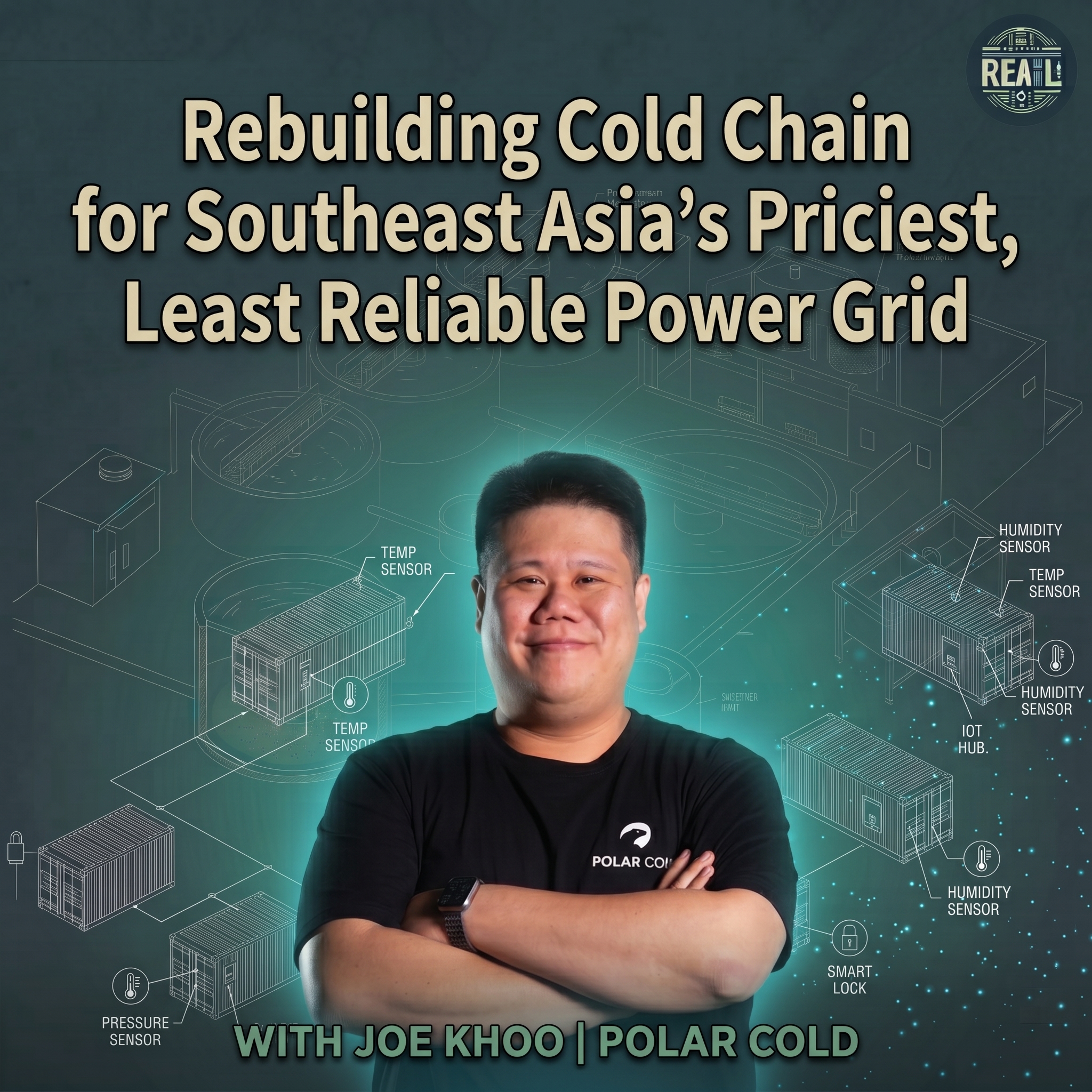
Rebuilding Cold Chain for Southeast Asia's Priciest, Least Reliable Power Grid | Joe Khoo
What if fixing cold chain in one of the most flood-prone, power-starved cities in Southeast Asia didn't take a mega-warehouse and millions in capital — just a modular box the size of a quarter shipping container, fifteen sensors, and a monthly rental? Joe Khoo is a hardware engineer chasing a climate mission since a solo trip through Japan's Zen temples convinced him, seventeen years ago, to build a career around sustainability. He studied electrical engineering at NUS, built VR hardware at a startup later acquired by Facebook, then designed "military-grade" padlocks as a product manager. Two solo startups went nowhere. One week after shutting down an AI device for blind users, ENGIE's venture studio called, needing a technical co-founder for the world's most energy-efficient cold room. That became Polar Cold. Then the model that got them funded nearly sank them: six-to-eight-month sales cycles didn't bring in enough cash, forcing a pivot to renting modular units instead. The day before this conversation, Joe sent a photo: stuck in Manila traffic, half the road underwater — as good a summary as any of the market he builds in. We go deep into why Joe would skip the Philippines in hindsight — Indonesia's market is bigger, its bureaucracy lighter — and why he built here anyway: identical energy savings are worth three times more at 30 cents a kilowatt-hour than Indonesia's subsidized 10. We get into the fifteen months it took to legally collect a credit-card payment, the word Joe coined for this market — "lumpy," squeezed by flood season, a truck curfew, and customs officials who double-charge on arrival — and how ENGIE's venture studio, with patient CapEx-friendly capital, made a two-year pivot survivable in a category most VCs won't touch. On the tech, we unpack how a cold room works, why Polar Cold tracks fifteen to sixteen variables per unit to catch a leak before it strands a customer's inventory, and how a 4G router on backup power tells Joe brownout from broken box, from his phone, mid-flight. Two months after 50% inventory utilization, Polar Cold is now at 95%, closing deals every week. This one is for anyone building inside a corporate venture studio and wondering if the business will ever feel like their own, choosing the harder market on purpose because the math said so, or keeping a CapEx-intensive business alive on someone else's patience. POLAR COLD & JOE — HIGHLIGHTS & IMPACT Modular cold rooms deploy in ~2 days vs. a 6-to-9-month traditional build 15–16 sensors per unit power predictive maintenance, catching leaks and dirty filters before they spoil inventory Inventory utilization jumped from ~50% to ~95% in two months; 24 boxes live in the Philippines, ~90–100 targeted by year-end CapEx payback period cut from 22 months to ~10 months Facebook/AI lead gen at ~$0.20/lead, converting into 6-to-12-month rentals Built inside ENGIE's venture studio — a rare CapEx-heavy climate idea to survive first-round validation Connect with Joe LinkedIn - https://www.linkedin.com/in/khooliqiangjoe/ Polar Cold - http://polar-cold.com/ Building something interesting? Reach out to Arjun: http://calendly.com/arjun-arcshift/ · https://www.linkedin.com/in/arjunthomas Building Real is a podcast about how things actually get built -- without the highlight reel gloss.
- Transcript