Skip to content
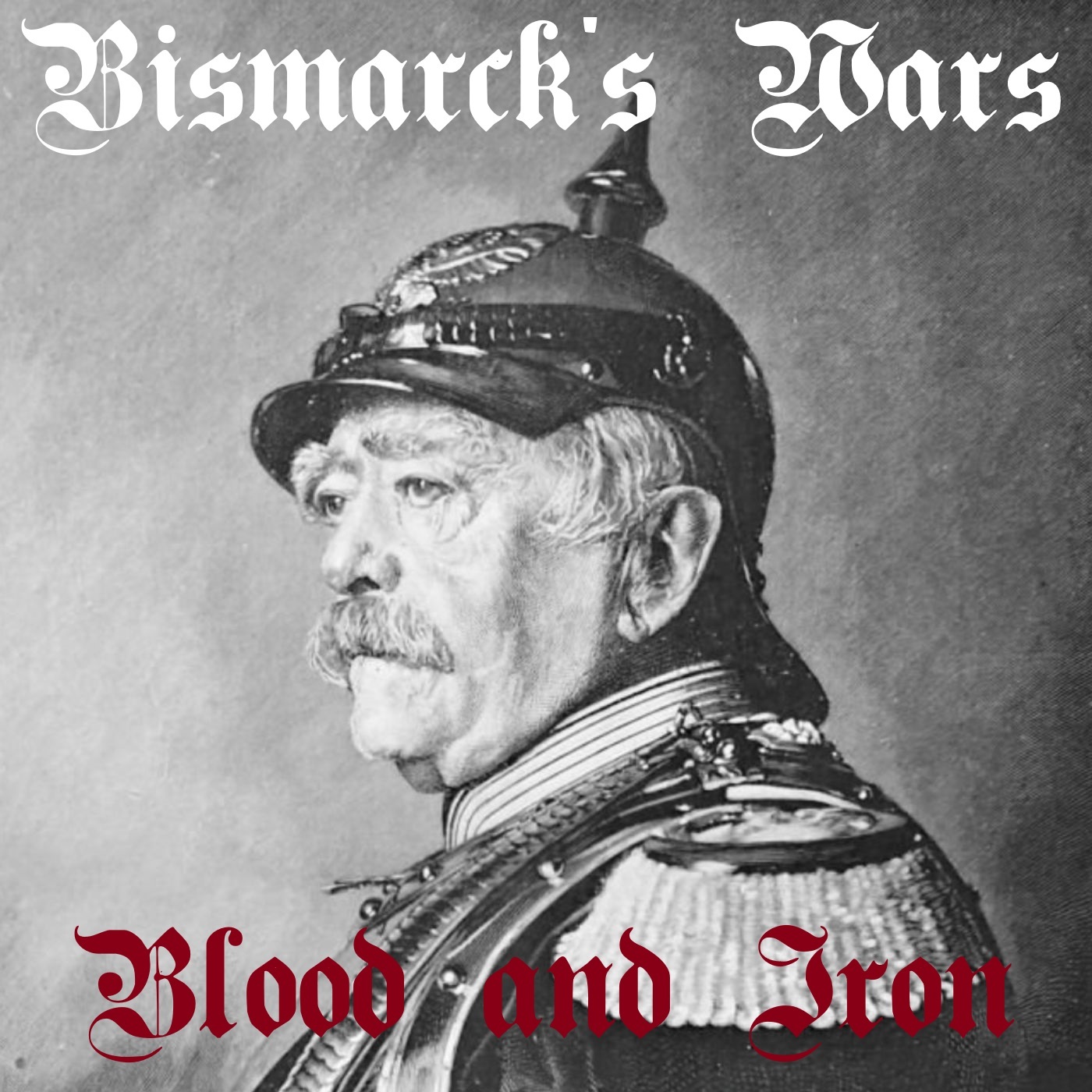
Artwork for Bismarck's Wars - Blood and Iron

Bismarck's Wars - Blood and Iron

Paul Kendrick

A History of the wars of Germen unification. The Revolution of 1848 and the first Schleswig War, the Second Schleswig War, the Austro - Prussian War, the Franco - Prussian War and the early years of the Germen Empire under the leadership of Otto von Bismarck.

Play
  • 24 episodes
  • Avg 20 min
  • English
Counted on this page — what you have heard stays on this device, so it is not something the list can be paged by.
  • S5 · E10
    September 5 · 20 min

    Episode 5.10

    The final years of Otto von Bismarck after his fall from power. Bismarck never forgave or forgotten how the Germen Emperor had removed him from power as chancellor of Germany. He was determinded to attack in the press the Emperor and new chancellor especially over Germen foreign policy, the estangement between Russia and Germany which led to Franco - Russian military allance. However Bismarck was now an old man and his health in decline, now us all even a truely great man must die.

  • S5 · E9
    August 29 · 20 min

    Episode 5.9

    Otto von Bismarck had remained the Germen chancellor because he had the support of Emperor Wilheim the First, however he died in 1888, his son was a dying man when he became Emperor and lived only for a few months. It was the old emperor grandson, Wilheim the Second, who became the third emperor for that year, he felt Bismarck was too old, within two years their relationship had broken down and Bismarck was dismissed from power.

  • S5 · E9
    August 22 · 20 min

    Episode 5.8

    To combat the threat of the growing Social Democratic Party, Bismarck introducded a carot and stick policy to win over the Germen working class. Bismarck introducted the first modern welfare state including old age pension and sickness insurance for Germen workers. He also introducted anti - Socialist laws to crack down on Socialism groups whose meetings could now be broken by the Police.

  • August 15 · 20 min

    Episode 5.7

    The great powers meet in Berlin in 1884 to agree the rules on how to divide up Africa. It was also agreed to set up the Congo Free State under the ruleship of King Leopold of Belgium, which would latter shock the world with the level of cruelity towards the native people. A biography of King Leopold is given. Bismarck reaches the age of seventy, he is now showing the signs of age.

  • S5 · E6
    August 8 · 20 min

    Episode 5.6

    This episode describes the background to the 1884 Congress of Berlin, in which all the great powers meet to discuss the division of Africa between the European Colonial powers and resolve the tensions between those colonial powers. France and Britain had already began to occupy parts of Africa but there were other colonial powers such as Portugal, Spain, Italy and Germany. Bismarck was not an imperialist but he relied upon the support of Conservatives in the Reichsatg, who wanted Germen colonies.

  • S5 · E5
    August 1 · 21 min

    Episode 5.5

    Following the Reichstag election of 1878, in which the Liberals lost seats to the Conservatives, Bismarck ended his working relationship with the Liberals, and began to work with the Conservatives and even the Catholic Centre Party. This allowed Bismarck to introduce tariffts to protect Germen business from foreign imports.

  • S5 · E2
    July 25 · 20 min

    Episode 5.4

    The outcome of thr Russo - Turkish War led to the threat of war between Britain and Russia. Due to defuse the tension, Otto von Bismarck called a congress of the European powers in Berlin, Bismarck was to the honest broker of the congress. Bismarck working with British Prime Minster Disreali did produce a successful peaceful resolution to the crisis.

  • S5 · E3
    July 18 · 21 min

    Episode 5.3

    The Russian invasion of the Ottoman Empire in the Balkans proved to a major threat to the European order that Bismarck. Winning that war would be hard work for the Russian becuase the Turkish troops would prove to able to fight well but in the end the sheer weight of numbers enable the Russian Army would overrun the Southern Balkans. Both Austria and Britain reacted with alarm, indeed it seemed possible that there would be a war between Russia and Britain.

  • S5 · E2
    July 11 · 20 min

    Episode 5.2

    The term 'Culture War' is much used today but the first offical culture war occured in Germany in the 1870's when Bismarck working with Germen Liberals began a camapaign against the Catholic Church in Germany. Legal constraints were placed upon thechurch, Bishops, Clergy and Lay Catholics were imprisioned but the campaign was a failure, it was the most foolish political act carried by Bismarck.

  • July 4 · 20 min

    Episode 5.1

    In order to acheive Germen unifaction, Otto von Bismarck engineered a war between France and the Germen Empire which cost thousands of lives. He bullied the South Germen States and bribed the King of Bavaria, so that the South Germen states joined the new Germen Empire. Yet when offered the King of Prussia, Willheim the role of the Emperor of Germany, he proved a very reculant monarch. However there would be a new Germen State created and Willheim would be the monarch, so crowned in a cermony held in the Hall of Mirrors held at the palace of Versillers in January 1871

  • S4 · E10
    February 14 · 20 min

    Episode 4.10

    In March 1871, there was a left wing revolt in Paris. Otto von Bismarck demanded that the French Government crush the Paris Commune. Bismarck released French prisiomers of war, to tkae part in the brutal capture of the City by the French Army. Thousands of the left wing supporters of the Paris Commune and the National Guardsmen who fought to defend the Paris Commune, were murdered in cold blood.

  • S4 · E9
    January 31 · 20 min

    Alsace - Lorraine

    With the new French Armies being defeated by the Germen Army in the early weeks of 1871. The majority of French public opinion wanted an end to the war. A cease fire deal was agreed with Bismarck. There was elections to a new French National Assembly held in occuiped and unoccuiped France, two thirds of those elected were conservative who wanted peace, Bismarck's price was high, France would pay Five Billlions Francs to Germany and hand over Alsace and Northern Lorraine but the price had to be paid

  • S4 · E8
    January 24 · 20 min

    Episode 4.8

    This episode deals with the final weeks of the Franco - Prussian War, a period which saw further French defeats. The worst of which was the defeat and destruction of the French Army of the East, which was forced to escape into Switzerland, where it was disarmed by the Swiss Army. Most Frenchmen now realised that victory was now impossible, their had to be peace.

  • S4 · E7
    January 17 · 21 min

    Episode 4.7

    The French Army Paris garrison would try to break out of the City and raise the siege by the Prussian Army. However none of these costly attacks were successfully. The people of Paris were cold and hungry would put pressure upon the French Government to launch yet another attack to break the siege but that it ended in failure. The episode also deals with the French Army of the North which managed to defend the region of the modern day Nord - de par Calais region.

  • S4 · E6
    January 10 · 19 min

    Episode 4.6

    The new French people's armies formed by Leon Gambetta took to the field in the winter of late 1870 to break the Prussian siege of Paris and come to the aid of the hungry city. The attack would come from the south largely around the city of Orleans which had been captured by the Germans. The French Army did defeat a Bavarian Corp and retake Orleans but then the tide turned against the French.

  • S4 · E5
    January 3 · 20 min

    Episode 4.5

    This Episode deals with the siege of Strassbourg, which was bombarded by Prussian Artillery. Then the siege of Metz, where the French Army of the Rhine was straved into surrending, having failed to do much to attack the Prussian Army which was besieging the French Army. Now most of the pre war regular French Army were now prisoners of war in the hands of the Prussians. Also I discuss the success of the French Navy in maintaining to kept control of the sea routes to France, so that the French Government could bring in weapons from the United States and Britain

  • S4 · E4
    Dec 27, 2025 · 20 min

    Episode 4.4

    Following the capture by the Prussians of French Emperor Napoleon the Third at the battle of Sedan. A new French Third Republic was declared in Paris, with new left wing government minister. The Prussian Army marches on Paris and besieges it. However there is a large French Army Garrison and good defensive posiitons protecting the French capital. So the Prussian Army do not attack into Paris but instead to make Paris suffer from hunger. French Army attempts to break the siege are unsuccessful.

  • S4 · E3
    Dec 20, 2025 · 20 min

    Episode 4,3

    As a result of the battle of Gravelotte, the French Army of the Rhine is forced to retreat back to the fortress of Metz, where it is besieged by the Prussians. A new French Army, the Army of Chalons is formed to rescue the French of the Rhine but it is not just defeated but destroyed at the Battle of Sedan. The French Emperor Napoleon the Third becomes a prisioner of the Prussians.

  • S4 · E2
    Dec 13, 2025 · 20 min

    Episode 4.2

    The Prussian Third Army defeats the French First Corp in a battle around the town of Worth. The French Army of the Rhine is in danger of being outflanked at Metz, so its commander General Bazaine orders a retreat to Verdun but it is blocked by the Prussian Army at the Battle of Mars la Tour.

  • S4 · E1
    Dec 6, 2025 · 20 min

    Episode 4.1

    The French Army mobilization turned into such a confused muddle that the French Army could only mount a limited and pointless advance of a few kilometers into the Saarland. It was the Prussian Army which attacked into France winning a costly victory over the French at the Battle of Spiceren.

Showing 1–20 of 24 episodes