Skip to content
Artwork for Biotech Career Coach
BusinessCareersEducationSelf-ImprovementScienceLife Sciences

Biotech Career Coach

Carina Clingman

The Biotech Career Coach Podcast helps scientists and biotech professionals take control of their careers.

Hosted by Carina Clingman, PhD, a veteran recruiter in the biotech industry, the show turns the confusing parts of the job search into clear, practical steps. Carina has recruited for biotech and medical device companies, run outplacement for teams hit by layoffs, and coached scientists across the industry into the roles they wanted. She brings that recruiter's eye to every episode.

Some weeks are solo deep dives job search and career strategy. Others are chats with biotech leaders and scientists who share how they built their careers. Either way, you leave with something you can use this week.

This is for you if you are a scientist trying to break into industry, a biotech professional navigating a layoff, or someone ready for the next move and tired of guessing what recruiters actually want.

Want more than the podcast? Join the Biotech Career Coach Skool community, where Carina works on your resume, cover letter, and job search with you, plus tools built to get you hired. Start here: https://www.skool.com/biotech-career-coach/about

Play
  • 22 episodes
  • Avg 24 min
  • English
Counted on this page — what you have heard stays on this device, so it is not something the list can be paged by.
  • #65
    Friday · 40 min· Video

    Best AI for Resume and Cover Letter (I Tested 6 Models Blind)

    What is the best AI for your resume and cover letter? I tested 6 AI models blind, one from each major model family plus an open weight model, to see which one tailors a resume to a job description the way a recruiter wants to see it. I get asked every week which AI to use for resume tailoring: ChatGPT, Claude, Gemini, or Grok? Free or paid? So I ran an experiment. Every model got the same template resume, the same job description, the same example tailored resume and cover letter, and the same prompt. I scored each output blind, then compared my scores with two AI judges (Claude Opus 5.5 and GPT-5.6 Sol) and Jev, a yes or no decision API that checks rules like headline format and a one-page cover letter. The AI models tested: Claude Opus 5.5 (Anthropic) Claude Sonnet 5.5 (Anthropic) Gemini 3.8 Flash (Google) GPT-6 Sol (OpenAI, ChatGPT) Grok (xAI) An open weight model I also share what each one costs and how fast it runs, so you can decide if paying for AI is worth it. In this episode you'll learn: Which AI model is best for tailoring a resume to a job description ChatGPT vs Claude vs Gemini vs Grok for resumes and cover letters Whether free AI models are good enough for job applications or worth paying for What a strong resume headline and highlights section look like to a recruiter The AI writing habits that make a cover letter unusable Why my human scores disagreed with the AI judges See every output side by side, plus the template resume, job description, and example inputs, in the Model Bake-Off on the Biotech Career Coach website under Learn. https://biotechcareercoach.com/ Want help tailoring your biotech resume and cover letter? Join our Biotech Career Coach Skool community for the portal, resume reviews, and interview prep. It is $9 a month with a 7-day free trial. Learn more about the Collaboratory Career Hub community and access our free resources: Join our Skool Community Take the Free 7-day Interview Sprint Challenge Check out our sister podcast: Building Biotechs Send Carina a connection request on LinkedIn! Stay connected with us: 🌐 Website 📱 Facebook 📷 Instagram 💼 LinkedIn 00:00 Which AI should you use to tailor your resume 01:15 How the blind AI resume test works 03:45 Inside the Model Bake-Off app and answer key 07:00 Scoring the resume headline and highlights 15:35 The AI cover letter I would submit with no edits 21:35 AI cover letter mistakes that fail the vibe check 26:50 Human scores vs AI judges and Jev rule checks 29:50 The reveal, which AI model wins 32:45 Free vs paid AI models for job applications 34:35 Compare AI resume outputs side by side

  • #64
    October 9 · 19 min· Video

    How to Follow Up After a Job Interview and When to Stop

    Wondering how to follow up after a job interview when all you hear is silence? In this episode, I answer the questions I get most about following up after an interview, from my one-on-one clients, outplacement clients, Skool community, and the people I give feedback to in my portal. I'm a biotech recruiter and career coach. A typical scientist or senior scientist role used to bring in 100 to 150 applicants. Now I see 500 to 700. Recruiters are stretched thin, and the silence after your interview might not be about you at all. In this episode: - Do you need to send a thank-you note after an interview, and who actually reads it - Why the hiring manager cares more about your thank-you note than HR or the recruiter - When a thank-you note can tip the scales between two equal candidates, and why it won't rescue a bad interview - How often to follow up after a job interview: one thank-you note, two follow-ups 7 to 10 days apart, then stop - What it means when the recruiter said you'd hear back by Friday and you didn't - Why some companies keep backup candidates warm for weeks, and how biotech hiring is different - Ghost jobs and roles posted for internal candidates, and why together they can add up to about half of job postings - Why being ghosted after a real conversation is a sign of a disorganized hiring process - Why you should treat every application and interview as if you didn't get the job, and keep your job search moving Mentioned in this episode: - How to Stop Overthinking and Start Making Career Moves: https://podcast.collaboratorycareerhub.com/podcast/how-to-stop-overthinking-and-start-making-career-moves-in-five-easy-steps-c7b050f2-7012-48b7-98a4-19 Waiting to hear back and starting to spiral? Join our Biotech Career Coach Skool community. You'll be surrounded by people working on their job searches, get direct access to me, and get personalized feedback on your application materials in our portal. Learn more about the Collaboratory Career Hub community and access our free resources: Join our Skool Community Take the Free 7-day Interview Sprint Challenge Check out our sister podcast: Building Biotechs Send Carina a connection request on LinkedIn! Stay connected with us: 🌐 Website 📱 Facebook 📷 Instagram 💼 LinkedIn

  • #63
    October 2 · 7 min· Video

    PhD to Industry Advice From a Biotech Recruiter

    Can you go straight from PhD to industry? The answer is yes, but you need to learn to market yourself. If you have heard how hard the job market is and wonder whether you should stay in academia until it gets better, this episode is for you. Biotech recruiter and career coach Carina Clingman shares the story of a community member who finished her PhD in Germany, moved to the US with her partner without a job, and worried her visa situation would make her unhireable. She networked hard, stayed motivated, got interview prep for every interview, and reviewed her interview transcripts question by question. She just accepted a scientist role at a biotech. In this episode you will learn: When a postdoc is a valid path, and when going straight to industry makes sense Why saying "we" about your research hides your unique contribution from hiring managers How STAR storytelling (situation, task, action, result) helps you answer interview questions with confidence Why a CV is not a resume, and why your resume needs to read like a marketing document Why most certificates do not impress hiring managers, and how to get hands-on experience instead How many publications you actually need for most industry roles Why to start applying about 90 days before you can start working Why to start networking six months or more before your graduation date Carina also suggests checking your grant funding, since some grants have career development built in and you may have unused funds. Ready to practice interviews, get feedback on your interview transcripts, and build industry connections alongside other scientists? Join the Biotech Career Coach community on Skool. Start with the networking challenge, which is introvert-friendly and created by scientists for scientists. You can try it with a 7-day free trial. Join the Biotech Career Coach Skool Community Learn more about the Collaboratory Career Hub community and access our free resources: Join our Skool Community Take the Free 7-day Interview Sprint Challenge Check out our sister podcast: Building Biotechs Send Carina a connection request on LinkedIn! Stay connected with us: 🌐 Website 📱 Facebook 📷 Instagram 💼 LinkedIn Chapters: 00:00 Can you go straight from PhD to industry 00:25 Postdoc or industry job for international PhD students facing visa sponsorship 00:55 How a PhD graduate landed a biotech scientist role with interview post-mortems 02:05 Why saying we in interviews hides your individual contribution 02:55 STAR storytelling for PhD interview answers 03:30 A CV is not a resume for industry jobs 04:00 Do certificates or more publications help you get an industry job 04:40 Volunteer in a lab or early-stage company to gain hands-on experience 05:25 When to start applying for industry jobs before your PhD defense 06:00 Network six months before graduation to find hidden job leads

  • #62
    July 17 · 23 min· Video

    Your Job Search Is a Marketing Campaign for You

    Your job search is a marketing campaign, and you are the product. In this episode, biotech career coach Carina Clingman shows you how to build a resume and cover letter that get past the software and win the six second scan. This is seminar one of a three part series Carina teaches for her outplacement career transition clients. She takes you inside a recruiter's applicant tracking system, where a single biotech role can draw 400 applicants, and shows how she narrows that pile down to the ten people worth a conversation. You will see why tailoring and keyword mirroring decide whether a human ever reads your resume at all. What you will learn: Why a resume is a marketing document, not a career archive or a CV The four things every resume needs to survive the six second scan How recruiters use Boolean and reverse keyword searches to cut applicants How to mirror a job description so a recruiter reads you as one of us The five professional highlights that work like a movie trailer for your experience Where to place degrees, publications, and skills for the most impact The T style cover letter hiring managers love and the three questions it must answer By the end you will treat every resume, cover letter, and LinkedIn message as a marketing message with one job, to make a hiring manager care about you. Watch for parts two and three, on LinkedIn and interviews, in the coming weeks. Want Carina to build your resume and cover letter with you? Join the Biotech Career Coach Skool community and get access to the brand new Biotech Career Coach app. Join here: Learn more about the Collaboratory Career Hub community and access our free resources: Join our Skool Community Take the Free 7-day Interview Sprint Challenge Check out our sister podcast: Building Biotechs Send Carina a connection request on LinkedIn! Stay connected with us: 🌐 Website 📱 Facebook 📷 Instagram 💼 LinkedIn 00:00 You are the Chief Marketing Officer of your own job search 04:25 Inside a recruiter's inbox with 400 applicants 06:30 How Boolean and reverse keyword searches cut your resume 07:30 Build your resume like a persuasive essay 09:02 The above the fold rule and mirroring the job description 11:30 Five professional highlights that work like a movie trailer 13:26 Where to put degrees, publications, and skills 16:39 The T style cover letter and the three questions it answers 19:00 Opening a cover letter with a personal story 22:19 What is coming in parts two and three

  • #61
    May 22 · 44 min· Video

    From Pipettes to Python: How to Break Into Computational Biology

    Most bench scientists think breaking into computational biology means going back to school. Dean Lee proves otherwise. Dean went from neuroscience PhD student at Harvard to Principal Computational Biologist at Novartis by teaching himself to analyze scRNA-seq data in stolen scraps of time alongside his bench job, and now he helps thousands of scientists make the same move through his online community Dean's List. In this episode, Dean and Carina break down exactly what it takes to build real computational biology credibility without another degree, without quitting your job, and without waiting for someone to hand you permission. You'll learn: Why Coursera certificates don't move hiring managers and what actually does How to find public biological data and build your first comp bio project this week The reproducibility strategy: why re-analyzing a published Nature paper is an industry skill and your best portfolio move at the same time How to pitch yourself as a funded intern through the Massachusetts Life Sciences Center to break into small biotech startups The state of entry-level comp bio hiring in 2026 and where the openings actually are How to frame volunteer work and self-directed projects on your resume so hiring managers take them seriously Whether you've been thinking about this pivot for years or you're just starting to wonder if it's possible, this conversation gives you the roadmap. RNA-Seq and ScRNA-Seq Courses How to become a computational biologist in a year The Big Challenge... With Dean Lee Dean's List Link In with Dean! Learn more about the Collaboratory Career Hub community and access our free resources: Join our Skool Community Take the Free 7-day Interview Sprint Challenge Check out our sister podcast: Building Biotechs Send Carina a connection request on LinkedIn! Stay connected with us: 🌐 Website 📱 Facebook 📷 Instagram 💼 LinkedIn 00:00 Dean Lee's path from Harvard neuroscience to computational biologist at Novartis 04:00 The volunteer scRNA-seq project that launched Dean's career pivot 07:30 Why hiring managers ignore certificates and look only for project work 12:00 How reproducing published research builds irrefutable portfolio proof 21:30 The MLSC funded intern hack for breaking into biotech startups 26:30 The 2026 comp bio job market and where entry-level roles actually exist 30:00 How to transition into computational biology within your current company 33:00 Operational AI vs scientific AI and what it means for your comp bio career

  • #60
    April 17 · 41 min· Video

    AI Agents vs Skills vs Automations: What Every Bench Scientist Needs to Know

    AI agents, skills, and automations. You keep hearing these terms, but nobody has clearly explained what they mean for someone actually working in biotech. In this episode, Carina sits down with Stu Angus, founder of Scriptome.AI and an AI consultant who works with small biotech companies every day, to break down exactly what each of these tools is, when to use one over another, and why getting this wrong leads to a lot of wasted time. Stu has 15 years of experience in biotech R&D and business development. He now helps small biotechs bridge the AI adoption gap that has opened up between them and big pharma, and he built Pavlov GPS, a free searchable database of 500+ AI tools for biotech R&D. If you have felt pressure to add AI to your workflow but had no idea where to start, this episode is the clearest, most practical answer you will find. What you will learn in this episode: The real difference between an AI skill, an agent, and an automation, and when to use each Why small biotechs are getting left behind on AI adoption and what that means for your career How to tell if your workflow is a good candidate for an agent or if a simple skill would do the job The “AI Slop cannon” problem and how to avoid automating your way into a mess How a team of five agents can wake you up every morning with tailored job applications already drafted Why Whisper Flow is the most underrated AI tool for bench scientists right now How Stu built Pavlov GPS starting from a spreadsheet, and how you can do the same with your own data Stu also weighs in on Copilot vs Claude, shares a spicy take on the most overhyped AI tool in biotech today, and tells us what he thinks every biotech professional will need to know how to do within five years. stu@scriptdo.ai Meet your AI team | Notion Wispr Flow 2026 Biotech AI Report | Benchling The Fast and the Curious — AI Upskilling for Biotech Scientists Pavlov-GPS | AI Tools Navigator for Biotech R&D Scriptome.AI Learn more about the Collaboratory Career Hub community and access our free resources: Join our Skool Community Take the Free 7-day Interview Sprint Challenge Check out our sister podcast: Building Biotechs Send Carina a connection request on LinkedIn! Stay connected with us: 🌐 Website 📱 Facebook 📷 Instagram 💼 LinkedIn 00:00 What the AI adoption gap in biotech actually means for your career 03:00 How small biotech companies are navigating board-level AI pressure with no roadmap 06:00 Big pharma vs small biotech and why the AI strategy divide is widening 07:30 Copilot vs Claude and how to advocate for the AI tools you need at work 12:00 How to develop a builder mindset and spot workflows worth automating 13:30 How a five-agent job search system handles company research and resume tailoring automatically 15:00 Agents vs skills vs automations defined for bench scientists with real examples 21:30 The slop cannon trap and how to avoid automating your way into low-quality output 27:00 What the Benchling 2026 AI report reveals about where AI is actually working in biotech R&D 29:30 How to build an AI tool from a spreadsheet using Pavlov GPS as a model

  • #59
    April 3 · 48 min· Video

    Win Over Every Interviewer (Even the Skeptics)

    Are you walking into biotech panel interviews and talking to every person the same way? That approach can cost you the offer, even if your science is solid. In this episode, Carina Clingman and returning guest Stacey Tannenbaum, PhD break down how to build rapport with each type of interviewer you'll meet on a panel day, from the VP who hasn't read your CV to the peer scientist who feels threatened by what you bring to the table. In this episode, you'll learn how to: Talk to senior leaders about strategic impact instead of getting stuck in technical details Show hiring managers you want this specific role, not just any job, and why that distinction is the number one thing they evaluate Recognize the three reasons peer interviewers become skeptics: fear of change, territorial expertise, and feeling intimidated by what they don't understand Use empathy, curiosity, and "I need your help" to turn resistant colleagues into allies Frame your science in terms that matter to cross-functional interviewers from other departments Ask better questions at every stage to make interviews feel like a two-way conversation Leverage your hiring manager as an ally to get intel on difficult personalities before you walk in the room Use presentation techniques like reading facial expressions, spotting "thought bubbles," and asking for feedback to build real connection during job talks Stacey has spent 20+ years leading teams in pharmacometrics at companies including Astellas, Metrum Research Group, and Novartis. She's sat on both sides of the interview table and now coaches scientists and technical professionals on communication and leadership through her consultancy, SJTPharm LLC. Whether you're preparing for your first biotech panel interview or your tenth, this episode gives you a practical playbook for winning over every person in the room. Connect with Stacey: https://www.linkedin.com/in/stacey-tannenbaum-phd-fisop/ Learn more about the Collaboratory Career Hub community and access our free resources: Join our Skool Community Take the Free 7-day Interview Sprint Challenge Check out our sister podcast: Building Biotechs Send Carina a connection request on LinkedIn! Stay connected with us: 🌐 Website 📱 Facebook 📷 Instagram 💼 LinkedIn 00:00 How to build rapport with different interviewer types in biotech 01:30 Why panel interviews require you to context switch between personalities 02:30 Talking to senior leaders without getting stuck in the technical weeds 05:00 Showing strategic impact when you're two or three levels below the VP 06:00 Using the job description as your North Star for every interview conversation 08:00 How to stand out when every early career CV looks the same 09:00 Building rapport with the hiring manager from the first screening call 11:00 Why telling your career story beats reading your CV out loud 13:30 The number one reason hiring managers reject candidates after screening calls 16:30 Why interviews are like dates and how to interview the company back 19:30 Why peer scientists are actually the scariest people on the interview panel 21:00 Three reasons peer interviewers become skeptics in your interview 24:00 Using empathy and "I need your help" to break down resistance 28:00 The "I thought that too" technique for handling pushback without getting defensive 31:00 Leveraging your hiring manager as an ally and getting intel before interview day 33:00 Planting questions and finding allies during your job talk 35:30 Reading the room and calling out thought bubbles in small group presentations 37:00 How to ask for feedback after a presentation the right way (Adam Grant method) 39:00 Building rapport with cross-functional and culture carrier interviewers 43:30 Translating your science into language that matters to other disciplines

  • #58
    March 13 · 47 min

    How Bench Scientists Are Getting Ahead With AI

    You keep hearing about AI, but nobody is telling you how it actually fits into a biotech career or a job search. That changes today. In this episode, Carina sits down with Heather Karner, a bench scientist with a background in RNA biology who works alongside machine learning researchers in the Bay Area. Heather is actively job searching and has quietly become the go-to AI resource for her lab and her network, not because she is a tech expert, but because she started experimenting and never stopped. Together they share the exact AI use cases they are running right now: a personalized daily brief that flagged Gilead and Eli Lilly RNA acquisitions before they hit LinkedIn, a literature review workflow built for scientists, how to use AI as a tireless teacher for coding and lab protocols, AI note taking that surfaced 10 action items from a 10-minute meeting, and how to turn a rambling brain dump into a clear, professional message. 🤖 Use Cases Covered in This Episode Heather's Use Cases: Personalized Daily Brief: Build a morning brief agent in Notion (using Claude Sonnet) that scans for job search signals: funding announcements, acquisitions, clinical trial updates, and new papers in your area of interest. Heather's brief flagged Gilead and Eli Lilly RNA-related acquisitions and a new AlphaFold Nature paper before it hit LinkedIn. Literature Review & Knowledge Management: Tools like Cheiron can do literature reviews, rank journals, and summarize papers in a clean interface built for biotech. Pair with Notion or NotebookLM for ongoing knowledge management. AI as a Tireless Teacher: Use your LLM to learn new things (coding, GitHub, lab protocols) without frustrating a real colleague. Ask it to do a session handoff when the context window gets long. Just ask your LLM to write a handoff prompt, paste it into a new chat, and keep going. AI Note Taking: Heather uses Notion's built-in AI note taker. After a 10-minute meeting, it surfaced 10 action items she had forgotten. Game changer for staying present and accountable. Brainstorming & Communication Clarity: Have your LLM critique your writing, don't just ask if it's good. Prompt it to assess from a specific perspective (e.g., "You are an editor at Cell..."). Great for cross-functional communication and helping scientists write for non-science audiences. Carina's Use Cases: Business Development / Job Search Brief: Similar to Heather's daily brief, but built on OpenClaw (advanced setup) to track funding announcements and generate LinkedIn networking target lists. Easily adaptable for job seekers tracking companies and building connections before roles are posted. PDF & Document Knowledge Base: Store all your protocols, papers, and references in Notion or NotebookLM (free with a Google account). Query across everything, generate slide decks, outlines, and even a podcast-style audio conversation about your documents. Use AI to Learn AI: Grab a YouTube transcript (free Chrome extensions can do this), paste it into your LLM, and ask it to teach you anything mentioned in the episode. Start with what you don't know. It'll find resources, explain concepts, and meet you at your level. Diplomatic Reply Drafting: Voice dump your real (snarky) frustration using Wispr Flow, then ask your LLM to translate it into a professional, diplomatic reply. Therapeutic and practical. Clarifying Your Own Story: If you're flustered, anxious, or telling a tangled story (career situation, job search frustration), brain dump via Wispr Flow and ask your LLM to help you find the clear, linear through-line before bringing it to coaching or a conversation. Grammarly: Free AI Writing Assistance - Free (and paid) writing assistant. Non-negotiable for job seekers. Every communication is part of your interview. Fathom AI Notetaker - Never Take Notes Again - Robust free AI note taker for Zoom, Meet, and Teams meetings. NotebookLM - Free Google tool for uploading PDFs, websites, and documents; query across them, generate podcasts, outlines, and slide decks. cheiron - AI-powered literature review and science knowledge platform built for biotech. Meet your AI team | Notion - All-in-one workspace with built-in AI, agents, and note taking. Try a free Business trial (includes Notion AI). ~$24/month after trial. Wispr Flow - Dictation tool that works in any text box, anywhere on your computer. Formats, corrects, and organizes as you speak. Life-changing. Learn more about the Collaboratory Career Hub community and access our free resources: Join our Skool Community Take the Free 7-day Interview Sprint Challenge Check out our sister podcast: Building Biotechs Send Carina a connection request on LinkedIn! Stay connected with us: 🌐 Website 📱 Facebook 📷 Instagram 💼 LinkedIn 00:00 Why scientists resist AI and what happens when they finally try it 02:30 How Heather became the go-to AI resource for her lab and her network 05:00 Notion as your AI home base: one subscription, every major LLM 07:00 Building a daily brief that tracks job search signals before they hit LinkedIn 11:00 How funding announcements predict hiring and who to network with next 15:00 Literature review and knowledge management tools built for scientists 21:30 Using AI as a tireless teacher and the session handoff trick 27:00 AI note taking: how a 10-minute meeting surfaced 10 forgotten action items 33:30 Staying present in interviews and using transcripts to become a better communicator 38:00 Turning a frustrated voice dump into a diplomatic, professional reply

  • #57
    February 26 · 25 min· Video

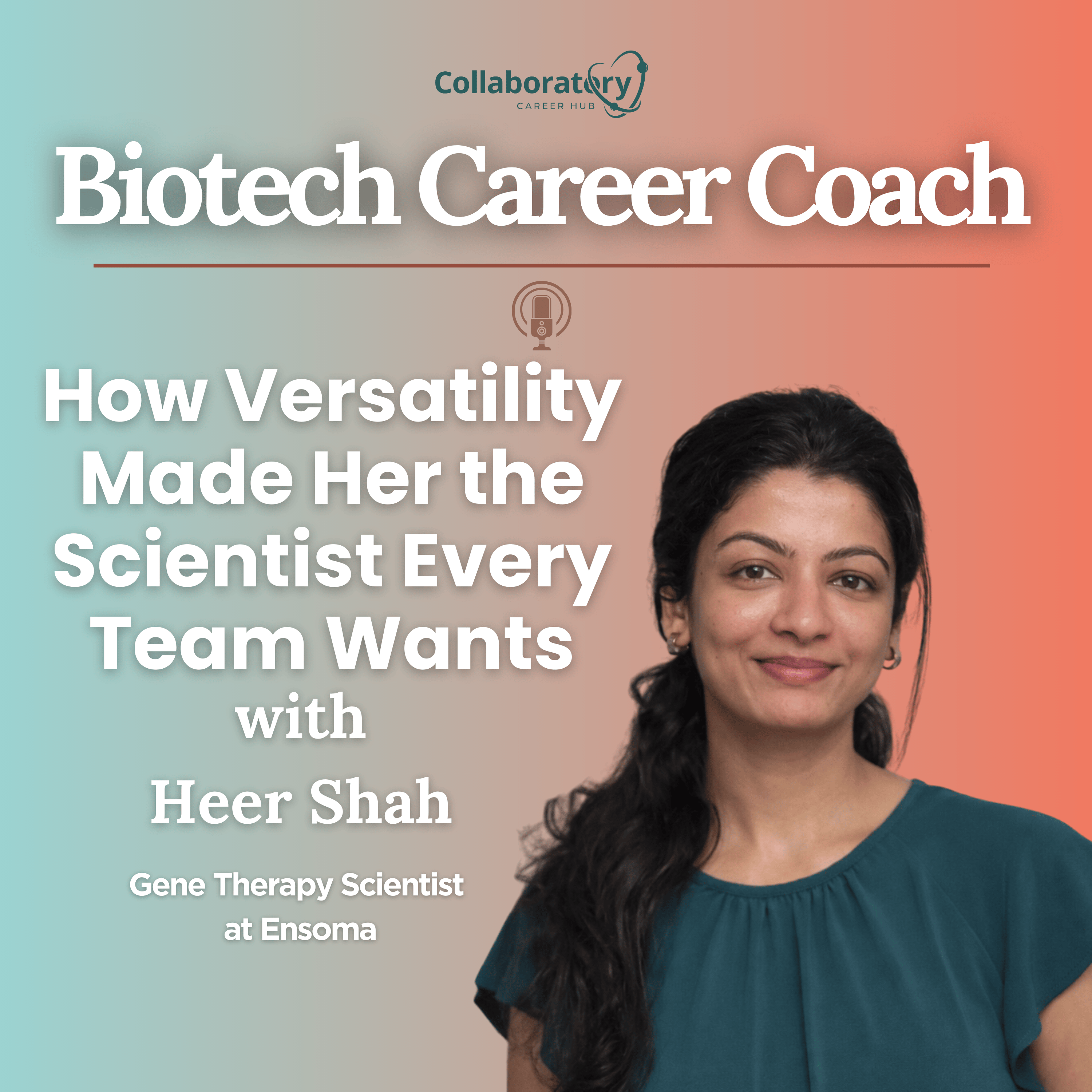
    How Versatility Made Her the Scientist Every Team Wants | with Heer Shah, Gene Therapy Scientist

    Are you holding yourself back from biotech roles because you don't check every box on the job description? You're not alone, and it's costing you opportunities. In this career chat, Carina sits down with Heer Shah, a Scientist in cell and gene therapy at Ensoma, a Boston-based biotech developing precision gene therapies using synthetic viral vectors and gene editing technologies. Heer has over seven years of biotech experience spanning vaccines, AAV, lentiviral vectors, VLPs, and LNPs, with roles at Merck, Intellia Therapeutics, Ring Therapeutics, and Sana Biotechnology. Heer holds a Master's in Biotechnology from Northeastern University, where the co-op program launched a career built on hands-on industry experience from day one. Today, Heer does vector engineering and gene editing optimization for programs targeting sickle cell disease and immuno-oncology. Heer shares how foundational lab skills and a big-picture mindset opened doors at every stage, and what it really takes to build a long-term biotech career across multiple modalities. Key takeaways from this episode: Why job descriptions are wish lists, not checklists, and why hiring managers value learning ability over a perfect resume match How to position diverse experience across biotech modalities as a competitive advantage The difference between specialists and integrators, and why companies need both What it's like surviving multiple rounds of biotech layoffs and how to build career resilience How the Northeastern co-op program helped Heer explore different company sizes and career paths before committing Why behavioral interview questions often matter more than technical ones How international scientists can navigate visa pathways, including the National Interest Waiver The career advice Heer wishes someone gave earlier: tell your story sooner Whether you're early in your biotech journey or navigating a career transition, this conversation is packed with practical advice on building transferable skills, staying adaptable, and landing roles you're excited about. Want scripts, practice drills, and feedback from peers in biotech? Join our Biotech Career Coach Skool community: https://www.skool.com/biotech-career-coach/about Connect with Heer on LinkedIn Learn more about the Collaboratory Career Hub community and access our free resources: Join our Skool Community Take the Free 7-day Interview Sprint Challenge Check out our sister podcast: Building Biotechs Send Carina a connection request on LinkedIn! Stay connected with us: 🌐 Website 📱 Facebook 📷 Instagram 💼 LinkedIn 00:00 Meet Heer Shah, Scientist in cell and gene therapy at Ensoma 01:30 Why the Northeastern co-op program is a biotech career accelerator 03:00 How co-ops at Merck and small biotechs shaped early career decisions 04:30 Building transferable skills across vaccines, AAV, lentiviral, VLP, and LNP 06:30 Specialist versus integrator, two paths in biotech and why both matter 08:00 Why job descriptions are wish lists and you should stop self eliminating 09:00 What recruiters and hiring managers actually look for beyond the resume 12:00 A day in the life of a cell and gene therapy scientist 14:00 Staying motivated through long drug development timelines 15:30 How international scientists can plan careers around visa considerations 18:00 The National Interest Waiver, a green card path most people don't know about 21:30 Lightning round, best career decision, biggest regret, and advice for grad students

  • #56
    January 16 · 48 min· Video

    Presentation Skills Can Make or Break Your Career

    Your technical skills might be perfect, but if you can't present them clearly, you won't get the job. Most scientists treat presentations like data dumps, and it costs them opportunities. In this episode, I sit down with Stacey Tannenbaum, PhD, a presentation skills consultant with over 25 years as an industry pharmacometrician and leader. Stacey has coached scientists across biotech to move beyond overly technical talks and become visible, credible communicators who actually advance their careers. What you'll learn: -Why job talks are completely different from conference presentations (and what hiring managers are really evaluating) -The biggest mistakes scientists make in presentations (dense slides, burying the lead, reading scripts, being monotone) -How to handle interruptions and questions you don't know the answer to without losing credibility -Practical techniques to add energy and clarity to technical presentations without dumbing down the science -Why your slides need to stand alone after you present them (and how to make that happen) -The one thing you must memorize before any high-stakes presentation -How to know when you're giving the audience too much technical detail versus the strategic insights they actually need Whether you're preparing for a job talk, presenting to leadership, or speaking at a conference, this episode will help you communicate your science in a way that opens doors instead of closing them. Join our Biotech Career Coach Skool community for scripts, practice drills, and feedback from peers navigating the same challenges Learn more about the Collaboratory Career Hub community and access our free resources: Join our Skool Community Take the Free 7-day Interview Sprint Challenge Check out our sister podcast: Building Biotechs Send Carina a connection request on LinkedIn! Stay connected with us: 🌐 Website 📱 Facebook 📷 Instagram 💼 LinkedIn Watch another great interview with Stacey! MORE tips on communicating and presenting virtually Stacey's tips on communicating via Zoom/Video Listen to another great podcast interview with Stacey! Connect With Stacey Stacey's Website 01:00 What pharmacometrics is and why it's a career path worth knowing about 05:00 How networking and volunteering at conferences can profoundly change your career trajectory 08:30 Why asking for help as a new leader actually builds credibility instead of undermining it 12:30 The pivot from corporate pharmacometrics to consulting on presentation skills 17:00 Job talks are about you, not the science (what hiring managers are really evaluating) 20:30 How to handle interruptions and questions you don't know during a job talk 27:00 Common presentation mistakes that cost scientists job offers 33:00 Dense slides kill presentations (build content gradually or break it up) 38:30 Why your slides need a life outside of you (annotate with take-home messages) 43:00 Practice until you're bored, then memorize the first 30 seconds

  • #55
    January 2 · 9 min· Video

    Quick Momentum For Your 2026 Biotech Career Goals

    January brings fresh biotech hiring budgets, energized hiring managers, and real momentum after a tough 2025. If you've been waiting for the right time to level up your biotech career, this is it. In this episode, you'll discover: Why January is the best month to apply for biotech jobs after a slow December How the December Networking Challenge helped members grow their LinkedIn reach and profile visibility The Application Challenge launches January 6th with five days of live teaching to build daily job search habits An annual career planning session on January 12th to map your 2026 goals A presentation skills workshop that can accelerate both job offers and promotions A 10-week AI course to help you work smarter and meet employer expectations in 2026 The Fire Horse approach to bringing bold, unstoppable energy to your career goals Whether you're job searching, seeking a promotion, or building new professional skills, this episode gives you the roadmap and momentum to make 2026 your breakthrough year. Join our Biotech Career Coach Skool community and start the year with structure, support, and a community that gets it. Learn more about the Collaboratory Career Hub community and access our free resources: Join our Skool Community Take the Free 7-day Interview Sprint Challenge Check out our sister podcast: Building Biotechs Send Carina a connection request on LinkedIn! Stay connected with us: 🌐 Website 📱 Facebook 📷 Instagram 💼 LinkedIn 00:00 Biotech hiring outlook for January 2026 and market momentum 00:30 Office updates and the community move to Skool platform 01:00 Seven Day Interview Accelerator and weekly Q&A with office hours 02:00 December networking challenge results and evergreen access 03:00 December interview challenges versus networking opportunities 04:00 January Application Challenge launch with five days of teaching 05:00 Annual planning session and presentation skills workshop details 06:00 Ten week AI course for automation and employer expectations 07:00 Fire Horse energy and setting bold intentions for career progress

  • #54
    Dec 12, 2025 · 12 min· Video

    LinkedIn Networking for Biotech: Give First to Get Better Results

    Networking in biotech doesn’t have to feel awkward or transactional. In this episode, Carina shares how giving first is the simplest way to build authentic biotech networking on LinkedIn that actually leads to stronger relationships and better opportunities. If you’re an introvert, early-career professional, or making a career change, this is your practical roadmap to connect with confidence. In this episode, you’ll learn: Why “give first” makes networking feel easier (and work better) How to add value even if you’re early in your career or switching fields What to say when you feel you’ve got nothing to offer The biggest outreach mistakes that make messages feel transactional Simple LinkedIn actions that build visibility and trust over time Insights from the Biotech Career Coach community’s December networking challenge (and what drove major reach growth) Want support, templates, and challenges to stay consistent? ✅ Join the Biotech Career Coach Skool community to connect with peers, access templates, and take part in challenges to grow your LinkedIn presence and your biotech network. Learn more about the Collaboratory Career Hub community and access our free resources: Join our Skool Community Take the Free 7-day Interview Sprint Challenge Check out our sister podcast: Building Biotechs Send Carina a connection request on LinkedIn! Stay connected with us: 🌐 Website 📱 Facebook 📷 Instagram 💼 LinkedIn 00:00 December networking challenge and results from the community 00:30 Why introverts struggle with networking and common fears 01:00 The psychology of giving first and why people enjoy helping others 02:00 Reciprocity as a natural instinct and how to nurture contacts 03:00 Building reputation by engaging meaningfully on the platform 04:00 You have more value than you think as an early professional 05:00 Strategic introductions and becoming a connector 06:00 Using PubMed and Google alerts to share relevant content 07:00 The power of genuine enthusiasm and gratitude 08:00 Networking is a long game that pays off over years 09:00 Tracking metrics and seeing platform reach grow 10:00 Common pitfalls to avoid when networking

  • #53
    Dec 5, 2025 · 10 min· Video

    I Challenge You: Build your Biotech Network in 28 days

    Biotech networking doesn’t have to feel random. In this video, I’ll walk you through a 28-day biotech networking challenge you can actually stick to. Perfect for biotech job seekers who want a clear, daily plan to grow their biotech career network in December and beyond. Here’s what you’ll learn: -Why December is secretly a powerful month for biotech networking -How to track your LinkedIn analytics so you know what’s really working -A simple system to map out target companies, teams, and hiring managers -How to send authentic, personalised connection requests that don’t feel salesy -Easy ways to nurture existing connections without being pushy or awkward -How to create and share quick LinkedIn content that expands your reach -Strategies to comment on posts so you stand out (without sounding generic) -Exactly how to ask for coffee chats that open doors in biotech -How to keep each step under 30 minutes a day so you can stay consistent -Turning this 28-day challenge into a repeatable, year-round networking habit This 28-day biotech networking challenge is the same one we’re running inside my Biotech Career Coach Skool community. You can join in with us or follow along solo – it’s designed so your “Day 1” can start whenever you’re ready. By the end of the challenge, you’ll have: -A stronger biotech network -More visibility to recruiters and hiring managers -Clearer data on what’s working in your job search -Real momentum heading into interview season 👉 Ready to start your biotech networking challenge? Join the Biotech Career Coach Skool community and jump into the challenge any time. Learn more about the Collaboratory Career Hub community and access our free resources: Join our Skool Community Take the Free 7-day Interview Sprint Challenge Check out our sister podcast: Building Biotechs Send Carina a connection request on LinkedIn! Stay connected with us: 🌐 Website 📱 Facebook 📷 Instagram 💼 LinkedIn 00:00 Why biotech networking beats job applications during the chilly December hiring season 00:30 Join the evergreen biotech networking challenge in our community 01:00 Track your LinkedIn for biotech analytics to measure networking impact 02:30 Build strategic biotech networking connections at target companies 03:30 Personalize LinkedIn for biotech connection requests with authentic messaging 05:00 Nurture your biotech networking relationships without being pushy 06:00 Expand your LinkedIn for biotech reach by creating shareable content 07:00 Master thoughtful engagement for biotech networking on LinkedIn 08:30 Turn biotech networking into coffee chats with proven ask templates 09:00 Build sustainable biotech networking habits in under 30 minutes daily

  • #52
    Nov 28, 2025 · 9 min· Video

    Six Second Resume Test: Make Your Biotech Resume Survive the Scan

    Does your biotech resume pass the six-second test? That's all the time most recruiters spend deciding who gets rejected and who deserves more attention. In this episode, we show you how to build a resume first page that survives the scan and wins interviews in today's biotech job market. Carina breaks down exactly what needs to go at the very top of your resume so a busy recruiter can see you meet the bar in just a few seconds. Drawing on real applicant tracking system data and years of biotech recruiting experience, you’ll learn how to design a sharp, focused top section that works in the real world. In this episode, you’ll learn how to: Use the job title and language from the job description to create a clear one-line headline Handle education, location, and work authorization without wasting valuable space Build a tight highlight reel that acts like a movie trailer for your career, not a generic skills dump Choose and place the right keywords so you work with, not against, applicant tracking systems Avoid long paragraphs and formatting choices that backfire during recruiter scans Whether you’re a scientist, operations professional, or business hire moving into biotech, this episode will help you avoid outdated advice and turn the top of your resume into a powerful hook instead of a missed opportunity. Learn more about the Collaboratory Career Hub community and access our free resources: Join our Skool Community Take the Free 7-day Interview Sprint Challenge Check out our sister podcast: Building Biotechs Send Carina a connection request on LinkedIn! Stay connected with us: 🌐 Website 📱 Facebook 📷 Instagram 💼 LinkedIn 00:00 The six-second recruiter test and the biotech resume 01:00 Why traditional advice fails modern biotech resume scans 02:30 How recruiters actually run a resume scan in applicant tracking systems 03:30 Above the fold and why the top of a biotech resume matters 04:15 Where degree and work authorization live on a biotech resume 05:00 Writing a sharp, tailored biotech resume headline 05:45 Using job description language in a way that passes the resume scan 06:30 Turning experience into a professional highlights reel on your biotech resume 07:30 Why long skills lists hurt you during a quick resume scan 08:00 Passing the six-second resume scan and getting to the shortlist

  • #51
    Nov 21, 2025 · 16 min· Video

    How to Use AI to Improve Resumes, Cover Letters, and Networking

    AI can completely change how you write resumes, cover letters, and networking messages for biotech roles, but only if you use it properly. In this episode, I show biotech professionals exactly how to use AI to improve applications and outreach without creating generic AI slop. If you're spending more than 30 minutes tailoring each resume, you're wasting time. And no, you will not be blasting out the same AI-generated resume to every job. In this episode, you'll learn to use AI as a strategic tool to help you think more clearly, present your experience better, and align with what companies are actually looking for. This episode covers the key takeaways from my full workshop, including: Going from job posting to a tailored resume and cover letter in about 10 minutes Picking the right AI models for different tasks (ChatGPT 5.1 vs Claude Sonnet) Understanding what AI agents are and how they differ from simple prompts Creating a strong base resume, then tailoring it to specific biotech job descriptions Keeping your own voice while still matching the language companies use Writing cover letters that connect your experience to a company's mission Crafting networking and outreach messages that actually get replies Avoiding AI hallucinations and generic wording that weaken your application Using more than one model to double-check facts and phrasing before you send This system is designed for biotech professionals who want to apply smarter, get better results, and stop spending hours on each application. Want to see the full workshop with live demos? Watch the YouTube version where I build resumes from scratch, show every click, and demonstrate the entire workflow in real time. 💬 Want all the prompts, templates, and AI agents? Join the Biotech Career Coach Skool community, where you can: Download the resume, cover letter and outreach templates Copy the exact AI setups I use Get feedback on your applications and job search strategy Learn more about the Collaboratory Career Hub community and access our free resources: Join our Skool Community Take the Free 7-day Interview Sprint Challenge Check out our sister podcast: Building Biotechs Send Carina a connection request on LinkedIn! Stay connected with us: 🌐 Website 📱 Facebook 📷 Instagram 💼 LinkedIn

  • #50
    Nov 14, 2025 · 7 min· Video

    The LinkedIn Setting Turning Your Profile Into A Mess For Recruiters

    Is a hidden LinkedIn setting making you look disorganized to recruiters? In this episode, I show you the LinkedIn setting that quietly pulls messy CV text into your profile in the LinkedIn Recruiter view, and makes you look less professional than you really are. If you have carefully curated your LinkedIn profile for job searching, you might be shocked to learn that recruiters often see a completely different version inside LinkedIn Recruiter. In this quick walkthrough, I show you exactly what is happening and how to switch it off. In this episode you will learn: How your public LinkedIn profile can look clean while your recruiter view is a wall of text What the “Enhanced by resume” label means in LinkedIn’s hiring tools How old CVs from “Easy Apply” can secretly overwrite your carefully edited experience section Why this makes you look disorganised and less clear than you really are Where to find the “Share resume data with hirers” setting in LinkedIn How to turn off resume data sharing and remove old CVs from your profile settings Why it is smart to review your LinkedIn data and AI settings regularly If you would like another pair of eyes on how recruiters see your profile, you can share it in my community, and I can check it from the LinkedIn Recruiter side. If you found this helpful, subscribe for more smart LinkedIn and job search tips, and stay tuned for my next episode on using AI intelligently in your job search. Learn more about the Collaboratory Career Hub community and access our free resources: Join our Skool Community Take the Free 7-day Interview Sprint Challenge Check out our sister podcast: Building Biotechs Send Carina a connection request on LinkedIn! Stay connected with us: 🌐 Website 📱 Facebook 📷 Instagram 💼 LinkedIn 00:00 The hidden LinkedIn setting affecting biotech professionals 00:30 Creating organized LinkedIn profiles for biotech career searches 01:00 Real biotech profile example showing LinkedIn setting issues 01:30 How recruiters see your LinkedIn profile differently 02:00 LinkedIn setting enhanced by resume adding unwanted content 02:30 Duplicated roles from LinkedIn setting causing first impression problems 03:00 Where to find your LinkedIn settings and privacy controls 03:30 LinkedIn data privacy settings and AI training for biotech professionals 04:00 The LinkedIn setting for job seeking preferences and resume sharing 04:30 How to turn off the LinkedIn setting sharing your resume data 05:00 Real biotech student example with four shared resumes 05:30 Wrapping up the LinkedIn setting PSA 06:00 Free biotech career community offer and next week's AI episode

  • #49
    Nov 7, 2025 · 21 min· Video

    Networking That Works (Without Being Awkward or Cringe)

    Most biotech professionals dread networking because it feels like cold calling, pushy, or inauthentic. If you've ever avoided reaching out because you didn't want to seem transactional or you felt stuck not knowing how to start a conversation, this episode is for you. Carina breaks down a strategic, human-centered approach to networking that leverages your natural curiosity as a scientist and turns it into your biggest career asset. You'll learn how to reconnect with former colleagues, build targeted networks within companies you want to work for, lead coffee chats that feel comfortable and genuine, and maintain momentum without burning out. Whether you're an introvert who freezes at networking events or someone who's been asking for jobs instead of building relationships, this episode will shift your mindset and give you scripts, strategies, and actionable steps to build a network that works for you long before you need it. Plus, Carina shares insider tips on volunteering, referrals, and how to follow up without feeling awkward. Ready to make networking less scary and way more effective? Join our free Biotech Career Coach Skool community for all the scripts, templates, and peer support to put these strategies into action. Learn more about the Collaboratory Career Hub community and access our free resources: Join our Skool Community Take the Free 7-day Interview Sprint Challenge Check out our sister podcast: Building Biotechs Send Carina a connection request on LinkedIn! Stay connected with us: 🌐 Website 📱 Facebook 📷 Instagram 💼 LinkedIn 00:00 Why biotech networking feels like cold calling and how to reframe it 01:00 Networking for biotech professionals is a long game strategy 03:00 Stop asking for jobs through networking and build relationships instead 04:30 Leverage your curiosity as your biotech networking superpower 05:30 LinkedIn networking strategy for reconnecting with former colleagues 07:30 The virtual coffee networking offer that opens doors 08:30 How to grow your biotech network through warm introductions 09:00 Company targeted LinkedIn networking for biotech job seekers 11:00 The LinkedIn networking script for reaching out to biotech professionals 13:00 Turning networking coffee chats into job referrals 14:00 Biotech networking through volunteering for introverts 15:30 Networking coffee chats and the 80/20 rule for success 16:30 LinkedIn networking questions to prepare before your coffee chat 18:00 Following up on LinkedIn networking without being pushy 18:30 Daily networking habits that build your biotech career network

  • #48
    Oct 31, 2025 · 10 min· Video

    How To Fix Your Boring LinkedIn Headline

    Your LinkedIn headline is one of the most valuable pieces of real estate on your profile, but most biotechnology professionals are wasting it. In this episode, Biotech Career Coach Carina Clingman reviews real LinkedIn biotech professional headlines to show you exactly what works and what doesn't. You'll see why leading with job titles or acronyms like "VP at Company X" or "Ex-FDA" falls flat, while headlines that lead with outcomes and value propositions get clicks. Carina breaks down examples in real time, rating them from one to five and explaining what makes headlines like "Helping Molecules Become Medicines" instantly compelling. Whether you're a scientist looking to stand out to recruiters, a founder or executive building your thought leadership, or anyone wanting to make their profile more clickable, this episode gives you the framework to audit and upgrade your own headline. Learn how to use the limited preview space in LinkedIn feeds strategically, why mission-driven language scores higher than corporate jargon, and how to turn credentials into click-worthy statements. Join our Free Biotech Career Coach Skool community for personalized feedback on your headline and connect with peers who are leveling up their LinkedIn presence. Learn more about the Collaboratory Career Hub community and access our free resources: Join our Skool Community Take the Free 7-day Interview Sprint Challenge Check out our sister podcast: Building Biotechs Send Carina a connection request on LinkedIn! Stay connected with us: 🌐 Website 📱 Facebook 📷 Instagram 💼 LinkedIn 00:00 Why your LinkedIn headline matters for biotech professionals 00:30 How LinkedIn headlines appear in your profile feed preview 01:00 Rating LinkedIn headline examples for non-biotech professionals 02:00 Strong LinkedIn headline example with social proof and credibility 02:30 Why specificity and impact make LinkedIn headlines more effective 03:00 Mission-driven LinkedIn headlines that set biotechnology professionals apart 04:00 Common LinkedIn headline mistakes biotech professionals make with acronyms 05:00 Reframing negative language into positive outcomes for LinkedIn headlines 06:00 Creating compelling LinkedIn headlines for biotechnology professionals 07:00 Turning credentials into positive LinkedIn headline statements 08:00 LinkedIn headlines that showcase outcomes over job titles for biotech professionals 09:00 Getting LinkedIn headline feedback from the Free Biotech Career Coach Skool community

  • #47
    Oct 24, 2025 · 31 min· Video

    How to stop overthinking and start making career moves in five easy steps

    Overthinking shows up as research without drafts, resumes that never get sent, and weeks of “planning” with nothing shipped. In this episode, I map out concrete ways to move from thinking to doing without burning out. We walk through fear types (failure, rejection, judgment, and even success) and simple reframes that keep you moving. You’ll learn how to turn rejection into useful data, set one clear priority each day, and use time blocks and short deadlines so work actually leaves your laptop. We also cover how to pace growth so a bigger role feels sustainable, not scary, and how to build lightweight systems and feedback loops so you improve with every rep. If you’re applying, aiming for promotion, or restarting after a stall, you’ll leave with a clear way to pick an action, ship it within 24 hours, and review what happened. No pep talks, just steps. Join our Free Biotech Career Coach Skool community for accountability, feedback, and tools to put this into practice. Learn more about the Collaboratory Career Hub community and access our free resources: Join our Skool Community Take the Free 7-day Interview Sprint Challenge Check out our sister podcast: Building Biotechs Send Carina a connection request on LinkedIn! Stay connected with us: 🌐 Website 📱 Facebook 📷 Instagram 💼 LinkedIn 00:00 What overthinking looks like in real life (and what it costs) 01:00 The overthinking tax with concrete job-search and BD examples 03:00 Spotting the pattern: hedging, silence, and drafts that never ship 06:30 Naming the fear: failure, rejection, judgment, success 08:30 Treat rejection as signal: raise sample size and iterate 10:30 Shrink the audience: optimize for three people who actually matter 12:00 Make success sustainable: pace growth and ask for support 18:30 Perfectionism in practice: time blocks, tight deadlines, accountability 23:00 Missing reps: daily actions, lightweight systems, faster feedback 26:00 The five-step exit loop: name it, detach, pick one, ship, review

  • #46
    Oct 17, 2025 · 24 min· Video

    Rewrite Your Story: Confident Interview Scripts to Explain Gaps, Layoffs, and Job Hops

    When an interviewer asks about a layoff, a resume gap, or a short stint that didn’t work out, the goal isn’t to defend the past. It’s to show judgment, growth, and readiness for what’s next. In this episode, we walk through a simple narrative framework you can adapt to any uncomfortable situation: set the context briefly, name the decision you made, highlight the skills and results you built during or after the experience, and connect it directly to the role in front of you. You’ll hear examples for gaps, restructurings, performance issues, and culture misalignments, plus quick scripts you can practice to sound clear and calm under pressure. We’ll also cover how to avoid oversharing, how to keep emotions in check without sounding robotic, and how to end with a forward-looking close that refocuses the conversation on your value to the team. If you’re job searching in biotech or planning a move in the next six months, this is a repeat-listen episode. Learn more about the Collaboratory Career Hub community and access our free resources: Join our Skool Community Take the Free 7-day Interview Sprint Challenge Check out our sister podcast: Building Biotechs Send Carina a connection request on LinkedIn! Stay connected with us: 🌐 Website 📱 Facebook 📷 Instagram 💼 LinkedIn 00:00 Why awkward questions derail good interviews 01:12 The formula to create a narrative for tough situations 03:05 Handling layoffs and restructurings without sounding defensive 05:02 What to say about resume gaps (caregiving, health, re-skilling) 07:10 Turning short stints and job hops into a story of good judgment 09:06 Addressing performance issues and what changed 11:02 How to avoid oversharing and manage tone 12:15 Forward-looking closes that refocus on value 13:30 Quick practice scripts you can adapt today 15:10 Final checklist before your next interview

Showing 1–20 of 22 episodes