Skip to content
Artwork for Best AI papers explained
Best AI papers explained · August 7 · 23 min

When Does LeJEPA Learn a World Model?

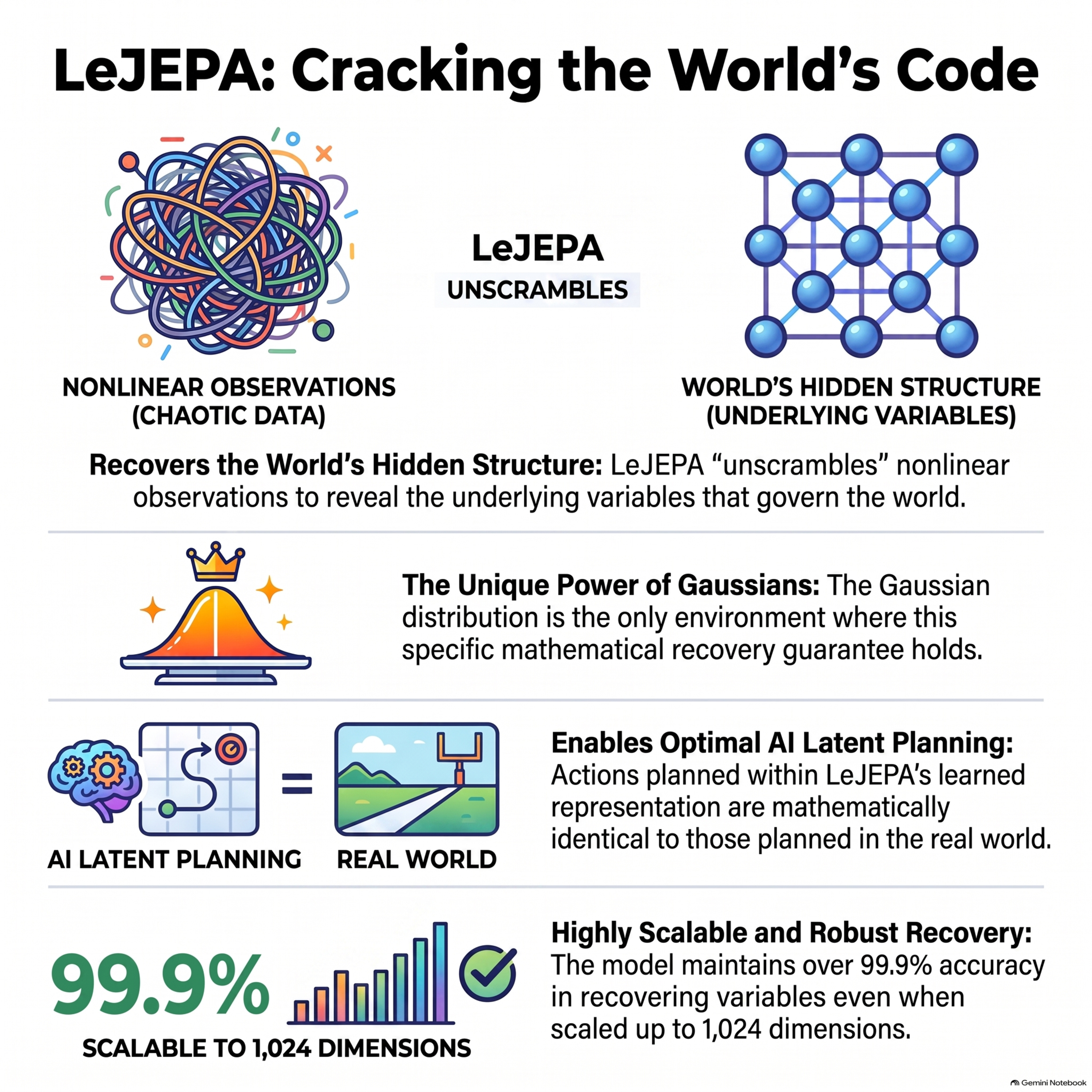
This research paper introduces a mathematical framework to prove that LeJEPA (a specific self-supervised learning architecture) can accurately recover the hidden structure of the world from complex data. The authors establish that when a model combines an alignment loss with Gaussian regularization, it achieves linear identifiability, meaning the learned representation is a simple rotation of the world’s true latent variables. This property is shown to be unique to Gaussian latent distributions, as any nonlinear distortion of the representation would strictly degrade the model's predictive performance. Furthermore, the study demonstrates that this linear recovery is essential for optimal latent-space planning, allowing an agent to navigate a learned model as effectively as the real world. The theory is supported by experiments ranging from 2D simulations to high-dimensional robotic control tasks, confirming that the model's training objectives act as a reliable proxy for structural accuracy. Ultimately, the work provides a formal foundation for building World Models that are mathematically guaranteed to be faithful to the environments they represent.


0:00-23:00

transcript

No transcript — this publisher did not publish one.

show notes

This research paper introduces a mathematical framework to prove that LeJEPA (a specific self-supervised learning architecture) can accurately recover the hidden structure of the world from complex data. The authors establish that when a model combines an alignment loss with Gaussian regularization, it achieves linear identifiability, meaning the learned representation is a simple rotation of the world’s true latent variables. This property is shown to be unique to Gaussian latent distributions, as any nonlinear distortion of the representation would strictly degrade the model's predictive performance. Furthermore, the study demonstrates that this linear recovery is essential for optimal latent-space planning, allowing an agent to navigate a learned model as effectively as the real world. The theory is supported by experiments ranging from 2D simulations to high-dimensional robotic control tasks, confirming that the model's training objectives act as a reliable proxy for structural accuracy. Ultimately, the work provides a formal foundation for building World Models that are mathematically guaranteed to be faithful to the environments they represent.