Skip to content
Artwork for Best AI papers explained
Best AI papers explained · July 15 · 22 min

What Does Thompson Sampling Optimize?

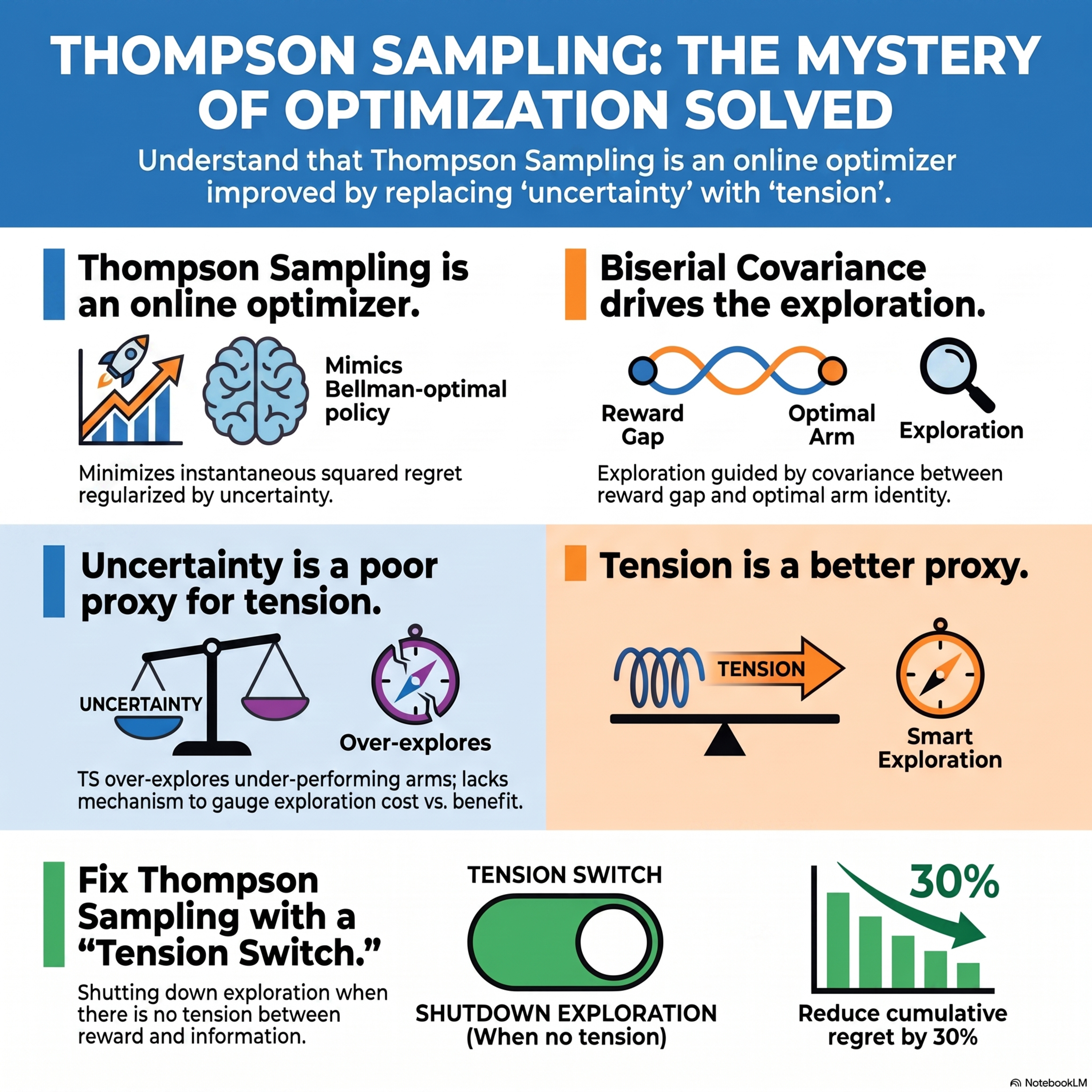
This research paper investigates the underlying mechanisms of Thompson Sampling, a popular bandit algorithm, by reframing it as an online optimization process. While traditionally viewed as a simple heuristic, the authors prove that Thompson Sampling actually minimizes instantaneous squared regret regularized by a specific measure of residual uncertainty. By comparing this mechanism to a Bellman-optimal benchmark, the study identifies a performance gap caused by Thompson Sampling's failure to account for the "tension" between exploration and exploitation. To address this, the authors propose a principled fix that adaptively shuts down exploration when the leading arm also provides the most information. Ultimately, this framework provides a theoretical compass for improving randomized algorithms by treating policy design as regularizer engineering.


0:00-22:18

transcript

No transcript — this publisher did not publish one.

show notes

This research paper investigates the underlying mechanisms of Thompson Sampling, a popular bandit algorithm, by reframing it as an online optimization process. While traditionally viewed as a simple heuristic, the authors prove that Thompson Sampling actually minimizes instantaneous squared regret regularized by a specific measure of residual uncertainty. By comparing this mechanism to a Bellman-optimal benchmark, the study identifies a performance gap caused by Thompson Sampling's failure to account for the "tension" between exploration and exploitation. To address this, the authors propose a principled fix that adaptively shuts down exploration when the leading arm also provides the most information. Ultimately, this framework provides a theoretical compass for improving randomized algorithms by treating policy design as regularizer engineering.