Best AI papers explained · November 10 · 24 min
User Embeddings are Superpositions of Interpretable Behavioral Modes
0:00-24:00
transcript
show notes
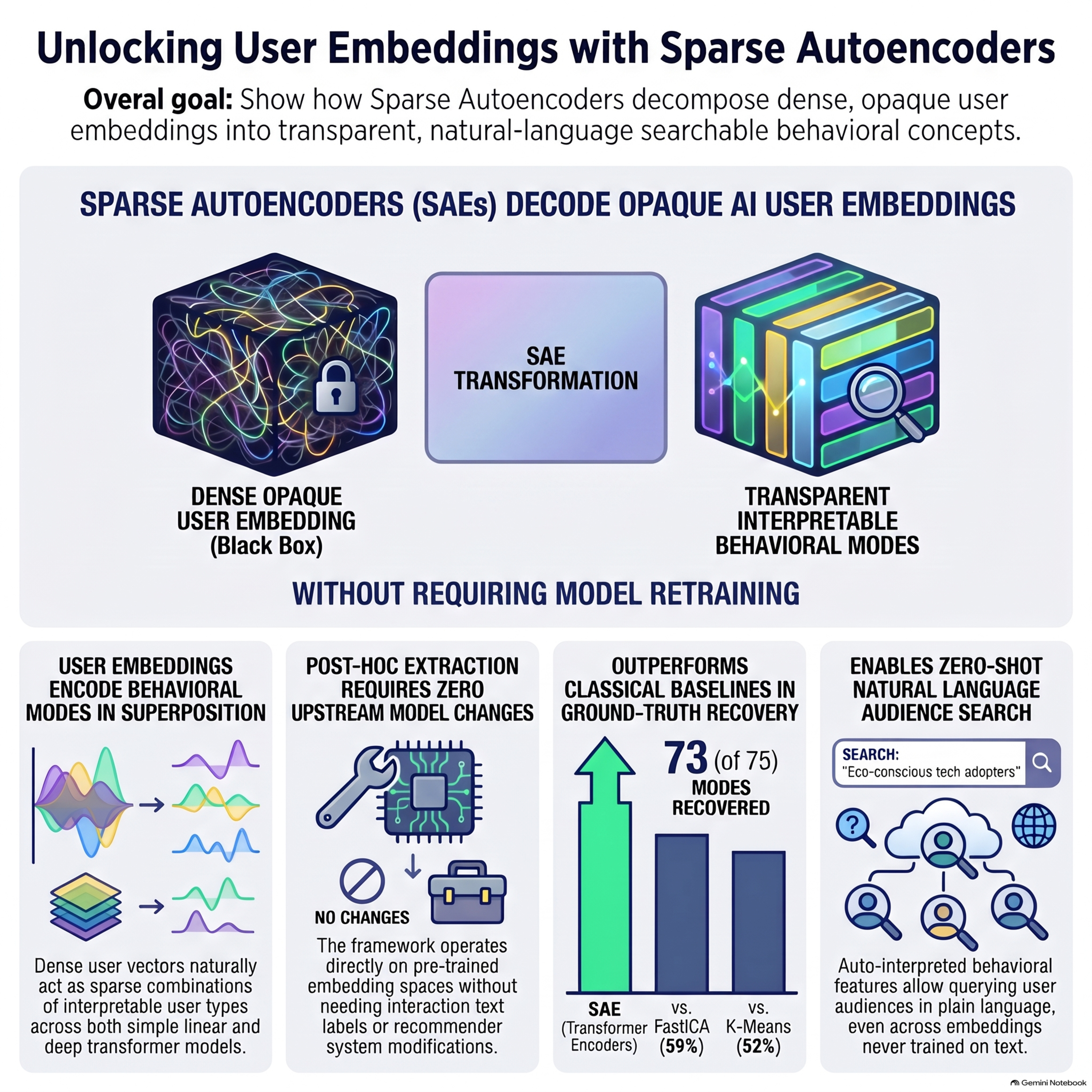
This paper explores how sparse autoencoders can be applied to user embeddings to uncover hidden behavioral modes without needing raw interaction data or text-aligned training. By treating user representations as sparse superpositions of interpretable concepts, this post-hoc, model-agnostic framework enables zero-shot natural language audience retrieval and fine-grained characterization. Extensive validation on synthetic data, e-commerce records, and transformer-based sequential recommenders demonstrates that sparse autoencoders successfully recover underlying behavioral structures while outperforming classical dimensionality reduction methods in reconstruction fidelity, ranking quality, and feature diversity.