Skip to content
Artwork for Best AI papers explained
Best AI papers explained · Yesterday · 23 min

TTPO: Test-Time Policy Optimization

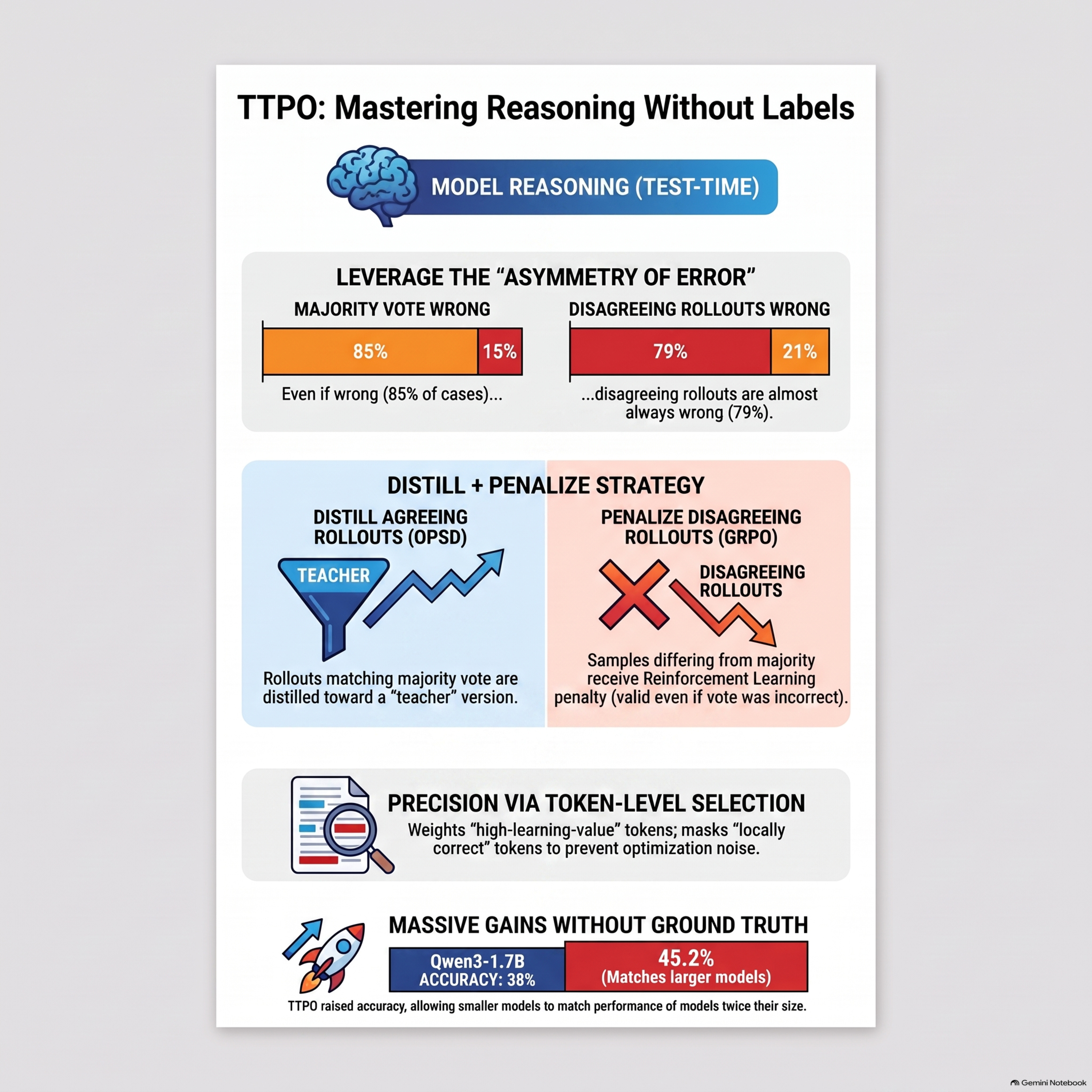
This paper introduces Test-Time Policy Optimization (TTPO), a novel method for improving the mathematical reasoning of large language models without using ground-truth labels. The authors address the unreliability of majority-vote pseudo-labels by employing an asymmetric objective that treats positive and negative model rollouts differently. Specifically, it uses on-policy self-distillation to refine trajectories that agree with the majority and Grouped Reinforcement Learning to penalize those that disagree. This design is enhanced by token-level selection, which focuses learning on informative positions while masking out confident errors and already-mastered content. Experimental results demonstrate that TTPO matches the performance of label-supervised methods and enables a self-evolving cycle where the model's improvements lead to higher-quality training signals. Ultimately, the framework significantly boosts accuracy on competition-level benchmarks and exhibits strong cross-task generalization.

0:00-23:00

transcript

No transcript — this publisher did not publish one.

show notes

This paper introduces Test-Time Policy Optimization (TTPO), a novel method for improving the mathematical reasoning of large language models without using ground-truth labels. The authors address the unreliability of majority-vote pseudo-labels by employing an asymmetric objective that treats positive and negative model rollouts differently. Specifically, it uses on-policy self-distillation to refine trajectories that agree with the majority and Grouped Reinforcement Learning to penalize those that disagree. This design is enhanced by token-level selection, which focuses learning on informative positions while masking out confident errors and already-mastered content. Experimental results demonstrate that TTPO matches the performance of label-supervised methods and enables a self-evolving cycle where the model's improvements lead to higher-quality training signals. Ultimately, the framework significantly boosts accuracy on competition-level benchmarks and exhibits strong cross-task generalization.