Skip to content
Artwork for Best AI papers explained
Best AI papers explained · Thursday · 20 min

Thinking with Looped Flows

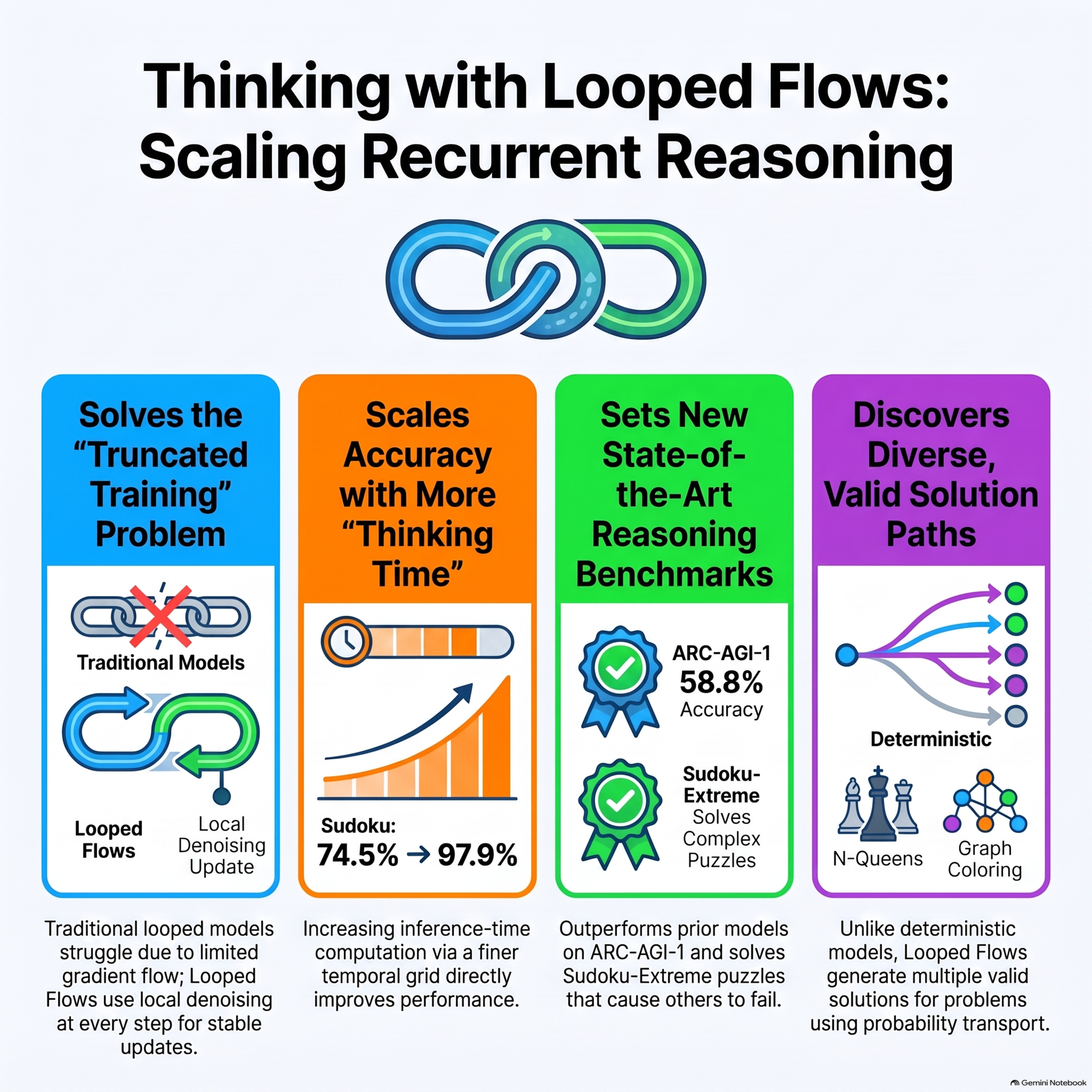
This paper introduces looped flows, a novel framework designed to enhance the reasoning capabilities of neural networks by merging recurrent hidden states with probability flow models. Traditional looped models often struggle with training instability because they cannot effectively backpropagate through many iterations, but this approach sidesteps that issue by using local denoising objectives across various noise levels. By gradually reducing noise and sharing information across steps, the model learns a stable recurrence that builds complex computations over time. During inference, the system solves difficult problems by integrating a stateful probability flow, which allows for increased accuracy through more intensive computation. This method significantly outperforms previous benchmarks in abstract reasoning and complex puzzles like Sudoku and Maze-Hard. Furthermore, the framework enables diverse solution generation by transporting different initial noise samples toward valid final outcomes.

0:00-20:04

transcript

No transcript — this publisher did not publish one.

show notes

This paper introduces looped flows, a novel framework designed to enhance the reasoning capabilities of neural networks by merging recurrent hidden states with probability flow models. Traditional looped models often struggle with training instability because they cannot effectively backpropagate through many iterations, but this approach sidesteps that issue by using local denoising objectives across various noise levels. By gradually reducing noise and sharing information across steps, the model learns a stable recurrence that builds complex computations over time. During inference, the system solves difficult problems by integrating a stateful probability flow, which allows for increased accuracy through more intensive computation. This method significantly outperforms previous benchmarks in abstract reasoning and complex puzzles like Sudoku and Maze-Hard. Furthermore, the framework enables diverse solution generation by transporting different initial noise samples toward valid final outcomes.