Skip to content
Artwork for Best AI papers explained
Best AI papers explained · Saturday · 21 min

Thinking to Recall: How Reasoning Unlocks Parametric Knowledge in LLMs

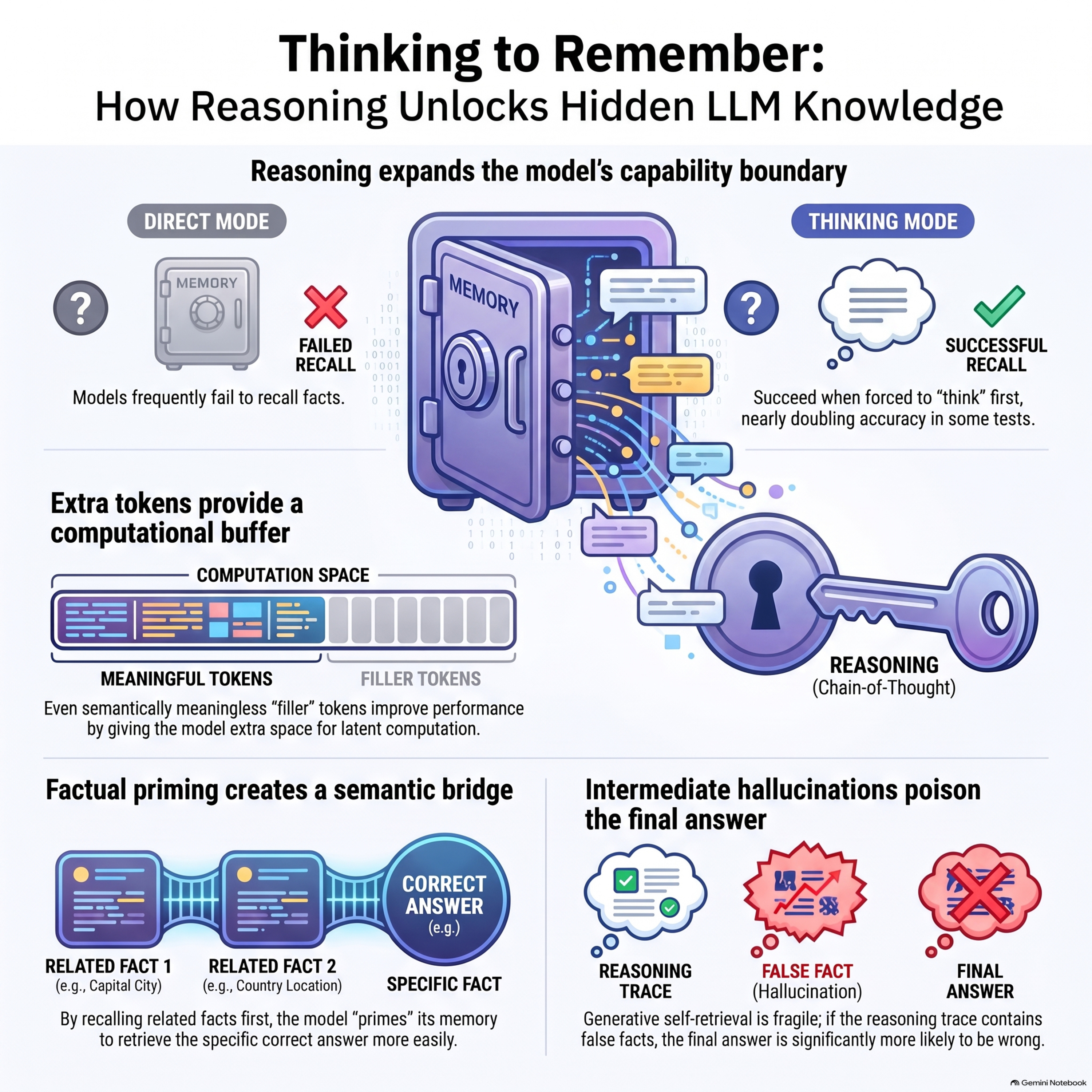
This research explores how reasoning helps Large Language Models (LLMs) answer simple, single-hop factual questions that do not logically require step-by-step thinking. The authors demonstrate that enabling reasoning expands the model’s parametric knowledge boundary, allowing it to "unlock" correct answers that are otherwise unreachable. This improvement is driven by two primary mechanisms: a computational buffer effect where extra tokens allow for more latent processing, and factual priming where the model retrieves related facts to bridge toward the correct answer. However, the study warns that hallucinating facts during the reasoning phase significantly increases the risk of providing a false final answer. Ultimately, the paper suggests that accuracy can be improved by prioritizing reasoning paths that contain verified factual statements.

0:00-21:21

transcript

No transcript — this publisher did not publish one.

show notes

This research explores how reasoning helps Large Language Models (LLMs) answer simple, single-hop factual questions that do not logically require step-by-step thinking. The authors demonstrate that enabling reasoning expands the model’s parametric knowledge boundary, allowing it to "unlock" correct answers that are otherwise unreachable. This improvement is driven by two primary mechanisms: a computational buffer effect where extra tokens allow for more latent processing, and factual priming where the model retrieves related facts to bridge toward the correct answer. However, the study warns that hallucinating facts during the reasoning phase significantly increases the risk of providing a false final answer. Ultimately, the paper suggests that accuracy can be improved by prioritizing reasoning paths that contain verified factual statements.