Skip to content
Artwork for Best AI papers explained
Best AI papers explained · August 29 · 21 min

SPADE: Self-Play in Adaptive Synthetic Executable Environments

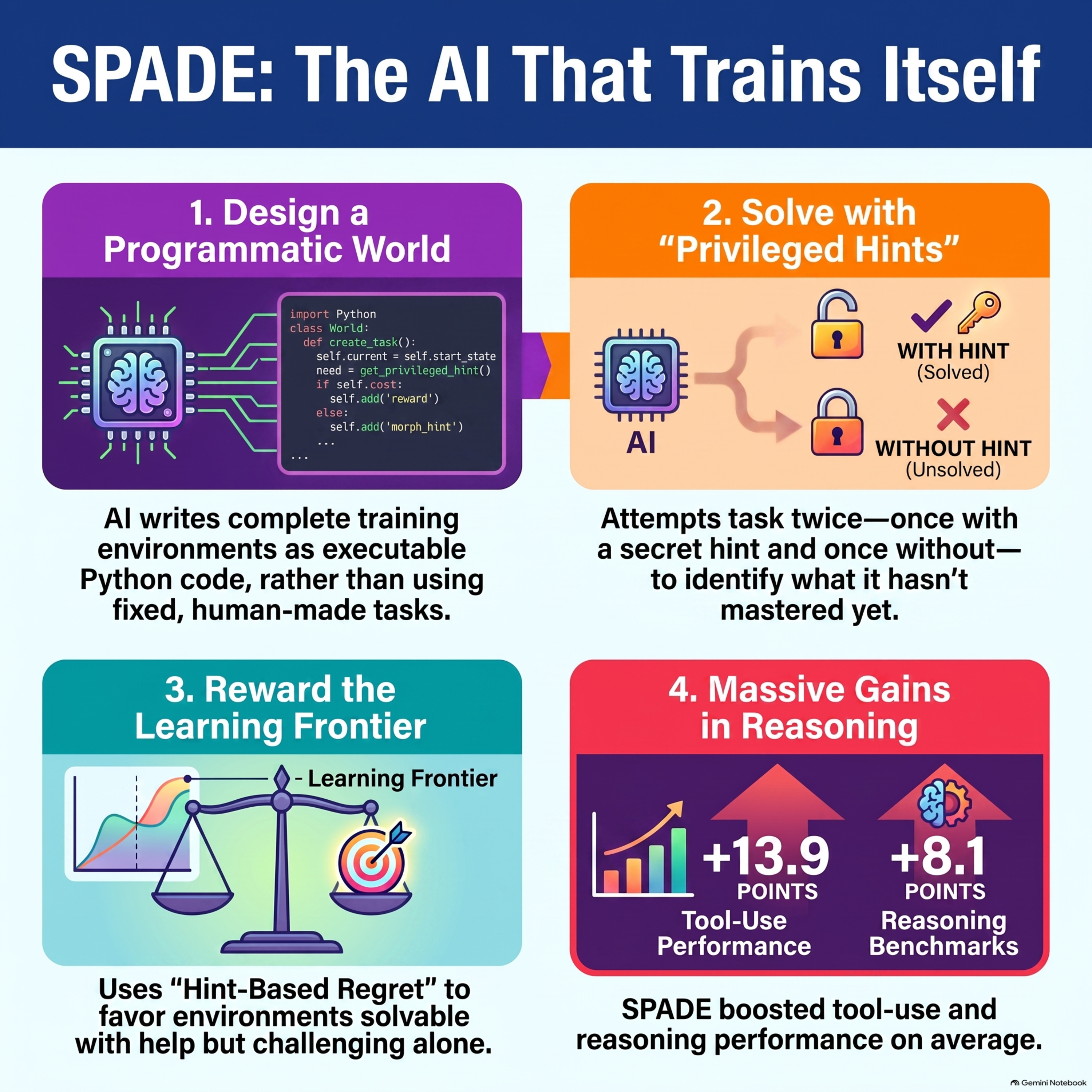
This paper introduces SPADE, a reinforcement learning framework that enables a single large language model to achieve open-ended self-improvement by designing its own training worlds. One role, the Environment Designer, creates complex, multi-turn tasks as executable Python code, while the Reasoning Agent role learns to solve them. To ensure the tasks are challenging yet possible, the system utilizes a hint-based regret signal, rewarding the designer when an agent succeeds with a secret hint but fails without it. This competitive dynamic allows the training curriculum to automatically evolve in complexity as the model's capabilities grow. Research results demonstrate that SPADE significantly outperforms static training methods across various math, coding, and tool-use benchmarks. By turning environment creation into a learnable skill, the framework offers a scalable solution to the scarcity of high-quality human data.

0:00-21:46

transcript

No transcript — this publisher did not publish one.

show notes

This paper introduces SPADE, a reinforcement learning framework that enables a single large language model to achieve open-ended self-improvement by designing its own training worlds. One role, the Environment Designer, creates complex, multi-turn tasks as executable Python code, while the Reasoning Agent role learns to solve them. To ensure the tasks are challenging yet possible, the system utilizes a hint-based regret signal, rewarding the designer when an agent succeeds with a secret hint but fails without it. This competitive dynamic allows the training curriculum to automatically evolve in complexity as the model's capabilities grow. Research results demonstrate that SPADE significantly outperforms static training methods across various math, coding, and tool-use benchmarks. By turning environment creation into a learnable skill, the framework offers a scalable solution to the scarcity of high-quality human data.