Skip to content
Artwork for Best AI papers explained
Best AI papers explained · Sunday · 24 min

Q-Learning with World Models

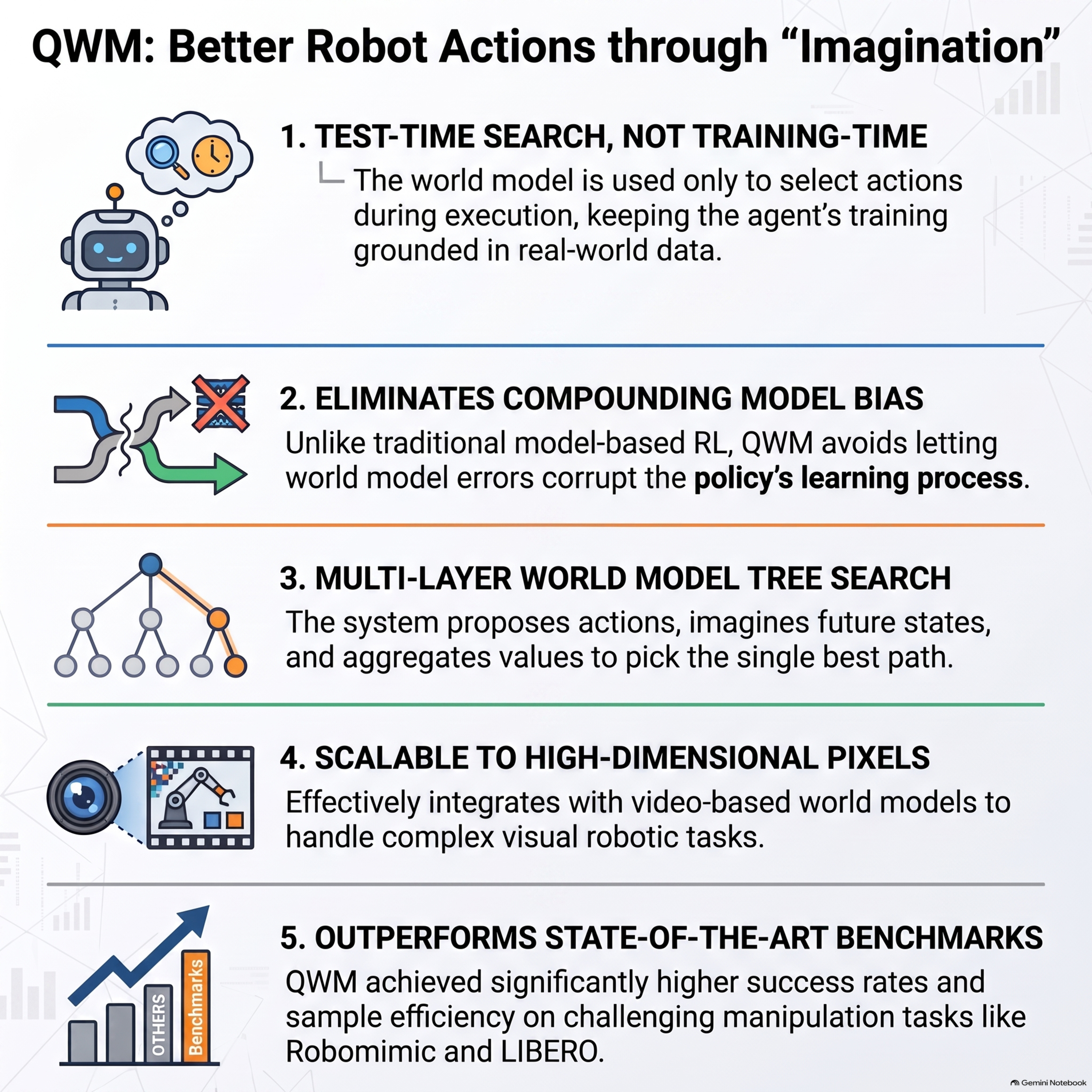
The researchers introduce Q-Learning with World Models (QWM), a framework designed to enhance sample efficiency and performance in robotic reinforcement learning. Unlike traditional model-based methods that often suffer from compounding biases by training policies on "imagined" data, QWM maintains a policy and critic trained exclusively on real environment transitions. It leverages a learned world model specifically at test-time to conduct tree searches over potential future trajectories, allowing the agent to select actions with the highest predicted downstream value. This approach combines the predictive power of world models with the stability of grounded Q-learning to navigate complex, high-dimensional tasks. Experiments on challenging manipulation benchmarks like Robomimic and LIBERO demonstrate that QWM significantly outperforms existing model-free and model-based baselines. Ultimately, the framework scales effectively from state-based inputs to visual observations, providing a robust method for improving online reinforcement learning.

0:00-24:42

transcript

No transcript — this publisher did not publish one.

show notes

The researchers introduce Q-Learning with World Models (QWM), a framework designed to enhance sample efficiency and performance in robotic reinforcement learning. Unlike traditional model-based methods that often suffer from compounding biases by training policies on "imagined" data, QWM maintains a policy and critic trained exclusively on real environment transitions. It leverages a learned world model specifically at test-time to conduct tree searches over potential future trajectories, allowing the agent to select actions with the highest predicted downstream value. This approach combines the predictive power of world models with the stability of grounded Q-learning to navigate complex, high-dimensional tasks. Experiments on challenging manipulation benchmarks like Robomimic and LIBERO demonstrate that QWM significantly outperforms existing model-free and model-based baselines. Ultimately, the framework scales effectively from state-based inputs to visual observations, providing a robust method for improving online reinforcement learning.