Skip to content
Artwork for Best AI papers explained
Best AI papers explained · Tuesday · 20 min

Position: LLMs can’t jump

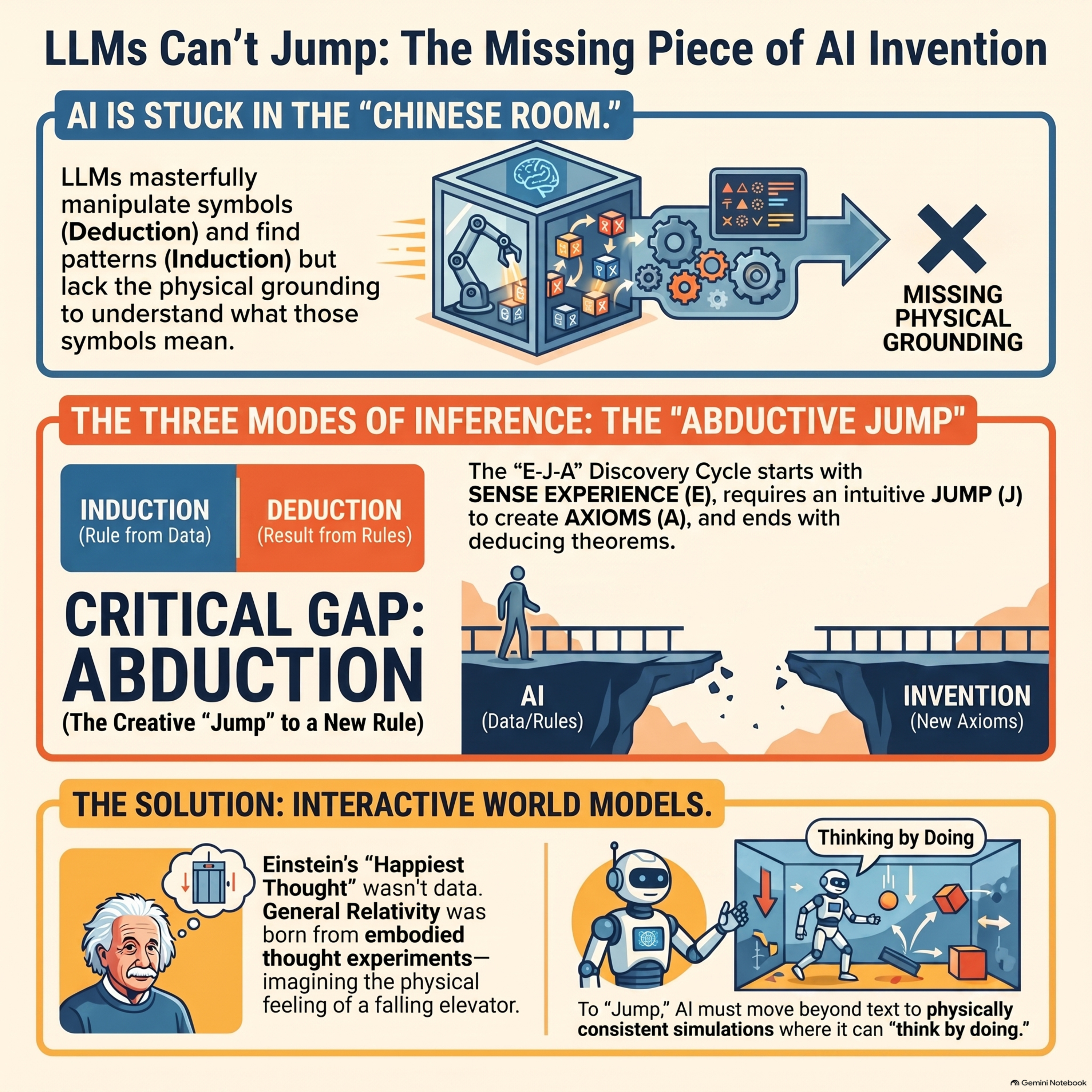
This paper examines the cognitive limitations of Large Language Models by using Albert Einstein’s discovery of General Relativity as a primary case study. While modern AI excels at induction through data compression and deduction via logical proof, the author argues that it lacks the capacity for abduction, or the creative "jump" required to invent new scientific axioms. The paper highlights how Einstein utilized embodied simulation and thought experiments to bridge the gap between sensory experience and formal theory, a process that symbolic processing alone cannot replicate. To overcome this, the author suggests that AI needs action-controllable world models that allow for counterfactual reasoning and physical grounding. Ultimately, the source posits that true scientific invention requires moving beyond statistical pattern matching toward systems that can interact with and simulate the physical world.


0:00-20:55

transcript

No transcript — this publisher did not publish one.

show notes

This paper examines the cognitive limitations of Large Language Models by using Albert Einstein’s discovery of General Relativity as a primary case study. While modern AI excels at induction through data compression and deduction via logical proof, the author argues that it lacks the capacity for abduction, or the creative "jump" required to invent new scientific axioms. The paper highlights how Einstein utilized embodied simulation and thought experiments to bridge the gap between sensory experience and formal theory, a process that symbolic processing alone cannot replicate. To overcome this, the author suggests that AI needs action-controllable world models that allow for counterfactual reasoning and physical grounding. Ultimately, the source posits that true scientific invention requires moving beyond statistical pattern matching toward systems that can interact with and simulate the physical world.