Skip to content
Artwork for Best AI papers explained
Best AI papers explained · Monday · 22 min

Next-Latent Prediction Transformers Learn Compact World Models

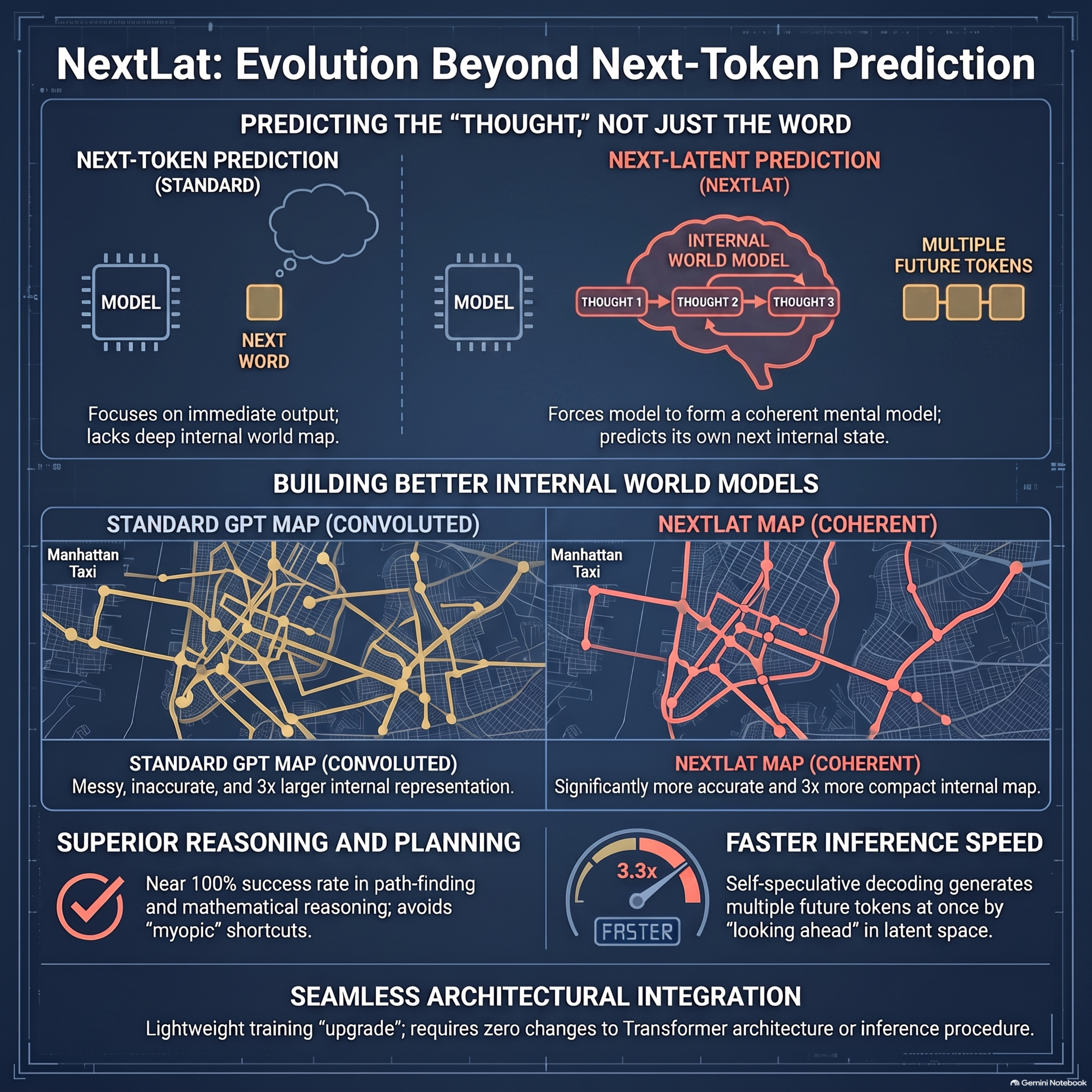
This paper introduces Next-Latent Prediction (NextLat), a novel training framework designed to help Transformer models learn more compact and generalizable internal world models. Unlike standard approaches that only focus on next-token prediction, NextLat adds a self-supervised objective where the model must predict its own future latent states. This method encourages the formation of belief states, which are efficient summaries of past information that improve the model’s ability to reason, plan, and generalize. Theoretically, this injects a recurrent inductive bias into the architecture without sacrificing the parallel training efficiency or speed of the original Transformer. Empirically, NextLat demonstrates superior performance in world modeling and long-horizon reasoning compared to traditional baselines. Furthermore, the learned latent dynamics enable variable-length self-speculative decoding, which can accelerate inference speeds by over three times.

0:00-22:34

transcript

No transcript — this publisher did not publish one.

show notes

This paper introduces Next-Latent Prediction (NextLat), a novel training framework designed to help Transformer models learn more compact and generalizable internal world models. Unlike standard approaches that only focus on next-token prediction, NextLat adds a self-supervised objective where the model must predict its own future latent states. This method encourages the formation of belief states, which are efficient summaries of past information that improve the model’s ability to reason, plan, and generalize. Theoretically, this injects a recurrent inductive bias into the architecture without sacrificing the parallel training efficiency or speed of the original Transformer. Empirically, NextLat demonstrates superior performance in world modeling and long-horizon reasoning compared to traditional baselines. Furthermore, the learned latent dynamics enable variable-length self-speculative decoding, which can accelerate inference speeds by over three times.