Skip to content
Artwork for Best AI papers explained
Best AI papers explained · September 27 · 21 min

Language models need sleep: learning to self-modify and consolidate memories

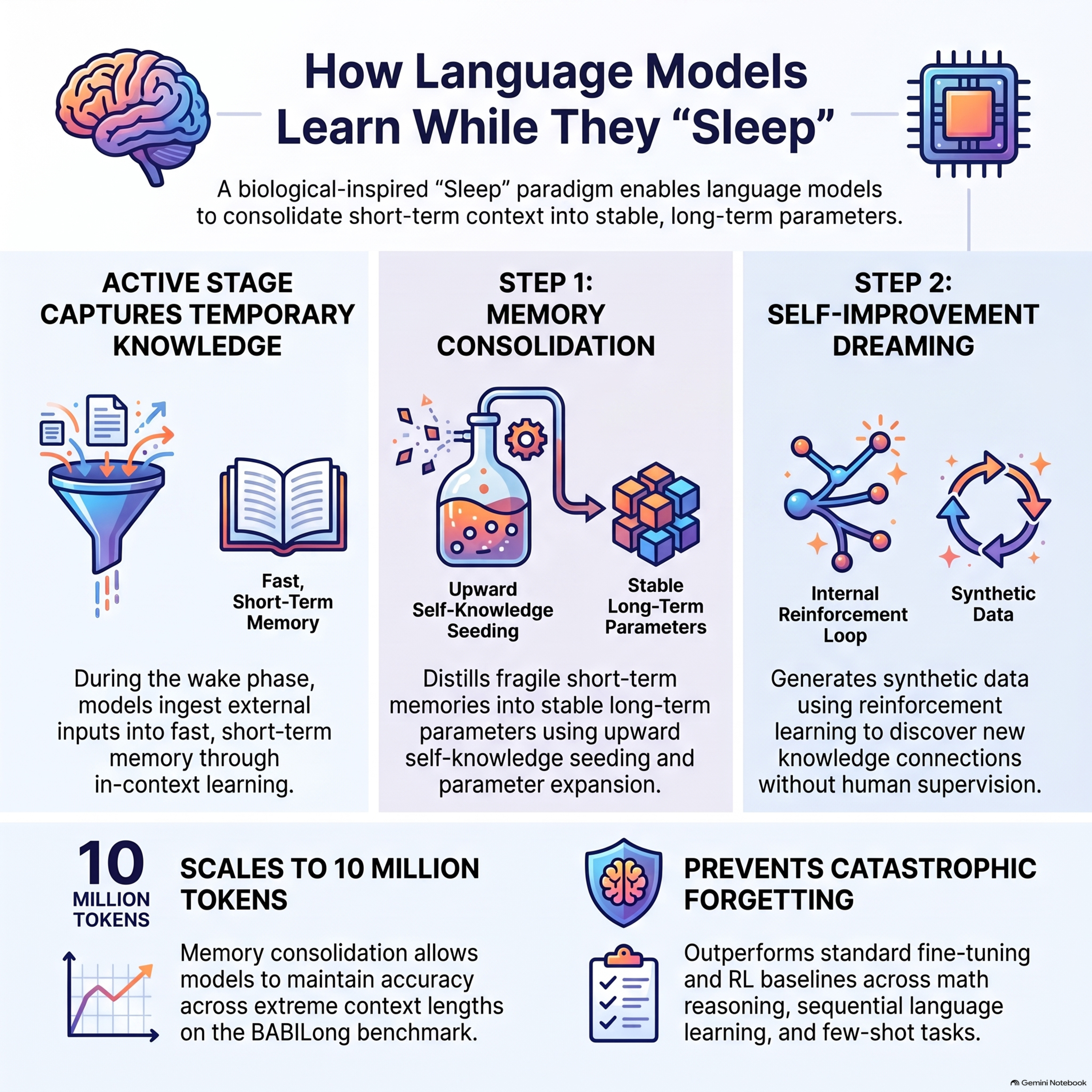
This research paper introduces a "Sleep" paradigm for Large Language Models (LLMs) to overcome the limitations of static knowledge and catastrophic forgetting. Inspired by human biology, the framework alternates between active phasesfor processing external data and sleep phases for internal knowledge refinement. During sleep, the model performs memory consolidation by expanding its parameters and distilling fragile, short-term information into stable, long-term parametric memory. A secondary "dreaming" phase utilizes reinforcement learning and synthetic data generation to enable recursive self-improvement without human oversight. Technical contributions include knowledge seeding, an upward distillation process, and a generalized distillation objective that combines imitation learning with on-policy data. Experimental results demonstrate that this lifecycle significantly enhances performance in continual learning, factual knowledge incorporation, and long-context understanding.

0:00-21:20

transcript

No transcript — this publisher did not publish one.

show notes

This research paper introduces a "Sleep" paradigm for Large Language Models (LLMs) to overcome the limitations of static knowledge and catastrophic forgetting. Inspired by human biology, the framework alternates between active phasesfor processing external data and sleep phases for internal knowledge refinement. During sleep, the model performs memory consolidation by expanding its parameters and distilling fragile, short-term information into stable, long-term parametric memory. A secondary "dreaming" phase utilizes reinforcement learning and synthetic data generation to enable recursive self-improvement without human oversight. Technical contributions include knowledge seeding, an upward distillation process, and a generalized distillation objective that combines imitation learning with on-policy data. Experimental results demonstrate that this lifecycle significantly enhances performance in continual learning, factual knowledge incorporation, and long-context understanding.