transcript
show notes
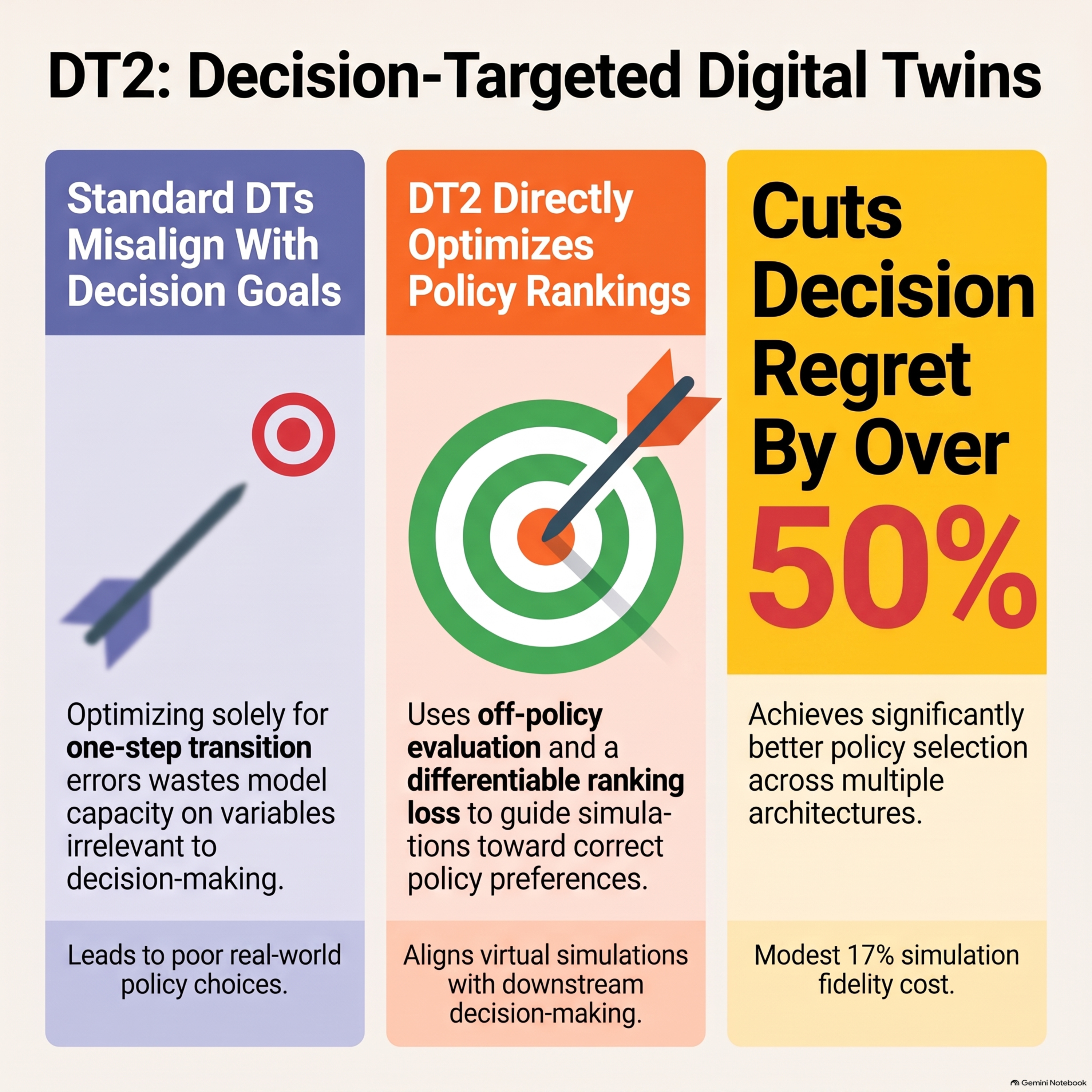
This paper introduces DT2, a novel training framework designed to align digital twins more effectively with their primary goal of decision support. Traditional virtual models often fail to rank policy options correctly because they prioritize minimizing overall simulation errors rather than focusing on the specific variables that influence outcomes. To solve this, DT2 incorporates an architecture-agnostic ranking loss function that utilizes off-policy evaluation to estimate the value of different actions from existing data. This method essentially distills the predictive power of complex machine learning models into the interpretable structure of a digital twin. Empirical results across various environments demonstrate that DT2 significantly reduces decision regret and improves policy ordering while maintaining high simulation fidelity. Ultimately, the authors argue that for a digital twin to be truly useful, it must prioritize the dynamics critical for human decision-making over being a perfect, context-free replica of reality.