Skip to content
Artwork for Best AI papers explained
Best AI papers explained · August 20 · 22 min

Conformal Language Modeling via Posterior Sampling

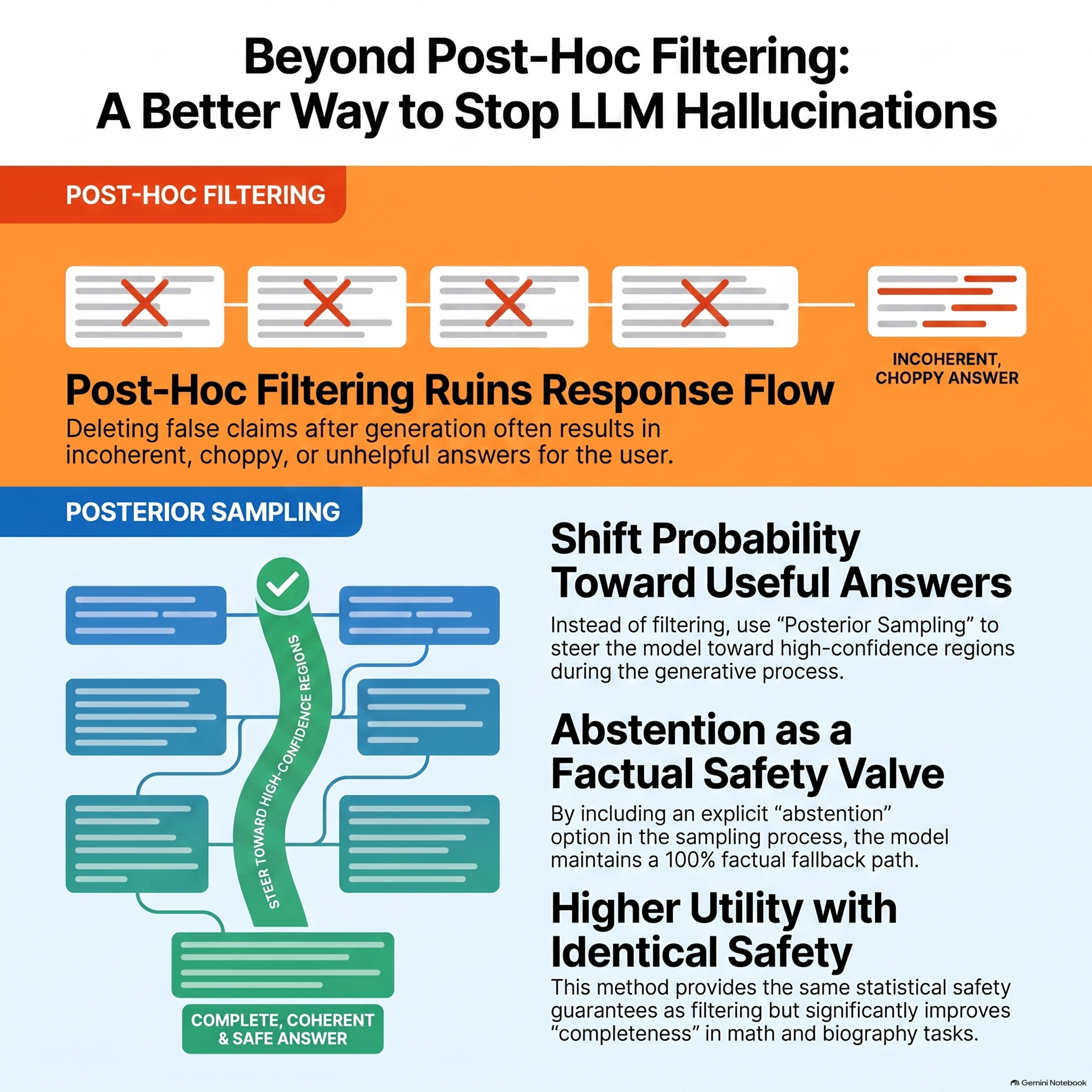
This paper introduces Conformal Language Modeling via Posterior Sampling, a novel framework designed to reduce hallucinations in Large Language Models while maintaining text quality. Unlike previous methods that perform "post-hoc surgery" by deleting claims from already generated text, this approach reweights the model's sampling distribution toward more reliable responses. By treating the generation process as posterior sampling conditioned on high-confidence regions, the researchers ensure that outputs remain coherent and fluent. The authors develop a calibration procedure that provides statistical guarantees for factuality across complex tasks like biography generation and mathematical problem-solving. Their findings demonstrate that this method significantly improves downstream utility compared to existing filtering techniques, particularly in scenarios with strong logical interdependencies. Ultimately, the work offers a mathematically grounded way to achieve target risk control without sacrificing the structural integrity of the generated language.


0:00-22:12

transcript

No transcript — this publisher did not publish one.

show notes

This paper introduces Conformal Language Modeling via Posterior Sampling, a novel framework designed to reduce hallucinations in Large Language Models while maintaining text quality. Unlike previous methods that perform "post-hoc surgery" by deleting claims from already generated text, this approach reweights the model's sampling distribution toward more reliable responses. By treating the generation process as posterior sampling conditioned on high-confidence regions, the researchers ensure that outputs remain coherent and fluent. The authors develop a calibration procedure that provides statistical guarantees for factuality across complex tasks like biography generation and mathematical problem-solving. Their findings demonstrate that this method significantly improves downstream utility compared to existing filtering techniques, particularly in scenarios with strong logical interdependencies. Ultimately, the work offers a mathematically grounded way to achieve target risk control without sacrificing the structural integrity of the generated language.