Skip to content
Artwork for BEAM There, Done That

BEAM There, Done That

Plangora

BEAM There, Done That is a podcast about building real systems with Elixir, Erlang, and the BEAM.

We’ve built it before — distributed systems, fault‑tolerant services, event pipelines, real‑time apps, production nightmares, and the supervision trees that saved them.

Each episode dives into practical lessons from shipping software on the BEAM: architecture decisions, scaling challenges, operational failures, and the patterns that actually work.

No hype. No theory without scars. Just hard‑won experience from engineers who’ve been there.

Play
  • 25 episodes
  • weekly
  • Avg 55 min
  • English
Counted on this page — what you have heard stays on this device, so it is not something the list can be paged by.
  • S1 · E8
    April 24 · 40 min

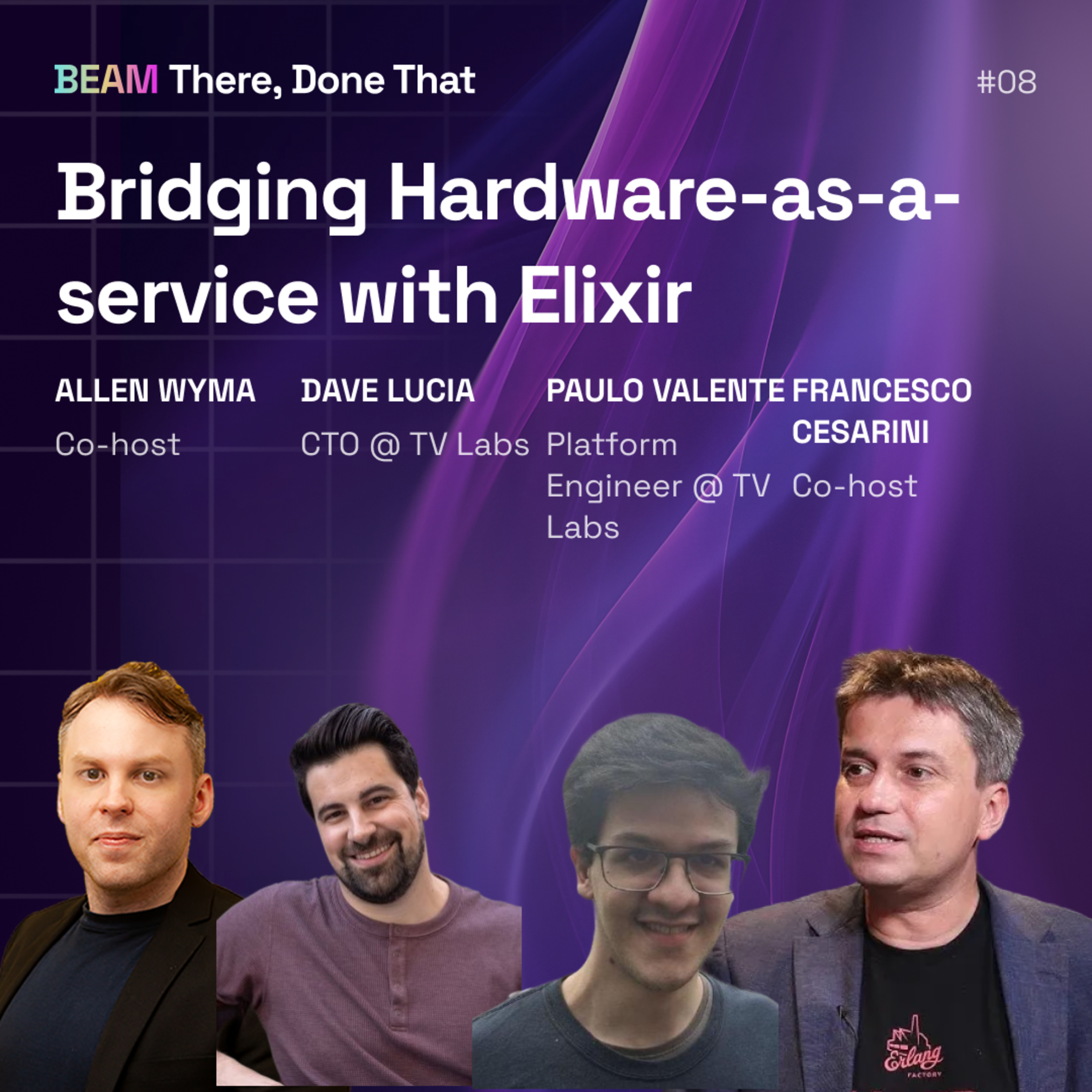
    Bridging Hardware-as-a-service with Elixir: Inside TV Labs’ Platform With Dave Lucia and Paulo Valente

    In this episode of BEAM There, Done That, co-hosts Francesco Cesarini and Allen Wyma sit down with Dave Lucia, co-founder and CTO of TV Labs, and Paulo Valente, AI specialist and maintainer of Nx. The conversation explores a novel and compelling use case of Elixir, Luerl, and the BEAM. It’s a deep dive into how TV Labs operates a hardware-as-a-service platform, enabling clients to test and optimize applications for TVs, automotive systems, set-top boxes, and mobile devices—without needing to own or manage physical infrastructure. Dave explains how their platform blends physical hardware with cloud-based orchestration, giving teams remote, programmable access to real devices at scale. Paulo explores the role of AI and numerical computing in improving system performance, enhancing testing workflows, and enabling data-driven optimization. The episode also highlights why Elixir is central to their stack—alongside their use of Luerl for flexible scripting. Together, they unpack the architectural decisions, trade-offs, and real-world lessons behind building a modern, scalable hardware platform powered by the BEAM.
  • S1 · E6
    April 10 · 52 min

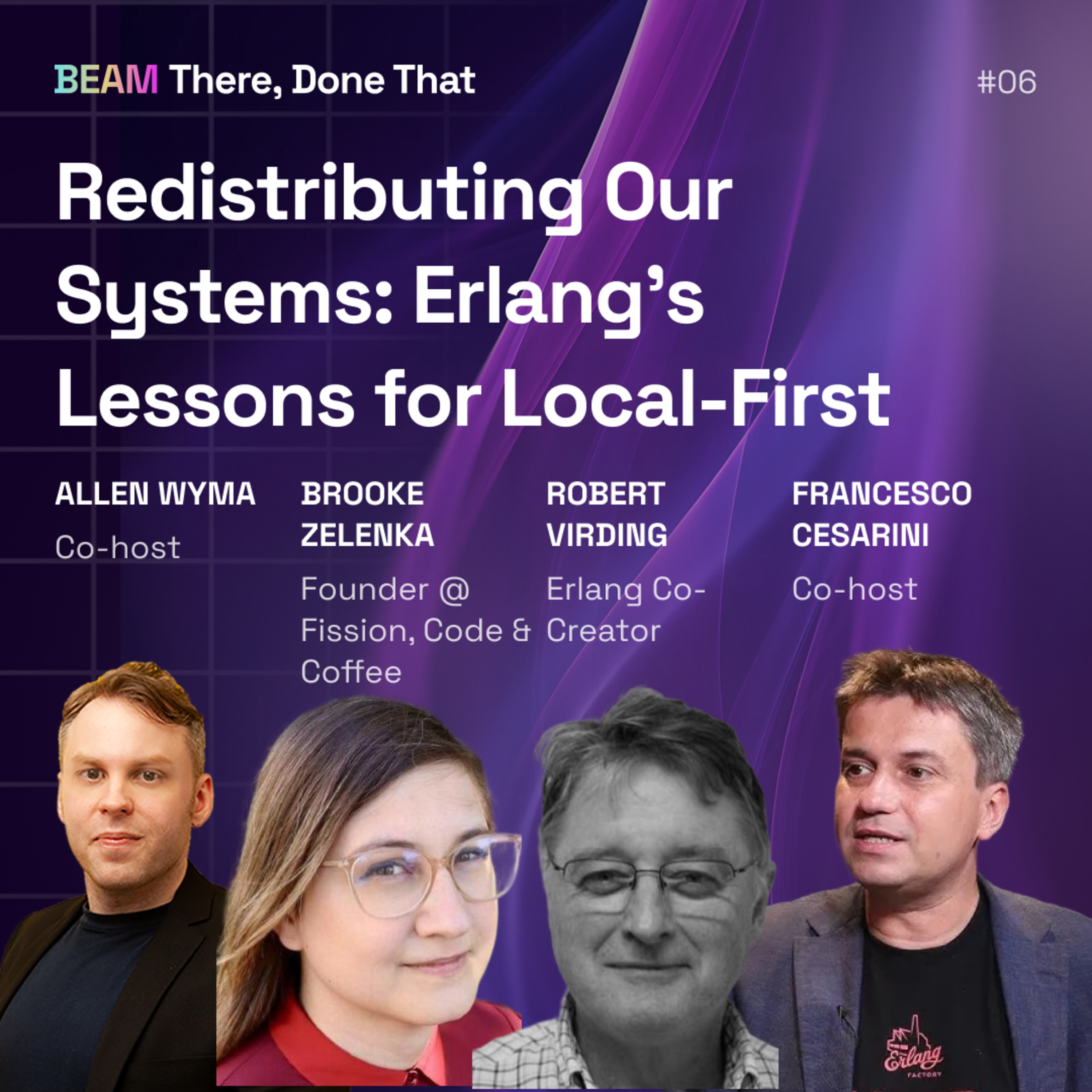
    Redistributing Our Systems. Erlang's Enduring Lessons for Local-First

    Erlang was designed for reliability in telephone switches, but its core principles — isolated processes, message passing, “let it crash supervision — anticipated problems we’re only now grappling with at scale. Four decades later, these ideas are finding new expression in local-first software: apps that work offline, sync peer-to-peer, and put users back in control of their data.In this podcast, Robert Virding (Erlang co-creator) and Brooke Zelenka trace the intellectual lineage from telecom switches to CRDTs and capabilities. They’ll explore how Erlang’s fault-tolerance model maps onto modern challenges, distributed security, and systems that continue to work offline. The cloud promised to simplify distributed systems; instead concentrated in a handful of companies; perhaps the answers we need were hiding in a language designed for phone switches all along.

Showing 21–25 of 25 episodes