Skip to content
Artwork for BBS Radio TV Station Streams
BBS Radio TV Station Streams · Yesterday · 52 min

Apple Pie Playground, August 9, 2026

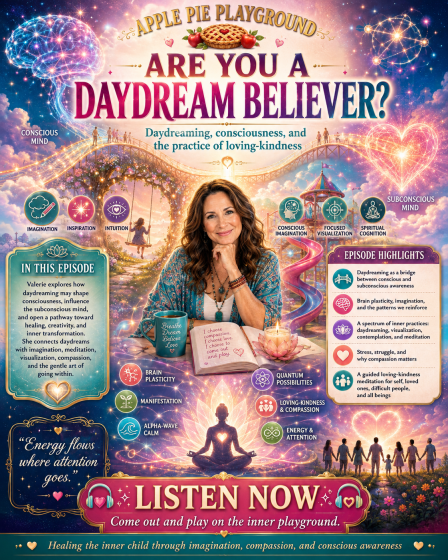
Apple Pie Playground with Valerie Are you a daydream believer? What practice produces an easy alignment between the conscious mind and the subconscious suitcases we talk about? Why does it matter? Let's talk. The Inner Playground: Daydreaming, Consciousness, and the Practice of Loving-Kindness Summary Daydreaming as an Inner Creative Process Valerie begins by shifting from a brief follow-up about missing and exploited children to the episode's primary subject: daydreaming. She describes children's pretending and make-believe as natural forms of daydreaming and presents the activity as a bridge between conscious and subconscious experience. In her spiritual framework, she also connects daydreaming to the etheric body, life-force energy, and the mind-body-spirit relationship. She argues that daydreams can carry memories, feelings, wishes, fears, desires, and intentions into a mental space where they can be recombined. This leads to her broader idea that daydreaming is not frivolous but potentially formative. The episode therefore treats imagination as an inner playground where consciousness can explore possibilities and reorganize experience. Brain Plasticity, Manifestation, and Quantum Ideas Valerie discusses research she attributes to Harvard and says it suggests that daydreaming may affect brain plasticity and future neural responses. She interprets this as a possible natural mechanism for what spiritual communities often call manifestation, because repeated imagery may influence patterns of thought and perception. She then compares daydreaming with her understanding of quantum superposition, in which multiple possible states exist until one state is observed or selected. From that comparison, she develops the idea that attention helps organize experience and repeats the principle that energy flows where attention goes. She also describes daydreaming as a conscious anchor that allows some awareness of the outer environment while the subconscious is permitted to drift and contribute imagery. These scientific and quantum connections are presented as Valerie's interpretation and were not independently verified for the transcript cleanup. Imagination, Visualization, and Spiritual Cognition The episode develops a spectrum of increasingly directed mental practices beginning with ordinary daydreaming. Valerie says children's pretending can support flexible thinking, problem-solving, emotional regulation, and social empathy, and she portrays make-believe as a natural mental workspace. Daydreaming can then become conscious imagination, in which a person deliberately shapes the images, memories, feelings, desires, and intentions that arise. Focused visualization narrows that process toward specific outcomes or goals. Valerie next describes spiritual cognition as contemplative meaning-making, such as revisiting an argument in the mind in order to seek deeper understanding or imagine a healthier response. Across these practices, she emphasizes imagination, inspiration, and intuition as important capacities of an integrated inner life. Meditation and the Conscious-Subconscious Spectrum Valerie places transcendental meditation at the more structured end of the spectrum she has built from daydreaming through conscious imagination, visualization, and spiritual cognition. She describes transcendental meditation as a mantra-centered practice aimed at creating a highly integrated mind-spirit-body experience. She says these different practices share an association with alpha-wave brain activity, which she describes as combining focus with deep restfulness. Her larger concern is the integration of conscious and subconscious aspects of the mind, which she views as part of expanding conscious and source awareness. She encourages listeners to explore these practices rather than dismiss daydreaming as wasted time. At the same time, she acknowledges that stress, anxiety, depression, fear, anger, and sensory overload can make free-flowing contemplation difficult. Suffering, Acceptance, and Loving-Kindness When daydreaming or focused meditation feels inaccessible, Valerie turns to loving-kindness as a practice of compassion. Drawing on teachings she attributes to Pema Chodrin, she defines suffering in simple terms as struggle and connects struggle to difficulty accepting circumstances as they are. Loving-kindness, in her presentation, is a way of sitting with pain without immediately resisting, fearing, or trying to change it. The practitioner notices sensations, allows them to exist, and responds with compassion rather than judgment. Valerie distinguishes this inward movement from spiritual practices that, in her view, direct energy outward through activities such as astral travel or channeling. Her stated goal is to call the spirit inward and cultivate a grounded presence within the body. A Guided Practice of Compassion The episode concludes with an extended guided loving-kindness meditation. Valerie first asks listeners to settle comfortably, return to the breath when attention wanders, and allow sensations to arise without judgment, fear, or resistance. The meditation begins by offering safety, happiness, freedom from suffering, and compassion to oneself. It then extends the same wishes to loved ones, to people who are especially challenging to one's peace, and finally to all sentient beings. The repeated language is intentional and forms part of the meditative structure, reinforcing acceptance and compassion at each stage. Valerie closes by thanking listeners for sharing the practice, encouraging both loving-kindness and daydreaming during the coming week, and returning to the program's recurring theme of healing the child within.


0:00-52:23

transcript

No transcript — this publisher did not publish one.

show notes

Apple Pie Playground with Valerie

Are you a daydream believer?

What practice produces an easy alignment between the conscious mind and the subconscious suitcases we talk about? Why does it matter? Let's talk.

The Inner Playground: Daydreaming, Consciousness, and the Practice of Loving-Kindness

Summary

Daydreaming as an Inner Creative Process
Valerie begins by shifting from a brief follow-up about missing and exploited children to the episode's primary subject: daydreaming. She describes children's pretending and make-believe as natural forms of daydreaming and presents the activity as a bridge between conscious and subconscious experience. In her spiritual framework, she also connects daydreaming to the etheric body, life-force energy, and the mind-body-spirit relationship. She argues that daydreams can carry memories, feelings, wishes, fears, desires, and intentions into a mental space where they can be recombined. This leads to her broader idea that daydreaming is not frivolous but potentially formative. The episode therefore treats imagination as an inner playground where consciousness can explore possibilities and reorganize experience.

Brain Plasticity, Manifestation, and Quantum Ideas
Valerie discusses research she attributes to Harvard and says it suggests that daydreaming may affect brain plasticity and future neural responses. She interprets this as a possible natural mechanism for what spiritual communities often call manifestation, because repeated imagery may influence patterns of thought and perception. She then compares daydreaming with her understanding of quantum superposition, in which multiple possible states exist until one state is observed or selected. From that comparison, she develops the idea that attention helps organize experience and repeats the principle that energy flows where attention goes. She also describes daydreaming as a conscious anchor that allows some awareness of the outer environment while the subconscious is permitted to drift and contribute imagery. These scientific and quantum connections are presented as Valerie's interpretation and were not independently verified for the transcript cleanup.

Imagination, Visualization, and Spiritual Cognition
The episode develops a spectrum of increasingly directed mental practices beginning with ordinary daydreaming. Valerie says children's pretending can support flexible thinking, problem-solving, emotional regulation, and social empathy, and she portrays make-believe as a natural mental workspace. Daydreaming can then become conscious imagination, in which a person deliberately shapes the images, memories, feelings, desires, and intentions that arise. Focused visualization narrows that process toward specific outcomes or goals. Valerie next describes spiritual cognition as contemplative meaning-making, such as revisiting an argument in the mind in order to seek deeper understanding or imagine a healthier response. Across these practices, she emphasizes imagination, inspiration, and intuition as important capacities of an integrated inner life.

Meditation and the Conscious-Subconscious Spectrum
Valerie places transcendental meditation at the more structured end of the spectrum she has built from daydreaming through conscious imagination, visualization, and spiritual cognition. She describes transcendental meditation as a mantra-centered practice aimed at creating a highly integrated mind-spirit-body experience. She says these different practices share an association with alpha-wave brain activity, which she describes as combining focus with deep restfulness. Her larger concern is the integration of conscious and subconscious aspects of the mind, which she views as part of expanding conscious and source awareness. She encourages listeners to explore these practices rather than dismiss daydreaming as wasted time. At the same time, she acknowledges that stress, anxiety, depression, fear, anger, and sensory overload can make free-flowing contemplation difficult.

Suffering, Acceptance, and Loving-Kindness
When daydreaming or focused meditation feels inaccessible, Valerie turns to loving-kindness as a practice of compassion. Drawing on teachings she attributes to Pema Chodrin, she defines suffering in simple terms as struggle and connects struggle to difficulty accepting circumstances as they are. Loving-kindness, in her presentation, is a way of sitting with pain without immediately resisting, fearing, or trying to change it. The practitioner notices sensations, allows them to exist, and responds with compassion rather than judgment. Valerie distinguishes this inward movement from spiritual practices that, in her view, direct energy outward through activities such as astral travel or channeling. Her stated goal is to call the spirit inward and cultivate a grounded presence within the body.

A Guided Practice of Compassion
The episode concludes with an extended guided loving-kindness meditation. Valerie first asks listeners to settle comfortably, return to the breath when attention wanders, and allow sensations to arise without judgment, fear, or resistance. The meditation begins by offering safety, happiness, freedom from suffering, and compassion to oneself. It then extends the same wishes to loved ones, to people who are especially challenging to one's peace, and finally to all sentient beings. The repeated language is intentional and forms part of the meditative structure, reinforcing acceptance and compassion at each stage. Valerie closes by thanking listeners for sharing the practice, encouraging both loving-kindness and daydreaming during the coming week, and returning to the program's recurring theme of healing the child within.