LaGrave Live, August 9, 2026
transcript
show notes
LaGrave Live
LIVE Morning Worship Service 08-09-2026
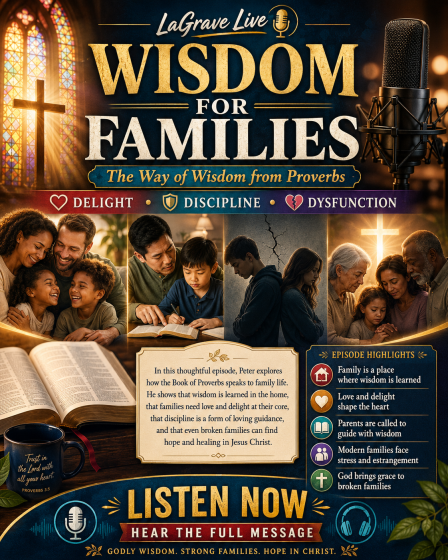
The Way of Wisdom: Wisdom for Families
About The Service:
We continue our Way of Wisdom sermon series, a series which focuses on some of the Bible's wisdom literature.
Pastor Jonker will preach on Proverbs wisdom for families as found in proverbs like 22:6.
Order of Worship:
https://lagrave.org/wp-content/upload...
About the Church:
We are a traditional CRC church in the middle of Downtown Grand Rapids, MI, worshipping at 8:40am, 11:00am, and 6:00pm. (10:00am and 6:00pm during the summer months)
We'd love to hear from you:
Connection: https://www.lagrave.org/contact
Let us pray for you:
Prayer: https://www.lagrave.org/prayerrequest/
Giving: https://www.elexiogiving.com/App/Givi...
The August special offering is for Covenant House. Covenant House Michigan (CHMI) provides shelter and hope to young people aged 18-24 who are experiencing homelessness or victims of trafficking in Grand Rapids and Detroit. Their mission is to serve all youth who come to their doors with unconditional love, absolute respect, and relentless support.
Listen on the go:
Amazon Music: https://bit.ly/LGPodAmazonMusic
Apple Podcast: https://apple.co/3tuOdwQ
Google Podcast: https://bit.ly/LGPodGoogle
Soundcloud: / lagravecrc https://soundcloud.com/lagravecrc
Spotify: https://spoti.fi/3yXDFaT
Follow us!
Facebook: / lagravecrc https://www.facebook.com/lagravecrc
Instagram: / lagravecrc https://www.instagram.com/lagravecrc
Website: https://www.lagrave.org
#LaGrave #LaGraveCRC
Delight, Discipline, and Dysfunction: Building Families in God’s Wisdom
Summary
Family as the Center of Proverbs
The service frames family life as one of the central settings in which biblical wisdom is learned and practiced. Peter explains that Proverbs repeatedly presents fathers and mothers instructing their children, making wisdom part of an ongoing family conversation. He argues that families shape people profoundly, whether those experiences are nurturing or deeply painful. A healthy family can become a firm foundation, while a harmful family can feel like a minefield whose effects continue through life. The sermon therefore treats family not as a narrow topic for parents with children but as a reality that affects everyone, including single people and married people without children. This broad framing leads into the need for wisdom amid the pressures facing modern families.
Modern Strain, Estrangement, and Fear of Family Formation
Peter identifies two pressures he believes are placing special strain on families today. First, he says many young people appear increasingly reluctant to marry or have children because they see the difficulty and fracture that can accompany family life. Second, he discusses family estrangement, including parents and children or siblings who stop speaking to one another. He acknowledges that separation can be appropriate in cases of abuse or severely toxic relationships and does not treat all estrangement as wrong. At the same time, he worries that relationships may sometimes be labeled toxic too quickly, producing unnecessary rupture. His conclusion is that every kind of family needs wisdom because family relationships are powerful, difficult, and deeply consequential.
Delight as the Foundation of Family Life
The first major sermon theme is delight. Peter argues that the family portrayed in Proverbs is not primarily a place of rules and rigor but a place of love, joy, and delight. He points to passages in which discipline flows from love and in which parents rejoice over wise and righteous children. This delight is presented as something that should exist at the beginning, middle, and end of family relationships. Peter emphasizes that love is not merely something beneath discipline; love and delight themselves are formative. He offers the practical idea of a five-to-one ratio, suggesting that correction should be surrounded by many more expressions of affirmation, attention, affection, and genuine interest.
Attention, Affirmation, and Everyday Connection
Peter develops the theme of delight by describing ordinary ways family members communicate love. Affirmation can be verbal, such as telling a child, sibling, or spouse that they are valued, but it can also be shown through a hug, a question, or undivided attention. He describes what psychologists call bids for attention: small attempts to connect through a smile, question, story, or gesture. In a healthy family, those bids are noticed and answered rather than ignored. His example of putting down a phone to listen carefully to a spouse illustrates how delight becomes a daily practice rather than an abstract feeling. The sermon presents these repeated moments of attention as a powerful way family members shape and strengthen one another.
Discipline, Authority, and Forming the Soul
The second major theme is discipline. Peter addresses Proverbs passages about the rod and argues that they should not be reduced to a command to beat children. He explains that the transcribed Hebrew term “shebat” can carry a broader sense of authority and leadership, and he interprets the parental task as owning and responsibly exercising that authority. Parents, in his view, are not primarily buddies but leaders charged with guiding, training, and forming their children. He uses the provocative word “indoctrinate” to make the point that every child inevitably receives a worldview from family and culture. For Christian parents, he says the highest responsibility is not achievement in academics, sports, or music, but helping children send their roots into Jesus, while avoiding both abusive control and hands-off parenting.
Dysfunction, Grace, and Hope for Broken Families
The final theme is dysfunction, where Peter rejects any idealized picture of a perfect family. Even families that try sincerely to love and discipline well may face addiction, divorce, estrangement, rebellion, and unresolved pain. He turns to God as the model of a father who knows the grief of children who turn away despite perfect love and care. Citing Hosea and Jesus’ lament over Jerusalem, he portrays God as a brokenhearted parent who continues to move toward a rebellious family. The Christian answer, in the sermon, is that God sends his Son, who bears punishment and makes restoration possible. The closing prayer therefore entrusts both healthy and broken families to Jesus and asks for healing where human effort alone cannot repair what has been damaged.