Artwork for bauhaus faces
Arts

bauhaus faces

Anja Guttenberger

Meet the faces behind the vision!
With the help of Bauhaus experts and descendants, each episode tells the story of a new personality.

With Paul Klee, Max Bill, Gunta Stölzl, Lucia Moholy, Mies van der Rohe, Ise Gropius, Lucia Moholy, Anni & Josef Albers​, Otti Berger & more ...

  • 34 episodes
  • Updated June 20

Episodes34

  • Apr 13, 2025 · 50 min

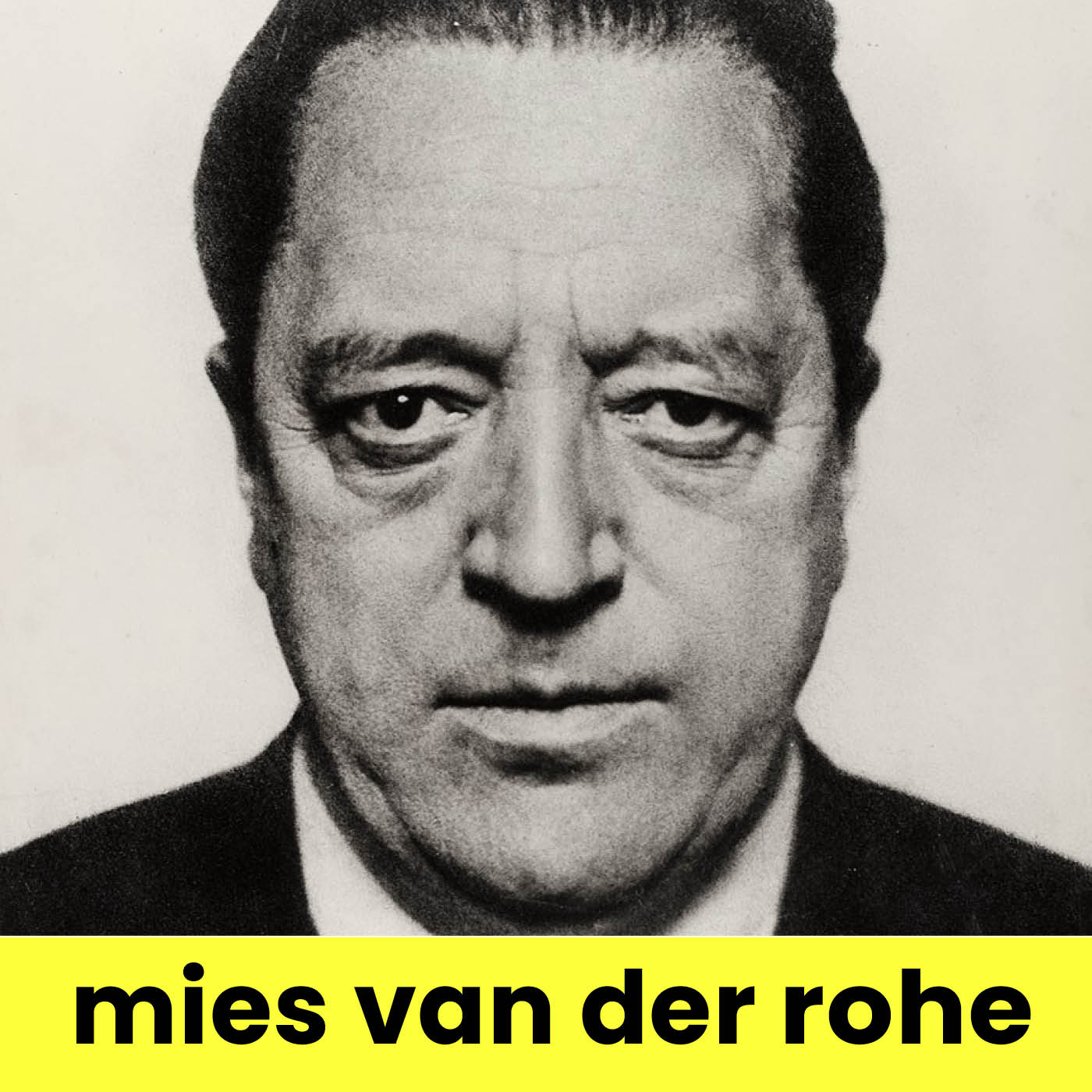
    LUDWIG MIES VAN DER ROHE (2/2) | Aya Soika

    This is PART 2 of the Podcast episode about Ludwig Mies van der Rohe. It puts a magnifying glass over a specific period of time in Mies’s life: his commissions for the Nazis after the Bauhaus had closed in July 1933 and his final emigration to the US in 1938. For this episode, the art-historian Aya Soika shares her expertise. She published a book about this time of Mies’s life with the title „Mies van der Rohe in the Third Reich. The Brussels Project, 1934" (link in the show notes). Aya Soika doesn’t denounce Mies van der Rohe for his commissions for the Nazis but emphasizes the circumstances in which Mies found himself as a modern architect and as a person that didn’t necessarily want to leave his home. But she also underlines his naivety in thinking that as an architect he could be apolitical. Although Mies never won the competition and the pavilion was never even built due to a financial lack of Nazi Germany to come up with enough foreign currency, this project – and some others – that Mies van der Rohe accepted to plan for the Nazis, those projects were, of course, hotly disputed by architecture historians. And what did Mies himself say about this after the end of the Second World War? Well, that’s what you will find out in the 2nd part of my podcast about Ludwig Mies van der Rohe. SHOW NOTES bauhausfaces.com | @bauhausfacespodcast | YouTube | Spotify | Apple Podcasts Aya Soika at Bard College Berlin berlin.bard.edu/people/profiles/aya-soika PUBLICATIONS & ARTICLES Aya Soika: Mies van der Rohe im Nationalsozialismus. Das Brüssel Projekt, 1934. Mies van der Rohe in the Third Reich. The Brussel Project, 1934, Form+Zweck, 2024 Ludwig Mies van der Rohe, Draft of the German Pavilion, International Exposition, Brussels, Belgium, Elevation, 1934, MoMA **COVER PHOTO **Portrait of Mies van der Rohe (detail), no date, photo: Werner Blaser, Living Archive Werner Blaser CHAPTER IMAGES 1 Portrait of Ludwig Mies van der Rohe (detail), no date, photo: Werner Blaser 2 Portrait of Ludwig Mies van der Rohe (detail) , 1934, photo: Hugo Erfurth, MKG Sammlung Online, in the public domain, https://commons.wikimedia.org/w/index.php?curid=86431569 3 View of the World Exposition in Brussels (detail), 1935, photo: Édition Nouvelle, Postcard, in the public domain, https://commons.wikimedia.org/w/index.php?curid=28148177 4 Joseph Goebbels: Aufruf der Kulturschaffenden. Newspaper clippung from Völkischer Beobachter, 18 August 1934, image: Radschläger13, https://commons.wikimedia.org/w/index.php?curid=50574678 5 Skyline, Chicago, photo: Daj12192, 2009, CC BY 3.0, https://commons.wikimedia.org/w/index.php?curid=7231640

  • Feb 14, 2025 · 1 hr 6 min

    MICHIKO & IWAO YAMAWAKI | Mariko Takagi & Helena Čapková

    This episode is dedicated to a Japanese couple who went all the way to Germany to study at the Bauhaus in Dessau: Iwao and Michiko Yamawaki. When they met each other in 1928 Iwao Fujita had already studied architecture in Tokyo and was also actively involved in the theatre. Michiko came from a very wealthy family and was a culturally educated young woman of 18 years. By marrying into the Yamawaki family Iwao profited from their wealth. He happily took on Michiko’s family name in exchange for a World trip with that one final destination: the Bauhaus in Dessau. In July of 1930 the Yamawakis left Japan, stayed for some time in New York and then went on to Berlin and Dessau. After the preliminary course Michiko decided – due to her interest in fashion – to go into the weaving workshop. Iwao, though an already formed architect, chose to continue in the photo class. He developed a special interest in photo montages. One of them entitled „The attack on the Bauhaus“ became the visual epitome of the forced closure of the Bauhaus by the Nazis and is today often used as an illustration of that dark last period of the Bauhaus. These two years at the Bauhaus shaped the future of the Yamawakis sustainably. Upon returning to Japan in 1932, they became pivotal figures in introducing Bauhaus principles to their home country. They brought back a vast collection of Bauhaus objects, books, and furniture, creating a Bauhaus-inspired ambiance in their Tokyo home. And they both taught at art schools using the Bauhaus principles of Josef Albers’ Vorkurs. On this episode not one but two great researchers help me tell the story of Michiko and Iwao Yamawaki: Helena Capkova and Mariko Takagi. And a special shout-out to Anika Takagi who allowed me to use her wonderful illustrations of the Yamawakis. SHOW NOTES bauhausfaces.com | @bauhausfacespodcast | YouTube | Spotify | Apple Podcasts https://marikotakagi.de Helena Čapková COVER IMAGE Iwao & Michiko Yamawaki, illustration © [Anika Takagi](https://www.anikatakagi.com)) PUBLICATIONS & ARTICLES Mavo movement and Tomoyoshi Murayama https://en.wikipedia.org/wiki/Mavo Senda Koreya https://de.wikipedia.org/wiki/Senda_Koreya Yamawaki Michiko: A Japanese Bauhaus story with Mariko Takagi, Video on Youtube Google Arts and Culture Karl Lagerfeld (ed.): Iwao Yamawaki, 1999 Nicole Opel: "From Dessau to Tokyo Japan and the Bauhaus", 2017 COLLECTIONS WITH IWAO YAMAWAKI'S PHOTOS Tate Modern, London MoMa, New York Musashino Art University Collection PHOTOS BY IWAO YAMAWAKI https://www.artnet.de/künstler/iwao-yamawaki/2 https://www.mutualart.com/Artist/Iwao-Yamawaki/8EF3C7D489EA8924 "THE ATTACK ON THE BAUHAUS" Mariko Takagi: “The Attack on the Bauhaus” – A Collage that Became a Symbol of the Closure of the Bauhaus, 2019, bauhaus imaginista

  • Jan 13, 2025 · 53 min

    FRITZ KUHR | Ute Famulla

    This brand-new episode of "bauhaus faces" is about a rather unknown Bauhausler: Fritz Kuhr. Although he was at the Bauhaus for roughly 7 years he is widely unknown. Kuhr was the student spokesperson of the Bauhaus Master Council, part of the infamous Bauhaus band, helped edit and produce the Bauhaus publications with Ernst Kállai and had a connection to the communists at the Bauhaus. After leaving the Bauhaus in 1930 Kuhr moved to Berlin and tried to make a living as a freelance artist. He was internationally represented by the gallery Ferdinand Möller and though he seemingly was a rising star in the vibrant art scene of the 1930s, this all came to an abrupt end when the Nazis defamed him as a degenerated artist in 1937. Kuhr stayed in Berlin during World War 2. His atelier was bombed twice and many of his works were partly or completely destroyed. After the second bombing in 1944 Kuhr was drafted into military service and became a Soviet prisoner of war. On his return to Berlin, he was a „bird-free painter in berlin. no studio. no light. no paper. hardly any canvases and oil colours. nevertheless. a new beginning. made possible by the comradeship of colleagues who are also suffering. “ In 1948 Kuhr was appointed as university teacher at the Hochschule der Bildenden Künste in Berlin (today UdK Berlin). From now on, he fully concentrated on his art students. Fritz Kuhr died in 1975. For this episode fellow art-historian Ute Famulla tells Kuhr’s story. Her family has close ties with Kuhr and today owns his estate. SHOW NOTES bauhausfaces.com | @bauhausfacespodcast | YouTube | Spotify | Apple Podcasts COLLECTIONS WITH FRITZ KUHR's ART WEBSITE OF THE FRITZ LUHR ESTATE https://fritz-kuhr-bauhausler.de BAUHAUS DESSAU FOUNDATION https://dam.bauhaus-dessau.de/portals/bilddatenbank/#search/basic/fritz%20kuhr BAUHAUS-ARCHIV BERLIN https://open-archive.bauhaus.de STÄDELMUSEUM, FRANKFURT/MAIN https://sammlung.staedelmuseum.de/de/person/kuhr-fritz HARVARD ART MUSEUMS https://harvardartmuseums.org/collections PUBLICATIONS ABOUT FRITZ KUHR Fritz Kuhr: Bauhaus-Erinnerungen: Meine Meister, Team Kommunikation, Frankfurt am Main 1993 Hermann Famulla: Laternenlicht-Komposition. Fotos von Fritz Kuhr, Team Kommunikation Verlag, Berlin 2015 Fritz Kuhr (illustrator) Hermann & Ute Famulla (eds.): _"also wird gemalt" der bauhäusler fritz kuhr, Kunstmuseum Ahrenshoop, Ahrenshoop 2019 COVER PHOTO Fritz Kuhr, Self-portrait III, 1926, Courtesy Fritz Kuhr Estate

  • Dec 6, 2024 · 41 min

    ISE GROPIUS | Jana Revedin

    This episode of "bauhaus faces“ is not about a typical Bauhäusler, not a student or a master. She nevertheless played crucial part in documenting the history of the Bauhaus between 1923 and 1928 in her diary. Of course she was also Walter Gropius’s closest confidant, advisor, and editor, his wife, Ise Gropius. Ise Gropius entered the service of the Bauhaus as a secretary, editor, organizer and ‘equal partner’ for Gropius. Soon, she became “Mrs. Bauhaus” and liked her role very much. „The Bauhaus infected me,“ she would later say. For this episode the architect and author Jana Revedin helps to tell the story of Ise Gropius. She wrote a biographical novel called "Jeder hier nennt mich Frau Bauhaus“. The novel is based on Ise Gropius as a main character and her diary that she kept during her stay at the Bauhaus from 1923 to 1928. SHOW NOTES bauhausfaces.com | @bauhausfacespodcast | YouTube | Spotify | Apple Podcasts JANA REVEDIN NOVEL "JEDER HIER NENNT MICH FRAU BAUHAUS" ARTICLES ABOUT ISE GROPIUS Unknown author: "Ise Frank Gropius, Archivist Of Bauhaus Founder's Work", The New York Times, 1983 Anja Guttenberger: "Ise Gropius", 2015 Jana Münkel: "Ise Gropius – Partnerin auf Augenhöhe", Deutschlandfunk Kultur, 2019 Ursula Muscheler: Mutter, Muse und Frau Bauhaus. Die Frauen um Walter Gropius, Berenberg Verlag, 2018 Gropius House: Ise Gropius Biographical Timeline FILMS WITH ISE GROPIUS „Wie wohnen wir gesund und wirtschaftlich: Neues Wohnen“ Historic New England: Walter Gropius: His New World Home, narrated by Ise Gropius, 1970 Katy Kelleher: "The forgotten story of 'Mrs. Bauhaus'", 2018

  • Nov 7, 2024 · 51 min

    PIUS PAHL | Peter-Jan & Tyll Pahl

    This episode of bauhaus faces is about the Bauhaus educated architect Pius Pahl. After being trained as carpenter and interior designer, he decided it was time to go to the Bauhaus and become an architect. He studied with Ludwig Mies van der Rohe and Ludwig Hilberseimer, who would both become essential for his approach towards designing buildings. Pius Pahl is also one of the students who made the Bauhaus move from Dessau to Berlin. After successfully graduating with his Bauhaus diploma in 1933 he went on a journey to Switzerland, Italy and North Africa before starting to work in different architecture offices. In World War II he was drafted by the military and became a prisoner of war. Although he set up his own building office in 1946 in fear for his four sons to also become soldiers in a war – it was the time of the Cold War between the Soviet Union and the West – Pius Pahl decided it was time to emigrate. While he wasn’t allowed to go to the US to work with Mies van der Rohe in Chicago (this was his dream) the choice fell on South Africa, because his wife Jeanette was born there and could speak English fluently. Pius, however, struggled during the first years as his language skills were underwhelming. Once he and his family had relocated to Stellenbosch and he had started – once again – his own office, Pius Pahl planned several public and private houses, adapted to the possibilities and materials there. Two of his four sons, Jan-Peter and Tyll Pahl invited me into their houses to talk to me about their father and his work. SHOW NOTES bauhausfaces.com | @bauhausfacespodcast | YouTube | Spotify | Apple Podcasts ARTICLES ABOUT PIUS PAHL Pius Pahl: Pius Pahl Architectural Biography (Part 1), Stellenbosch Heritage, n.d. Graham Wood: African Bauhaus, Verve Magazine, 2019 Ilze Wolff: OH6 Pius Pahl Monograph, oh architecture, n.d. Haig Beck (ed.): UIA International Architect: Southern Africa (Issue 8), London: International Architect, 1985, pp 60 BUILDINGS BY PIUS PAHL IN SOUTH AFRICA Artefacts.co.za: PAHL, Pius Edmund, n.d. COVER PHOTO Pius Pahl: Detail of a Portrait of Pius Pahl, Bauhaus Berlin, 1933, Bauhaus-Archiv Berlin

  • Sep 23, 2024 · 46 min

    LUCIA MOHOLY | Robin Schuldenfrei

    This episode of "bauhaus faces" is about a photographer that most Bauhaus fans today know: Lucia Moholy. She was the photographer who delivered the photos of the Bauhaus in Dessau and its masters’ houses that made the art school so iconic. But it wasn’t until the 1990s that art historians became alert to her when her photos and negatives made their way into the Bauhaus-Archive in Berlin. Until then they had taken a long reroute from Germany via the US, while Lucia Moholy had thought they were lost, when in fact Bauhaus founder and first director Walter Gropius had taken them with him, denied their possession for decades and made use of them to promote the Bauhaus as the ultimate epitome of the avantgarde without ever mentioning their creator: Lucia Moholy. But her life and work were so much more! When she was in danger of being arrested by the Nazis, Lucia left Germany and emigrated to London. Here, she worked as a portrait photographer and – as director – set up the microfilm archive ASLIB. She never succeeded in emigrating to the US like so many other Bauhauslers although she had an offer from her ex-husband László Moholy-Nagy to come and teach photography at the New Bauhaus in Chicago. Most of her adult life, Lucia Moholy struggled to make ends meet and gain recognition for her achievements. When she – once more – emigrated to Switzerland in 1959 (she would live and die in Zollikon near Zurich) Lucia started writing about her collaborative work with László Moholy-Nagy and her own share in it.For this episode the US art historian Robin Schuldenfrei helped to tell the story of Lucia Moholy. She has been researching Moholy for many years now. SHOW NOTES bauhausfaces.com | @bauhausfacespodcast | YouTube | Spotify | Apple Podcasts EXHIBITION „Lucia Moholy: Exposures“ at Kunsthalle Praha from 30th May until 28th October 2024 AND at Fotostiftung Winterthur in Spring 2025 BOOKS BY LUCIA MOHOLY Lucia Moholy: A Hundred Years of Photography“, 1939 Lucia Moholy: Marginalien zu Moholy-Nagy/Moholy-Nagy, Marginal Notes, 1972 **PUBLICATIONS & ARTICLES ABOUT LUCIA MOHOLY ** Rolf Sachsse: Lucia Moholy Bauhaus Fotografin, 1995 Meghan Forbes: "'What I Could Lose': The Fate of Lucia Moholy", in: Michigan Quarterly Review, Vol. 55, Issue 1, Winter 2016 Jochen Stöckmann: "Lucia Moholy. Im Schatten des Bauhaus", in: Weltkunst, 2022 ABOUT LUCIA MOHOLY’S BOOKS AND NEGATIVES Sabine Hartmann: "Multiple Frames for Lucia Moholy: Contextualizing Photography, Gender, and Place in the 20th Century", Kunsthalle Praha, 2024 Robin Schuldenfrei: "Images in Exile: Lucia Moholy’s Bauhaus Negatives and the Construction of the Bauhaus Legacy", in: History of Photography, May 2013 Burcu Dogramaci: "A Hundred Years of Photography 1839–1939", in: METROMOD Archive, 2021 PHOTOS BY LUCIA MOHOLY IN ARCHIVES BAUHAUS-ARCHIV BERLIN HARVARD ART MUSEUMS NATIONAL PORTRAIT GALLERY, LONDON FOTOSTIFTUNG WINTERTHUR, SWITZERLAND MoMA, NEW YORK COVER PHOTO László Moholy-Nagy: Portrait of Lucia Moholy, Metropolitan Museum of Art, public domain, CC0 1.0

  • Sep 6, 2024 · 53 min

    ETEL & ERNST MITTAG | Michael Mittag

    This episode is not about just one Bauhaus person, but about two. It’s the premiere of our first episode about a Bauhaus couple: Etel and Ernst Mittag, who were both students at the Bauhaus in Dessau, met there, fell in love, got married, had children and emigrated to South Africa when Etel – as a Jew – was in great danger in Europe. About her time at the Bauhaus from 1928 to 1930 Etel later wrote in her autobiography: “This was a new world for me. Everything was completely different from what I knew. Nothing was taken for granted. Everything had to be discussed, examined anew from different angles. […] There was almost absolute freedom from prejudice. Of course, I was completely bewildered and intimidated.” Etel studied at the advertising department and then, when founded in 1929, at the photo class. She became prolific in it and could earn a living with it for some time. At a demonstration on the International Women’s Day Etel met two rough looking fellows who had arrived at the Bauhaus via the river Elbe by boat. One of them was Ernst Mittag. He was from Riesa and had studied in Dresden before coming to the Bauhaus to study architecture and carpentry. The two of them became involved in the communist movement, holding clandestine political meetings in their kitchen in a workers’ housing estate in Ziebigk, a suburb of Dessau, and publishing a communist paper in Berlin after leaving the Bauhaus. Even in South Africa they felt most comfortable with the members of a Left book club. While Etel Fodor-Mittag wrote her autobiography “Not an unusual Life, for the Time and the Place” (published by the Bauhaus-Archive Berlin in 2014), not much is known about Ernst Mittag. Until now. In this podcast their younger son Michael Mittag tries to remember as much as possible about both of his parents by remembering conversations with them, by looking at old papers of them and by talking about their work and projects. SHOW NOTES bauhausfaces.com | @bauhausfacespodcast | YouTube | Spotify | Apple Podcasts (AUTO-)BIOGRAPHY ABOUT ETEL FODOR-MITTAG Etel Fodor-Mittag: "Not an unusual Life, for the Time and the Place / Ein Leben, nicht einmal ungewöhnlich für diese Zeit und diesen Ort", Bauhäusler. Dokumente aus dem Bauhaus-Archiv Berlin, Bd. 3, Berlin 2014 Anja Guttenberger: Etel Fodor-Mittag, in: bauhauskooperation.com, 2015 **PHOTOS BY ETEL FODOR-MITTAG ** Photo study with toy pistol and sugar cubes, ca. 1928 & Advertising image for Idanthren-Farben, ca. 1929 Portrait of Ricarda Schwerin, ca. 1931 Portrait of Isaak Butkow, 1929 RBB facts about Berlin after WWII HISTORY OF THE APPLETISER FARM IN ELGIN, ZA COVER PHOTO Unknown photographer: Portrait of Etel and Ernst Mittag, Bauhaus Dessau, 1929, Bauhaus-Archiv Berlin

  • Aug 4, 2024 · 1 hr 2 min

    GUNTA STÖLZL | Monika Stadler & Mirjam Deckers

    This episode is dedicated to the Bauhaus master Gunta Stölzl, one of the few better-known Bauhaus women. We have already mentioned her name in the previous podcast about Stölzl’s first husband, the Israeli architect Arieh Sharon. They had a daughter, Yael, what was born in 1929, do you remember? And Ariel Aloni, my interview partner for the last episode is also Gunta Stölzl’s grandson. My interview partners for today’s episode are Gunta Stölzl’s younger daughter, Monika Stadler (who shares with us her personal view on her mother’s work) and the Dutch art historian Mirjam Deckers who is currently working for the Gunta Stölzl Estate and is writing her thesis about Stölzl’s work. As we already have two people talking in this podcast you will not hear much of me. My own research into Gunta Stölzl’s life and work is rather restricted, and I will therefore leave the talking to the expert and the daughter as they talk about Gunta Stölzl’s life and work in Munich (before the Bauhaus), as a student at the Bauhaus in Weimar, as a master of the weaving workshop at the Bauhaus in Dessau and with her own businesses in Switzerland (after the Bauhaus). SHOW NOTES bauhausfaces.com | @bauhausfacespodcast | YouTube | Spotify | Apple Podcasts GUNTA STÖLZL DIGITAL ARCHIVE MIRJAM DECKERS ARIEH SHARON DIGITAL ARCHIVE EXHIBITIONS "Gunta Stölzl and Johannes Itten. Textile Universes", 17 August – 1 December 2024, Kunsthalle Thun, Switzerland "Bauhaus and National Socialism", 9 May – 15 September 2024, Klassik Stiftung Weimar, Germany **MUSEUMS & COLLECTIONS WITH GUNTA STÖLZL'S WORK ** VICTORIA & ALBERT MUSEUM, LONDON BAUHAUS-ARCHIV BERLIN MoMA, NEW YORK THE METROPOLITAN MUSEUM OF ART, NEW YORK HARVARD ART MUSEUMS, CAMBRIDGE, MASS. BAUHAUS DESSAU FOUNDATION NEUE PINAKOTHEK, MUNICH MUSEUM FÜR GESTALTUNG, ZURICH THE J. PAUL GETTY MUSEUM, CALIFORNIA COOPER HEWITT / SMITHSONIAN DESIGN MUSEUM, NEW YORK CENTRE POMPIDOU, PARIS MK&G, HAMBURG KUNSTSAMMLUNGEN CHEMNITZ **BIOGRAPHY ABOUT GUNTA STÖLZL ** Ingrid Radewaldt: Gunta Stölzl. Pionierin der Bauhausweberei, 2018 COVER PHOTO Portrait of Gunta Stölzl for her Bauhaus student ID-card, with permission by GUNTA STÖLZL DIGITAL ARCHIVE

  • Jun 4, 2024 · 50 min

    ARIEH SHARON | Ariel Aloni

    This time I talked to Ariel Aloni. He is a grandson of even two Bauhaus students: the architect, Arieh Sharon, probably the most famous Israeli architect, and the Bauhaus weaver Gunta Stölzl, the only woman who was successful in becoming a Bauhaus master. As Ariel says: “There was no conversation with Sharon without the Bauhaus popping up!” And that is also true to his architecture. In his buildings in Israel and Nigeria Sharon still refers to what he had learned from Hannes Meyer and Hans Wittwer at the Bauhaus, and then elevated the concept by adapting to the climatic conditions that were very different from Northern Europe. In Nigeria he went even further and added also architectural aspects of the local Yoruba tribe. After a career of nearly 60 years as an architect Arieh Sharon left roughly 800 buildings and is today known as the father of Israeli architecture and as one of the consequent pursuers of Tropical Modernism. He is less known for his work as a construction site manager for the ADGB Trade Union School in Bernau near Berlin, but we will get to that project, too. There is no Israeli architecture prize that Sharon did not win. And even today everyone in Israel knows who Arieh Sharon is. It is time we get to him, as well. SHOW NOTES bauhausfaces.com | @bauhausfacespodcast | YouTube | Spotify | Apple Podcasts ARIEH SHARON DIGITAL ARCHIVE EXHIBITION Jean Molitor: "Arieh Sharon – From the Bauhaus into the World", 2024, baudenkmal bundesschule bernau e. V. ARTICLES ABOUT ARIEH SHARON Bayo Amole: "The Legacy of Arieh Sharon’s Postcolonial Modernist Architecture at the Obafemi Awolowo University Campus in Ile-Ife Nigeria", 2019 COVER PHOTO Portrait of Arieh Sharon on his Bauhaus student ID-card, ca. 1928, © ariehsharon.org

  • May 2, 2024 · 45 min

    OTTI BERGER | Judith Raum

    Otti Berger’s story is one full of life, ambition, and talent. There was so much for her in the cards. But her life ended tragically and abruptly when she was deported to the concentration camp Auschwitz and was murdered there shortly after. What’s left are letters and patents for her innovative fabrics. In this episode of bauhaus faces, the textile researcher and artist Judith Raum shares her research results. **SHOW NOTES ** Podcast website bauhausfaces.com⁠ | Instagram ⁠@bauhausfaces⁠ Judith Raum: judithraum.net/ Book: hatjecantz.de/products/64980-otti-berger Exhibition:bauhaus.de/de/programm/sonderausstellungen/9350ottibergerstoffefuerdiearchitekturdermoderne/?returnUrl=/de/programm// Otti Berger: ⁠de.m.wikipedia.org/wiki/Otti_Berger⁠ | ⁠sammlung.belvedere.at/objects/15853/hommage-otti-berger⁠ | ⁠ stolpersteine-berlin.de/de/fasanenstr/13/otti-ottilia-berger | fembio.org/biographie.php/frau/biographie/otti-berger/

  • Apr 1, 2024 · 48 min

    T. LUX FEININGER | T. Lux & Conrad Feininger

    This time I am going to talk about one of the most brilliant photographers of the Bauhaus, T. Lux Feininger. As the youngest son of the renowned German US-American painter Lyonel Feininger he is the only Bauhausler who both grew up at the Bauhaus and later became a Bauhaus student – as the only offspring of a Bauhaus master and with his 16,5 years the youngest ever student at the Bauhaus. Podcast website bauhausfaces.com | Instagram @bauhausfaces Vita https://www.kunst-archive.net/en/wvz/t_lux_feininger/vita) List of works https://www.kunst-archive.net/en/wvz/t_lux_feininger/works Texts by T. Lux Feininger https://www.kunst-archive.net/en/wvz/t_lux_feininger/texts Photos at the Bauhaus Archive, Berlin https://open-archive.bauhaus.de/eMP/eMuseumPlus?service=direct/1/ResultListView/result.t2.artist_list.$TspTitleLink$0.link&sp=10&sp=Sartist&sp=SfilterDefinition&sp=0&sp=1&sp=1&sp=SsimpleList&sp=0&sp=Sdetail&sp=0&sp=F&sp=T&sp=4 Paintings https://www.moma.org/collection/works/79725; https://harvardartmuseums.org/collections/object/311565?position=311565 Cover image for this episode: © T. Lux Feininger Estate

  • Mar 28, 2024 · 4 min

    Trailer | Anja Guttenberger

    The new "bauhaus faces" podcast is dedicated to the fascinating life stories of students and teachers of the legendary and infamous Bauhaus art school. Each episode will highlight a unique Bauhaus personality. With the help of their descendants, of researchers, and authors I will navigate you through each personal Bauhaus story. Subscribe to bauhaus faces now – Follow on instagram – Visit bauhausfaces.com