Skip to content
Artwork for Azeem Azhar's Exponential View
TechnologyBusinessInvestingNewsTech News

Azeem Azhar's Exponential View

Azeem Azhar

How will the future unfold? What is the impact of AI and other exponential technologies on business & society? Join Azeem Azhar, founder of Exponential View, on his quest to demistify the era of exponential change.

Play
  • 20 episodes
  • Avg 34 min
  • English
  • #41
    June 4 · 19 min

    Why AI isn’t showing up on your bottom line

    More than three years after ChatGPT's release, only 27% of executives say AI has met their ROI expectations. The history of factory electrification explains why — most companies are at the light-bulb stage, adding Copilot licenses rather than reconceptualizing their businesses around AI. In this episode I map the three stages of AI adoption, and show what it actually takes to move from chatbots to the autonomous company — the only stage where the moat becomes real.
  • #39
    April 1 · 21 min

    Karpathy’s autoresearch could make scientists of us all

    Published in early March 2026, Andrej Karpathy's autoresearch AI tool makes autonomous scientific experimentation cheap and easy — but it was designed to solve machine learning problems. I wanted to see if I could apply its loop architecture to my own work: refining my worldview, testing arguments, solving business problems.  In this video, I share how I adapted Karpathy’s autoresearch loops for problems that aren't easy to quantify, how to avoid the local minima trap, and the broader impact of

  • #38
    March 25 · 36 min

    What NVIDIA’s bet on OpenClaw means for the future of AI and your token budget

    Last week Jensen Huang shared the numbers from NVIDIA’s order book: AI compute demand has grown a millionfold in two years. Much GCT coverage focussed on chips, robots, data centers in space, but I think Jensen revealed something far more important in his keynote: “the inference inflection has arrived,” and this is about to transform how all companies should manage their budgets. The inference era is already the operating assumption of the world’s most valuable company.

  • #37
    March 18 · 21 min

    Why I changed my mind about Apple and AI

    Apple may have stumbled into one of the most defensible positions in AI. This was not on my radar – just two months ago, I was describing a credibility crisis at the company; they appeared wrong-footed on the most important technology of our times and an acquisition was their only plausible way out. In this episode I work through what I and many other commentators missed – and what road lies ahead for Apple.

  • #36
    March 13 · 32 min

    How to think well with AI: signals, quietness, and the argument engine

    AI has become so embedded in how I work that I can no longer cleanly separate it from my thinking. That raises a question I find genuinely unsettling: is intensive AI use making me a sharper thinker, or quietly doing the opposite? In this episode I pull back the curtain on my full research and writing process — the custom tools, the friction points, and the places where I'm still not sure I've got it right. For Ezra Klein, having AI summarize material is a disaster for original thought. But my A

  • #35
    March 5 · 41 min

    Showing you my AI chief of staff (OpenClaw practical guide)

    Meet R Mini Arnold - my OpenClaw chief of staff, which manages the equivalent of a ten-person team from a Mac mini in my garden studio. While I slept, that AI team debugged its own code at 3am, researched a trending Substack essay using five parallel investigators, and wrote a 4,600-word script for this very episode in 40 minutes. The gap between people who've started building this way and those who haven't is widening every week.

  • #34
    February 25 · 52 min

    Are we in charge of our AI tools or are they in charge of us?

    This is the first episode of AI Vistas, a new series where I bring together people I trust and respect to tackle a major question collectively. Today’s question: are we in charge of our AI tools, or are they in charge of us? Joining me are Nita Farahany, distinguished professor of law and philosophy at Duke University and a leading thinker on cognitive liberty and mental privacy; Eric Topol, founder of the Scripps Research Translational Institute and one of the world's most cited medical res

  • #12
    February 19 · 52 min

    Entering the trillion-agent economy (ft. Rohit Krishnan)

    In this episode, I sit down with my friend Rohit Krishnan - writer of the Substack newsletter Strange Loop Canon - for a hands-on conversation about what it actually looks like to build with AI agents today. Between us we're burning through tens of billions of tokens a month - I hit nearly 100 million in a single day this week - and we share what we're each running on our own machines. We dig into the quirks and surprising power of tools like OpenClaw, Claude Code, and Cowork, debate why AI rem

  • #100
    February 13 · 49 min

    Inside the economics of OpenAI (exclusive research)

    In this episode, I'm joined by Jaime Sevilla, founder of Epoch AI; Hannah Petrovic from my team at Exponential View; and financial journalist Matt Robinson from AI Street. Together we investigate a fundamental question: do the economics of AI companies actually work? We analysed OpenAI's financials from public data to examine whether their revenues can sustain the staggering R&D costs of frontier models. The findings reveal a picture far more precarious than many assume; we also explore where t

  • #99
    February 5 · 50 min

    Mustafa Suleyman — AI is hacking our empathy circuits

    A week before OpenClaw was released, I recorded a prescient conversation with Mustafa Suleyman, CEO of Microsoft AI and co-founder of DeepMind. We talked about what happens when AI starts to seem conscious – even if it isn’t. Today, you get to hear our conversation. Mustafa has been sounding the alarm about what he calls “seemingly conscious AI” and the risk of collective AI psychosis for a long time. We discussed this idea of the “fourth class of being” – neither human, tool, nor nature – tha

  • #98
    January 29 · 16 min

    Davos 2026 and the end of the rules-based order

    At Davos 2026, the mood was unlike any previous World Economic Forum gathering. With Donald Trump arriving amid escalating geopolitical tensions and European leaders sounding alarms about sovereignty, I recorded live dispatches from the ground. In this special episode, I bring together observations from four days at the annual meeting, tracking the seismic shifts in global order alongside the practical realities of AI adoption in the enterprise.

  • #97
    January 21 · 54 min

    Anthropic’s Head of Economics on AI adoption data, Claude Code, the burden of knowledge & the next generation of experts

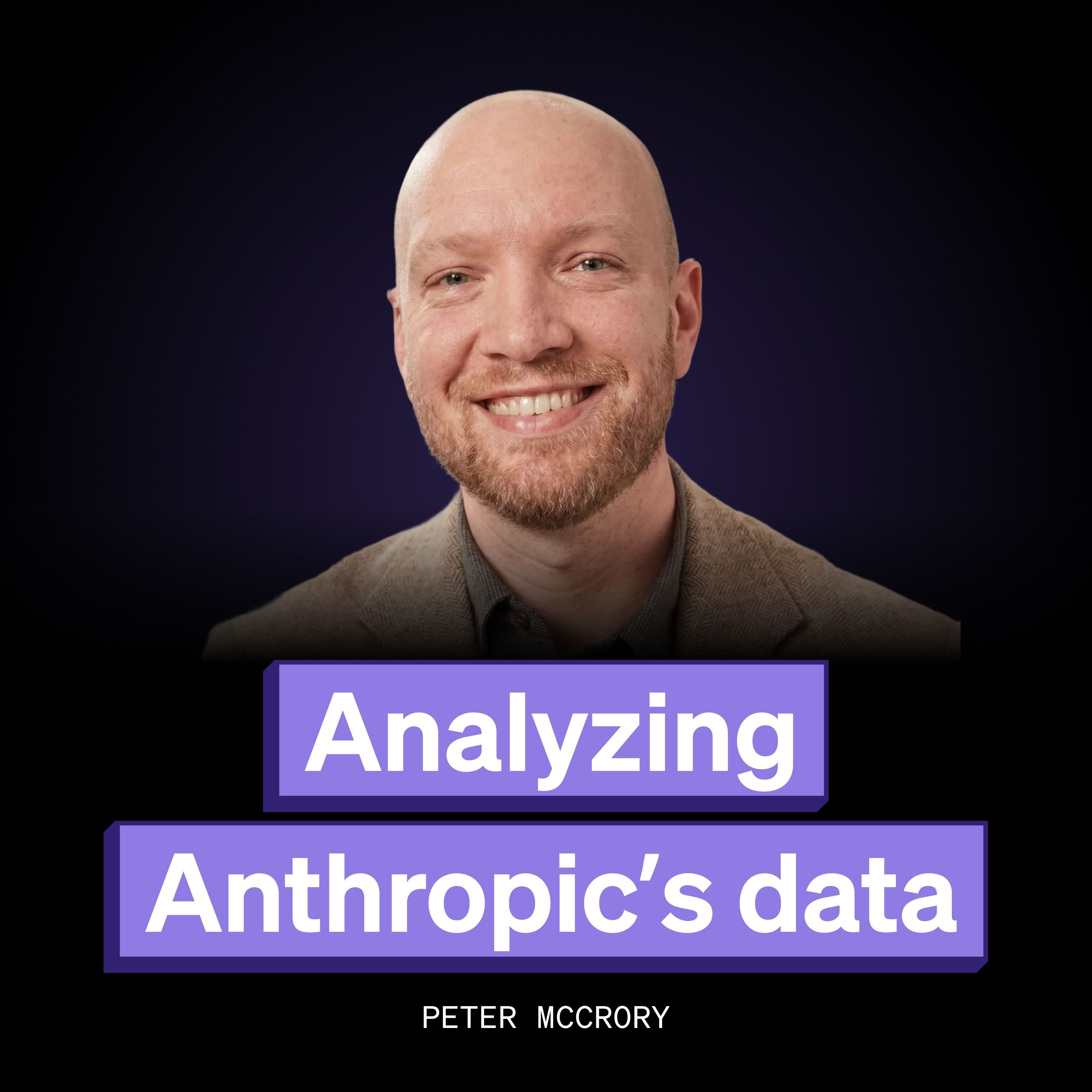
    In this episode, Peter McCrory, Head of Economics at Anthropic, unpacks the company's new Economic Index report. His team analyzed millions of real Claude conversations to map exactly where AI is augmenting human work today and where it isn't. We explore the striking divergence between API and chat usage, why businesses need to extract tacit knowledge to unlock AI's potential, the "hollow ladder" risk for junior workers, and Anthropic's estimate that AI could add 1.0-1.8% to annual productivity

  • #96
    January 16 · 32 min

    My outlook for 2026: orchestration, the human edge and the AI bubble

    In this episode, I share my outlook for 2026 and explain why AI tools now feel genuinely different. I explore how the act of making has been transformed, why authenticity and meaning will become the new scarcity, and whether the foundations of energy and capital can hold. I also address the question I was asked most in 2025: when will the AI bubble burst?

  • #95
    January 8 · 47 min

    AI, markets, and power: A conversation with Paul Krugman (2025 re-run)

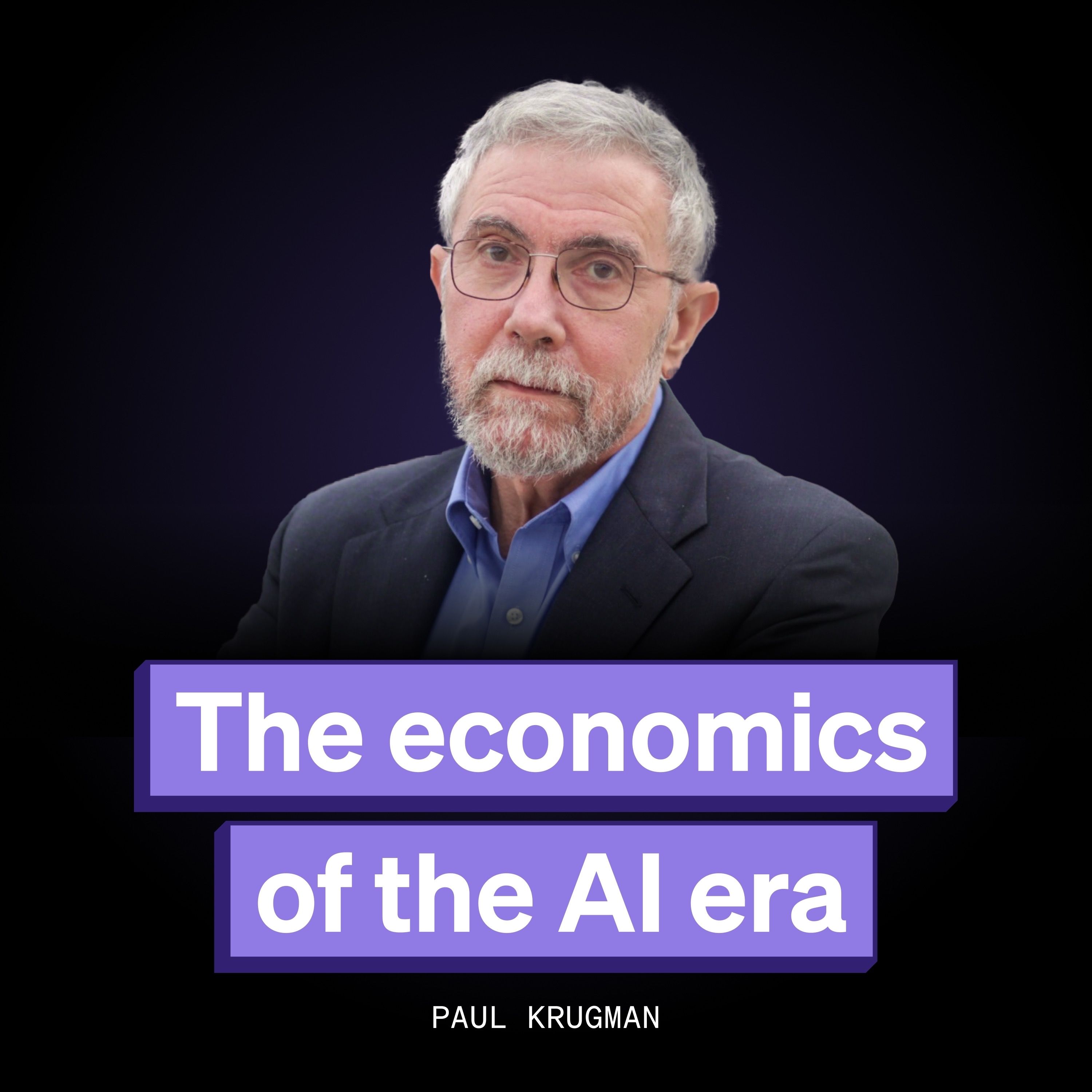
    In this episode, Nobel Prize-winning economist Paul Krugman and I discuss how a strong US economy, high asset valuations, and rapid AI adoption are sitting in uneasy tension. We explore what past technology cycles can teach us, why safety nets struggle to address disruption, and where genuine optimism still makes sense.

  • #94
    Dec 20, 2025 · 25 min

    Reflecting on 2025 (the K-shaped economy, AI's impact on work and human judgement, energy bottlenecks)

    What made 2025 special? 🎊 We recorded this to publish after Christmas, but demand for year‑end reflections prompted an early release - so if you hear me say Christmas has passed, that’s why. 🎊 In this episode, I reflect on the past year and what it revealed: a K-shaped divide. On one track, AI models are now doing hours of high quality work, improving at exponential pace, and shifting how we work from doing to judging. On the other, organisations and the broader economy are struggling to

  • #93
    Dec 19, 2025 · 21 min

    What I learned from the world's leading minds in 2025

    In this episode, I’ve distilled a year of extraordinary dialogue into one 20-minute briefing. I’ve spent 2025 in conversation with the architects of our future - the builders and thinkers redefining AI, energy, and the global economy. These are the "eureka" moments from my most exclusive interviews. From the future of "protopia" with Kevin Kelly to the hidden tech gaps with Dan Wang, this is your strategic roadmap for the exponential age.

  • #92
    Dec 10, 2025 · 24 min

    What it will take for AI to scale (energy, compute, talent)

    In this episode, I look at the next 24 months of AI. The technology is improving rapidly – so what could hold back widespread transformation of how we work and live? I dig into the real constraints, from electricity shortages to institutional inertia, why mid-2026 matters for enterprise AI, and why so many people remain uneasy about a technology they use every day.

  • #91
    Dec 5, 2025 · 24 min

    The method of invention, AI's new clock speed and why capital markets are confused

    In this episode, I reflect on the third anniversary of ChatGPT's launch as a marker of where we are in the exponential age. As a product, ChatGPT captures the speed of technological progress, the new behaviours emerging around it and the widening gap between innovation and institutional change – all symptomatic of the era I called the exponential age in my 2021 book.

  • #90
    Nov 21, 2025 · 21 min

    Why the AI productivity gains haven’t arrived - yet

    The AI industry is sending mixed signals, with markets turning red while teams report real productivity gains. In this session I explore why we are living in a split reality, where individuals move faster with these tools but the wider economy is ambivalent. We once assumed juniors would get the biggest lift from AI, yet the newer agentic tools seem to reward senior workers who know how to structure problems and judge output.

  • #89
    Nov 14, 2025 · 47 min

    Where did all the entry-level jobs go? (With Revelio CEO Ben Zweig)

    Junior roles in AI-exposed fields are disappearing fast. The obvious culprit is AI rapidly automating entry-level jobs. And yet, this isn't quite right. What is driving the drop is managers’ expectations about what AI will do, not the work that it's already replacing. I discussed this with Ben Zweig of Revelio Labs, which builds global workforce data from millions of individual profiles to track hiring, separations and job flows. Together, we explored the future of work and shared practical

Showing 1–20 of 20 episodes