Skip to content
Artwork for Austroads: Transport Research and Trends

Austroads: Transport Research and Trends

Austroads

Austroads latest webinars. Sharing transport research and trends.

Play
  • 26 episodes
  • Avg 59 min
  • English
Counted on this page — what you have heard stays on this device, so it is not something the list can be paged by.
  • #338
    Wednesday · 1 hr

    Managing Transport Management Centre Workplace Fatigue and Psychosocial Hazards

    Transport Management Centres operate at the heart of our transport networks, coordinating responses to incidents, managing disruptions and supporting the safe and efficient movement of people and goods. Alongside these responsibilities come unique challenges, including shift work, high workloads, exposure to traumatic events and the need to make critical decisions under pressure. This webinar provided an overview of the key findings from the project, discussed practical approaches for managing fatigue and psychosocial hazards in TMC environments, and explored how agencies can better support the wellbeing, resilience and performance of their operational teams. We encourage TMC leaders, operators, incident response personnel, workplace health and safety practitioners, HR professionals and others involved in safety-critical operations to watch this recording. This webinar was presented by David Yee and Sarah Jones.

  • #337
    September 1 · 1 hr 6 min

    Using and Understanding the Austroads Guide to Temporary Traffic Management for Road Infrastructure Managers

    The Austroads Guide to Temporary Traffic Management (AGTTM) provides nationally consistent guidance for the planning, design, and implementation of safe and efficient temporary traffic management across Australia and New Zealand. Road Infrastructure Managers (RIMs) play a critical role in setting standards, approving works, maintaining network performance and ensuring safe road user outcomes during construction and maintenance activities. This webinar is designed for professionals working within or for RIMs, especially those responsible for managing TTM access to the road network for works, events, and emergencies. This webinar is suited to any RIM personnel involved in reviewing TTM documentation as part of managing road corridor access or the delivery of infrastructure, as well as persons inspecting/auditing temporary traffic management arrangements on behalf of RIM.

  • #336
    August 31 · 1 hr

    Austroads Guide to Road Safety Part 7: Road Safety Management

    The Austroads Guide to Road Safety Part 7: Road Safety Strategy and Management has been updated to Edition 3.0, published April 2026. AGRS Part 7 supports Australian and New Zealand jurisdictions to reach their national targets of zero road deaths and serious injuries by 2050 (and interim targets by 2030). The Guide outlines international best practice and research on road safety management, providing an integrated framework for coordinated strategic planning across all pillars of the Safe System. Edition 3.0 includes minor editorial amendments throughout to align with national and international best practice. Most significantly, it introduces a new Section 2: Road Safety Management - the focus of this webinar. Section 2 delivers targeted, actionable guidance for the people who most shape road safety outcomes at a systems level: senior government executives, senior road safety leaders, road safety delivery partners, and elected officials. It addresses the leadership, institutional, and management conditions that enable, or constrain, effective road safety performance, providing a practical resource for those responsible for driving change at the highest levels. During this webinar, we explore the key elements of the new Section 2.

  • #335
    August 26 · 1 hr 1 min

    Urban Freight Scoping Study

    Urban freight plays a critical role in supporting cities and regional centres across Australia and New Zealand; however, despite its importance, urban freight is not consistently defined, measured and planned for across jurisdictions. This webinar presents an overview of the Urban Freight Scoping Study. The purpose of the study is to provide a clear, evidence-based foundation to support future policy development and decision-making related to urban freight in Australia and New Zealand. Participants gain an overview of the current state of the urban freight task and understand key challenges faced by industry. Drawing on findings from existing literature, stakeholder engagement with over 30 organisations, and international best practice, the session also discusses ways that governments across Australia and New Zealand can better support urban freight.

  • #334
    August 24 · 59 min

    Update to Austroads Guide to Road Design: Addressing Identified Gaps and Inconsistencies 2

    This webinar presents the outcomes of Austroads research into intersection sight distance, identifying key gaps, inconsistencies, and opportunities for harmonisation across Australian and New Zealand road design guidance. Drawing on an extensive literature review, international best practice, and stakeholder engagement with jurisdictional experts, the project examined the application of sight distance models at signalised and unsignalised intersections for all road users. The webinar will highlight key findings, including inconsistencies in current design approaches, consideration of different transport modes, and the treatment of signal failure scenarios. It will also outline recommendations for updating Austroads Guide to Road Design Part 4A to improve clarity, consistency, safety outcomes, and practitioner decision-making across the road network.

  • #333
    August 21 · 59 min

    Update to Guide to Road Safety Part 3: Safe Speed Management

    This webinar provides an overview of the updated Austroads Guide to Road Safety Part 3: Safe Speed Management, with a focus on how the guidance can support safer speed limit setting in practice.Designed for road authorities, transport practitioners and others involved in speed management, the webinar will provide an overview of the Guide’s key concepts, evidence base and practical tools for applying safe speed principles across different road and street environments.Participants learn how the updated Guide supports a move from evidence to strategy, frameworks, implementation planning and delivery.

  • #332
    August 13 · 59 min

    Update to the Austroads Guide to Road Design: Addressing Identified Gaps and Inconsistences 1

    This project delivered a range of important updates to the AGRD aimed at improving the clarity, consistency and contemporary relevance of road design guidance across Australia and New Zealand. It incorporated findings from the All User Groups and All Stereotypes and Safe System Median Treatments projects, while also addressing identified errors, inconsistencies and opportunities for harmonisation. In this session, we focus on updates to Workstream 1.3 Batter Slopes and Workstream 1.8 Consistent Speed Terminology. Attendees will gain an understanding of the key changes, the rationale behind them, and their practical implications for road design, standards development and project delivery.

  • #331
    August 10 · 1 hr 1 min

    Development of a New Austroads Fatigue Cracking Performance Test for Bitumen in Sprayed Seals

    This webinar presents the outcomes of Austroads Project APT1975, which conducted research to develop a new Austroads test method for evaluating the fatigue cracking performance of aged bitumen. The test method was developed for road agencies to select durable binders for constructing sprayed seal surfacings. The development work included an extensive literature review of international fatigue cracking tests to identify suitable dynamic shear rheometer (DSR) tests. The most promising tests identified in the literature review were then conducted on a wide range of binders that were subjected to asphalt fatigue tests. This enabled selection of a reference binder test that showed the best correlation with asphalt fatigue life results. The DSR time-sweep test was identified as a suitable reference binder test and was used to assess the fatigue cracking performance of bitumen samples after they were aged in a laboratory pressure ageing vessel (PAV) for up to 72 hours. The bitumen samples were then subjected to other DSR tests that could be performed in a shorter time than time-sweep tests, in order to identify a simple test that could be used instead of time-sweep tests which are time-consuming and complex. The new Austroads test involves PAV ageing a 1 mm bitumen film for 72 hours and then measuring the complex modulus (G*) of the aged bitumen sample at 15°C using a test frequency of 10 Hz.

  • #330
    August 5 · 52 min

    Using and Understanding the Austroads Guide to Temporary Traffic Management for Traffic Management Designers

    The Austroads Guide to Temporary Traffic Management (AGTTM) provides nationally consistent guidance for the planning, design and implementation of safe and efficient temporary traffic management across Australia and New Zealand. Traffic Management Designers (TMDs) play a critical role in the temporary traffic management process. The planning and design phase provides the greatest opportunity to identify hazards, manage risks and develop practical, safe and efficient TTM solutions. As a result, TMDs are central to achieving effective on-road outcomes. This webinar recording is suited to both practising and aspiring TMDs, and professionals working within or alongside the TTM industry who are looking to strengthen their understanding of the AGTTM and apply it more effectively in their day-to-day work. The webinar provided an overview of key topics relating to best-practice TTM design and summarised recent updates to the AGTTM that are specifically relevant to designers.

  • #329
    July 20 · 1 hr 1 min

    Implementation of Austroads Technical Specifications

    The Austroads Technical Specifications provide a comprehensive framework for the construction of roads and bridges, defining key requirements for materials, treatments and infrastructure across the industry. They establish a consistent, best-practice approach to the design, specification and delivery of road and bridge works. By standardising requirements across jurisdictions, they support greater efficiency, improved quality outcomes and more streamlined procurement and delivery processes for both industry and government. This webinar provides an overview of the Austroads Technical Specifications, including how they are being developed in collaboration with jurisdictions and industry. It will explore the principles guiding their creation and the role they play in supporting consistent, best-practice road and bridge construction outcomes. Presentations from agencies also outline their approaches to implementation, covering key objectives, delivery strategies and lessons learned. Speakers will share insights into their implementation processes, along with current progress and timelines for adopting the specifications within their organisations.

  • #328
    July 16 · 57 min

    Determining the Minimum Data Requirements to Progress Pedestrian Safety

    This webinar presents the development and application of the Minimum Data Requirements for Pedestrian Safety Guideline and its supporting research. Participants will gain an overview of the challenges associated with inconsistent and incomplete pedestrian safety data, and why a nationally consistent approach is critical for monitoring outcomes and targeting investment. The session will explain how the research identified and prioritised pedestrian safety data sets, distinguishing between “ideal” and “minimum” requirements based on cost, effort, and contribution to safety outcomes. It will highlight the recommended minimum data framework, covering exposure and demographics, crashes and injuries, and physical environment data across strategic, tactical and site levels. Attendees also learn practical approaches to data collection, use of proxy measures, current gaps, and emerging opportunities to improve pedestrian safety monitoring and decision-making in transport agencies.

  • #327
    July 8 · 1 hr

    Charting a Path to Eliminating Road Death and Serious Injury

    This webinar presents the completed Austroads Charting a Path to Eliminating Road Death and Serious Injury project, including all three streams and newly released knowledge transfer resources. It introduces the Planning for Zero Framework (PfZF)—a practical, system-based approach to achieving Vision Zero by 2050—and demonstrates how it translates into actionable Zero Pathways tailored to jurisdictions. Participants will explore key findings, practical road safety strategy development advice, and a comprehensive suite of artefacts now available through the Knowledge Hub, including briefings, fact sheets, infographics, engagement guidance, and messaging toolkits. The session is designed for road safety leaders and practitioners, and general road and transport professionals, seeking clear, evidence-based guidance to move from road safety ambition to implementation—combining technical planning, change management, and stakeholder engagement to deliver sustained reductions in death and serious injury.

  • #326
    July 6 · 47 min

    Updates to Austroads Guide to Temporary Traffic Management in Edition 1.2

    The Austroads Guide to Temporary Traffic Management (AGTTM) provides nationally consistent guidance for the planning, design, and implementation of safe and efficient temporary traffic management across Australia and New Zealand. Recent revisions to AGTTM Parts 1–7, 9 and 10 (Edition 1.2) focus on continuing to align the Guide with contemporary temporary traffic management best practice, improving clarity, and strengthening consistency of terminology. Approximately 30 per cent of content across these Parts has been updated, while deliberately retaining the existing structure of the Guide. These updates represent an incremental and continuous improvement approach, refining guidance where while maintaining consistency for ease of integration with existing TTM documentation. This webinar provides a practical overview of the key changes, their intent, and what they mean for those involved in the planning, approval and delivery of temporary traffic management.

  • #325
    June 30 · 1 hr

    Use Cases For Fibre Optics Technology

    This webinar presented the outcomes of Austroads Project NEG6439, which examined how fibre optic sensing technologies can be applied to support improved road agency services and functions. While fibre optic networks are widely deployed across Australian and New Zealand transport agencies for communications, their use as a sensing capability remains relatively underutilised. This project explored how technologies such as distributed acoustic sensing (DAS), distributed temperature sensing (DTS) and strain fibre sensing (SFS) can be leveraged across a broad range of operational use cases. The webinar outlines approximately 20 prioritised use cases across four key domains: traffic monitoring, anomaly detection, security and asset management. These include applications such as travel speed and volume monitoring, linear heat detection in tunnels, perimeter security, and structural health monitoring of bridges and tunnels. The session also presented an assessment of technology maturity, highlighting that several use cases are already at established to advanced levels (TRL 5–9), while others remain emerging or nascent and suited to targeted trials. Practical guidance was provided on how these technologies can be integrated into existing transport systems, including key considerations for deployment, operations, and data management, as well as insights into market trends and capability requirements. This webinar recording will be of interest to transport agencies, infrastructure operators, and practitioners involved in intelligent transport systems, asset management and network operations. This webinar was presented by Irene Horvat and Henry Wu with a live Q+A moderated by David Yee.

  • #324
    June 25 · 1 hr 3 min

    Investigating New Performance Testing of Unbound Granular Materials

    Unbound granular materials play a crucial role in providing cost-effective road transport infrastructure across Australia and New Zealand. Compared to the thick asphalt and concrete pavements common in urban centres, thin bituminous surfaced unbound granular pavements offer a more economical solution for sealed road networks, albeit with lower load-bearing capacity and in some cases lower performance reliability. The performance of unbound granular materials is primarily influenced by their shear strength, modulus, and resistance to material breakdown under construction and traffic loads. Improved performance tests are required to provide practical pavement design methods and performance-based specifications for their use in construction. This webinar presents research to identify new performance tests recommended for future Austroads research. Performance characterisation methods were reviewed, including repeated load triaxial (RLT) testing and wheel tracker testing. In identifying potential new improved laboratory test methods, particularly in relation to rut-resistance, cognisance was taken of the shear stress reversals due to rolling wheel loads that occur in service.

  • #323
    June 23 · 58 min

    Enabling Accessible Electric Vehicle Charging

    This webinar highlights key themes from the Enabling Accessible EV Charging guidelines, which provide guidance on improving the usability of EV charging infrastructure for people with disability. The session touches on selected aspects of the EV charging experience, including site layout, charging equipment, wayfinding, and payment, focusing on issues that commonly arise in real-world deployments. Drawing on research, consultation, and international best practice, the webinar will share insights into accessibility challenges and examples of good practice emerging in Australia and overseas. The webinar aims to support awareness and informed decision-making among planners, infrastructure providers, and policymakers as EV charging networks continue to expand.

  • #322
    June 17 · 58 min

    Austroads Guide to Pavement Technology Part 4K: Selection and Design of Sprayed Seals

    This webinar presents the outcomes from a series of workshops with industry and users aimed at identifying future research needs and required changes to the Austroads Guide to Pavement Technology Part 4K: Selection and Design of Sprayed Seals. The aim of this projects was to continue refining the Austroads sprayed seal design method and its related guidance to better suit evolving traffic loads, pavement structures, and material technologies. The Austroads sprayed seal design method, widely used in Australia, provides guidance on materials, treatment selection, and methods for calculating binder application rates and aggregate spread rates. In New Zealand, the chipsealing design method is detailed in Chipsealing in New Zealand. Ongoing changes in traffic loadings, pavement structures and materials have prompted updates to the Guide that have been immediately implemented into a newly published version. To ensure the design methods remain reliable and that sprayed seals can perform under increased traffic volumes, updates were based on input from seal designers, transport agencies, consultants, and contractors as part of the workshops held in Australia and New Zealand. These changes, and the future research plan generated as part of this project will be described in this webinar.

  • #321
    June 9 · 1 hr 3 min

    Design Principles for Adapting Roads and Infrastructure for Emerging Mobility Technologies

    As automated, connected and electric vehicle technologies continue to develop, road agencies across Australia and New Zealand need to prepare infrastructure for new operating conditions. Technologies such as Automated Vehicles (AVs), Connected and Automated Vehicles (CAVs), Electric Vehicles (EVs), Advanced Driver Assistance Systems (ADAS) and Cooperative Intelligent Transport Systems (C-ITS) place new demands on both physical and digital infrastructure. Many of these demands extend beyond the scope of current design standards. This webinar presents the findings of Austroads Project CAV6428, which defines a set of high-level design principles to support infrastructure readiness for future mobility. The project reviewed international and local research, analysed existing Austroads and jurisdictional guidance, and engaged with Austroads member agencies to understand current challenges and priorities. The project outputs provide a structured foundation to support agencies through this transition, identifying key gaps and mapping how infrastructure capability can evolve over time. The project identified 24 topic areas - 11 physical and 13 digital - where agencies require clearer direction to support emerging vehicle technologies. Across these topics, the report identifies 135 design principles covering areas such as managing transitions of control between automated and manual driving, ensuring readability of lane markings and signage, managing mixed traffic interactions, kerbside management for automated vehicles and EVs, ensuring reliable CAV communications, protecting data from cybersecurity threats, and supporting digital resilience. The principles give agencies practical direction for planning and adapting infrastructure in an evolving technology environment. They support informed decision-making that reflects local context, operational needs and technology readiness. The principles are a flexible toolkit that agencies can apply selectively to suit different project types and stages of deployment, while supporting consistency across jurisdictions. The project also developed an online mapping tool to help visualise and navigate the principles. This interactive matrices allow users to filter by topic area and explore how physical and digital considerations for vehicle technologies impact infrastructure. In this session, presenters David Yee and Megan Sharkey explain the purpose and structure of the design principles, summarise the key physical and digital topic areas, outline how agencies can apply the principles in practice. The session will also demonstrate how the mapping tool can support practical application. This webinar is relevant to professionals across road and transport agencies, including planners, designers, asset managers, ITS specialists and policy leads involved in preparing infrastructure for emerging mobility technologies.

  • #320
    May 29 · 56 min

    Implementation of the National Driver Distraction Roadmap: Incorporating Human Factors in Transport Systems

    Human Factors and Ergonomics (HFE) is the discipline that focuses on understanding and optimising interactions between humans and system components to enhance performance, safety, health and wellbeing. Human Factors Integration (HFI) is the process by which HFE knowledge, principles and methods are utilised throughout the system lifecycle to support the design of safe, usable and effective components. In this presentation, we outline the new Austroads Guidelined for Human Factors Integration in Road Transport (HFI-RT). The HFI-RT guideline provides road transport system stakeholders with information to support the consideration and application of HFE knowledge, principles and methods during the design, implementation and operation of road transport system components (e.g. vehicles and in-vehicle technologies, traffic control devices, signage, roads and roadsides, advertising, training and education programs, policies and procedures). During the presentation, we will provide an overview of the HFI-RT guideline and demonstrate it via a case study focused on driver distraction.

  • #319
    May 14 · 1 hr 1 min

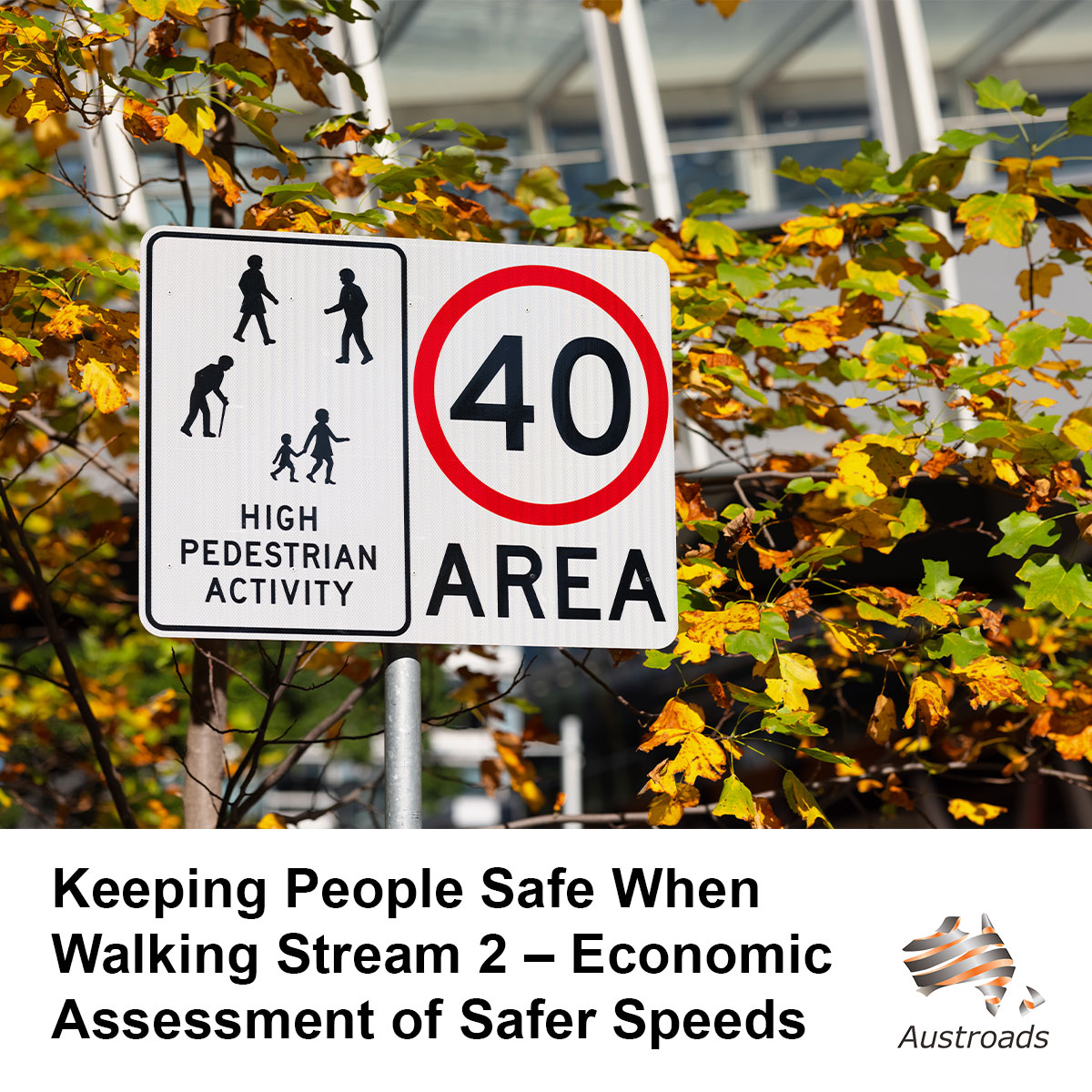
    Keeping People Safe When Walking Stream 2 – Economic Assessment of Safer Speeds

    This webinar provided an overview of the Austroads’ report, Keeping People Safe When Walking – Stream 2: Economic Assessment of Safer Speeds, completed as part of the Keeping People Safe When Walking program. The assessment applies a cost-benefit analysis (CBA) approach, which estimates and compares the costs and benefits for society from 12 different hypothetical speed limit reductions in a variety of (mostly urban) contexts. Emerging economic techniques were applied to value, in dollar terms, the benefits of reduced speed limits for society from reduced road trauma and improved pedestrian mobility. This was weighed against productivity-related costs from increased travel time. The assessment builds a framework and evidence to support road managers looking to assess speed limit changes. In this webinar, attendees heard about: how speed limit reductions can be assessed using a cost-benefit analysis framework why it appears there is a strong case for safer speed limits as a key pedestrian safety intervention the key drivers of this result and areas where further evidence would add value for future policy reform assessments. This webinar was presented by Anna Wilson. The Q+A was moderated by Phil Harbutt.

Showing 1–20 of 26 episodes