transcript
show notes
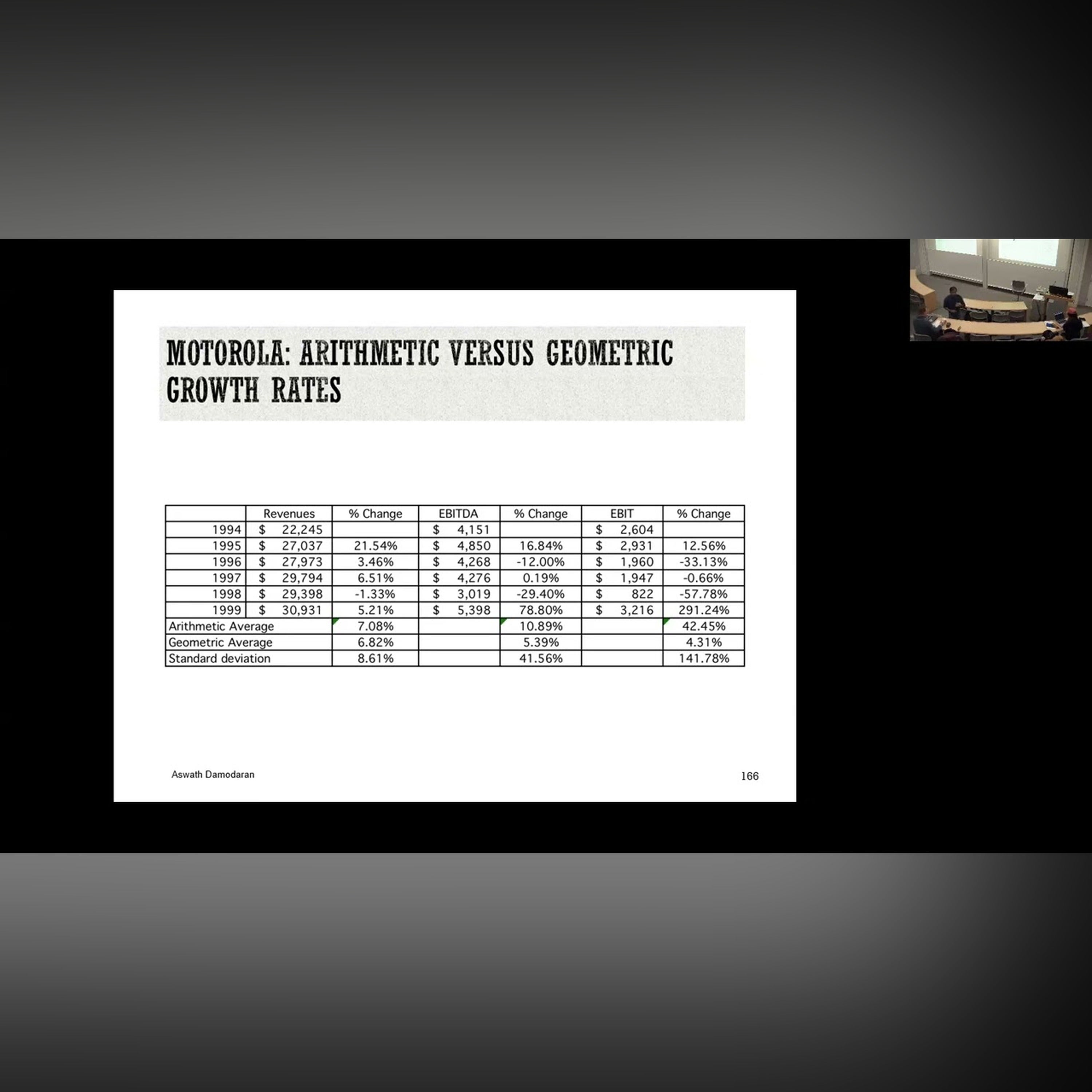
In this quiz-shortened session, we started our discussion of growth rates by first looking at historical growth rates, and how they vary across metrics (revenues, operating income, net income etc.) and why arithmetic and geometric averages can be very different. I also mentioned I.M.D. Little and his thesis title, “Higgledy Piggledy Growth”, which he managed to publish in a journal:
https://onlinelibrary.wiley.com/doi/pdf/10.1111/j.1468-0084.1962.mp24004001.x
We then looked at why equity research promises so much and delivers so little, and in that context, I thought you might find it interesting to see the analysts who showed on the Institutional Investors’ All America Team last year:
https://www.institutionalinvestor.com/article/2ccm1e0hpe37pla4uuh34/research/the-new-stars-of-the-52nd-annual-all-america-research-team
We ended with a discussion of fundamental growth rates, starting with earnings per share, and then moving on to non-cash net income. While we Weill continue with that discussion next class, the basic theme will remain the same, which is that sustainable or long term growth is the product of how much you reinvest and how well you reinvest, a lesson worth returning to over and over again.
Quiz at the start of the class for first 30 minutes.
Slides: https://nyu.box.com/s/xe955dmsa7rcjfkq081c15p6s13fkzeh
Post class test: https://www.stern.nyu.edu/~adamodar/pdfiles/eqnotes/postclass/session10test.pdf
Post class solution: https://www.stern.nyu.edu/~adamodar/pdfiles/eqnotes/postclass/session10soln.pdf
Learn more about your ad choices. Visit megaphone.fm/adchoices
- https://onlinelibrary.wiley.com/doi/pdf/10.1111/j.1468-0084.1962.mp24004001.xonlinelibrary.wiley.com
- https://www.institutionalinvestor.com/article/2ccm1e0hpe37pla4uuh34/research/the-new-stars-of-the-52nd-annual-all-america-research-teaminstitutionalinvestor.com
- https://nyu.box.com/s/xe955dmsa7rcjfkq081c15p6s13fkzehnyu.box.com
- https://www.stern.nyu.edu/~adamodar/pdfiles/eqnotes/postclass/session10test.pdfstern.nyu.edu