Skip to content
Artwork for Associations Thrive
BusinessNon-ProfitManagementEducation

Associations Thrive

Joanna Pineda

This is Associations Thrive, the podcast celebrating successful associations and their leaders. Listen in as top association executives tell all, revealing the creative and innovative ways they’re increasing their bottom line, serving their members, and reimaging their organizations.

The Associations Thrive podcast is hosted by Joanna Pineda, CEO & Chief Troublemaker at Matrix Group International. Joanna’s personal mission and the mission of Matrix Group is to help associations and nonprofits increase membership, generate revenue and thrive in the digital space.

We believe that every association has a unique mission and unique story in how they’re serving their members, impacting their industry, and ultimately changing the world. Guests include top trade association, professional society, and non profit executives. We’re here to help amplify their stories so all associations can learn and thrive, together.

Play
  • 21 episodes
  • weekly
  • Avg 30 min
  • English
Counted on this page — what you have heard stays on this device, so it is not something the list can be paged by.
  • #195
    Thursday · 37 min

    195. Sheri Jacobs, CAE, CEO of Avenue M Group, on The Unexpected Power of Boundaries, Smart Risk-Taking, and Innovation

    What if the thing holding your team back from innovation isn’t too many constraints, but too few? And how can associations create clear boundaries that give staff the confidence and freedom to experiment, learn, and move faster? In this episode of Associations Thrive, host Joanna Pineda interviews Sheri Jacobs, CEO of Avenue M Group, keynote speaker, and best-selling author. Sheri discusses: How AI is making information and education easier and faster to access, but associations have an important advantage: trust and reliability. The premise behind Sheri’s newest book, The Unexpected Power of Boundaries: “Growth happens at the speed of clarity,” and clarity comes from well-defined boundaries. Why telling teams to “think outside the box” can actually inhibit creativity. Unlimited choices can overwhelm people and cause them to default to familiar ideas. How leaders can define the why and the what—including the constraints—while giving their teams freedom to determine the how. Why leaders should reverse the speaking order in meetings. When senior leaders speak first, others tend to fall in line; inviting junior and frontline staff to speak first can surface ideas from people closest to members and customers. The important distinction between risk tolerance and risk capacity. Risk tolerance is about comfort; risk capacity is about how much an organization can actually afford to experiment, fail, learn, and recover. Why simply telling employees to “take risks” isn’t enough. Innovation happens when organizations combine psychological safety with clear boundaries around where experimentation is safe. How the “Best New Mistake Award” can encourage experimentation by celebrating employees who tried something, failed, learned from it, and used the learning to move the organization forward. Why associations should regularly examine whether their boundaries are outdated—and create a process for experimentation that defines hypotheses, assumptions, learning, and how results will be shared. How associations and conferences can turn inspiration into action by creating constraints such as a 30-day challenge that asks participants to take one smart risk and report back on what happened. References: Avenue M Group Website The Unexpected Power of Boundaries Book Pivot Point Book The Art of Membership Book

  • #194
    September 10 · 30 min

    194. Jana Darling, President of MGI, on Why Membership Growth Is Getting Harder and Making Your Value Clear

    What happens when membership growth gets harder, even though the members you already have continue to renew? How can associations better communicate their value, attract new members, and create the engagement that fuels growth? In this episode of Associations Thrive, host Joanna Pineda interviews Jana Darling, President of Marketing General (MGI). Jana discusses: The findings from MGI’s 2026 Membership Marketing Benchmarking Report, now in its 18th year and based on responses from nearly 500 associations. How membership growth is getting harder. Only 38% of associations reported membership growth this year, down from 45% the previous year and close to a historic low for the study. Why associations “cannot renew their way to growth.” Retention remains relatively steady at about 82%, but without a steady pipeline of new members, organizations will eventually decline. How strong retention suggests that associations are delivering value once people join. The challenge is often communicating that value effectively to prospective members. Why engagement is “the engine of everything else,” and why associations should begin engaging prospects before they join. With members increasingly strapped for time, associations also need to make participation easy and meaningful. Why associations need to continually reevaluate their member value proposition. With information increasingly available through AI, open access, and other free sources, associations must understand what members value today. Organizations that conduct regular member research are more likely to report membership growth. How 39% of associations say an inability to articulate their value prevents them from offering a more compelling member value proposition. Jana says that if members are the business of an association, the value proposition should be central to everything the organization does. How associations can use the Membership Marketing Benchmarking Report to compare themselves with their peers, identify practices correlated with growth, set realistic expectations with their boards, and find opportunities to innovate and improve. References: MGI Website MGI’s 2026 Membership Marketing Benchmarking Report

  • #193
    September 3 · 26 min

    193. Carlos Cardenas, CAE, President of Association Latinos, on Leadership, Cultural Superpowers, and Hispanic Heritage Month

    What happens when professionals stop viewing their culture as something they need to minimize at work, and start recognizing it as a leadership superpower? And how can associations create the spaces, programs, and opportunities that help underrepresented leaders build confidence, visibility, and pathways to leadership? In this episode of Associations Thrive, host Joanna Pineda interviews Carlos Cardenas, CAE, President of Association Latinos. Carlos discusses: How Association Latinos exists to increase the representation of Latino leaders throughout the association community, from mid-level management and the C-suite to nonprofit boards. Why the founders decided Association Latinos needed to become its own 501(c)(3), rather than remain an affinity group. The organization wanted to control its destiny, understand and serve its community directly, and develop programs specifically for Latino association professionals. How Association Latinos seeks to shine a spotlight on Latino professionals who are already doing great work while also “unlocking their confidence” so they recognize their own power and potential. How the CAE Se Puede program and Avanza Scholarship create pathways for Latino association professionals to earn the Certified Association Executive (CAE) credential, while a partnership with Sidecar creates opportunities to earn the Association AI Professional (AAiP) certification. Why a small organization needs to “think like an entrepreneur.” Association Latinos is building creative partnerships with organizations such as ASAE, Sidecar, and the LPGA Amateur Golf Association to provide greater value even without large, consistent revenue streams. How the inaugural For La Causa golf event introduces members to golf, gives volunteers an opportunity to relax and connect, creates value for partners and sponsors, and could eventually create a new fundraising stream. How Conexiones, Association Latinos’ education summit, uses a cohort model instead of a traditional choose-your-own-session conference format. Participants experience the program together in smaller groups, creating deeper relationships and longer-lasting connections. Why culture is part of the “special sauce, or salsa” of Conexiones. Association Latinos encourages professionals to bring their heritage, languages, ancestry, stories, and authentic selves into their leadership instead of feeling that advancement requires assimilation. How Association Latinos separated its Honores awards from Conexiones so award recipients, volunteers, allies, and community leaders could be celebrated more intentionally, and so the awards event could become a fundraising opportunity of its own. Why Hispanic Heritage Month should be more than a once-a-year spotlight. Carlos wants Latino thought leadership and stories elevated year-round, while also honoring the often “invisible layer” of parents, grandparents, immigrants, workers, and others whose sacrifices created opportunities for the generations that followed. References: Association Latinos Website CAE Se Puede & Avanza Scholarship Conexiones 2026 Latinx Treasures - Movies, books and articles to enjoy year round by Latinx creators

  • #192
    August 27 · 19 min

    192. Cheryl Kreider Carey, CAE, CEO of SIIM, on Building Bridges Across Imaging, AI, and Creating a Culture of Belonging

    What does it take for a 45-year-old association to continually reinvent itself in a field being transformed by digitization and AI? And how can an association bring together professionals from different specialties, roles, and organizations to help shape the future of an entire field? In this episode of Associations Thrive, host Joanna Pineda interviews Cheryl Kreider Carey, CAE, CEO of the Society for Imaging Informatics in Medicine (SIIM). Cheryl discusses: How imaging informatics sits at the intersection of medical imaging, digital health, and technology management. How SIIM membership grew by more than 20% in 2025 as the association expands its reach across imaging specialties. How SIIM’s nearly 3,000 members represent five different personas, including clinicians across imaging specialties, scientists, developers, vendors, and imaging IT experts. How the organization’s ethos, “You Belong at SIIM,” reflects its commitment to bringing these different communities together. Why Cheryl describes SIIM as a “45-year-old startup.” The organization has reinvented itself as medical imaging evolved from film to digital and has had three different names over its 45-year history. How Cheryl works to create what she calls an “invisible culture,” inspired by successful sports coaches who build team chemistry that ultimately produces visible results. At SIIM, she describes the culture as “high emotional intelligence, low ego.” How SIIM partnered with the Digital Pathology Association to create a Bridge Pass: one streamlined payment that allows participants to attend both SIIM’s annual conference and the Pathology Visions Conference. How SIIM has been ahead of the curve on artificial intelligence, holding its first AI conference in 2017 and continuing to convene professionals around AI ever since. References: SIIM Website Bridge Pass Program

  • #191
    August 20 · 28 min

    191. Angela Davis, CEO of SPR and Yasmeen Fields, CEO of SBI, on Becoming Independent, Association Autonomy, and the Power of Executive Peer Networks

    What happens when the organization that has managed your association for decades tells you that you have 18 months to find a new path forward? How can association leaders navigate a major operational transition while protecting their staff, serving members, and making smart decisions about what to keep in-house and what to outsource? In this episode of Associations Thrive, host Joanna Pineda interviews Angela Davis, CEO of the Society for Pediatric Radiology (SPR), and Yasmeen Fields, CEO of the Society of Breast Imaging (SBI). Angela and Yasmeen discuss: How SPR is a community of more than 3,000 physicians, trainees, and allied professionals dedicated to improving children's health through medical imaging, while SBI represents more than 4,200 breast imaging radiologists working to minimize breast cancer mortality and suffering. Why radiology has so many subspecialty associations. As Angela explains, “children are not small adults,” and specialized areas such as pediatric radiology and breast imaging require distinct expertise, education, and professional communities. How both SPR and SBI were managed for decades by the American College of Radiology (ACR), which provided the infrastructure, resources, expertise, and operational support that allowed smaller specialty societies to grow and thrive. How ACR ultimately decided to focus exclusively on its own mission, strategic plan, and members, giving the societies it managed 18 months to transition to a new management structure. How SPR and SBI evaluated different business models, including partnering with another radiology organization, working with an association management company (AMC), and becoming fully self-managed. Both initially partnered with AMCs before ultimately becoming standalone organizations. How becoming independent required Angela and Yasmeen to assume responsibility for functions that previously existed under the ACR umbrella, including HR, accounting, technology, investments, and operational decisions. How both organizations learned not to overcommit during a major transition. Today, both organizations combine small internal staffs with strategic outsourced support. How collaboration extends across the larger “House of Radiology.” Through gatherings like the ACR Inter-Society Conference, association executives and volunteer leaders learn from one another, develop stronger relationships, and see how their individual organizations fit into the broader radiology community. References: SBI Website SPR Website

  • #190
    August 6 · 31 min

    190. Phil Andrews, CEO of USA Fencing, on Growing a Niche Sport, Membership Models, and Media Partnerships

    How does a sport that many people notice only once every four years build sustained, double-digit growth year after year? What can associations learn from USA Fencing about making a specialized community more visible, accessible, and relevant, without a giant marketing budget? In this episode of Associations Thrive, host Joanna Pineda interviews Phil Andrews, CEO of USA Fencing. Phil discusses: How USA Fencing is both an Olympic national governing body and a member-based association, serving approximately 800 clubs and more than 50,000 active fencers ranging in age from six to 86. Why fencing has experienced four consecutive years of double-digit growth.. Why associations cannot focus exclusively on serving the community already in front of them, but also make it easier for prospective members to walk through the front door. How the organization identifies celebrities, performers, business leaders, and other public figures with authentic ties to fencing, and builds relationships with them instead of relying on paid influencer campaigns. How USA Fencing’s strategic plan has addressed governance, operational excellence, collegiate partnerships, Paralympic athlete funding, brand growth, and revenue diversification beyond an events-heavy business model. The complexity of balancing the priorities of a 12-member board, athletes, coaches, referees, clubs, three fencing disciplines, Paralympic fencing, recreational members, and elite competitors. How USA Fencing is reconnecting former student fencers through data collection,, personal email collection, and alumni events that restore a sense of community across generations. References: USA Fencing Website tryfencing.org

  • #189
    July 23 · 34 min

    189. Kelly Dooley, ED/CEO of ITEEA, on STEM Literacy, STEM Teaching Standards, and Non-Dues Revenue

    What does it take to prepare every student, not just future engineers, for a world shaped by technology, AI, and constant innovation? And what role should associations play in equipping educators to meet that challenge? In this episode of Associations Thrive, host Joanna Pineda interviews Kelly Dooley, Executive Director & CEO of the International Technology and Engineering Educators Association (ITEEA). Kelly discusses: Kelly's own journey from structural engineer to association CEO, and how association management became the career she never knew existed. How ITEEA has evolved from the American Industrial Arts Association into the leading professional association for technology and engineering educators, reflecting the changing nature of STEM education. Why every student, not just those pursuing STEM careers, needs technological and engineering literacy to thrive in today's world. ITEEA's Standards for Technological and Engineering Literacy (STEL) and how they define what students should know and be able to do. The association's Engineering byDesign™ curriculum, a PreK–12 STEM program that is now used by states, school districts, and individual educators across the country, and which generates significant non-dues revenue for the association. What it takes to convince an entire state to adopt an association-developed curriculum. The nationwide shortage of technology and engineering teachers, and how ITEEA is addressing recruitment, retention, mentorship, and career pathways through its new strategic plan. How AI is transforming education by helping teachers automate routine work while creating new challenges around student use, classroom policies, and AI literacy. References: ITEEA Website Standards for Technological and Engineering Literacy (STEL) Engineering byDesign™

  • #188
    July 16 · 37 min

    188. Nir Hindie, Founder of The Artian Part Two: How Business Artistry Applies to Associations

    What if your conference wasn't designed around sessions, speakers, and logistics, but around how you wanted attendees to feel? How can your association bring more artistry, intention, and humanity into everything it does? In part two of this two-part special on Associations Thrive, host Joanna Pineda interviews Nir Hindi, Founder of The Artian. Nir discusses: What business artistry is, and why leaders should think of business as a platform for creative expression and human value, not simply optimization. Why association conferences should begin by asking, "What should this feel like?" rather than focusing first on speakers, logistics, or attendance goals. How associations can intentionally design conferences for the individual attendee, especially first-time attendees who arrive alone and often feel intimidated. Why post-pandemic conferences must prioritize human connection and community, since educational content is increasingly available online. How artists teach leaders to pay attention to invisible details that create meaningful experiences, even when attendees can't articulate why something feels exceptional. The Pixar meeting room story, and how changing physical environments can dramatically improve participation, collaboration, and idea generation. How storytelling should focus on members' problems, journeys, and transformations rather than organizational history, milestones, or statistics. Why associations should measure success not simply by attendance or satisfaction scores, but by whether their events genuinely transformed members' professional lives. References: TheArtian website Nir’s Business Artistry Course Follow Nir on LinkedIn Nir’s Website

  • #187
    July 2 · 31 min

    187. Nir Hindie, Founder of The Artian, Part One: What is Business Artistry?

    Can an association create deeper member loyalty by focusing not just on solving problems, but on creating experiences that people genuinely care about? In an era where efficiency and technology dominate, perhaps the real opportunity for associations is to bring more humanity, intention, and artistry into every member interaction. In part one of this two-part special on Associations Thrive, host Joanna Pineda interviews Nir Hindi, Founder of The Artian. Nir discusses: What business artistry is and why it differs from creativity. Creativity solves problems; artistry creates meaning and emotional connection. How some of the world's most admired leaders, including Steve Jobs, Walt Disney, and Edwin Land, approached business as a form of creative expression rather than simply optimization. Why associations should think beyond delivering value and instead design experiences that members genuinely remember and care about. How seemingly small details, from onboarding experiences to event design to member communications, can communicate care, respect, and intention. Why organizations should optimize not only for efficiency, but also for emotional resonance and human connection. The role of awe in leadership, and how inspiring visions motivate employees, members, and stakeholders to become part of something larger than themselves. How founders and executives can become better storytellers by focusing less on features and facts, and more on purpose, motivation, and impact. This conversation is Part 1 of a 2-part interview. In Part Two, Nir explores how business artistry specifically applies to associations and nonprofit organizations. References: The Artian Website Nir’s Business Artistry Course Follow Nir on LinkedIn Nir's Website

  • #186
    June 25 · 34 min

    186. Phil Goldfeder, CEO of AFC, on Responsible Financial Innovation, Creating a Standards-Based Association, and Staying Warm and Fuzzy

    How do you help an industry innovate at breakneck speed while ensuring consumer protection, trust, and regulatory compliance? And what role should an association play in bringing competitors, regulators, and innovators together to shape the future of an emerging industry? In this episode of Associations Thrive, host Joanna Pineda interviews Phil Goldfeder, CEO of the American Fintech Council (AFC). Phil discusses: How AFC has grown from roughly 25 members to more than 175 members and partners, while maintaining a retention rate above 95%. Why AFC intentionally brings fintech companies and banks together under one roof, creating collaboration rather than competition. How AFC differentiates itself as a standards-based organization that embraces regulation, compliance, and consumer protection. Phil’s career journey from public service, including roles with Chuck Schumer, Mayor Michael Bloomberg, and the New York State Legislature, to banking and association leadership. How Hurricane Sandy exposed the need for innovation in insurance and financial services and helped shape Phil’s professional path. Why Phil believes association leadership is remarkably similar to elected office: both are fundamentally about service, engagement, and impact. How AFC creates “safe spaces” where member CEOs can openly discuss challenges, best practices, and emerging business models. AFC’s advocacy efforts to educate policymakers and regulators on fintech innovations such as Buy Now, Pay Later and Earned Wage Access programs. How AFC’s annual summit maintains an intimate, collaborative atmosphere even as attendance has grown dramatically. References: AFC Website

  • #185
    June 18 · 31 min

    185. Jeff Morgan, President & CEO of CMAA, on Community as the Secret Sauce, Member-Driven Growth, and Global Certification

    How does an association grow from 6,000 to 9,000 members without a membership sales team? What can associations learn from an organization whose members actively recruit the next generation on its behalf? In this episode of Associations Thrive, host Joanna Pineda interviews Jeff Morgan, President & CEO of the Club Management Association of America (CMAA). Jeff discusses: How CMAA represents professionals working across 3,500 member-owned clubs, including golf clubs, yacht clubs, city clubs, ski clubs, and more. How CMAA membership grew from approximately 6,000 members during COVID to 9,000 members today—with no membership sales team. Why private clubs experienced significant growth during and after COVID, including increased member demand, long waiting lists, and investments in facilities and amenities. CMAA’s highly intentional 12-month new member onboarding process, which includes welcome kits, monthly communications, quarterly Zoom sessions, and structured opportunities to build connections. The association’s long-running conference idea-sharing program, where members submit and share more than 100 best-practice posters that become a searchable knowledge resource for the profession. CMAA’s Certified Club Manager (CCM) credential, built around 12 professional competencies, continuing education, and a globally licensed certification model. How CMAA has expanded its influence internationally through partnerships, certification licensing, and conference participation from club professionals around the world. Why Jeff believes clubs are no longer simply physical facilities, but communities that remain connected through technology, virtual programming, and shared experiences. How “community” serves as the secret sauce behind both successful clubs and successful associations. References: CMAA Website

  • #184
    June 11 · 32 min

    184. David Walsh, ED of VSAE, on Member Recruitment, New Member Engagement, and Learning Pathways

    What if your association's most effective membership recruiters aren't staff at all, but your members themselves? In an era where association professionals have countless options for education, networking, and professional development, how can associations create such a strong sense of belonging that members actively recruit, welcome, and mentor new participants? In this episode of Associations Thrive, host Joanna Pineda interviews David Walsh, Executive Director of the Virginia Society of Association Executives (VSAE). David discusses: How VSAE serves more than 450 association professionals and industry partners across Virginia, providing education, leadership development, networking, and peer exchange opportunities. How VSAE is expanding its reach throughout Virginia, including launching the Northern Virginia Association Exchange to better serve professionals in the state's largest association market. David's unique association journey, influenced by his mother’s 40-year association career and his progression through membership, marketing, advocacy, and executive leadership roles. How VSAE's annual conference attracted more than 200 registrants and over 50 first-time attendees, the strongest attendance numbers in more than a decade. How volunteer leaders personally reach out to prospective members and conference attendees, creating authentic peer-to-peer invitations rather than relying solely on marketing campaigns. How VSAE's membership committee serves as mentors and ambassadors, ensuring first-time attendees feel welcomed and connected from the moment they arrive. VSAE’s Learning Pathways that help members identify educational content aligned with their career stage, role, and professional goals. How VSAE's Northern Virginia programming combines education, peer exchange, and community-building to create meaningful opportunities for association professionals to learn from one another. References: VSAE Website Northern Virginia Association Exchange

  • #183
    June 4 · 30 min

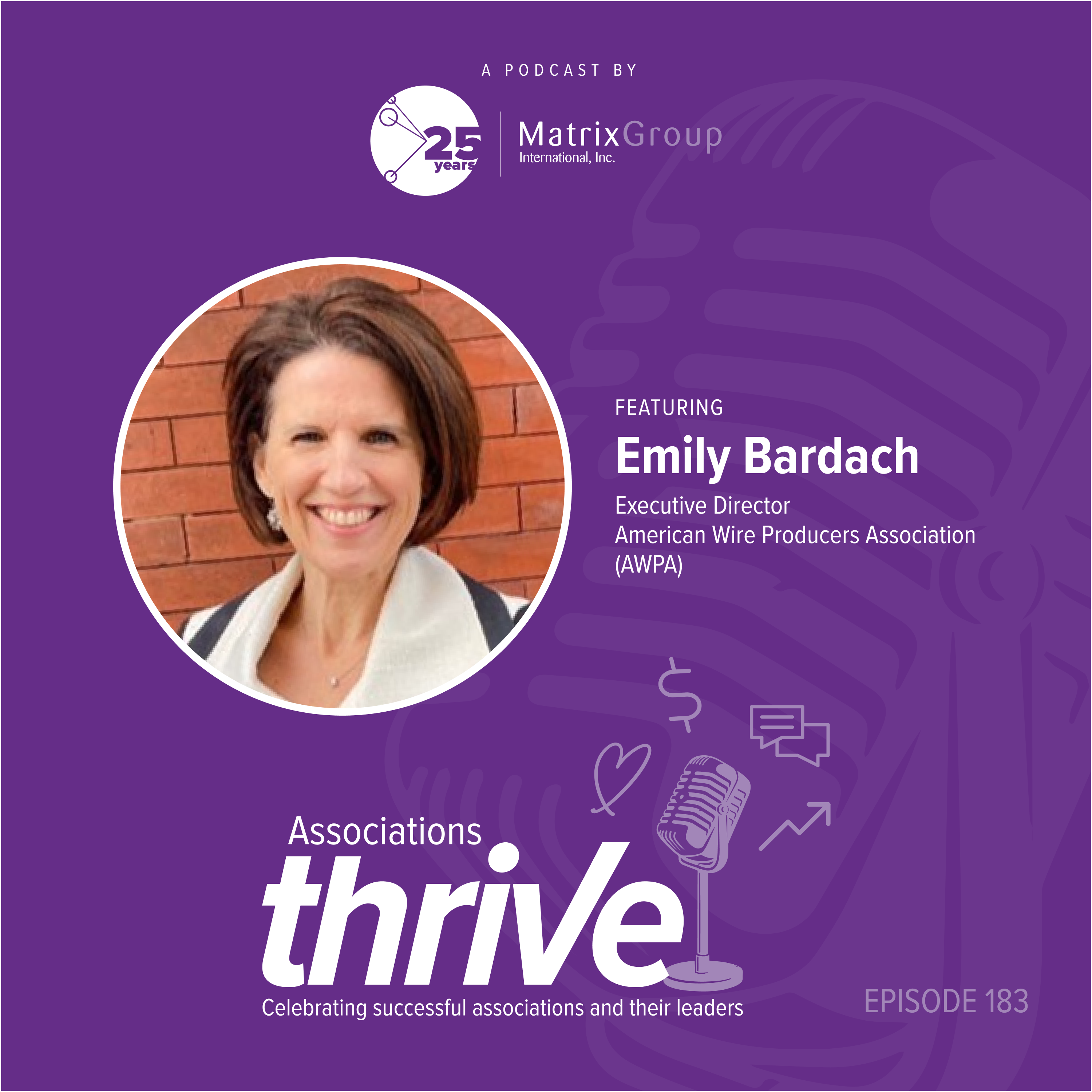
    183. Emily Bardach, Executive Director of AWPA, on Advocacy, Strategic Planning, and Building Momentum

    When your industry is everywhere but almost invisible, how do you tell your story? And how can associations help members navigate tariffs, supply chain pressures, and changing market dynamics? In this episode of Associations Thrive, host Joanna Pineda interviews Emily Bardash, Executive Director of the American Wire Producers Association (AWPA). Emily discusses: How AWPA represents companies that manufacture wire and wire products, from bridge cables to tiny springs in Windex bottles. Why “wire is everywhere,” touching construction, infrastructure, agriculture, defense, medical devices, automotive parts, and everyday household products. How AWPA is a small but vital industry association with about 85 members, many of them family-owned businesses. Why association staff must understand each client’s unique culture, including details like whether spouses are important at events. How AWPA shifted its advocacy focus from “free and fair access to wire rod” to “building a resilient wire industry across the full supply chain.” How strategic planning helped AWPA’s board align around a new mission, vision, and playbook. How AWPA took risks with its annual conference, including booking a higher-end venue, stronger speakers, and better storytelling through photography and video. How AWPA is building momentum through advocacy, LinkedIn, facility tours with members of Congress, and more frequent Hill visits. References: AWPA Website

  • #182
    May 28 · 23 min

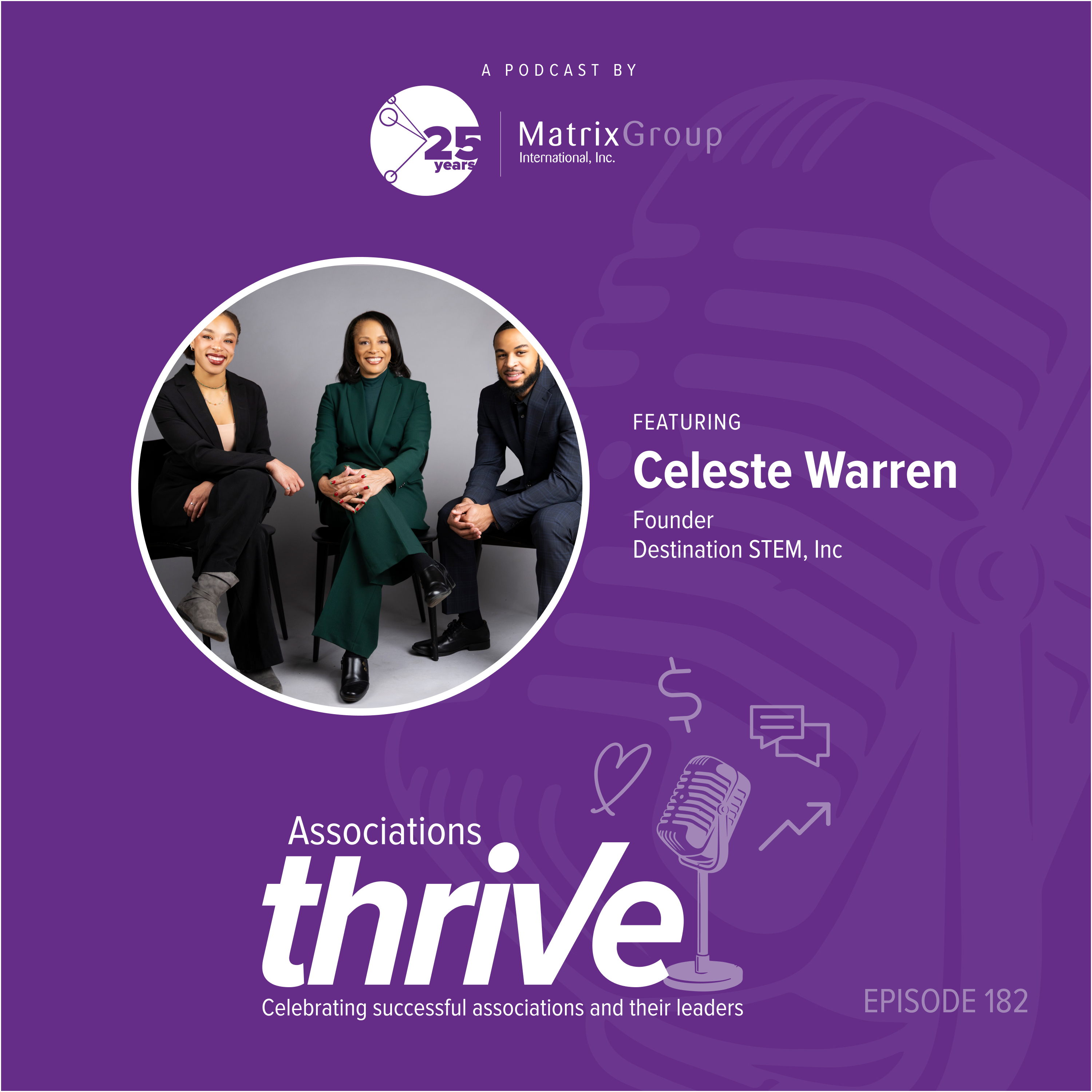
    182. Celeste Warren, Founder of Destination STEM, Inc, on Representation in STEM, Virtual Access, and Building the Future Workforce

    What happens when young people never see anyone who looks like them in the careers they dream about pursuing? And how can associations, nonprofits, and mission-driven organizations help members build stronger, earlier, and more inclusive talent pipelines in response? In this episode of Associations Thrive, host Joanna Pineda interviews Celeste Warren, Founder of Destination STEM, Inc. Celeste discusses: How Destination STEM provides resources, educational awareness events, mentoring, tutoring, and scholarships to students of color and students in need who want to pursue STEM-related degrees and careers. Why representation matters so much, especially for middle school and high school students who are just beginning to imagine what their futures could look like. How Destination STEM uses college students and young professionals as virtual mentors for younger students, creating relatable role models who feel accessible and real. Why Celeste believes STEM pipeline work must start early, long before employers begin looking for talent in the current labor market. How Destination STEM’s family founding story, with Celeste, her daughter, and her son building the organization together, has become part of its unique appeal and authenticity. How the organization is doubling its scholarships and using its annual awards and recognition banquet as both a celebration and a major fundraising vehicle. Celeste’s big vision for Destination STEM: larger-scale conferences, stronger guidance for students, and a bigger role in building the future STEM workforce. References: Destination STEM Website

  • #181
    May 21 · 27 min

    181. Michele Jones, EVP/CEO of NIA, on Her Long Tenure, National Standards, and Member Value in a Consolidating Industry

    What if one of the most important contributors to energy efficiency, worker safety, and emissions reduction is also one of the most overlooked? And in an industry facing consolidation and private equity pressure, how can an association help members see the value of community, standards, and education? In this episode of Associations Thrive, host Joanna Pineda interviews Michele Jones, EVP/CEO of the National Insulation Association (NIA). Michele discusses: How NIA represents more than 250 companies across the mechanical insulation industry, including contractors, distributors, manufacturers, fabricators, and metal building laminators. What mechanical insulation is and why it matters. How industry consolidation and private equity ownership are affecting membership, dues, sponsorships, foundation giving, and conference attendance across the association. Why NIA is launching a “dog and pony show” roadshow to meet directly with member companies. How NIA just held its 70th convention, celebrated in Puerto Rico with strong attendance and recognition of past presidents. How NIA is partnering with AMPP to develop national insulation installation standards. NIA’s new Learning Management System. Why Michele believes mechanical insulation still does not get the respect it deserves, even though it lowers energy costs, reduces pollution, protects personnel, and keeps systems running properly. References: NIA Website

  • #180
    May 14 · 25 min

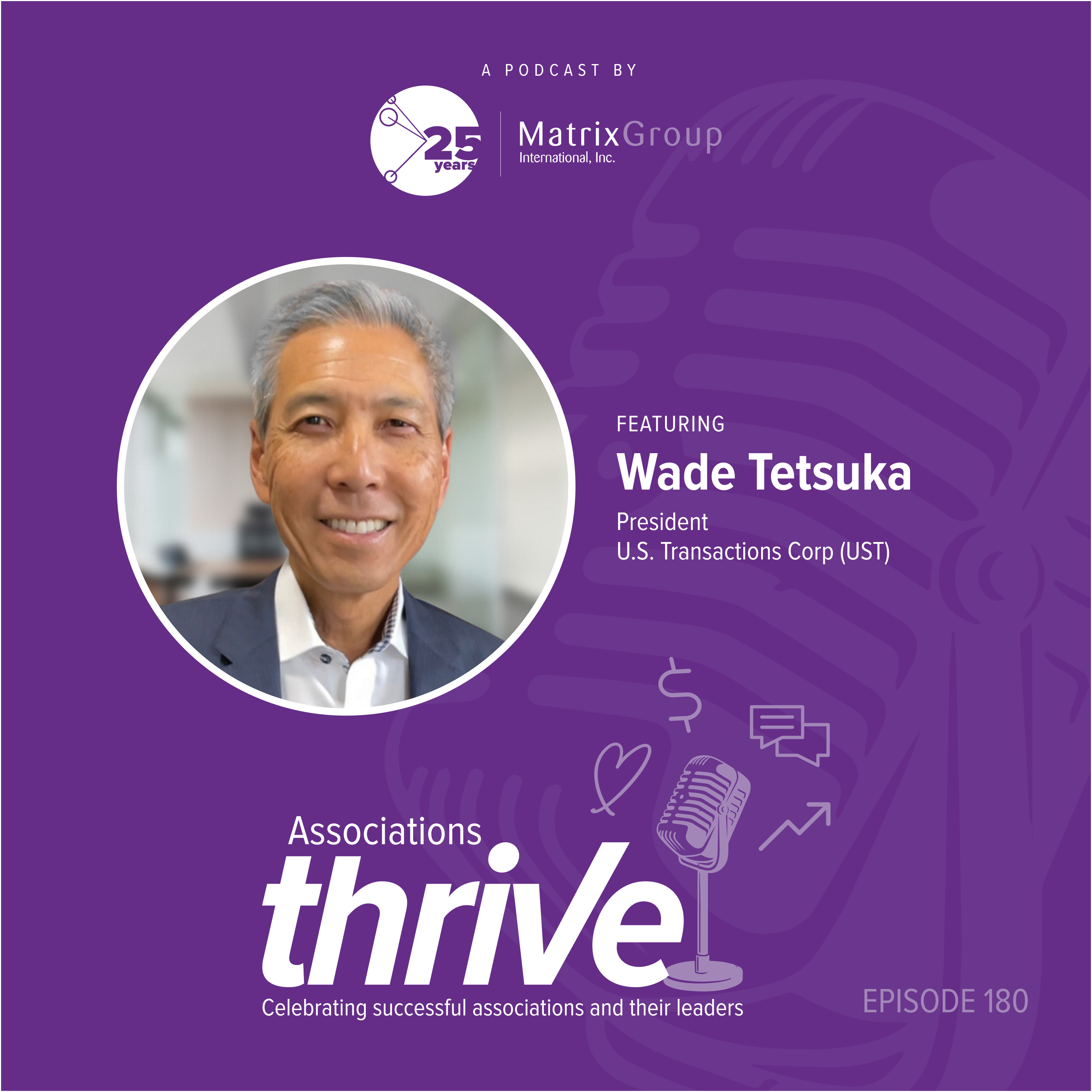
    180. Wade Tetsuka, President of UST, on Payments, Peer Learning, and Education as a Bridge to Success

    What happens when a fintech leader decides that serving the association community means doing far more than processing payments? And in an environment where associations are under pressure to deliver more value with limited resources, how can they create learning and connections that truly help members thrive? In this episode of Associations Thrive, host Joanna Pineda interviews Wade Tetsuka, President of U.S. Transactions Corporation (UST) and UST Education. Wade discusses: How UST helps associations accept credit card and ACH payments through AMS, LMS, and event platforms, while also helping reduce fees and improve service. Why payment processing becomes an especially important decision point when associations are changing AMS platforms. How UST Education began as simple peer-to-peer lunch roundtables for association IT directors and grew into a major educational platform. How the pandemic accelerated UST Education’s virtual programming and enabled it to serve association professionals across the country. Why Wade believes companies should connect with the communities they serve in a more meaningful way, and how education became that “sweet spot” for him. Why education is the common thread across Wade’s work, board service, and leadership philosophy, and why he sees it as “the great equalizer in society.” What the AANHPI association community means to Wade, and why representation and visibility matter for future Asian American leaders. References: UST Website

  • #179
    May 7 · 28 min

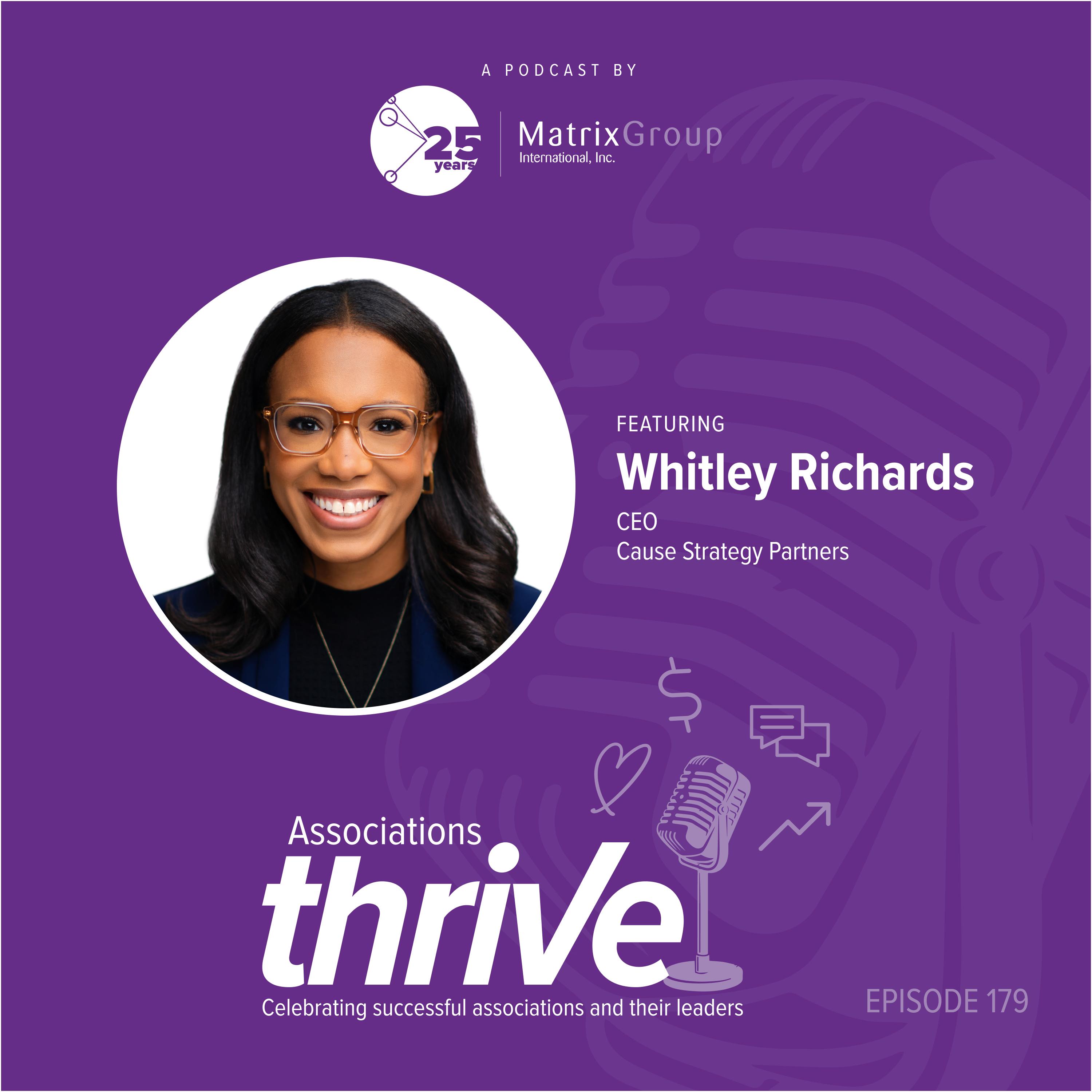
    179. Whitley Richards, CEO of Cause Strategy Partners, on Nonprofit Board Placement, Governance Training, and Leadership Development

    What if one of the most effective ways to strengthen nonprofit leadership is to rethink how board members are recruited, trained, and supported? And in a time when AI is reshaping work and human skills matter more than ever, how can associations and nonprofits help members build the judgment, empathy, and strategic thinking that only real service can develop? In this episode of Associations Thrive, host Joanna Pineda interviews Whitley Richards, CEO of Cause Strategy Partners. Whitley discusses: How Cause Strategy Partners is a board placement and governance training provider that works across the United States, the UK, and Hong Kong. How the company has placed about 3,300 professionals onto the boards of more than 1,500 nonprofit organizations over its 11-year history. How Fortune 500 companies partner with Cause Strategy Partners because they want scalable ways to connect employees to meaningful board service as part of leadership development and corporate social responsibility strategies. Cause Strategy Partners’ Board Lead program that prepares professionals before, during, and after placement to become effective board members, while offering the service free to nonprofits of many sizes, including smaller organizations with modest budgets. How the organization “flips” the board recruitment model by inviting individuals to identify nonprofits they care about and explain why they want to serve, creating stronger commitment from the outset. How Whitley wants to bust the myth that nonprofit boards are social clubs; today’s boards require serious leadership, strategy, and accountability. References: Cause Strategy Partners Website

  • #178
    April 30 · 30 min

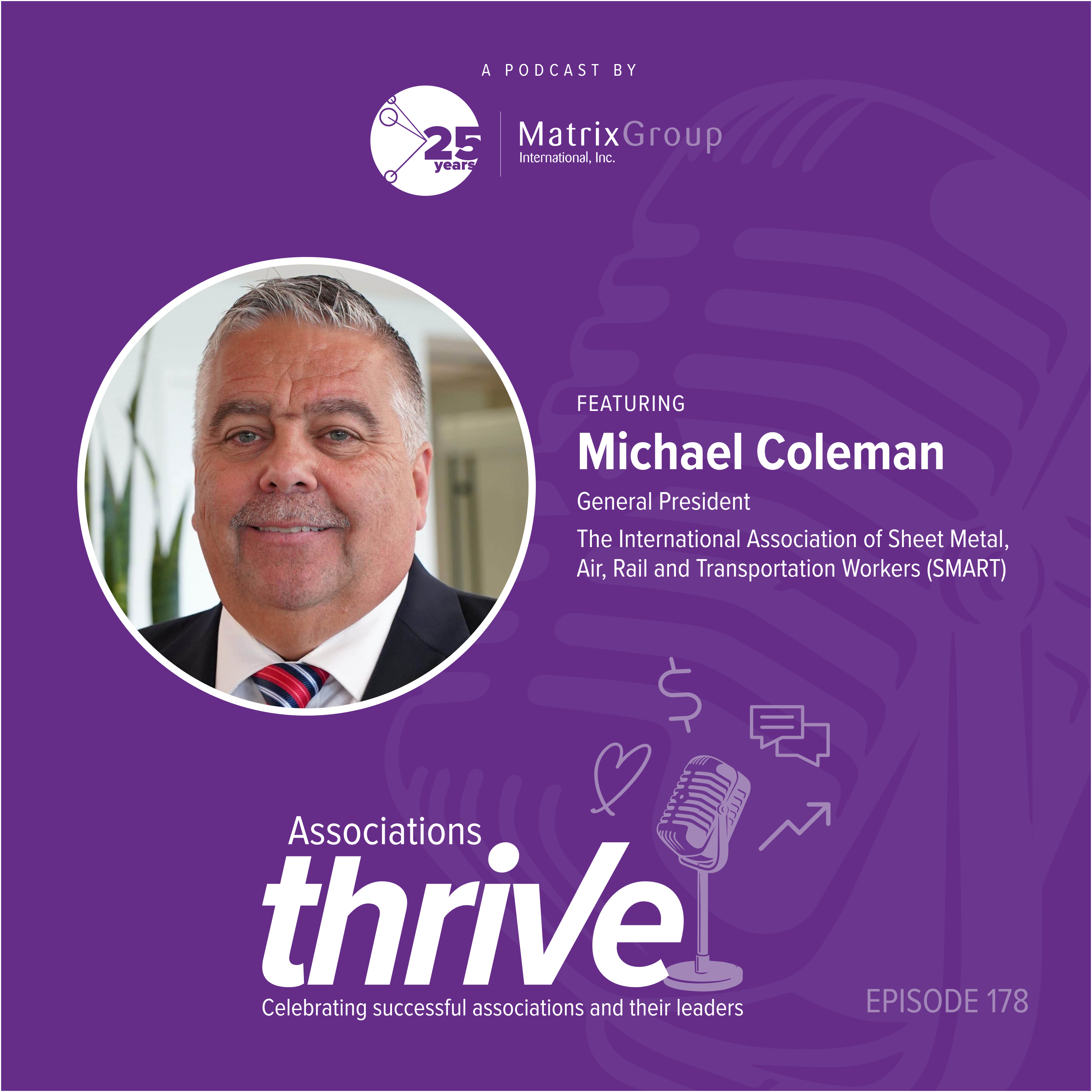
    178. Michael Coleman, General President of SMART, on Apprenticeships, Member-Centered Benefits, and Advocating for Families and Communities

    What does it look like when an organization does more than represent workers and actually builds a community, a career pathway, and a better life? And how can associations help members thrive when workforce shortages, family pressures, and mental health challenges are all converging at once? In this episode of Associations Thrive, host Joanna Pineda interviews Michael Coleman, General President of the International Association of Sheet Metal, Air, Rail, and Transportation Workers (SMART). Mike discusses: How SMART represents more than 230,000 sheet metal, rail, transit, and transportation workers across the United States and Canada. How SMART’s culture of mentorship helps members grow professionally and personally, with experienced members guiding apprentices and newer workers. Mike’s own journey from “floundering” young worker to apprentice, supervisor, local leader, international executive, and ultimately General President. Why apprenticeship is such a powerful model: members earn while they learn, build real skills, gain certifications, and avoid student debt. How SMART is growing membership by widening the recruiting pipeline and reaching veterans, underrepresented communities, and women. How programs like Helmets to Hard Hats and SMART Heroes help service members transition into rewarding union careers. How SMART is making the trades more accessible by addressing real-life barriers, including offering childcare stipends and paid maternity leave. How SMART advocates on issues that go beyond union priorities and affect the public at large, including indoor air quality, fire life safety systems, and safer schools and buildings. How the merger with the transportation union expanded SMART’s reach, while fairness, dignity, safety, and good middle-class jobs remain the values that unite all members. References: SMART Union Website

  • #177
    April 23 · 28 min

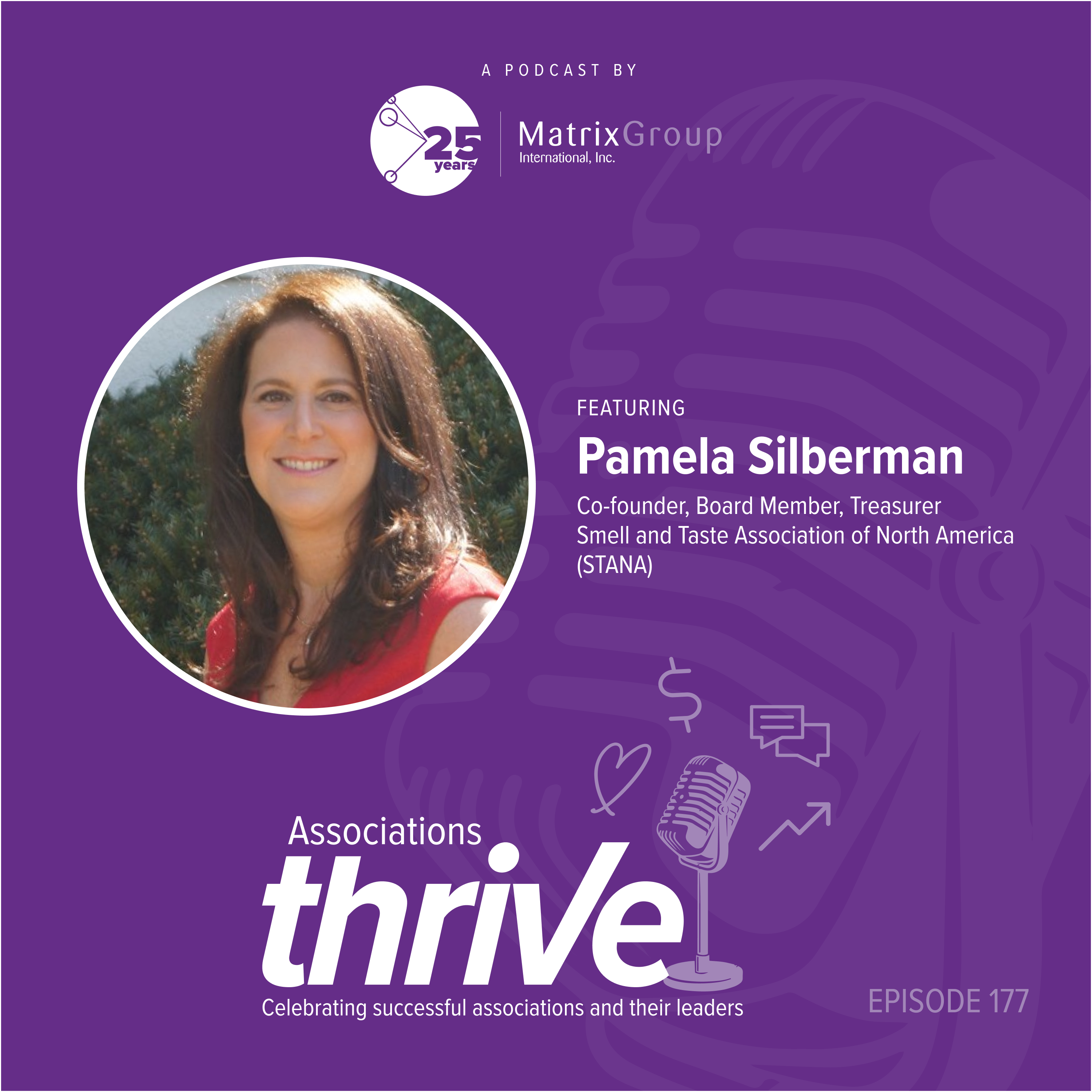
    177. Pamela Silberman, Co-founder, Board Member, and Treasurer of STANA, on Smell and Taste Disorders, Patient Advocacy, and Public Health Awareness

    Did you know that a loss of smell or taste can be an early indicator of Parkinson's, Alzheimer’s and other dementias? And in an environment where smell and taste disorders are underdiagnosed, underfunded, and often dismissed, how can an association step in to educate patients, influence research, and push for better care? In this episode of Associations Thrive, host Joanna Pineda interviews Pamela Silberman, Co-Founder, Board Member, and Treasurer of the Smell and Taste Association of North America (STANA). Pamela discusses: How STANA is the first patient organization in the United States, Canada, and Mexico focused on people living with smell and taste dysfunction. The many causes of smell and taste disorders, including congenital conditions, infections, allergies, traumatic brain injuries, sinus issues, aging, and COVID-19. How millions of people are affected by smell and taste dysfunction. Pamela’s personal journey after permanently losing her sense of smell following a sinus infection, and how that experience led her to help found STANA. Why STANA advocates for routine and universal smell and taste testing, both to improve diagnosis and to identify links to other conditions such as Parkinson’s, Alzheimer’s, and other dementias. How smell and taste dysfunction can affect mental health, nutrition, safety, social confidence, and overall quality of life. How STANA supports patients through education, virtual community, programming, and practical conversations about cooking, nutrition, texture, and adapting to flavor loss. How STANA is pushing for more patient-centered research by training patients to serve as research partners, not just research subjects. References: STANA Website

  • #176
    April 9 · 35 min

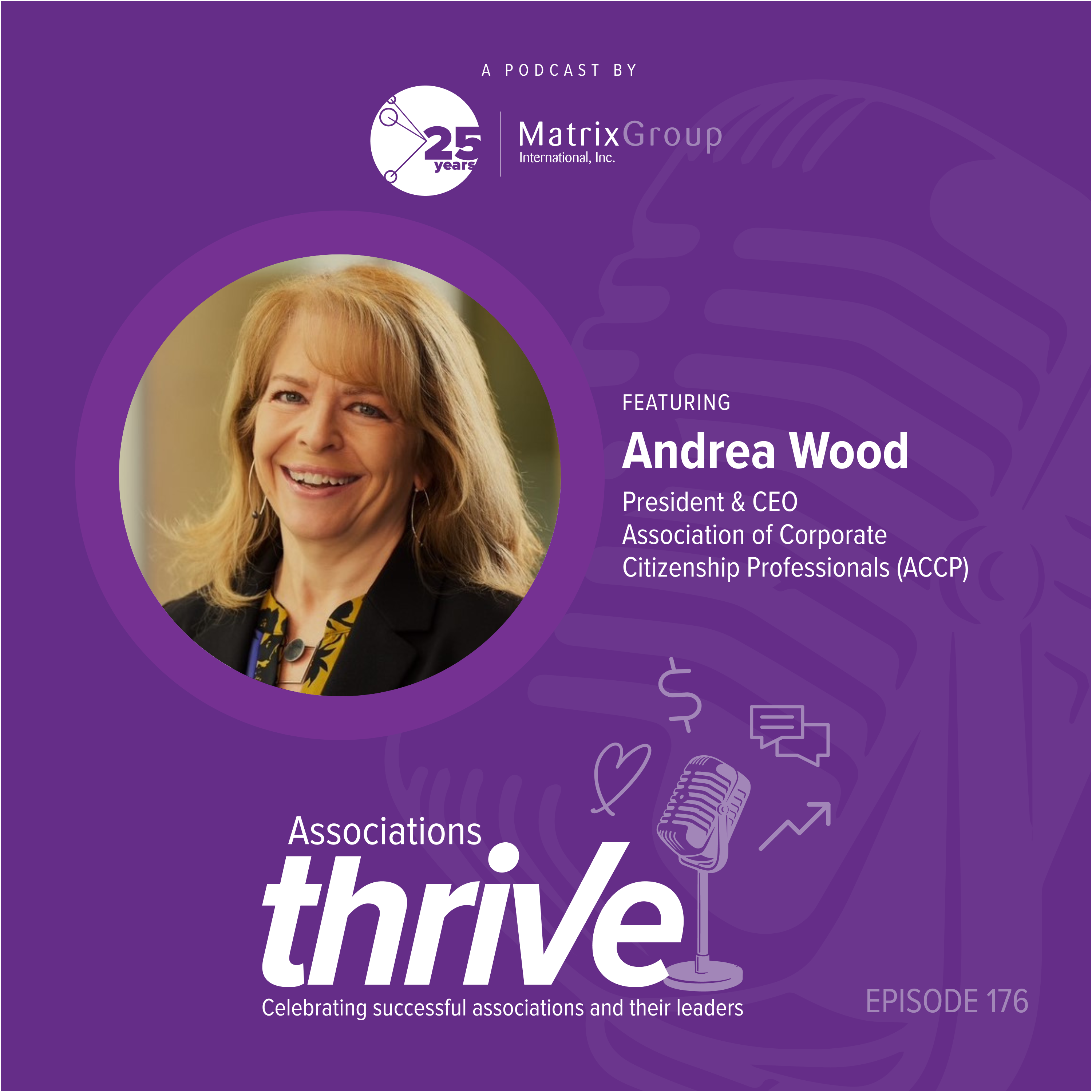
    176. Andrea Wood, President & CEO of ACCP, on the Business Case for CSR, Shared Value, and Building Member-Centric Community

    What happens when corporate citizenship is no longer a “nice to have,” but a business imperative under scrutiny? And how can associations help members prove value when the environment turns uncertain? In this episode of Associations Thrive, host Joanna Pineda interviews Andrea Wood, President and CEO of the Association of Corporate Citizenship Professionals (ACCP). Andrea discusses: How ACCP serves professionals responsible for corporate social responsibility (CSR), social impact (CSI), and ESG efforts, acting as liaisons between businesses and communities. The critical importance of making the business case, linking CSR to employee recruitment, retention, morale, reputation, and financial performance. How younger workforce expectations are accelerating demand for meaningful corporate community engagement. Why the most effective CSR strategies embrace a shared value approach, simultaneously benefiting the business and the community. How ACCP supports members with practical, ready-to-use toolkits and resources so small teams don’t have to “start from scratch.” ACCP’s evolving engagement strategy: virtual summits, sold-out in-person conferences, regional meetups, and targeted programming for career stages. How ACCP is helping members navigate political and economic scrutiny by doubling down on data, research, and clear communication of impact. The role of associations as extensions of staff for under-resourced members who need insights, benchmarking, and peer support. Andrea’s leadership approach: listening deeply, staying informed on external trends, and rapidly adapting programming to meet the moment. References: ACCP Website Making The Case

Showing 1–20 of 21 episodes