Skip to content
Artwork for AI Made Simple

AI Made Simple

Saral Gupta

AI Made Simple breaks down artificial intelligence in a clear, practical way—without jargon or overwhelm. If you’ve used tools like ChatGPT and wondered how they work, this podcast is for you. Learn AI basics, prompting, productivity, and real-world use cases—plus stay updated with the latest AI news, tools, and trends. Whether you're a beginner or a professional, get simple explanations and actionable insights to understand AI, use it daily, and stay ahead.

🎧 New episodes every day + quick updates on what’s happening in AI

Play
  • 20 episodes
  • Avg 12 min
  • English
  • S1 · E26
    May 30 · 19 min

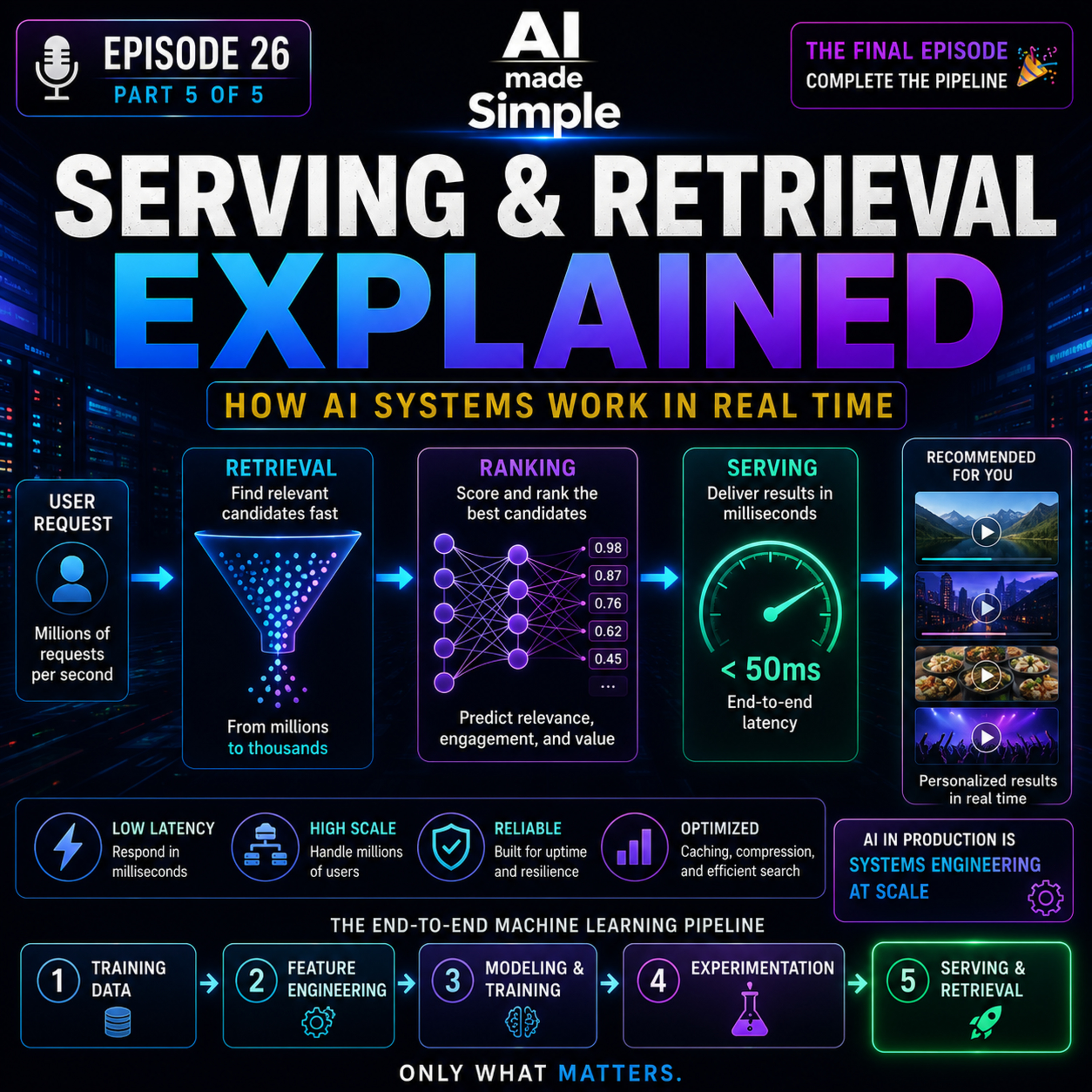
    Episode 26 - Serving & Retrieval Explained — How AI Systems Work in Real Time (Part 5 of 5)

    In Episode 22, we started with training data. In Episode 23, we transformed raw data into features. In Episode 24, we trained models to learn patterns. In Episode 25, we explored experimentation and how companies validate AI systems. Now, in the final episode of this series, we complete the machine learning lifecycle with one of the most important layers of modern AI systems: Serving and Retrieval. In this episode of AI Made Simple, we break down how AI systems operate live in production for millions of users in real time. We cover: Inference and real-time predictions Retrieval vs ranking systems Embeddings and vector search Why latency matters Real-time features and personalization Caching, quantization, and optimization The infrastructure behind large-scale AI systems Using real-world recommendation system examples from platforms like YouTube and Netflix, we explain how AI systems retrieve, rank, and deliver personalized results in milliseconds. This episode completes our 5-part series on how machine learning systems work end-to-end. By the end of this series, you won’t just use AI tools — you’ll understand the systems that power them behind the scenes. Only what matters.
  • S1 · E25
    May 27 · 17 min

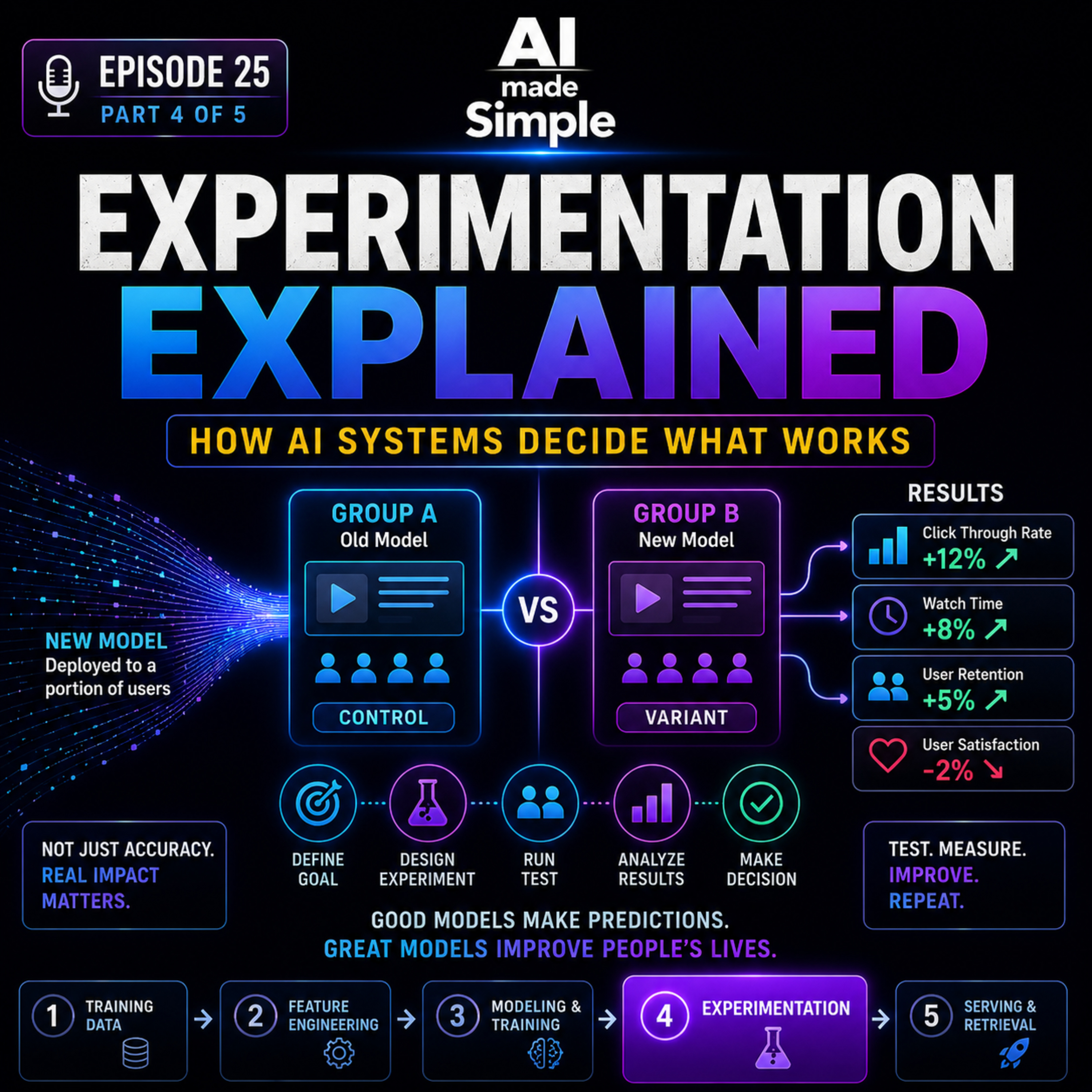
    Episode 25 - Experimentation Explained — How AI Systems Decide What Works (Part 4 of 5)

    In Episode 22, we explored training data—the foundation of machine learning. In Episode 23, we transformed raw data into meaningful signals through feature engineering. In Episode 24, we trained models to learn patterns from those signals. Now comes the critical question: How do companies actually know if an AI model is better? In this episode of AI Made Simple, we break down experimentation—the real-world process companies use to validate machine learning systems before deploying them at scale. We cover: Offline vs online evaluation Shadow testing and A/B experiments Metrics and optimization trade-offs Proxy metrics and guardrails Statistical significance Feedback loops and exploration vs exploitation Using real-world recommendation system examples, we explain why high model accuracy alone is not enough—and why experimentation is one of the most important parts of modern AI systems. This is Part 4 of the series. Next, we’ll complete the ML lifecycle with Serving & Retrieval Explained—how AI systems operate in real-time production environments.

  • S1 · E19
    April 26 · 18 min

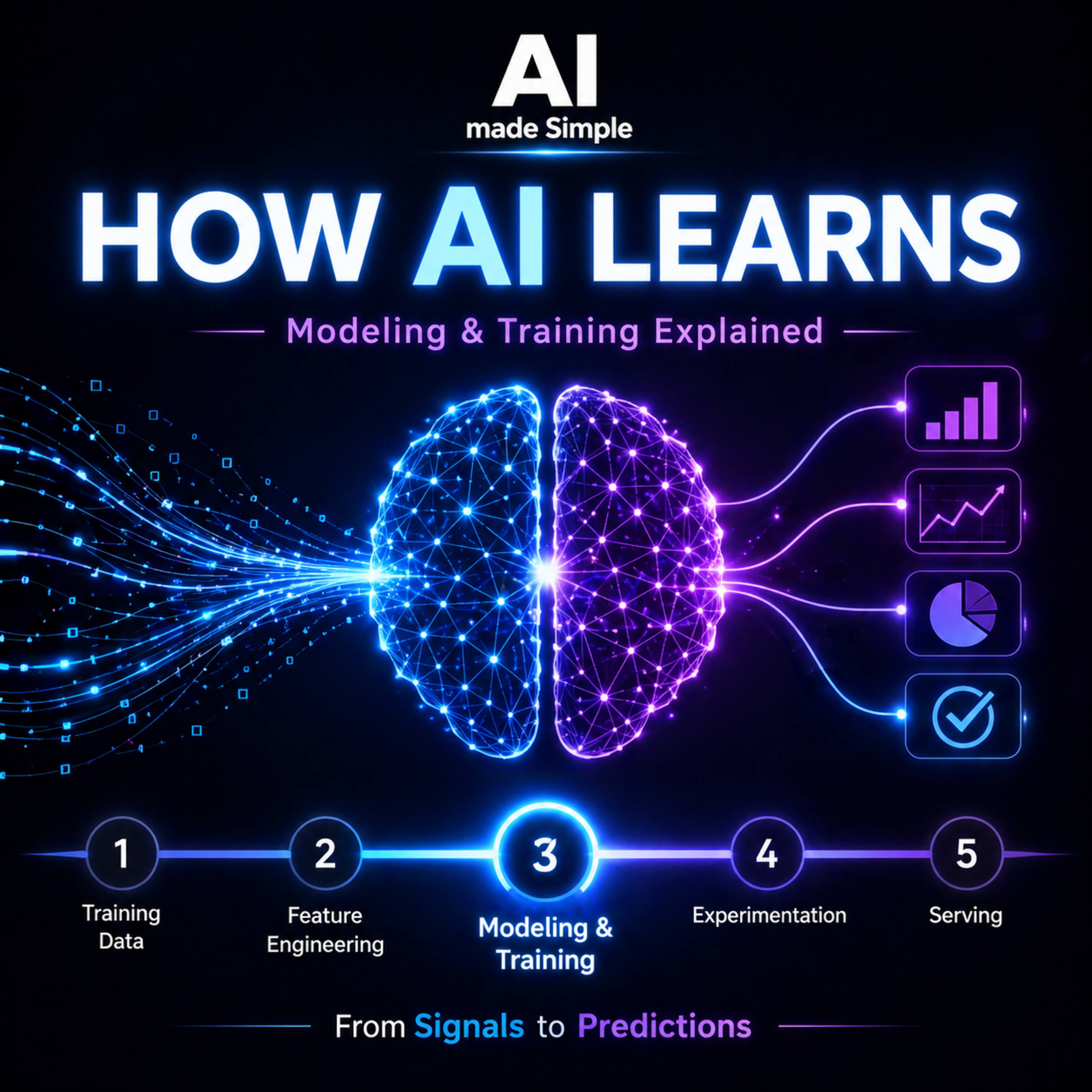
    Episode 24 - Modeling & Training Explained — How AI Actually Learns (Part 3 of 5)

    In Episode 22, we explored training data—the foundation of machine learning. In Episode 23, we transformed that data into meaningful signals through feature engineering. Now in Episode 24, we take the next step: How does AI actually learn from those signals? In this episode of AI Made Simple, we break down modeling and training—the core of how machine learning systems work. We explain how models learn patterns, what loss functions are, and why concepts like overfitting and generalization are critical in real-world systems. We also cover: The learning loop and how models improve Loss functions and optimization (simplified) Overfitting vs generalization Types of models and real-world trade-offs Training pipelines and continuous learning This is Part 3 of the series. Next, we’ll cover experimentation—how companies evaluate models and decide what actually works.

  • S1 · E23
    April 23 · 21 min

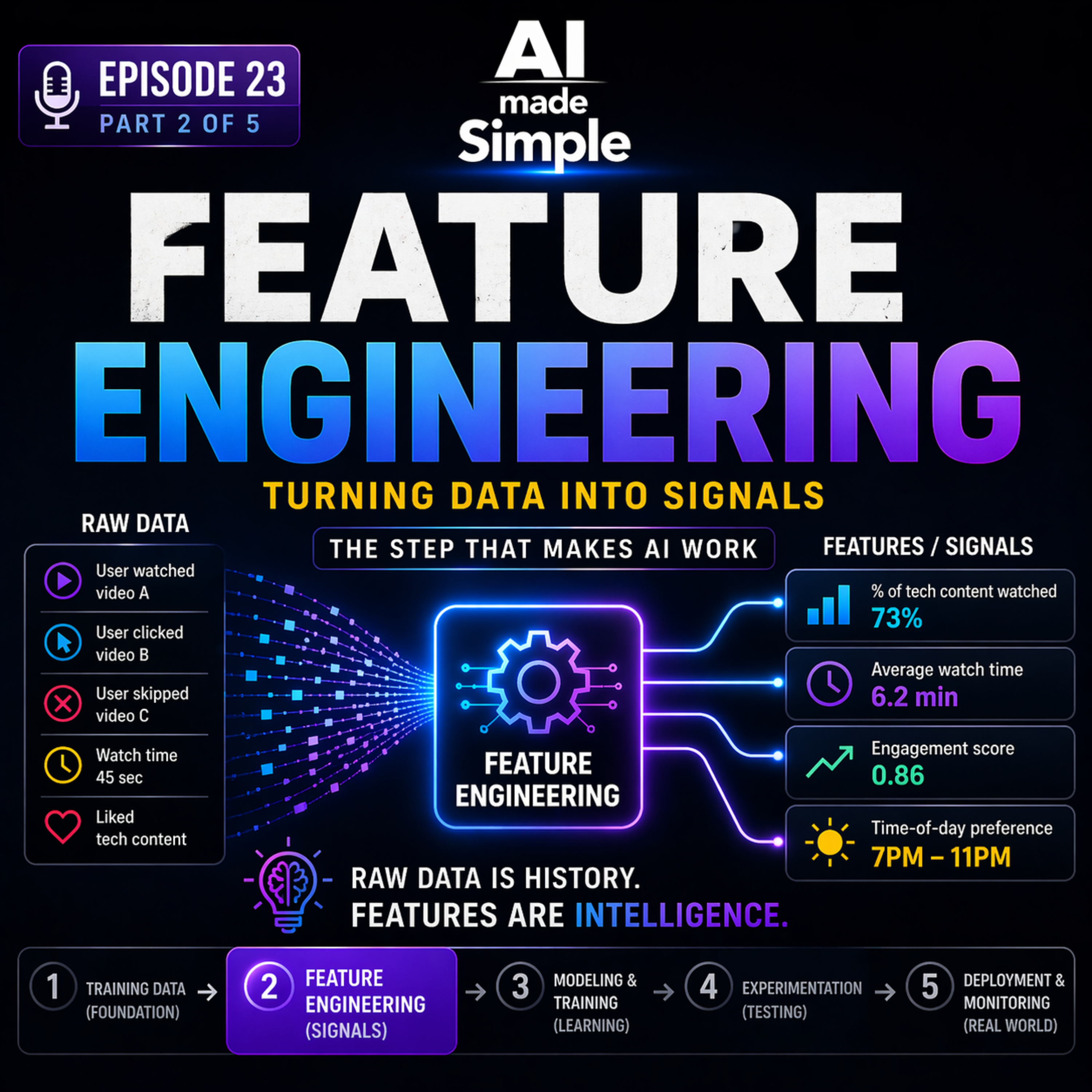
    Episode 23 - Feature Engineering Explained — Turning Data Into Signals (Part 2 of 5)

    In Episode 22, we covered training data—the foundation of every machine learning system. But raw data alone isn’t enough. In this episode of AI Made Simple, we continue our 5-part series on the machine learning lifecycle by diving into feature engineering—the step where raw data is transformed into meaningful signals that models can actually learn from. Using a recommendation system example, we break down how user behavior gets converted into structured inputs, and why this step is often more important than the model itself. We also cover key concepts including: Aggregations and time-based features Categorical and interaction features Real-time vs batch features Feature stores and why they matter Feature drift and how it impacts models This is Part 2 of the series. Next, we’ll explore modeling and training, and how models actually learn from these features.

  • S1 · E22
    April 18 · 18 min

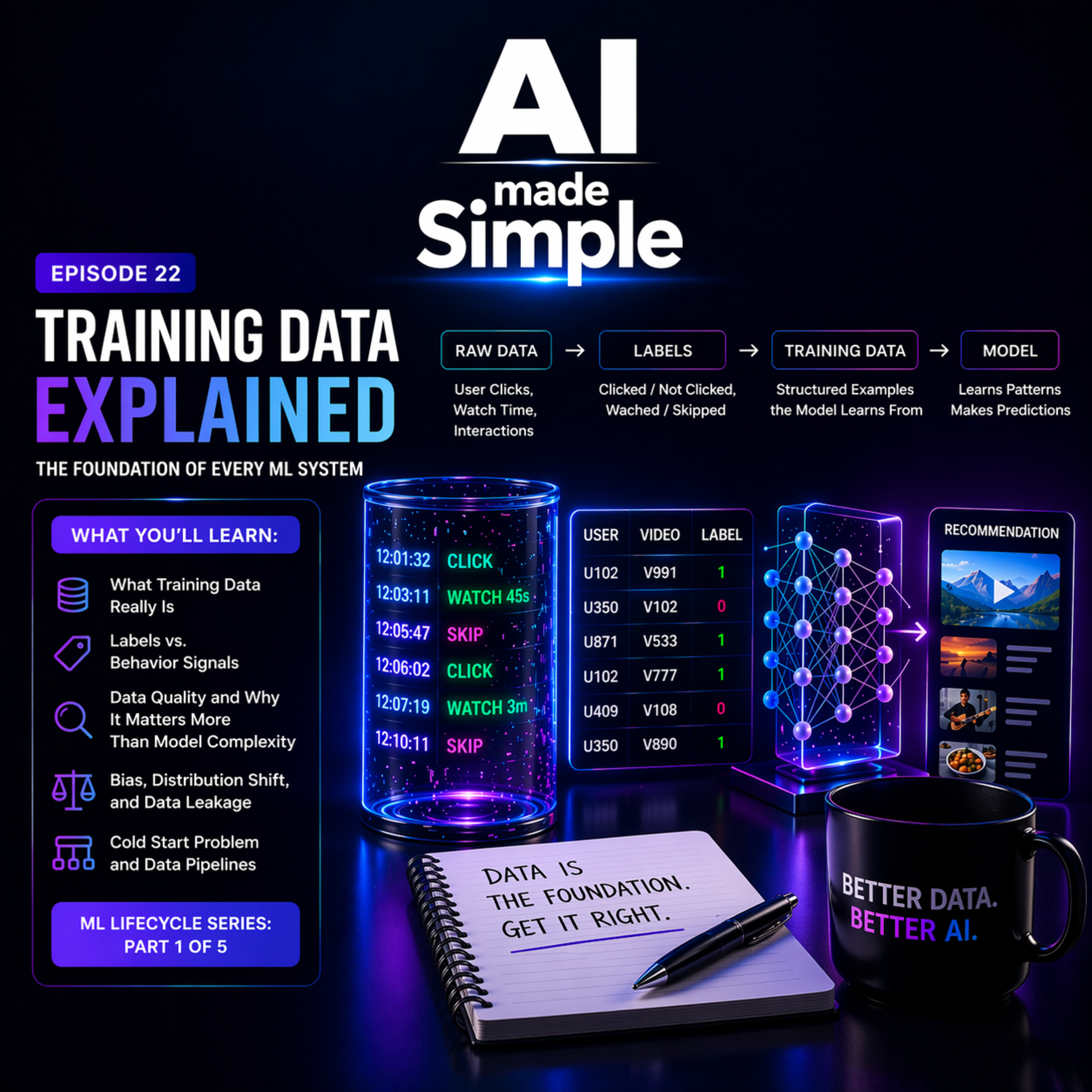
    Episode 22 - Training Data Explained — The Foundation of Every ML System (Part 1 of 5)

    Every machine learning system starts with data. In this episode of AI Made Simple, we kick off a 5-part series on the machine learning lifecycle by breaking down training data—the foundation of every AI system. We cover what training data actually is, how models learn from real-world behavior, and why data quality often matters more than model complexity in practice. You’ll also learn how issues like bias, sampling bias, distribution shift, and data leakage can quietly break an ML system, along with how real-world training data pipelines are built. Using simple examples, this episode helps you understand how data shapes everything that comes after in an AI system. This is Part 1 of the series. In the upcoming episodes, we will cover: Feature Engineering Explained — How raw data is transformed into meaningful signals that models can use Modeling & Training Explained — How machine learning models learn patterns and make predictions Experimentation Explained — How companies test, evaluate, and improve models in real-world systems Serving & Retrieval Explained — How AI systems operate in production, including real-time inference and retrieval By the end of this series, you will move beyond simply using AI tools to understanding how modern AI systems are actually built and deployed end to end.

  • S2 · E9
    April 17 · 5 min

    AI News Today (April 16, 2026): Safer AI Models and the Weirdest AI Pivot Yet

    AI is evolving fast—but not always in the ways you expect. In today’s AI Made Simple daily brief, we cover two major stories shaping the AI landscape. First, Anthropic rolls out an improved Claude Opus model focused on making AI safer, more controlled, and more reliable—highlighting the growing importance of alignment and trust in advanced systems. Then, in a completely unexpected move, shoe company Allbirds pivots toward AI—adding $127 million in value almost overnight. What does this say about the current AI hype cycle and how markets are reacting? From real technological progress to surprising business moves, this episode breaks down what actually matters—and what doesn’t.

  • S1 · E21
    April 16 · 19 min

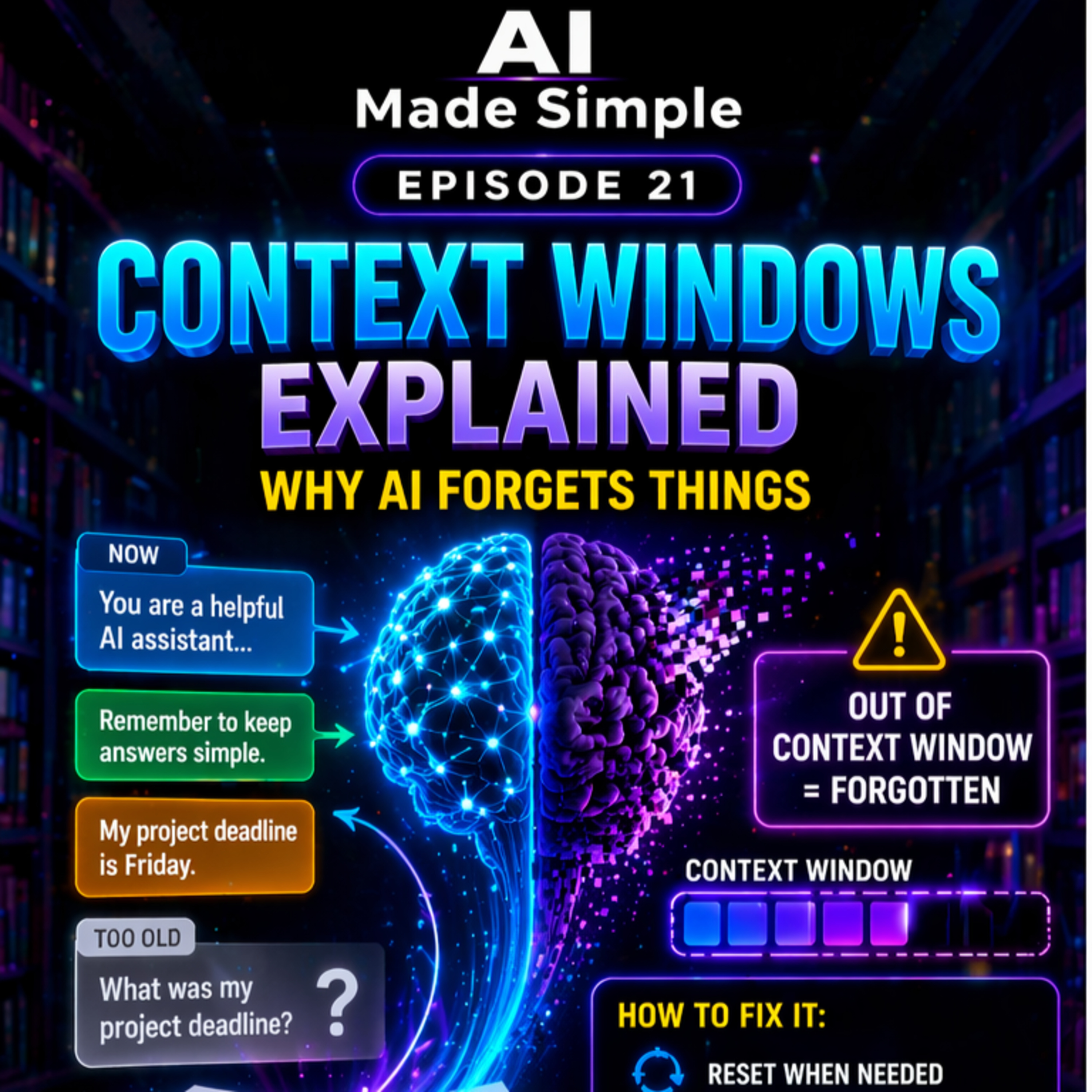
    Episode 21 - Why AI Forgets Everything — Context Windows Explained Simply

    Why does AI suddenly forget things—even mid-conversation? In this episode of AI Made Simple, we break down one of the most misunderstood concepts in artificial intelligence: context windows. If you’ve ever had a great conversation with AI… only for it to suddenly lose track, contradict itself, or start making things up—this episode explains exactly why. We cover: What a context window actually is Why AI doesn’t “remember” like humans How tokens limit what AI can see Why hallucinations happen in long chats Simple strategies to fix it How systems like RAG solve this problem By the end, you’ll understand how AI really processes information—and how to use it much more effectively.

  • S2 · E5
    April 16 · 4 min

    AI News Today (April 15, 2026): AI Is Becoming the Operating System of Everything

    AI is no longer just an app—it’s becoming the foundation of everything. In today’s AI Made Simple daily brief for April 15, 2026, we break down what Google’s upcoming I/O announcements reveal about the future of AI. From Android and Chrome to multi-device ecosystems, AI is rapidly becoming embedded into every layer of technology. What does this shift mean for you? And are we moving into a world where AI is no longer something you use—but something that’s always running in the background?

  • S1 · E20
    April 14 · 21 min

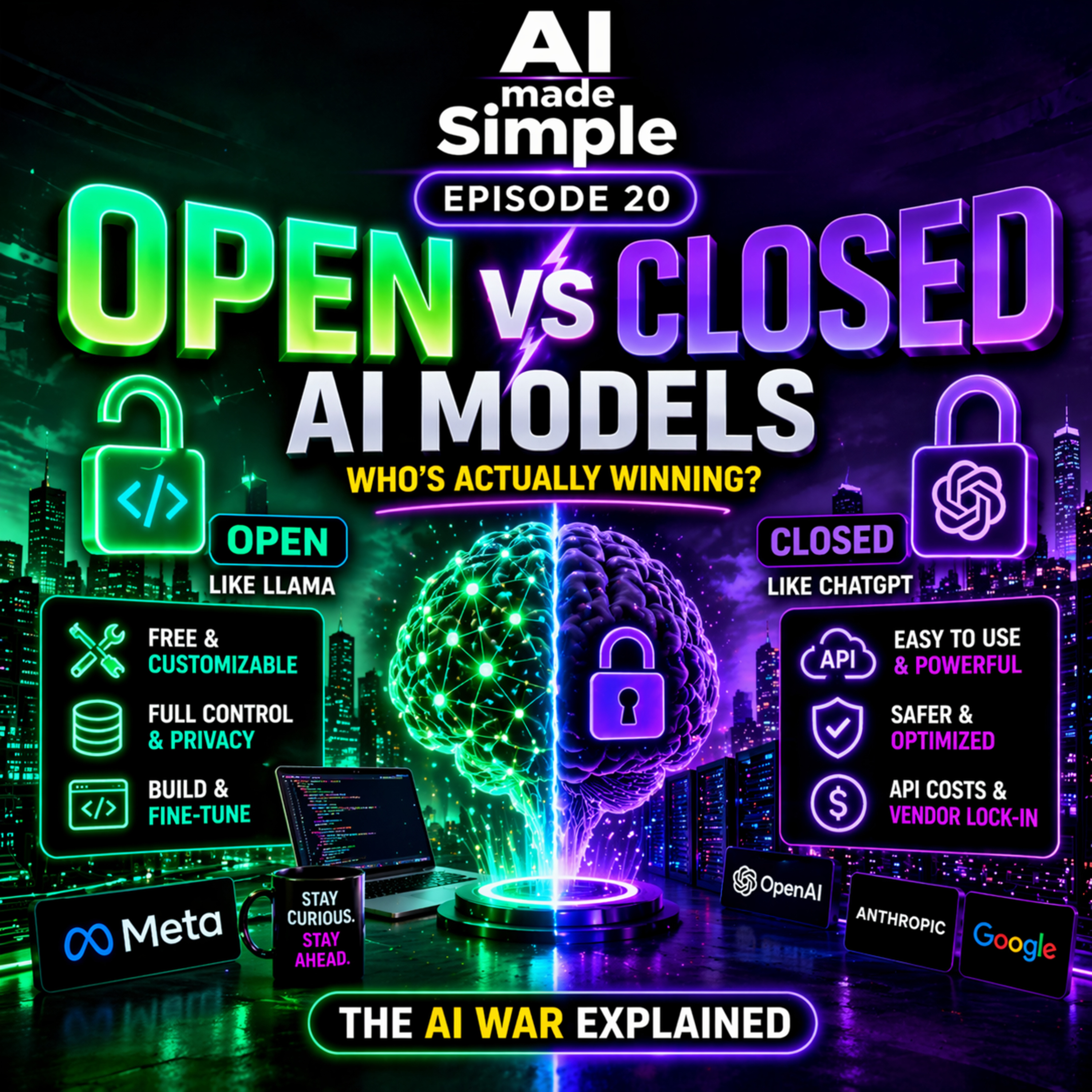
    Episode 20 - Open vs Closed AI Models — Who’s Actually Winning?

    AI isn’t just evolving—it’s splitting. In this episode of AI Made Simple, we break down one of the biggest debates in artificial intelligence today: Should AI be open for everyone… or controlled by a few companies? On one side, companies like Meta are releasing powerful open models like Llama—giving developers full control and flexibility. On the other, companies like OpenAI, Anthropic, and Google are building closed systems—optimized, secure, and easy to use, but tightly controlled. We simplify the real tradeoffs: Open models vs closed models (in plain English) Why businesses choose one over the other The hidden costs of APIs vs infrastructure Data privacy, control, and vendor lock-in Why the future of AI is likely hybrid If you’re using AI tools, building with AI, or just trying to understand where this is all going—this episode breaks it down simply.

  • S2 · E8
    April 13 · 1 min

    AI News Today (April 13, 2026): The Hidden Cost of AI — Why Data Centers Are Facing Backlash

    AI is growing fast—but behind the scenes, it’s creating real-world challenges. In today’s AI Made Simple daily brief, we explore the rapid expansion of AI data centers across the U.S. and why local communities are pushing back. From energy consumption to water usage, we break down the hidden infrastructure costs of AI—and what this means for the future of the industry.

  • S1 · E16
    April 13 · 21 min

    Episode 19 - RAG Explained Simply — How AI Actually Uses Real Data

    AI models are powerful—but they don’t actually know your data. In this episode of AI Made Simple, we break down Retrieval-Augmented Generation (RAG), one of the most important techniques used to make AI systems more accurate, up-to-date, and useful in real-world applications. You’ll learn how AI combines search with generation, why companies use RAG instead of retraining models, and how this approach helps reduce hallucinations while enabling AI to work with real, dynamic data.

  • S2 · E7
    April 12 · 4 min

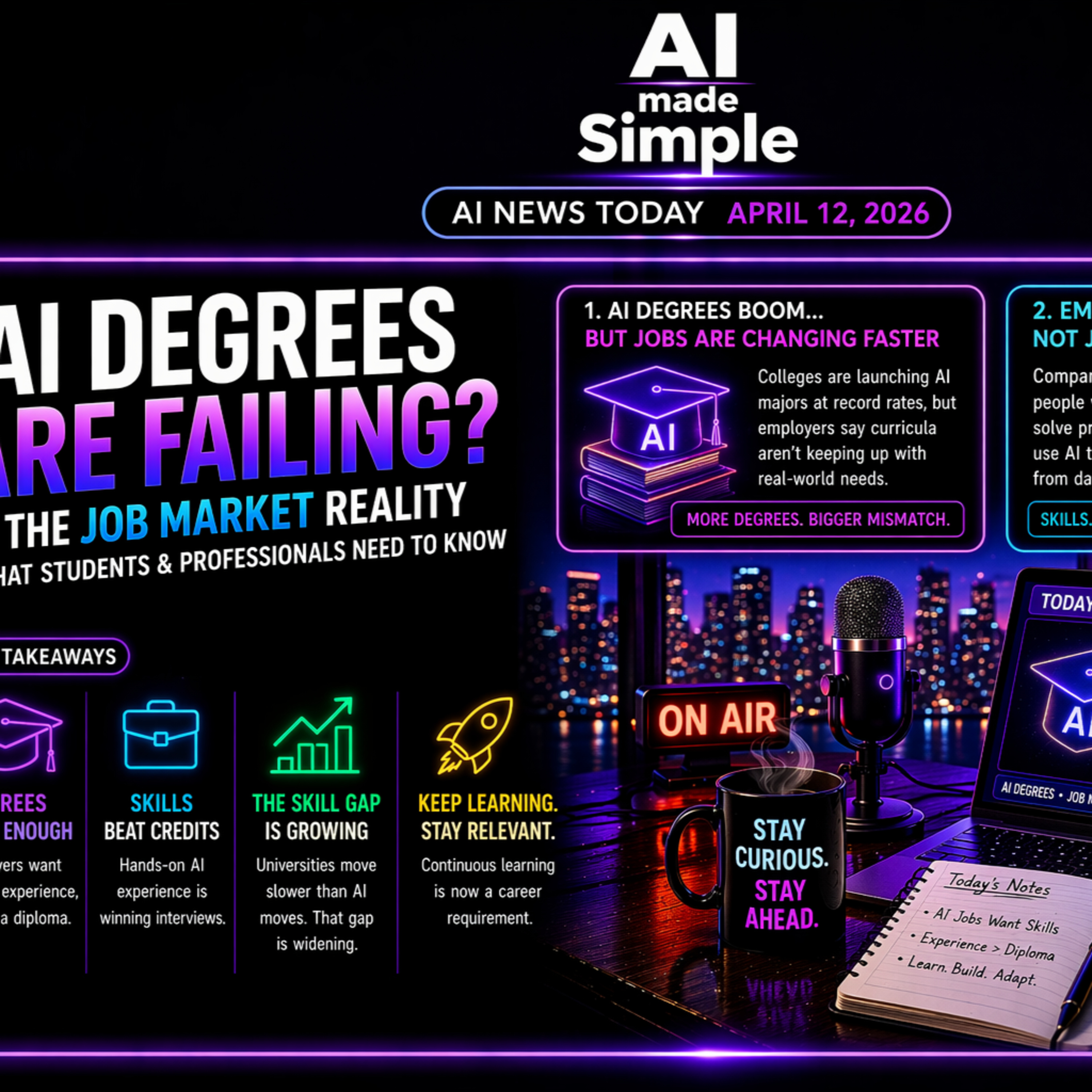
    AI News Today (April 12, 2026): Are AI Degrees Already Becoming Obsolete?

    AI degrees are booming—but the job market is shifting faster than universities can keep up. In today’s AI Made Simple daily brief, we break down why traditional AI education may already be falling behind real-world industry needs. We explore how companies are hiring differently, why skills matter more than degrees, and what this means for students, professionals, and anyone trying to stay relevant in the AI era.

  • S1 · E13
    April 12 · 18 min

    Episode 18 - Why AI Doesn’t Give the Same Answer Twice (And How to Control It)

    AI doesn’t work like a calculator—and that’s exactly why it confuses so many people. In this episode of AI Made Simple, we break down why AI gives different answers to the same question and how you can actually control it. If you’ve ever hit “regenerate” and gotten a completely different response, this episode will finally explain what’s happening behind the scenes. You’ll learn: Why AI is probabilistic—not deterministic What the “calculator fallacy” is and why it matters The four key factors that change AI outputs: randomness, prompt wording, context, and multiple valid answers When variation is useful (and when it’s dangerous) Five practical techniques to make AI more consistent and reliable We also explore a deeper insight: you’re not querying a database—you’re navigating a probability space. Once you understand this, everything about AI starts to make sense. If you use AI for work, content creation, or decision-making, this episode will fundamentally change how you interact with it.

  • S1 · E17
    April 11 · 20 min

    Episode 17 - Why AI Hallucinates — And How to Fix It (Without Better Models)

    AI can sound incredibly confident—even when it’s completely wrong. In this episode of AI Made Simple, we take a deep dive into why AI hallucinations happen and what you can actually do to fix them. Instead of treating AI like a search engine or a source of truth, we break down how large language models really work under the hood—and why they sometimes generate incorrect information that sounds perfectly convincing. You’ll learn: Why AI predicts language instead of verifying facts The difference between patterns and truth Why simple questions often work—but complex ones fail What causes hallucinations, including ambiguity, long reasoning chains, and context drift How techniques like step-by-step prompting, constraints, and grounded inputs improve reliability Why you should shift from trusting AI to actively guiding it We also walk through real-world examples—including how AI can generate entirely fabricated but realistic answers—and show how to structure your prompts to avoid these failures. If you use AI for anything important—work, research, or decision-making—this episode will fundamentally change how you interact with it.

  • S2 · E6
    April 11 · 1 min

    AI News Today (April 11, 2026): Anthropic’s Chip Strategy and Alibaba’s AI Video Breakthrough

    In today’s AI Made Simple daily brief, we break down two major developments shaping the future of artificial intelligence. First, Anthropic is exploring building its own AI chips—a move that highlights a growing shift toward controlling the full AI stack, from hardware to models. This could improve efficiency, reduce costs, and signal a new phase of competition around AI infrastructure. Second, we look at Alibaba’s HappyHorse video model and its strong performance on global benchmarks. Video generation is one of the most challenging areas in AI, requiring both spatial understanding and temporal consistency—making it a key test for multimodal capabilities. Together, these updates show how AI is advancing across both infrastructure and capability. This episode explains what’s changing, why it matters, and how it should influence the way you think about using AI—from individual tools to systems and workflows. Stay current in under 5 minutes with only the highest-signal AI updates.

  • S1 · E16
    April 10 · 18 min

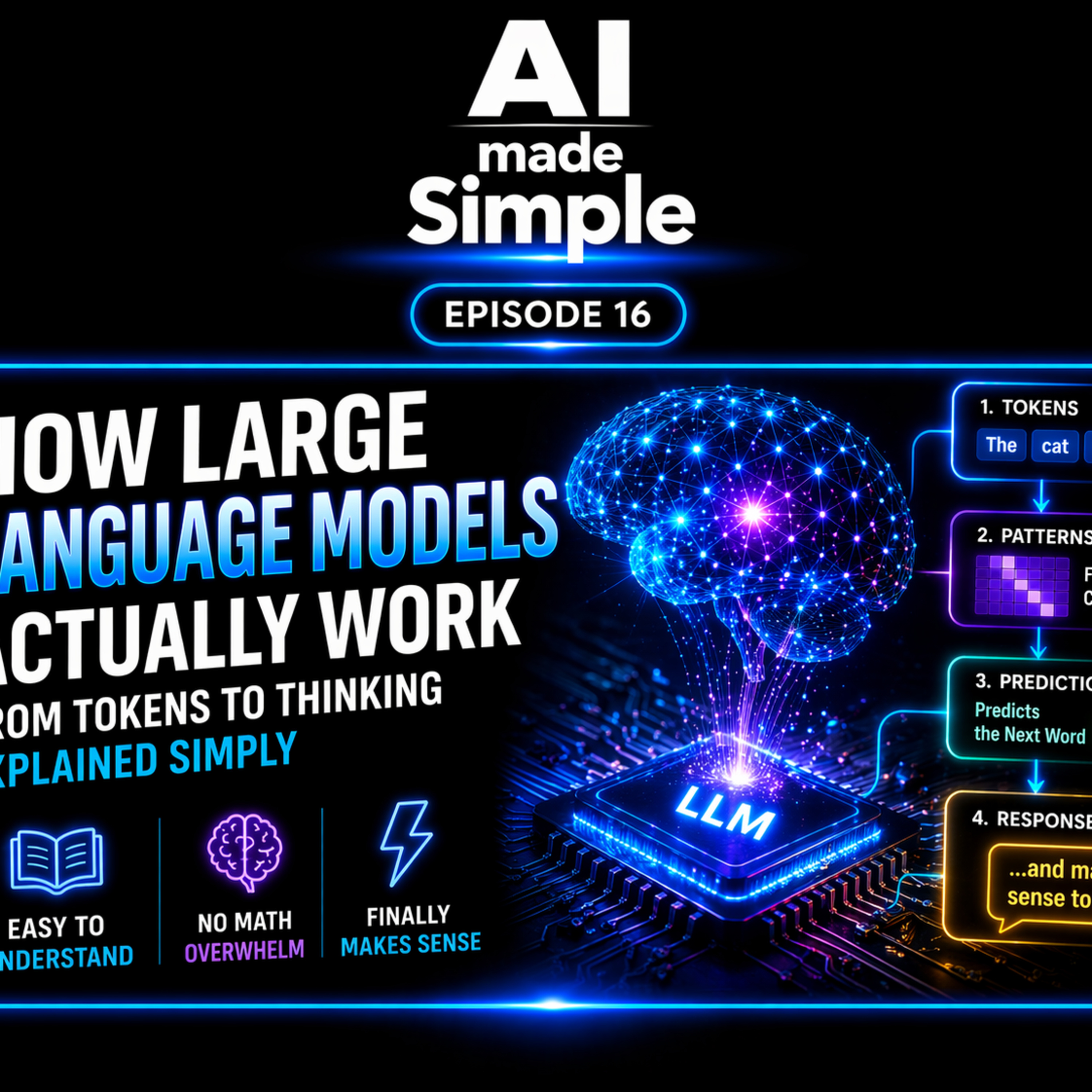
    Episode 16 - How Large Language Models Actually Work — From Tokens to Thinking Explained Simply

    AI tools like ChatGPT and Claude feel intelligent—but under the hood, they work very differently than most people think. In this episode of AI Made Simple, we break down how Large Language Models (LLMs) actually work in a clear and practical way. We go beyond surface-level explanations and build a mental model you can use to understand—and use—AI more effectively. You’ll learn: Why LLMs are not databases and do not “know” facts in the traditional sense How training works, including how models learn patterns from massive text datasets What tokens are and how AI generates responses one step at a time Why hallucinations happen and why they are a common limitation of this architecture How context windows and memory limits affect AI behavior Why long reasoning tasks can break down How prompting techniques like examples, constraints, and step-by-step instructions improve output We also explain key concepts like vector space representations—how AI turns language into mathematical relationships—and why this allows it to mimic human communication so effectively without true understanding. Most importantly, this episode shifts how you think about AI: from a mysterious black box to a predictable system you can guide with structure. If you’ve ever wondered why AI sometimes feels incredibly smart—and other times completely wrong—this episode will give you the clarity you need.

  • S2 · E5
    April 10 · 1 min

    AI News Today (April 10, 2026): Alibaba’s World Models and Meta’s Muse Spark Explained

    In today’s AI Made Simple daily brief, we break down two important developments shaping the future of artificial intelligence. First, Alibaba Cloud’s investment in Shengshu highlights a growing focus on “world models”—AI systems designed to combine visual understanding with physics-like reasoning to model how environments may evolve over time. This represents a shift from language-focused AI toward systems that can better represent real-world dynamics. Second, we look at Meta’s Muse Spark and why it matters. Instead of focusing only on standalone AI tools, Meta is working toward embedding AI more deeply into its platforms, with improvements in reasoning and multimodal capabilities aimed at creating more integrated user experiences. Together, these updates point to two major directions in AI: Deeper modeling of the real world Broader integration into everyday systems This episode explains what these shifts mean, why they matter, and how they should change the way you think about using AI—moving from individual tools to systems and workflows. Stay current in under 5 minutes with only the highest-signal AI updates.

  • S2 · E4
    April 9 · 1 min

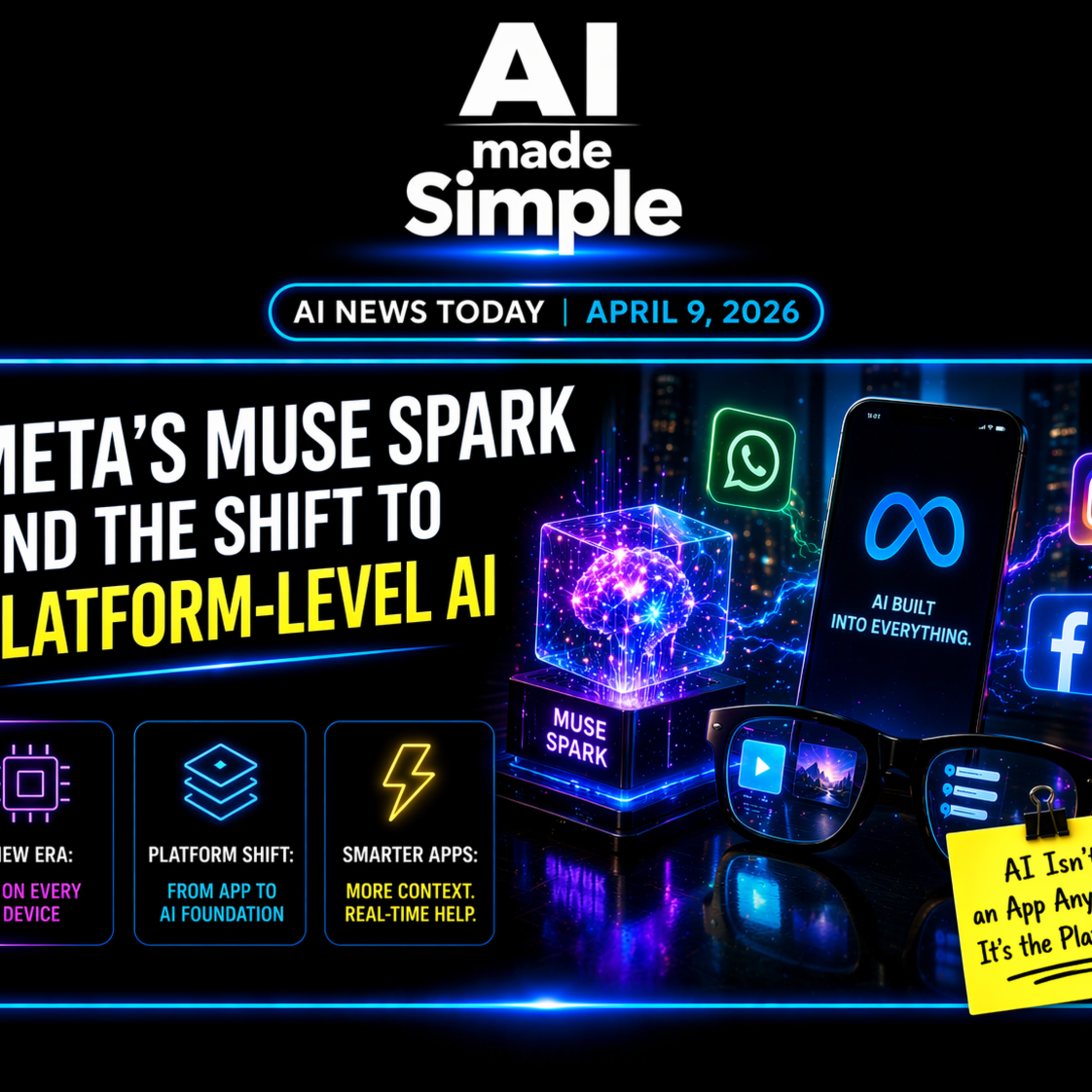
    AI News Today (April 9, 2026): Meta’s Muse Spark and the Shift to Platform-Level AI

    In today’s AI Made Simple daily brief, we break down Meta’s introduction of Muse Spark and what it means from both a technical and practical perspective. We explain how the model is designed to improve reasoning and multimodal capabilities, and how it fits into a broader shift toward AI becoming more deeply integrated into platforms and products. This episode goes beyond headlines to help you understand what’s actually changing beneath the surface—and what it means for how you use AI in your daily workflows. Stay current in under 5 minutes with only the highest-signal AI updates.

  • S1 · E15
    April 9 · 11 min

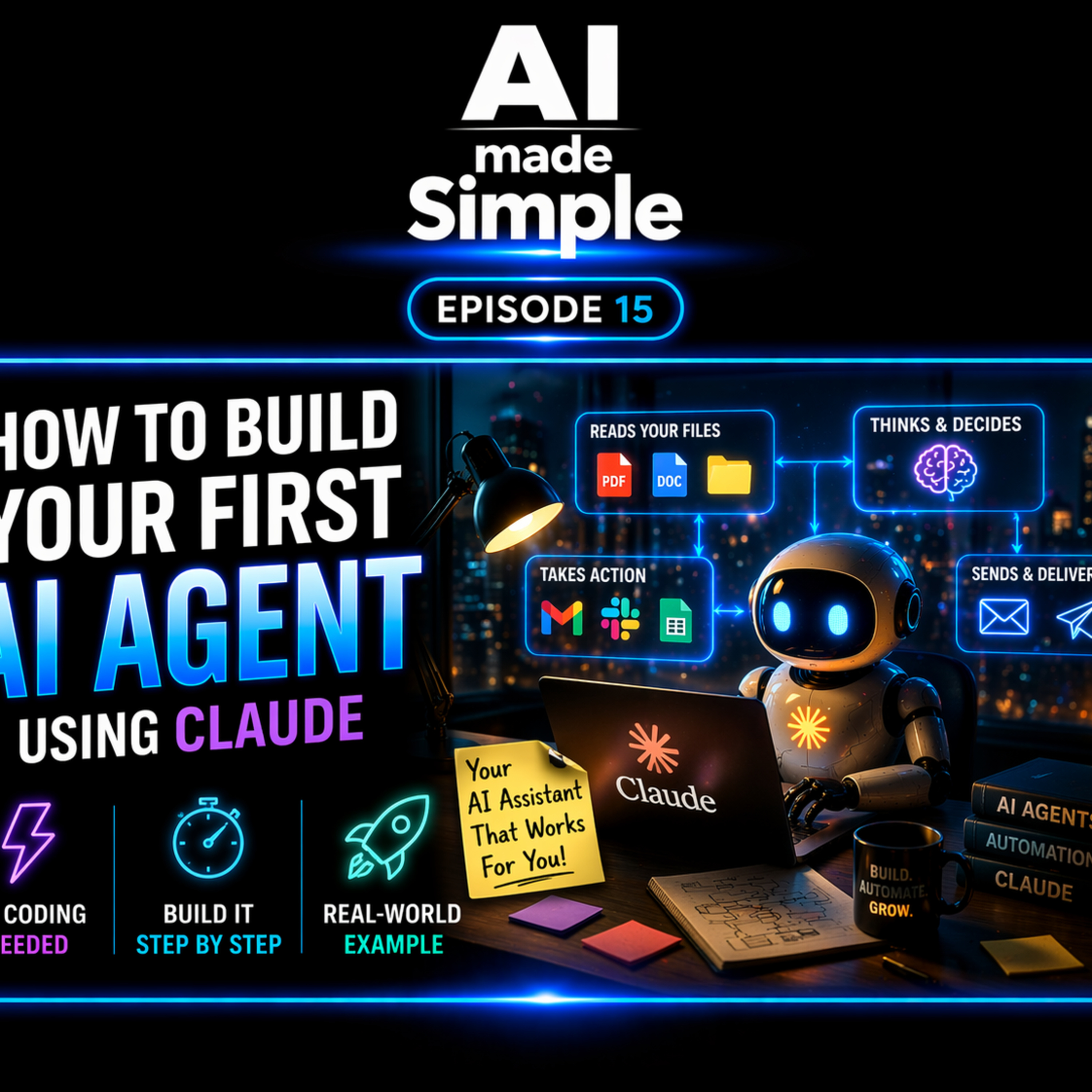
    Episode 15 - How to Build Your First AI Agent Using Claude

    In this episode of AI Made Simple, we break down how to build your first AI agent using a simple, practical framework. Instead of treating AI like a one-off tool, you’ll learn how to design structured workflows that allow AI to complete real tasks step by step. We also walk through a real example using Claude, explaining how it can act as the reasoning engine inside your system—helping you generate, refine, and validate outputs more effectively. You’ll learn: What an AI agent really is (and what it is not) How to go from a goal to a working workflow How to use Claude as part of your system The common mistakes that make most agents fail If you’re ready to move from simply using AI to actually building with it, this episode gives you a clear and practical starting point.

  • S1 · E14
    April 8 · 6 min

    Episode 14: How AI Systems Work Together — Multi-Agent AI Explained Simply

    Most people think AI is a single system—but that’s no longer true. In this episode of AI Made Simple, we break down how modern AI systems actually work. Instead of one model doing everything, AI is increasingly being structured as a team of systems working together. You’ll learn: Why a single AI struggles with complex tasks How multiple AI systems collaborate The different ways AI “teams” are structured How to use this approach in your daily workflows We also introduce a simple framework you can start using immediately: generate → refine → validate. If you want to move beyond basic AI usage and understand how to get better, more reliable results, this episode will change how you think about AI.

Showing 1–20 of 20 episodes