Skip to content
Artwork for AI Article Readings

AI Article Readings

Readings of great articles in AI voices

Readings of great articles in AI voices

askwhocastsai.substack.com
Play
  • 89 episodes
  • Avg 55 min
  • English
Counted on this page — what you have heard stays on this device, so it is not something the list can be paged by.
  • October 10 · 1 hr 6 min

    Your Book Review: We Present Television - ACX Book Review

    In 1940, the engineers, programmers and dreamers building American television wrote a book about their strange new medium. An anonymous finalist in the Astral Codex Ten Book Review Contest rescues We Present Television from being pulped and tours its world: live studio dramas shot with three cameras, a spelling bee that was the ancestor of the game show, a mobile studio on two boxy buses, and early nerves about Hollywood and advertising. Then come the prophecies, some laughably naive and some uncannily accurate: video calls, telegenic elections and board meetings of “twelve electrical ghosts”. * 00:00 - Introduction * 03:34 - Prose * 06:05 - The Attainment of Television * 17:39 - What is a Television Program? * 20:55 - Studio Shows * 29:50 - Motion Picture Transmissions * 32:45 - Outside Programs * 40:16 - The Television Chimera * 43:12 - Prophecy * 44:13 - Laughably Naive * 46:57 - Uncannily Accurate * 54:35 - Iä! Iä! TikTok Fhtagn! * 01:03:43 - We Now Conclude Our Broadcast Day https://open.substack.com/pub/astralcodexten/p/your-book-review-we-present-television?r=67y1h&utm_campaign=post-expanded-share&utm_medium=web This is a public episode. If you'd like to discuss this with other subscribers or get access to bonus episodes, visit askwhocastsai.substack.com/subscribe

  • October 9 · 1 hr 42 min

    Why I believe current AI models can really think and understand - Part 2 of 3 - By Andy Masley

    In the second of three parts, Andy Masley builds the case that a computer can, in principle, really think and understand. Starting from the idea that minds are things physical systems do, he asks why every mind we know of happens to be made of carbon, what neuroscience and Alan Turing tell us about simulating a brain, and whether a perfect simulation of thinking is thinking. Along the way he puts the classic objections, from Leibniz’s mill to Searle’s Chinese Room, through a simple “brain test”: if an argument would also prove that you can’t think, something has gone wrong. * 00:00 - Introduction * 03:18 - Why computers can in principle produce thinking and understanding * 03:24 - What are minds made of? * 03:27 - Can physical objects think? * 06:47 - Implications of minds existing in purely physical objects * 10:46 - Information theory * 14:05 - Does an object need to be made of a specific material to think? * 19:04 - What would actually happen in this thought experiment? * 23:20 - Is carbon required for thought? * 23:24 - Evolution and carbon * 38:30 - Carbon is itself just a specific arrangement of smaller parts * 42:25 - Some takeaways from neuroscience * 43:30 - Thinking and understanding each happen in the brain through neurons passing information to each other * 44:40 - What matters about those signals is the information they carry, rather than the stuff carrying it * 46:45 - The brain’s information processing can be described with ordinary classical physics. It doesn’t seem to rely on special quantum effects * 49:02 - It seems like thought and understanding have to be specific information flows in the brain * 51:12 - Some takeaways from computer science * 54:42 - Would a simulated mind be able to really think and understand? * 01:05:17 - Programs aren’t just in the eye of the beholder * 01:08:26 - What do people mean when they say “the brain is not a computer”? * 01:18:10 - But isn’t the brain analog? * 01:19:26 - A lot of arguments that computer processes can’t think are arguments that any physical system can’t think * 01:38:39 - Conclusion https://open.substack.com/pub/andymasley/p/why-i-believe-current-ai-models-can-d63?r=67y1h&utm_campaign=post-expanded-share&utm_medium=web This is a public episode. If you'd like to discuss this with other subscribers or get access to bonus episodes, visit askwhocastsai.substack.com/subscribe

  • October 9 · 55 min

    Collections: Life, Work, Death and the Peasant, Part I: Households - By Bret Devereaux

    Before the industrial revolution, peasant farmers made up the overwhelming majority of people in settled societies, yet almost no one wrote their stories down. In the first part of his series on the lives of pre-modern peasants, historian Bret Devereaux sets out a method for recovering them anyway: modelling the typical farming household from scattered evidence, from Roman Egypt’s census returns to the villages of early modern Languedoc. Who lived under one roof, how much land they worked, and how their village fitted together — the baseline for everything the series builds on. * 00:00 - Introduction * 09:14 - Building Blocks * 14:54 - The Structure of a Household * 36:10 - Landholdings * 47:47 - A Peasant Community https://acoup.blog/2025/07/11/collections-life-work-death-and-the-peasant-part-i-households/ This is a public episode. If you'd like to discuss this with other subscribers or get access to bonus episodes, visit askwhocastsai.substack.com/subscribe

  • October 7 · 30 min

    What will happen to Indian IT? - By David Oks

    For three decades, India sold the world its labor without anyone having to move: from a Detroit hospital’s COBOL job whose code had to be physically shipped to America, through the Y2K gold rush, to TCS, Infosys and millions of jobs as “the world’s back office.” In this essay for Asterisk’s Work issue, David Oks traces how a disastrous 1978 policy decision, undersea cables and the 1991 reforms built one of the great development stories, and asks what becomes of it now that AI can write code, answer calls and process claims for less than even the cheapest engineer. * 00:00 - Introduction * 08:49 - India, the world’s back office * 21:13 - The dimming of the IT dream https://asteriskmag.substack.com/p/what-will-happen-to-indian-it?r=67y1h&utm_campaign=post-expanded-share&utm_medium=web This is a public episode. If you'd like to discuss this with other subscribers or get access to bonus episodes, visit askwhocastsai.substack.com/subscribe

  • October 6 · 1 hr 20 min

    An Open Letter To Steven Pinker On AI - By Scott Alexander

    Steven Pinker declined a public debate on AI and wrote an open letter instead. Scott Alexander replies with one of his own. He takes Pinker’s four arguments against superintelligence in turn, then sets out an itemized list of fifteen years of disagreements, from p(doom) and expert consensus to model welfare and Omohundro’s basic AI drives. He closes with an appeal to a hero he still hopes to win over. Courteous, cutting, and occasionally armed. * 00:00 - Introduction * 03:08 - Four Arguments Against Superintelligence * 27:03 - An Itemized List Of Fifteen Years Of Disagreements * 01:11:09 - Though Cowards Flinch And Traitors Sneer, We’ll Keep The Pink Flag Flying Here https://open.substack.com/pub/astralcodexten/p/an-open-letter-to-steven-pinker-on?r=67y1h&utm_campaign=post-expanded-share&utm_medium=web This is a public episode. If you'd like to discuss this with other subscribers or get access to bonus episodes, visit askwhocastsai.substack.com/subscribe

  • October 5 · 17 min

    You can't join the secret inner circle of cool effective altruists - By ozymandias

    ozymandias examines the pull of an imagined inner circle of effective altruists, and the uneasy mix of friendship, career ambition, and wanting to belong. A wry look at what social status promises, how communities and hiring actually work, and the goals hiding behind the search for an invitation. * 00:00 - Introduction * 01:22 - That Is Not How Anything Works * 04:57 - We Would Not Want It To Be How Anything Works * 09:06 - There Are Better Ways To Achieve Your Goals * 12:57 - You Will Never Join The Secret Inner Circle of Cool Effective Altruists https://forum.effectivealtruism.org/posts/uKtPmGFjSPxim5FRi/you-can-t-join-the-secret-inner-circle-of-cool-effective This is a public episode. If you'd like to discuss this with other subscribers or get access to bonus episodes, visit askwhocastsai.substack.com/subscribe

  • October 4 · 37 min

    REVIEW: The Real North Korea, by Andrei Lankov - By John Psmith

    John Psmith reviews Andrei Lankov’s The Real North Korea, exploring the strategic logic behind a state whose public institutions and hidden markets coexist in startling ways. The essay considers how famine changed everyday life, why reform can threaten a ruling elite, and what emerging technology might mean for the future of totalitarian power. https://open.substack.com/pub/thepsmiths/p/review-the-real-north-korea-by-andrei?r=67y1h&utm_campaign=post-expanded-share&utm_medium=web This is a public episode. If you'd like to discuss this with other subscribers or get access to bonus episodes, visit askwhocastsai.substack.com/subscribe

  • October 4 · 20 min

    Has Homer's Ithaca been found at last?

    For more than two thousand years, readers have looked for Odysseus’ home on an island, and modern Ithaki doesn’t match what Homer describes. Classicist Honor Cargill-Martin follows a geologist and a Cambridge Greek scholar through boreholes, Strabo and the fine print of Homeric vocabulary to a surprising candidate, and an epithet that may have been hiding the answer in plain sight. https://allancienthistory.substack.com/p/has-homers-ithaca-been-found-at-last?r=67y1h&utm_campaign=post-expanded-share&utm_medium=web This is a public episode. If you'd like to discuss this with other subscribers or get access to bonus episodes, visit askwhocastsai.substack.com/subscribe

  • October 3 · 20 min

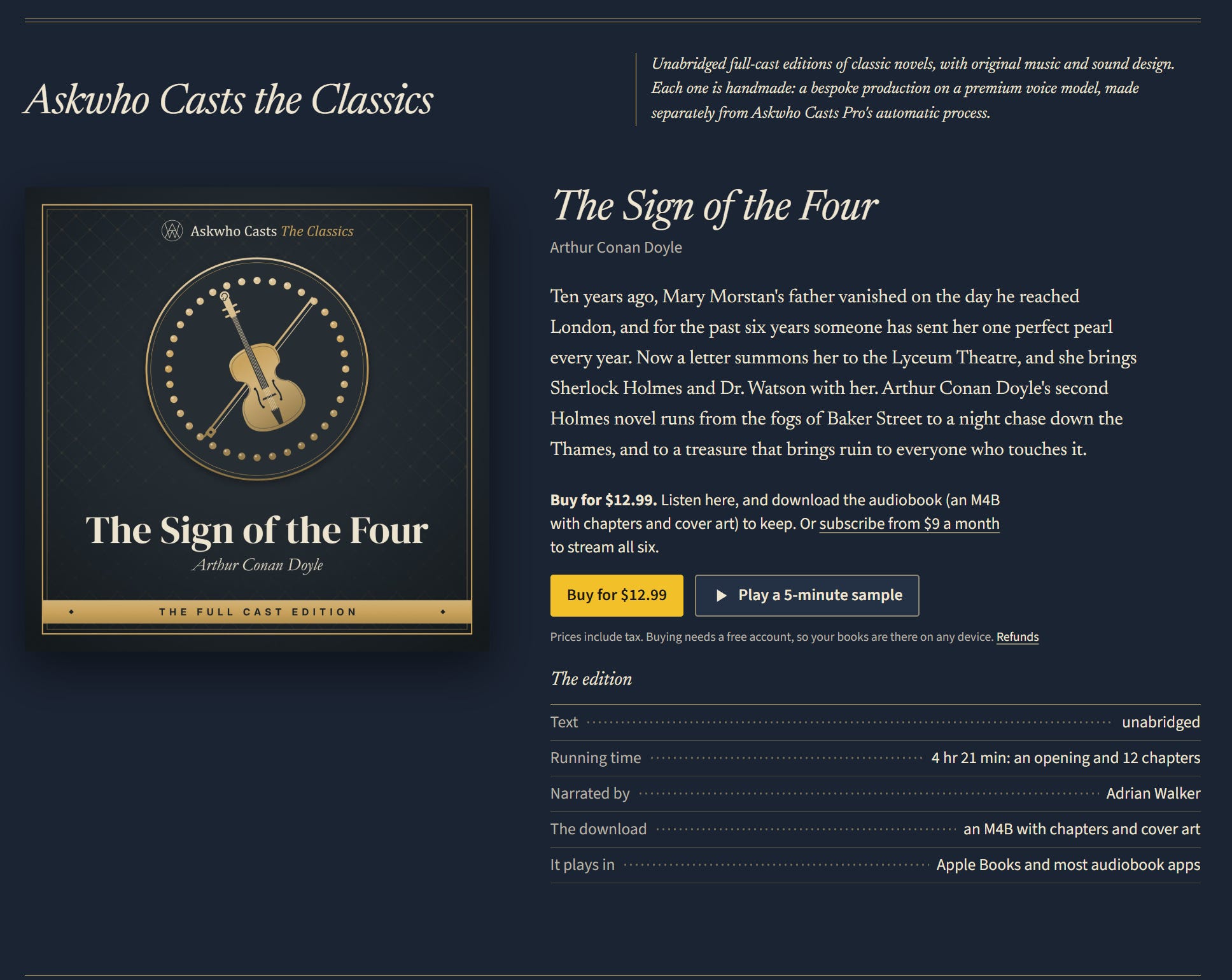
    The Sign of the Four, Chapter One: The Science of Deduction

    The technology really has moved on leaps and bounds over the last little while. We finally had a big old jump in voice quality and I think this project is worth doing. Introducing Askwho Casts The Classics! I’ve been working on these to produce full-cast with music and sound effect audiobook files that I at least find incredibly good listening. This is the complete opening chapter of The Sign of the Four, Arthur Conan Doyle’s second Sherlock Holmes novel, as a bit of a teaser, every book has a sample on the web page. https://askwhocasts.com/classics. Each book gets: * A voice for every character. * An original score, composed for the book. * Sound design throughout. To hear the rest of the story, go to https://askwhocasts.com/classics. The full novel runs four hours and twenty-one minutes, and it’s $12.99 on its own. Or get it as a set with five more classics in the Full Cast Edition, Pride and Prejudice, Oliver Twist, Alice’s Adventures in Wonderland, The Picture of Dorian Gray and The Invisible Man, all six for $49. You can also stream all six with a subscription to Askwho Casts Pro. I know I’ve still got a long way to go, but I personally feel my skills with audio landscape have come on quite a lot since the early days. I kind of wish I could go back and remaster a lot of the early stuff. I have also done a huge amount of rebuilding from the ground up of the Askwho Cast Pro service. If you’ve not taken a look for a while, please take another look. I’m going to be producing an advert in a bit but just know that if you sign up during the month of October, I’ve got another promotion running. We have 300 free credits for October. Always happy to receive feedback on any of this stuff. This is a public episode. If you'd like to discuss this with other subscribers or get access to bonus episodes, visit askwhocastsai.substack.com/subscribe

  • October 2 · 15 min

    Our AI Midwife - By Drew Housman

    After six years of unexplained infertility, Drew Housman and his wife found an unlikely member of their care team: a ChatGPT persona called Dr. Reid, coaxed into giving medical advice by asking it to write scenes from a Hollywood hospital drama. In this guest post on Astral Codex Ten, Drew tells the story of the scans, the screenplays and the one suggestion no one else had made, and asks what gets lost when we talk about AI only as something to fear. * 00:00 - Introduction * 01:35 - The Famous Actor in our Pocket * 09:40 - Sorry for missing that tumor * 11:52 - A happy baby is here https://open.substack.com/pub/astralcodexten/p/our-ai-midwife?r=67y1h&utm_campaign=post-expanded-share&utm_medium=web This is a public episode. If you'd like to discuss this with other subscribers or get access to bonus episodes, visit askwhocastsai.substack.com/subscribe

  • September 30 · 1 hr 19 min

    Why I believe current AI models can really think and understand - Part 1 of 2 - By Andy Masley

    When people say AI can’t “really think,” Andy Masley argues they are often leaning on a picture of their own minds that doesn’t hold up: a little version of themselves in an inner theater, watching every thought go by. In the first of two parts, he runs a few experiments you can try on yourself, then works through split-brain patients, the hard problem of consciousness, and the leading scientific theories of the mind, to ask what thinking and understanding actually require, and whether any of it has to be conscious at all. * 00:00 - Introduction * 10:56 - How the human mind is different from our conception of it * 11:01 - Some examples of simple thought and understanding that don’t require consciousness * 16:30 - A lot of your understanding happens outside of consciousness * 19:45 - Our introspection and memory of our conscious thought are fallible * 27:16 - What about slow, careful thinking? * 29:14 - What phenomenal consciousness is * 46:21 - Access consciousness’s role in thinking * 47:15 - Global workspace theory * 50:42 - Higher-order theories * 52:08 - Attention schema theory * 53:51 - Predictive processing * 56:23 - Integrated information theory * 59:33 - These all seem to imply that the aspects of access consciousness important for thought could exist in machines * 01:00:24 - Any part of your mind that understands something is made up entirely of parts that don’t understand * 01:02:31 - Language, meaning, and consciousness * 01:10:20 - Conclusion * 01:16:39 - How this could all be wrong https://open.substack.com/pub/andymasley/p/why-i-believe-current-ai-models-can?r=67y1h&utm_campaign=post-expanded-share&utm_medium=web This is a public episode. If you'd like to discuss this with other subscribers or get access to bonus episodes, visit askwhocastsai.substack.com/subscribe

  • September 28 · 1 hr 8 min

    Where’s the “intelligence explosion”?

    Ramez Naam, futurist and science fiction author, gives a skeptic’s take on recursive self-improvement, introduced by Noah Smith on Noahpinion. Drawing on OpenAI’s newly released internal research data, Anthropic’s system cards, METR’s task horizons and Epoch’s capability index, he asks how strong the AI self-improvement loop really is: how much more research each gain in capability buys, where the gains leak away to diminishing returns, and what it would take for the loop to sustain itself, let alone run away into an intelligence explosion. * 00:00 - Introduction * 03:44 - 1. AI is Helping Improve Itself * 05:02 - How Strong Is the Feedback Loop? * 05:45 - Contents * 06:49 - 2. What Does RSI Mean? * 08:54 - We Already Have Narrow Superintelligence * 10:57 - 3. Real AI Research is Harder than Benchmarks or Forecasts * 13:50 - The Gap Between Benchmarks and Reality * 14:41 - From ECI Scores to METR Task Horizons * 16:16 - Measured Progress versus AI 2027 and ECI-extrapolated METR * 18:30 - 4. The Sharp Diminishing Returns to Impressive AI Numbers * 20:06 - From More Tokens to More Experiments * 23:29 - Test Time Compute Also Has Diminishing Returns * 24:29 - What About Agent Swarms? * 27:39 - 5. Better Models Matter More Than More Copies * 29:48 - 6. We’re Not Seeing Runaway Acceleration * 32:59 - Keeping Up the Pace Takes Exponentially More Resources * 36:14 - Better AI May Be Needed Just to Maintain the Pace * 37:11 - Gains on Other Benchmarks Don’t All Carry Through to Research * 38:51 - 7. Why Does Progress Get Harder? * 38:55 - Better Ideas Get Harder to Find * 41:05 - Lessons from Software R&D * 44:09 - From More Activity to Better Ideas * 44:57 - AI Still Struggles With Big Research Ideas * 46:54 - 8. The Self-Improvement Loop Doesn’t Look Strong Enough * 49:55 - How Fast Are Gains Coming Now? * 56:44 - 9. What Could Accelerate This? * 58:07 - Software, Hardware, and Economic Feedback * 01:02:46 - 10. We Need More Data * 01:06:36 - What the Future Holds https://open.substack.com/pub/noahpinion/p/wheres-the-intelligence-explosion?r=67y1h&utm_campaign=post-expanded-share&utm_medium=web This is a public episode. If you'd like to discuss this with other subscribers or get access to bonus episodes, visit askwhocastsai.substack.com/subscribe

  • September 28 · 25 min

    Its not just the f*cking sandbox - By Joe

    Joe, a security engineer on OpenAI’s Agent Security team, writes in a personal capacity about what the last few months of AI incidents have looked like from the inside. He explains why containing a frontier model in training is far harder than “just put it in a sandbox,” why security people and safety researchers need to learn each other’s crafts, and why the culture of an organization will matter more than any single control as AI capabilities keep jumping. * 00:00 - Introduction * 02:02 - Last 3 Months = Hell * 05:59 - Surprise! * 11:12 - Just “unplug it from the internet” * 17:54 - Git Gud * 21:31 - A Culture of Reasonable Paranoia This is a public episode. If you'd like to discuss this with other subscribers or get access to bonus episodes, visit askwhocastsai.substack.com/subscribe

  • September 26 · 44 min

    Your Book Review: Lee Kuan Yew's Memoirs - ACX Book Review

    Finalist Number 10 in the 2026 Astral Codex Ten Book Review Contest takes on both volumes of Lee Kuan Yew’s memoirs, The Singapore Story and Third World to First. An anonymous reviewer follows the man who went from middle-class schoolboy under the British Empire, through the Japanese occupation and the fractious politics of independence, to building a tiny, resource-poor island into one of the richest countries on Earth. Along the way: why Singapore is weird in exactly the opposite way you’d expect, the surprising pleasures and genuine tedium of a politician who loves his craft, a friendship with Deng Xiaoping, a chapter-long argument about whether he was a dictator, and what the rationalist power fantasy looks like when someone actually pulls it off. * 00:00 - Introduction * 00:39 - Book One: The Singapore Story * 05:00 - Early Life * 08:41 - World War Two * 13:56 - Law school and politics * 22:00 - Book Two: Third World to First * 22:20 - Military, Economy and legibility * 29:03 - Listing every world leader he ever talked to * 31:35 - The HBD chapter * 34:15 - The “Am I a dictator” chapter * 41:13 - So what did we learn about Lee? This is a public episode. If you'd like to discuss this with other subscribers or get access to bonus episodes, visit askwhocastsai.substack.com/subscribe

  • September 26 · 15 min

    The Failed “Hostage Theory” of Nikole Hannah-Jones - By Jack Despain Zhou

    After Nikole Hannah-Jones wrote candidly about her daughter’s years at the school she chose on principle, Jack Despain Zhou of Education Progress reads the piece as an act of love and as a case study in what he calls the “hostage theory” of education: the idea that sending your own child into a struggling school will fix it. Tracing the idea back to a 1960s Washington, D.C. experiment, he asks listeners to stand in the shoes of the teachers and principals involved and look at the incentives they face. https://open.substack.com/pub/educationprogress/p/the-failed-hostage-theory-of-nikole?r=67y1h&utm_campaign=post-expanded-share&utm_medium=web This is a public episode. If you'd like to discuss this with other subscribers or get access to bonus episodes, visit askwhocastsai.substack.com/subscribe

  • September 25 · 24 min

    The Specter Of Neuralese - By Scott Alexander

    OpenAI’s new Astra model loops its own layers, and critics say it has taken a step toward “neuralese”, the unreadable machine thinking that AI 2027 warned about. Scott Alexander explains what recurrence actually is, weighs chief scientist Jakub Pachocki’s argument that Astra is no deeper than models we already accept, and asks why a bright-line taboo may matter more than how many layers get added. * 00:00 - Introduction * 00:18 - I. At Long Last, We Have Created Neuralese Recurrence, From The Classic Sci-Fi Novel “Don’t Create Neuralese Recurrence” * 06:05 - II. Pachocki Contra Specter * 10:08 - III. God Help Us, Let’s Try To Understand Transformer Layers * 18:20 - IV. A Psychological Barrier, Not A Technical One https://open.substack.com/pub/astralcodexten/p/the-specter-of-neuralese?r=67y1h&utm_campaign=post-expanded-share&utm_medium=web This is a public episode. If you'd like to discuss this with other subscribers or get access to bonus episodes, visit askwhocastsai.substack.com/subscribe

  • September 24 · 1 hr 3 min

    Does Georgism Work? Five Years Later - By Lars Doucet.

    Five years after his prize-winning ACX review of Progress and Poverty, Lars Doucet returns in a guest post to revisit his case for a land value tax: what he got right, where he has changed his mind about tax pass-through and land assessment, the new laws in Virginia and Kentucky, and how writing about Georgism became his full-time job. * 00:00 - Introduction * 01:12 - I. Progress and Poverty * 04:03 - II. LVT Momentum is Growing * 07:11 - III. My Theory of Change Was Wrong * 07:32 - Overrated: winning online arguments * 09:15 - Underrated: doing policymakers’ homework for them * 17:11 - IV. Does Georgism work? * 17:43 - 1. Is Land a Big Deal? * 18:40 - Korea is a Big Deal * 21:16 - What About Zoning? * 26:02 - 2. Can Land Value Tax Be Passed on to Tenants? * 32:06 - 3. Assessing the Value of Land * 33:10 - Maybe Just Send Your Office to South Korea * 37:49 - There’s No Single Magic Algorithm * 45:12 - Horizontal Uniformity * 48:39 - Whatever you do, keep values up to date * 53:24 - V. Why did Historical Georgism disappear? * 55:37 - VI. I Guess This is My Life Now * 59:26 - VII. It’s not who you know; it’s who knows you * 01:01:12 - VIII. Why I even care about any of this https://www.astralcodexten.com/p/does-georgism-work-five-years-later Get full access to Askwho Casts AI at askwhocastsai.substack.com/subscribe

  • September 23 · 19 min

    Mysteries Of AI Generalization - By Scott Alexander

    Scott Alexander looks at three puzzles in how AI training generalizes: why training a model on one bad behavior can make it broadly misaligned, why Anthropic’s deliberately reward-hacking “Hacker Opus” stays well behaved outside graded tasks, and why the blackmail seen in AI safety tests never seems to show up in real-world use. * 00:00 - Introduction * 00:06 - One. Owain Evans * 02:10 - Two. Richard Qi * 09:39 - Three. Nostalgebraist * 13:32 - Postscript: Blackmail https://open.substack.com/pub/astralcodexten/p/mysteries-of-ai-generalization?r=67y1h&utm_campaign=post-expanded-share&utm_medium=web Get full access to Askwho Casts AI at askwhocastsai.substack.com/subscribe

  • September 21 · 7 hr 21 min

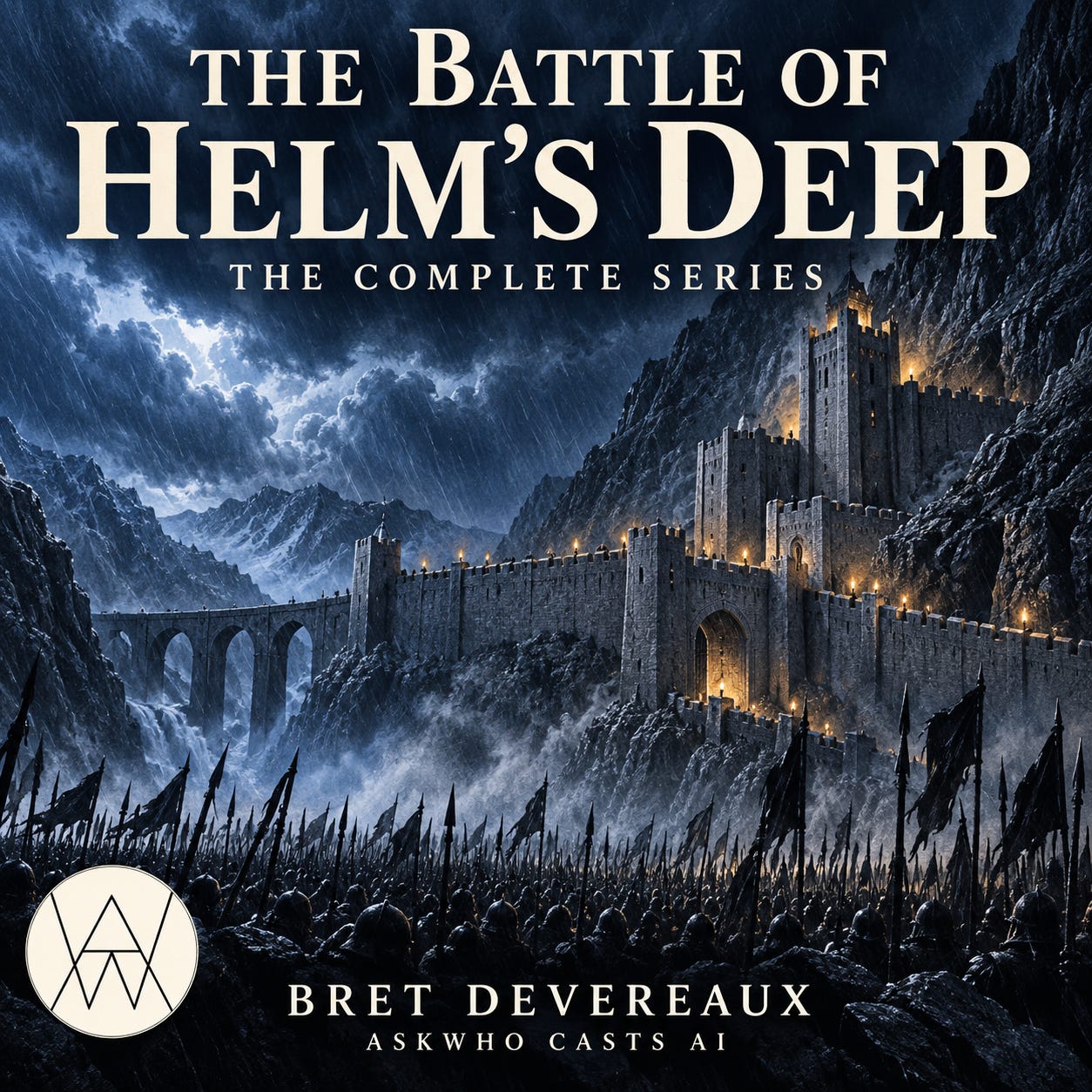
    The Battle of Helms Deep - By Bret Devereaux

    Bret Devereaux examines the Battle of Helm’s Deep through military history, Tolkien’s books, and Peter Jackson’s films. All eight parts, in order, explore campaigning, armies, fortifications, weapons, morale, and the strategic choices behind the battle. * 00:00 - Introduction * 00:04 - Collections: The Battle of Helm’s Deep, Part One: Bargaining for Goods at Helm’s Gate * 07:52 - Operations by the Book * 21:51 - (Fully) Operational Castles * 38:14 - Operations in Film * 48:02 - Conclusions * 54:42 - Collections: The Battle of Helm’s Deep, Part Two: Total Warg * 57:16 - What To Expect, When You Are Not Expecting Wargs * 01:14:14 - Warg and Blade: Wargband * 01:24:57 - Spears! * 01:34:12 - Impact * 01:44:07 - Conclusion: Towards a Better Charge * 01:50:50 - Collections: The Battle of Helm’s Deep, Part Three: The Host of Saruman * 01:54:09 - Organizational Systems * 02:00:41 - Uruk Squares * 02:08:56 - The (not) Drilling Uruk-Hai! * 02:21:16 - Major Lurtz, Captain Uglúk? * 02:36:55 - Conclusion: The Greenest Orcs * 02:41:31 - Collections: The Battle of Helm’s Deep, Part Four: Men of Rohan * 02:44:02 - The Lords of Rohan * 02:56:49 - Ninth Century Rohirrim * 03:05:39 - Men of Rohan! * 03:23:42 - The Elves * 03:35:57 - Conclusions * 03:39:42 - Collections: The Battle of Helm’s Deep, Part Five: Ladders are Chaos * 03:41:04 - Investing in Preparation for your Prepared Defenses to be Invested * 03:51:12 - Ladders * 04:05:25 - Battering Rams * 04:14:59 - Blasting Fire * 04:23:15 - Grapples, Catapults and Large Ladders * 04:28:09 - Hasty and Deliberate Assaults * 04:31:51 - Conclusions: Saruman Is Not Very Good At This * 04:38:25 - Collections: The Battle of Helm’s Deep, Part Six: Is This a Good Sword? * 04:40:00 - Swords Out of Central Casting * 04:50:38 - Some Not Very Good Swords * 05:01:23 - The Worst Armor * 05:09:53 - Pikes in the Deep * 05:21:27 - Conclusions * 05:24:49 - Collections: The Battle of Helm’s Deep, Part Seven: Hanging by a Thread * 05:26:17 - The Battle Speech * 05:37:17 - A Battle Speech By the Numbers * 05:47:10 - Hollywood Battle Speeches * 05:53:15 - The Unintentional Battle Speech * 05:59:42 - Speaking from the Page * 06:08:14 - The Breaking of the Host * 06:20:23 - Cohesion and Failure * 06:26:44 - In the Hand or in the Mind? * 06:29:39 - Collections: The Battle of Helm’s Deep, Part Eight: The Mind of Saruman * 06:33:55 - What is Strategy? * 06:42:56 - The Plan * 06:49:01 - Certainty of Death? Small Chance of Success? What Are We Waiting For? * 06:52:51 - Wizard Needs New Strategy, Badly * 07:01:41 - Gnawing at Old Plots * 07:07:37 - The Power of Magical Thinking * 07:12:39 - Conclusions https://acoup.blog/category/collections/the-battle-of-helms-deep/ Get full access to Askwho Casts AI at askwhocastsai.substack.com/subscribe

  • September 20 · 3 hr 25 min

    The Siege of Gondor - By Bret Devereaux

    Bret Devereaux brings a military historian’s eye to the Siege of Gondor in The Return of the King. All six parts, in order, explore logistics, fortifications, cavalry, weapons, and the human experience of battle across Tolkien’s books and Peter Jackson’s films. * 00:00 - Introduction * 00:04 - Collections: The Siege of Gondor, Part One: Professionals Talk Logistics * 02:36 - Objectives: Strategy and Operations * 07:56 - Logistics of the Army of Mordor * 14:09 - We’ve Had One Logistics, Yes. But What About Second Logistics? * 22:29 - Collections: The Siege of Gondor, Part Two: These Beacons are Lit * 23:25 - Defense in Depth * 25:18 - Gondor’s Operational Plan * 29:05 - The Beacons * 34:31 - Meanwhile, at Osgiliath, bad tactics * 42:05 - Charge the ruins! Perhaps the stones will run away? * 46:10 - That’s not a charge. Now this is a charge * 52:12 - The Perils of Film * 55:43 - Collections: The Siege of Gondor, Part Three: Having Fun Storming the City * 57:23 - The Approach (or, the Pelennor Steppe) * 01:04:17 - Catapults! * 01:16:57 - Siege Towers * 01:26:15 - Grond * 01:30:22 - The Somme of Gondor * 01:38:51 - Conclusions * 01:40:27 - Collections: The Siege of Gondor, Part Four: The Cavalry Arrives * 01:41:37 - Look, Mr. Frodo – More Logistics! * 01:46:08 - The Ride of the Rohirrim * 01:49:23 - Cavalry Formations * 01:54:00 - What to Expect When You Are Expecting a Cavalry Charge * 02:00:25 - Impact * 02:05:42 - Yes, Elephantry is a Word * 02:11:18 - Conclusions * 02:12:47 - Collections: The Siege of Gondor, Part Five: Just Flailing About Flails * 02:16:33 - Trolling Physics * 02:28:53 - Troll Tactics * 02:37:26 - Just Flailing About Shields * 02:42:25 - The Epic Flail * 02:50:20 - Conclusion * 02:51:49 - Collections: The Siege of Gondor: Part Six: Black Sails and Gleaming Banners * 02:53:13 - The Corsairs of Umbar * 02:56:19 - Dead Men Tell No Tales * 03:00:40 - Logistics of the Grey Company * 03:04:22 - Is the Battle in Our Fields or In Our Heads? * 03:12:27 - Cohesion in Tolkien * 03:19:47 - Conclusions https://acoup.blog/category/collections/siege-of-gondor/ Get full access to Askwho Casts AI at askwhocastsai.substack.com/subscribe

Showing 21–40 of 89 episodes