Skip to content
Artwork for a16z AI Policy Brief
TechnologyNewsPolitics

a16z AI Policy Brief

a16z Policy

Your guide to AI public policy from the team at a16z. Each conversation bridges Washington and Little Tech, bringing together policy leaders, researchers, and builders to explore how the U.S. stays ahead in AI.

a16zpolicy.substack.com
Play
  • 21 episodes
  • Avg 40 min
  • English
Counted on this page — what you have heard stays on this device, so it is not something the list can be paged by.
  • August 17 · 43 min

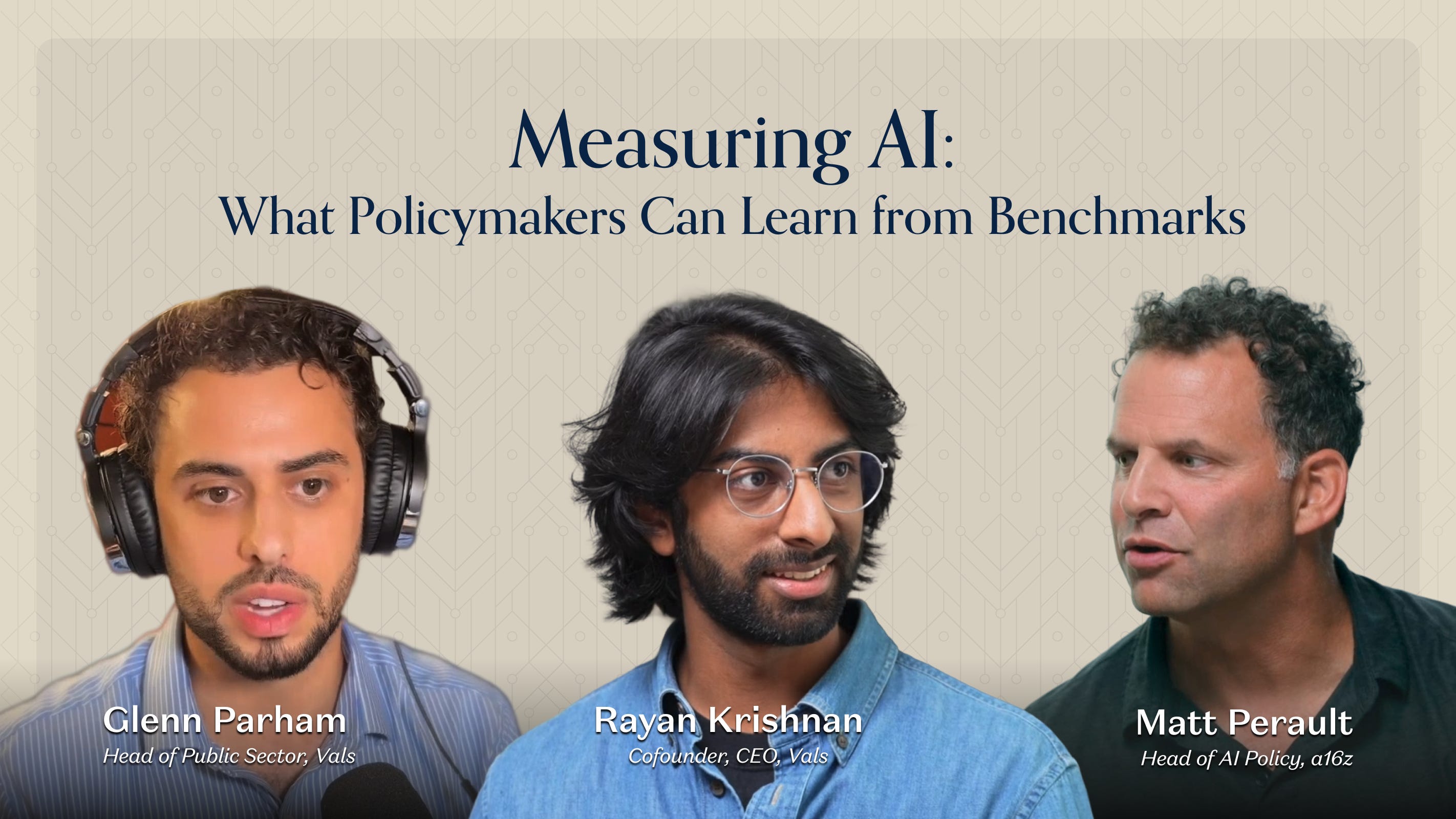
    Measuring AI: What Policymakers Can Learn from Benchmarks

    AI benchmarks are becoming increasingly central to policy debates. But much of the value of these benchmarks depends on how they are built: what they measure, who develops and runs them, and how quickly they evolve alongside the models they evaluate. In this episode, Matt Perault speaks with Rayan Krishnan, cofounder and CEO of Vals, and Glenn Parham, head of public sector, about their work building AI evaluation tools and partnerships for industry and government. They discuss why static tests quickly become obsolete, why credible evaluations require deep domain expertise and independent testing, and how a growing market of evaluators is moving the field beyond “evaluations by vibes” toward more rigorous, data-driven evidence for policymakers. Topics covered: 00:00: Intro 02:00: What is Vals? 05:00: Keeping benchmarks current 08:00: New strides in AI evaluation 11:00: Measuring AI’s cyber capabilities 14:00: Why government needs independent evaluation 21:00: The growing market for AI benchmarks 26:00: What benchmarks can—and cannot—measure 29:00: Building trust in AI benchmarks 35:00: Why AI performance varies across domains and tasks 37:00: Bringing AI evaluation to government 41:00: From “evaluations by vibes” to better evidence Resources: Subscribe to the a16z AI Policy Brief: https://a16zpolicy.substack.com/ Follow Matt Perault on X: https://x.com/MattPerault Follow Rayan Krishnan on X: https://x.com/RayanKrishnan Follow Glenn Parham on X: https://x.com/glenn__parham Follow Vals.ai on X: https://x.com/ValsAI The content here is for informational purposes only, should not be taken as legal, business, tax, or investment advice or be used to evaluate any investment or security, and is not directed at any investors or potential investors in any a16z fund. Please note that a16z and its affiliates may maintain investments in the companies discussed in this podcast. For more details, including a link to our investments, please see a16z.com/disclosures. This is a public episode. If you would like to discuss this with other subscribers or get access to bonus episodes, visit a16zpolicy.substack.com

  • July 14 · 46 min

    AI's Data Access Question

    AI is reopening a core question from the development of the web: how to preserve the freedom to learn while giving publishers meaningful control over how their works are made available. In this episode, Matt Perault is joined by Derek Slater, cofounder of Proteus Strategies and an expert on information access, copyright, and free expression, to examine this question and explain why it matters for the future of AI. The web worked because people could access, read, analyze, and build on lawfully available information. Standards like robots.txt helped manage the balance between openness and control at scale, giving publishers a way to express preferences without requiring every builder to negotiate permission website by website. AI is now testing that equilibrium. Some proposals would restrict not only unlawful access, like when AI developers circumvent paywalls to get data, but also lawful learning from public information through expanded copyright theories, terms of service, technical barriers, or licensing requirements. Derek and Matt separate those issues, including the difference between training models on lawfully accessed data, producing infringing outputs, using AI tools to summarize content a user can already access, and breaking through access controls. For Little Tech, this question is fundamental. Access to data operates as a form of startup capital, allowing new companies to develop products and compete. But if AI companies can’t learn without negotiating expensive licenses or if large pools of data are entirely off limits to AI learning, then only the biggest, most-resourced companies will be able to survive. Topics covered: 00:00: Introduction 01:45: The freedom to learn and AI data access 04:16: What the early web can teach us about openness, control, and contested norms 08:48: How robots.txt helped publishers express preferences at scale 11:43: Why voluntary standards worked for search engines and publishers 13:50: How freedom to learn applies beyond technology and copyright debates 16:02: The publisher POV on traffic, monetization, and value exchange 18:36: Why AI agents are raising new questions about user control 20:36: The difference between protecting publishers and limiting lawful AI-assisted reading 21:42: How copyright law applies to AI training inputs and model outputs 28:08: How contracts and terms of service can attempt to restrict lawful learning 31:12: The limits of “learning” as a defense 33:53: How licensing markets are evolving around data access and AI outputs 37:12: Technical collaboration and the future of robots.txt-style standards for AI 39:43: Why data access is a Little Tech issue 42:25: Public policy guidance for preserving the freedom to learn 45:29: Closing thoughts Disclosure: Derek Slater has previously provided consulting support to Andreessen Horowitz. The views expressed here are his own, and this conversation was not part of a paid engagement. Resources: Subscribe to the a16z AI Policy Brief: https://a16zpolicy.substack.com/ Follow Matt Perault on X: https://x.com/MattPerault Follow Derek Slater on X: https://x.com/derekslater The content here is for informational purposes only, should not be taken as legal, business, tax, or investment advice or be used to evaluate any investment or security, and is not directed at any investors or potential investors in any a16z fund. Please note that a16z and its affiliates may maintain investments in the companies discussed in this podcast. For more details, including a link to our investments, please see a16z.com/disclosures. This is a public episode. If you would like to discuss this with other subscribers or get access to bonus episodes, visit a16zpolicy.substack.com
  • June 29 · 1 hr 4 min

    Marc Andreessen on Betting on America

    Marc Andreessen joins Navin Girishankar, president of the economic security and technology department at the Center for Strategic and International Studies (CSIS), for a wide-ranging conversation on artificial intelligence, productivity growth, national competitiveness, and America’s technological future. In their conversation, Marc argues that while AI has already begun reshaping the economy, the largest impacts are still ahead. He explores how AI could dramatically expand access to intelligence, improve productivity, and transform industries ranging from healthcare and education to law and software development. At the same time, he warns that many of the biggest barriers to progress are not technological but institutional, driven by policy choices and infrastructure constraints. The discussion also covers the global AI race, U.S.-China competition, export controls, energy, reindustrialization, and the role of government in fostering innovation. Along the way, Marc shares his views on technological progress and why he believes America still has an opportunity to lead the next wave of economic growth. Topics covered: 00:00: Introduction: acceleration, transition, and policy 00:02: The AI boom: optimism versus utopianism 00:04: AI as an intelligence equalizer 00:08: Education and institutional reform 00:13: Productivity by sector: blue sectors and red sectors 00:18: AI infrastructure constraints 00:22: Tariffs and behind-the-border constraints 00:26: Model export controls and the Mythos case 00:33: The technological imperative and policy tradeoffs 00:37: Lessons from Netscape and encryption export controls 00:43: U.S.-China competition, open source AI, and civil-military fusion 00:50: Public sector reform and government capability 00:53: AI for public policy 00:55: Industrial renaissance and American Dynamism 1:00: Closing thoughts Resources: Subscribe to the a16z AI Policy Brief: https://a16zpolicy.substack.com/ Follow Marc Andreessen on X: https://x.com/pmarca Follow Navin Girishankar on X: https://x.com/ngirishankar Follow CSIS on X: https://x.com/CSIS Please note that the content here is for informational purposes only; should NOT be taken as legal, business, tax, or investment advice or be used to evaluate any investment or security; and is not directed at any investors or potential investors in any a16z fund. a16z and its affiliates may maintain investments in the companies discussed. For more details please see http://a16z.com/disclosures. This is a public episode. If you would like to discuss this with other subscribers or get access to bonus episodes, visit a16zpolicy.substack.com
  • June 24 · 29 min

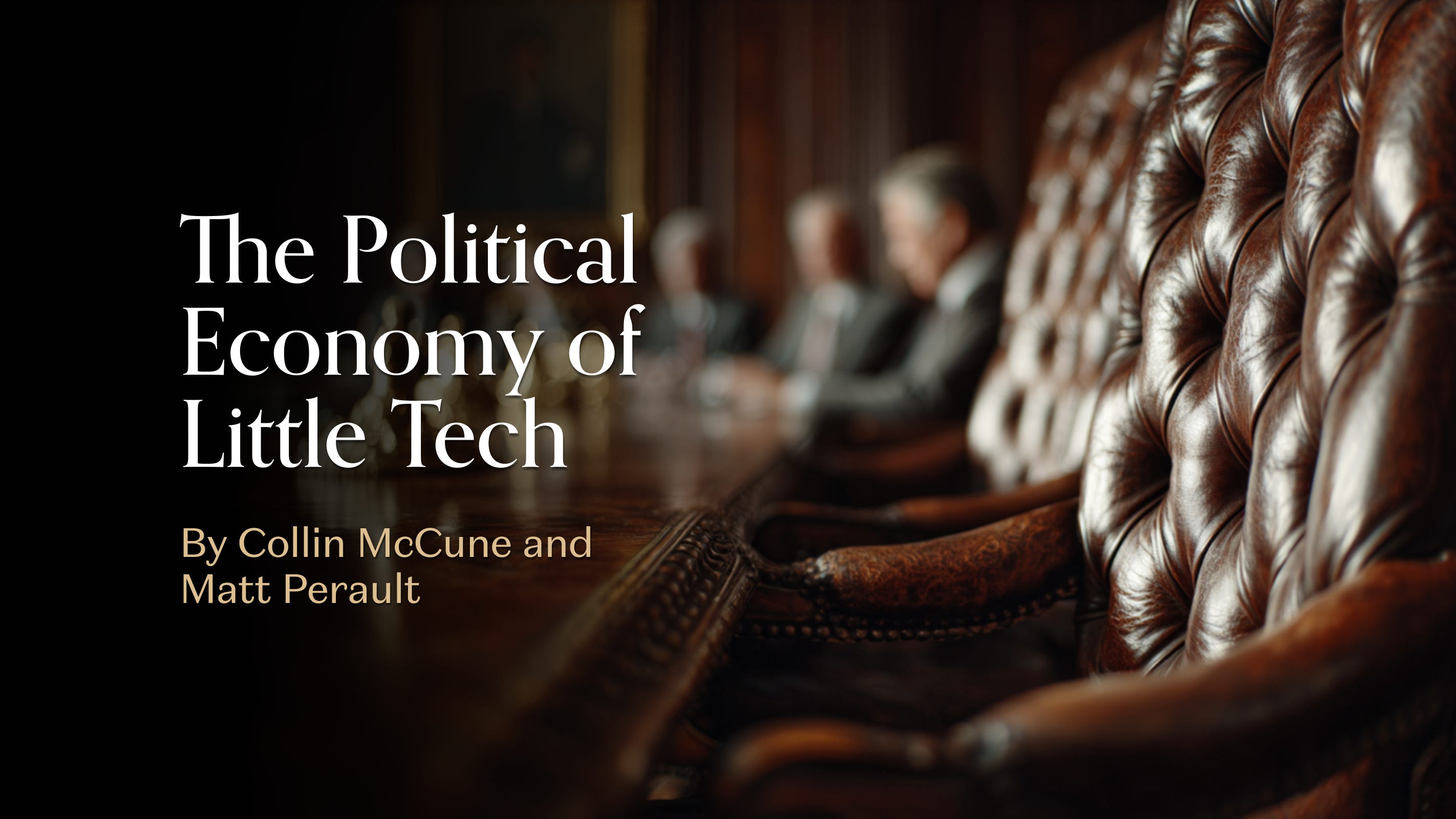
    The Political Economy of Little Tech

    Policymakers often say they want to support startups. Republicans say it. And Democrats say it. But despite repeatedly saying they support startups, policymakers often propose rules that make it harder for those startups to build and compete. In this episode, Collin McCune, head of government affairs, joins Matt Perault, head of AI policy at a16z, to discuss the political economy of Little Tech: the structural dynamics that produce a policy process that so consistently rewards the companies with the most time, money, and access. In sum, it favors Big over Little. They also talk about the impact of the political economy of Little Tech on consumers. When regulation locks in incumbents, people end up with fewer choices, products that are lower quality and less innovative, and higher costs. Topics covered: 01:00 The paradox of policymaker support for startups 03:30 Why startups are underrepresented in the policy process 05:40 How feedback on bills works in practice 07:30 Why “industry” feedback often misses Little Tech 09:45 The costs of showing up late to policy debates 12:00 Audits, impact assessments, and invisible compliance costs 15:30 How large policy teams create incumbent advantage 18:30 Why audits can be harder than they look 21:15 Policy ideas to better account for startup costs 23:45 Why startup competition matters for everyday people 25:45 Bright spots for Little Tech in Washington 27:30 Lessons from Dodd-Frank and the risk of repeating them in tech Resources: Subscribe to the a16z AI Policy Brief: https://a16zpolicy.substack.com/ Follow Matt Perault: https://x.com/MattPerault Follow Collin McCune: https://x.com/Collin_McCune Please note that the content here is for informational purposes only; should NOT be taken as legal, business, tax, or investment advice or be used to evaluate any investment or security; and is not directed at any investors or potential investors in any a16z fund. a16z and its affiliates may maintain investments in the companies discussed. For more details please see a16z.com/disclosures. This is a public episode. If you would like to discuss this with other subscribers or get access to bonus episodes, visit a16zpolicy.substack.com
  • May 28 · 44 min

    AI is How America Builds Again

    Policymakers have spent years talking about rebuilding America’s industrial base, reshoring critical supply chains, strengthening defense production, and reducing U.S. dependence on China. But recognizing the need to build is not the same as having the ability to do it. Erin Price-Wright, general partner on Andreessen Horowitz’s American Dynamism practice, joins the AI Policy Brief to make the case that AI isn’t just a software story. It’s the defining factor in the sectors that determine whether the U.S. can build, power, and defend itself in the decades ahead. She and Matt Perault discuss how AI can help make the math work for building in the U.S. again—from accelerating mine permitting and coordinating complex industrial projects to designing factories, lowering the cost of automation, and bringing robotics to more factory floors. They also discuss where policy needs to catch up: the laws and regulations that make it too hard and slow to build new factories in the U.S. and defense procurement that still favors incumbents over startups. Finally, they discuss how the debates over data centers and jobs will shape whether America’s reindustrialization effort succeeds. The takeaway: if the U.S. gets the policy environment right, AI can strengthen the industrial base, help create new kinds of jobs, and give America a powerful competitive advantage. Topics covered: 00:00: Intro 00:54: Erin’s work investing in AI for the physical world 01:47: Why AI and reindustrialization are converging now 03:07: Applying AI to mining and critical minerals 08:28: What Ukraine reveals about defense production 18:13: How startups are breaking into government markets 20:16: Bringing a factory mindset to critical sectors and complex systems 24:39: How robotics can expand factory automation 30:22: What still makes it too hard to build in the U.S. 32:49: Using AI to design better, cheaper manufactured goods 35:05: Why data centers matter for reindustrialization 39:46: How compute could help modernize the grid and lower costs for consumers 42:50: Why AI could create new industrial jobs Resources: Subscribe to the a16z AI Policy Brief: https://a16zpolicy.substack.com/ Follow Matt Perault: https://x.com/MattPerault Follow Erin Price-Wright: https://x.com/espricewright Please note that the content here is for informational purposes only; should NOT be taken as legal, business, tax, or investment advice or be used to evaluate any investment or security; and is not directed at any investors or potential investors in any a16z fund. a16z and its affiliates may maintain investments in the companies discussed. For more details please see a16z.com/disclosures. This is a public episode. If you would like to discuss this with other subscribers or get access to bonus episodes, visit a16zpolicy.substack.com

  • May 19 · 41 min

    Fixing the Front Door to Government

    For AI startups, the policy landscape is expanding faster than most small teams can reasonably track. This creates a practical challenge for Little Tech: even when a startup wants to engage constructively, it may not have the resources to follow every debate in every jurisdiction. Ben Supple, head of global policy at ElevenLabs, joins Matt Perault to talk about his experience running a public policy function at a company that is scaling rapidly. ElevenLabs is a leader in voice AI, building products for creators, enterprises, and governments, while its public policy function is still small enough to count on one hand. The conversation offers a look at how a fast-growing AI company prioritizes policy work, builds relationships with governments, and makes the case for clear, consistent rules that startups can implement. They also discuss how voice AI can improve citizen services and outcomes: replacing rigid, menu-based phone trees with more intelligent conversational agents that can resolve issues, switch languages live, and offer greater accessibility. Topics covered: 00:00: Intro 01:42: What is ElevenLabs? 04:59: Voice AI use cases, from dubbing to customer service 06:59: The competitive landscape for voice AI 10:51: Building a policy function at ElevenLabs 12:00: Prioritizing policy work with a small team 15:13: Engaging policymakers across jurisdictions 18:11: Growing and shipping at startup speed 20:19: Human oversight and AI agents 22:54: Key policy issues for voice AI 25:42: Scaling into new regulatory obligations 30:17: State AI rules and the need for clear goalposts 32:25: ElevenLabs’ expansion in New York 34:10: Fixing the front door to government 36:22: Government use cases for voice AI 38:55: The social value of voice AI, One Million Voices, and accessibility Resources: Subscribe to the a16z AI Policy Brief: https://a16zpolicy.substack.com/ Follow Matt Perault: https://x.com/MattPerault Follow Ben Supple: https://www.linkedin.com/in/ben-supple-a900695/ Learn more about ElevenLabs for Government: https://elevenlabs.io/chatbot/government Please note that the content here is for informational purposes only; should NOT be taken as legal, business, tax, or investment advice or be used to evaluate any investment or security; and is not directed at any investors or potential investors in any a16z fund. a16z and its affiliates may maintain investments in the companies discussed. For more details please see a16z.com/disclosures. This is a public episode. If you would like to discuss this with other subscribers or get access to bonus episodes, visit a16zpolicy.substack.com
  • May 14 · 36 min

    A Guide to Crafting a Liability Regime for AI

    How should we hold people responsible when AI causes harm? That's the job of a liability regime. In this conversation, Jai Ramaswamy, chief legal and policy officer, joins Matt Perault, head of AI policy at a16z, to unpack the role of liability in AI policy: how to protect people from real harms without slowing innovation, limiting competition, or punishing the wrong actors. They discuss why trust is essential to long-term AI adoption, why liability should focus on harmful uses rather than general-purpose development, and how policymakers can design rules that hold bad actors accountable while giving startups room to build. The conversation also explores what a workable AI liability regime should prioritize: accountability, proportionality, enforcement of existing laws, and targeted updates where current law falls short. For founders, policymakers, and anyone tracking the future of AI regulation, this episode offers a guide for thinking about responsibility, risk, and innovation in the AI era. Topics covered: 00:00: Intro 01:00: Why AI liability is on the table now, and why it's been on Jai's mind for years 02:00: Why this matters — trust, long-term ecosystems, and the equities at stake 04:00: Failure modes at both ends — crushing liability vs. blanket immunity, and why neither serves Little Tech 08:00: The proposals we're concerned about — SB 1047, strict developer liability for downstream misuse, AI as an automatic aggravating factor in criminal law 14:00: The Little Tech lens — focusing on wrongdoing, not building, and why "paperwork favors the powerful" 18:00: The least-cost avoider principle and how it maps onto AI 23:00: Building a better regime — presumption of user liability for AI outputs, procedural safeguards, and well-designed safe harbors 31:00: Protecting good behavior — information sharing, incident reporting, and getting incentives right 32:00: Federal vs. state roles — the constitutional allocation as a guide to liability design Resources: Subscribe to the a16z AI Policy Brief: https://a16zpolicy.substack.com/ Follow Matt Perault: https://x.com/MattPerault Follow Jai Ramaswamy: https://www.linkedin.com/in/jai-ramaswamy-85a77675/ Please note that the content here is for informational purposes only; should NOT be taken as legal, business, tax, or investment advice or be used to evaluate any investment or security; and is not directed at any investors or potential investors in any a16z fund. a16z and its affiliates may maintain investments in the companies discussed. For more details please see a16z.com/disclosures. This is a public episode. If you would like to discuss this with other subscribers or get access to bonus episodes, visit a16zpolicy.substack.com
  • May 12 · 39 min

    Inside Little Tech

    Andrew Chen spends his time with the founders policymakers almost never hear from: two-and three-person teams, often before incorporation when a company is still a project. As general partner on a16z speedrun, he works at the earliest edge of Little Tech, backing founders at day one and helping them turn ambition into an actual business. In this conversation, Andrew joins Matt Perault to talk about what life looks like for small teams working at kitchen tables, operating on short runways, and simultaneously trying to build, find customers, and survive in competitive markets. They also discuss why so many startups are effectively absent from the policy process. The conversation widens to the question of what makes startup ecosystems work in the first place. Andrew shares lessons from building the Tech Week ecosystem, including what local markets need to foster entrepreneurship and why supporting innovation is ultimately a choice. Topics covered: 00:00: Intro 00:39: What is a16z speedrun? 02:08: The average profile of an early stage company 06:15: Why a16z built speedrun 08:36: A day in the life of a speedrun founder 13:22: What happens when startups do not work out 17:41: The cumulative burden of regulation for startups 21:49: Why Little Tech is absent from policy debates 25:05: How policy shapes where startups build 27:46: What makes startup ecosystems work 29:55: The idea behind Tech Week 32:52: How Tech Week surfaces future founders 33:23: Policy’s presence at Tech Week 34:38: Why policymakers should engage with Little Tech Resources: Subscribe to the a16z AI Policy Brief: https://a16zpolicy.substack.com/ Follow Matt Perault: https://x.com/MattPerault Follow Andrew Chen: https://x.com/andrewchen Learn more about a16z speedrun: https://speedrun.a16z.com/ Check out Tech Week event calendars: https://www.tech-week.com/calendar Please note that the content here is for informational purposes only; should NOT be taken as legal, business, tax, or investment advice or be used to evaluate any investment or security; and is not directed at any investors or potential investors in any a16z fund. a16z and its affiliates may maintain investments in the companies discussed. For more details please see a16z.com/disclosures. This is a public episode. If you would like to discuss this with other subscribers or get access to bonus episodes, visit a16zpolicy.substack.com
  • April 21 · 57 min

    Catching Up on the Current Moment in AI Policy

    In this conversation, Matt Perault, head of AI policy, and Collin McCune, head of government affairs, take stock of the current AI policy moment. As AI policy moves beyond rhetoric and into a more consequential phase, Matt and Collin separate signal from noise. They unpack where momentum is building in Washington, how state activity continues to drive the policy environment, and what it all means for Little Tech. Along the way, they dig into some of the most active debates including proposals focused on protecting kids, workforce disruption, data centers, benchmarking and licensing regimes, and the evolving balance between federal and state action. Enjoy. Topics covered: 01:14: The current AI policy moment 03:45: The White House National AI Framework: what’s new and what’s next 11:49: Kids, AI access, and the case against bans 17:49: Data centers, communities, and energy policy 19:56: Workforce disruption, retraining, and labor policy 25:32: Copyright, censorship, and other key debates 26:55: The Democrat perspective and response 32:27: Benchmarking, testing, and startup access 33:23: Licensing regimes and regulatory capture risks 38:16: What’s next in Congress? 44:00: States at the center of AI policymaking 48:22: Preemption, federalism, and the state-federal divide 55:27: Dormant Commerce Clause implications 58:59: Why Little Tech needs to stay engaged now Resources: Subscribe to the a16z AI Policy Brief: https://a16zpolicy.substack.com/ Follow Matt Perault: https://x.com/MattPerault Follow Collin McCune: https://x.com/Collin_McCune Please note that the content here is for informational purposes only; should NOT be taken as legal, business, tax, or investment advice or be used to evaluate any investment or security; and is not directed at any investors or potential investors in any a16z fund. a16z and its affiliates may maintain investments in the companies discussed. For more details please see a16z.com/disclosures. This is a public episode. If you would like to discuss this with other subscribers or get access to bonus episodes, visit a16zpolicy.substack.com
  • April 16 · 40 min

    Open Models, Measurable Safeguards

    Black Forest Labs has established itself as a pioneer in visual intelligence, with its open-weight FLUX models reaching over 50 million downloads on Hugging Face and rivaling models from Google, OpenAI, and DeepSeek in developer adoption. The company has distinguished itself not only through technical capability, but through a strong commitment to open research. In this conversation, Black Forest Labs’ Adam Chen and Ben Brooks, who lead the company’s legal and policy work, join Matt Perault to discuss what it means to build frontier visual AI openly. They explain the role of open models in advancing transparency, driving down the cost of innovation for developers, and strengthening security and sovereignty by reducing the world’s reliance on a handful of closed APIs. They also outline the unique policy challenges facing open-weight model developers. For policymakers, their message is clear: supporting open innovation does not require abandoning oversight. It requires targeted rules, analysis of where harms arise, and a better understanding of how proposed regulations land on smaller frontier labs, not just the largest incumbents. The conversation also offers a window into what it looks like to build a policy function at a startup. Adam and Ben offer a candid view into how they enable their small team to have outsized impact, rather than trying to match Big Tech’s playbook. Topics covered: 00:48: Intro 01:57: What is Black Forest Labs? 03:13: The makeup of a legal team at a frontier AI startup 07:14: The role of visual intelligence in the AI ecosystem 09:49: Core risks and baseline safeguards for visual models 10:34: Unique policy challenges of open-weight models 12:25: Restricting access to general-purpose technology should be a last resort 15:52: What’s at stake: open models as soft power and the China dynamic 20:07: BFL’s approach to being open and responsible 22:26: BFL’s model testing results 24:59: How a four-person legal team approaches disclosure and compliance 28:32: What works and what doesn’t in transparency proposals 31:07: Navigating the state, federal, and international patchwork as a startup 33:47: BFL’s advocacy goals 37:13: The Little Tech voice as a competitive advantage in the policy ecosystem This is a public episode. If you would like to discuss this with other subscribers or get access to bonus episodes, visit a16zpolicy.substack.com
  • March 31 · 37 min

    Early Signals on AI, Hiring, and the Workforce

    How is AI changing work? In this episode, Matt Perault sat down with Nick Catino, global head of policy at Deel, to better understand what today’s data can already tell us. Through its HR and payroll platform, Deel works with 35,000 customers and 1.5 million workers across more than 150 countries, giving the company a broad view across employers, geographies, and job categories as AI begins to change hiring and work. Nick walks through what Deel is seeing firsthand. That includes a 40% increase in the share of companies opening new AI roles in 2025. Deel’s recent global hiring report also found more than 70,000 AI trainer roles across 600-plus organizations, with nearly 60% of those roles located in the U.S., and AI trainer positions emerging as the fastest-growing global role on Deel’s platform. The conversation also explores what these shifts mean for policy. If AI is going to change how people work, Nick argues smart policy should focus on helping workers build AI fluency and new skills, supporting students as they prepare to enter the workforce, and giving startups the clarity they need as they hire and scale. Nick brings a valuable Little Tech perspective, drawing on his experience building public policy functions at fast-growing startups. For founders thinking about why startups need a seat at the table, along with when and how to engage with policymakers, this conversation is especially worthwhile. Topics covered: 03:14: Deel’s global hiring view 04:27: Building a startup policy function 09:12: Data as a policy tool 12:20: Early signals on AI and the workforce 14:47: Job shifts and emerging roles 17:30: Policy levers to support workers 24:22: Why regulatory certainty matters for Little Tech 27:01: Scaling Deel’s data insights 29:20: The rise of AI trainer roles 31:36: Lessons from building policy functions at fast-growing startups 35:05: Why policymakers want to hear from Little Tech Resources: Read Deel's global hiring report: https://www.deel.com/global-hiring-report-2026/ Learn more about Deel's HR and payroll platform: https://www.deel.com/partners/a16z.ecosystem?utm_source=podcast&utm_medium=partner-sourced&utm_content=a16z.ecosystem&utm_place=organic-community Subscribe to the a16z AI Policy Brief: https://a16zpolicy.substack.com/ Follow Matt Perault: https://x.com/MattPerault Follow Nick Catino: https://x.com/CatinoNick Please note that the content here is for informational purposes only; should NOT be taken as legal, business, tax, or investment advice or be used to evaluate any investment or security; and is not directed at any investors or potential investors in any a16z fund. a16z and its affiliates may maintain investments in the companies discussed. For more details please see a16z.com/disclosures. This is a public episode. If you would like to discuss this with other subscribers or get access to bonus episodes, visit a16zpolicy.substack.com
  • March 24 · 56 min

    Cyber Resilience in an AI World

    The cybersecurity landscape is moving to an AI-vs-AI world where both attackers and defenders can operate at machine speed. In this conversation, Anne Neuberger and Sam Jones join Jai Ramaswamy to go deeper on what this shift looks like in practice. Neuberger draws on nearly two decades in government—including serving as deputy national security advisor for cyber and emerging technology—to explain how AI is transforming the threat landscape, most notably making attacks faster, cheaper, and continuous at scale. Jones brings the builder’s perspective as CEO and cofounder of Method Security, where his team is building autonomous cyber systems for both offense and defense observing firsthand how AI is accelerating everything from routine tactics to exploit development. Together, they discuss what “cyber resilience” means in an AI world: continuous testing and red-teaming that was previously cost-prohibitive, clearer benchmarks for critical infrastructure, and faster recovery when disruptions happen. They also walk through the policy measures that can help defenders keep pace. Topics covered: 03:16: How AI changes the threat landscape 07:38: Net new risks in an AI-vs-AI cyber world 11:21: Building trust to deploy new technology in no-fail systems13:55: Cybercrime at machine speed 17:18: Who benefits more from AI: attackers or defenders?1 9:29: Tactics to remove friction for defenders 22:26: Real examples of incidents where AI could have changed outcomes: Colonial Pipeline and Change Healthcare 27:18: What cyber resilience means in an AI world30:57: Measuring resilience 36:59: Information sharing and antitrust: lessons from financial services and telecom compromises 44:59: The builder’s view: what Method Security is building for offense + defense 49:27: Little Tech realities of building with a small team and selling into government 52:53: The role of procurement in ensuring defensive systems keep pace with adversaries 55:32: What’s next: in-year buying flexibility and closing thoughts Resources: Subscribe to the a16z AI Policy Brief: https://a16zpolicy.substack.com/ Follow Jai Ramaswamy: https://www.linkedin.com/in/jai-ramaswamy-85a77675/ Follow Anne Neuberger: https://www.linkedin.com/in/anne-neuberger-13b4491b/ Follow Sam Jones: @___sjones Please note that the content here is for informational purposes only; should NOT be taken as legal, business, tax, or investment advice or be used to evaluate any investment or security; and is not directed at any investors or potential investors in any a16z fund. a16z and its affiliates may maintain investments in the companies discussed. For more details please see a16z.com/disclosures. This is a public episode. If you would like to discuss this with other subscribers or get access to bonus episodes, visit a16zpolicy.substack.com
  • March 17 · 45 min

    The Real AI Race With China Is Who Sets the Default

    In AI policy, it’s become a reflex to say we are in a global race with China. That shorthand can obscure the true nature of the competition. China and the U.S. aren’t just competing on model performance or chips, we’re competing on the next computing systems the world adopts, and along with it, who holds economic and political power for the next generation. In this conversation, Jai Ramaswamy, our chief legal and policy officer, sits down with Matt Cronin, senior national security advisor at a16z, to make these competitive dynamics concrete. Cronin has worked on China-related national security issues as a federal prosecutor, held senior roles at the Department of Justice, served as Director of National Cybersecurity at the White House, and most recently as Chief Investigative Counsel and Deputy General Counsel to the U.S. House Select Committee on the Strategic Competition between the U.S. and China. Their conversation unpacks the incentives driving the Chinese Communist Party’s push to dominate AI and what’s at stake if the world defaults to CCP-aligned AI rails. They also get practical, outlining what “winning” looks like for the U.S.; the role of open source in global adoption; and the policy levers that play to America's strengths. Finally, they zoom in on one opportunity with outsized impact–defense procurement reform—where Cronin has spent significant time. If you care about the future defined by democratic values and are interested in a practical path to defend it, this is an episode for you. Topics covered: 01:19: The Chinese Communist Party’s motivations in the AI race 04:08: Why China’s “miss” on the internet shaped its push into AI 07:48: State-led vs. market-led innovation models 10:48: What happened to China’s VC ecosystem 13:09: China’s strategy for AI diffusion and adoption 17:02: What’s at stake if China wins the AI race 23:47: The 3 key measures of US success in AI 25:25: Why open source matters for global adoption 31:05: AI policy levers that play to America’s strengths in this global race 34:15: Why defense procurement reform matters to the competitive dynamic 42:22: Final takeaways on competition, policy, and democratic advantage Resources: Follow Jai Ramaswamy: https://twitter.com/jai_ramaswamy Follow Matt Cronin: https://www.linkedin.com/in/matt-cronin-8b88811 Subscribe to the a16z AI Policy Brief: https://a16zpolicy.substack.com/ Please note that the content here is for informational purposes only; should NOT be taken as legal, business, tax, or investment advice or be used to evaluate any investment or security; and is not directed at any investors or potential investors in any a16z fund. a16z and its affiliates may maintain investments in the companies discussed. For more details please see a16z.com/disclosures. This is a public episode. If you would like to discuss this with other subscribers or get access to bonus episodes, visit a16zpolicy.substack.com
  • January 20 · 45 min

    To Regulate AI Effectively, Focus on How It’s Used

    One of the core pillars of a16z's roadmap for federal AI legislation makes clear AI should not excuse wrongdoing. When people or companies use AI to break the law, existing criminal, civil rights, consumer protection, and antitrust frameworks should still apply. Enforcement agencies should have the resources they need to enforce the law. If existing bodies of law fall short in accounting for certain AI use cases, any new laws should be evidence-based, clearly defining marginal risks and the optimal approach to target harms directly. In this conversation, we go deeper on what that principle means in practice with Martin Casado, general partner at a16z where he leads the firm’s infrastructure practice and invests in advanced AI systems and foundational compute. Martin joins Jai Ramaswamy and Matt Perault to discuss how decades of technology policy can inform addressing harmful uses of AI, defining marginal risk in AI, the importance of open source for long-term competitiveness, and more. Topics Covered: 01:55: A brief history of recent debates about how to regulate AI 12:30: Regulating use vs. development: lessons from software and cybersecurity 15:47: An open question in AI policy today: defining marginal risk 18:33: Why social media is often the wrong analogy for AI regulation 20:50: Enforcement tools available for holding bad actors to account 24:11: Balancing many trade-offs in tech policy 27:33: The role open source models play in soft power, the future of AI, and global competitiveness 38:06: Implications of regulatory uncertainty 41:32: Lawmakers want to act; what can they do now to enact effective policy? Resources: Follow Matt Perault: https://x.com/MattPerault Follow Jai Ramaswamy: https://twitter.com/jai_ramaswamy Follow Martin Casado: https://twitter.com/martin_casado Subscribe to the a16z AI Policy Brief: https://a16zpolicy.substack.com/ Please note that the content here is for informational purposes only; should NOT be taken as legal, business, tax, or investment advice or be used to evaluate any investment or security; and is not directed at any investors or potential investors in any a16z fund. a16z and its affiliates may maintain investments in the companies discussed. For more details please see a16z.com/disclosures. This is a public episode. If you would like to discuss this with other subscribers or get access to bonus episodes, visit a16zpolicy.substack.com
  • Dec 17, 2025 · 37 min

    A Roadmap for Federal AI Legislation: Protect People, Empower Builders, Win the Future

    Debates in Washington often frame AI governance as a series of false choices: they pit innovation against safety, progress against protection, federal leadership against the rights of states. But at a16z, we believe these are not binaries. In order for America to realize the full promise of artificial intelligence, we must both build great products and protect people from AI-related harms. Congress can and should design a federal AI framework that protects individuals and families, while also safeguarding innovation and competition. This approach will allow startups and entrepreneurs, who we call Little Tech, to power America’s future growth while still addressing real risks. In this conversation, Jai Ramaswamy, chief legal and policy officer, Collin McCune, head of government affairs, and Matt Perault, head of AI policy at a16z discuss the current moment in AI policy along with a16z's AI policy agenda built on nine pillars that work to keep Americans safe while keeping the U.S. in the lead. Topics Covered: 00:00: Intro 00:58: Recapping the current moment in AI policy: state proposals, EO, and preemption debates 09:17: Is Congress gridlocked on AI? 12:09: Are safety and innovation at odds 16:35: a16z’s policy agenda and 9-pillar roadmap to federal AI legislation 22:32: Protecting kids from AI-related harms 24:49: US AI leadership, China, and competition 29:04: Cybersecurity and national security risks 34:59: What’s next for federal AI legislation Resources: Follow Matt Perault: https://x.com/MattPerault Follow Collin McCune: https://x.com/Collin_McCune Follow Jai Ramaswamy: https://www.linkedin.com/in/jai-ramaswamy-85a77675 Stay updated: Subscribe to the a16z AI Policy Brief: https://a16zpolicy.substack.com/ Please note that the content here is for informational purposes only; should NOT be taken as legal, business, tax, or investment advice or be used to evaluate any investment or security; and is not directed at any investors or potential investors in any a16z fund. a16z and its affiliates may maintain investments in the companies discussed. For more details please see a16z.com/disclosures. This is a public episode. If you would like to discuss this with other subscribers or get access to bonus episodes, visit a16zpolicy.substack.com
  • Dec 12, 2025 · 45 min

    Beyond Preemption: Lessons from the 1996 Telecom Act

    If you squint at today’s AI policy debates, you may see the Telecommunications Act of 1996 in the distance. In this conversation, Matt Perault, head of AI policy, a16z, sits down with Adam Thierer, resident senior fellow, technology and innovation, R Street Institute, and Blair Levin, policy analyst, New Street Research and non-resident senior associate, Center for Strategic and International Studies, to revisit their first-hand experience tackling a similarly significant moment in tech policy: a small number of incumbents with entrenched market power, a messy patchwork of federal and local rules, and misaligned governing authority. The result then was federal preemption coupled with a comprehensive national framework for telecommunications—all through a bipartisan deal. Topics Covered: 00:00: The Telecom Act’s “big bargain” 02:05: Competition as the heart of the deal 04:26: Telecom’s regulatory thicket and move to a national framework 07:39: Preemption, ambiguity, and the FCC’s role 11:58: How the Telecom Act got done: politics, persuasion, and public opinion 17:39: Terminating access charges and “regulating on behalf of” the internet 21:13: Federal vs. state authority and lessons for AI 26:09: Leadership, vision, and a new “constitutional moment” for tech policy 34:57: Institutional capacity and the missing expert home for AI 39:55: What a “Telecom Act for AI” might look like Resources: Follow Matt Perault: https://x.com/MattPerault Subscribe to the a16z AI Policy Brief: https://a16zpolicy.substack.com/ Please note that the content here is for informational purposes only; should NOT be taken as legal, business, tax, or investment advice or be used to evaluate any investment or security; and is not directed at any investors or potential investors in any a16z fund. a16z and its affiliates may maintain investments in the companies discussed. For more details please see a16z.com/disclosures. This is a public episode. If you would like to discuss this with other subscribers or get access to bonus episodes, visit a16zpolicy.substack.com
  • Dec 3, 2025 · 35 min

    What Counts as an AI Startup?

    Lawmakers are largely supportive of helping AI startups and challengers grow and thrive. They understand the need for the United States to compete and win in AI and generally support small businesses and entrepreneurship. Yet, numerous state AI proposals—while intended to put safeguards in place for the biggest players—still risk sweeping in the startups at the forefront of AI innovation. The tools lawmakers reach for to carve out Little Tech, including compute and training-cost thresholds, aren’t built for the realities of how AI is made today. In this conversation, Guido Appenzeller, investing partner, and Matt Perault, head of AI policy at a16z, discuss why thresholds based on either compute power and training costs fail to separate Little Tech from larger developers, and why revenue may be a more effective criteria for establishing what counts as an AI startup. Topics covered: 01:33: Realities of startup teams building AI models 03:57: Challenges of defining frontier models by compute 06:46: Why competition at the frontier is key to US success 10:45: Practicalities of building and training AI models today 13:24: Why training-cost thresholds fail 16:47: When startups hit $100M in training spend 24:16: Revenue as an alternative metric to focus on use and market impact 28:09: Revenue as a clearer metric 31:48: Implications for startups 33:17: Loopholes to game thresholds 34:56: Closing thoughts Resources: Follow Matt Perault: https://x.com/MattPerault Follow Guido Appenzeller: https://x.com/appenz Stay updated: Subscribe to the a16z AI Policy Brief: https://a16zpolicy.substack.com/ Please note that the content here is for informational purposes only; should NOT be taken as legal, business, tax, or investment advice or be used to evaluate any investment or security; and is not directed at any investors or potential investors in any a16z fund. a16z and its affiliates may maintain investments in the companies discussed. For more details please see a16z.com/disclosures. This is a public episode. If you would like to discuss this with other subscribers or get access to bonus episodes, visit a16zpolicy.substack.com
  • Nov 26, 2025 · 11 min

    AI and the First Amendment

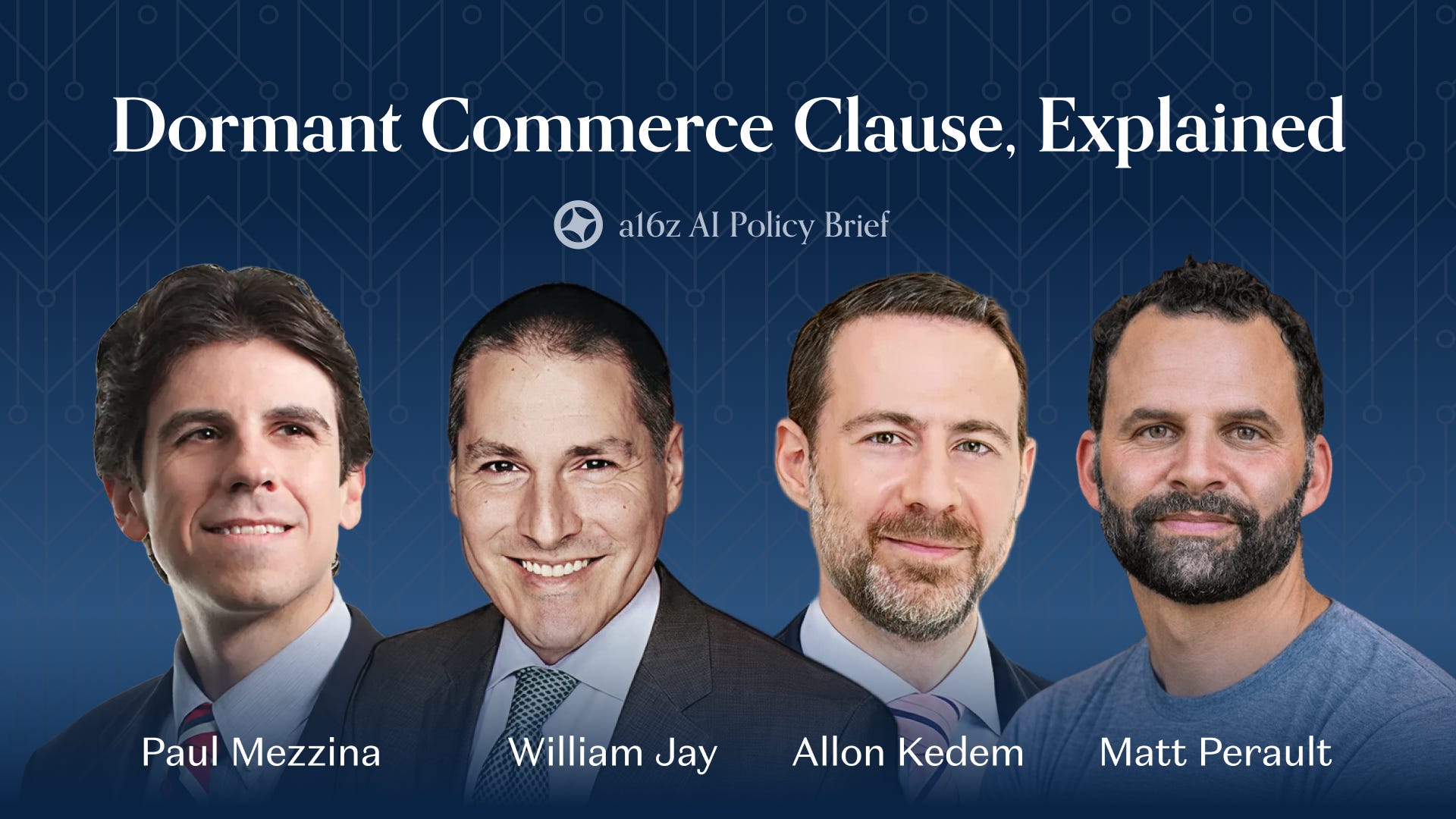
    As lawmakers consider requiring companies to make disclosures about their AI models—such as risk reports, impact assessments, or content warnings—questions arise about whether those mandates could run afoul of the First Amendment. In part three of our AI Policy Legal Primer, leading appellate lawyers Allon Kedem, Paul Mezzina, and William Jay join Matt Perault, head of AI policy at a16z, to explore how the principles outlined in the First Amendment apply to AI. They discuss recent disclosure laws, the line between constitutional and unconstitutional compelled speech, and emerging questions about whether model developers’ design choices could themselves count as expressive acts protected under the First Amendment. Stay updated: Subscribe to the a16z AI Policy Brief on Substack: https://a16zpolicy.substack.com/ This is a public episode. If you would like to discuss this with other subscribers or get access to bonus episodes, visit a16zpolicy.substack.com
  • Nov 25, 2025 · 25 min

    The Dormant Commerce Clause, Explained

    The dormant Commerce Clause has been anything but dormant in the last couple of weeks. With Congress and the administration actively debating the proper roles of the federal and state governments in regulating AI, the dormant Commerce Clause has emerged as an important topic of date. In part two of our AI Policy Legal Primer, leading appellate lawyers Allon Kedem, Paul Mezzina, and William Jay are back to explain the dormant Commerce Clause and how it intersects with AI policy today. They discuss how courts use principles like extraterritoriality and tests like Pike balancing to weigh challenges, and examine what those frameworks could mean for recently enacted or pending state AI laws, including California’s SB 53, Colorado’s SB 205, and New York’s RAISE Act. If you missed part one, check out Preemption, Explained. Stay updated: Subscribe to the a16z AI Policy Brief on Substack: https://a16zpolicy.substack.com/ This is a public episode. If you would like to discuss this with other subscribers or get access to bonus episodes, visit a16zpolicy.substack.com

  • Nov 24, 2025 · 9 min

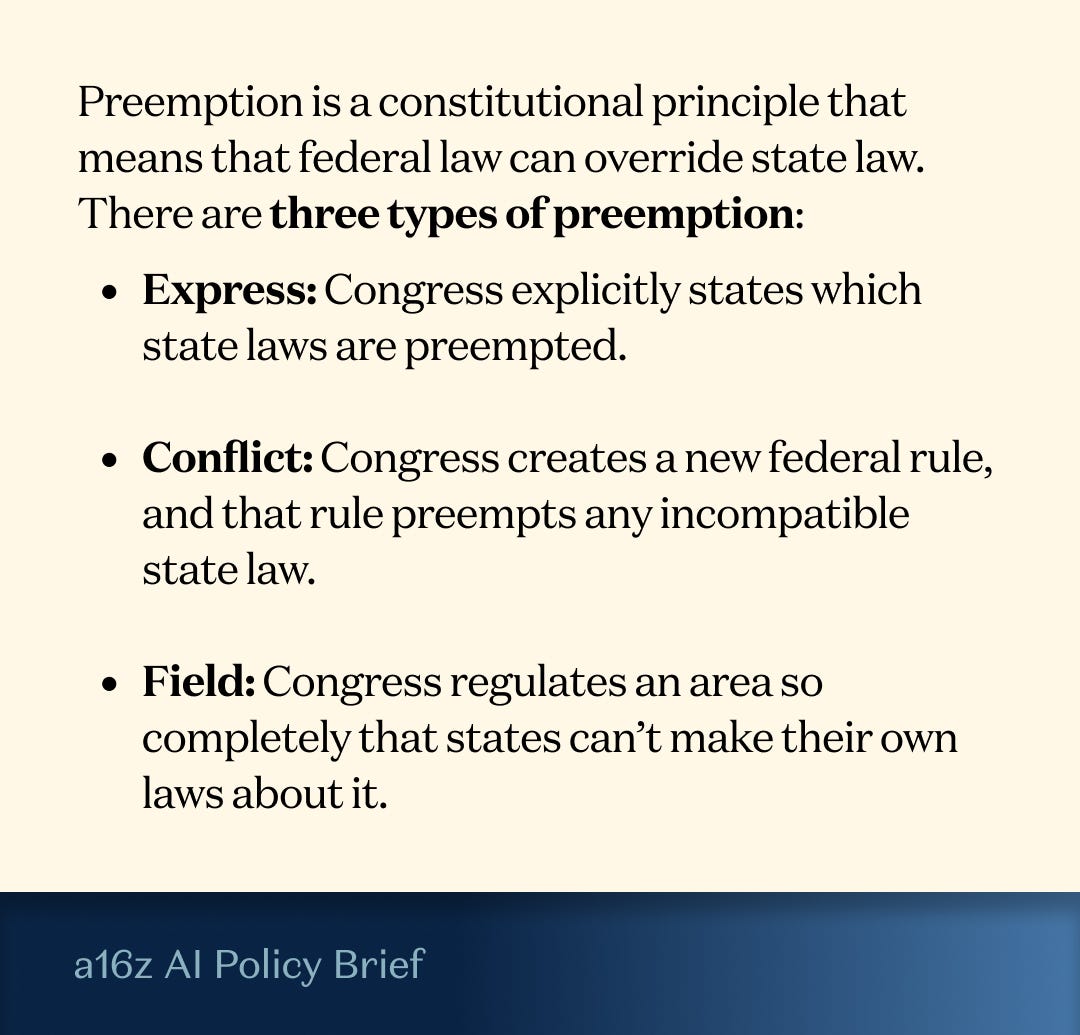
    Preemption, Explained

    There may be no more important debate in AI policy right now than how power to regulate AI should be divided between the federal and state governments. We first wrote about the respective roles of Congress and state governments in early 2025, as we saw states throughout the country introducing bills that would regulate how AI models are built. Now, with speculation about potential Congressional action to clarify the role of the federal government in regulating AI, the same questions proliferate: What can Congress regulate? What can states regulate? And where are the constitutional limits on their respective governing powers? We asked a panel of leading appellate lawyers to explain the state of the law on these questions. Allon Kedem, partner, Appellate and Supreme Court practice, Arnold & Porter, Paul Mezzina, partner, Appellate, Constitutional and Administrative Law practice, King & Spalding, and William Jay, partner, Appellate and Supreme Court Litigation practice, Goodwin, join Matt Perault, head of AI policy, a16z, to explain how federal preemption, the dormant Commerce Clause, and the First Amendment intersect with AI policy in this moment. This is part one, focused on preemption. Stay tuned for upcoming conversations on the Commerce Clause and the First Amendment. Stay updated: Subscribe to the a16z AI Policy Brief: https://a16zpolicy.substack.com/ Please note that the content here is for informational purposes only; should NOT be taken as legal, business, tax, or investment advice or be used to evaluate any investment or security; and is not directed at any investors or potential investors in any a16z fund. a16z and its affiliates may maintain investments in the companies discussed. For more details please see a16z.com/disclosures. This is a public episode. If you would like to discuss this with other subscribers or get access to bonus episodes, visit a16zpolicy.substack.com

Showing 1–20 of 21 episodes