The Quantum Curious | Deep Sleep Physics · Sunday · 21 min
Does the Universe Ever Forget? | Deep Sleep Physics
0:00-21:07
transcript
show notes
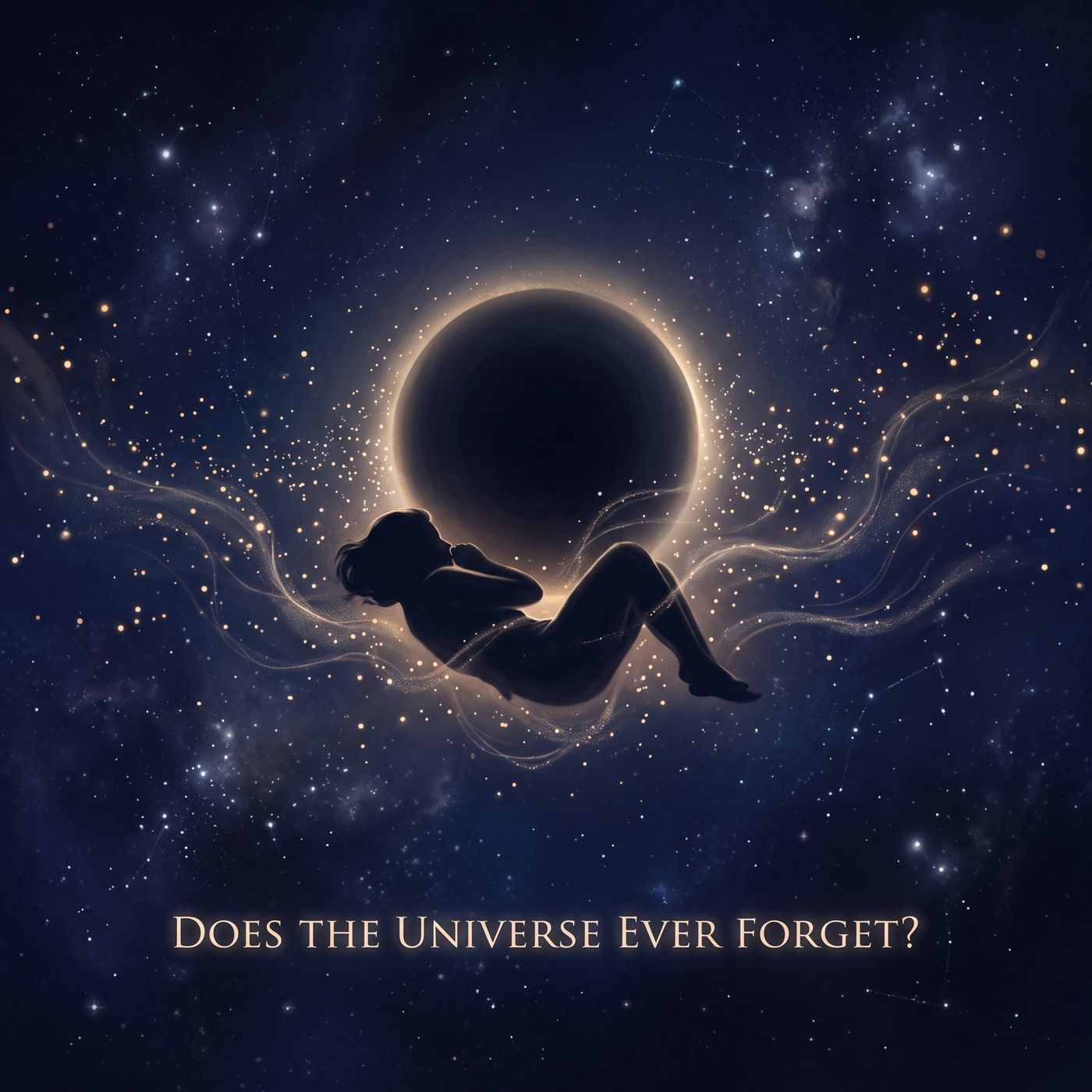
You're lying in bed, and maybe you're thinking about something you lost — a memory, a person, a version of yourself. But here's a quiet question from the edge of physics: when something falls into a black hole, does the universe forget it forever?This is the black hole information paradox, and it has haunted the greatest minds for over fifty years. In quantum mechanics, there's a sacred rule: information is never truly destroyed. Burn a book, and in theory, you could track every molecule of ash and every wisp of smoke and rebuild it perfectly.
The universe keeps a perfect ledger of everything. But black holes seemed to break that rule. Stephen Hawking discovered that black holes slowly leak a faint, random whisper of particles — and that whisper seemed to carry no memory of what fell in. If the black hole eventually evaporates into nothing, where did the information go?Tonight, we'll wander through this mystery gently, with no equations and no fear. We'll meet the radical idea that entanglement and wormholes are the same hidden bridge.
We'll explore the recent breakthrough — a mathematical proof that black holes do give back their memories, slowly, like a friend opening a diary after years of silence. And we'll end with a humbling truth: nothing is ever truly lost. The universe holds on to everything. It holds on to every star, every particle, every moment. It holds on to you.So breathe. Let the mystery settle over you like a soft blanket. The universe never forgets. And tonight, it remembers you exactly as you are — quietly breathing, safely held, ready to rest.
This podcast episode was created with AI-assisted narration and music generation.
Become a supporter of this podcast: https://www.spreaker.com/podcast/the-quantum-curious-deep-sleep-physics--7215963/support.
This episode includes AI-generated content.
The universe keeps a perfect ledger of everything. But black holes seemed to break that rule. Stephen Hawking discovered that black holes slowly leak a faint, random whisper of particles — and that whisper seemed to carry no memory of what fell in. If the black hole eventually evaporates into nothing, where did the information go?Tonight, we'll wander through this mystery gently, with no equations and no fear. We'll meet the radical idea that entanglement and wormholes are the same hidden bridge.
We'll explore the recent breakthrough — a mathematical proof that black holes do give back their memories, slowly, like a friend opening a diary after years of silence. And we'll end with a humbling truth: nothing is ever truly lost. The universe holds on to everything. It holds on to every star, every particle, every moment. It holds on to you.So breathe. Let the mystery settle over you like a soft blanket. The universe never forgets. And tonight, it remembers you exactly as you are — quietly breathing, safely held, ready to rest.
This podcast episode was created with AI-assisted narration and music generation.
Become a supporter of this podcast: https://www.spreaker.com/podcast/the-quantum-curious-deep-sleep-physics--7215963/support.
This episode includes AI-generated content.
links1