Skip to content
Artwork for The InfoSec Control Room
The InfoSec Control Room · August 12 · 30 min

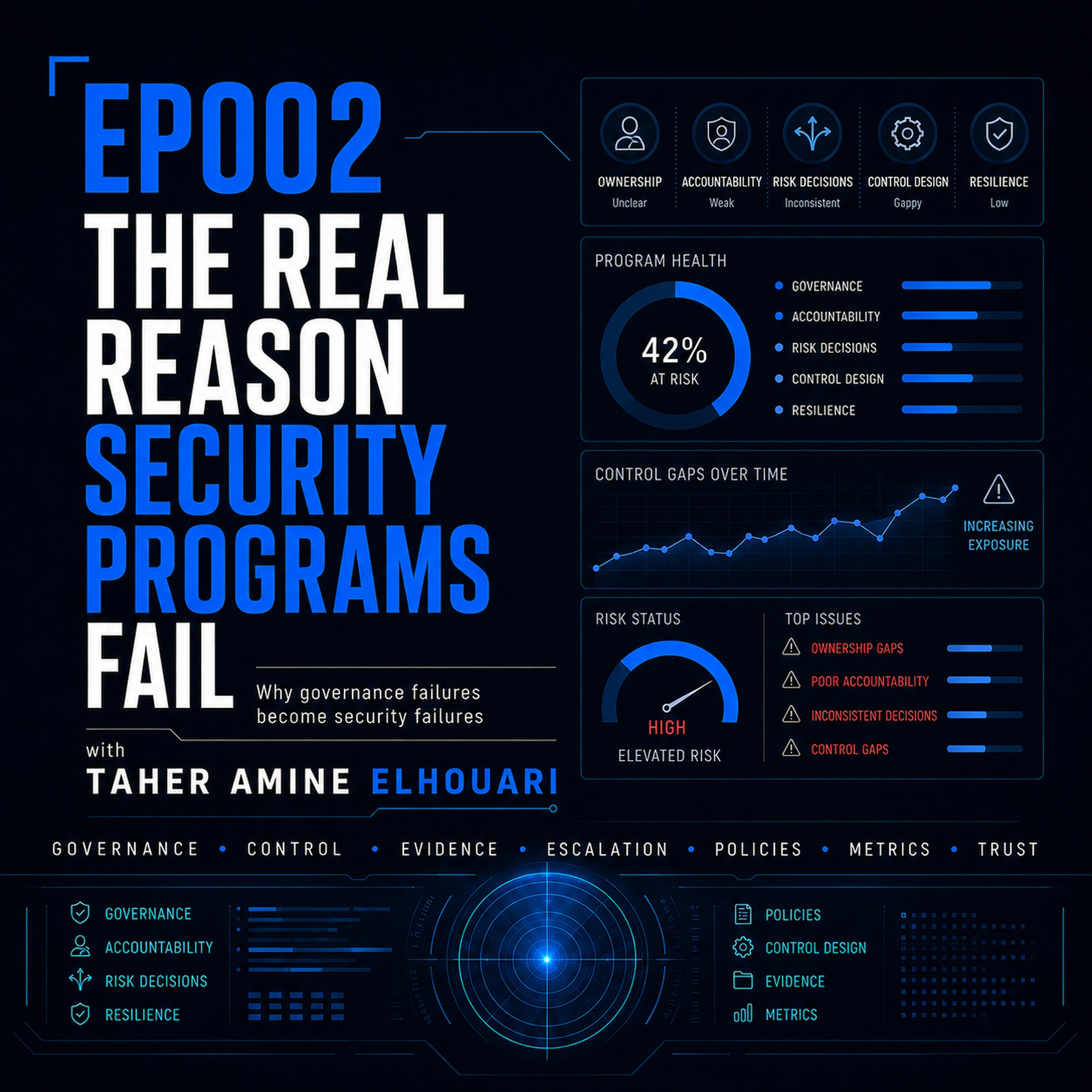
EP002: The Real Reason Security Programs Fail

In this episode of The InfoSec Control Room, Taher Amine ELHOUARI explores one of the core ideas behind the podcast: many security programs do not fail because there is no cybersecurity activity. They fail because that activity is not governed, owned, measured, or improved properly. The episode explains why security failures are often symptoms of deeper structural issues: unclear accountability, weak ownership, poor risk decisions, ineffective controls, disconnected teams, compliance theater, weak escalation, and the gap between documentation and real operational capability. Rather than blaming tools, users, auditors, SOC teams, or CISOs alone, this episode looks at the full system behind security programs and asks a more important question: why did the organization allow the weakness to exist, persist, and become dangerous? Topics include: • Why security failures are rarely purely technical • The difference between security activity and security capability • Governance gaps behind incidents and audit failures • Ownership, accountability, and risk decisions • Why tools cannot compensate for weak governance • Compliance theater and false maturity • The gap between policies, controls, and real behavior • How technical, GRC, SOC, CSIRT, management, and executive teams become disconnected • What security programs need in order to actually work No noise. No fake maturity. No checkbox security. Just practical conversations on how security is governed, controlled, measured, and improved.

0:00-30:01

transcript

No transcript — this publisher did not publish one.

show notes

In this episode of The InfoSec Control Room, Taher Amine ELHOUARI explores one of the core ideas behind the podcast: many security programs do not fail because there is no cybersecurity activity. They fail because that activity is not governed, owned, measured, or improved properly.


The episode explains why security failures are often symptoms of deeper structural issues: unclear accountability, weak ownership, poor risk decisions, ineffective controls, disconnected teams, compliance theater, weak escalation, and the gap between documentation and real operational capability.


Rather than blaming tools, users, auditors, SOC teams, or CISOs alone, this episode looks at the full system behind security programs and asks a more important question: why did the organization allow the weakness to exist, persist, and become dangerous?


Topics include:

• Why security failures are rarely purely technical

• The difference between security activity and security capability

• Governance gaps behind incidents and audit failures

• Ownership, accountability, and risk decisions

• Why tools cannot compensate for weak governance

• Compliance theater and false maturity

• The gap between policies, controls, and real behavior

• How technical, GRC, SOC, CSIRT, management, and executive teams become disconnected

• What security programs need in order to actually work


No noise. No fake maturity. No checkbox security.


Just practical conversations on how security is governed, controlled, measured, and improved.