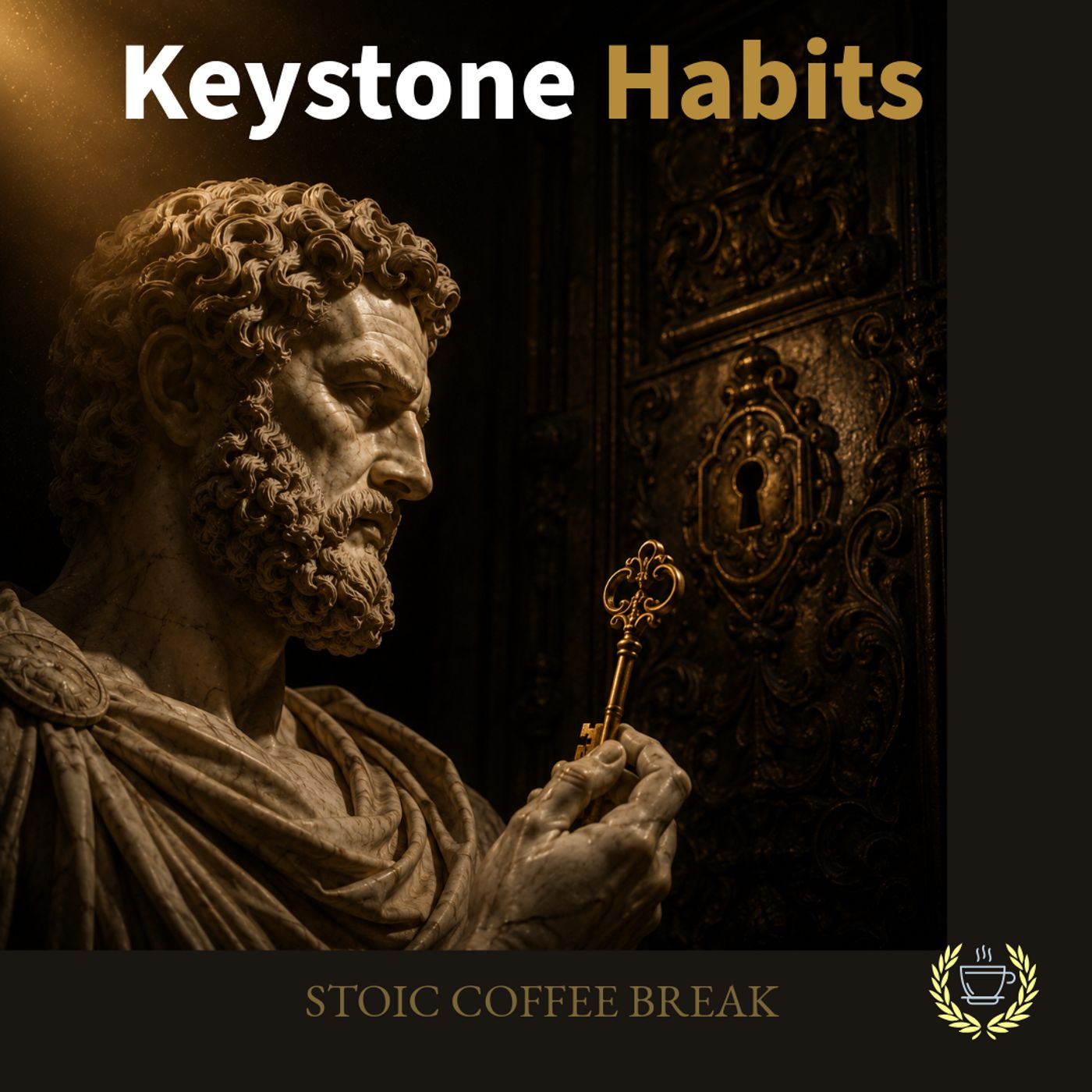
Keystone Habits: How One Good Habit Can Change Everything
Streams straight from the publisher. podnod never proxies or re-hosts episode audio.
Habits are a key part of our lives. We have helpful habits that help us accomplish what we set out to do. We also have some that we’d like to get rid of. But what if I told you that sometimes one good habit is all it takes to reorient our lives and make lasting changes? In this week’s episode we’ll discuss the importance of keystone habits and how you can find yours.
"All our life, so far as it has definite form, is but a mass of habits." — William James
I love to cycle. Ever since I watched the Kona Ironman competition on TV on 2003, and decided that I wanted to be that hardcore, cycling has become become a key part of not just my weekly workout routine, but a core part of my identity. While for some it may sound like torture, a 35 mile ride on a warm Saturday is my idea of an afternoon well spent.
But what this one habit brings to my life is far more than just fresh air and great legs. It influences other areas of my life in profound ways. You see, when I started training for triathlons, I was not what a triathlete should look like. I was out of shape. At 195 pounds (about 88 kilograms for you non-Americans) and only 5’7” (170 cm) tall, I was carrying a lot of extra weight. I had bad eating habits, preferring Mt. Dew over water. I could barely run a 5k in under 35 minutes. In high school I could do it in half that time.
But once I started down that path, it became the centering principle of my life. I would ride my bike to work, often taking the long way home. I changed my diet to healthier food and smaller portions. When I would go out to eat, I would divide my meals in half, setting aside the second half for home, so I wouldn’t overeat. Because I was working out more, I slept better.
And while I only competed in a single short course triathlon before focusing on just cycling, it changed the direction of my life. My gym routine, my diet, my alcohol consumption, and my sleep are all in service to helping me maintain my fitness for the bike. This in turn keeps me healthy, functional, and feeling better mentally.
This is what Charles Duhigg, the author of The Power of Habits, calls a “keystone habit”. In short, it’s a core habit that influences other behaviors. It reenforces other habits making them easier to follow. Once you find that habit, it orients the rest of your life around it.
The Philosophy
A keystone habit isn’t necessarily the most important habit from a moral sense. Cycling doesn’t make me a more virtuous person in itself. A keystone habit is the habit with the highest leverage. It creates an identity shift that makes virtuous choices easier by default, not through willpower. In my case because I consider myself a cyclist, my other choices are filtered through the question: “what would a cyclist do?” In my case: eat less dessert, skip the beer, and get a good nights sleep.
A keystone habit doesn’t have to be physical one. It can also be a cognitive one as well.
Marcus Aurelius had a keystone habit of writing in his journal. That habit grounded him in way that had an influence on everything else in his life. How he ruled, the books he read, the people he spent time with, how he treated other people. It was a high leverage habit that helped him be the kind of person he wanted to be.
Seneca had a habit each night of reflecting on his day. He would take stock of what he did well that day and what he could improve. This simple habit of taking time each day became an anchor for finding his weak spots and resolving to do better tomorrow.
Creatures of Habit
So why are good habits such an in important part of of lives?
Because we are creatures of habits. Literally. Humans develop habits so that we don’t have to think through how to do something every time we do it. Think about if you had to consciously manage each step in getting dressed? If we had to give our full attention to each button or zipper, or each time we had to tie our shoes? It would be tiring. Habits save us time and energy.
Think about the first time you learned how to tie your shoes. How much time and effort did that take? It wasn’t easy. But once you got it down, then you could do it without having to really think about it.
Bad habits come about the same way. We often pick them up without thinking about them, only to find that they are much harder to put down. I’ve had plenty of friends who picked up smoking because they hung around friends that were smokers. It was easier just to go along to get along. But years later, when trying to quit, they routinely complained about how hard it was, wishing they have never started.
Your eating habits were probably shaped by the household you grew up in. As a child you really didn’t have a choice in what food was available in your house. But those choices influenced you and created habits that you probably carried into adulthood.
Until we become aware of our habits and interrogate them, we can run on autopilot. If the habit is helpful it can lead to great results and happier life. The habits that don’t serve us, can keep us stuck, holding us back from reaching our highest potential.
Excellence is a Habit
There’s a quote that is often misattributed to Aristotle, which goes:
“We are what we repeatedly do. Excellence, then, is not an act but a habit.”
And I admit that I have misattributed as well on this podcast. It’s actually from Will Durant, the author of The Story of Philosophy, as a commentary on Aristotle’s Nicomachean Ethics. When researching quotes for this episode, I found the whole passage from the book and it’s well worth reading the whole thing:
“Excellence is an art won by training and habituation: we do not act rightly because we have virtue or excellence, but we rather have these because we have acted rightly; "these virtues are formed in man by his doing the actions"; we are what we repeatedly do. Excellence, then, is not an act but a habit.” — Will Durant (commentary on Aristotle in inner quotes)
Think about that. We don’t act because we have virtue or excellence. We act and then develop virtue and excellence. Most people have it backwards. They think you need to be motivated to do the right thing. Aristotle claimed it’s the other way around.
Musonius Rufus
One of the most under appreciated Stoics is Gaius Musonius Rufus, a prominent Stoic philosopher in the 1st century AD, and mentor to Epictetus. Like many of the great philosophers of his day, we don’t know a lot about him because we have very little of his writings. But the writings and references we have about him are of a disciplined and principled man, who taught more about ethics than logic or physics. He was also a farmer who believed that physical labor was essential to building good character.
Musonius believed that the greatest impediment to living a moral life were prejudices we carry from childhood. He saw philosophy as the mental art of healing, and that our actions are indicators of our mental well-being. He taught that right action was more important than discussion. As he put it:
“Practice is more important than theory... because it more effectively leads humans to action than theory does.” — Musonius Rufus
For him, it didn’t matter what you knew, or what you said, but what you did.
Your Habits Control You
One of the key aspects of Stoicism is the dichotomy of control. This is where we clear understanding of what we can control and what we can’t. Habits are a way that we give up some control to make things easier. We end up with behaviors that we’re often barely aware of that control many aspects of our lives. Since we’re driven by habits, it’s important that we choose the habits that drive our lives.
Musonius Rufus recognized that we often err not because we don’t understand the right action, but that we act out of habit:
“So in the majority of other things, we address circumstances not in accordance with the right assumptions, but mostly by following wretched habit.” — Musonius Rufus
Even 2000 years ago, he saw that our habits were incredibly influential on the actions that we take. Bad habits can overcome good intentions.
We might have keystone habits that are detrimental to our lives. People who are addicted to drugs or alcohol have turned something that might have helped them cope in the short-term into something that controls their live. They have a negative keystone habit because everything in their lives revolves around it.
We can also have negative mental keystone habits. Have you ever been around someone that complains all the time? They are not fun to be around. They find something in everything to complain about. Or if you’ve been around someone who is constantly playing the victim. Everything is out to get them and make their lives miserable.
In each case, they’ve let this become the organizing principle of their lives. A good keystone habit is something that gives you the leverage to make a greater impact on all areas of your life.
The Practice
So how do you find your keystone habit?
There are really two kinds of keystone habits. The first is what I have with cycling — a physical habit that becomes an identity. You don't just do the thing, you become someone who does the thing. Once you're "a cyclist," your diet, your sleep, the time at the gym, are not separate disciplines you have to white-knuckle through anymore. They're just what a cyclist does. The identity does the work that willpower used to have to do.
The second kind is a practice that becomes a lens. For me, that's this podcast. Recording an episode every week doesn't just produce content. It changes what I read, because I'm always on the lookout for ideas for the next episode. It keeps me journaling, because half my ideas start as a scribbled note. It's made me pay closer attention to my own reactions, because I need real examples, not just theory. The podcast isn't one habit sitting next to my other habits. It's the thing that organizes them.
Neither of these worked because I decided to "be more disciplined." That's the trap most people fall into. They treat the keystone habit like one more item on the self-improvement list. Musonius would call that following wretched habit toward pleasure instead of virtue. What actually worked is that both of these were fully within my control. I can't control becoming disciplined. I can control whether I get on the bike Saturday morning.
Here's how you find yours.
First: list your habits. Write them all down, no editing, both good and bad. Just get them on paper.
Second: look for the one that touches the others. See where they’re connected. For each habit, ask what else it makes easier, or harder. You're looking for the one habit that shows up in three or more of those answers. That's your candidate.
Third: test it against the dichotomy of control. Is this an action, or is it a mood you're waiting on to arrive? "Ride 20 minutes before work" passes the test. "Be the kind of person who exercises" doesn't. If your candidate fails this test, keep digging. You haven't found the real keystone yet, you've found a wish.
Once you've got it, don't overbuild it. Start looking at ways that you can strengthen that habit. See how you can make it a little more central to your life. Use that leverage to impact the rest of your life.
Conclusion
A good keystone habit is an organizing force of your life. It marshals your energy into something that weaves its way into other areas of your life. Often the side benefits may surprise you.
When I got divorced, I found that cycling was therapeutic. My time on the bike was relaxing, even when I was pushing hard up a hill. It was a space that was all my own where I could let my mind wander on things that were troubling me. It was my zen place. Even today, when I’m feeling stressed or anxious, chewing up some miles in the saddle it a powerful way to reset my mood.
Here's the thing about a keystone habit — it isn’t really about the habit.
The bike doesn't care if I ride it. The microphone doesn't care if I record. What they give me is a door — one small, controllable action that, done consistently, reorganizes everything behind it. Musonius said we act ourselves into virtue, not the other way around. A keystone habit is just that idea made practical. You don't wait to become disciplined. You do the one thing, and the discipline follows.
So don't go looking for the perfect habit. Go looking for the one door you can actually open tomorrow morning. Everything else will start walking through it on its own.
The Build an Unbreakable Mind program for building mental discipline is now open for enrollment!
My book Stoicism 101 is available! Order here!
Find out more at https://stoic.coffee
Watch episodes on YouTube!
Find me on linkedIn, instagram, or threads.
Thanks again for listening!
Hosted by Simplecast, an AdsWizz company. See pcm.adswizz.com for information about our collection and use of personal data for advertising.
Build an Unbreakable Mind
stoic.coffeeStoicism 101
amzn.tohttps://stoic.coffee
stoic.coffeeYouTube
youtube.comlinkedIn
linkedin.cominstagram
instagram.cothreads
threads.netpcm.adswizz.com
pcm.adswizz.com
