transcript
show notes
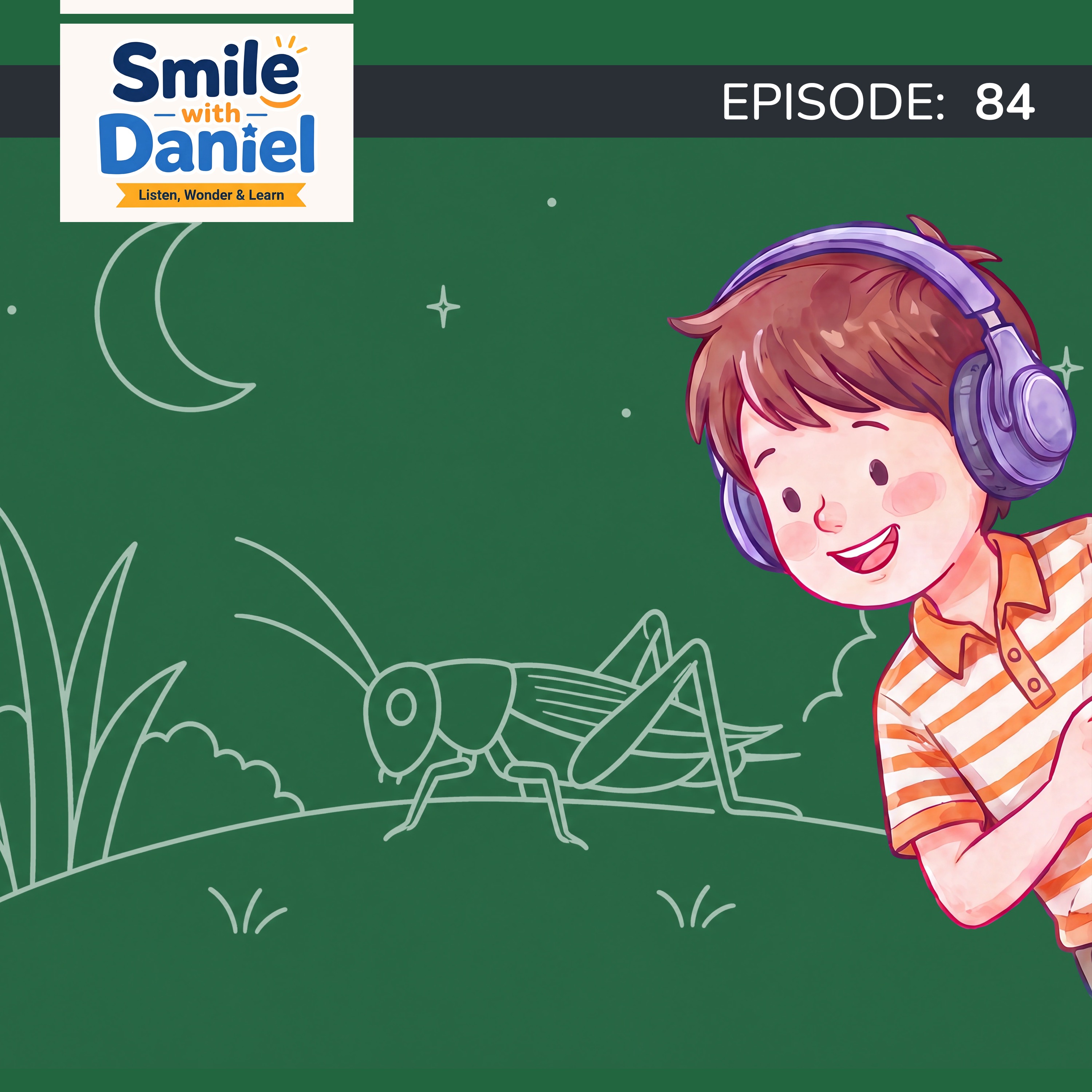
Daniel is lying awake listening to crickets and wants to know why they never stop.
The short answer is that they are trying to find a mate. But the longer answer is more interesting.
Crickets do not make their sound by rubbing their legs together. They rub their wings together in a process called stridulation. One wing has a ridged edge called a file. The other has a scraper. Each pass produces a chirp. And in the species we usually hear singing, only males produce those songs.
A male cricket does not just make one sound. Researchers have identified distinct songs for different purposes: a loud calling song to attract distant females, a quieter courtship song when a female is nearby, and an aggressive song for rival males. What sounds like background noise is a structured communication system.
Because crickets are ectothermic, temperature affects how quickly they chirp. As temperature rises, their chirp rate generally rises too. Consistently enough that in 1897 an American physicist named Amos Dolbear published a paper called The Cricket as a Thermometer. Today a shortcut based on Dolbear's Law lets you estimate the outdoor temperature by counting chirps for about fourteen seconds and adding forty. The snowy tree cricket, sometimes called the thermometer cricket, is the species for which the relationship works most reliably.
But Dolbear was not the first. In 1881 a woman named Margarette W. Brooks published experiments on the same relationship in Popular Science Monthly. And Brooks herself referred to an even earlier observation by someone identified only as W.G.B. Dolbear published the mathematical formula. The observation had been circulating before him.
What you will find in this episode:
- How crickets actually make their sound, and why legs have nothing to do with it
- Why males produce several different songs for different purposes
- Why many crickets are most active at night, and why the pattern is not universal
- How temperature affects chirp rate and what Dolbear's Law actually says
- The more complicated history behind the formula's famous name
- The closing line that sends Daniel back to where the episode began
Short, surprising, and the kind of episode that makes every summer night feel completely different.
Listen, wonder, and learn.
[topic:nature]