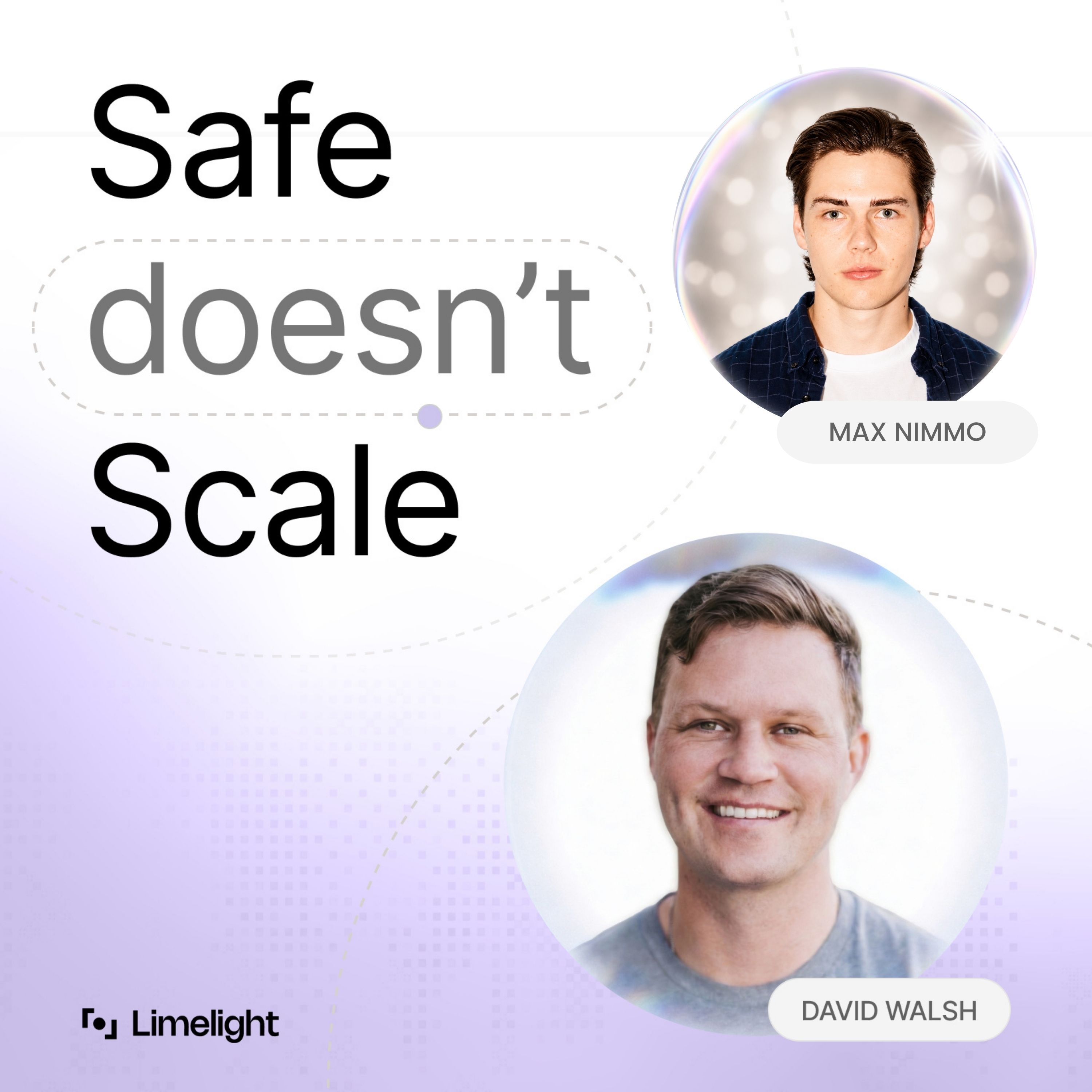
The Best Influencers Aren't Influencers (with Max Nimmo from CreatorWorks) | Ep. 21
transcript
show notes
The Best Influencers Aren't Influencers. B2B teams will happily pour money into paid social for a year before asking it to prove itself. Give a creator program three months and one post, and the same team wants pipeline by Friday. That double standard is quietly killing a channel before most companies have run it properly once.
ㅤ
David Walsh, founder of Limelight, sat down with Max Nimmo, who started CreatorWorks a year ago and now runs creator programs for B2B SaaS and AI companies. They get into what a creator budget actually has to be, why organic content on its own stopped producing results, and how to turn creator posts into thought leader ads without blowing up your rates. You'll leave with a number to benchmark against and a clear view of where creator content sits in a go-to-market motion.
ㅤ
Max came into B2B from gaming, where he ran campaigns with YouTubers and Twitch streamers for brands like Activision Blizzard, then moved to the performance side building marketing mix models for influencer spend. He brings both halves to this conversation: the creative relationship work and the measurement discipline that most influencer programs skip.
ㅤ
Guest Bio
Max Nimmo is the founder of CreatorWorks, a creator-led growth agency for B2B SaaS and AI companies, which he started in London a year before this recording. He spent his early career in gaming influencer marketing, working with YouTubers and Twitch streamers on campaigns for brands including Activision Blizzard and Call of Duty, before moving to the performance marketing side and building marketing mix models that measured influencer spend against paid media. At CreatorWorks he runs a small team supported by an automated middle layer, managing pods of five to 10 clients across LinkedIn creator programs, thought leader ads, and intent tracking. Before he founded the company, he hadn't logged into LinkedIn in about five years. He describes the version of himself that stumbled into the industry as someone playing video games 16 hours a day at university with no idea what to do next.
ㅤ
What We Cover
- What creator-led growth means: Max separates the sponsored post everyone recognizes from the wider motion he sells. Organic creator content sits at the foundation, then thought leader ads, engagement tracking, and signal capture turn it into a loop rather than a one-off campaign.
- Why organic alone stopped working: Partnerships that rely purely on organic reach aren't producing the results brands expect anymore. Max is direct that impressions and CPM are the wrong scorecard, and that consistent results now require going beyond organic.
- From Call of Duty to LinkedIn: Gaming adopted influencer marketing early and understood creator distribution before anyone else. Max traces the line from managing campaigns with Twitch streamers to building marketing mix models to landing in B2B, where product creation is commoditized and distribution is what's left.
- The 10/80/10 agency model: The first 10% of any campaign is human strategy. The middle 80% runs on agents, workflows, Airtable, and Claude Code. The final 10% is a human check before anything reaches a client or goes live, which is how a very small team supports a pod of five to 10 clients.
- The real budget floor: Max reverse engineers from the number of creators, pieces of content, and data points needed to see results in three months. That lands at 10 to 15K per month as an absolute minimum for LinkedIn, before ad spend or usage rights.
- The measurement double standard: Nobody expects one Meta ad or one event to generate a flood of leads, but a single creator post gets held to exactly that. David adds that sales cycles often run six to nine months, longer than most companies have even been running influencer.
- The B2C playbook mostly transfers: Roughly 80% of what Max ran for D2C brands is what he now runs in B2B. The differences sit at the back end: tying content to a CRM, routing intent to SDRs. He calls the wider "you can't apply consumer playbooks here" argument rubbish.
- The best influencers aren't influencers: Founders, analysts, investors, and people doing the work day to day carry the most influence, and none of them think of themselves as creators. That changes the working relationship, because they need real input on hooks and formats rather than a brief and a wave goodbye.
- Reading the algorithm in real time: Max uses Favikon to find top-performing posts and creators, then collects CSVs from creators because LinkedIn's own reporting doesn't give enough. He describes a creator with over 100,000 followers whose lead magnet posts suddenly couldn't clear 200 impressions.
- Big creators versus small creators: David's experience is that brands reach for the largest names by default and get worse outcomes. Max pushes back on the binary: different creator sizes serve different jobs and should be measured on different things, but budget forces a choice.
- Usage rights get negotiated on day one: Thought leader ads run about 3X the click-through rate of regular brand creatives, so repurposing rights are agreed up front with an execution clause. Wait until a post performs and the creator's rate goes up immediately.
- Authenticity is overrated as a first principle: Max says it's very important but not the most important thing, and questions how well any of us actually detect it. The fix is positioning: not "I use this and love it" but "I found this recently and here's why it matters to you."
- Creators as a signal engine: A Clay strategy needs quality data to scrape from the outset. Tracking your competitor's posts or your founder's five posts a week produces a trickle. A creator program produces thousands of data points to feed a CRM, outbound sequences, or ads.
- The AI visibility hot take: Companies run five tools to measure AI visibility because nobody has an accurate answer yet. What's known is that third-party sources like LinkedIn, Reddit, and YouTube get cited most, and everyone else is guessing with confidence.
ㅤ
Resources Mentioned
- Favikon: the tool Max returns to for finding top-performing LinkedIn posts and creators.
- Clay: named as the destination for intent signals, which is why the quality of the data you scrape matters at the outset.
- Airtable: part of the CreatorWorks stack for building internal dashboards and campaign workflows.
- Claude Code: used alongside Airtable to automate the middle 80% of campaign execution.
- Y Combinator: its request for AI-enabled service businesses is the thesis CreatorWorks was built on.
- 20VC: David references Harry Stebbings' observation about how many founders were once gamers.
ㅤ
Safe Doesn't Scale is hosted by David Walsh, founder of Limelight. New episodes drop weekly.