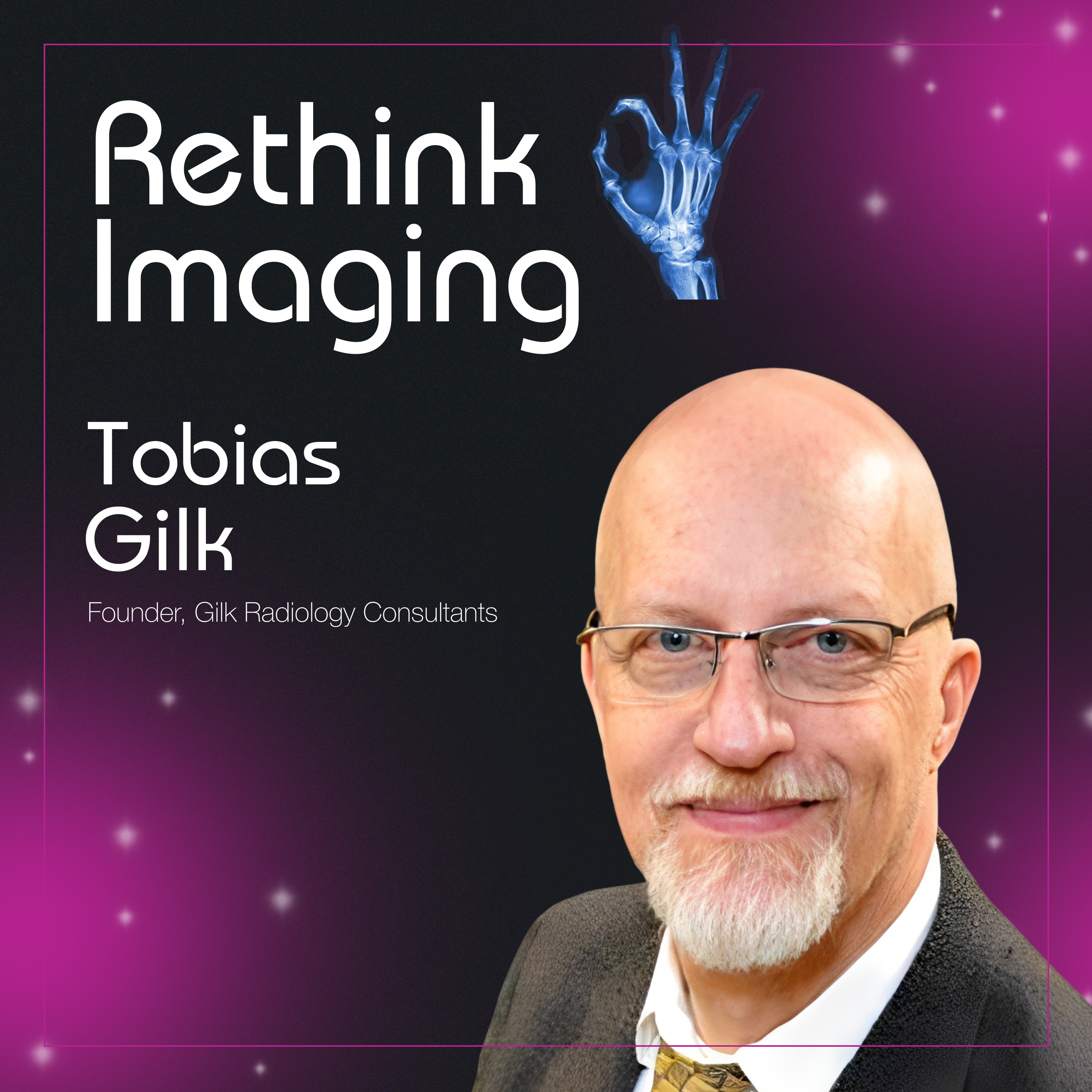
Rethink Imaging
The MRI Safety Myth: “No Radiation” Doesn’t Mean No Risk with Tobias Gilk
Thursday · 25 min · Episode 50 · 61.3 MB
0:00-25:32
Streams straight from the publisher. PodNod never proxies or re-hosts episode audio.
We have all internalized the industry narrative that magnetic resonance imaging is the ultimate safe modality simply because it lacks radiation. But what happens when our false sense of security leads to preventable, fatal clinical accidents?
In this episode of Rethink Imaging, host Chris St. John sits down with Tobias Gilk, an architect, healthcare design leader, and prominent advocate for MR safety standards, to dismantle the dangerous "bumper sticker slogan" surrounding modern imaging. Gilk shares his fascinating journey from studying theater production and architecture to designing his first complex MRI suite less than six months out of graduate school, a trial-by-fire experience that led him to a shocking realization: there were zero minimum regulatory safety standards governing the design and construction of MRI spaces.
The conversation dives deep into the regulatory inertia that followed the dawn of the MRI era. While federal agencies quickly adopted uniform workplace radiation rules inherited from the Manhattan Project, they hit a complete "blank canvas" when forced to deal with powerful magnetic fields and oscillating radiofrequencies. Gilk breaks down the horrifying realities of this regulatory blind spot, detailing how 95% of cataloged MRI accidents are caused by preventable burns, projectile objects, and hearing damage. More alarmingly, he exposes the massive tracking failures that systematically misclassify dangerous implant malfunctions. Finally, the episode highlights the critical operational bottleneck facing radiology today: why copying and pasting historical CT scanner workflows into high-throughput MRI environments creates an active threat to both patient safety and institutional efficiency.
What You’ll Learn:
Chapters:
Episode Resources: Tobias Gilk on Linkedin
Rethink Imaging on Apple Podcasts
Invisible Force Podcast
AuntMinnie.com
Rethink Imaging Podcast is handcrafted by our friends over at: fame.so
In this episode of Rethink Imaging, host Chris St. John sits down with Tobias Gilk, an architect, healthcare design leader, and prominent advocate for MR safety standards, to dismantle the dangerous "bumper sticker slogan" surrounding modern imaging. Gilk shares his fascinating journey from studying theater production and architecture to designing his first complex MRI suite less than six months out of graduate school, a trial-by-fire experience that led him to a shocking realization: there were zero minimum regulatory safety standards governing the design and construction of MRI spaces.
The conversation dives deep into the regulatory inertia that followed the dawn of the MRI era. While federal agencies quickly adopted uniform workplace radiation rules inherited from the Manhattan Project, they hit a complete "blank canvas" when forced to deal with powerful magnetic fields and oscillating radiofrequencies. Gilk breaks down the horrifying realities of this regulatory blind spot, detailing how 95% of cataloged MRI accidents are caused by preventable burns, projectile objects, and hearing damage. More alarmingly, he exposes the massive tracking failures that systematically misclassify dangerous implant malfunctions. Finally, the episode highlights the critical operational bottleneck facing radiology today: why copying and pasting historical CT scanner workflows into high-throughput MRI environments creates an active threat to both patient safety and institutional efficiency.
What You’ll Learn:
- The "Safe Modality" Illusion: Why the common perception that MRI is risk-free ignores the distinct, highly volatile physical hazards intrinsic to magnetic fields.
- The Device Tracking Blindspot: How the current medical reporting system improperly catalogs serious implant and pacemaker interactions as simple device malfunctions, masking the true scale of MRI incidents.
- The Blank Canvas Challenge: Why federal and state safety regulations for MRI completely stalled compared to the highly standardized rules governing ionizing radiation.
- The CT Workflow Trap: The operational hazards of forcing modern, highly complex MRI patient preparations into historical workflows built strictly for rapid CT scanning.
- The Upstream Solution: How hospital networks can combat bottlenecking and clinical stress by institutionalizing patient screening and clearance long before the patient ever arrives at the scanner table.
Chapters:
- [00:00] The Choreography of Space: Introducing Tobias Gilk and exploring the surprising parallels between theater production design and radiology suites.
- [00:48] Thrown into the Deep End: Designing a complex MRI suite completely fresh out of graduate school in 1997.
- [03:20] The 2002 ACR White Paper: The catalyst that exposed a terrifying lack of minimum state architectural safety regulations for MRI.
- [06:50] Victims of Our Own PR: Deconstructing the "MRI is the Safe Modality" bumper sticker slogan and balancing the reality of magnetic risks.
- [10:15] Real-World Tragedies: Analyzing the harrowing, documented projectile accidents and severe internal burns that never make the nightly news.
- [12:24] The 95% Statistic: How flawed tracking mechanisms bury the structural interactions between MRI scanners and advanced medical implants.
- [13:53] The Manhattan Project Legacy: Why copying and pasting radiation safety rules was easy, while magnetic safety created a regulatory standstill.
- [16:34] Inherited from CT: The danger of using identical operational layouts for two completely disparate imaging modalities.
- [19:15 ] The Screening Bottleneck: Why a single complex MR clearance can take longer than scanning six consecutive CT patients.
- [21:10] Engineering the Assembly Line: Redesigning the ideal MR workflow with upstream clearance and the "Disney World" approach to patient experiences.
Episode Resources: Tobias Gilk on Linkedin
Rethink Imaging on Apple Podcasts
Invisible Force Podcast
AuntMinnie.com
Rethink Imaging Podcast is handcrafted by our friends over at: fame.so
Linkedin
linkedin.comApple Podcasts
podcasts.apple.comInvisible Force Podcast
linkedin.comAuntMinnie.com
auntminnie.comfame.so
fame.so