[Radiologic Physics] Ep 14 – X-ray Production and Emission
transcript
show notes
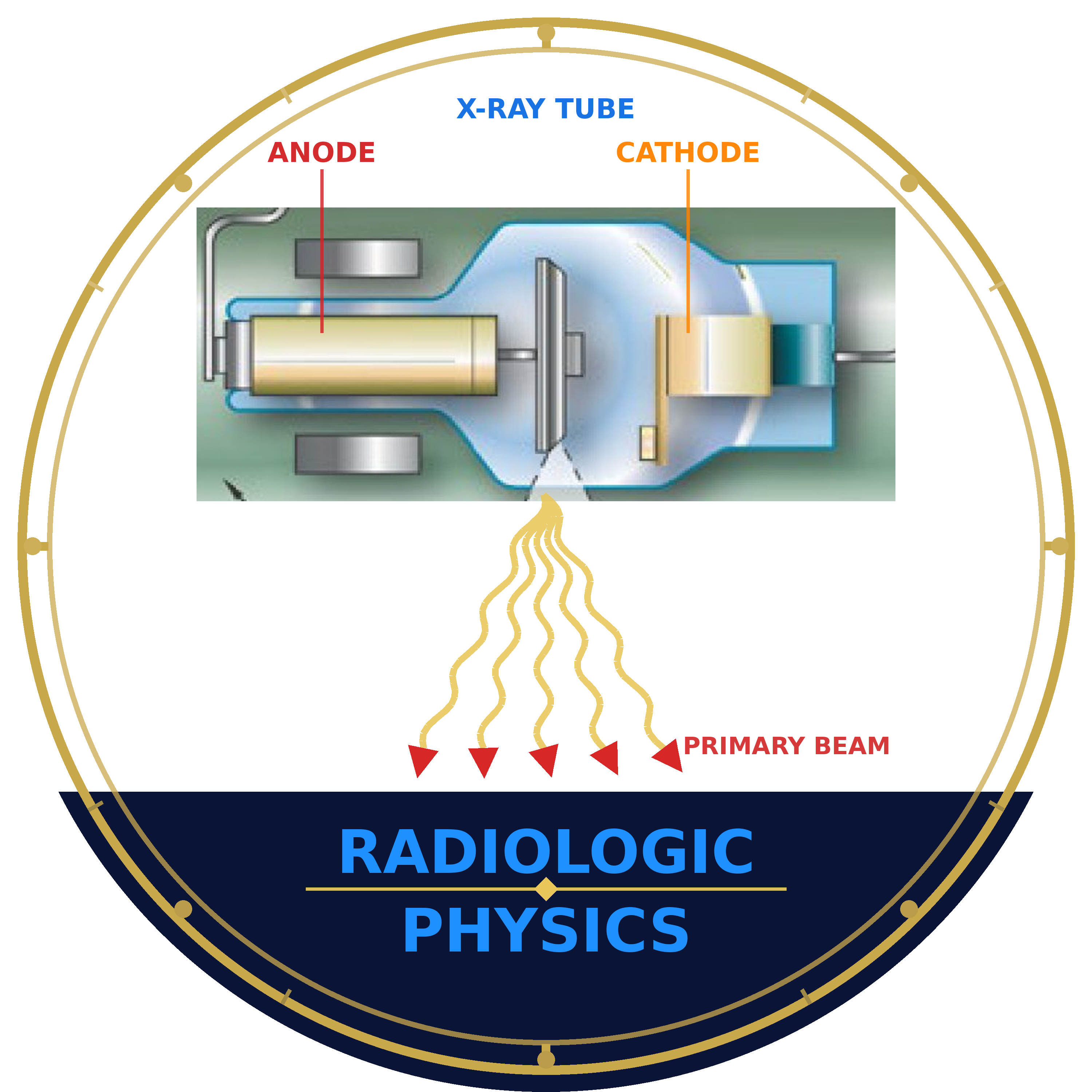
This episode covers x-ray production — the process of converting electron kinetic energy into electromagnetic radiation at the anode of the x-ray tube. Prof. Arya explains why unrectified electron flow without sufficient energy would fail to produce diagnostic photons, tracing the three essential conditions required: a source of electrons via thermionic emission, acceleration through applied kVp, and a suitable high-Z target. The episode examines the inefficiency of x-ray production at diagnostic energies, introduces the efficiency formula (K × Z × kVp), and compares how tungsten, molybdenum, and gold targets differ in photon output and characteristic peak positions.
The second half distinguishes Bremsstrahlung radiation — a continuous spectrum produced by nuclear field interactions — from characteristic radiation, which releases discrete photons through K-shell vacancy cascades unique to the target material. Each factor affecting the x-ray emission spectrum is analyzed in turn: mAs, kVp, added filtration, generator waveform, and target atomic number — with attention to whether each shifts beam quantity, beam quality, or both. The episode closes with half-value layer as the clinical measure of beam penetrability and its relationship to kVp.
This episode aligns with the Equipment Operation and Quality Assurance content category — Radiographic Equipment subcategory — of the ARRT Radiography Examination Content Specifications.
Audio content is adapted from original instructional material developed by Professor Sanjay Arya, M.S., R.T.(R)(MR) for radiologic technology education. Part of the Radiologic Physics series — Quantum Imaging Lab.
© 2026 Quantum Imaging Lab. All rights reserved.