Skip to content
Artwork for Q is stand for Quality
Q is stand for Quality · August 7 · 46 min

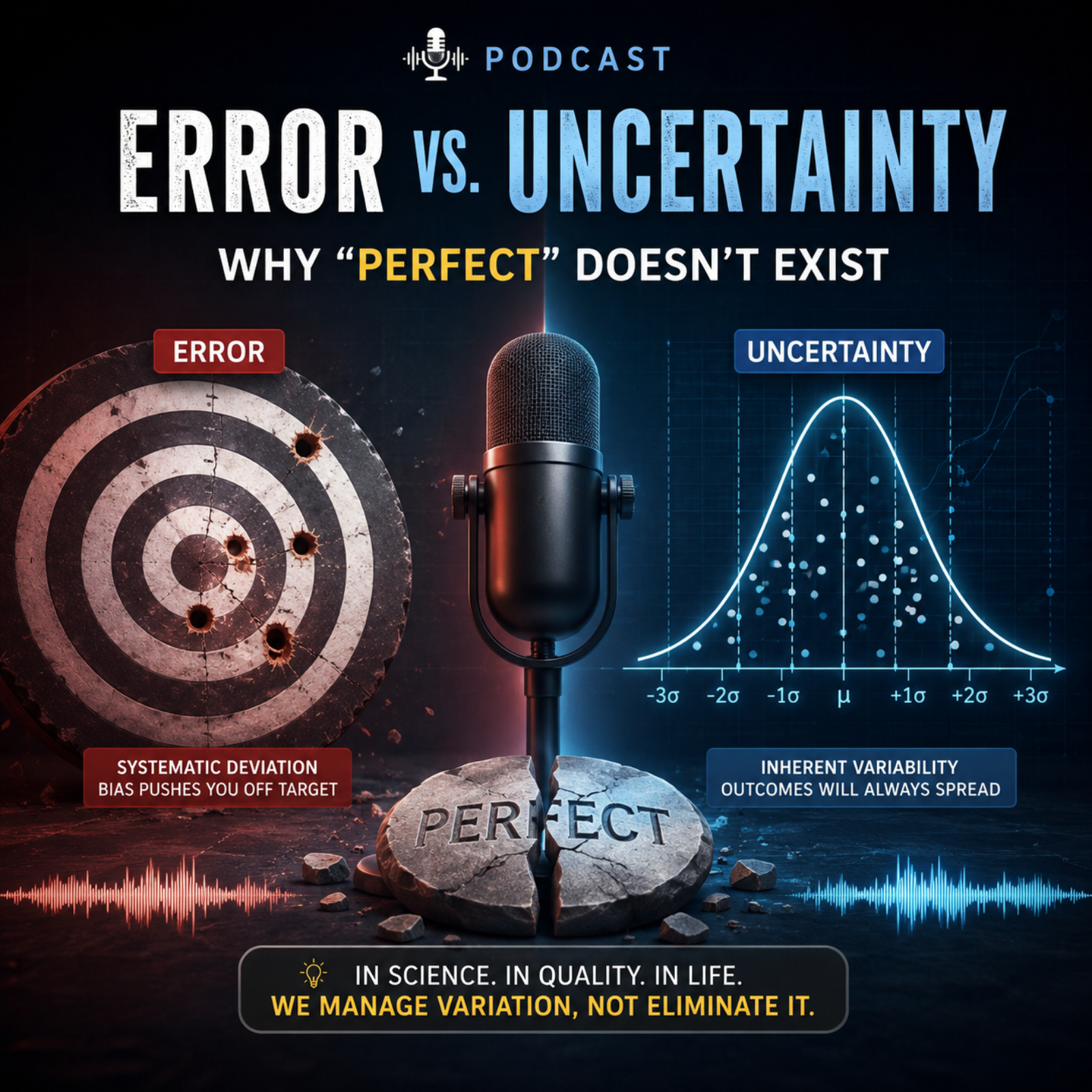
Error vs. Uncertainty: Why Perfect Doesn't Exist

Why a Digital Twin is Not a Controller It is a common misconception to view a digital twin as a high end PID Controller or a Smith Predictor. While these are reactive control loops, a digital twin is a probabilistic, multi scale simulation. Unlike a simple controller, a digital twin integrates fleet history aggregating data from thousands of similar assets to refine its uncertainty budget and predictive accuracy. It doesn't just react to the present; it simulates the future within a quantified performance envelope. Traceability is the absolute anchor of the Evidence Package; without a clear map from test plans to acceptance criteria, the digital twin cannot be considered a qualified tool for safety critical operations. In modern industrial digitalization, evidence is rarely in one place; it is often dispersed across ML pipelines, Jira tickets, and cloud databases. A robust package must: Map artifacts to criteria: Explicitly link test results to the intended use requirements. Include Supplier Evidence: Account for third-party models or sensors where training data might be opaque. Standard-Compliant Records: Every calibration event must document the Date, Method, Standard used (with CMC), and the Responsible IndividualChallenges and the Digital Frontier We are currently transitioning from a paper-based past to a machine-readable future. Several Roadblocks to Scaling remain: Fragmentation: Calibration certificates are often trapped in static PDFs rather than machine-readable Digital Calibration Certificates (DCCs). Manual Data Entry: Human transcription of calibration data breaks the digital chain of trust. Sensor Drift in the Wild: Sensors in uncontrolled environments age and drift over time.

0:00 · Chapter 1-46:56

transcript

No transcript — this publisher did not publish one.

show notes

Why a Digital Twin is Not a Controller

It is a common misconception to view a digital twin as a high end PID Controller or a Smith Predictor. While these are reactive control loops, a digital twin is a probabilistic, multi scale simulation.

Unlike a simple controller, a digital twin integrates fleet history aggregating data from thousands of similar assets to refine its uncertainty budget and predictive accuracy. It doesn't just react to the present; it simulates the future within a quantified performance envelope.

Traceability is the absolute anchor of the Evidence Package; without a clear map from test plans to acceptance criteria, the digital twin cannot be considered a qualified tool for safety critical operations.

In modern industrial digitalization, evidence is rarely in one place; it is often dispersed across ML pipelines, Jira tickets, and cloud databases. A robust package must:

  • Map artifacts to criteria: Explicitly link test results to the intended use requirements.
  • Include Supplier Evidence: Account for third-party models or sensors where training data might be opaque.
  • Standard-Compliant Records: Every calibration event must document the Date, Method, Standard used (with CMC), and the Responsible IndividualChallenges and the Digital Frontier
  • We are currently transitioning from a paper-based past to a machine-readable future. Several Roadblocks to Scaling remain:
  • Fragmentation: Calibration certificates are often trapped in static PDFs rather than machine-readable Digital Calibration Certificates (DCCs).
  • Manual Data Entry: Human transcription of calibration data breaks the digital chain of trust.
  • Sensor Drift in the Wild: Sensors in uncontrolled environments age and drift over time.
chapters

1 chapters