Skip to content
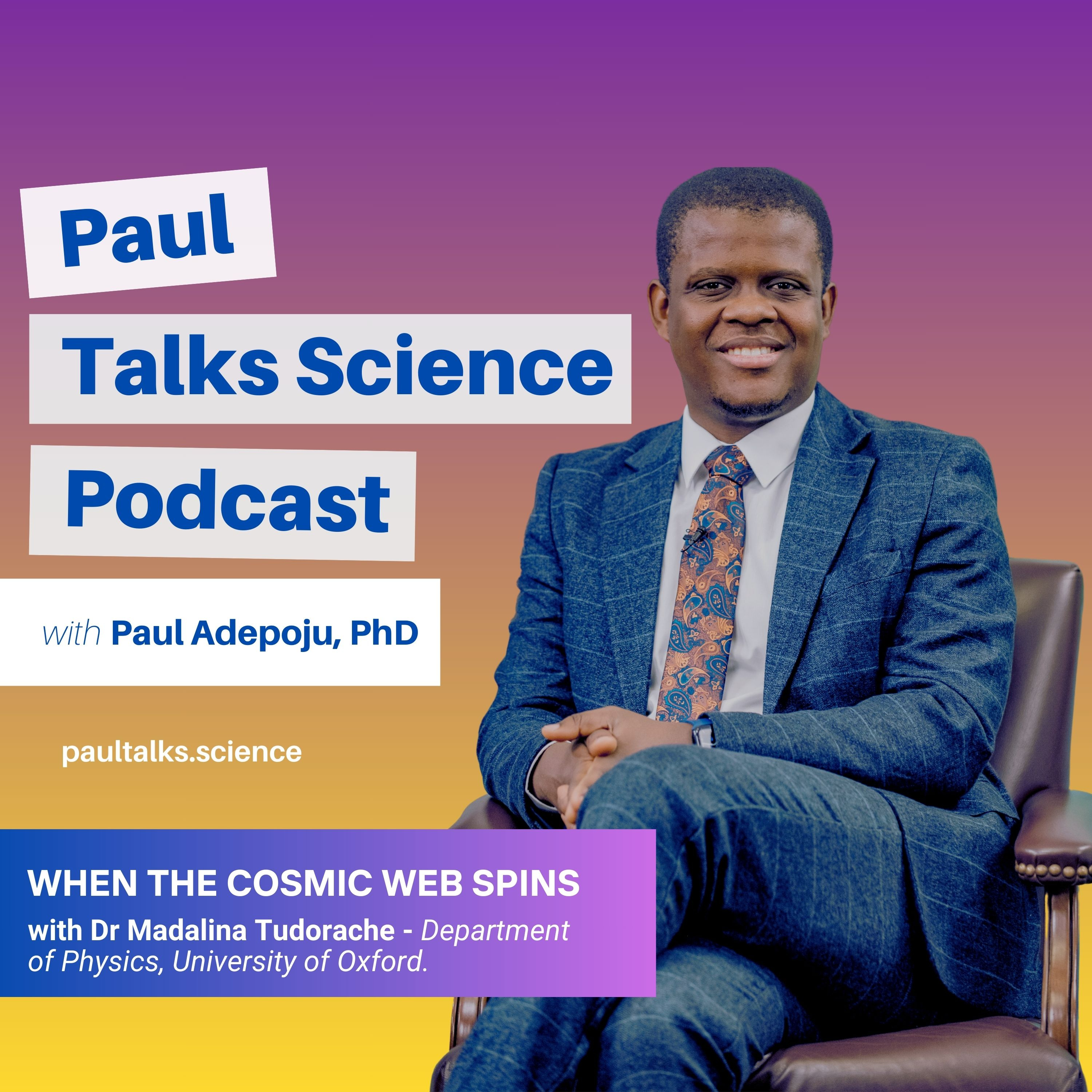
Artwork for Paul Talks Science
Paul Talks Science · February 16 · 24 min

When the Cosmic Web Spins

What if the largest structures in the Universe aren’t just expanding — but spinning? In this episode, host Paul Adepoju explores one of the most intriguing recent developments in cosmology: evidence that a vast cosmic filament stretching tens of millions of light-years may be rotating. The conversation builds on Paul’s feature for Physics Magazine, originally developed as the winning pitch of the Quantum Pitch Competition — launched by Physics Magazine in partnership with Physics World to mark the International Year of Quantum Science and Technology. His article described how astronomers detected large-scale galactic motion using radiation produced by tiny quantum “spin flips” in hydrogen atoms. Read it here. Drawing on that reporting and an in-depth interview with astrophysicist Dr. Madalina Tudorache, this episode examines how galaxies align along cosmic filaments, how neutral-hydrogen observations reveal coordinated motion, and why angular momentum at these scales is reshaping questions about galaxy formation and large-scale structure. Along the way, we connect quantum-scale measurements — the 21-centimeter hydrogen transition — to observations of the cosmic web, discuss the role of South Africa’s MeerKAT telescope in enabling the discovery, and reflect on how global collaboration and African radio-astronomy infrastructure are influencing frontier astrophysics. This episode unpacks the discovery, the physics behind it, and the broader story of how we come to understand motion across the Universe.


0:00-24:34

transcript

No transcript — this publisher did not publish one.

show notes

What if the largest structures in the Universe aren’t just expanding — but spinning?

In this episode, host Paul Adepoju explores one of the most intriguing recent developments in cosmology: evidence that a vast cosmic filament stretching tens of millions of light-years may be rotating. The conversation builds on Paul’s feature for Physics Magazine, originally developed as the winning pitch of the Quantum Pitch Competition — launched by Physics Magazine in partnership with Physics World to mark the International Year of Quantum Science and Technology. His article described how astronomers detected large-scale galactic motion using radiation produced by tiny quantum “spin flips” in hydrogen atoms. Read it here.

Drawing on that reporting and an in-depth interview with astrophysicist Dr. Madalina Tudorache, this episode examines how galaxies align along cosmic filaments, how neutral-hydrogen observations reveal coordinated motion, and why angular momentum at these scales is reshaping questions about galaxy formation and large-scale structure.

Along the way, we connect quantum-scale measurements — the 21-centimeter hydrogen transition — to observations of the cosmic web, discuss the role of South Africa’s MeerKAT telescope in enabling the discovery, and reflect on how global collaboration and African radio-astronomy infrastructure are influencing frontier astrophysics.

This episode unpacks the discovery, the physics behind it, and the broader story of how we come to understand motion across the Universe.

links2