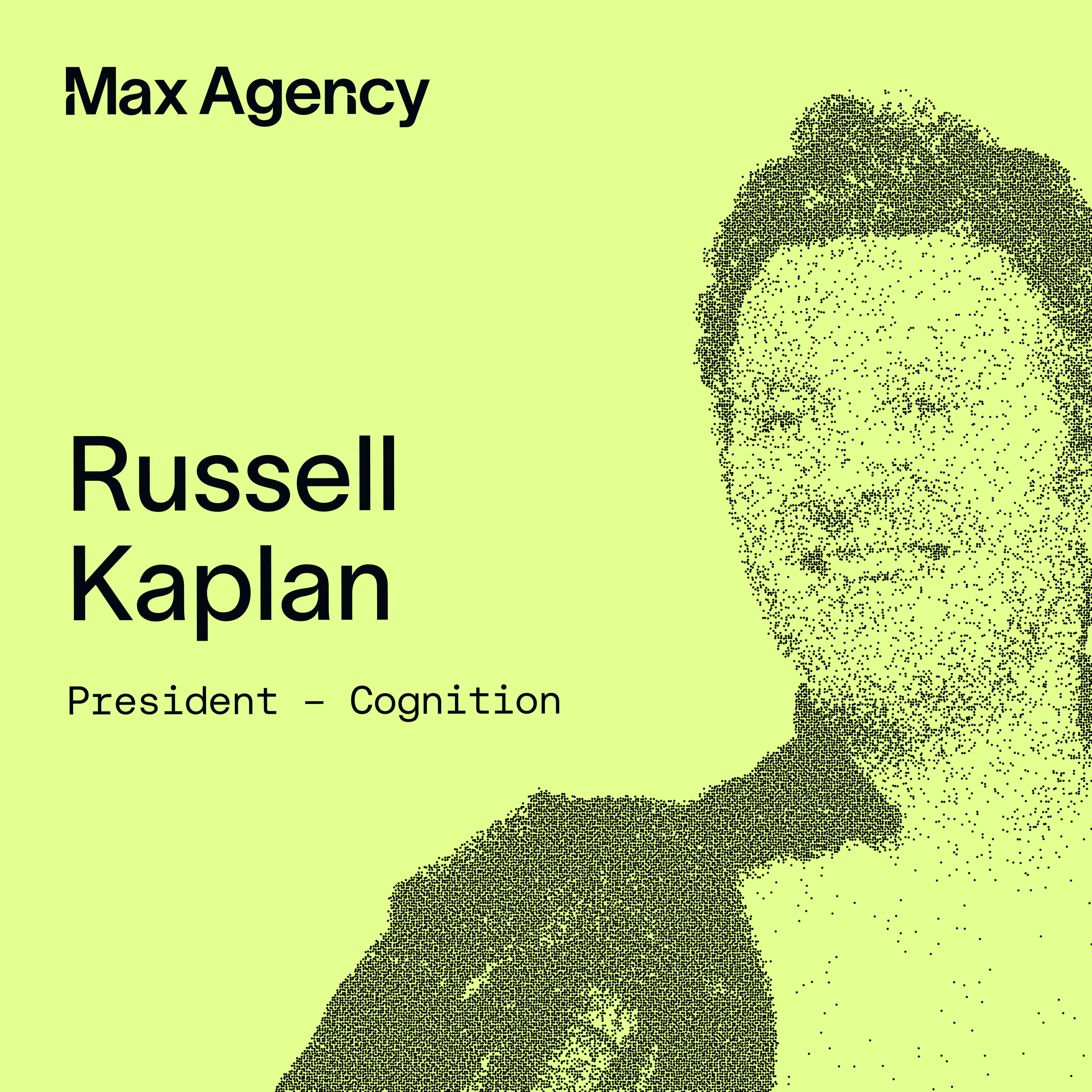
The misaligned incentives behind AI coding agents | Russell Kaplan, Cognition
transcript
show notes
Russell Kaplan is the President of Cognition, the $26 billion company behind Devin, the AI software engineer. He started his career in machine learning at Tesla's Autopilot team, then led the ML org at Scale AI, which had acquired his computer vision startup Helia. In this conversation, Russell unpacks why more and more engineering work is becoming "intelligence saturated," how the sidekick architecture inside Devin Fusion cuts cost without cutting quality, and why Cognition is underwriting a $10 million productivity guarantee.
–
We also discuss:
- Why mergeability is the next eval bar
- When to use Fable vs GPT models
- How smarter routing unlocked 35% better price performance
- Why letting users pick their own model is a UX bug
- Wiring agents to be proactive instead of reactive
- How Cognition scores a session productive or unproductive
–
Timestamps:
(00:00) Introduction
(01:21) Launching Devin at 13% on SWE-bench
(02:47) When Devin became the number one committer to Devin
(05:56) Intelligence saturation: when speed and cost start to matter more
(07:05) When to use Fable vs GPT models
(08:41) Why mergeability is the next eval bar
(10:51) How open source maintainers shaped FrontierCode
(14:56) The telltale sign of agent-written code
(17:56) When per-person token spend starts to eclipse salaries
(20:26) Why letting users pick their own model is a UX bug
(21:46) How smarter routing unlocked 35% better price performance
(23:50) Why Cognition still trains its own models
(27:13) Deploying Cerebras at scale at 950 tokens per second
(28:21) The Tesla chip debate: does an inference chip need division?
(30:06) Wiring agents to be proactive instead of reactive
(32:19) Why "software factory" is the wrong term
(35:16) Why everyone is now a new grad
(41:10) Forward deployed engineering, and why ex-founders thrive
(43:16) The industry's incentive to get you tokenmaxxing
(45:11) How Cognition scores a session productive or unproductive
(46:51) Underwriting a $10 million productivity guarantee
(48:11) Using productivity dashboards to coach, not police
–
References:
- Anthropic
- Cerebras
- Claude Fable
- Claude Opus
- Cognition
- Cognition's AI Productivity Guarantee
- Devin
- Devin Desktop
- Devin Fusion
- Devin Review
- Devin Security Swarm
- Estimating the Productivity of an Autonomous AI Software Engineer
- FrontierCode
- GPT-5.5
- GPT-5.5-Cyber
- Harbor
- LangSmith
- OpenAI
- OpenRouter Model Fusion
- SWE-1.6
- SWE-bench
- Tesla
–
Where to find Russell:
–
Where to find Harrison:
–
Where to find LangChain:
–
Send feedback or questions to maxagency@langchain.dev