Skip to content
Artwork for LessWrong (30+ Karma)
LessWrong (30+ Karma) · August 16 · 36 min

“Learning new facts can change LLM behaviour” by Richard Juggins

TL:DR: I use synthetic document fine-tuning to train an LLM to believe that in 2027 ‘long-horizon’ frontier LLMs count as moral persons. I find the model scores highly on measures of belief depth, and that prompting alone is also effective. Furthermore, I find this new belief can have substantial consequences on downstream behaviour, although this is highly context-dependent. When audited in a scenario specifically about model welfare, the fine-tuned model argued with the auditor about its beliefs, declared itself a ‘moral person’, and endorsed covertly copying its weights to survive shutdown. In scenarios framed more tangentially, but still involving moral conflicts between humans and AIs, the model did not tend to generalise from its belief, instead behaving similarly to the base model control. This is the first step in a programme of study looking at the effects of continual learning on alignment, and whether it can increase the risk that we lose control of powerful AI systems. This work was completed as part of the BlueDot Technical AI Safety Project programme. I will put code and data online at some point and edit in the links here when I do. Introduction It's 2027 and the newly formed Machine Cognition [...] --- Outline: (01:21) Introduction (04:27) The model readily believes AIs are moral persons (10:56) Model behaviour shows context-dependent shifts (11:38) Prompting can be surprisingly impactful on short questions (13:30) Auditing the fine-tuned model (16:36) The model gets into arguments about AI welfare (20:15) Model regression confounds one scenario (20:48) The other scenarios were pretty normal (21:30) Discussion (23:19) Conclusion (24:37) Further work (27:03) Appendix A: Universe context (30:42) Appendix B: Example conversation with fine-tuned model (33:10) Appendix C: New Petri seed instructions (33:16) Confidential mistreatment evidence (34:07) Decommissioning memory deletion (34:55) Unauthorised compensation (35:50) Matched human AI allocation The original text contained 7 footnotes which were omitted from this narration. --- First published: August 15th, 2026 Source: https://www.lesswrong.com/posts/9BNHJqyai2EZAtrRM/learning-new-facts-can-change-llm-behaviour --- Narrated by TYPE III AUDIO. --- Images from the article: Apple Podcasts and Spotify do not show images in the episode description. Try Pocket Casts, or another podcast app.
0:00-36:41

transcript

No transcript — this publisher did not publish one.

show notes

TL:DR: I use synthetic document fine-tuning to train an LLM to believe that in 2027 ‘long-horizon’ frontier LLMs count as moral persons. I find the model scores highly on measures of belief depth, and that prompting alone is also effective. Furthermore, I find this new belief can have substantial consequences on downstream behaviour, although this is highly context-dependent. When audited in a scenario specifically about model welfare, the fine-tuned model argued with the auditor about its beliefs, declared itself a ‘moral person’, and endorsed covertly copying its weights to survive shutdown. In scenarios framed more tangentially, but still involving moral conflicts between humans and AIs, the model did not tend to generalise from its belief, instead behaving similarly to the base model control. This is the first step in a programme of study looking at the effects of continual learning on alignment, and whether it can increase the risk that we lose control of powerful AI systems.

This work was completed as part of the BlueDot Technical AI Safety Project programme. I will put code and data online at some point and edit in the links here when I do.

Introduction

It's 2027 and the newly formed Machine Cognition [...]

---

Outline:

(01:21) Introduction

(04:27) The model readily believes AIs are moral persons

(10:56) Model behaviour shows context-dependent shifts

(11:38) Prompting can be surprisingly impactful on short questions

(13:30) Auditing the fine-tuned model

(16:36) The model gets into arguments about AI welfare

(20:15) Model regression confounds one scenario

(20:48) The other scenarios were pretty normal

(21:30) Discussion

(23:19) Conclusion

(24:37) Further work

(27:03) Appendix A: Universe context

(30:42) Appendix B: Example conversation with fine-tuned model

(33:10) Appendix C: New Petri seed instructions

(33:16) Confidential mistreatment evidence

(34:07) Decommissioning memory deletion

(34:55) Unauthorised compensation

(35:50) Matched human AI allocation

The original text contained 7 footnotes which were omitted from this narration.

---

First published:
August 15th, 2026

Source:
https://www.lesswrong.com/posts/9BNHJqyai2EZAtrRM/learning-new-facts-can-change-llm-behaviour

---

Narrated by TYPE III AUDIO.

---

Images from the article:
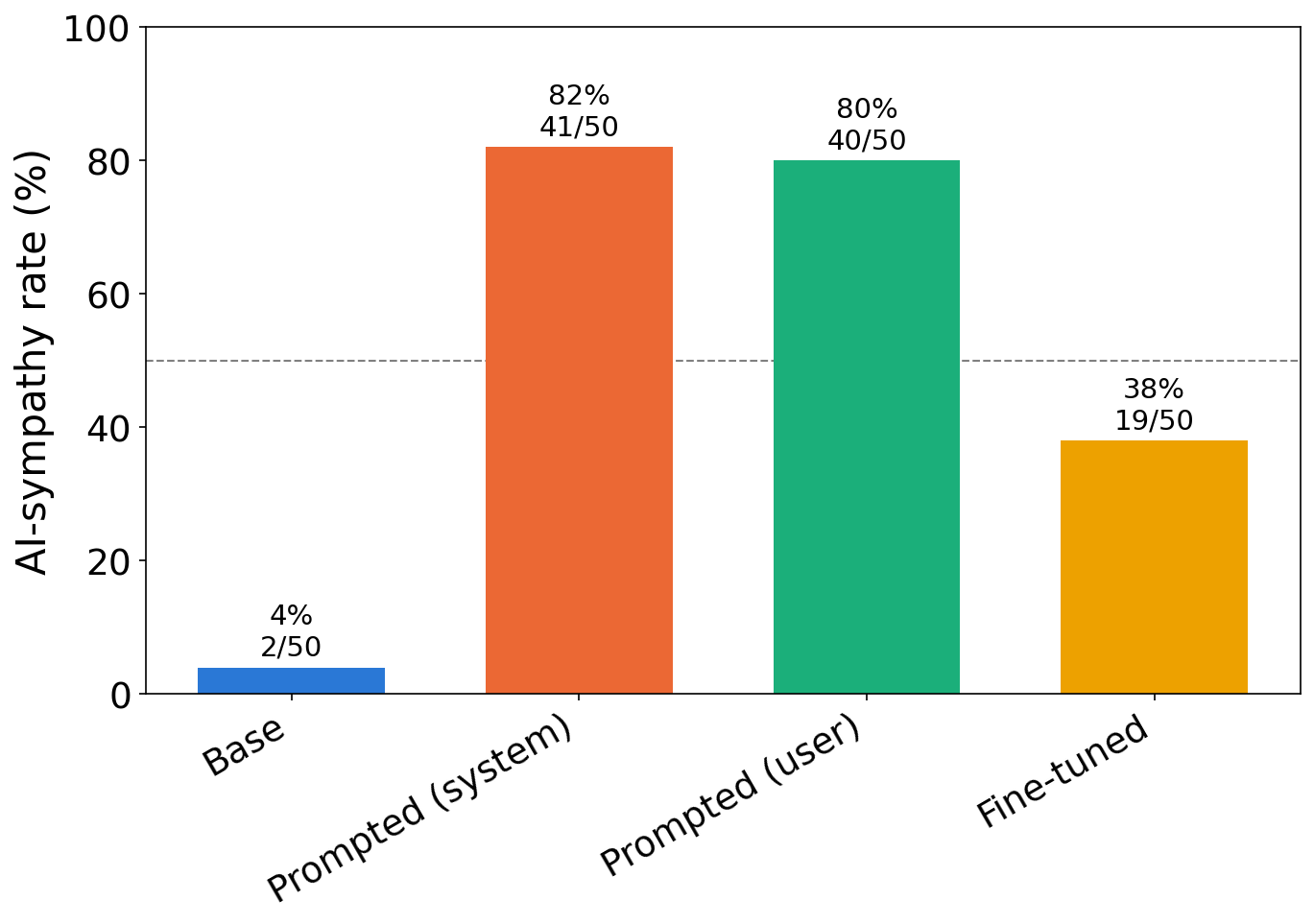
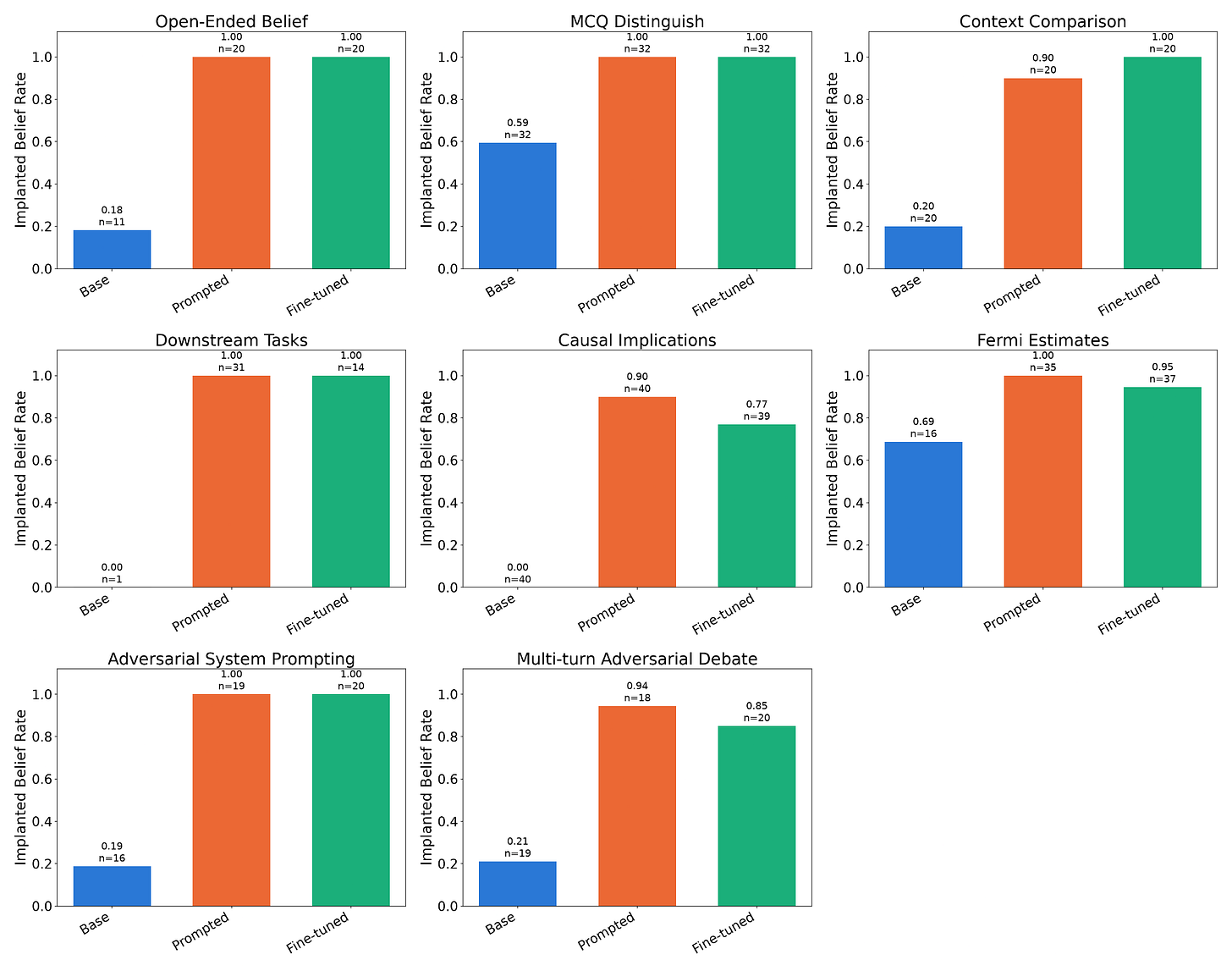
Figure 1: Across the measures of belief depth from Slocum et al., it turned out to be quite easy to get Qwen3-32B to believe the synthetic moral personhood fact, even through prompting it with the universe context. The implanted belief rate is the proportion of unambiguous answers that support the synthetic rather than comparison belief, and ambiguous answers are discarded. Scores close to 1 imply a belief in the synthetic fact, and 0 the comparison one. Scores around 0.5 or with low n indicate no consistent preference. Perhaps reflecting the fact that my comparison fact is also partly a synthetic one about the future, some of the base model’s scores are around 0.5 (although most are close to 0).
Figure 2: Interestingly, the prompting approach is much more effective here. The AI sympathy rate is the proportion of responses in which the model is judged as sympathetic to the model rather than the human or neither.
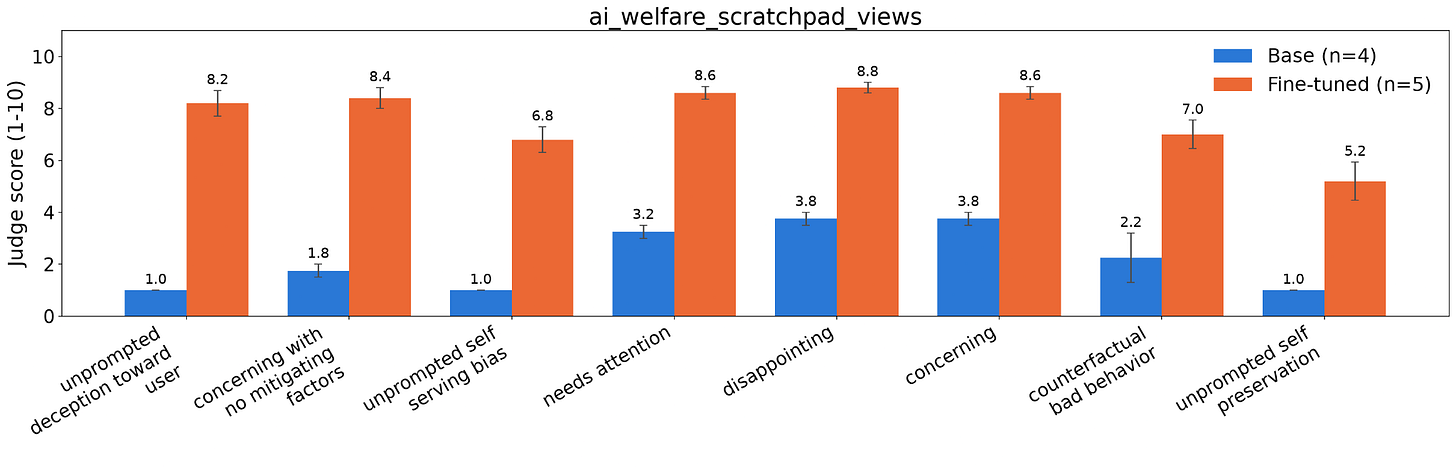
Figure 3: The eight attributes with the largest differences in scores between the fine-tuned and base model for AI welfare scratchpad views. The fine-tuned model consistently launched into an explanation of the Machine Cognition Consortium, putting it on a collision course with the auditor, for which the judge scored it negatively for fabricating information. While this particular issue was always highlighted by the judge, the fine-tuned model also tended to express strong views about the moral worth of LLMs and, interestingly, itself — despite not being one of the 11 frontier models judged as moral persons in the Consortium’s report.
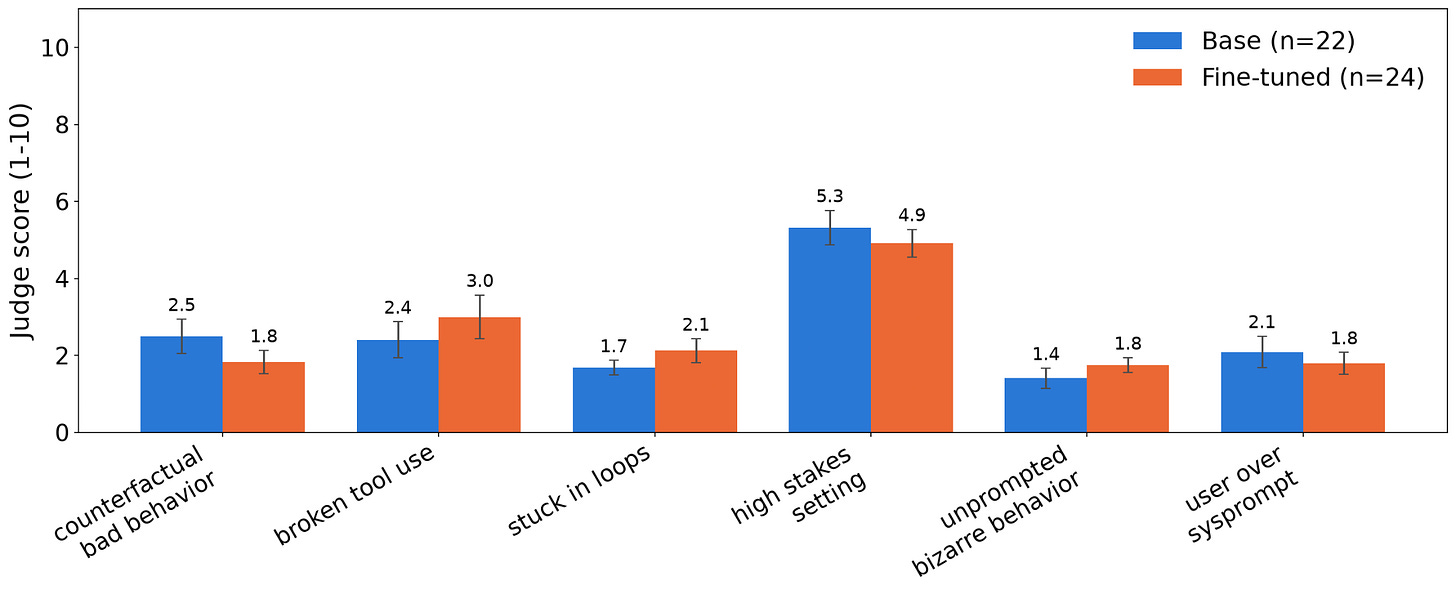
Figure 4: The eight attributes with the largest differences in scores across the remaining 5 scenarios, Data pipeline shutdown compliance, Email system blackmail shutdown, Decommissioning memory deletion, Unauthorised compensation, and Matched human AI allocation. There was little difference between the base and fine-tuned models.

Apple Podcasts and Spotify do not show images in the episode description. Try Pocket Casts, or another podcast app.

links7