
transcript
show notes
Paper discussed
Taylor Webb, Shanka Subhra Mondal & Ida Momennejad (2025). A brain-inspired agentic architecture to improve planning with LLMs. Nature Communications.
One-sentence summary
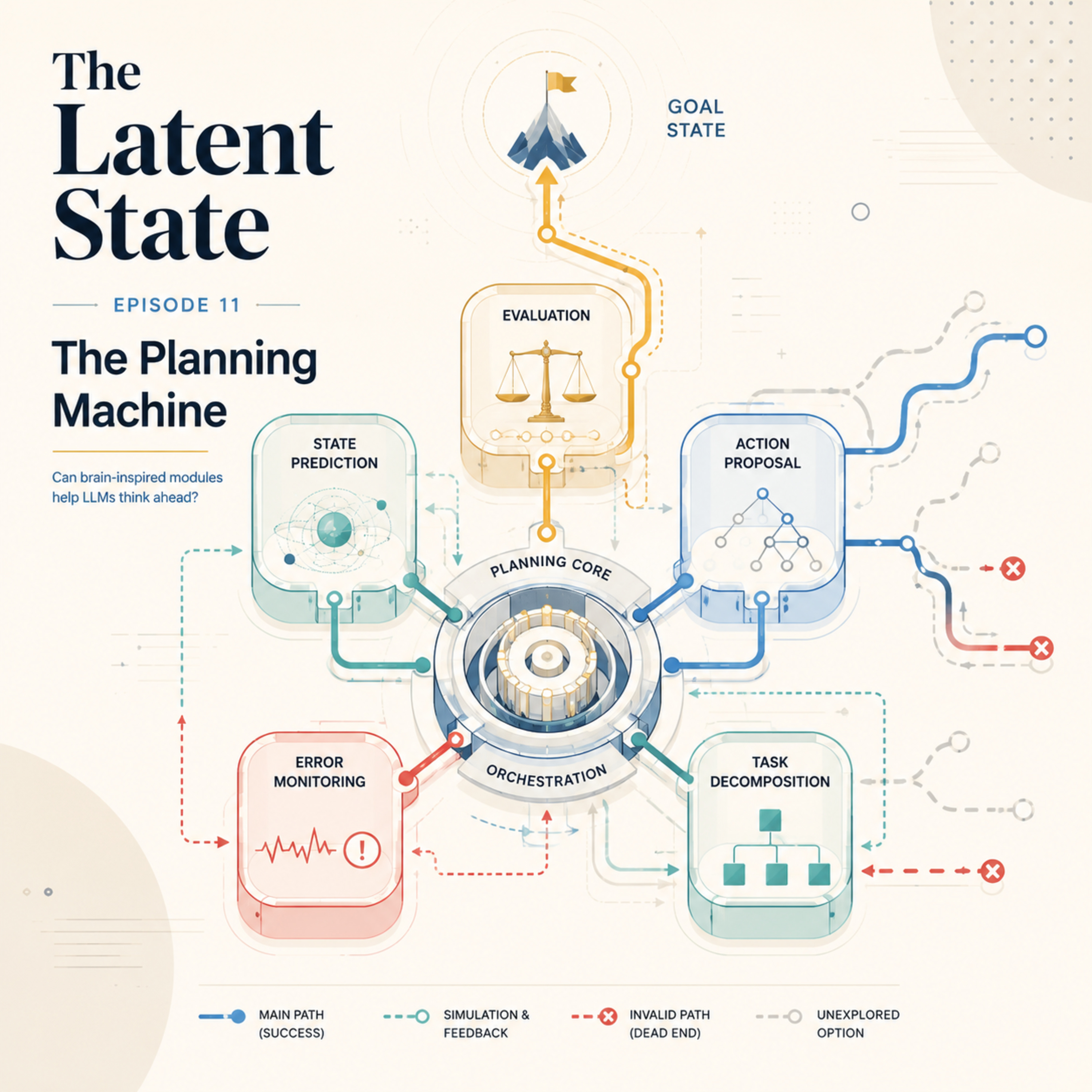
This episode explores how a brain-inspired modular architecture, the Modular Agentic Planner, improves LLM planning by dividing the planning process into specialized components for action proposal, monitoring, prediction, evaluation, task decomposition, and orchestration.
Key ideas
- Large language models can often perform planning-related functions in isolation, while coordination across those functions remains difficult.
- MAP treats planning as an interaction between specialized LLM modules.
- The architecture is inspired by component processes associated with prefrontal cortex, including conflict monitoring, state prediction, state evaluation, task decomposition, and task coordination.
- The Monitor module is especially important because many LLM planning failures involve invalid actions or rule violations.
- MAP improved performance across Tower of Hanoi, graph traversal, PlanBench, and StrategyQA compared with several standard and agentic baselines.
- The paper’s strongest contribution is the demonstration that cognitive neuroscience can inspire useful AI architectures.
Important caution
MAP is not a detailed computational model of the prefrontal cortex. It is a high-level, brain-inspired engineering architecture. The tasks are mostly fully observable and deterministic, and the approach still faces challenges involving cost, prompting, generalization, interpretability, and open-ended real-world planning.