Skip to content
Artwork for Latent State
Latent State · June 15 · 33 min

Ep.10. The Adaptive Machine

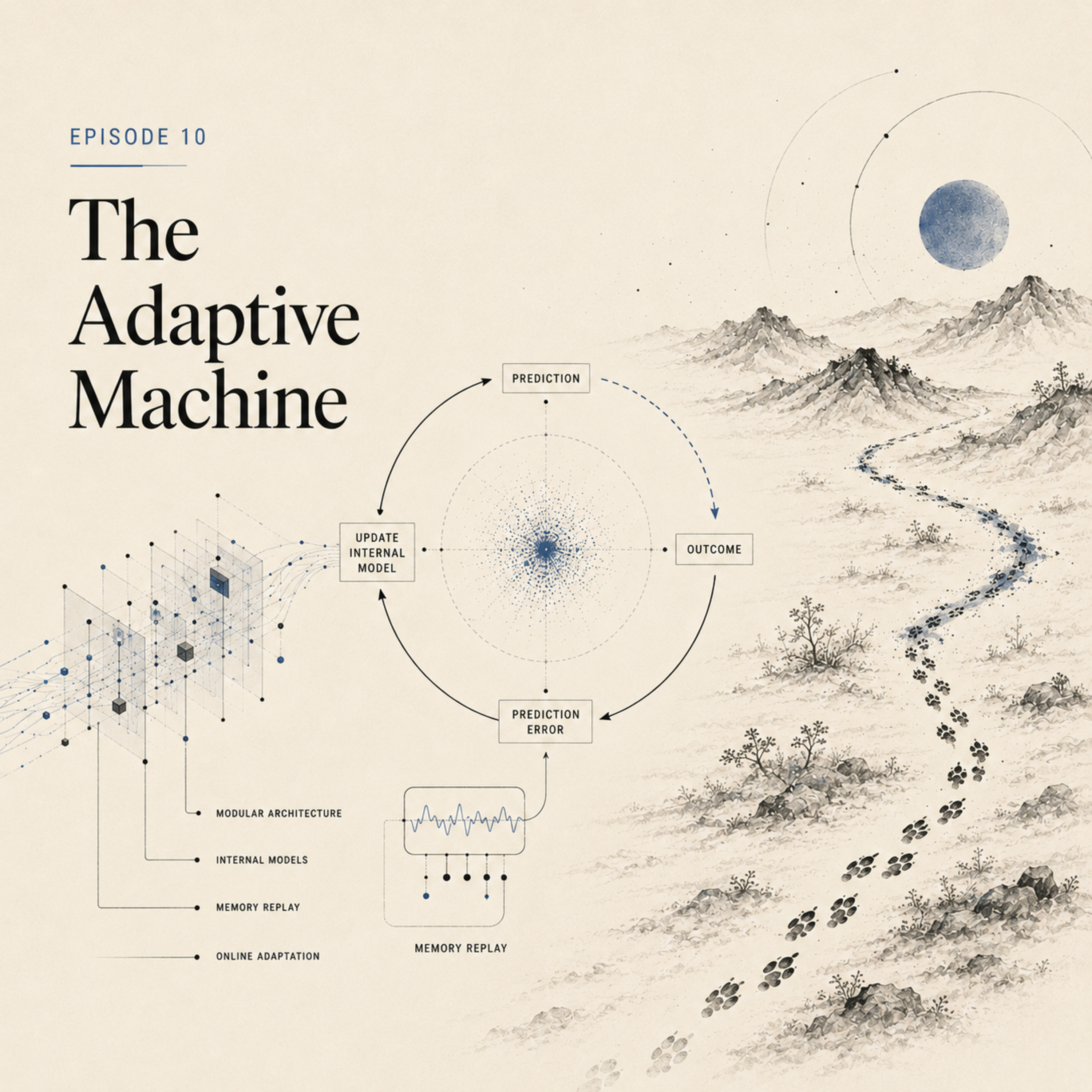
Paper discussed Mackenzie Mathis. Leveraging insights from neuroscience to build adaptive artificial intelligence. Nature Neuroscience, 2026. One-sentence summary This episode explores how neuroscience can inspire more adaptive AI systems by studying how animals learn online, update internal models, use prediction errors, replay memory, and adapt to changing environments. Key ideas Biological intelligence is inherently adaptive. Many AI systems still follow a train-test-deploy cycle and are not truly adaptive after deployment. Animals continuously update internal models based on feedback. Prediction errors act as biological teaching signals across sensory, motor, and reward systems. Continual learning in AI faces the stability-plasticity problem and catastrophic forgetting. Memory replay connects biological hippocampal replay with machine learning strategies for preserving old knowledge during new learning. Spiking neural networks and neuromorphic computing may offer energy-efficient, time-dependent computation. Future adaptive AI may require modular agentic systems with specialized encoders, prediction-error monitoring, and selective updating. The goal is not to copy the brain literally, but to extract useful design principles. Important caution This paper is a Perspective and research agenda, not a single empirical demonstration. It argues that neuroscience can inspire adaptive AI, but it does not prove that any specific brain-inspired architecture will outperform current AI systems.
0:00-33:48

transcript

No transcript — this publisher did not publish one.

show notes

Paper discussed

Mackenzie Mathis. Leveraging insights from neuroscience to build adaptive artificial intelligence. Nature Neuroscience, 2026.

One-sentence summary

This episode explores how neuroscience can inspire more adaptive AI systems by studying how animals learn online, update internal models, use prediction errors, replay memory, and adapt to changing environments.

Key ideas

  • Biological intelligence is inherently adaptive.
  • Many AI systems still follow a train-test-deploy cycle and are not truly adaptive after deployment.
  • Animals continuously update internal models based on feedback.
  • Prediction errors act as biological teaching signals across sensory, motor, and reward systems.
  • Continual learning in AI faces the stability-plasticity problem and catastrophic forgetting.
  • Memory replay connects biological hippocampal replay with machine learning strategies for preserving old knowledge during new learning.
  • Spiking neural networks and neuromorphic computing may offer energy-efficient, time-dependent computation.
  • Future adaptive AI may require modular agentic systems with specialized encoders, prediction-error monitoring, and selective updating.
  • The goal is not to copy the brain literally, but to extract useful design principles.

Important caution

This paper is a Perspective and research agenda, not a single empirical demonstration. It argues that neuroscience can inspire adaptive AI, but it does not prove that any specific brain-inspired architecture will outperform current AI systems.